
Église Saint-Martin de Vieux-Bellême
Saint-Martin-du-Vieux-Bellême, Orne, Normandy, France
Église Saint-Martin de Vieux-Bellême
In the bocage country of the Perche, where hedgerows divide pastures that have looked much the same for five centuries, a slate spire rises above the rooftops of an unassuming village. Within these walls, between 1620 and 1630, four children of Vincent Gaulin and Marie Bonnemer received the sacrament of baptism. Two of those children would one day cross an ocean and seed a vast French-Canadian lineage. Their names remain in this parish register because a Sulpician archivist named Archange Godbout walked through this church in 1925 and copied them down.
The Gaulin Children at Saint-Martin
Marie — baptized 11 May 1623
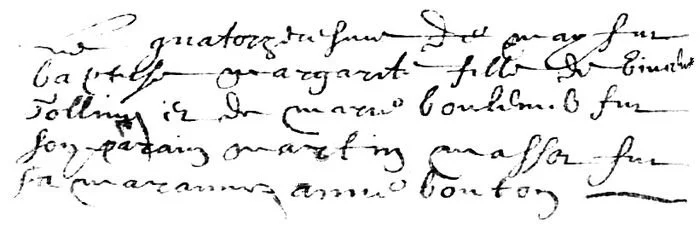
Marguerite — baptized 14 May 1627
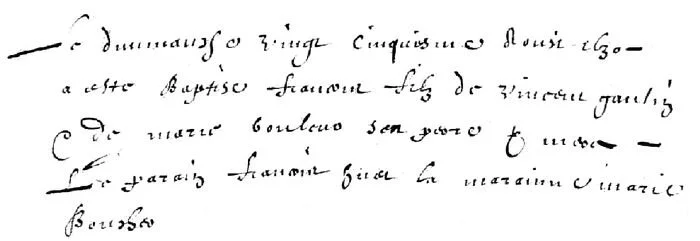
François — baptized 25 August 1630
All four baptisms are preserved in the verbatim transcriptions published by Sulpician genealogist Archange Godbout in 1925 (Origine des familles canadiennes-françaises, p. 168), drawn directly from the parish registers of Saint-Martin-du-Vieux-Bellême. Two of these children — Marguerite and François — would later cross the Atlantic and establish lines in New France.

Église Saint-Martin de Vieux-Bellême today. The pale limestone walls, narrow Gothic windows, and slate-clad timber spire form a profile that would have been familiar — in essentials — to Vincent and Marie Bonnemer Gaulin when they carried their newborn children to this door four centuries ago.
The village of Saint-Martin-du-Vieux-Bellême sits in a fold of the Perche, a regional park in southern Normandy where bocage hedgerows still divide farms into the same small, irregular fields they have occupied for centuries. The fortified hill-town of Bellême rises a short walk to the east. But Saint-Martin is older than its neighbor: it grew up around an 11th-century Benedictine priory dependent on the great abbey of Marmoutiers near Tours, and its parish church has stood guard over the valley ever since.
For French-Canadian genealogists, this church holds a particular significance. Like Tourouvre, Mortagne, and a handful of other Perche parishes, Saint-Martin sent some of its sons and daughters to New France in the great seventeenth-century migration organized by Robert Giffard and the merchants of Rouen and La Rochelle. Among them were two children of Vincent Gaulin and Marie Bonnemer, baptized at the font of this church and remembered today in the parish registers preserved by the Archives départementales de l'Orne.
A Dependency of Marmoutiers
The medieval origins of Saint-Martin-du-Vieux-Bellême are bound up with the history of the Lords of Bellême, the formidable feudal family whose castle once crowned the neighboring hill. The Lords of Bellême spent the eleventh century alternately serving and defying the Dukes of Normandy and the Counts of Anjou, and the small village in the valley below — gathered around its priory church — bore witness to their conflicts.
The church itself was built alongside the Priory of Saint-Martin, a dependency of the Benedictine Abbey of Marmoutiers near Tours. Some architectural elements have been dated to the 11th, 13th, and 15th centuries, suggesting a long process of building, destruction, and rebuilding that mirrors the turbulent history of the region. The most substantial reconstruction took place in the 15th century, after the upheavals of the Hundred Years' War, and gave the church the proportions it retains today — unusually large for so small a village, a memory of its former importance as a priory center.
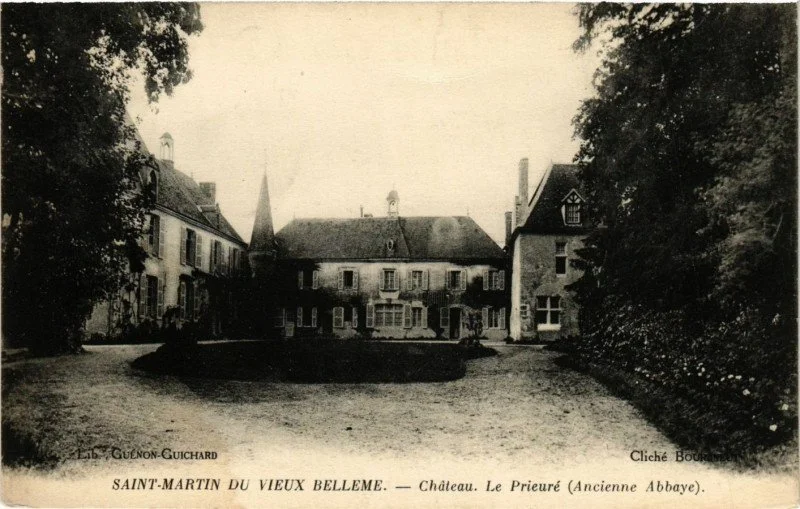
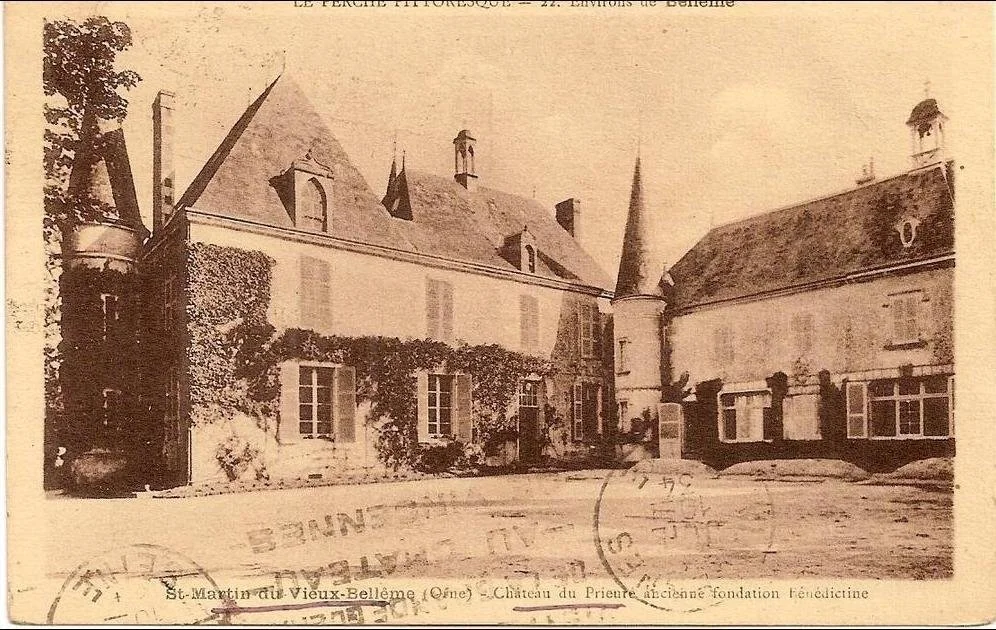
"Château du Prieuré — Ancienne Abbaye." An early twentieth-century postcard of the priory grounds at Saint-Martin. The medieval monastic complex was converted to a private residence after the Revolution, but its layout still echoes the original Benedictine plan that stood here when the Gaulin family lived in the parish.
During the spring of 1229, Blanche of Castile — regent of France for her young son Louis IX — laid siege to the castle of Bellême to subdue the rebellious Pierre de Dreux, Duke of Brittany. The fifteen-year-old king accompanied his mother on the campaign. According to local tradition recorded on a commemorative plaque inside the church, the young Saint Louis attended Mass at the Priory of Saint-Martin during the three months of the siege, between January and March 1229. The plaque, installed in 2014 to mark the eight-hundredth anniversary of his birth, is among the small details that make the building feel layered with French royal and ecclesiastical history.

Commemorative plaque, Église Saint-Martin: "Le Roi Saint-Louis 1214–1270 a assisté à la messe dans cette église de janvier à mars 1229. 1214–2014." Installed for the 800th anniversary of the king's birth.
Inside the Church
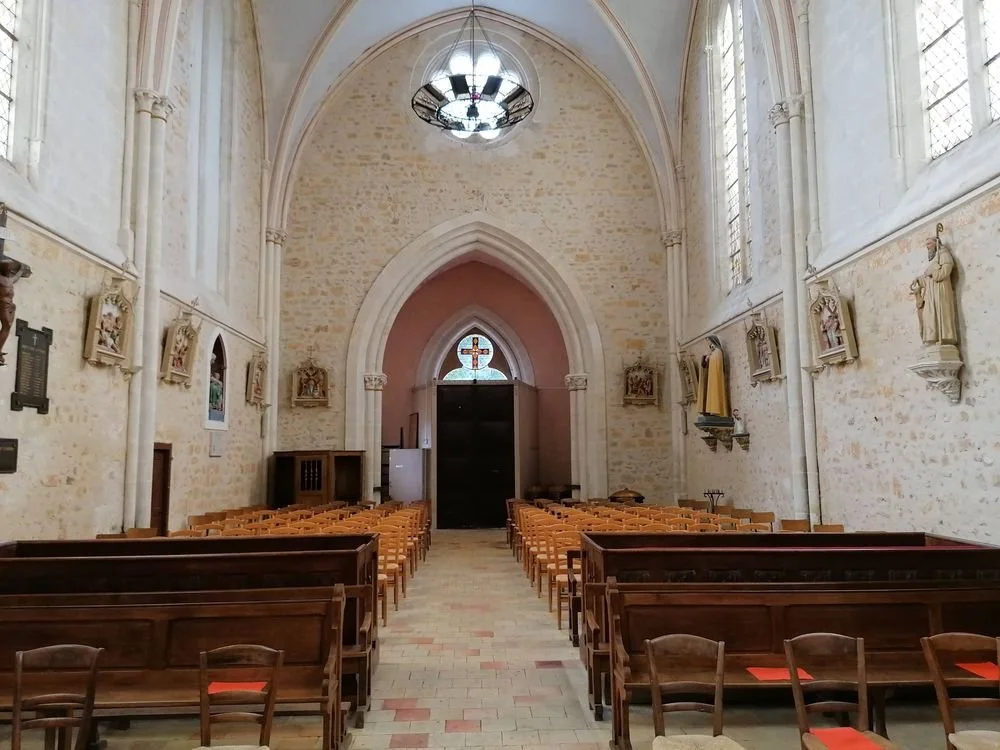
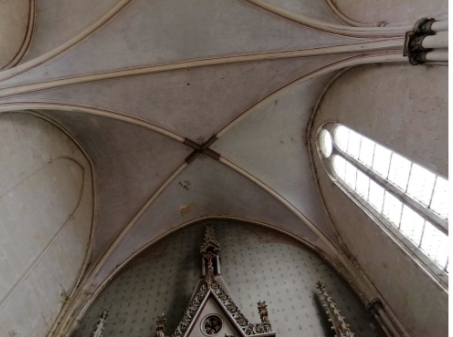
The interior of Saint-Martin retains much of its late-medieval character. Whitewashed limestone walls rise to ribbed vaulting; tall, narrow lancet windows admit cool northern light; and along the choir, sixteenth-century carved misericords — the small ledges hidden beneath the folding choir stalls, designed to support the weight of monks during long offices — are protected as classified historic monuments (monuments historiques classés).
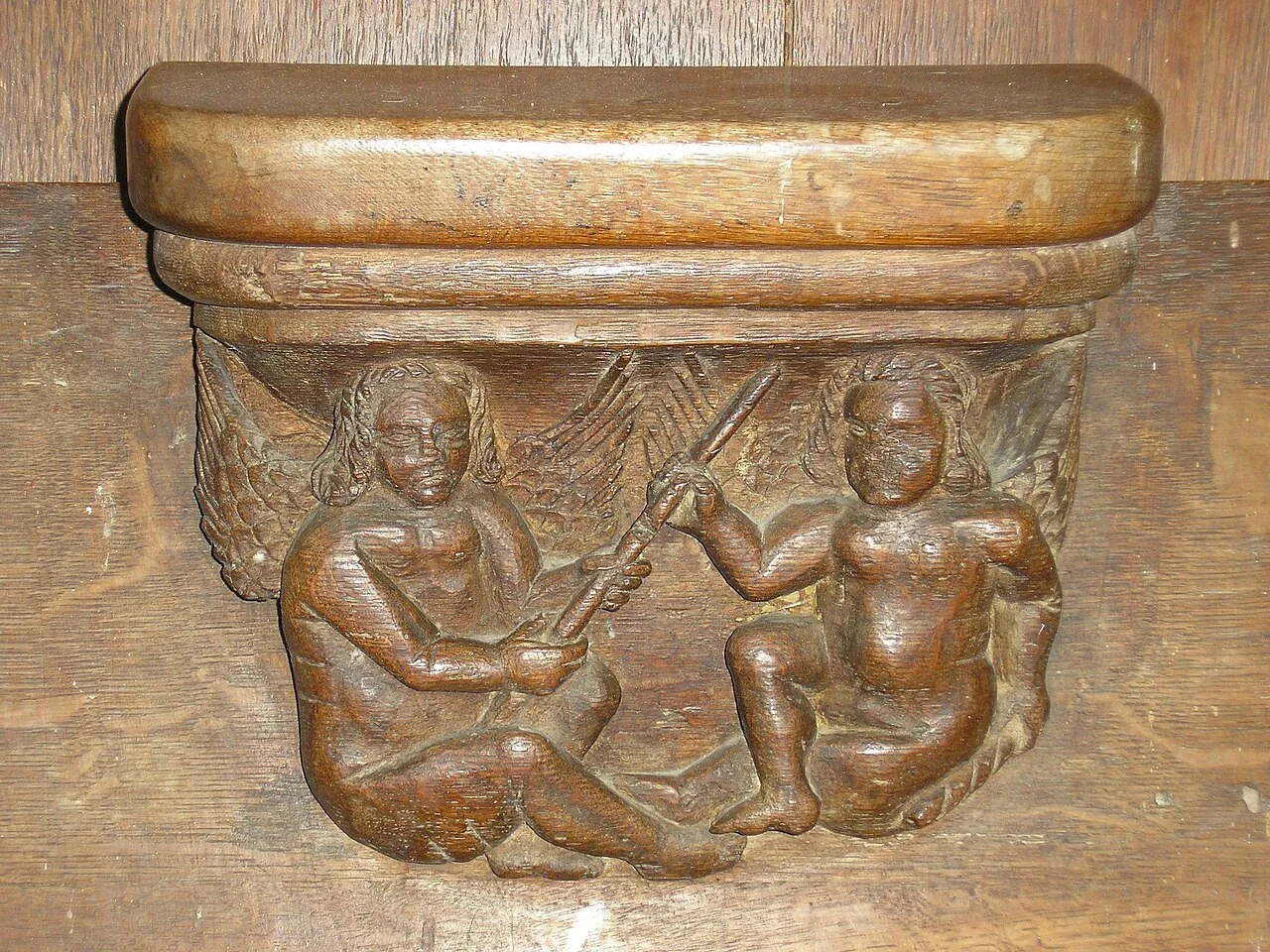
A sixteenth-century carved misericord from the choir stalls of Saint-Martin: two winged figures, hand-cut in oak, classified as a French monument historique. When Vincent Gaulin stood at his children's baptisms, these carvings — already a century old — were part of the furniture of his parish.
The Gaulin–Bonnemer Family at Saint-Martin
The story of the Gaulin family at Saint-Martin survives almost entirely because of one nineteenth- and early-twentieth-century scholarly tradition: the painstaking transcription of French parish registers by Catholic priest-genealogists who saw it as their vocation to preserve the European origins of New France's pioneer families.
Foremost among these was Father Archange Godbout, OFM, whose Origine des familles canadiennes-françaises, published at Lille in 1925, gathered baptism, marriage, and burial entries from parishes across France that had contributed settlers to Quebec. For Saint-Martin-du-Vieux-Bellême, Godbout consulted the registers held at the mairie, examined baptisms from 1612 to 1633 and burials from 1632 to 1637, and copied out — verbatim — four entries that belonged to a single household: Vincent Gollins (Gaulin) and Marie Bonnemer (Boulemer, Boulmer).
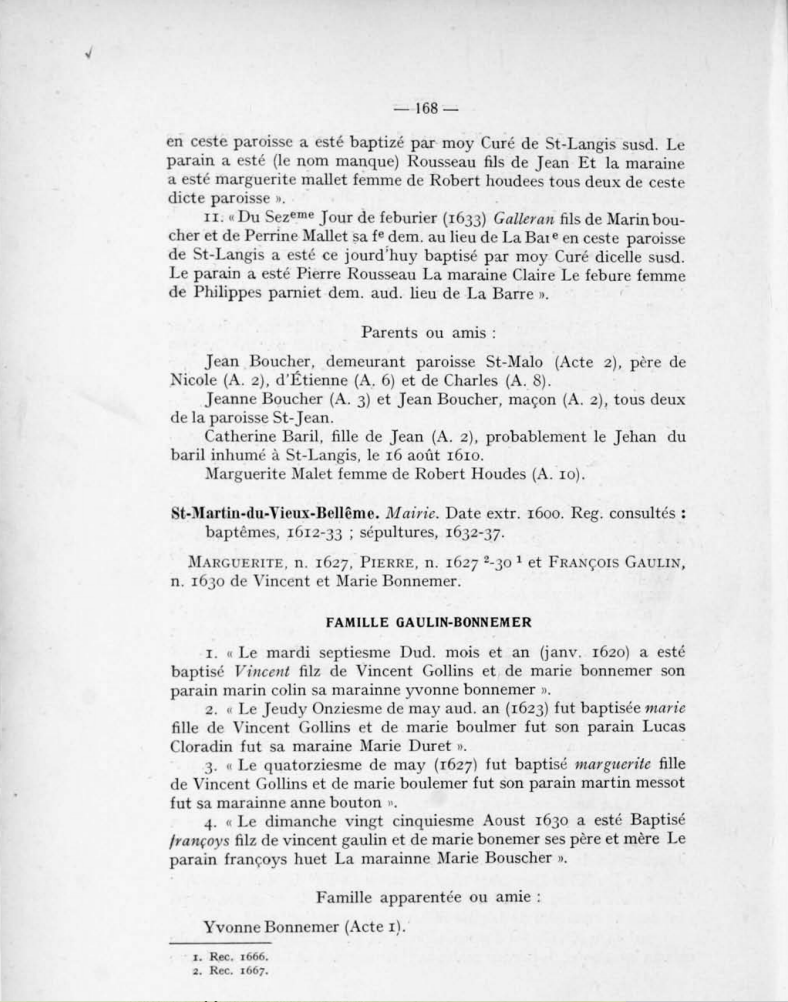
Page 168 of Archange Godbout's Origine des familles canadiennes-françaises (Lille, 1925), under the heading "FAMILLE GAULIN–BONNEMER." Four baptism entries, transcribed verbatim from the Saint-Martin parish register, anchor the family in this village.
What Godbout Preserved
Across the four entries, the surname is spelled Gollins, Gollin, Gaulin; the mother's name appears as Bonnemer, Boulmer, Boulemer, Bouleus. These are not separate families. They are the same household, recorded by successive parish clerks who wrote names down phonetically — and Godbout copied each spelling exactly as he found it, refusing to "correct" the historical record.
Their four children were baptized in this church between January 1620 and August 1630.
Vincent Gollins (Gaulin)
Father: Vincent Gollins
Mother: Marie Bonnemer
Godfather (parrain): Marin Colin
Godmother (marraine): Yvonne Bonnemer (likely a maternal aunt)
— Archange Godbout, Origine des familles canadiennes-françaises, Lille, 1925, p. 168, entry no. 1.
Marie Gollins (Gaulin)
Father: Vincent Gollins
Mother: Marie Boulmer
Godfather: Lucas Cloradin
Godmother: Marie Duret
— Godbout, p. 168, entry no. 2.
Marguerite Gollins (Gaulin)
Father: Vincent Gollins
Mother: Marie Boulemer
Godfather: Martin Messot
Godmother: Anne Bouton
— Godbout, p. 168, entry no. 3.
François Gaulin
Father: Vincent Gaulin
Mother: Marie Bonnemer
Godfather: François Huet
Godmother: Marie Bouscher
— Godbout, p. 168, entry no. 4.
The Creste Connection at Tourouvre
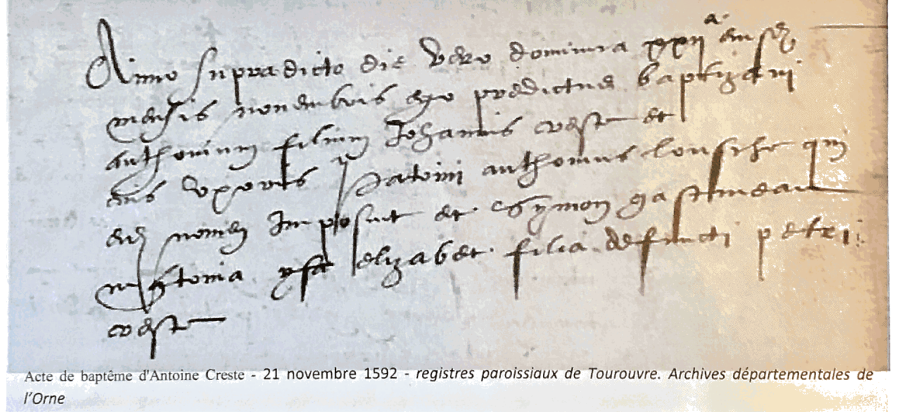
Marguerite Gaulin's husband, Jean Creste, was himself a Percheron — the son of Antoine Creste, baptized at the neighboring parish of Saint-Aubin de Tourouvre on 21 November 1592. Tourouvre, some thirty kilometers north of Saint-Martin-du-Vieux-Bellême, was the principal recruiting parish of the Percheron migration to New France — closely associated with Robert Giffard de Moncel of nearby Autheuil — and its register supplied the European origins of an unusually large number of Quebec pioneer families.

Baptismal record of Antoine Creste, 21 November 1592, parish registers of Saint-Aubin de Tourouvre, diocese of Chartres. Father of Jean Creste, who would later marry Marguerite Gaulin in New France. Microfilm, Archives départementales de l'Orne.
The Latin-language entry — the use of Latin for parish records persisted in some French dioceses into the seventeenth century — records the baptism of "Anthonius filius Johannis Creste" with godparents identified by their Christian names and the patronymic Gastineau, and the godmother Elizabeth filia defuncti Petri. The handwriting, the Latin abbreviations, and the rough parchment of the original tell their own story about the rural Catholic culture in which both the Gaulin and Creste families were embedded.
From Saint-Martin to the Saint Lawrence
The Perche became one of the principal source regions of the seventeenth-century migration to New France. Robert Giffard, seigneur of Beauport, recruited his first contingent of colonists in 1634; subsequent recruiters and ships' contracts drew on the same dense web of parishes around Tourouvre, Mortagne, Bellême, and Saint-Cosme-en-Vairais. The numbers were small by modern standards — a few hundred individuals across the century — but their demographic impact was extraordinary. Most modern Quebecers can trace at least one line, often several, back to a Perche village no larger than Saint-Martin.
The Perche of the early seventeenth century was a region of small farms, tight-knit Catholic parishes, and modest holdings — exactly the kind of place where younger sons and unmarried daughters faced limited prospects at home. Robert Giffard, born at Autheuil around 1589, knew its families personally and recruited along lines of kinship and trust. For Marguerite Gaulin, leaving Saint-Martin meant joining a stream that was already flowing — relatives, neighbors, parishioners had gone before, and word of the new colony came back to Norman villages with returning sailors and traders.
Marguerite arrived in New France around 1654 as one of the filles à marier — the young women recruited (in advance of the later, royally-sponsored filles du Roi of the 1660s–1670s) to balance the colony's heavily male population. She married Jean Creste at Beauport, near Quebec City, and the couple had a substantial family. Her brother François followed a few years later and married Marie Rocheron in 1657. From these two Percheron emigrants — siblings baptized at the same font, in the same village church, three years apart — descend nearly all North American Gaulins today.
Follow Marguerite to New France
The baptismal entry of 14 May 1627 is only the opening chapter of Marguerite Gaulin's life. The full narrative of her crossing, her marriage at Beauport, and her family in the new colony is told in the Documentary Biography; the evidence behind her identification is laid out, in BCG portfolio form, in the accompanying Case Study.
Then & Now


Timeline: Église Saint-Martin Through the Centuries
"L'église Saint-Martin du Vieux-Bellême est très fréquentée, notamment par les Canadiens, car Saint-Martin a été un lieu de départ vers le Canada au XVIIe siècle."
The Perche, Then and Now
To visit Saint-Martin today is to step into a landscape that has, in its essentials, changed remarkably little since the Gaulin family lived here. The bocage country of the Perche — the patchwork of small fields divided by hedgerows of oak, ash, and hawthorn — was already old when Vincent Gaulin walked it. The regional park (Parc naturel régional du Perche) created in 1998 has preserved much of this character; the misty mornings, the apple orchards, the slate-roofed stone farmhouses, the long horizontal rhythm of pasture and copse are still here.
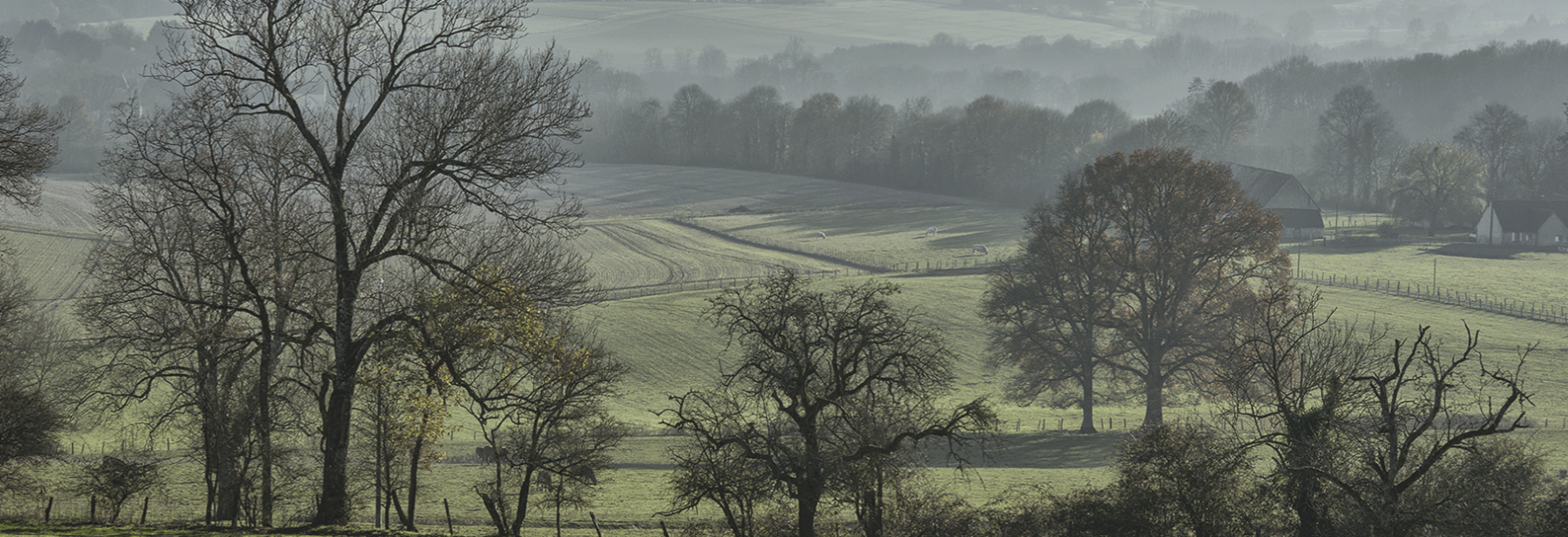
The Perche countryside on a winter morning: bare oaks, hedgerows, scattered sheep, and the long mist of the Norman bocage. This is the landscape Marguerite Gaulin would have left behind in the 1650s, and that her descendants in Quebec, even four centuries later, sometimes recognize when they come to walk these fields.
A general view of the village from a mid-twentieth-century postcard captures the same essential composition: gentle hills, an apple-orchard foreground, the small huddle of houses, and — rising above them all — the slate spire of Saint-Martin, the marker by which the village is recognized for kilometers around.
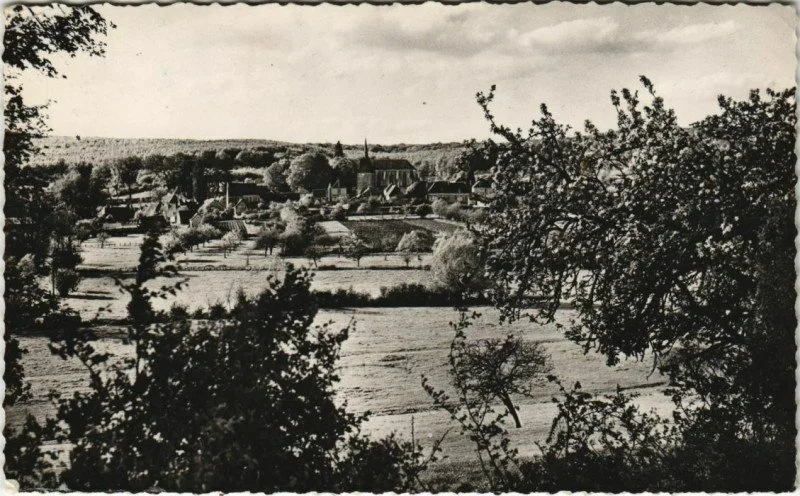
"Vue Générale." A mid-twentieth-century postcard showing the village from a hilltop to the north, with the church spire dominating the skyline above orchards and pasture.
Visiting the Site
Location: Place de l'Église, 61130 Saint-Martin-du-Vieux-Bellême, Orne, Normandie, France
Access: The church is open to the public daily, with free entry. A modern automated sound-and-light installation plays sacred music when visitors enter.
What to see: The 15th-century Flamboyant Gothic nave, classified 16th-century misericords in the choir, the commemorative Saint Louis plaque, and (for those who can read Old French handwriting) the original parish registers preserved on microfilm at the Archives départementales de l'Orne in Alençon.
Nearby: The fortified hill-town of Bellême with its surviving medieval gatehouse and ramparts; the Tourouvre parish church and migration museum; the Parc naturel régional du Perche.
Document Gallery
Want to Know When New Stories Are Published?
Subscribe to receive updates on new family history research—no spam, just meaningful stories when there's something worth sharing.
SUBSCRIBE TO OUR NEWSLETTEREvery Family Has a Story Worth Telling
Whether you're just beginning your research or ready to transform years of work into a narrative your family will treasure, I'd love to hear your story.
BEGIN YOUR RESEARCH INQUIRY