
Eliza Kenny: The Other Grandmother
Eliza Kenny
She was born in Ireland around 1810. She married Richard Kenny in Brooklyn in 1843. She was widowed by 1854 and she never remarried. She raised two sons alone for thirty-three years. She ran a grocery on Walworth Street. She died in a charity hospital. She has no grave marker of her own. Almost every fact we know about her, we know because of what she didn't do.
Named for a Woman We Barely Know
The Paradox at the Heart of This StoryOn July 28, 1879, in Brooklyn, Margaret McKenny Kenny gave birth to a daughter. The child was named Elizabeth. She would be called Lillian for most of her life, and formally renamed Mary Elizabeth at her Catholic baptism. But her first name — the name on her 1880 census line, ten months old in her father's household — was Eliza. She was named for her paternal grandmother, Eliza Kenny, who was sixty-nine years old that summer and living in the same household.
It is the only thing we can say with certainty about what her family thought of her. The naming is the evidence. Her granddaughter — born into a Brooklyn Irish household where two grandmothers were present and where Margaret was already pregnant with her next child — carried Eliza's name. Not Ann, her maternal grandmother. Not a Catholic saint. Eliza.
And then, within a decade, the name stopped being used. By 1888 Elizabeth was "Lillian" to everyone. By 1920 she was officially Elizabeth Kenny on her marriage license, and Lillian Corbett in the census three months later. The granddaughter renamed herself out of the inheritance she had carried at birth.
This is the shape of Eliza Kenny's story. She is remembered and not remembered in the same gesture. The documents name her because they have to: a widow needs a maiden identifier, a grandmother appears in a household, a death index lists her among the dead. But the substance of her — where in Ireland she came from, what her maiden name was, what she looked like, what she thought of anything — is gone. She is the negative space around which the rest of the Kenny–McKenny family becomes visible.
Ireland Before Brooklyn
c. 1810 · What We Don't KnowEliza Kenny was born in Ireland around 1810. Her age is derived from the 1887 death index ("age 77") and the 1880 federal census ("age 70") — dates that back-calculate to roughly 1810, give or take two years. No earlier document has been found. Her birth parish, her townland, her parents' names, and her maiden name all remain unknown. Her surname in marriage — Kenny — is the name we know her by, and the possibility that it was also her maiden name (she married a Kenny) is not yet ruled out.
She would have crossed to New York in the 1830s or 1840s — before the worst of the Famine, or in its early years, depending on when the crossing occurred. The 1843 Brooklyn marriage record is the first evidence we have that she was in America. She was approximately thirty-three years old that June.
The Marriage of Rich and Eliza Kenny
St. Paul's Catholic Church, Brooklyn · June 23, 1843On June 23, 1843, Richard Kenny and Eliza Kenny were married at St. Paul's Roman Catholic Church in Brooklyn. Their witnesses were John Rielly and Eliza (El.) Farrell — a detail preserved in the parish register and later in James R. Reilly's compiled transcription of St. Paul's baptism and marriage records. The register gives only first names, the surname Kenny for both bride and groom, the date, and the witnesses. It does not give parents' names. It does not give ages or birthplaces.

Marriage Register — Richard and Eliza Kenny, June 23, 1843, St. Paul's R.C. Church, Brooklyn. The first documented moment of Eliza's American life.
Richard Kenny was a laborer, Irish-born, about the same age as Eliza. By the 1850 census he would be recorded as forty — placing his birth around 1810 as well. He and Eliza would have two surviving sons: James, born about 1839, and John, born about 1845.
1850: The Only Census with the Family Intact
Ward 5, Brooklyn · October 14, 1850The federal census enumerator came down Ward 5 on October 14, 1850, and found the Kenny household at dwelling 1018, family 2349. Richard, age 40, laborer, Ireland. Elizabeth, age 40, Ireland. James, age 4, New York. John, age 3, New York. Four people, two generations, one intact household. It is the only census in which all four of them appear together. Richard would be dead within four years.

1850 Census — the complete Kenny family. Richard would be dead before the next federal enumeration.
Widowed in 1854
Richard's Death · Holy Cross Cemetery, Section PLOT, Row 10, Plot 31Richard Kenny died in July 1854. His burial at Holy Cross Cemetery was on July 15, 1854, in Section PLOT, Row 10, Plot 31, Grave 41' FRONT. He was approximately forty-four years old. Eliza was approximately forty-four as well. James was eight. John was five or six.
No death certificate survives. Brooklyn's pre-1866 vital records were incomplete and many are now lost. But the cemetery kept its book. The plot Richard was buried in that summer would eventually hold him, Eliza, both sons — and would be shared with his brother Thomas Kenny's family. It is the Kenny family plot: not the plot Ann Lynch would purchase at Holy Cross seventeen years later for her daughter Margaret and herself, but a separate, earlier, parallel plot in the same cemetery, bought by the Kenny side of the family.
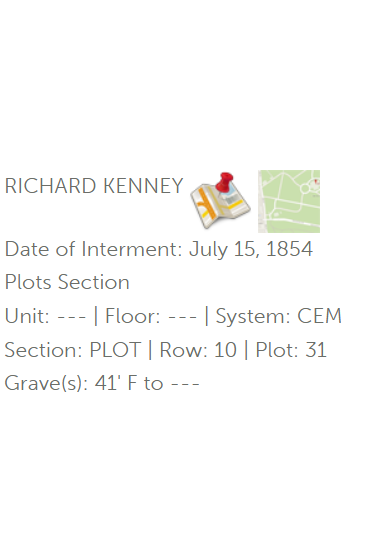
Holy Cross Cemetery burial record — Richard Kenney, July 15, 1854. The plot Eliza would join thirty-three years later.
Eliza was forty-four years old in 1854, with two small boys and no husband. She did not remarry. In every subsequent record — for the next thirty-three years — she is a widow.
1855: The First Record of a Widow
New York State Census, 7th Ward, Brooklyn · June 23, 1855One year after Richard's burial, the New York State enumerator found Eliza in the 7th Ward of Brooklyn, living in a frame house. She was forty-nine (so recorded, though she was probably forty-five), listed as a grocer. With her were her sons James, nine, and John, seven. The household had moved out of Ward 5 and into Ward 7 — the same neighborhood where, fifteen years later, George and Ann Lynch McKenna would be raising their own daughters a few blocks away.
The 1855 census is the first document that shows Eliza alone with her sons. It is the template for every subsequent census in her life: Eliza as head of household, her sons present, no husband. For thirty-three years this household structure would hold. Other women in her situation remarried within two or three years — the economic pressure on an Irish widow with small children in 1850s Brooklyn was extreme. Eliza did not.

1855 Census — Eliza as head of household, widow one year, running a grocery. The pattern that would hold for thirty-three years.
The Grocery Years
Walworth Street · 1862 – 1875By 1862 Eliza had established a grocery on Walworth Street near Park Avenue. She appears in the Brooklyn Directory that year as "Kenny, Eliza wid. grocery, Walworth nr Park Av." Two other Kenny entries are on the same page: James Kenny, laborer, at Walworth near Park Avenue (her son, age approximately sixteen); and Thomas Kenny, foreman, at Park Avenue corner Spencer (her husband Richard's brother, the well-documented Brooklyn Thomas Kenny whose funeral notice in the Brooklyn Daily Eagle in April 1891 would identify him as "an old resident of this city," father of John Kenny of the City Works Department and uncle of Detective John Corcoran of the Bedford Avenue Station).
Kenny, James laborer h r Walworth n Park Av
Kenny, Thomas foreman h Park Ave c Spencer
The directory record is compact but it tells us a great deal. Eliza owned — or rented with her name on the lease — a grocery at a specific street address. She was listed in her own right, by her own name. Her brother-in-law lived a block away. Her son was already listed as a laborer at sixteen. This is the stable Kenny cluster that had formed in the 7th and 21st Wards of Brooklyn by the early 1860s.
Running a grocery was how a widow in the 1850s and 1860s survived without a husband. It required credit, the willingness of a landlord to sign a lease, enough literacy to keep accounts, and a neighborhood that would buy from an Irish woman. It put Eliza at a counter six days a week for thirteen documented years.
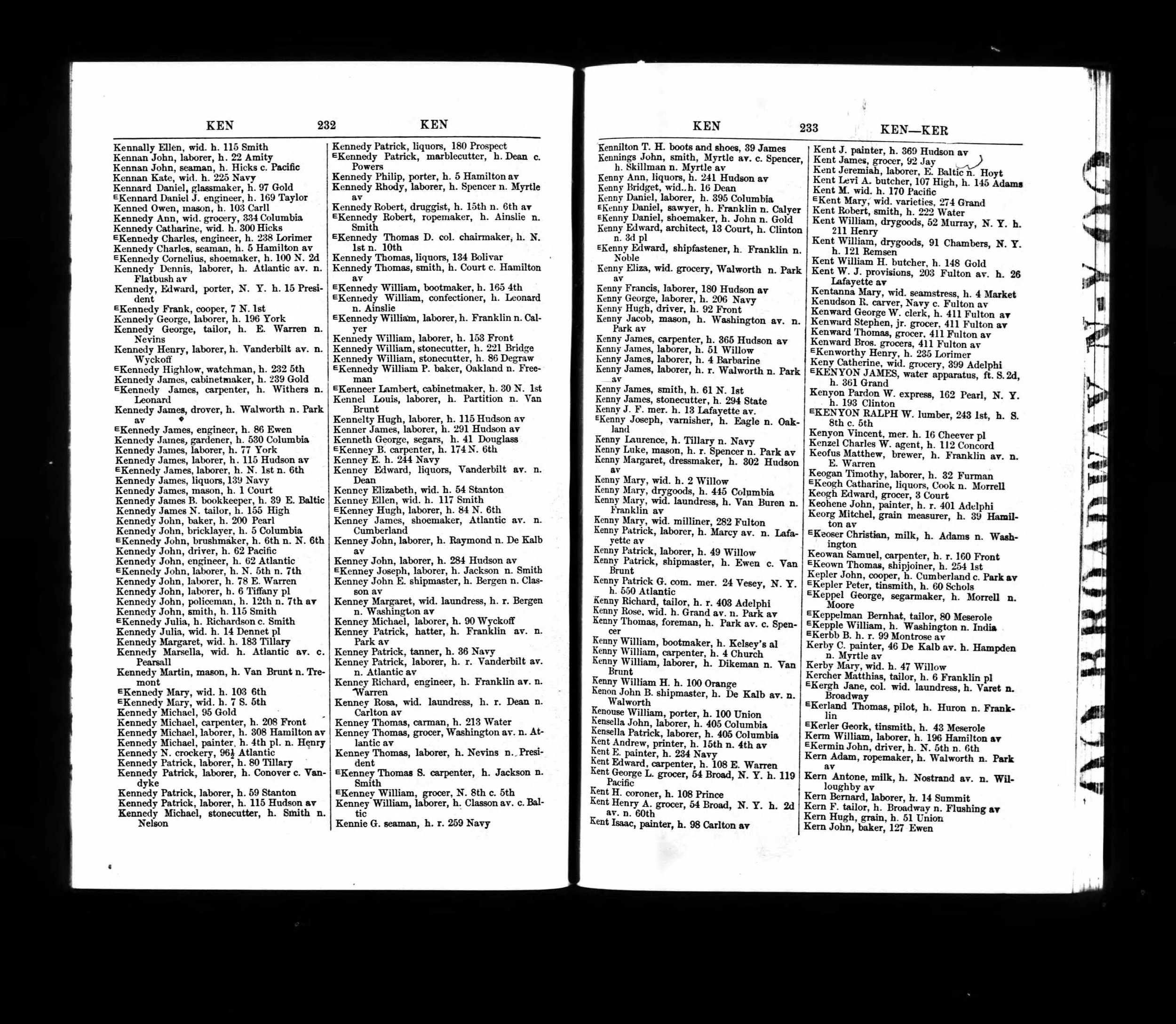
1862 Directory — the Kenny cluster on Walworth Street. Eliza's grocery. James, a laborer. Thomas, the brother-in-law.

1860 Census — Eliza at 47, grocer, $200 personal estate, with James (14) and John (12).
Eliza continued to run a grocery at least into the early 1870s — she is documented with a grocery at 66 Dean Street in 1873. The directories and the censuses repeat the pattern: widow of Richard, grocer, 75 Walworth Street, 7th or 21st Ward. The address would eventually be the one where John Kenny himself would later be listed, first as "matmkr" and then as "hatter" — living with his mother at the house she had held since the 1860s.
1870: The Mat Maker Emerges
John's First Documented Trade · The Household Under ElizaThe 1870 federal census caught the family in Ward 21 of Brooklyn, where they had migrated as the neighborhood grew. Elizabeth Renney (the enumerator's spelling), age 56, keeping house, Ireland. James, age 22, working in hat factory. John, age 20, Mat Maker. This is the first appearance of John's distinctive occupation — the trade that, later called "matmkr" in the directories, would become the thread that allowed him to be correctly identified among the dozens of John Kennys in Brooklyn.

1860 Census — Eliza, widow, grocery, with James and John. The household continues.
The 1875 New York State census records the household similarly: Eliza Kenny, 60, mother, Ireland, keeping house; James Kenny, 27, son, Kings, hatter; John Kenny, 25, son, Kings, mat weaver. Two sons, still unmarried, still under their mother's roof. James has moved from laborer to hatter. John from mat maker to mat weaver (the trades overlapped).
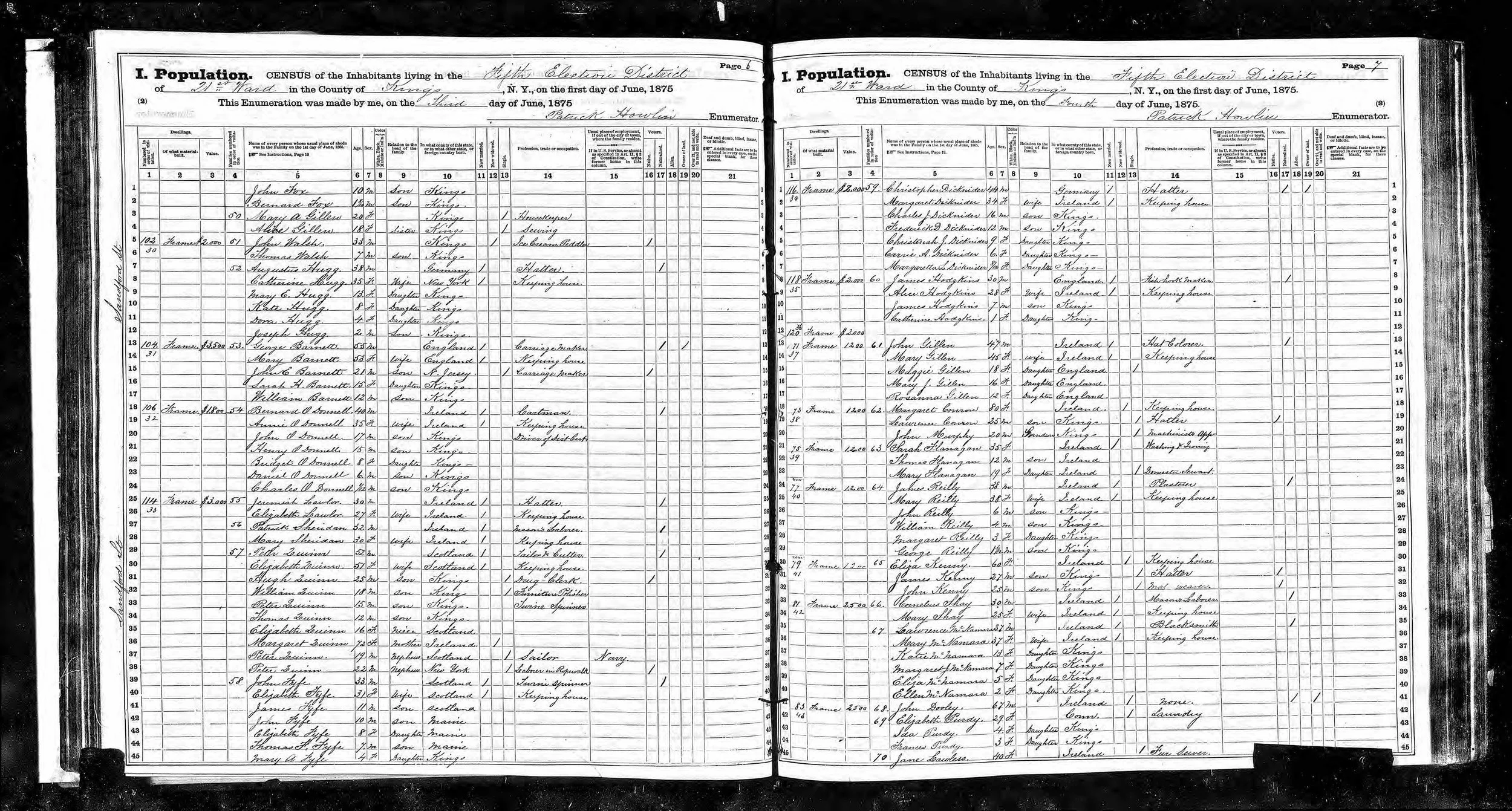
1875 Census — Eliza with both sons. James as hatter. John as mat weaver. Five months from James's death.
1875: James Dies of Smallpox
79 Walworth Street · November 25, 1875James Kenny died on November 25, 1875, at 79 Walworth Street, Ward 21, Brooklyn. He was twenty-nine years old. The cause of death was smallpox. He was buried at Holy Cross Cemetery — in the same plot where his father lay, Section PLOT, Row 10, Plot 31. His death certificate listed him as a hatter, Irish-parented, U.S.-born. It did not list his parents' names, because Brooklyn death certificates of 1875 did not record them. The document recorded the fact of James's death, but not the identity of the mother it had orphaned.
Eliza was now sixty-five years old. She had buried her husband. She had now buried a son. She had one son remaining, John, age twenty-seven, unmarried, a mat maker living in her household. She continued to run the household alone.

Death Certificate No. 11355 — James Kenny, age 29, smallpox, 79 Walworth Street. Eliza had now buried both a husband and a son.
The Four Words
Brooklyn City Directory, 1879 · 75 WalworthIn the 1879 Brooklyn City Directory, an entry appears:
Elsewhere on the same page: Kenny John, matmkr, h r 75 Walworth. And across the page, on a separate cluster: Kenny Thomas, at 525 Park Ave (the uncle, Richard's brother); Kenny John, 26 Spencer (the cousin, Thomas's son, later of the Brooklyn City Works Department).
The phrase "wid. Richard" is the single most consequential phrase in the entire research chain that rebuilt this family. Four words. A widow, named, tied to a dead husband, at a specific address, living with a specific son. For decades the Kenny family had been lost in the mass of John Kennys and Eliza Kennys and James Kennys in Brooklyn directories — dozens of them, impossible to distinguish. Those four words anchored the right Elizabeth, the right Richard, the right John, the right address. Everything else in the research proceeded from there.

1879 Directory — the entry that rebuilt the family. "Wid. Richard" named the dead husband and anchored the mother.
1880: The Grandmother in the House
John and Margaret's Household · 75 Walworth · Infant Eliza in the CradleThe 1880 federal census caught one of the most important moments in the entire Kenny family story. John Kenny, 28, works mat factory, with his wife Margaret, 27, keeping house, and their infant daughter Eliza, ten months old, born in July 1879. And in the household: Eliza Kenny, 60 (she was 70; the enumerator reduced the age), mother, at home.
Four generations of evidence converge on this single census line. Eliza, the widow. John, her son. Margaret, her daughter-in-law. Baby Eliza, her granddaughter — named for her. All under one roof at 75 Walworth Street in June 1880.
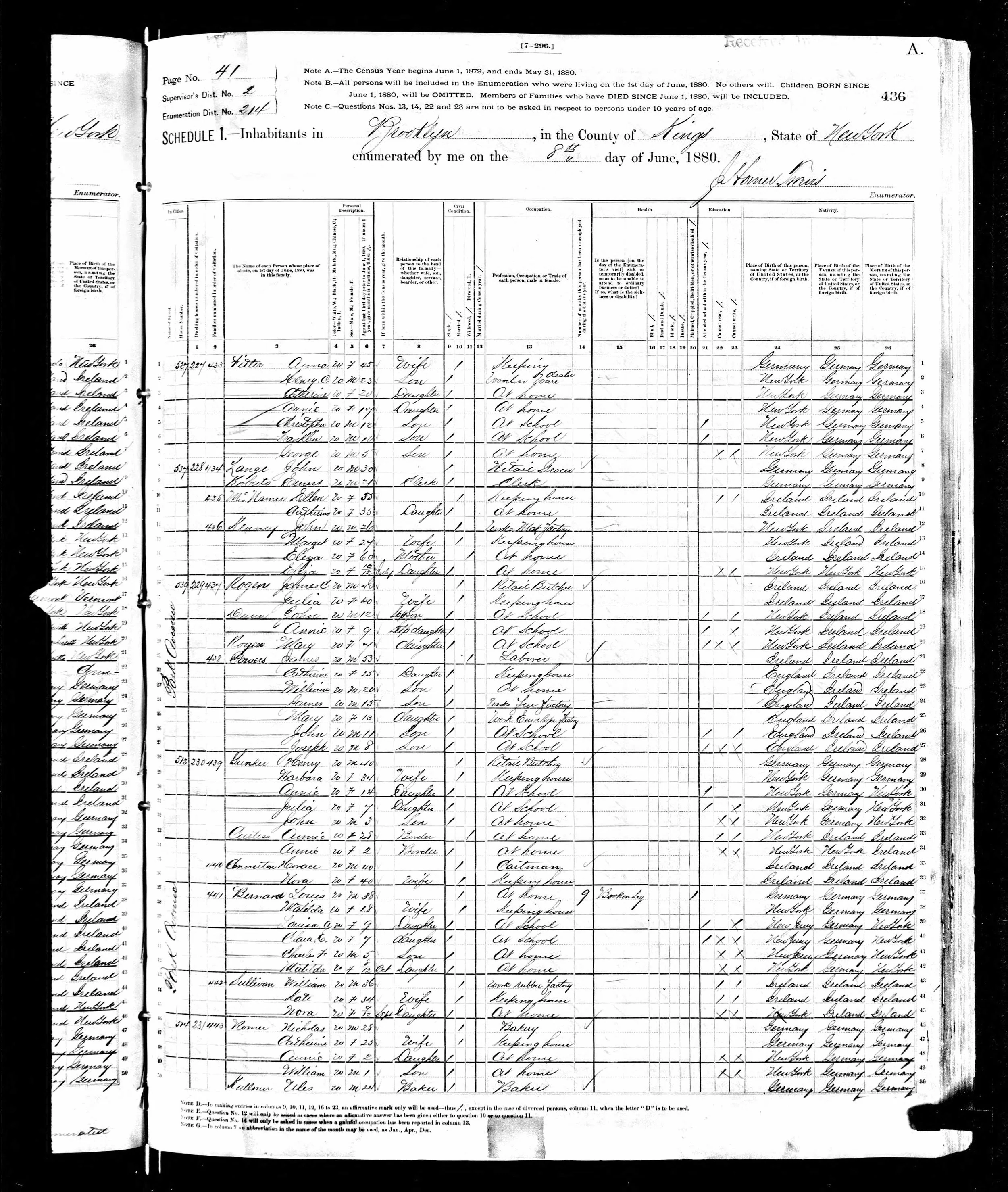
1880 Census — Eliza (grandmother) and Eliza (infant granddaughter) in the same household. The only census that captures them together.
This is the moment of the naming. The baby had been baptized Elizabeth at St. Patrick's in July 1879 and was called Eliza on the federal census line ten months later. She was the eldest grandchild; she was named for the widow who had raised John. Eliza the grandmother would live another seven years. Eliza the granddaughter would outlive her by sixty-three.
The Last Years
1880 – 1887 · From Walworth Street to Kings County HospitalAfter 1880 Eliza disappears from the directories. She was seventy years old that year. The Brooklyn City Directory entries that had carried her name since 1862 — "Kenny Elizabeth wid. Richard" — stopped being published for her. Whether she moved in entirely with John and Margaret, or whether the directory simply stopped recording her at some point in her seventies, cannot be determined from the record.
What is clear is the next event. On December 2, 1887, Eliza Kenney died at Kings County Hospital in Flatbush. She was seventy-seven years old. The Record of Deaths for the Town of Flatbush gives the cause as "Asthenia" and "Senectus" — extreme weakness and old age — secondary: "Senectus." The attending physician was Dr. Jno. A. Arnold. Place of burial: Holy Cross Cemetery.

Record of Deaths, Town of Flatbush — Eliza Kenney, December 2, 1887. Kings County Hospital. Holy Cross burial.

1887 Death Index — the independent confirmation.
Kings County Hospital was the public charity hospital of Brooklyn, serving the indigent, the chronically ill, and the elderly without family resources. That Eliza died there — rather than at home, or at St. Catherine's (the Catholic charity hospital where John Kenny himself would die eleven months later) — suggests the household had reached the limit of what it could provide at home. She was seventy-seven. Her remaining son John was already showing the tuberculosis symptoms that would kill him. Her daughter-in-law Margaret had been dead three years. The household at 75 Walworth was now John, her son; his surviving children Elizabeth (eight) and Mary Agnes (four); and possibly Eliza herself until some point in late 1887, when she was admitted to Kings County Hospital for what would be her final illness.
She was buried at Holy Cross Cemetery on December 2 or 3, 1887 — in the Kenny family plot she had carried since 1854. Section PLOT, Row 10, Plot 31. She joined Richard and James. She would be joined eleven months later by John. Together the four of them — husband, wife, two sons — rest in the plot that Richard's death had first required.
The Kenny Plot
Holy Cross Cemetery · Section PLOT, Row 10, Plot 31The plot where Eliza lies is not marked with a headstone of her own. The headstone at Section PLOT, Row 10, Plot 31 bears the name of Thomas Kenny and his family — Richard's brother, the well-documented Brooklyn foreman whose surviving son John Kenny worked for the City Works Department. Thomas purchased or held the plot; his family's names are carved on the stone.
But the cemetery's burial records, confirmed directly by telephone with Holy Cross, place four members of Eliza's immediate family in the same ground:

The Kenny family plot — Thomas's headstone marks it; Eliza, Richard, James, and John lie here without markers of their own.
Margaret — John's wife, who died in May 1884 — is not here. She is three-quarters of a mile away at the same cemetery, in Lett Row L Plot 336, with her own mother Ann Lynch McKenna and her infant daughter. The two grandmothers of Elizabeth and Mary Agnes Kenny never lay in the same ground. The two plots, Ann's at Lett Row L and the Kenny plot at Section PLOT Row 10, exist as parallel anchors in Brooklyn's Irish Catholic cemetery — one on the McKenny side, one on the Kenny side, each holding its own portion of the family the two women produced together.
Two Grandmothers, One Family, Two Plots
What Eliza Shared with Ann LynchEliza Kenny and Ann Lynch McKenna never met in any document we can find, though they must have known each other. Their children married each other — John Kenny married Margaret McKenny in the mid-1870s. Their granddaughters were Elizabeth and Mary Agnes. They lived in adjoining Brooklyn wards: Ann in Ward 7 on Kent Avenue, Eliza in Ward 21 on Walworth Street, within a fifteen-minute walk of each other.
They were born roughly the same year (c. 1810 and c. 1822). They both came from Ireland. They both married men named Kenn/Ken — in Ann's case McKenney, in Eliza's case Kenny — who both died of respiratory illness decades before their own deaths. They were both widowed young and neither remarried. They both raised their children alone. They both buried a grown child in their own lifetime. They both died in Brooklyn in successive years — Eliza December 2, 1887; Ann May 10, 1888 — five months apart.
And they are both, in their own ways, the root of the family. Ann's plot holds the McKenny/Robertson line (through Margaret and her daughter Mary Agnes). Eliza's plot holds the Kenny line proper (through her sons). The children of John and Margaret — Elizabeth Kenny Corbett and Mary Agnes Kenny Robertson — were the living intersection of both grandmothers. Elizabeth, born in 1879, was named for Eliza. Mary Agnes, born in 1883, was named for her aunt Mary MacKinney (Ann's daughter) and shared Ann's own name as well.
What We Do Not Know
The Shape of Eliza's AbsenceAlmost every fact we have established about Eliza Kenny is a positive datum — a census line, a directory entry, a burial record. But the shape of her story is defined by the facts that are missing:
We do not know her maiden name. Brooklyn pre-1866 death certificates did not require it, and she died in a period when mother's maiden names were not recorded on her children's death certificates either. The 1843 marriage register gives only "Kenny" — it is possible she was a Kenny by birth who married another Kenny (not uncommon among Irish families in the same county), but no documentary evidence has confirmed or refuted this.
We do not know her county or parish in Ireland. All records give only "Ireland." No Irish parish register, no passenger list, no naturalization petition has been found that can be matched confidently to her.
We do not know the date of her emigration. The 1855 census "20 years" entry suggests c. 1835, but this is a single data point from a document whose other ages are approximate. She may have come in the late 1830s. She may have come with Richard already; they may have met in Brooklyn.
We do not know what Richard did before his 1854 death beyond "laborer." We do not know how he died. We do not know whether Eliza had other children who died as infants before the 1850 census.
We do not know what she looked like. No photograph of Eliza Kenny is known to exist. No description survives.
We do not know what she thought of Ann Lynch, or of Margaret McKenny, or of the grandchildren who bore her name. We do not know what she thought of the son who outlived her by only a year, or of the country she came to and the country she left. She ran a grocery for thirteen years and raised two sons alone for thirty-three years and did not remarry, and the only meaningful sentence she has in the historical record is the one she did not write herself — "wid. Richard." Widow of Richard. Defined by her husband even in her own absence from the page.
The documentary paradox: Eliza is everywhere in the Kenny family records and nowhere in her own right. Her grandchildren were named for her. Her plot holds her husband and both her sons. Her four-word directory entry is the phrase that rebuilt the entire family tree. And yet she comes to us almost entirely through what she did not do, did not say, and did not leave behind. She is the most well-documented unknown woman in the series.
Eliza Kenny
Vital Statistics| Born | c. 1810, Ireland (maiden name, county, parish unknown) |
| Emigrated | United States, approximately 1835 (per "20 years" entry in 1855 NY State census) |
| Married | Richard Kenny, June 23, 1843, St. Paul's R.C. Church, Brooklyn. Witnesses: John Rielly & Eliza Farrell |
| Children | James Kenny (c. 1846 – November 25, 1875, smallpox, age 29); John Kenny (c. 1846 – November 30, 1888, pulmonary tuberculosis, age ~42) |
| Widowed | July 1854, Brooklyn, New York, at approximately age 44 |
| Did not remarry | Confirmed across every subsequent record, 1854–1887 |
| Occupation | Grocer. Documented 1855 (Ward 7), 1862 (Walworth near Park Av), 1873 (66 Dean Street). "Keeping house" in later censuses |
| Residences | Ward 5, Brooklyn (1850); Ward 7, Brooklyn (1855); Walworth near Park Avenue (1862); 79 Walworth Street (1875, James's death); 75 Walworth Street (1879–1880, with John) |
| Died | December 2, 1887, Kings County Hospital, Flatbush, Brooklyn; age 77 |
| Cause of death | Asthenia, Senectus (extreme weakness, old age) |
| Attending physician | Dr. Jno. A. Arnold, Kings County Hospital |
| Buried | Holy Cross Cemetery, Brooklyn, Section PLOT, Row 10, Plot 31, Grave 41' FRONT — the Kenny family plot (no individual marker) |
| Certificate | No. 38246, New York State Death Index 1887 (Town of Flatbush) |
| Legacy | Granddaughter Elizabeth "Lillian" Kenny Corbett (1879–1950) named for her; the four words "wid. Richard" in the 1879 Brooklyn directory became the methodological key that rebuilt the Kenny family tree |
Eliza Kenny was the great-great-great-grandmother of the researcher. Her son John was the researcher's great-great-grandfather; her granddaughter Mary Agnes Kenny Robertson was the researcher's great-grandmother; her great-granddaughter Lillian Josephine Robertson O'Brien was the researcher's grandmother. Eliza's name passed to her other granddaughter Elizabeth ("Aunt Lillian Corbett"), who was the researcher's great-grand-aunt. Documentary confirmation of the Kenny family plot was obtained by telephone directly with Holy Cross Cemetery, Brooklyn. Research by Mary Hamall Morales, 2018–2026. Ireland-side research — Eliza's maiden name, county, parish, and emigration — remains ongoing. The 1843 St. Paul's marriage register is the earliest known record of her American life; the 1879 Brooklyn directory entry "Kenny Elizabeth, wid. Richard, h r 75 Walworth" is the four-word phrase that made every subsequent reconstruction possible.
Continue the Series
Six generations of women who stayed, kept, and remembered. One Brooklyn family, 1810–1942.
Return to Series Index Episode 2: The Root Episode 1: Three Names, One LifeDocument Gallery
Primary sources documenting Eliza Kenny (c. 1810–1887) · Click any image to enlarge
1843 — Marriage Register
St. Paul's R.C. Church, Brooklyn
1850 — Federal Census
The family intact, Ward 5
1855 — NY State Census
Widow with two sons, grocery
1862 — Brooklyn Directory
Grocery on Walworth near Park
1860 — Federal Census
Ward 9, Eliza still a grocer
;1880https://images.squarespace-cdn.com/content/68c0da6a048d1b5ea482febc/43e53efb-d41b-45cc-a952-ed05492d2d35/1870+Census+John+Kenny+Ward+21.jpg?content-type=image%2Fjpeg)
1870 — Federal Census
John emerges as "Mat Maker"
1875 — NY State Census
James hatter, John mat weaver
1875 — James's Death Cert
Smallpox, 79 Walworth, age 29
1879 — "Wid. Richard"
The four-word breakthrough

1879 — Directory Page
The Kenny cluster, full context
1880 — The Naming
Eliza & infant Eliza, same roof
1887 — Record of Deaths
Kings County Hospital, Flatbush
1887 — Death Index
Cert. No. 38246, independent

1888 — John's Death Cert
Eleven months after his mother
Richard Kenney — Plot
Sec PLOT, Row 10, Plot 31

Thomas & Richard Kenny
Brothers, shared family plot
The Kenny Family Plot
No individual marker for Eliza
Are You Connected to the Kenny & McKenny Line?
If you descend from the Brooklyn Kenny family of the Mat Maker (also Kenney, Kinney; County Longford) or the McKenna / McKenny / MacKinney family of Ann Lynch and George McKenna — or from the connected Lynch, Corcoran, Heffernan, or Robertson lines — in Brooklyn, New Jersey, or Ireland, I’d like to compare notes. Documented trees, Brooklyn and Irish records, DNA matches, and old family photographs have all moved this research forward.
Get in Touch About This FamilyCousin connections are informal and reciprocal — no fee, no obligation, just shared work on shared ancestry.
Questions about your own research? Begin a research inquiry.
