
Marguerite Gaulin: A Fille à Marier of the Perche
Marguerite Gaulin
A Fille à Marier of the Perche
Before there was a King's Daughters program. Before the Crown paid for crossings. Before recruitment of marriageable women became official colonial policy. There were the filles à marier—roughly 262 women who crossed to New France on private contracts, without subsidy and without ceremony, between 1634 and 1662. Marguerite Gaulin was one of them.
Her story does not turn on tragedy. Where Gillette Banne's life ended on a Quebec scaffold at thirty-six, Marguerite's life accumulated quietly across seven and a half decades: a Perche childhood in the parish of Saint-Martin-du-Vieux-Bellême, a transatlantic voyage in her mid-twenties, a marriage solemnized inside the manor house of the seigneur of Beauport, forty-nine years as the wife of a master wheelwright who rose to demi-seigneur, ten children, and a final winter tended by her daughter and son-in-law. She died on January 15, 1703, at about seventy-five years old, and was buried that same day in the cemetery of the Nativité-de-Notre-Dame at Beauport.
One sorrow does run through the documentary record like a current: in August of 1685, her firstborn son Louis—newly married in La Rochelle and on his way back to her—died aboard the boat that was carrying him home. The priest who administered the last sacraments was traveling on the same vessel. Marguerite was fifty-eight years old when Louis's body was buried at Saint-Laurent on the Île d'Orléans.
Direct Descent: Marguerite Gaulin is the 9th great-grandmother of the researcher through her daughter Marie (Creste) Crête's second marriage to the master carpenter Jean Brideau (c. 1687). The line descends Marie Anne Bridault → Joseph Morin → Marie Charlotte Morin → Gabriel Guilbault père—joining the Guilbault Line of this site at the late eighteenth century. The full eleven-generation chain is shown below.
| Element | As recorded |
|---|---|
| Name | Marie Marguerite Gaulin; status recorded as immigrant |
| Father | Vincent Gaulin |
| Mother | Marie Bonnemer (rendered Boulemer in the Saint-Martin register itself) |
| Baptism | 14 May 1627 · Saint-Martin-du-Vieux-Bellême, diocese of Sées, Perche (arrondissement of Mortagne, Orne) |
| Marriage | 13 September 1654 · Québec (Notre-Dame-de-Québec), to Jean Crête, son of Antoine Crête and Jeanne Legrand |
| Death | 15 January 1703 |
| Burial | 15 January 1703 · Beauport (Nativité-de-Notre-Dame) |
Abstracted from the parish registers and cross-checked against Programme de recherche en démographie historique (PRDH-IGD), individual record no. 36251. Note the divergence in the mother's surname: the compiled database normalizes to Bonnemer, while the Saint-Martin baptismal act as transcribed by Godbout in 1925 reads Boulemer. The register form is the earlier witness and is discussed below.
Saint-Martin-du-Vieux-Bellême: The Perche Parish
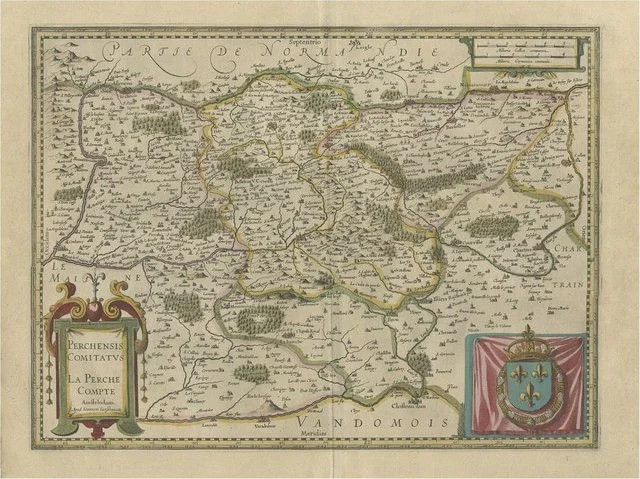
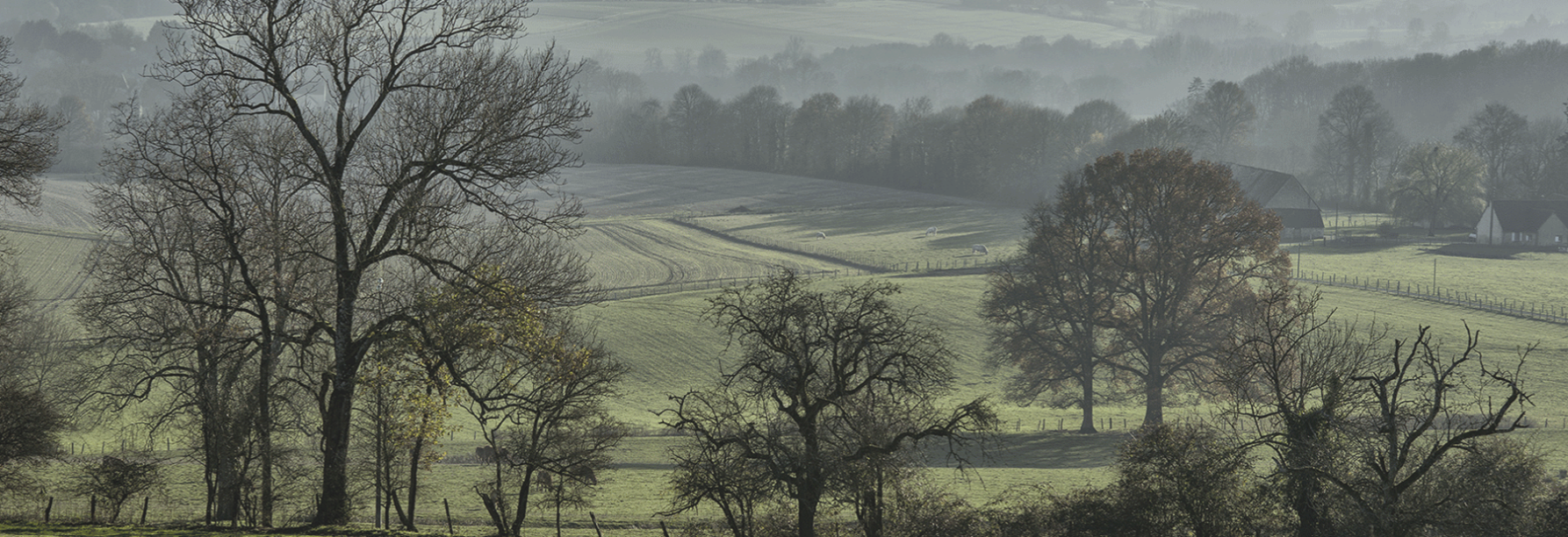
Marguerite was baptized on May 14, 1627, in the parish church of Saint-Martin at Saint-Martin-du-Vieux-Bellême, a small commune of the historic county of Perche in what is today the département of Orne. Perche was a country of forests, bocage hedges, and ironworks—a frontier between Normandy to the north and the Loire valley to the south—and it would become, in the second quarter of the seventeenth century, the single most productive emigration corridor in the founding of New France. The Juchereau, Giffard, Guyon, Cloutier, Drouin, and Pelletier families all came from Perche; so, in time, would the Crête, the Gaulin, the Roussin, and the Pingvet.
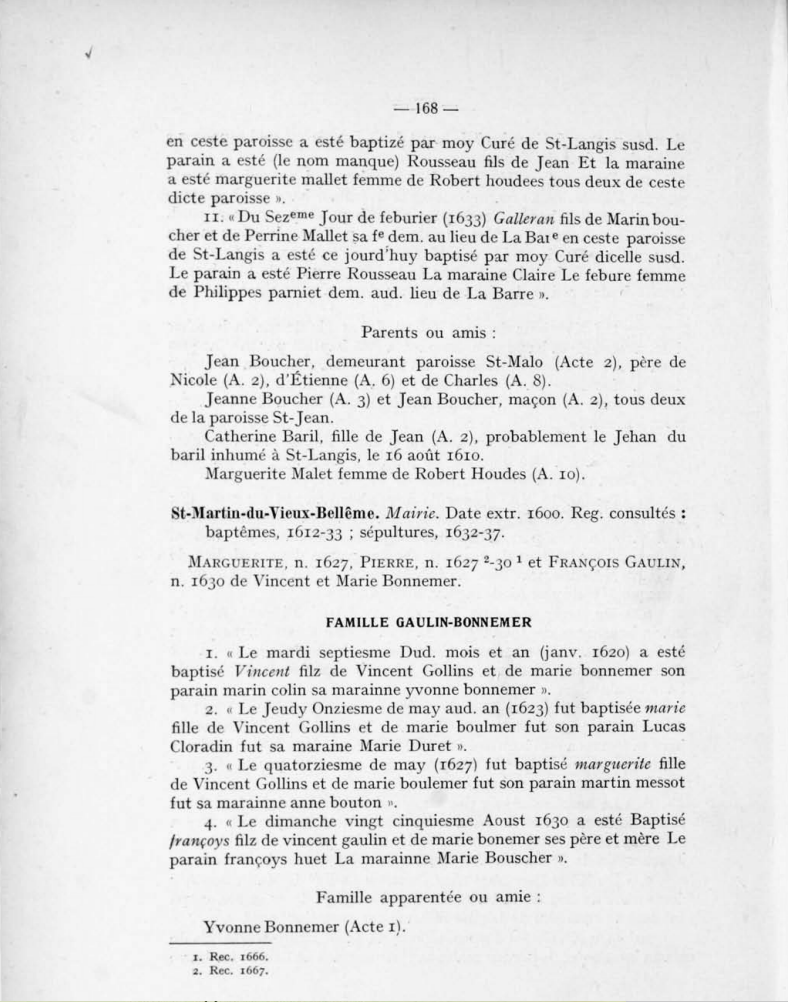
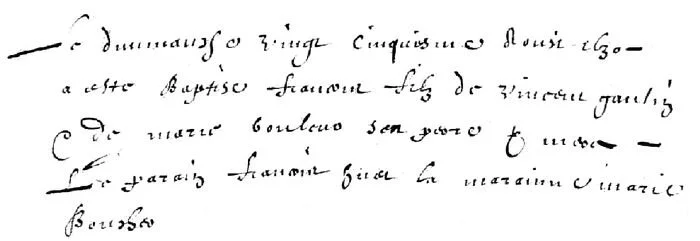
The baptism itself is preserved only through Archange Godbout's 1925 transcription Origine des familles canadiennes-françaises, which set down the parish register entries from Saint-Martin verbatim before later twentieth-century losses or restrictions of access. The relevant entry reads as Godbout copied it:
Three details deserve attention. The surname is recorded as Gollins, a phonetic variant of Gaulin that Godbout's later compendium index expressly cross-references with the standardized form. The mother's surname is recorded as Boulemer—not the conventional Bonnemer by which later compiled references would normalize her. And the godparents, Martin Messot and Anne Bouton, are otherwise undocumented in the Quebec emigration records: they remained in France.
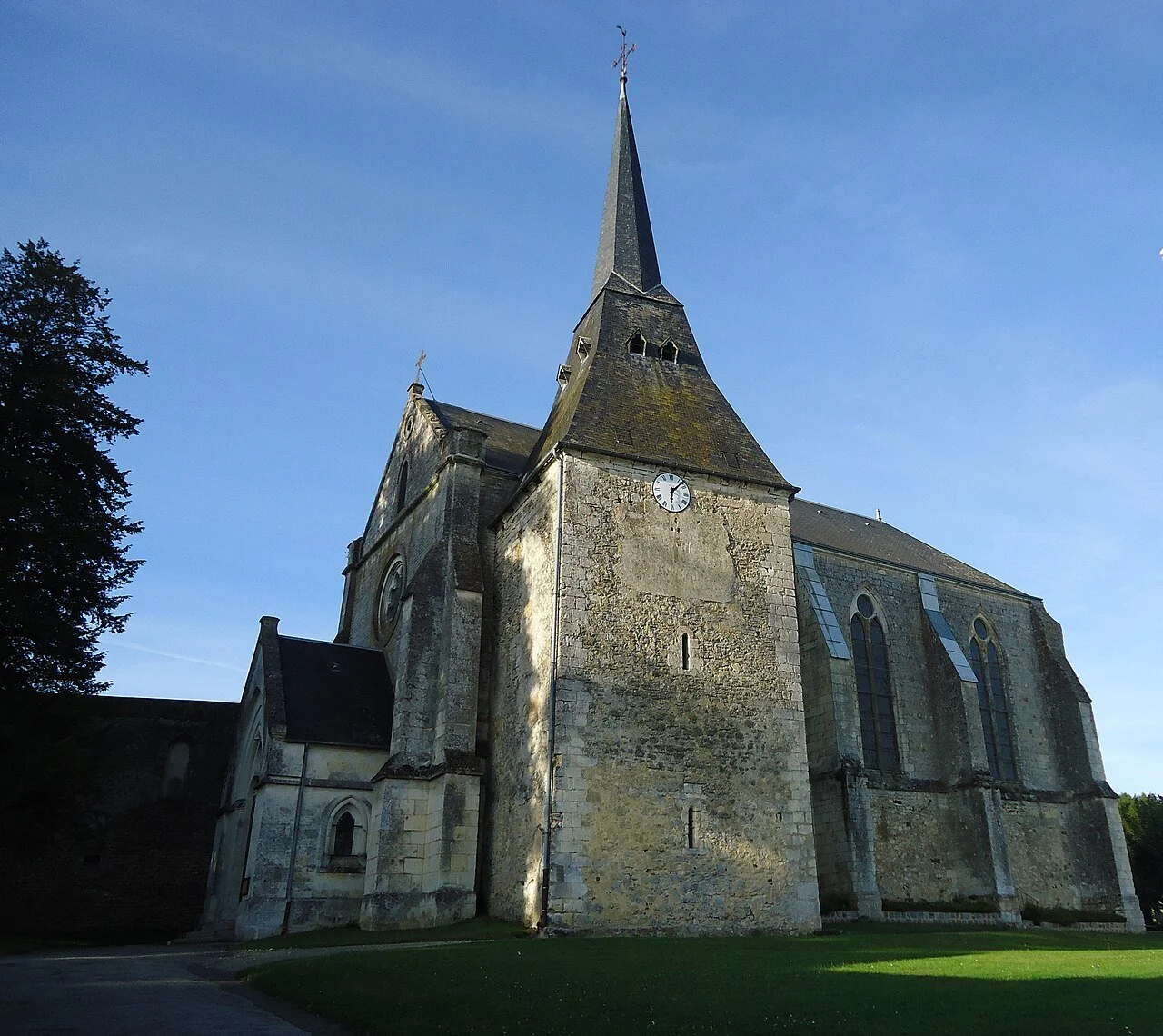
The Gaulin Family of Saint-Martin
Marguerite's father Vincent Gaulin (Gollins) and mother Marie Boulemer were married before 1620—the earliest baptism that survives from their household, that of their son Vincent Jr., is dated 7 January 1620. Four of their children's baptisms are preserved in Godbout's transcription of the Saint-Martin register (the register itself spans 1612–1633 for baptisms, with sepulchers from 1632–1637):
| Child | Baptism Date | Godparents | Fate |
|---|---|---|---|
| Vincent Gaulin (II) | 7 January 1620 | Marin Colin & Yvonne Bonnemer | Did not emigrate; presumed France |
| Marie Gaulin | 11 May 1623 | Lucas Cloradin & Marie Duret | Married Jean Garnier 1654 Illiers-Combray; stayed in France |
| Pierre Gaulin | 14 May 1627 (per PRDH; not transcribed by Godbout) | (not transcribed) | Emigrated; m. Jacqueline Lauvergnat 21 April 1664, Château-Richer; d. 16 November 1677, Ste-Famille (Île d'Orléans) |
| Marguerite Gaulin | 14 May 1627 | Martin Messot & Anne Bouton | Emigrated; m. Jean Crête 13 September 1654, Québec; d. 15 January 1703, Beauport |
| François Gaulin | 25 August 1630 | François Huet & Marie Bouscher | Emigrated; m. Marie Rocheron 25 September 1657, Québec; d. 8 December 1675, Ste-Famille (Île d'Orléans) |
Baptism dates and godparents from Godbout's 1925 transcription of the Saint-Martin register; the Quebec marriages and deaths of the three emigrant siblings verified against PRDH-IGD couple record no. 125 (Vincent Gaulin × Marie Bonnemer), which records the parents' marriage only as avant 1627 and lists just the three children who crossed to New France. The two who remained in France — Vincent II and Marie — appear in Godbout alone.
The two Marguerite-1627 and Pierre-1627 entries raise a documentary question that the surviving record cannot quite close. PRDH-IGD's family file places Pierre's baptism on the same day as Marguerite's—May 14, 1627—suggesting twins; the earlier published Filles à Marier reference of Peter Gagné explicitly identifies Marguerite as Pierre's twin. Godbout, however, did not transcribe a baptism act for Pierre at all; his note about Pierre records only that the 1666 and 1667 New France censuses gave him as born in 1627 or 1630, respectively. The likeliest reading is that Pierre and Marguerite were in fact twins, baptized together at Saint-Martin on May 14, 1627. The original AD-61 register would close the question definitively. As of this writing, that consultation remains open.
Two of the five Gaulin children—Vincent and Marie—remained in France. Three crossed the Atlantic, the brothers settling on the Île d'Orléans, and Marguerite at Beauport on the north shore of the Saint-Laurent. By 1666, all three were established New France habitants. The Gaulin name in Quebec descends from this single sibling group.
Of the parents Vincent and Marie there is only what the register fragments contain. Vincent is not marked deceased on Marguerite's 1654 Quebec marriage act, suggesting he was likely still living in France at the date of her wedding; Marie is named explicitly as défunte ("late"), establishing that she had died before September 13, 1654. Yvonne Bonnemer, who stood as godmother to the eldest brother Vincent in 1620, was almost certainly Marie's sister—the only Bonnemer name in the local register and consistent with seventeenth-century godparent conventions.
Crossing the Atlantic
The Fichier Origine project of the Fédération québécoise des sociétés de généalogie estimates that Marguerite arrived in New France around 1652; Peter Gagné's Before the King's Daughters places her arrival in 1654, the year of her marriage. The 1666 census, taken twelve years after her wedding, records her age as thirty-eight—mathematically consistent with the 1627 baptism—and shows her established in the Beauport household with five children. Whether she crossed in 1652, 1653, or 1654 is not currently determinable from primary documents.
What is determinable is that she was no child bride. Where Gillette Banne arrived in 1649 at thirteen and was married the same year, Marguerite arrived in her mid-twenties. The 1654 marriage was her first; her husband-to-be was a wheelwright already settled at Beauport, with property purchased the month before their wedding. Both parties were, in the conventions of the seventeenth century, mature.
The voyage itself took between six and twelve weeks depending on winds, departing typically from Dieppe or La Rochelle. Marguerite's exact ship and crossing date are not recorded in the surviving Quebec passenger lists, which are incomplete for the years before 1663.
The Marriage in Sieur Giffard's House
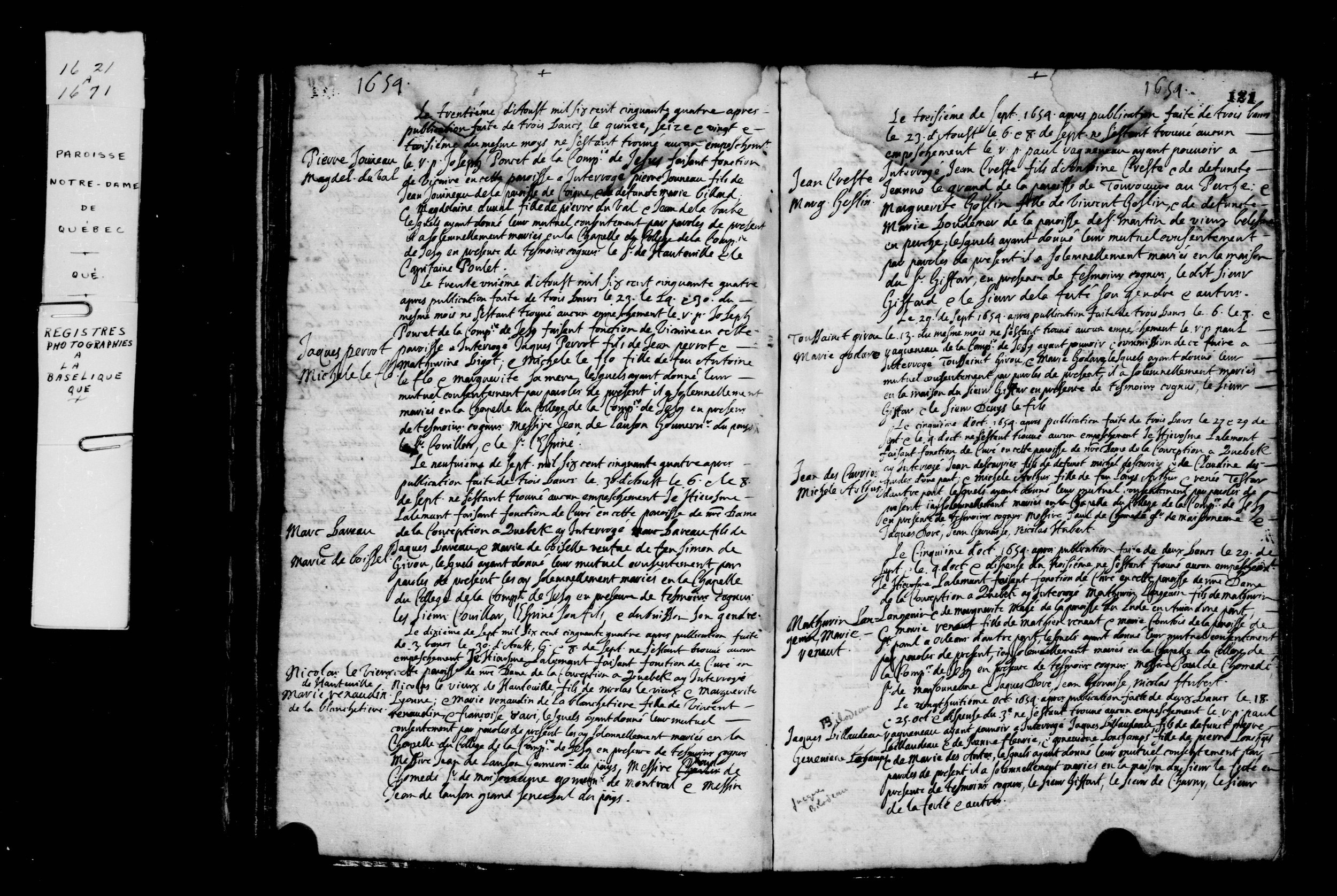
The wedding of Jean Crête and Marguerite Gaulin took place on Sunday, September 13, 1654. It was not solemnized in the parish church of Notre-Dame de Québec, although the marriage was entered in that parish's register on page 121. It was solemnized in the manor house of Sieur Robert Giffard, seigneur of Beauport—the older, larger, and more politically significant of the early Beauport seigneurial holdings. The bride had brought no dowry from the Crown; the groom had purchased his Beauport land a month earlier. The Giffard manor was the natural civic and religious gathering point for the small farming settlement.
The officiant was Father Paul Ragueneau, S.J., who had been superior of the Jesuit missions in New France from 1645 to 1650 and who in 1654 was attached to Québec. Two of the witnesses are named explicitly in the register: Robert Giffard himself, and his son-in-law the Sieur de la Ferté. The banns had been called on August 27 and on the sixth and thirteenth of September. The full primary register entry reads:
The register entry establishes more than the wedding. It establishes that both mothers—Marie Boulemer in Perche and Jeanne Legrand in Tourouvre—were already deceased by September 13, 1654. It establishes that the bridegroom was a son of the carriage-maker Antoine Crête of Tourouvre. It establishes the marriage venue as not just Beauport but specifically Giffard's manor. And it establishes the officiating priest as the same Paul Ragueneau, S.J., who five years later would baptize this couple's third child in the same building.
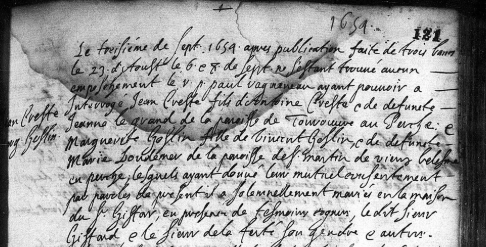
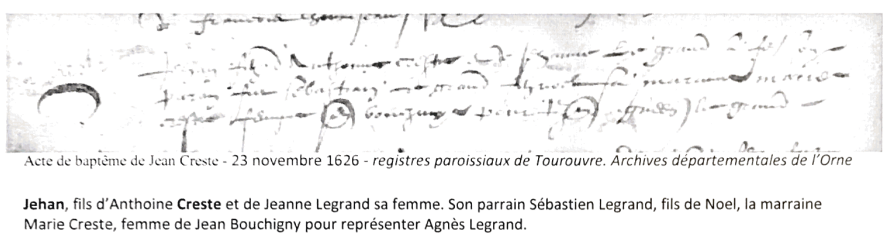
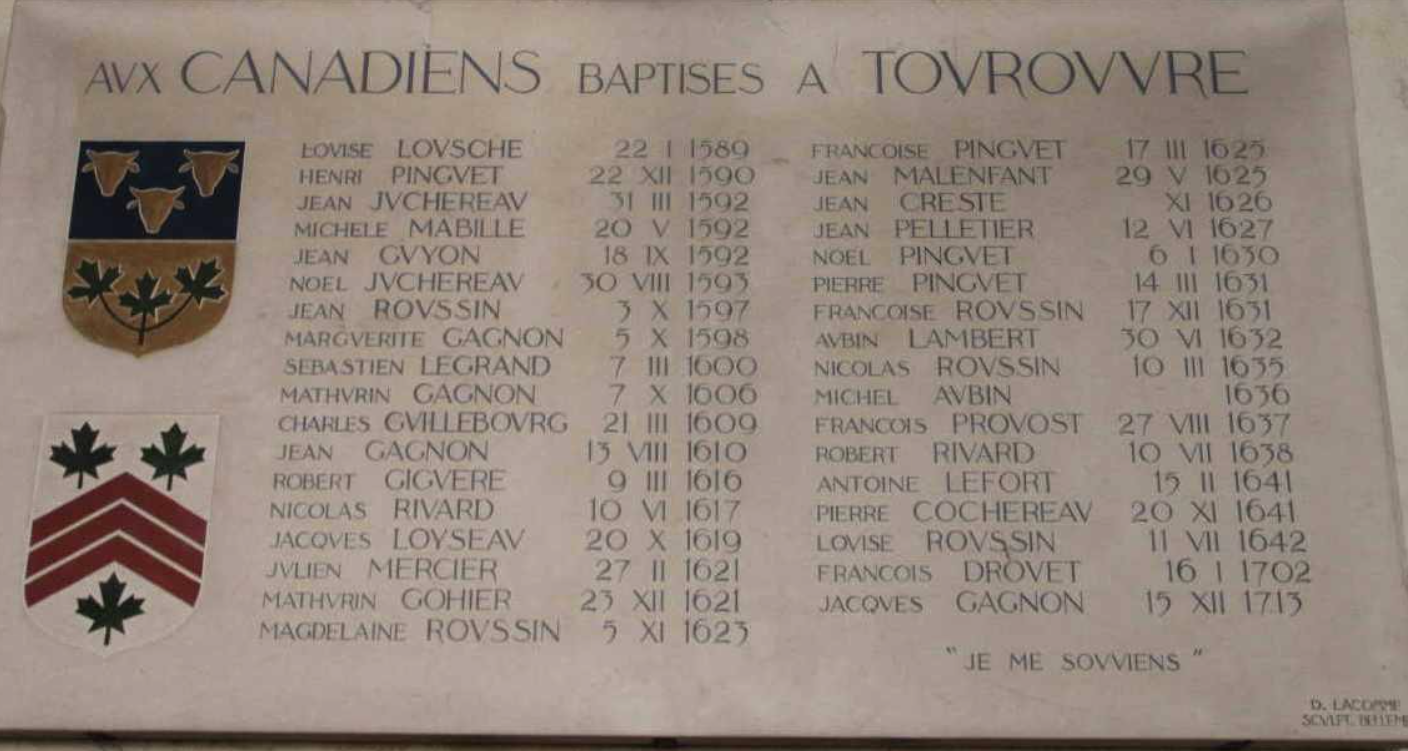
Jean Crête, the bridegroom, had been baptized at Saint-Aubin de Tourouvre on November 23, 1626—seven months before Marguerite at Saint-Martin. He was the third child and only son of Antoine Crête (a carriage maker at the family hamlet of Les Boullais) and of Jeanne Legrand, daughter of the merchant Noël Legrand. He had crossed to New France in 1649 under a three-year indenture to Michel Leneuf, Sieur du Hérisson of Trois-Rivières, contracted at Tourouvre in March of that year with his father Antoine attending as witness — an act known from the published literature on the Perche emigration and not yet retrieved from the departmental archive. Jean's three-year contract had long since expired by 1654; he was twenty-seven, a free man, a wheelwright by training, and a Beauport landowner of just under a month's standing when he met Marguerite at the altar in Giffard's house.
The First Decade at Beauport
The Crête household began its life on a one-arpent-by-ten-arpents lot at the Bourg de Fargy section of Beauport, purchased from Maurice Arrivé on August 11, 1654, before the notary Paul Badeau for 200 livres. Within four years, by October 14, 1658, Jean had resold forty-two square perches to the neighbor Toussaint Giroux—an early sign of a household trading up. Children came on a roughly two-year rhythm:
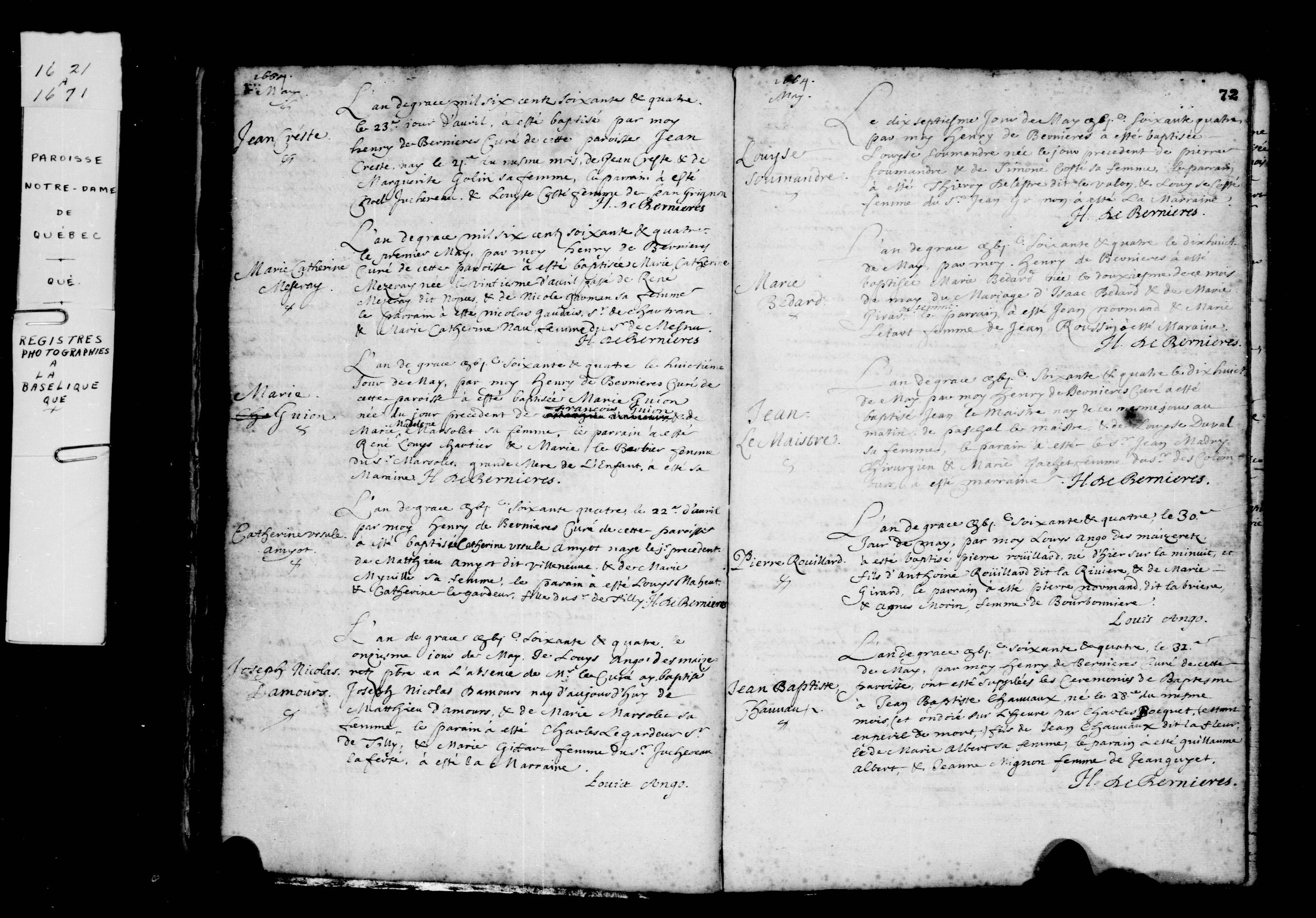
- Louis baptized 20 May 1656, Québec
- Marie baptized 10 October 1657, Québec
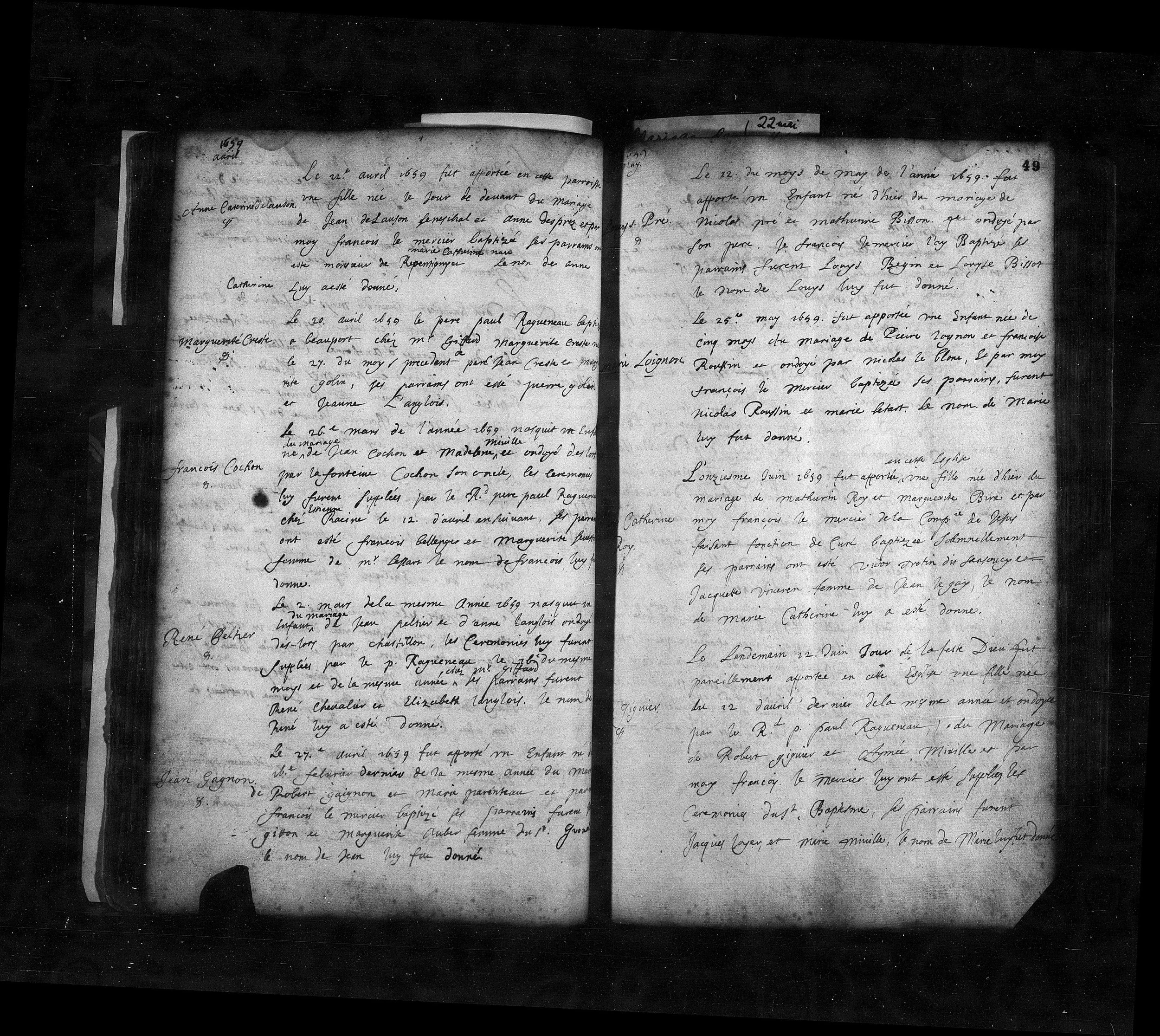
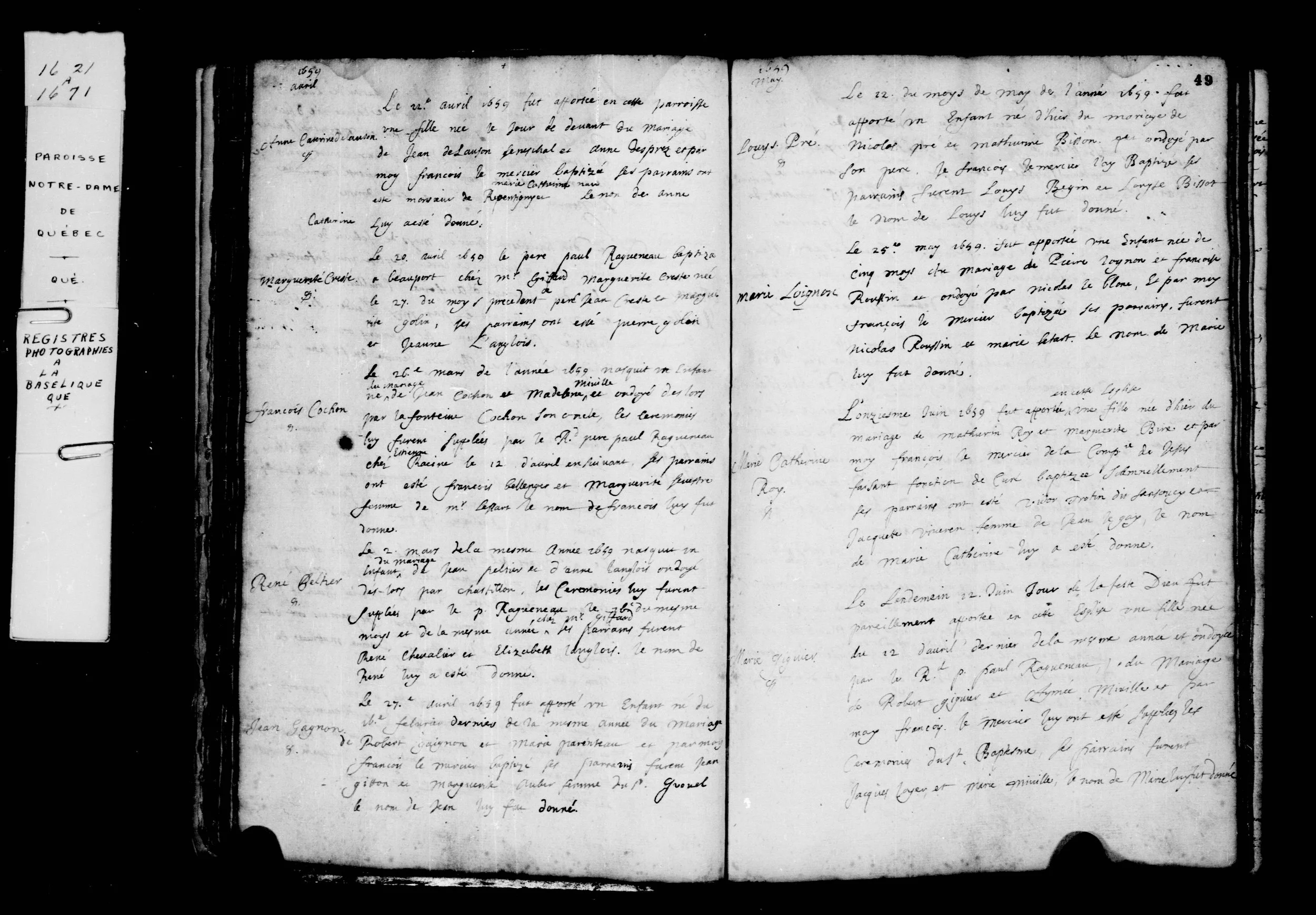
- Marguerite baptized 20 April 1659, Beauport, chez Mr Giffard
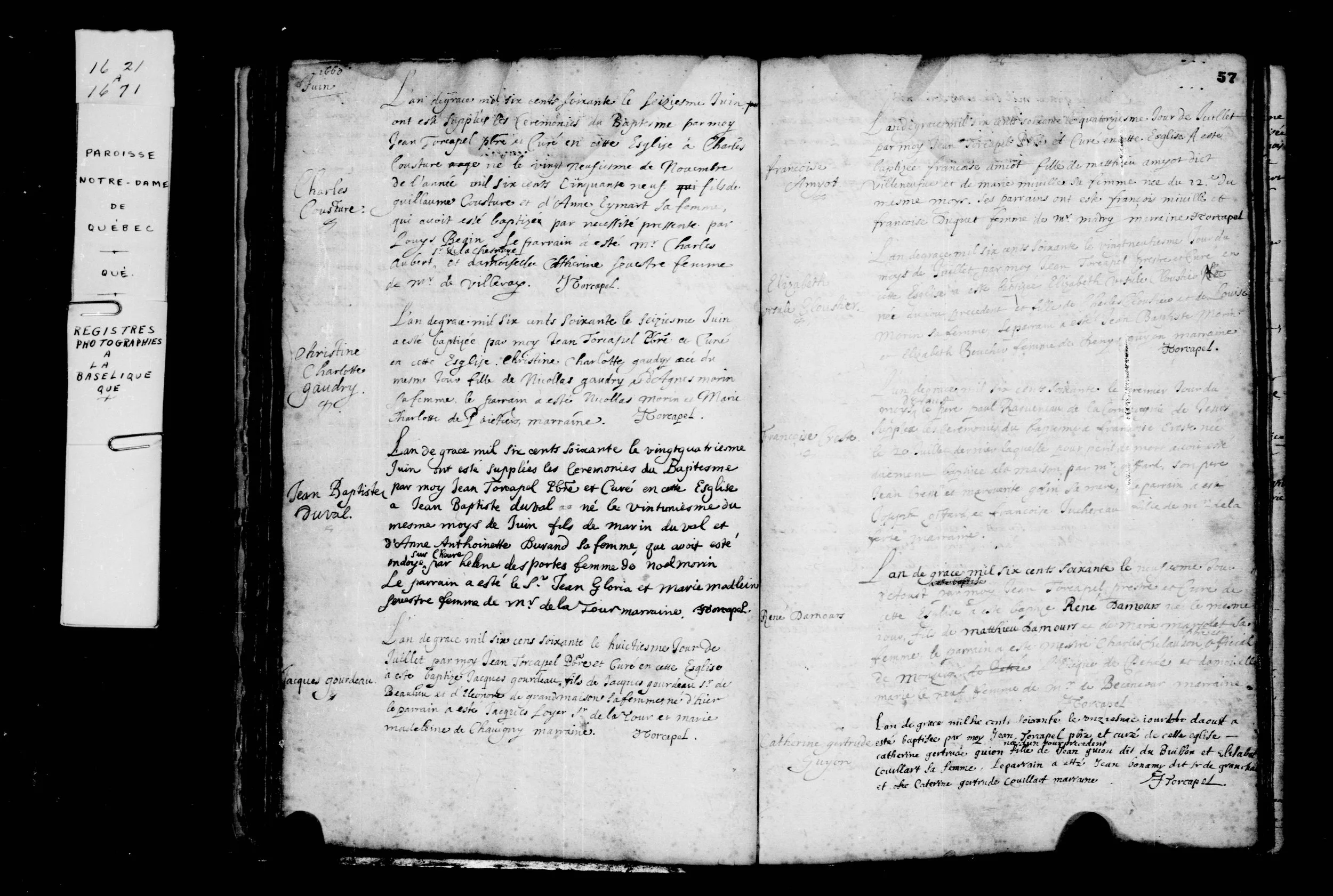
- Françoise baptized 1 August 1660, Québec (Hôtel-Dieu)
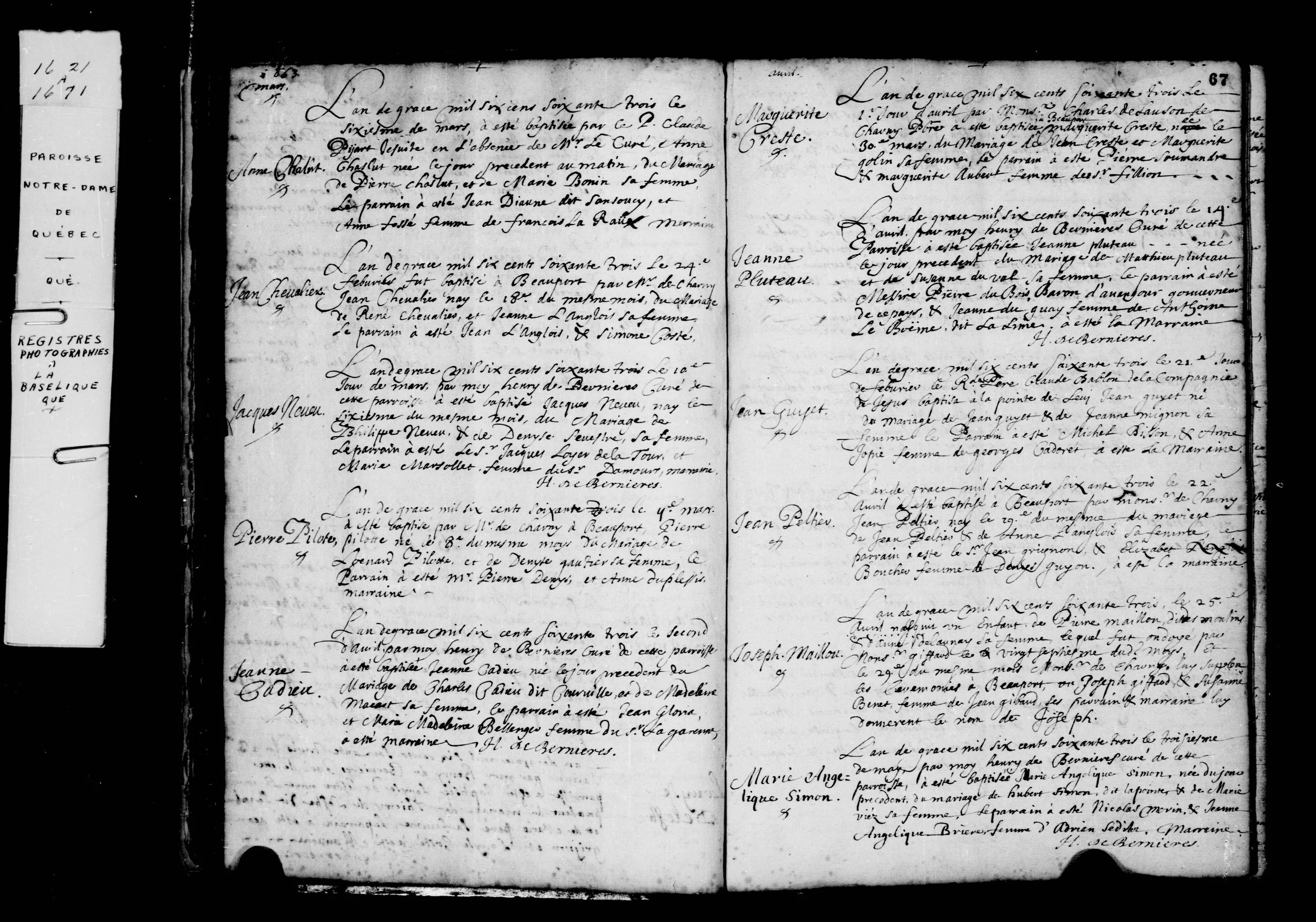
- Marguerite (the second) baptized 1 April 1663, Beauport
The third child's baptism record deserves a pause. Five years after the marriage at Giffard's house, the same Father Paul Ragueneau returned to baptize a new Crête infant at the same manor—not at the parish church, but again at Giffard's residence. The Notre-Dame de Québec register entry for April 20, 1659, makes the venue explicit:
The persistence of the Giffard manor as a venue for Crête family sacraments—wedding in 1654, baptism in 1659—is the documentary footprint of a patron-client relationship with the seigneurial family of Beauport, a relationship that would deepen further across the 1660s through the seigneurial baptisms. In August of 1666 Jean Crête also acquired a parcel within the Dubuisson fief, in Giffard's seigneurie—not from the Giffard family but by private sale from Claude Guion and his wife Catherine Collin of Île d'Orléans before the Royal Notary Paul Vachon—and would in time render foi et hommage for that holding to the Giffard line as overseigneurs.
The 1666 Census of New France
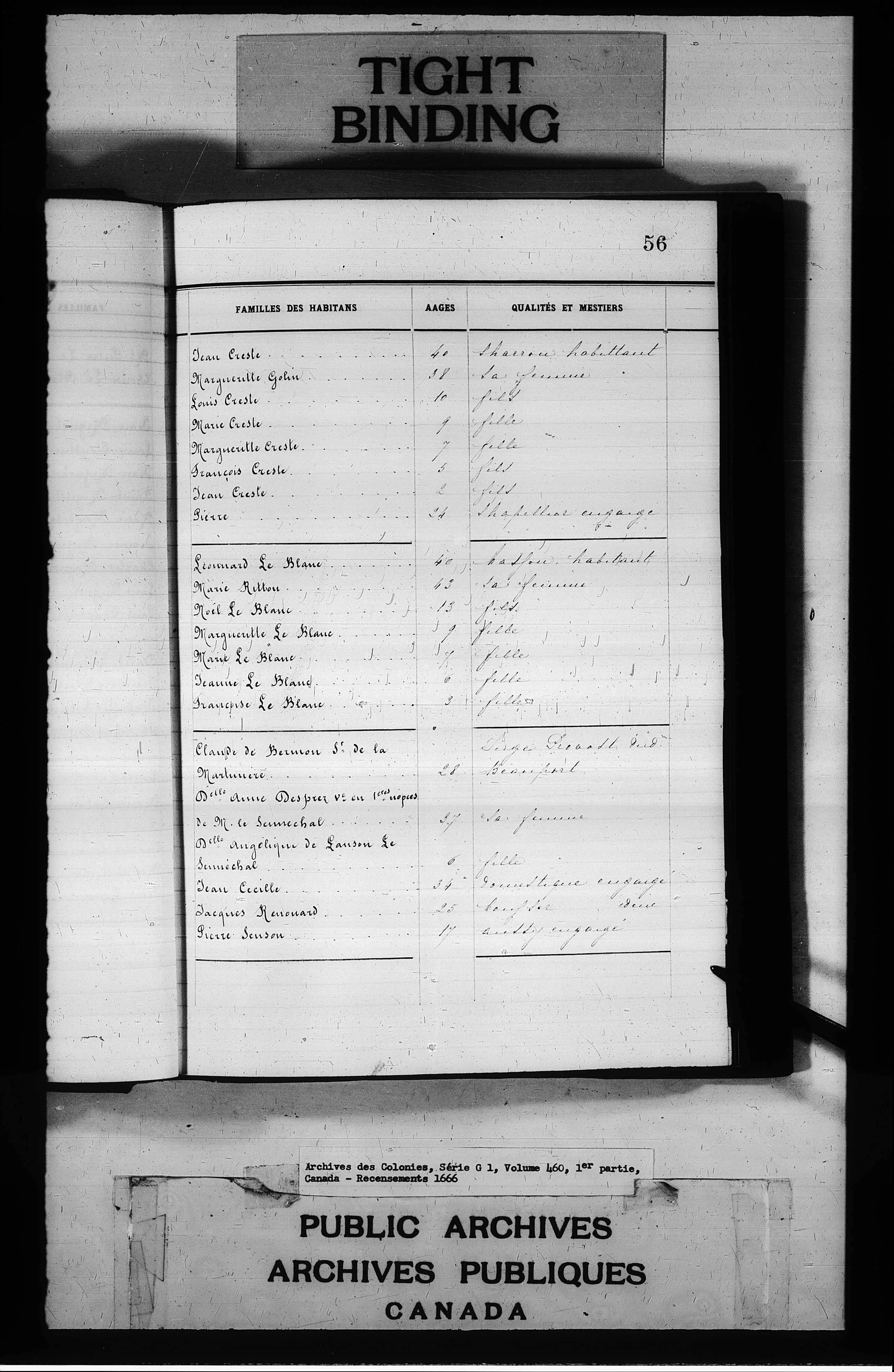
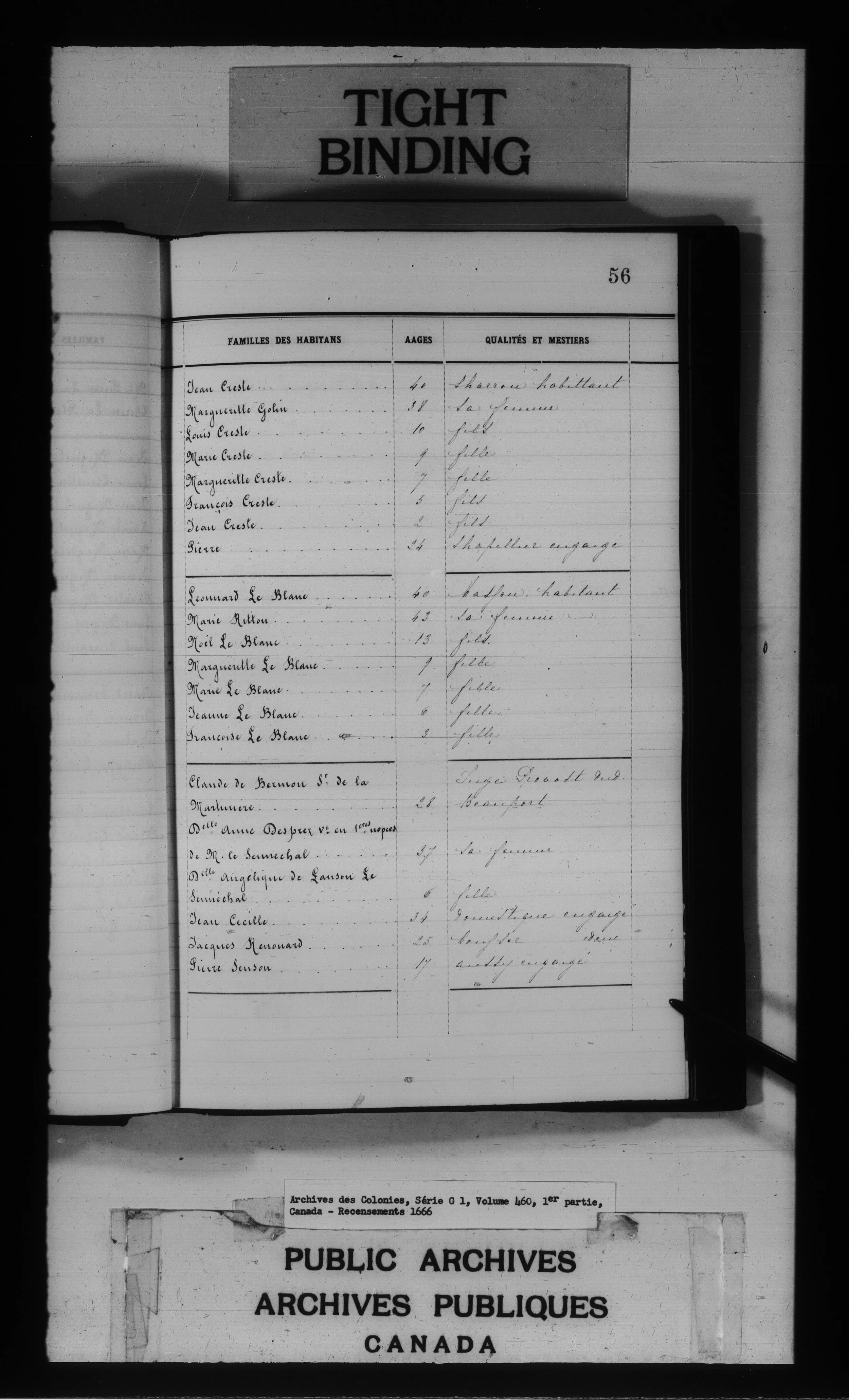
The royal intendant Jean Talon's 1666 census was the first comprehensive enumeration of New France's habitants. The Beauport entry, folio 56 of the surviving microfilm copy at Library and Archives Canada (Archives des Colonies, Série G1, Volume 460), records the Crête household as follows:
The Crête Household — Beauport, 1666
- Jean Cresté — 40 — charron habitant (wheelwright settler)
- Marguerite Golin — 38 — sa femme (his wife)
- Louis Cresté — 10 — fils
- Marie Cresté — 9 — fille
- Marguerite Cresté — 7 — fille
- François Cresté — 5 — fils (probably Françoise, misrecorded)
- Jean Cresté — 2 — fils
- Pierre — 24 — chapellier engagé (indentured hatter; no surname recorded)
Two details from this 1666 entry resolved long-standing genealogical questions about the family. First, the record of "Marguerite Cresté, 7"—the daughter baptized at Giffard's house in 1659—settled which of the two Marguerites in the family later married the Batiscan habitant Pierre Gaillou: it was this one, the elder, who survived into adulthood. The infant Marguerite II, born March 30, 1663, was the daughter who would die within weeks and be buried at Notre-Dame de Québec in May of 1663, "petite fille agée d'un mois et demy, fille de Jean Creste, habitant de Beauport." Earlier secondary sources had assigned these fates the other way around.
Second, "François Cresté, 5" was almost certainly Françoise, the daughter baptized at Notre-Dame de Québec on August 1, 1660. The 1667 royal census, taken just a year later, lists her correctly as "Françoise" age seven. And the primary baptism register of August 1, 1660 names her unambiguously female. The 1666 census-taker simply misrecorded her name and sex.
The presence of a twenty-four-year-old engagé—an indentured worker—in the household is itself notable. His given name is entered as Pierre; the words chapellier engagé stand in the qualités et métiers column, which is the trade column, and no surname was recorded for him. By 1666, the Crête family was sufficiently established to be employing hired labor.
The Ten Children of Jean Crête and Marguerite Gaulin
| Child | Born / Baptized | Marriage(s) | Death |
|---|---|---|---|
| Louis | 1656-05-06 | Madeleine Briault, 28 May 1685, La Rochelle (St-Sauveur) | August 1685 (at sea); bur. St-Laurent, Île d'Orléans — see date note below |
| Marie (I) | 1657-10-06 | (1) Robert Pepin 1670; (2) Jean Brideau ~1687; (3) Pierre Jourdain dit Bellerose 1706 — line of descent via Brideau | 1722-11-09 Québec |
| Marguerite (I) | 1659-03-27 / bp. at Giffard's house | Pierre Gaillou, 6 Nov 1678; settled at Batiscan | 1734-10-12 Batiscan (St-François-Xavier) |
| Marie Françoise | 1660-07-20 / bp. 1660-08-01 | Henri Delaunay, 6 Nov 1679, Beauport | 1702-11-29 Québec (Hôtel-Dieu) |
| Marguerite (II) | 1663-03-30 | — | May 1663, Notre-Dame de Québec (age about six weeks) |
| Jean (II) | 1664-04-21 | — | 1684-11-04, Beauport (age 20, bachelor) |
| Joseph | 1666-04-30 | — | 1689-01-20, Beauport (age ~22, bachelor) |
| Marie (II) | 1668-02-16 | Jean Baptiste Lefebvre-Duchassenal, 22 Oct 1685, Beauport | 1724-11 (per PRDH) |
| Louise | 1670-08-03 | — | before 1681 census (died young) |
| Pierre | 1671-08-19 | Marthe Marcoux, 3 Nov 1693, Beauport (13 children) | 1719-11-15, Beauport |
Compiled from the Notre-Dame de Québec and Beauport parish registers, with the children's marriages and deaths checked against PRDH-IGD couple record no. 866 (Crête × Gaulin). Two dates in this table warrant a note of their own, set out immediately below.
Marie Françoise Crête died on 29 November 1702. The register of the Hôtel-Dieu du Précieux-Sang de Québec, in the roll of patients present on the first of November 1702, carries her admission on the twentieth of that month with the marginal notation morte: "francoisse Crette fame de delauné agé de 43 ans de quebec — morte le 29 nov[em]bre." Admitted on the twentieth, dead nine days later. The stated age of forty-three is the hospital clerk's approximation; measured from her 20 July 1660 birth she was forty-two years and four months. PRDH-IGD individual record no. 19407 gives the same date for both death and burial.
Louis Crête's burial date is unsettled. The Saint-Laurent act transcribed below reads "le vingt-cinquième jour du mois d'aoust" — the twenty-fifth — and that reading is used here. PRDH-IGD burial record no. 35618 carries 21 August 1685 for both the death and the burial. The act states no date of death beyond "le jour mesme de son retour de France," and the register page is to be re-read.
Where a compiled database record and the parish act it indexes disagree, the act governs and the divergence is stated rather than smoothed.
Of the ten children, four died before marrying—Marguerite II in infancy, Louise before her tenth year, Jean II at twenty, and Joseph at twenty-two. The remaining six lived long enough to marry; five had families of their own. Louis, the firstborn, did marry but died three months later. The descent line to the present runs through the second child, Marie, by way of her second marriage.
Around the Font: A Decade of Beauport Baptisms
The ten baptisms of the Crête children, performed between 1656 and 1671, are something more than a sequence of sacramental dates. Taken together, they document a deliberate and tightening social network—a fifteen-year record of which priests came to Beauport for the Crête family, and which neighbors stood at the font as godparents. Reading the register entries in order is reading the social ascent of the household.
The roster of officiating priests is itself a who's-who of the early Quebec church:
- 1656 (Louis): Father Joseph Poncet, S.J.—the Jesuit who would later be captured and ransomed by the Iroquois—performed the ceremonies in the absence of Father Jérôme Lalemant. Louis himself had been emergency-baptized at home by the neighbor Anne Martin when he appeared in danger of death.
- 1657 (Marie): Gabriel de Queylus—Sulpician, Vicar Apostolic of New France from 1657 to 1659—solemnly baptized Marie at Notre-Dame de Québec.
- 1659 (Marguerite I): Father Paul Ragueneau, S.J., the former superior of the Jesuit missions, baptized her at the manor house of Sieur Giffard.
- 1660 (Françoise): Robert Giffard, the seigneur of Beauport, personally emergency-baptized the infant in his own house when she was in danger of death. Father Paul Ragueneau supplied the solemn ceremonies a week and a half later.
- 1663 (Marguerite II): Charles de Lauson de Charny, Grand Vicar and Official of Bishop François de Laval, baptized the infant at Beauport. She would die some six weeks later.
- 1664 (Jean II): Father Henri de Bernières, the curé of Notre-Dame de Québec from 1659 and first superior of the Séminaire de Québec, baptized the boy who would die at twenty.
- 1666 (Joseph): Charles de Lauson de Charny again—the Grand Vicar of the bishop was the highest ecclesiastical figure who could have come, short of Laval himself.
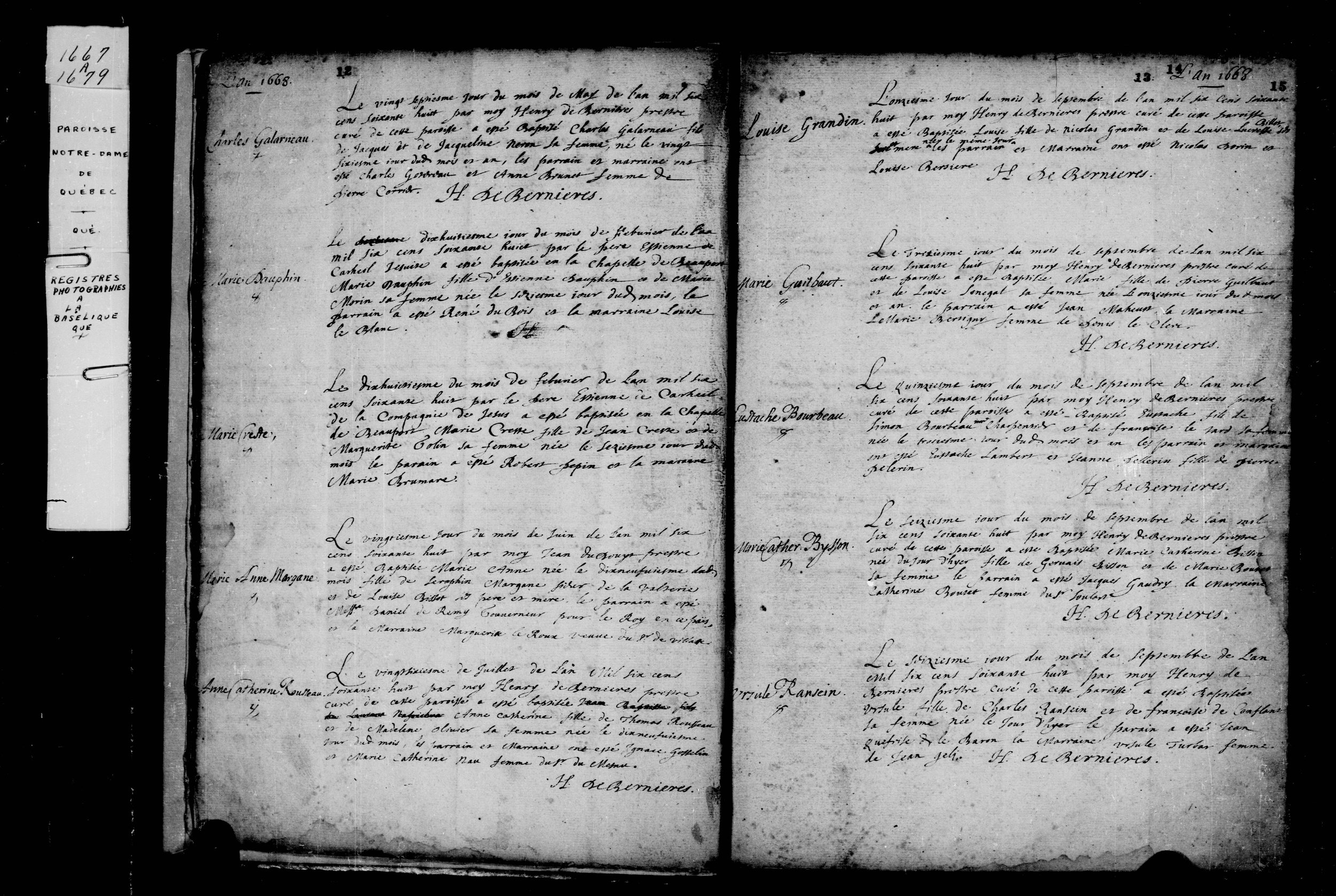
- 1668 (Marie II): Father Étienne de Carheil, S.J., the renowned Jesuit missionary, officiated. The godfather was Robert Pepin—who two years later would marry Marie's elder sister, Marie.
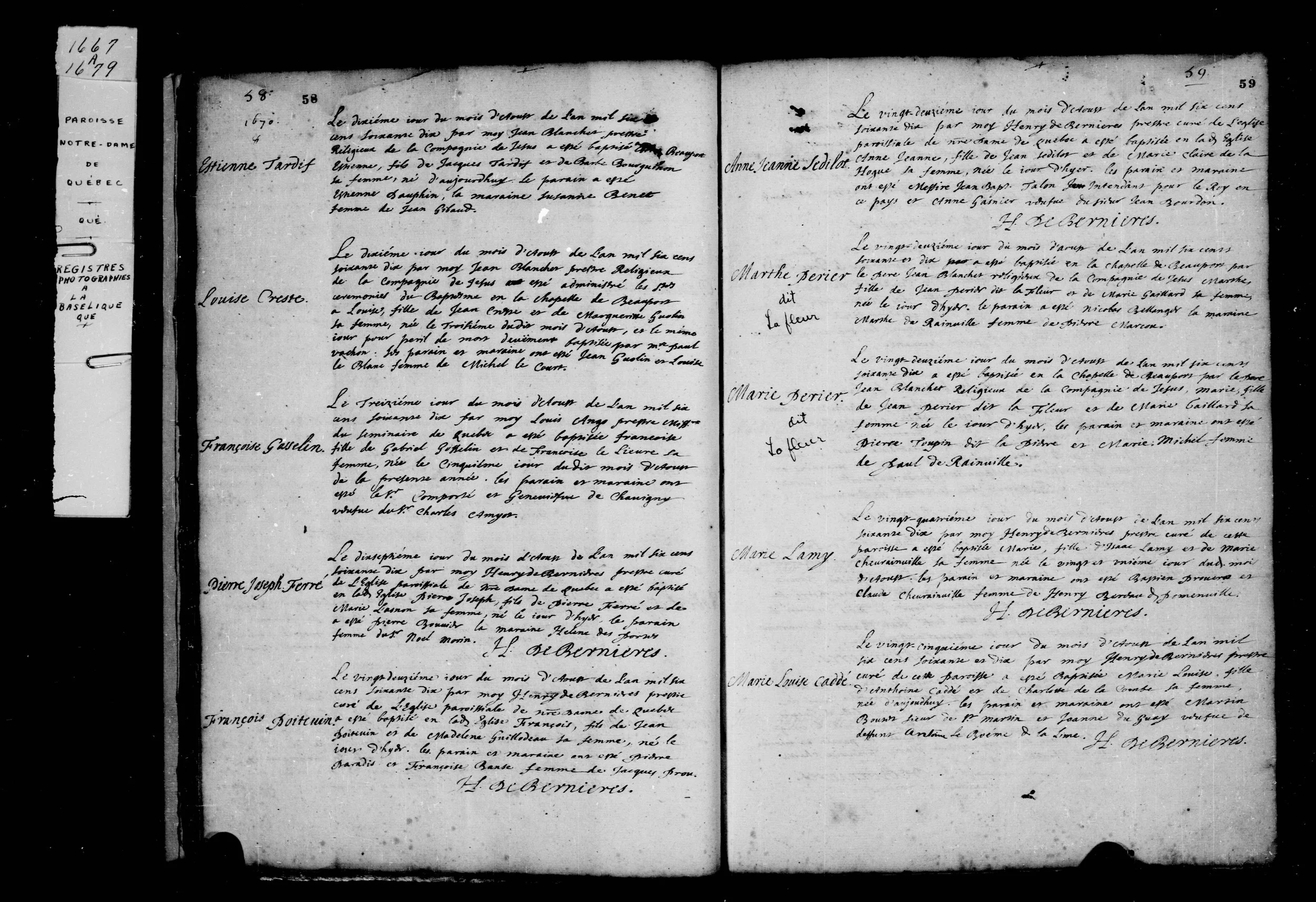
- 1670 (Louise): Paul Vachon, the Royal Notary of Beauport, performed the emergency baptism "pour peril de mort" when the infant lay in danger of death. Father Jean Blanchet, S.J., supplied the solemn ceremonies a week later. Louise would not survive to the 1681 census.
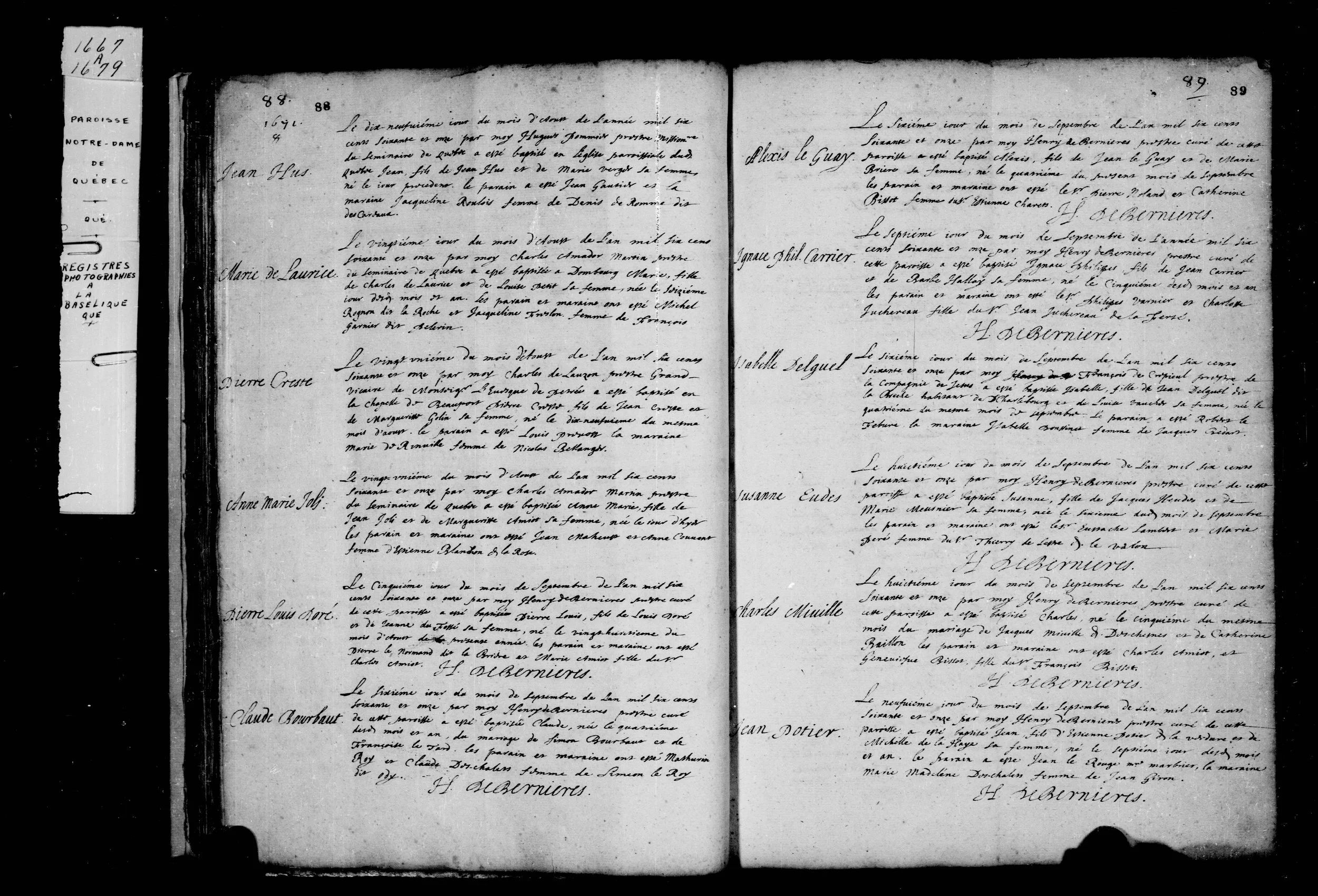
- 1671 (Pierre): Charles de Lauson de Charny for a third time—this time at the newly formalized chapel of Beauport itself.
Three of the ten children needed emergency baptism at birth—Louis in 1656, Françoise in 1660, and Louise in 1670—and the identities of those who performed each emergency rose with the family's social position. The neighbor woman Anne Martin for Louis. Robert Giffard, the seigneur, for Françoise. Paul Vachon, the Royal Notary, for Louise. Across fourteen years, the people closest at hand in moments of medical crisis went from neighbor to seigneur to public official.
The list of godparents is even more telling. Two acts stand out.
Read this carefully. The seigneur of Beauport, Robert Giffard, personally baptized the infant in his own house when she was in danger of death—an act of immediacy that required physical presence and personal involvement. Then his son Joseph (the future seigneur) and his granddaughter Françoise Juchereau (daughter of the Sieur de la Ferté) stood as the godparents. The child Françoise, baptized in the Giffard manor by Giffard's hand, was named for Giffard's granddaughter.
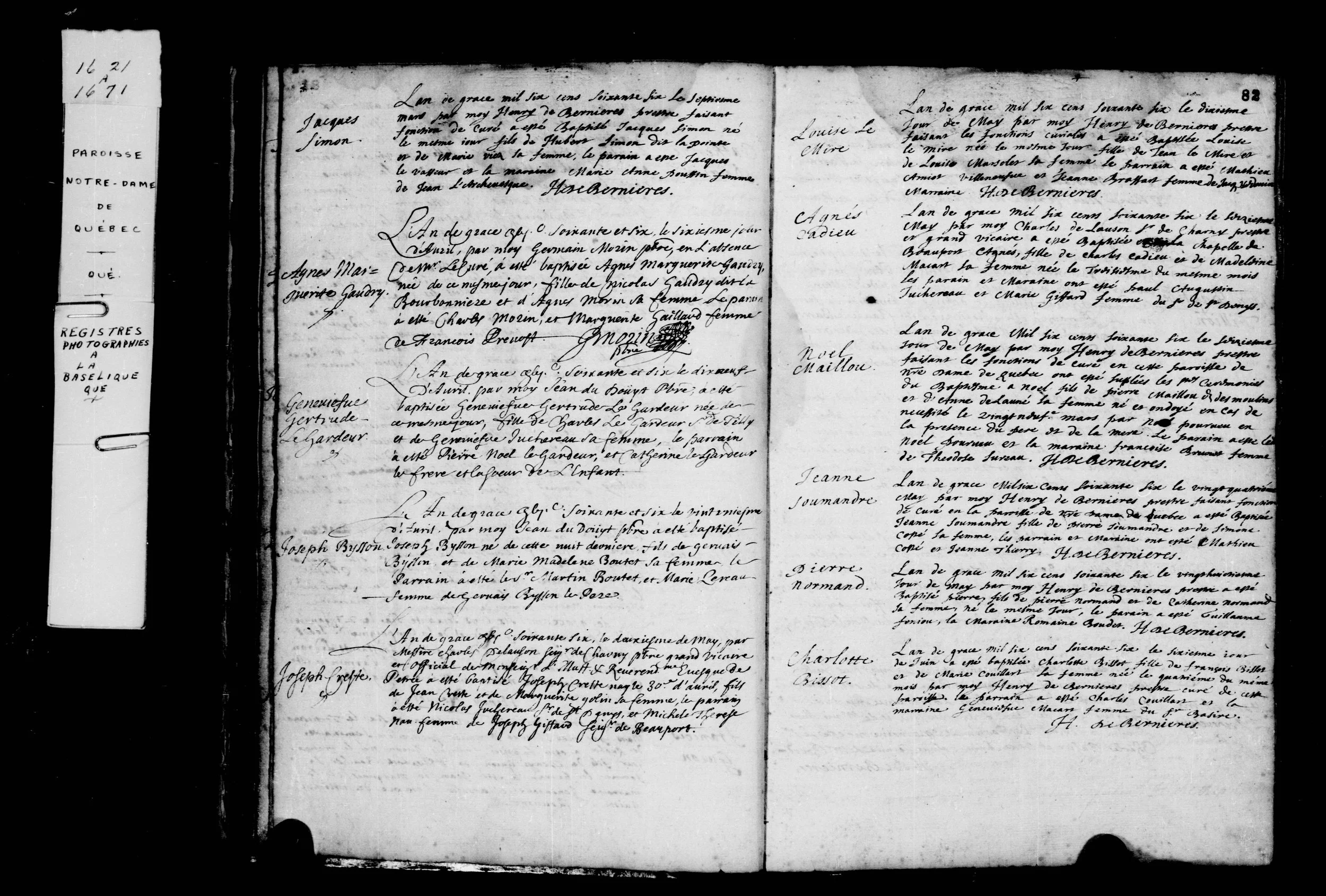
Six years later, the documentary signal grew louder still. The 1666 baptism of Joseph Crête—a child born the very year Jean Crête acquired a parcel within the Dubuisson fief in the Giffard seigneurie—was a ceremonial event at the highest social level Beauport produced:
The officiant is the Grand Vicar of Bishop Laval. The godfather is Nicolas Juchereau, Sieur de Saint-Denis—a Juchereau lord married to one of Robert Giffard's daughters. The godmother is the wife of Joseph Giffard, the seigneur of Beauport himself. The child is named Joseph—a name carried in the family thereafter, but in 1666 unmistakably honoring the seigneur. The Crête-Giffard-Juchereau alignment is at its documentary peak.
What the baptisms collectively show, and what no notarial act records as cleanly, is that by the late 1660s the Crête household was not just a Beauport habitant household. It was networked into the seigneurial circle at the level of godparents and named children. Robert Giffard had personally baptized Françoise. His son Joseph had godfathered her. The wife of that same Joseph had godmothered the next-born son, who took the seigneur's name. The Grand Vicar of the diocese had officiated three of the ten baptisms—Marguerite II, Joseph, and Pierre. Four of the ten Crête children were baptized at Giffard's house, at Beauport itself, or at the chapel of Beauport rather than at the parish church in Quebec City.
The economic ascent from wheelwright to demi-seigneur, documented across the three censuses, has its social counterpart in this baptismal record. The two trajectories are the same trajectory, seen from different documentary angles.
From Wheelwright to Demi-Seigneur
Between 1654 and 1666, Jean Crête's economic standing rose substantially. The 200-livre lot purchased before his wedding was followed by a piecemeal accumulation of property: the partial resale to Toussaint Giroux in 1658, a series of notarial acts before Paul Vachon (the Royal Notary of Beauport and later godfather to Jean's son), and—most consequentially—the acquisition on August 4, 1666 of a parcel within the Dubuisson fief in the seigneurie of Beauport, by private sale from Claude Guion and his wife Catherine Collin of Île d'Orléans before the Royal Notary Paul Vachon. The 4 August 1666 sale before Notary Paul Vachon (D-059) was followed one week later by Jean Crête's formal act of faith and homage to Robert Giffard at the door of the seigneurial castle of Beauport (D-067, 11 August 1666) — kneeling, bare-headed, calling out three times to Monseigneur de Beauport. Seven years later, with Robert dead and the seigneurie passed to his son, Jean Crête rendered his aveu et dénombrement to Joseph Giffard (D-069, 25 April 1673) — detailing his six-and-a-half perches of frontage on the St. Lawrence, seven arpents under cultivation, and the surrounding boundaries. A surveyor's division of the same parcels was recorded six months later (D-068, 5 November 1673). A 96-livre receipt of 1 June 1667 referenced in earlier secondary literature remains the one element of this documentary chain not yet retrieved. The trajectory across three royal censuses—1666, 1667, 1681—measures the ascent in arable land and livestock.
Three Censuses, Fifteen Years
1666: Jean 40, Marguerite "Golin" 38, five children at home, a Pierre, 24, as engagé. (D-025)
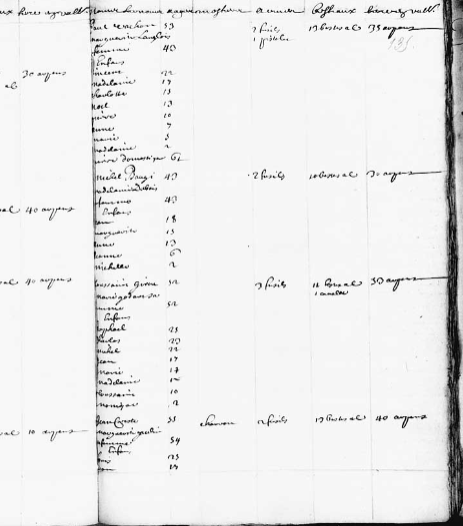
1667: Jean 42, Marguerite "Gosselin" 40 (mis-recorded), six children at home including infant Joseph age 1, six livestock and fifteen arpents under cultivation. Neighbors: Toussaint Giroux above, Pierre Lefebvre below. (D-055)
1681: Jean 55, Marguerite "Gaudin" 54 (mis-recorded again), surviving children at home, Marie Chapacou 16 as servante, two firearms, thirteen horned cattle, forty arpents of usable cleared land. (D-056)
The household's land more than doubled across the fifteen years between 1667 and 1681 (fifteen arpents to forty), and its cattle more than doubled (six to thirteen). Two firearms now appeared. The census-takers, three different men working on three separate enumerations, all struggled with the same surname—"Golin" in 1666, "Gosselin" in 1667, "Gaudin" in 1681. The mother's name was the only thing in the household that did not grow over the decade and a half.
The trajectory matters because it locates Marguerite Gaulin in a specific economic and social position. She was not the wife of a struggling habitant; nor was she the wife of a great seigneur. She was the wife of a master wheelwright who became a demi-seigneur of Beauport—a man wealthy enough to be sued and to sue in the Sovereign Council of New France, prosperous enough to keep an indentured worker and a servant, but rooted enough to remain in the same parish for forty-nine years.
The Beauport household had a wheelwright shop, agricultural lands, livestock, and—from at least 1666—a portion of a seigneurial fief subject to feudal dues. Marguerite managed it across the decades of her husband's commercial expansion. Her name does not appear on the notarial purchases—Jean is the legal actor in the eighteen surviving notarial transactions—but the children she bore and the household she ran were the foundation of every transaction.
In November of 1693, Marguerite and Jean witnessed the marriage of their youngest son. Pierre Crête, then twenty-two, married Marthe Marcou at her father's house in Beauport before the royal notary Paul Vachon. The contract is one of the richest documentary acts in which Marguerite is named. The three Crête daughters and their husbands were all present — Marie and her second husband Jean Brideau, Françoise and Henri Delaunay, Marie the younger and Jean Lefebvre — together with Jean Pepin, son of Marie's first marriage. Pierre Marcou and Marthe de Rainville settled their daughter with 150 livres of goods and a brown cow. Jean and Marguerite, for their part, gave Pierre six arpents of the Buisson fief — the very land Jean had acquired from Claude Guion and his wife Catherine Collin of Île d'Orléans in the August of 1666 — here passing to the youngest son a generation later. At the signing, Marguerite was named among those who "declared not to know how to write or sign." She was sixty-six. The line of her assent is the closest the documentary record will ever come to her own hand.
August 1685: A Son's Voyage Home
The eldest Crête son, Louis, born in May of 1656, took ship for France in the spring of 1685. He was twenty-nine years old. His own beginning had not been certain: the 1656 baptism register at Notre-Dame de Québec records that he had been "ondoyé"—privately, emergency-baptized—at home by his mother's neighbor Anne Martin before the priest could arrive. Father Joseph Poncet, S.J., supplied the solemn ceremonies on May 20, 1656, in the absence of Father Jérôme Lalemant. The boy who would die at sea twenty-nine years later had also nearly died as a newborn. His life opened and closed with precarious crossings.
The reason for his voyage is recorded in the parish register of Saint-Sauveur in La Rochelle: on May 28, 1685, in the Aunis port city, Louis married Madeleine Briault. She was twenty years old, born April 2, 1665, at Notre-Dame-de-Cogne in La Rochelle, daughter of Jean Briaud and Andrée Cherbonneau. Whether Louis had crossed to France specifically to marry her, or had met her there during a trading voyage, the surviving record does not say. What is clear is that the couple sailed for Quebec together later that summer.
Louis did not survive the crossing.
The boat carrying him home belonged to a man identified in the burial register only as Sieur Niel. Among the passengers, providentially, was Father Benoist Duplain, a priest canon of the cathedral of Quebec. When Louis fell into his fatal illness, Father Duplain administered the last sacraments aboard the vessel and prepared the formal certificate. The boat continued on; Louis's body was carried into Saint-Laurent on the Île d'Orléans, where it was buried in the parish cemetery. The full primary register entry reads:
| Role in the act | Name as recorded | Detail |
|---|---|---|
| Deceased | Louis Creste | Age given as about thirty; died aboard ship on the day of his return from France |
| Boat owner | Niel | Given name not stated in the act |
| Witness | Mathurin Chabot | Habitant of the parish; the only signatory |
| Witness | Jean Estourneau | Habitant of the parish |
| Attending priest at sea | Benoist Duplain | Priest canon of the cathedral of Quebec; administered the last sacraments aboard and sent the certificate |
| Officiating priest | Francheville | The undersigned priest, promoter general of the officiality of Quebec, performing the curial functions at Saint-Laurent; named in the database extract, not in the act's own body |
Abstracted from the parish register entry and cross-checked against PRDH-IGD burial record no. 35618, which supplies the surname of the officiant the act itself leaves as "prestre soussigné" and which carries the marginal note that he died in Mr. Niel's boat upon his return from France. The database and the register disagree on the date of burial; see the discrepancy note in the preceding section.
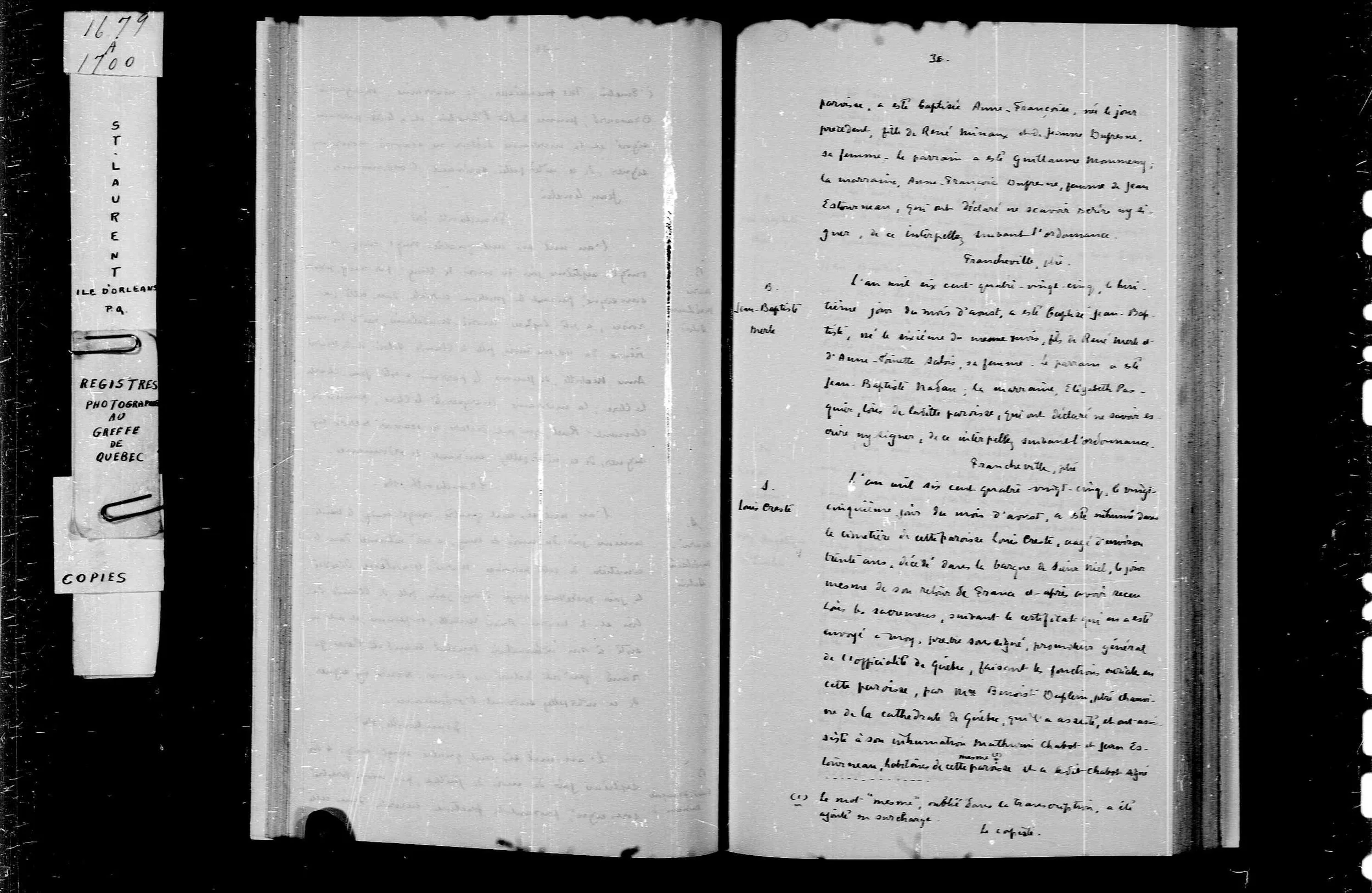
The phrase "le jour mesme de son retour de France"—"the very day of his return from France"—is the heart of the entry. He died not after landing, not the day after arrival, but at sea on the voyage home, on the day the boat finally came in.
Marguerite was fifty-eight in that August. Whether she saw her son's body before its burial, or only heard the news after the fact, the documentary record does not say.
Madeleine Briault did not return to France. On May 14, 1686—nine months after Louis's burial—she married Nicolas Langar, son of Paul Langar and Jeanne Bourseau, at Notre-Dame de Québec. She had survived the crossing that killed her first husband and would live out her own life in New France.
The Daughters Established
By the time Louis died at sea in August of 1685, three of his sisters were already married and settled.
Marguerite the elder, the daughter baptized at Giffard's house in 1659, had married Pierre Gaillou on November 6, 1678; the couple had moved to Batiscan, on the north shore of the Saint-Laurent about sixty miles upriver from Beauport. She would live there until her death in 1734, more than seven decades after her birth in the Giffard manor.
Marie Françoise, born 20 July 1660 and baptized on the first of August, had married Henri Delaunay on November 6, 1679, in the parish of Beauport itself — son of Pierre Delaunay and Françoise Pinguet. The couple raised their family in the Beauport district across twenty-three years of marriage. She would not live to see her mother's death: she was admitted to the Hôtel-Dieu de Québec on 20 November 1702 and died there on the twenty-ninth, aged forty-two.
Marie, the second-born and the daughter through whom this site descends, had married Robert Pepin on November 4, 1670, at Notre-Dame de Québec when she was just thirteen years old. The primary register entry names Jean Crête, the father of the bride, as one of the principal witnesses—standing alongside Paul Vachon (Royal Notary of Beauport) and Michel Le Court. By 1685 she was twenty-eight and the mother of several children.
And finally, in the same year as Louis's death and only weeks later: Marie the younger, the daughter born in 1668, married Jean Baptiste Lefebvre-Duchassenal at Beauport on October 22, 1685. He would become, in time, the son-in-law whose name appears at every consequential moment of Marguerite Gaulin's final eighteen years—as caretaker, as account-holder, as burial witness.
The Lefebvre Care: Winter 1702–1703
The closing months of Marguerite's life can be reconstructed from two notarial acts drawn up in April of 1703, three months after her burial. On April 17, 1703, the notary Duprac compiled the inventory of the marital community of Jean Crête and the late Marguerite Gaulin—the standard procedure following the death of a married woman whose property had been held under the customary communauté de biens. The next day, April 18, Jean acknowledged before the same notary that his daughter Marie and her husband Jean Lefebvre had spent fifty-five livres five sols on the terminal care of his late wife.
The figure itself is small—about a month's wages for a skilled artisan in the colony—but its existence is documentary. It tells us that in her final illness, Marguerite was attended at home by her daughter Marie and son-in-law Jean Lefebvre, who carried the household costs of medicines, food, and whatever care could be given. The location is consistent with the parish burial record, which describes her dying in Beauport and being buried the same day in the parish cemetery.
The winter of 1702–1703 was marked in Quebec by a smallpox epidemic—the disease that would in February of 1703 carry off the seigneur Charles Aubert de la Chesnaye and numerous other prominent habitants. Whether Marguerite died of smallpox or of another illness or of plain old age in her seventy-sixth winter is not recorded.
What the record does establish is that she was not the first of the household to go that winter. Seven weeks before her own death, on 29 November 1702, her fourth child Marie Françoise died at the Hôtel-Dieu de Québec at the age of forty-two. The hospital's roll of patients shows her admitted on the twentieth of November and dead on the twenty-ninth — nine days. Marguerite was seventy-five, and being nursed at Beauport by another daughter, when the news of the first one's death came. The two women died within seven weeks of each other in the same epidemic winter, the daughter in the Quebec hospital and the mother at home in Beauport.
The Burial of January 15, 1703
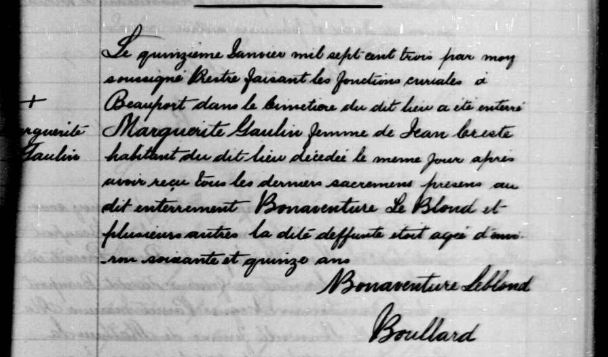
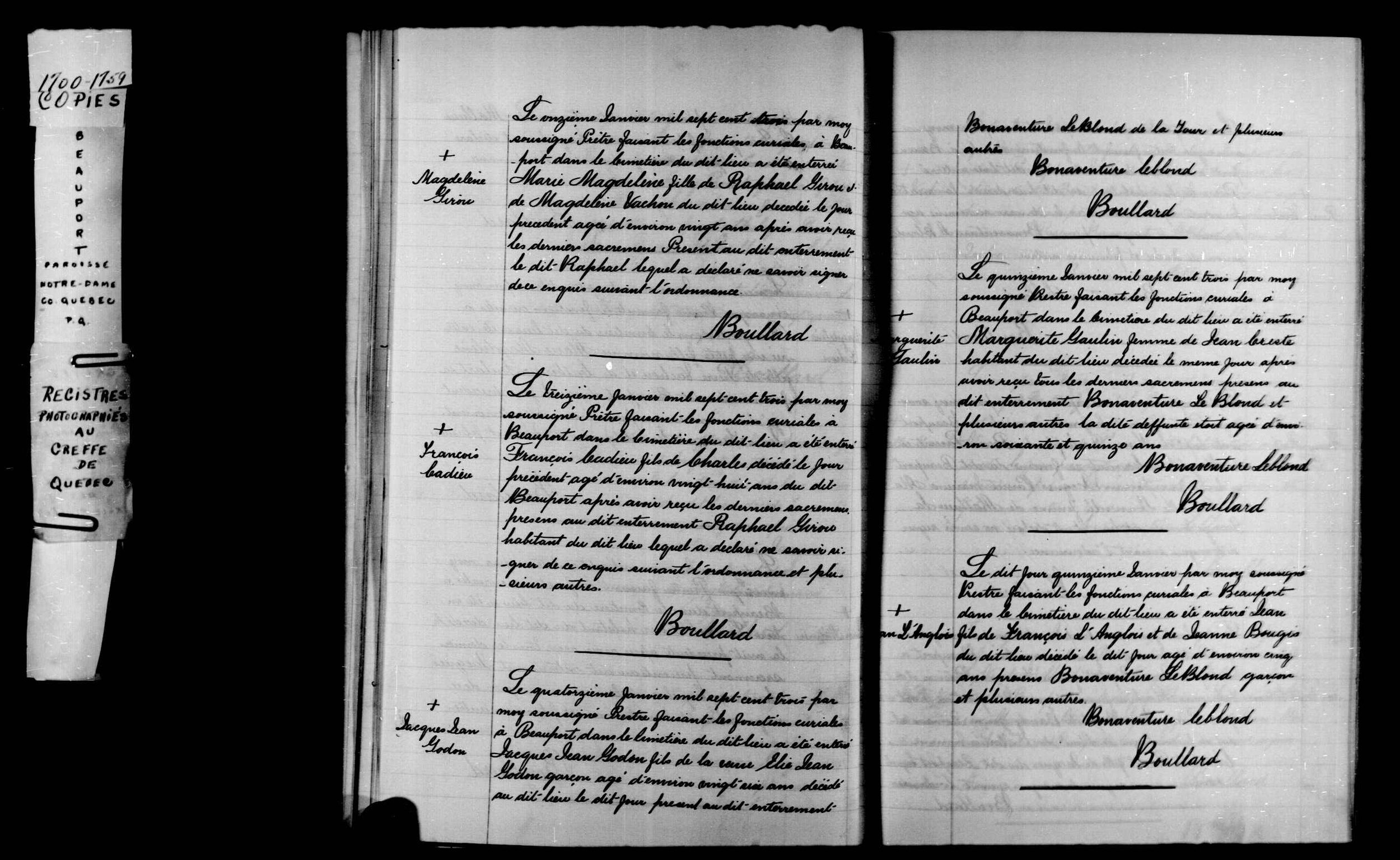
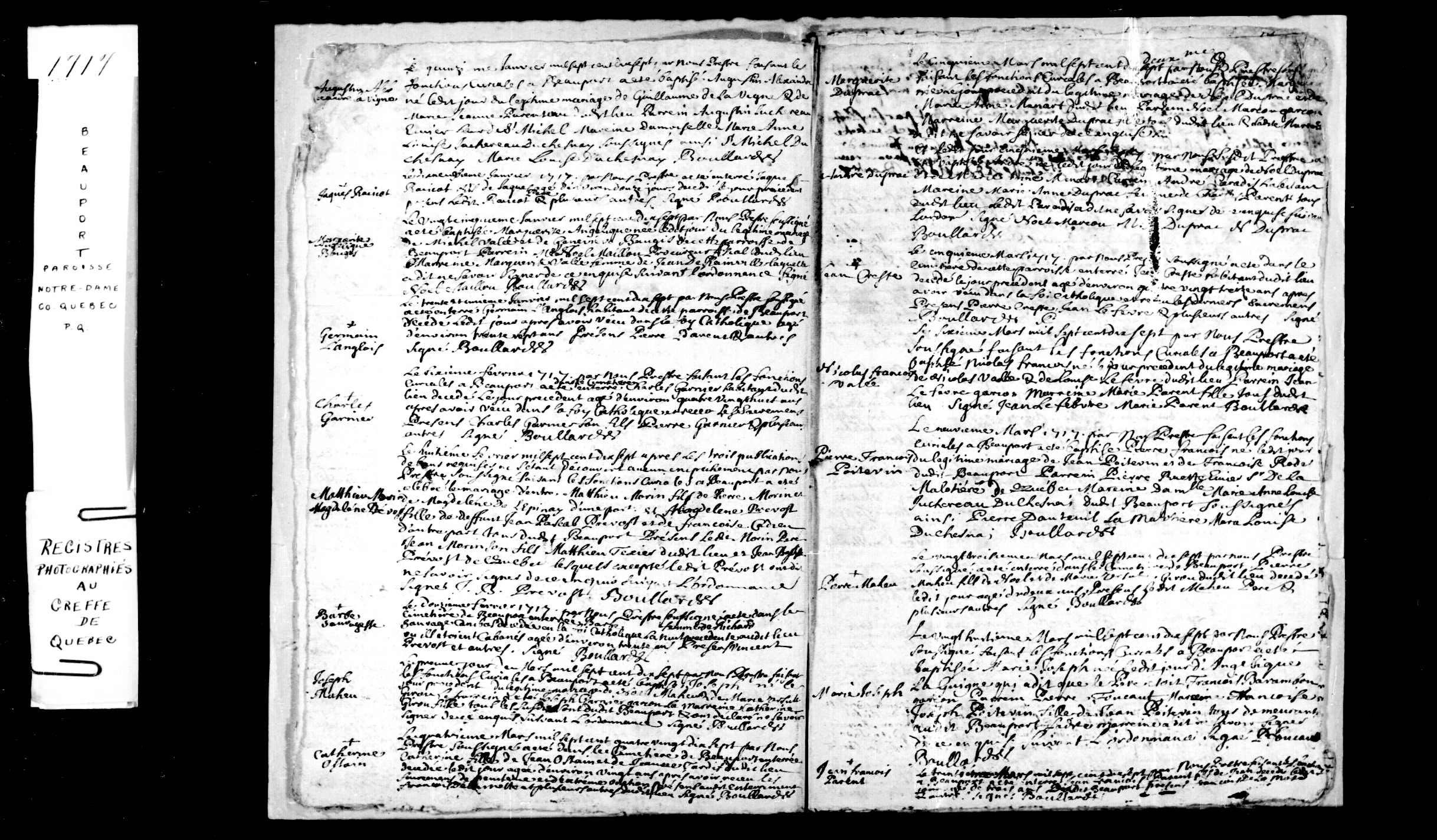
The primary register entry for Marguerite Gaulin's burial survives in the 1700–1759 copy of the Beauport parish records. It is brief, formal, and complete:
| Role in the act | Name as recorded | Detail |
|---|---|---|
| Deceased | Marguerite Gaulin | Age given as about seventy-five; died and was buried the same day; resident of Beauport |
| Surviving spouse | Jean Creste | Habitant of Beauport; recorded as widower |
| Witness | Bonaventure Leblond | Beauport neighbour; signed the act |
| Officiant | Boullard | Priest performing the curial functions at Beauport; given name not stated |
Abstracted from the parish register entry and cross-checked against PRDH-IGD burial record no. 77697. The stated age of about seventy-five is precisely the figure for a woman baptized 14 May 1627 and dying 15 January 1703; she would have turned seventy-six the following May. The figure of seventy-six carried in some secondary references is a year off.
Three details are worth noting. First, she died and was buried on the same day, January 15, 1703—not delayed for a wake or for a journey. Second, she had received the last rites; the parish priest, Father Boullard, was the same priest who would attend her husband's burial fourteen years later. Third, the cited age—"agée d'environ soixante et quinze ans"—matches the baptismal arithmetic exactly.
The signing witness, Bonaventure Leblond, was a Beauport neighbor. The officiating priest, Father Boullard, signed below him. There is no mention of which family members were present—a typical reticence of seventeenth-century French burial registers, which named only the witnesses required to authenticate the act.
After: Jean Crête's Last Fourteen Years
Jean Crête outlived his wife by fourteen years. He was seventy-six when she died in January of 1703; he would not himself die until March 4, 1717, and was buried the following day at Beauport. Measured from his November 1626 baptism at Tourouvre he was ninety; the burial register records the priest's estimate of about ninety-three. Across those fourteen years he attended the marriages, baptisms, and notarial settlements of his children and grandchildren.
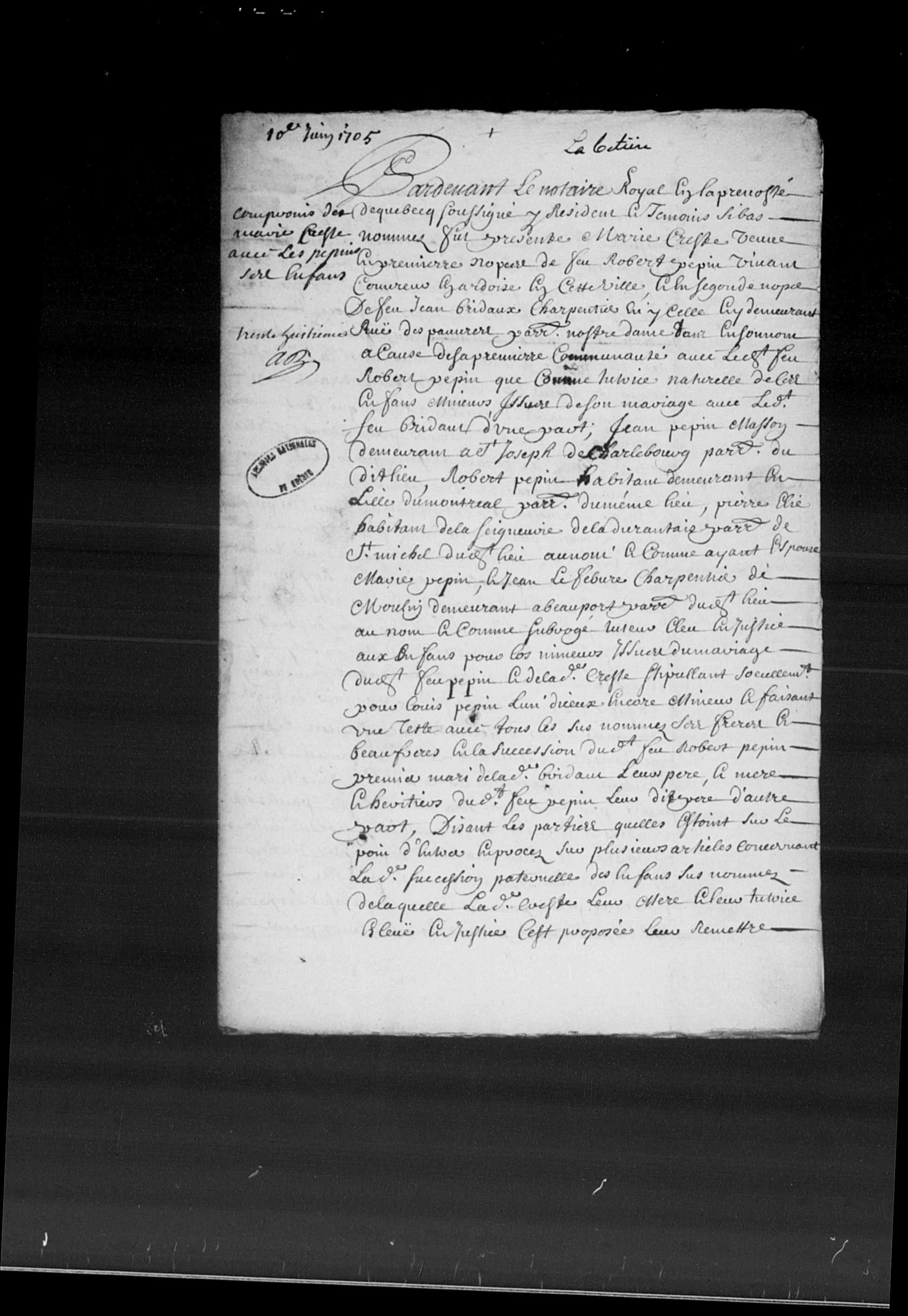
On June 10, 1705, the notarial arbitration that finalized Marie Crête's first-marriage estate to the late Robert Pepin was concluded in the offices of the notary Chambalon—settling Marie's accounts with her Pepin children and freeing her for a third marriage six months later.
On December 20, 1705, Marie's third marriage contract was signed before a Royal Notary; the church wedding followed at Notre-Dame de Québec on January 9, 1706. The groom was Pierre Jourdain dit Bellerose, a Caporal in the troops of the Marine maintained in Quebec by His Majesty—son of a Paris merchant bourgeois of the parish of Saint-Jacques-de-la-Boucherie. The notarial contract describes Marie as widow of two prior husbands: "en premières noces de defunct Robin lepin, et en secondes noces de defunct Jean Brideau vivant maître charpentier." Jean Crête, then seventy-nine years old, attended his daughter's third marriage as the bride's surviving parent. (The 1705 marriage contract has been read by some interpreters as carrying the surname "Soudain"; the preponderance of primary evidence — including the husband's own signed autographs on the 1707 surveyor's partition near the Hôtel-Dieu de Québec and the 1712 lots-et-ventes receipt paid to the Crown's farmer-general — establishes the reading as Jourdain. The full preponderance-of-evidence proof argument is set out in the companion Marie Crête case study.)
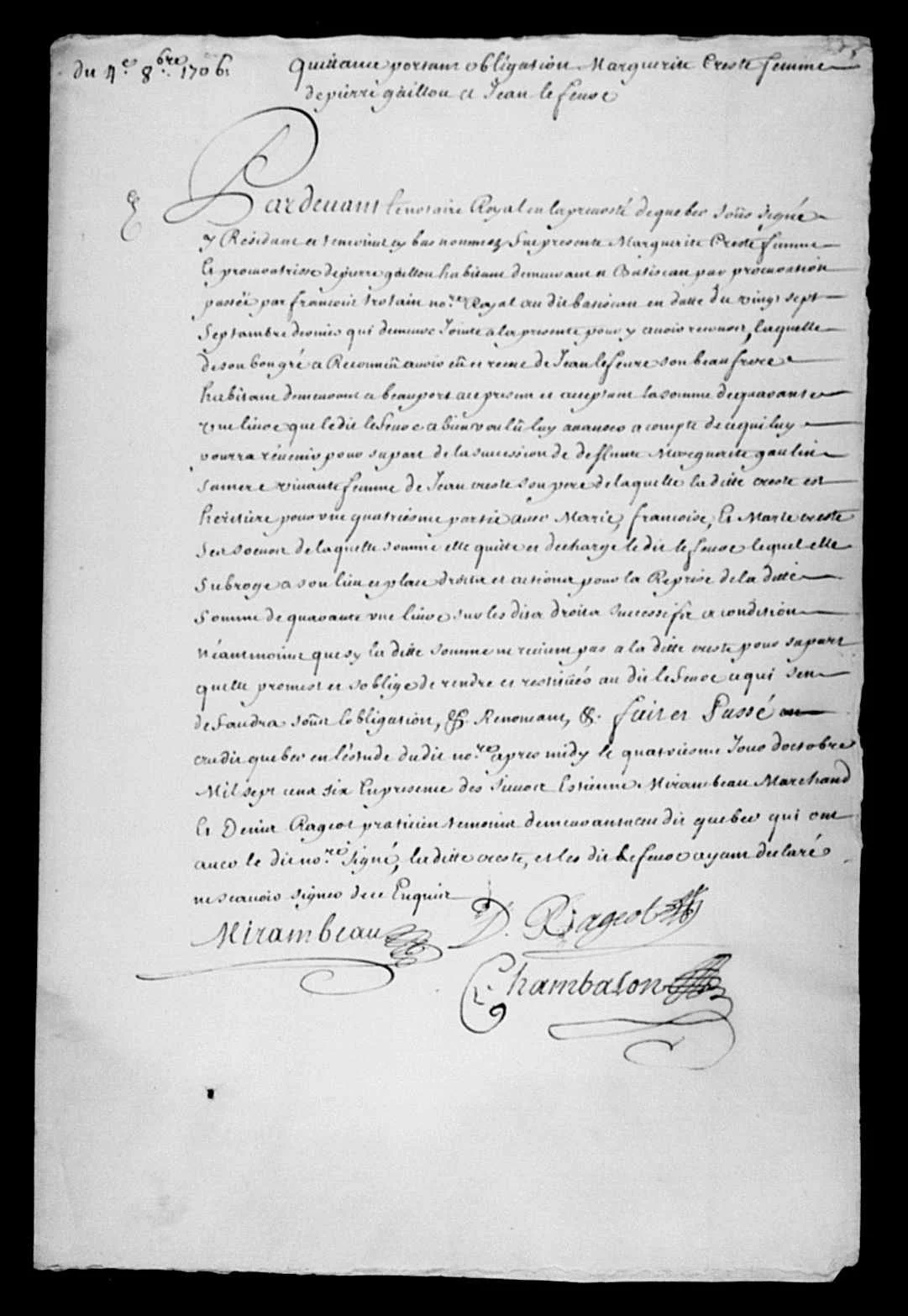
On October 4, 1706, the elder daughter Marguerite Crête—then resident at Batiscan with her husband Pierre Gaillou (whose surname the Chambalon clerk transcribed as "Gaultin")—appeared at the Quebec studies of the notary Chambalon, by power of attorney executed before the Batiscan notary François Trottain on September 27. She acknowledged receipt from her brother-in-law Jean Lefebvre of forty-one livres (quarante un livres), advanced against her one-quarter share in the succession of her late mother. The act identifies four co-heirs at one-quarter each: Marguerite herself (Mme Gaillou, of Batiscan); a Mme Henri Delauney of Beauport; her sister Marie Crête—the elder daughter, then Mme Pierre Jourdain, having married her third husband ten months earlier; and a fourth heir unnamed in the act but implied by Jean Lefebvre's role as beau-frère, his wife being Marie Crête the younger (born 1668), the daughter who had tended Marguerite Gaulin through her terminal illness. The surviving son Pierre, then thirty-five, had already received his share of family land through the six-arpent transfer in his 1693 marriage contract with Marthe Marcou.
One element of that act remains open. Marie Françoise Crête died on 29 November 1702, some seven weeks before her mother, so she cannot have taken a quarter share in her own right, and the "Mme Henri Delauney of Beauport" named in October 1706 cannot be her. Two readings remain possible and the act itself must settle which: either the name stands for Marie Françoise's children taking by representation, with their father acting for them, or Henri Delaunay had remarried by 1706 and the clerk recorded his then-current wife under the same style. The four-quarter structure is not in doubt; the identity behind the second quarter is. Until the Chambalon minute is re-read, the co-heir list is carried here as three named daughters and one open identity. The notarial language—"laquelle de son bon gré a Reconnu avoir esté et reçeu de Jean lefevre son beau frere"—names Lefebvre once again, the son-in-law who had tended Marguerite Gaulin in her terminal illness and now coordinated her succession on behalf of the daughters. The act also confirms that Jean Crête was still living at the date of its execution.
Jean Crête's own burial register entry, recorded March 5, 1717, by the same Father Boullard who had buried Marguerite in 1703, names the witnesses present: son Pierre Crête and son-in-law Jean Lefebvre. The phrase that closed Marguerite's burial act in 1703—"presens Bonaventure Leblond et plusieurs autres"—is echoed fourteen years later in her husband's: "presens Pierre Cresté, Jean Lefebvre et plusieurs autres." The same Lefebvre. The same Father Boullard. The same Beauport cemetery, where Jean would be laid beside his wife.
Direct Descent: Marguerite Gaulin to the Guilbault Line
The descent passes through Marie (Creste) Crête's second marriage to the master carpenter Jean Brideau—not her first marriage to Robert Pepin nor her third to Pierre Jourdain dit Bellerose. The published reference of Lebel and Laforest correctly named both the Brideau marriage and the Jourdain surname of the third husband; the preponderance of primary evidence — including the husband's own signed autographs on the 1707 surveyor's partition and the 1712 lots-et-ventes receipt — confirms the Jourdain reading against an outlier interpretation of the 1705 Chambalon marriage contract as "Soudain."
What the Documentary Record Carries
It is tempting, when writing about a seventeenth-century ancestor whose own voice is nowhere preserved—who could probably not write her name, who left no diary, no letter, no remembered saying—to invent an interior life for her. The temptation should be resisted. What we know of Marguerite Gaulin we know from registers and notarial acts: parish baptisms, a wedding entry, a colonial census, her son's burial at sea, her own death at home, the small notarial acknowledgments that attended her succession.
What that documentary footprint can carry, with discipline, is the shape of a woman's life rather than its sentiment. She was born in a Perche parish in May of 1627, baptized at Saint-Martin among neighbors named Bonnemer and Messot. She crossed the Atlantic in her mid-twenties, in years that left no list of her ship or its date of arrival. She married Jean Crête in September of 1654 at Sieur Giffard's manor house, before Father Paul Ragueneau and the seigneur himself. She lived forty-nine years on the north shore of the Saint-Laurent, raised ten children, lost four of them before they could marry and one more at sea, buried a grown daughter seven weeks before her own death, and was tended in her final winter by another daughter and the son-in-law who would still be present at her husband's burial fourteen years later. She died at home in Beauport on the fifteenth of January 1703 at the age of about seventy-five, and was buried that same day in the parish cemetery of the Nativité-de-Notre-Dame.
The Crête line that descends from her runs in a single thread through her second daughter's second marriage, to a master carpenter named Jean Brideau, and then through three generations of Morin and four of Guilbault to the present compiler of these notes. Of the roughly 262 filles à marier who founded the colony, she is one of the women through whom the line continues. Her name, in the register and in the notarial acts and on the 1666 census, is the foundation of everything that has followed.
Case Study Summary
A portfolio-grade overview of the research arc behind this biography — sources catalogued, discrepancies resolved, findings documented to BCG standards.
View the Case Study →Document Gallery
Original records only — parish registers, censuses, notarial minutes, a published 1925 transcription, and contemporary cartography. Database entries consulted in the course of this research are listed by record number in the Sources section below rather than reproduced here.
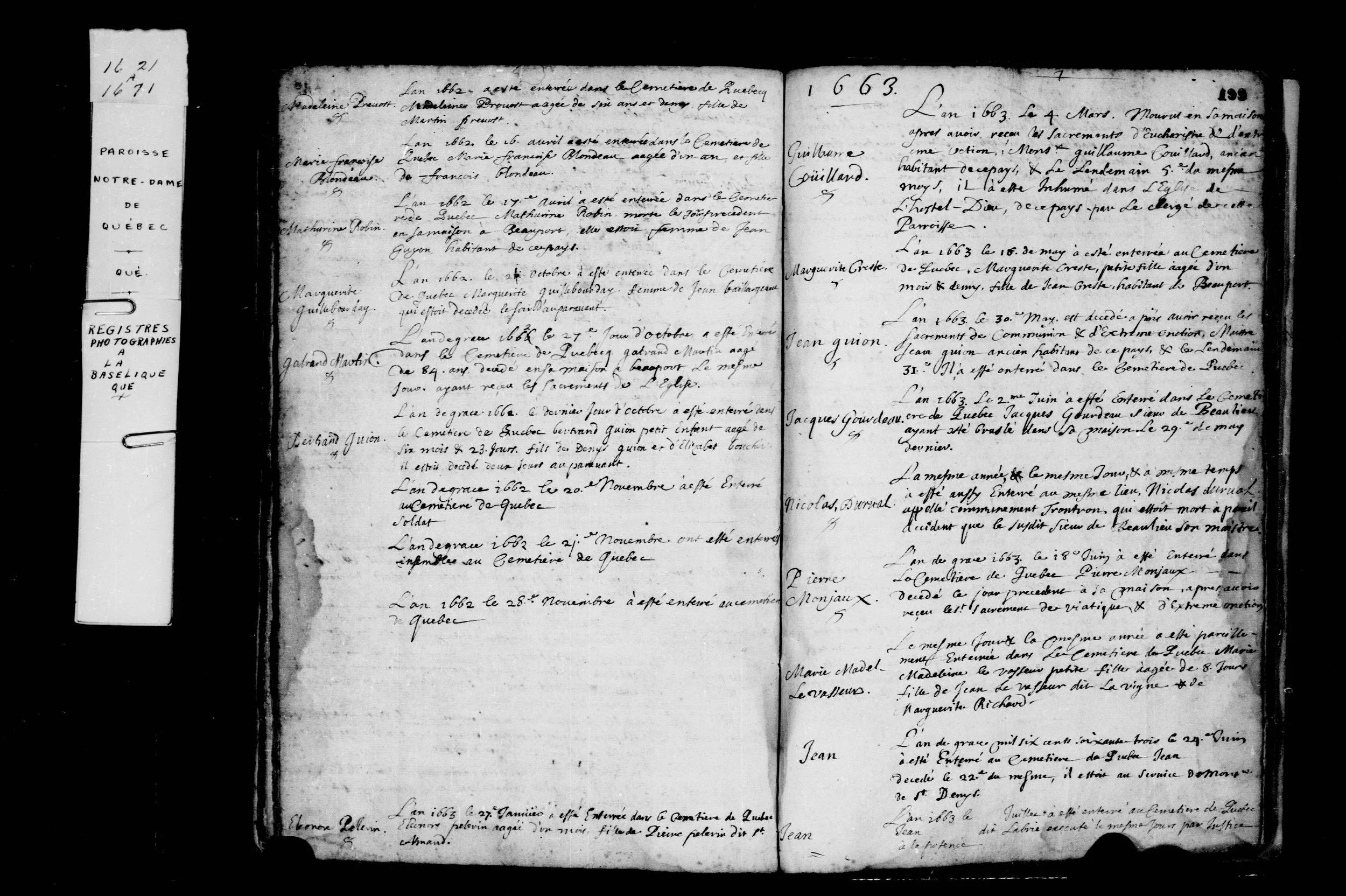
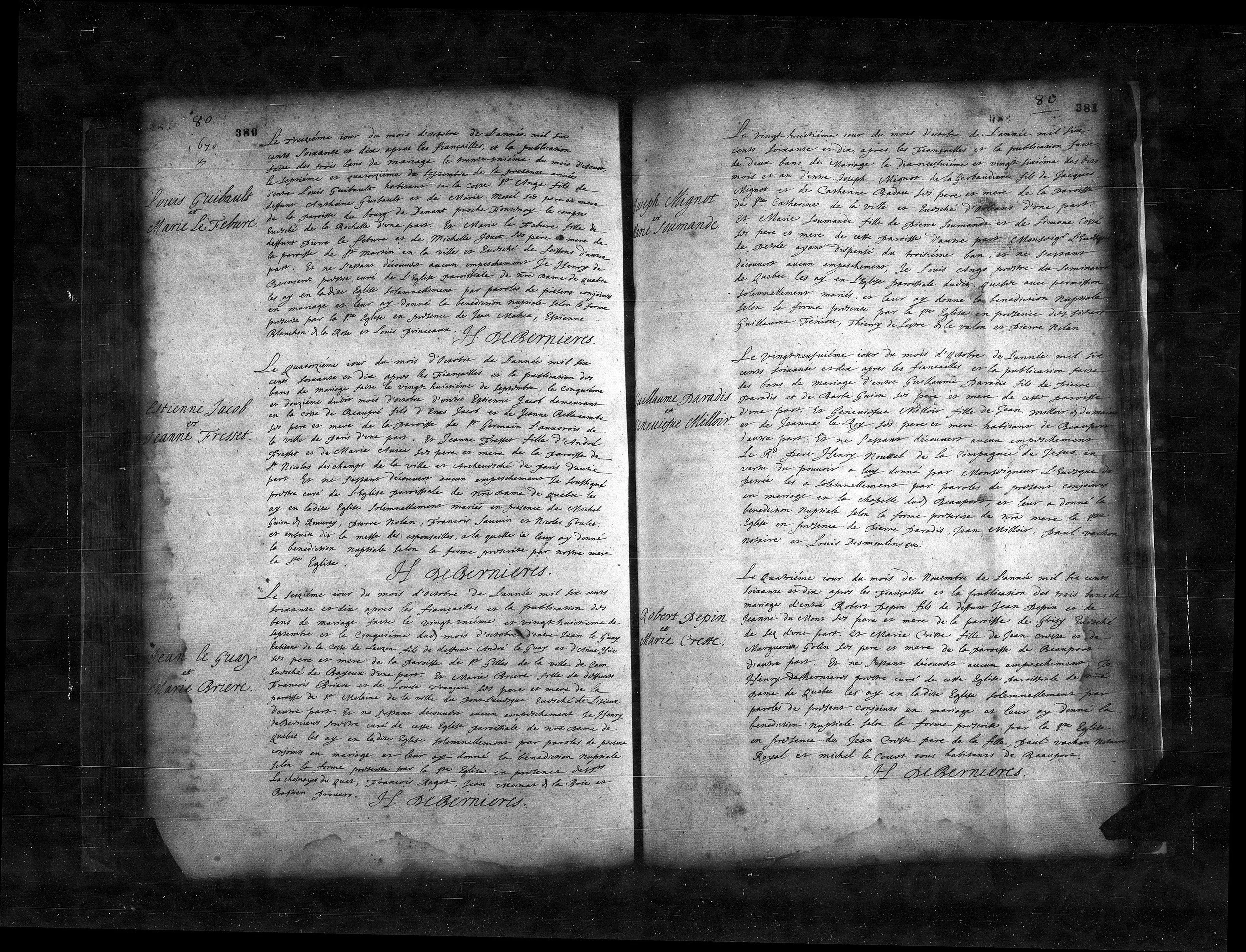
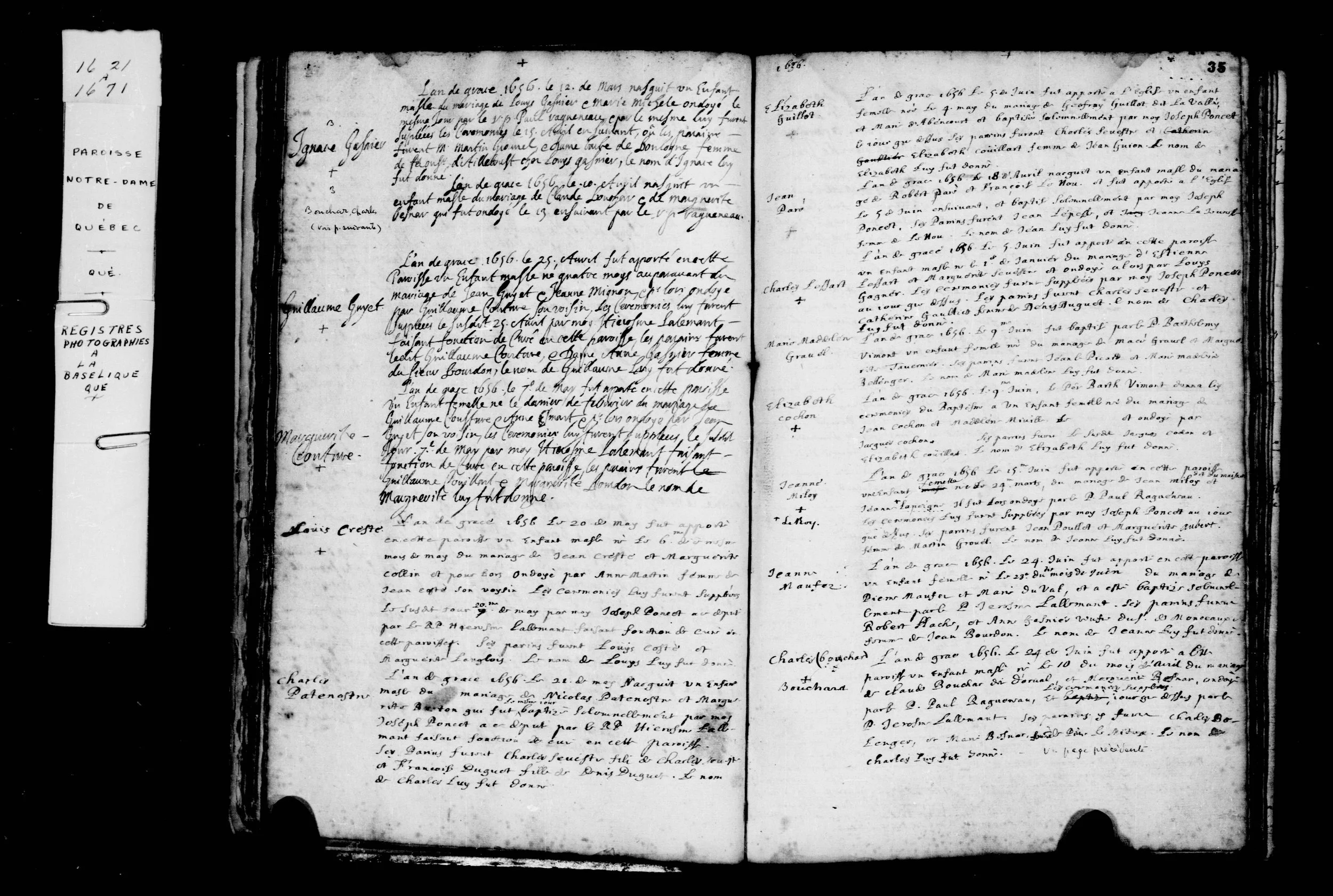
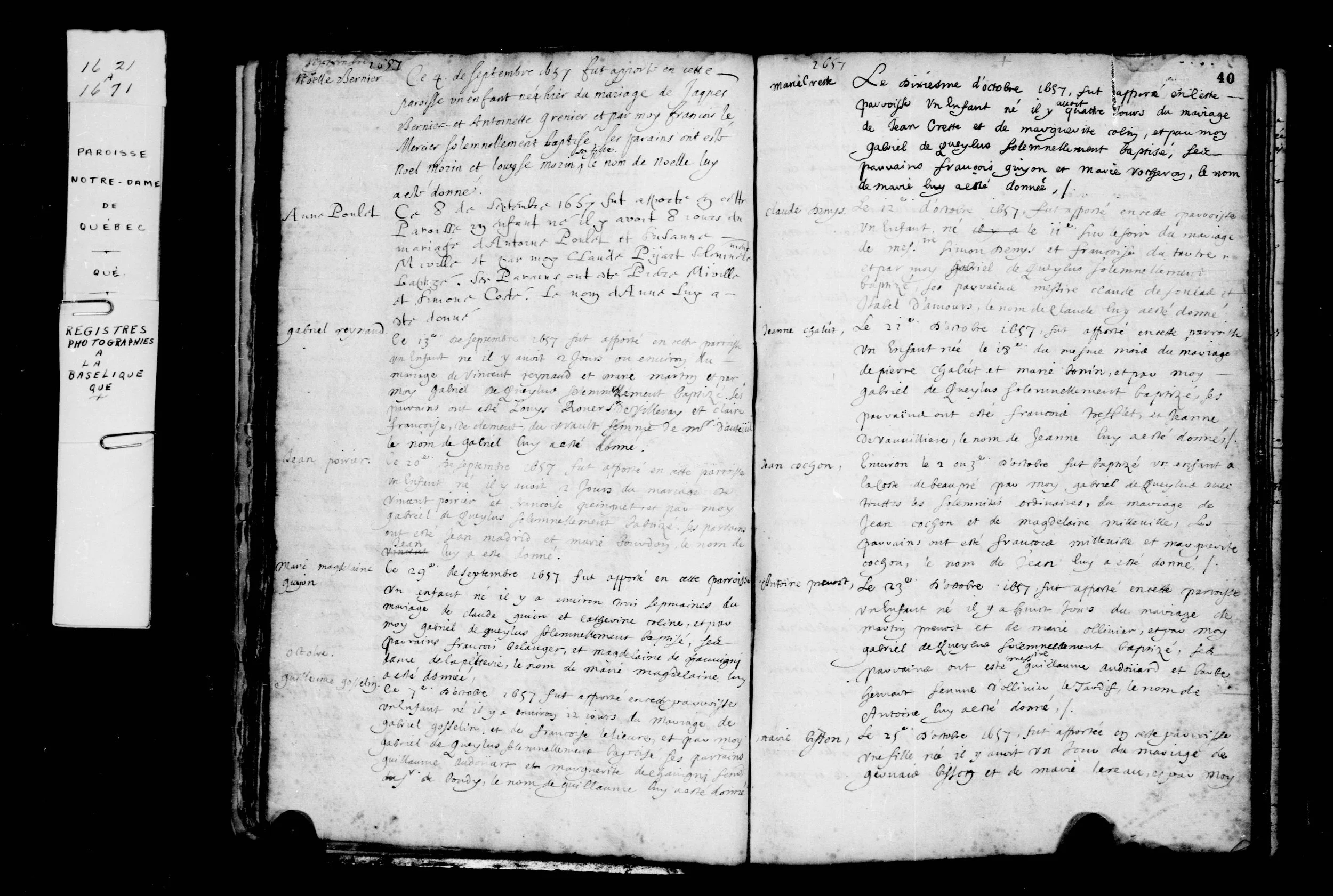
Sources
Primary Sources — Parish Registers (France)
Parish register of Saint-Martin-du-Vieux-Bellême (Orne 61426, commune St-Martin-du-Vieux-Bellême). Baptism of Marguerite Gaulin, 14 May 1627, transcribed in Godbout, Origine des familles canadiennes-françaises, 1925, p. 168. Archives départementales de l'Orne (AD-61); Fichier Origine #241711.
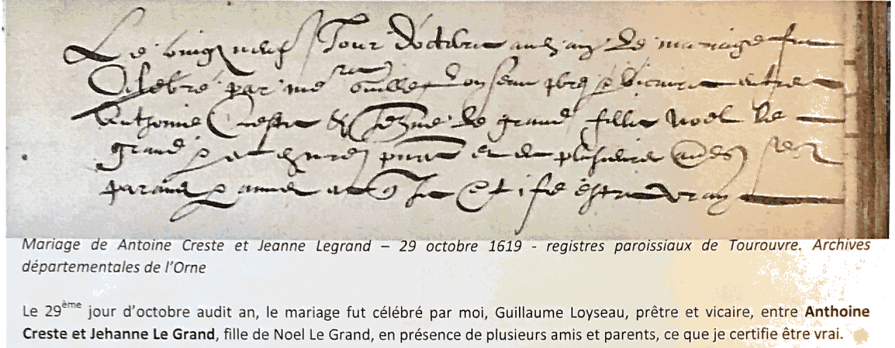
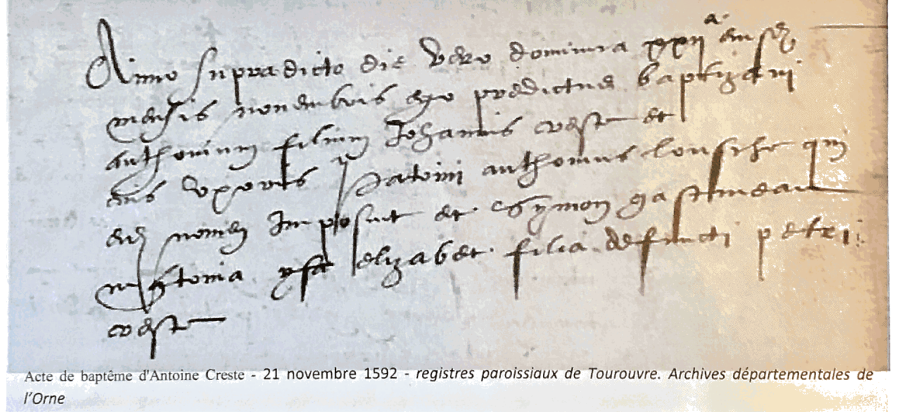
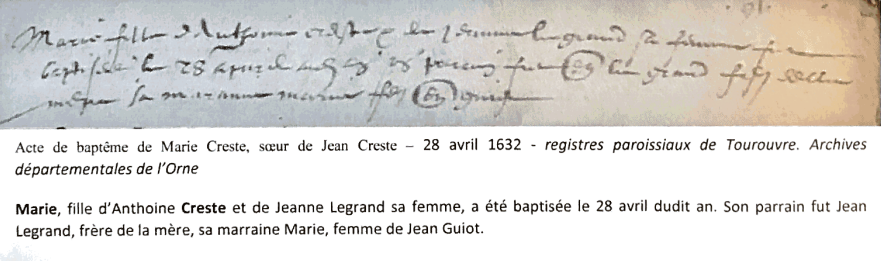
Parish register of Saint-Aubin de Tourouvre (Orne 61491). Baptism of Jean Crête (entry #317), 23 November 1626; baptism of Antoine Crête, 21 November 1592; marriage of Antoine Crête and Jeanne Legrand by Father Guillaume Loyseau, 29 October 1619 (PRDH-IGD couple record no. 72 gives 29 October 1620; the register reading is preferred); baptism of Marie Crête (sister of Jean), 28 April 1632. AD-61; Fichier Origine #241071.
Primary Sources — Parish Registers (New France)
Notre-Dame de Québec (Basilique). Marriage register, p. 121, entry of 13 September 1654, Jean Crête and Marguerite Gollin. Burial register, p. 199, entry of May 1663, infant Marguerite Cresté. Baptism register for the ten Crête children, 1656–1671: Louis (p. 35, 20 May 1656, emergency by Anne Martin); Marie (p. 40, 10 October 1657); Marguerite I (p. 49, 20 April 1659, at Giffard's house); Françoise (p. 57, 1 August 1660, emergency by Robert Giffard); Marguerite II (1 April 1663, at Beauport); Jean II (p. 72, 23 April 1664); Joseph (p. 82, 2 May 1666); Marie II (18 February 1668); Louise (10 August 1670, emergency by Paul Vachon "pour peril de mort"); Pierre (p. 89, 21 August 1671, at chapel of Beauport). Officiants across the ten baptisms include Joseph Poncet S.J., Gabriel de Queylus, Paul Ragueneau S.J., Henri de Bernières, Charles de Lauson de Charny (Grand Vicar of Bishop Laval, officiating three times), Étienne de Carheil S.J., and Jean Blanchet S.J. Register images consulted in the Drouin Collection, Institut Généalogique Drouin, via genealogyquebec.com.
Beauport (Nativité-de-Notre-Dame). Burial register, 1700–1759 copies. Entry of 15 January 1703, Marguerite Gaulin. Entry of 5 March 1717, Jean Crête. Drouin Collection, via genealogyquebec.com.
Hôtel-Dieu du Précieux-Sang de Québec. Register of patients and domestics, 1698–1709, roll opening "Les malades et domestiques qui se trouvent à l'hostel dieu de Quebec le pr novembre 1702." Entry of 20 November 1702 with marginal notation morte: Françoisse Crette, wife of Delauné, aged 43, of Quebec, died the 29th of November. Registres photographiés à l'hôpital.
Saint-Laurent (Île d'Orléans). Burial register, 1679–1700 copies, p. 35, entry of 25 August 1685, Louis Crête, died on the boat of Sieur Niel on the day of his return from France. Drouin Collection, via genealogyquebec.com.
Primary Sources — Census
Recensement de la Nouvelle-France, 1666. Beauport entry, Archives des Colonies, Série G1, Volume 460, 1re partie, folio 56; Library and Archives Canada. Consulted on FamilySearch microfilm 008126224, image 68 of 883 (ark:/61903/3:1:3Q9M-CSVK-Y952-4); not indexed at the time of consultation. Crête household: Jean Creste 40, charron et habitant; Margueritte Golin 38, sa femme; Louis 10; Marie 9, fille; Margueritte 7, fille; François 5, fils (mis-recorded; Françoise per the 1667 census and the 1660 baptism); Jean 2, fils; and a Pierre, 24, entered in the qualités et métiers column as chapellier engagé, with no surname given.
Recensement de la Nouvelle-France, 1667. Beauport entry. Jean Crête 42, Marguerite "Gosselin" (mis-recorded) 40, six children including infant Joseph age 1, six cattle and fifteen arpents under cultivation. LAC.
Recensement de la Nouvelle-France, 1681. Beauport entry, page 269 of 335. Jean Crête 55 (charron), Marguerite "Gaudin" (mis-recorded) 54, surviving children at home, Marie Chapacou 16 as servante; 2 firearms, 13 horned cattle, 40 arpents of cleared land. LAC.
Primary Sources — Notarial Records
Land purchase, Jean Crête from Maurice Arrivé, Notary Paul Badeau, 11 August 1654. BAnQ — Greffe de Québec.
Marital community inventory (17 April 1703) and Lefebvre care acknowledgment (18 April 1703), Notary Duprac. Marriage contract of Pierre Jourdain and Marie Crête, 20 December 1705. Notarial arbitration of Pepin-Crête estate, 10 June 1705. Quittance of Marguerite Crête, daughter, before Notary Chambalon, 4 October 1706 (with Trottain power of attorney, 27 September 1706). All BAnQ — Greffe de Québec.
Cartographic Sources
Janssonius, Johannes (Jan Jansson). "Perchensis Comitatus — La Perche compte." Hand-colored map of the former province of Perche, ca. 1640, from a composite atlas.
Database Sources
Programme de recherche en démographie historique (PRDH-IGD), Université de Montréal. The records below were consulted as finding aids and as a check against the parish registers; where the two differ, the register governs and the divergence is noted in the Methodological Note. prdh-igd.com
| Record no. | Type | Subject | Event date and place |
|---|---|---|---|
| 36251 | Individual | Marie Marguerite Gaulin | bp. 14 May 1627 St-Martin-du-Vieux-Bellême · d. 15 Jan 1703 Beauport |
| 40753 | Individual | Jean Crête | bp. Nov 1626 Tourouvre · d. 4 Mar 1717 Beauport |
| 19407 | Individual | Marie Françoise Crête | b. 20 Jul 1660 · bp. 1 Aug 1660 · d. and bur. 29 Nov 1702 Québec (Hôtel-Dieu) |
| 40959 | Individual | Madeleine Briault | b. 2 Apr 1665 Notre-Dame-de-Cogne, La Rochelle |
| 72 | Couple | Antoine Crête and Jeanne Legrand | m. 29 Oct 1620, France (register reads 1619) |
| 125 | Couple | Vincent Gaulin and Marie Bonnemer | m. before 1627 · three emigrant children listed |
| 866 | Couple | Jean Crête and Marie Marguerite Gaulin | m. 13 Sep 1654 Québec · ten children, 1656–1671 |
| 5533 | Couple | Louis Crête and Madeleine Briault | m. 28 May 1685, France |
| 57636 | Baptism | Marie Creste | 10 Oct 1657 · Notre-Dame de Québec |
| 57726 | Baptism | Marguerite Crête I | 20 Apr 1659 · at Giffard's house, Beauport |
| 57802 | Baptism | Françoise Crête | 1 Aug 1660 · Notre-Dame de Québec |
| 57925 | Baptism | Marguerite Crête II | 1 Apr 1663 · Beauport |
| 57972 | Baptism | Jean Crête II | 23 Apr 1664 · Notre-Dame de Québec |
| 58088 | Baptism | Joseph Crête | 2 May 1666 · Notre-Dame de Québec |
| 58213 | Baptism | Marie Crête II | 18 Feb 1668 · Notre-Dame de Québec |
| 58451 | Baptism | Louise Crête | 10 Aug 1670 · Notre-Dame de Québec |
| 58606 | Baptism | Pierre Crête | 21 Aug 1671 · chapel of Beauport |
| 35618 | Burial | Louis Crête | Aug 1685 · St-Laurent, Île d'Orléans — date disputed, see note |
| 68946 | Burial | Marguerite Crête II (infant) | May 1663 · Notre-Dame de Québec |
| 77697 | Burial | Marguerite Gaulin | 15 Jan 1703 · Beauport (Nativité-de-Notre-Dame) |
| 77925 | Burial | Jean Crête | 5 Mar 1717 · Beauport (Nativité-de-Notre-Dame) |
Genealogy of French in North America (Denis Beauregard). Couple references #260 (Crête × Gaulin, with mtDNA haplogroup H1bu predicted), #2862 (Antoine × Jeanne), #2351 (Vincent × Marie). francogene.com
Fichier Origine, Fédération québécoise des sociétés de généalogie. Records #241711 (Marguerite Gaulin/Gollins), #241710 (François Gaulin), #241071 (Jean Crête). Researchers Archange Godbout and Lise Dandonneau. fichierorigine.com
Published References
Gagné, Peter J. Before the King's Daughters: The Filles à Marier, 1634–1662. Pawtucket, Rhode Island: Quintin Publications, 2002. Entries for Marguerite Gaulin (pp. 149–151) and Jean Crête (pp. 150–151). ISBN 1-58211-035-X.
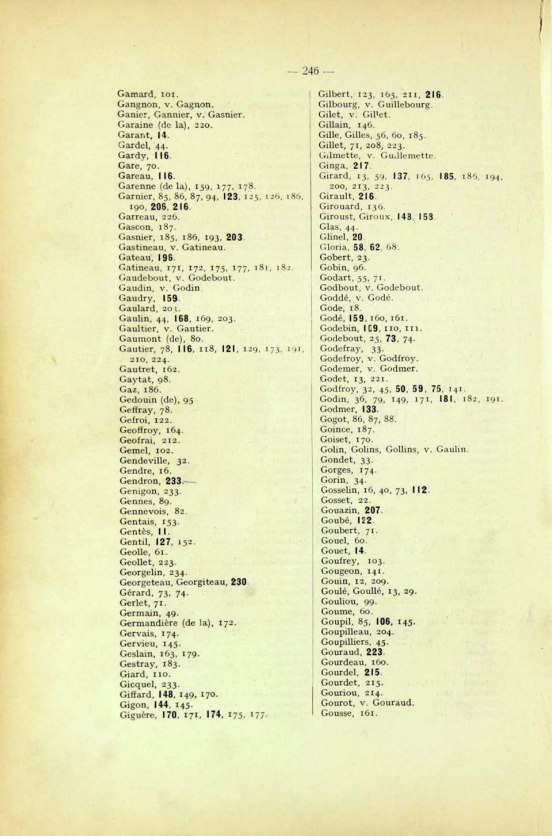
Godbout, Archange. Origine des familles canadiennes-françaises. Extrait de l'état civil français. Lille: Société Saint-Augustin, Desclée, de Brouwer, 1925. 262 p. BAnQ Collections. Family Gaulin-Bonnemer transcriptions, p. 168; surname index, p. 246.
Lebel, Gérard, and Thomas John Laforest (trans.). Our French-Canadian Ancestors, Volume 3, Chapter 8: "Jean Crête," pp. 65–72. FamilySearch ID 235556_03. Several details of dating in this chapter (1626 baptism, February 1703 burial, Louis dying a bachelor) have since been corrected by primary-source examination.
Methodological Note
This biography follows the standards of the Board for Certification of Genealogists (BCG): conclusions are sourced to primary documents wherever those documents survive, with secondary references cited as such; discrepancies among published sources are noted and resolved against the primary record; and language is calibrated to distinguish documented fact from probable inference. Compiled database entries are treated as finding aids and as derivative evidence, not as documentation; their record numbers are cited so that any reader may retrieve them, and the substance of each is restated here in the compiler's own tabulation rather than reproduced in facsimile.
Of the eighteen substantive source discrepancies tracked in the working research log, fourteen have been resolved by primary-source examination: Marguerite's baptism year, burial month, and mother's surname; Antoine and Jeanne's marriage date (register 1619 against PRDH 1620); the identity of the infant Marguerite buried in 1663; the marriage status of Louis; both burial ages; the diocese designation at Jean's baptism; the 1666 census misrecording of Françoise as "François" (resolved by the 1660 primary baptism register and the 1667 census, which both name her unambiguously female); the Buisson fief vendor (corrected to Claude Guion and Catherine Collin of Île d'Orléans per the 1666 Vachon notarial record); the GAILLOU / GAULTIN orthographic variant for Marguerite Crête I's husband; the four-heir structure of Marguerite Gaulin's 1706 succession; and the full form of Jean Baptiste Lefebvre dit Duchassenal per PRDH. One further item is now resolved by the broader documentary corpus integrated for the companion Marie Crête biography: the third husband's surname, formerly carried in the log as "Pierre Soudain dit Bellerose" on the reading of the 1705 Chambalon marriage contract, is established as Pierre Jourdain dit Bellerose by the preponderance of subsequent primary evidence — the husband's own signed autographs on the 1707 surveyor's partition (BAnQ CA301, S56, P149) and the 1712 lots-et-ventes receipt (BAnQ E1, S4, SS1, D224, P3), the PRDH marriage and individual records, and the consistent secondary attribution by Lebel and Laforest. The contested reading of the 1705 contract awaits Parchemin re-examination.
A fifteenth discrepancy was resolved in the course of preparing this page: the death date of the daughter Marie Françoise, established at 29 November 1702 by the register of the Hôtel-Dieu du Précieux-Sang de Québec and by PRDH-IGD individual record no. 19407. One consequence is carried forward rather than absorbed: the second of the four quarter-shares in the 1706 succession act cannot belong to Marie Françoise in her own right, since she predeceased her mother, so the identity behind "Mme Henri Delauney of Beauport" in October 1706 is an open question requiring re-reading of the Chambalon minute.
Five items remain open: Marguerite's exact arrival year; the existence and date of Pierre Gaulin's baptism record; the question of Pierre Gaulin's twin status; the identity of the second co-heir in the 1706 quittance; and the date of Louis Crête's burial (the Saint-Laurent register reads 25 August 1685; PRDH burial record no. 35618 carries 21 August for both death and burial). None is stated as settled anywhere on this page. The full corpus of primary-source documentation includes the baptism register acts for all ten Crête children (1656–1671), three royal censuses (1666, 1667, 1681), and the surrounding network of marriage, burial, and notarial records traced across both Perche and New France. A fuller account of the source hierarchy, defensible language framework, and complete discrepancy resolution table is available on the companion research methodology page.
Are You Connected to the Guilbault Line?
If you descend from the Guilbault (Guilbeau, Guilbeault) family of Charlesbourg and the Quebec parishes, from the children of Marie Josephte Abitakijikokwe, or from the founding families of the line — Senécal, Séguin dit Ladéroute, Morin, Couillaud dit Roquebrune, Gaulin — I’d like to compare notes. Documented trees, DNA matches, family papers, and even half-remembered stories have all moved this research forward.
Get in Touch About This FamilyCousin connections are informal and reciprocal — no fee, no obligation, just shared work on shared ancestry.
Every Family Has a Story Worth Telling
Whether you're just beginning your research or ready to transform years of work into a narrative your family will treasure, I'd love to hear your story.
BEGIN YOUR RESEARCH INQUIRY