
From Aklan to America: Under the Stars and Stripes
Under the Stars and Stripes
Episode 1 left two communities rooted in the river town of Numancia and the surrounding parishes of Aklan. Episode 2 follows the next generation through the half-century when sovereignty over the Philippines passed from Spain to the United States, and briefly to Imperial Japan. It is the generation of your great-grandparents—born under the American flag, married beneath it, and tested by a war that reached even the quiet provinces of Panay.
Two marriages anchor this chapter. From the first—Mamerto Morales and Patrocinio Gonzales—came the physician son, Dr. Romulo G. Morales. From the second—Jose Tamayo and Maria Corazon Roldan—came the physician daughter, Dr. Hally R. Tamayo. A generation later their lives would converge; here, we meet the parents who raised them, and the documents that prove—and in one painful case, cannot quite prove—how their lives unfolded.
The World They Inherited
When American forces landed at Iloilo on February 11, 1899, the Spanish world your ancestors had known was already passing. ContextThe Philippine–American War that followed reached the Visayas hard; Panay saw active campaigning, and the towns of Capiz Province—Numancia among them—were drawn into a long pacification that did not settle until civil government took hold after 1901.
What that new government brought to a town like Numancia was, above all, a different architecture of record-keeping: an English-language public school system, a civil registry, a notarial code, and the bureaucratic machinery of the American Insular Government and, after 1935, the Commonwealth of the Philippines. It is precisely this paperwork—and its catastrophic loss in 1944—that shapes everything we can and cannot prove about the two couples at the center of this episode.
From Insular Government to Commonwealth
The Tydings–McDuffie Act of 1934 set the Philippines on a ten-year path to independence, and in 1935 the Commonwealth was inaugurated under President Manuel L. Quezon. For a rising class of educated provincial Filipinos, these were years of opportunity—professional careers, civic office, and the expectation of a sovereign republic to come. Mamerto Morales the notary, and the physician children of both families, belonged to exactly this generation. The promise would be interrupted by war in December 1941.
Two Households, One Future Line
In Episode 1 you met the founding families—Gonzales, Morales, Martelino-Roldan, Isturis, and the Tamayos who married in. Here those lines narrow to two marriages, each producing a doctor who would one day carry the family to California.
Mamerto L. Morales & Patrocinio Gonzales
A notary public of Numancia—son of the former seminarian Juan Apdon Morales—and his wife, daughter of Cenón Gonzales and Emilia Quimpo. Their household was large; their story turns on a profession and a wartime loss.
Their son who carries the line: Dr. Romulo Gonzales Morales (1931–2017).
Jose Icamina Tamayo & Maria Corazon Roldan
Son of Felipe Tamayo and Natividad Icamina; daughter of Fortunato Roldan and Margarita Isturis—uniting two lines you followed in Episode 1. Married at St. Joseph's the year before the Commonwealth was even imagined.
Their daughter who carries the line: Dr. Hally Roldan Tamayo (1932–2017).
A Man of the Register: Mamerto L. Morales
Your great-grandfather Mamerto Morales was, the family always knew, a notary public. What the records now confirm is how much that single fact reveals.
ConfirmedMamerto L. Morales held an appointed commission as notary public of Numancia, then in the province of Capiz. His own notarial register survives on microfilm and documents his official acts across 1933 through 1938, under annual appointments—the earliest found dated February 27, 1933, and renewed through the 1937 commission year. The middle initial “L.”—long absent from family records—is fixed by the register's own header, where his hand signs each weekly certification “Mamerto L. Morales, Notary Public.” The pages for 1937 even record a Patrocinio Gonzales among the witnesses to his acts—in all likelihood his own wife, signing beside him.
Capiz Province
The Notarial Register of Mr. Mamerto L. Morales, Notary Public, Numancia, Capiz (appointments renewed annually; earliest found February 27, 1933), survives on GSU/FamilySearch microfilm—project PHIL.0009D, images 1–122. It records his official acts in chronological order with the weekly certifications the law required, establishing him as an active professional in the town across the 1930s.
What a Notarial Commission Meant
Under the American-era notarial law in force at the time—Act No. 2387 of 1914—no one could be commissioned a notary public who was not a practicing lawyer, had not passed the bar or justice-of-the-peace examination, or had not completed formal studies in law. Mamerto's appointment therefore tells us something the family had only remembered: he was a man of legal training, in a town where few held such qualifications, keeping exactly the chronological, weekly-certified register the statute demanded.
Research Discovery · Two Independent Sources
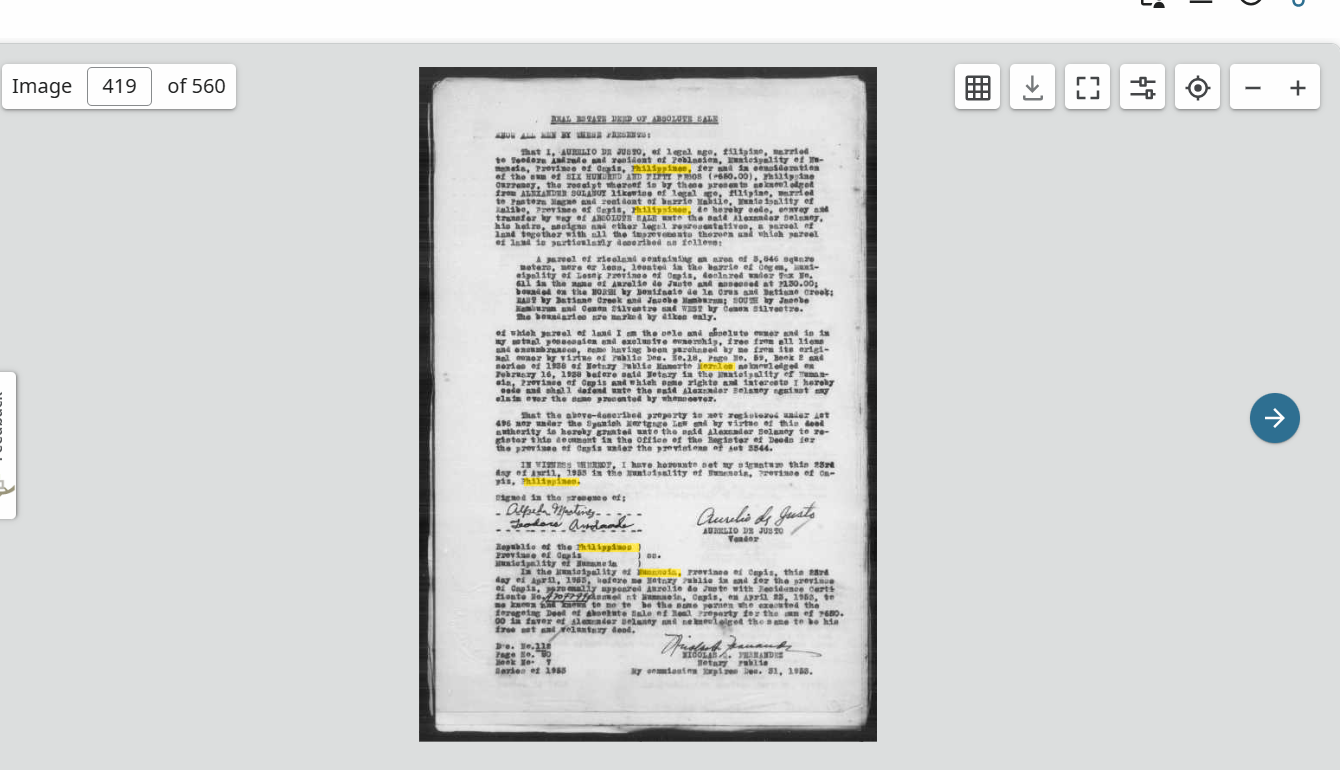
The last direct evidence of Mamerto alive and at work is an acknowledgment he notarized on February 16, 1938—entered in his own register as Public Document No. 18, Page 59, Book 2, Series of 1938. That same act is cited independently fifteen years later, in a 1953 deed of sale that recites its full notarial reference. Two records, one date: on February 16, 1938, Mamerto Morales was unmistakably living and practicing in Numancia.
The Neighbor Who Called for the Midwife: Patrocinio Gonzales
ConfirmedPatrocinio Gonzales y Quimpo was born in Numancia on November 17, 1905, daughter of the spouses Cenón Gonzales and Emilia Quimpo of Poblacion, Numancia. Because the town's civil and church records were destroyed in the war, her birth is established instead by a sworn Joint Affidavit of Birth—given by two elderly neighbors, one of whom testified that she herself had summoned the midwife the night Patrocinio was born. The same affidavit states plainly that this Patrocinio “was later on married to Mamerto Morales,” binding the two lines together in a single document.
Research Discovery
This affidavit does two things at once. It resolves, with primary evidence, who Patrocinio's parents were—placing the Quimpo name squarely in the maternal line and confirming the Gonzales descent you traced in Episode 1—and it confirms the marriage on which this entire episode is built. It is the document that joins the Morales and Gonzales families on paper.
A Clan with Two Origin Stories
Patrocinio's mother, Emilia Quimpo, carries this household into the wider Quimpo–Kimpo clan of Numancia and Kalibo—a family whose own oral tradition debates whether its name began as Chinese (“Quim-Po”) or Korean (“Kimpo”), and which remembers a town mayor, Leoncio Quimpo, named with his son a Numancia delegate to the Taft Commission of April 1901. Whether Leoncio sits in your direct line is an open question—a testable lead, not yet a proven link—and is carried forward to its own study.
A Wedding at St. Joseph's: Jose Tamayo & Maria Corazon Roldan
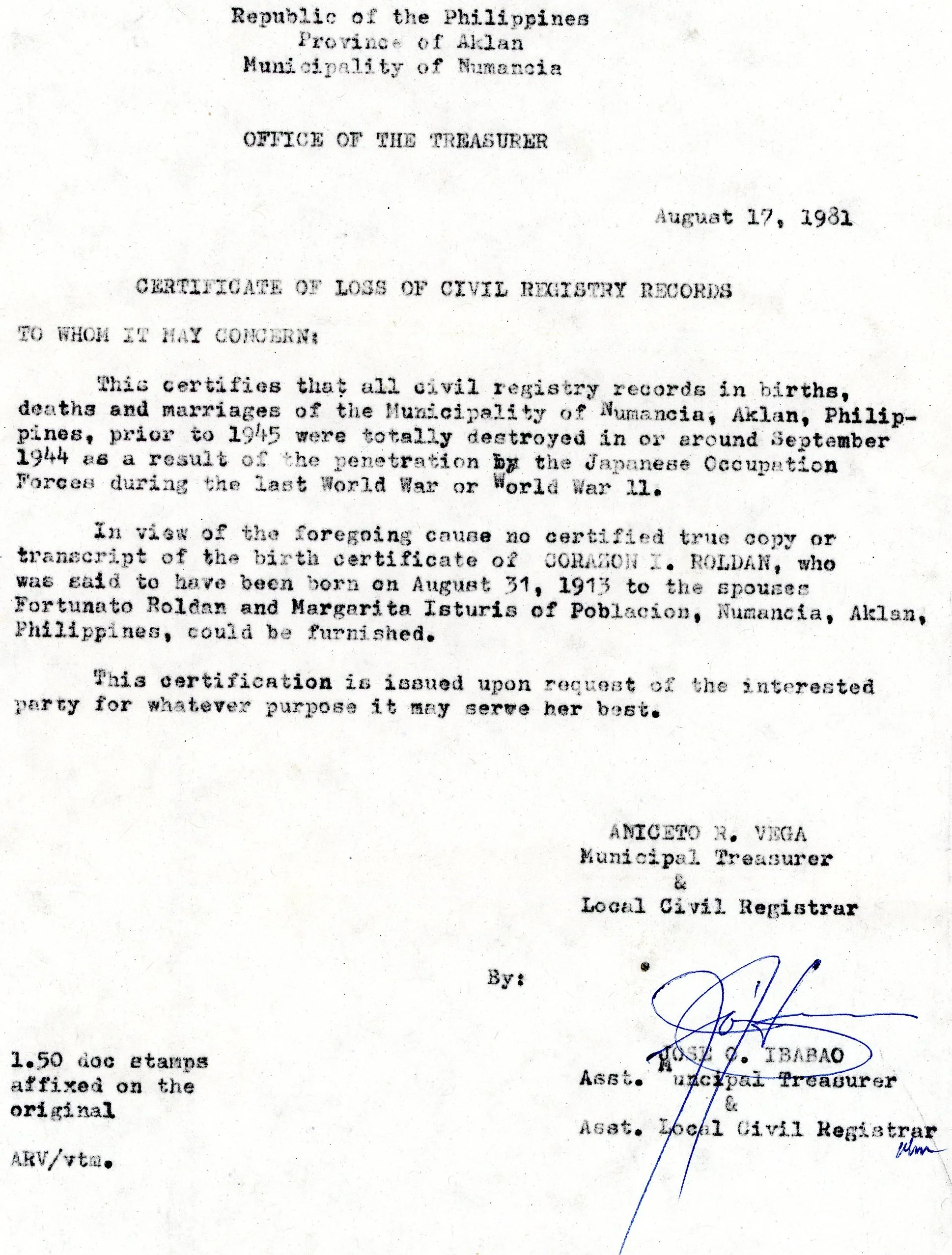
ConfirmedOn June 27, 1931, Jose Tamayo married Maria Corazon Roldan, the ceremony solemnized by Rev. Proculo Ilijay at the St. Joseph Catholic Church in Numancia. The original marriage record did not survive the war—but the marriage itself is documented by an official Certificate of Loss of Civil Registry Records that names the date, the church, and the priest, issued decades later when the family needed proof the registry could no longer supply.
Numancia, Aklan
Issued by the Office of the Treasurer and Local Civil Registrar of Numancia, this certificate attests that the marriage of Jose Tamayo and Corazon Roldan, said to have been solemnized June 27, 1931 by Rev. Proculo Ilijay at St. Joseph Catholic Church, could not be furnished because the registry records prior to 1945 were destroyed. The destroyed original is replaced, in the evidentiary record, by the State's own sworn acknowledgment that it once existed.
ConfirmedThe bride's origins are fixed the same way. Maria Corazon Isturis Roldan was born August 13, 1913 in Poblacion, Numancia, to Fortunato Roldan and Margarita Isturis—the very couple whose union closed Episode 1's Tamayo maternal line. Her birth, too, is attested by a Certificate of Loss after the destruction of the town's books.
“Totally Destroyed in or Around September 1944”
A peculiar evidentiary form defines this place and generation. Across the 1960s, '70s, and '80s, the Office of the Treasurer of Numancia certified again and again that all civil registry records of births, deaths, and marriages prior to 1945 were “totally destroyed in or around September 1944” when Japanese occupation forces penetrated the locality. For this family, the war did not only take lives. It took the proof that they had lived—leaving these certificates of loss as the closest surviving witnesses. For how a family is reconstructed from exactly this kind of wreckage—salvage books, notarial registers, delayed registrations, and the immigration papers of relatives who emigrated—see the companion field guide, When the War Burned the Records.
Agtawagon Hill, 1942: As His Sons Told It
Japan invaded the Philippines on December 8, 1941. ContextBy the spring of 1942 the defense of Bataan and Corregidor had collapsed; in the provinces, courts and town offices broke down, lawyers and officials scattered to the mountains, and ordinary civil notarization—the very work Mamerto had done so methodically—came to a halt across occupied Panay.
OralIt is here that the family's most enduring memory falls. As his sons told it for the rest of their lives, Mamerto Morales died in 1942 at Agtawagon Hill, in the violence and displacement of the occupation's first year. No contemporaneous death record, burial entry, or casualty list has yet been located to fix that date—and given that Numancia's records were destroyed wholesale in 1944, it is entirely possible no such civil document was ever created.
Sound research requires telling this honestly. The documents give us a bracket, not a point—and the remembered date sits squarely inside it:
Research Note · The Death-Date Discipline
Mamerto's death is documented to February 16, 1938 on one side and to Patrocinio's recorded widowhood by April 15, 1951 on the other. The 1942 account lives between them—told the way his sons told it: as remembered, not as recorded. (A 1953 deed that cites his 1938 act does not bear on this; it references an old notarized document, not his status in 1953.) Closing this gap with a death, burial, or wartime casualty record remains the single most valuable thing this line could yet recover.
The war that ended Mamerto's life also burned the records that might have proven how it ended. The silence in the archive is itself a casualty of 1944.
A Widow, Her Children, and the Salvage Books
Patrocinio raised a large family through the occupation and into the postwar republic. ConfirmedBy April 15, 1951, she appears in a real estate mortgage explicitly as a widow—the earliest record yet found to confirm Mamerto's death and the document that draws the bracket closed. Two sons can be documented directly, and two physician children—one from each household—carry the story forward into Episode 3.
ConfirmedHer son Mamerto Miguel Gonzales Morales—“Tito Memet”—was born September 9, 1934 in Numancia and lived until 1997; United States records name his father as Mamerto Morales and his mother as Patrocinio Q. Gonzales, independently confirming the couple as his parents. ConfirmedAnother son, V. G. Morales, was born June 26, 1935; the Parish of St. Joseph later certified his birth from its salvage books—the fragments that survived the fire—while noting that no complete record could be furnished.
The Two Doctors Who Carry the Line
The first child of the Morales household to carry the line forward was Dr. Romulo Gonzales Morales (1931–2017). On the Tamayo side, the line passes through Dr. Hally Roldan Tamayo (1932–2017), whose own birth in 1932 was likewise reconstructed from the Parish of St. Joseph's salvage books. Two physicians, born a year apart in the same small town, each emerging from the same vanished registry.
Tamayo side: Jose Tamayo (1910–1970) & Maria Corazon Roldan (1913–2005) → Dr. Hally R. Tamayo (1932–2017)
Converging in Episode 3 → Romulo T. Morales (b. 1959)
First Crossings: The Road That Points West
The American era did more than reshape the records; it laid the rails out of them. By the 1960s and '70s the family was preparing the paperwork of emigration—the small private documents on which a Pacific crossing then depended.
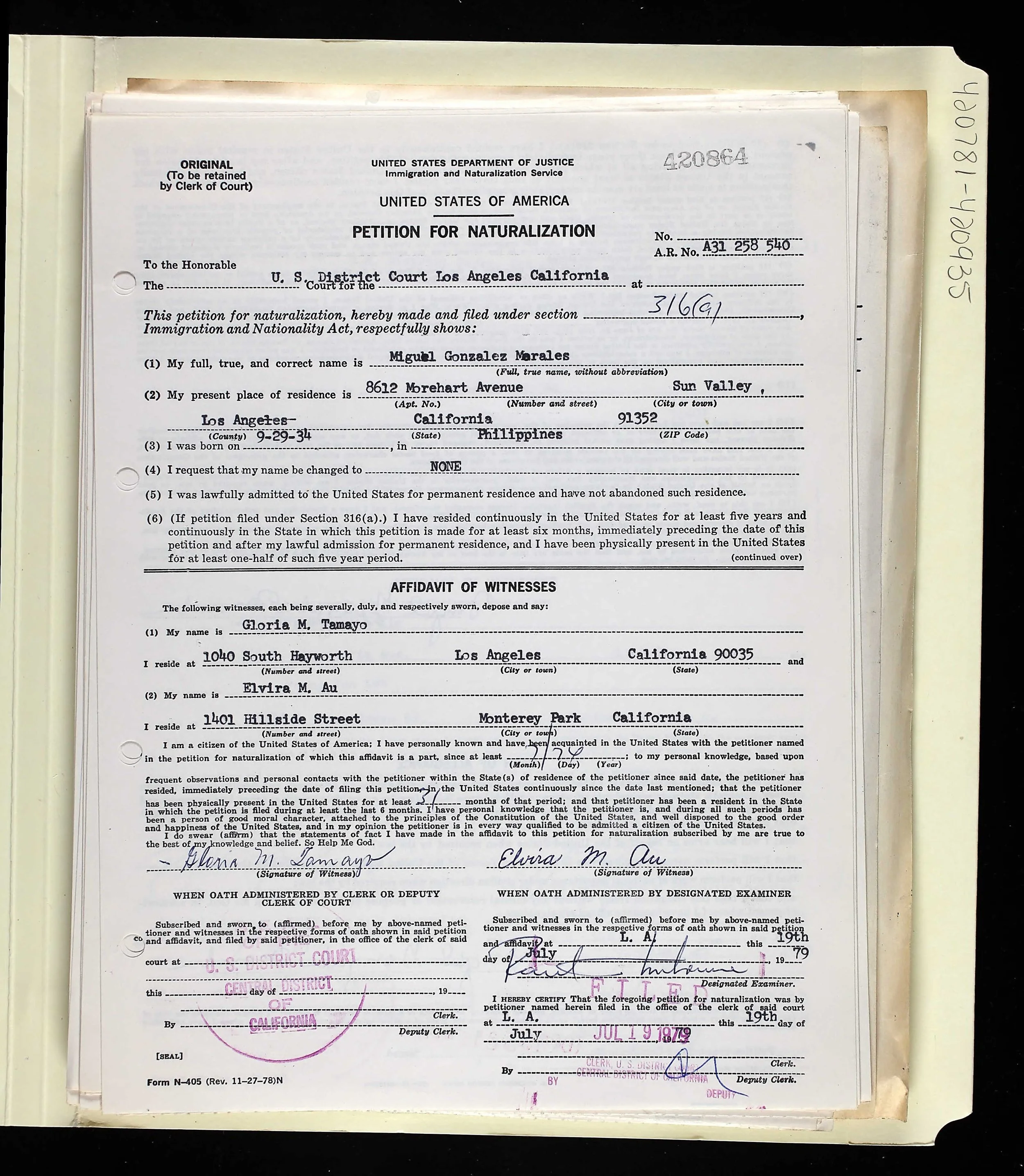
ConfirmedAn Affidavit of Support sworn by Ernesto Roldan—a bank employee of M'lang, Cotabato, who identified himself as a cousin of Dr. E. R. Tamayo—pledged to underwrite Tamayo's proposed journey to the United States. ConfirmedOn the Morales side, Miguel Gonzales Morales had settled in Sun Valley, Los Angeles, by the 1970s; his 1979 Petition for Naturalization records his Philippine birth of September 29, 1934 and was witnessed by Gloria M. Tamayo—the two Numancia families already standing beside one another in a Los Angeles courtroom, a continent and a generation removed from the river town where Episode 1 began.
The flag overhead had changed from Spanish to American to Japanese and back again. The town's records had burned. And out of that vanished registry, two physician children of Numancia were already turning toward California—carrying with them the names this episode has worked to prove.
Primary Sources








Are You Connected to the Morales-Tamayo Line?
If you descend from the Morales or Tamayo families of Numancia and Kalibo, Aklan, or from the intermarried Numancia families — Gonzales, Quimpo, Roldan, Isturis, Martelino, Icamina, Ferrer — whether your branch remained in the Philippines or emigrated to the United States, I’d like to compare notes. Documented trees, DNA matches, family papers, and even half-remembered stories have all moved this research forward.
Get in Touch About This FamilyCousin connections are informal and reciprocal — no fee, no obligation, just shared work on shared ancestry.
Questions about your own research? Begin a research inquiry.
