
Église Saint-Aubin de Tourouvre
Tourouvre-au-Perche, Orne, Normandy, France
Église Saint-Aubin de Tourouvre
In a small village in the heart of the Perche, the parish church of Saint-Aubin witnessed the baptisms, marriages, and burials of generations of Creste, Legrand, Mercier, Juchereau, Pinguet, Gagnon, and Roussin — families whose names would shortly become foundational lineages of New France. On 23 November 1626, the parish priest baptized Jehan Creste, the wheelwright's son who, twenty-three years later, would sign an indenture before the local notary and sail for Trois-Rivières. Today, two centuries of stained glass, a marble plaque, and a thousand-year-old church still preserve his name — and the names of more than thirty other Tourouvre Canadiens.
The Creste Family at Saint-Aubin de Tourouvre
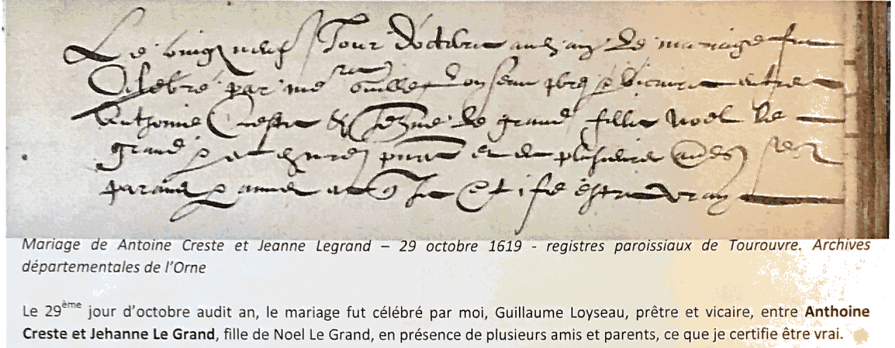
29 October 1619 — Marriage of Antoine Creste and Jeanne Legrand, daughter of the merchant Noël Legrand. Officiated by Guillaume Loyseau, vicar.
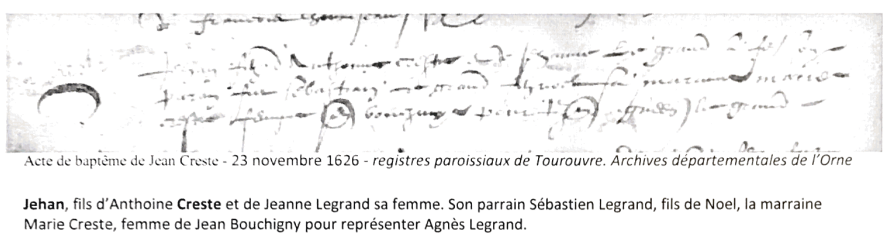
23 November 1626 — Baptism of Jehan (Jean) Creste, son of Antoine Creste and Jeanne Legrand. Godfather: Sébastien Legrand, son of Noël. Godmother: Marie Creste, wife of Jean Bouchigny, standing in for Agnès Legrand.
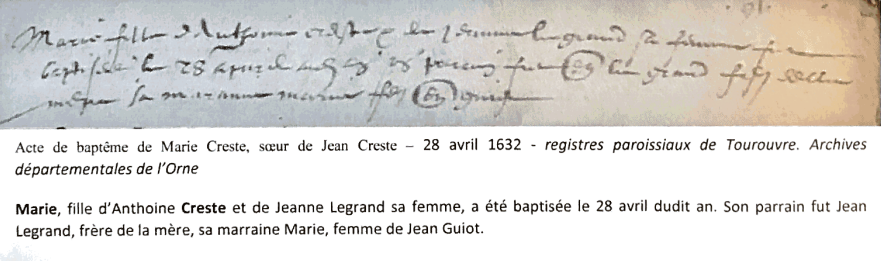
28 April 1632 — Baptism of Marie Creste, daughter of Antoine and Jeanne. Godfather: Jean Legrand, brother of the mother. Godmother: Marie, wife of Jean Guiot.
The four records together establish three generations of the Creste family at Saint-Aubin de Tourouvre — and identify Jean Creste as the third child and only son of his parents, baptized seven months before his future wife Marguerite Gaulin was baptized at Saint-Martin-du-Vieux-Bellême.

Église Saint-Aubin de Tourouvre, viewed from the southeast. The nave dates to the twelfth century; the apse and bays were modified in the fifteenth. Classified as a Monument Historique in 1991. The church is the most important surviving building in Tourouvre after the destruction of August 1944.
The Perche hills slope gently toward the north, and where a small road bends through the village of Tourouvre — twenty kilometers north of Saint-Martin-du-Vieux-Bellême, thirty south of Mortagne — stands a long stone parish church with a distinctive lantern-capped bell tower. Its southern wall is Romanesque, twelfth century. Its northern aisle is Gothic, fourteenth. Its altarpiece is Baroque, dated 1646. Its stained-glass windows are nineteenth century. And the names cut into the commemorative plaque on its interior wall — the Aux Canadiens baptisés à Tourouvre — record the baptisms of more than thirty pioneers of New France, all of whom were christened in this church between 1589 and 1713.
One of those names belongs to a wheelwright's son baptized here on the twenty-third of November 1626 as Jehan, fils d'Anthoine Creste et de Jeanne Legrand sa femme. Twenty-three years later, in March 1649, he would sign a contract before the local notary, cross the Atlantic, and become the founding ancestor of nearly every Creste, Crête, and "Crete" line in North America. The church preserves the entry of his baptism, the marriage of his parents, the baptism of his father, the baptism of his sister, and — through the late-nineteenth-century plaque — a permanent line in stone that connects his French christening to his Canadian descendants.
A Church of Eight Centuries
The earliest stones of Saint-Aubin date to the eleventh and twelfth centuries — a fortified Romanesque sanctuary built when the Perche was a contested borderland. The southern wall (the mur gouttereau sud) is the principal surviving fragment of that earliest church. In the fourteenth and fifteenth centuries, after the upheavals of the Hundred Years' War, the building was substantially enlarged with a northern side aisle and ribbed Gothic vaults. The sixteenth and seventeenth centuries added the distinctive bell tower with its lantern-shaped campanile, expanded the windows in the Renaissance style, and roofed the main nave with the timber-paneled ceiling that still defines the building's interior atmosphere.
On 13 August 1944, as Allied forces pushed inland from the Normandy beaches and the German Seventh Army began its long retreat through the Falaise pocket, retreating troops set fire to the village of Tourouvre. Most of the town's historic buildings burned to the ground. The Église Saint-Aubin survived — almost entirely untouched. Its eight centuries of Romanesque, Gothic, Renaissance, and Baroque fabric remained intact when the war ended weeks later.
French heritage protection followed in due course: the church was officially classified as a Monument Historique on 31 May 1991, the highest level of architectural protection under French law. The plaques on its interior walls now honor both the pioneers who left Tourouvre for New France in the seventeenth century and the Canadian soldiers who returned in 1944 to help liberate Normandy — a coincidence of history written into the building's commemorative furniture.
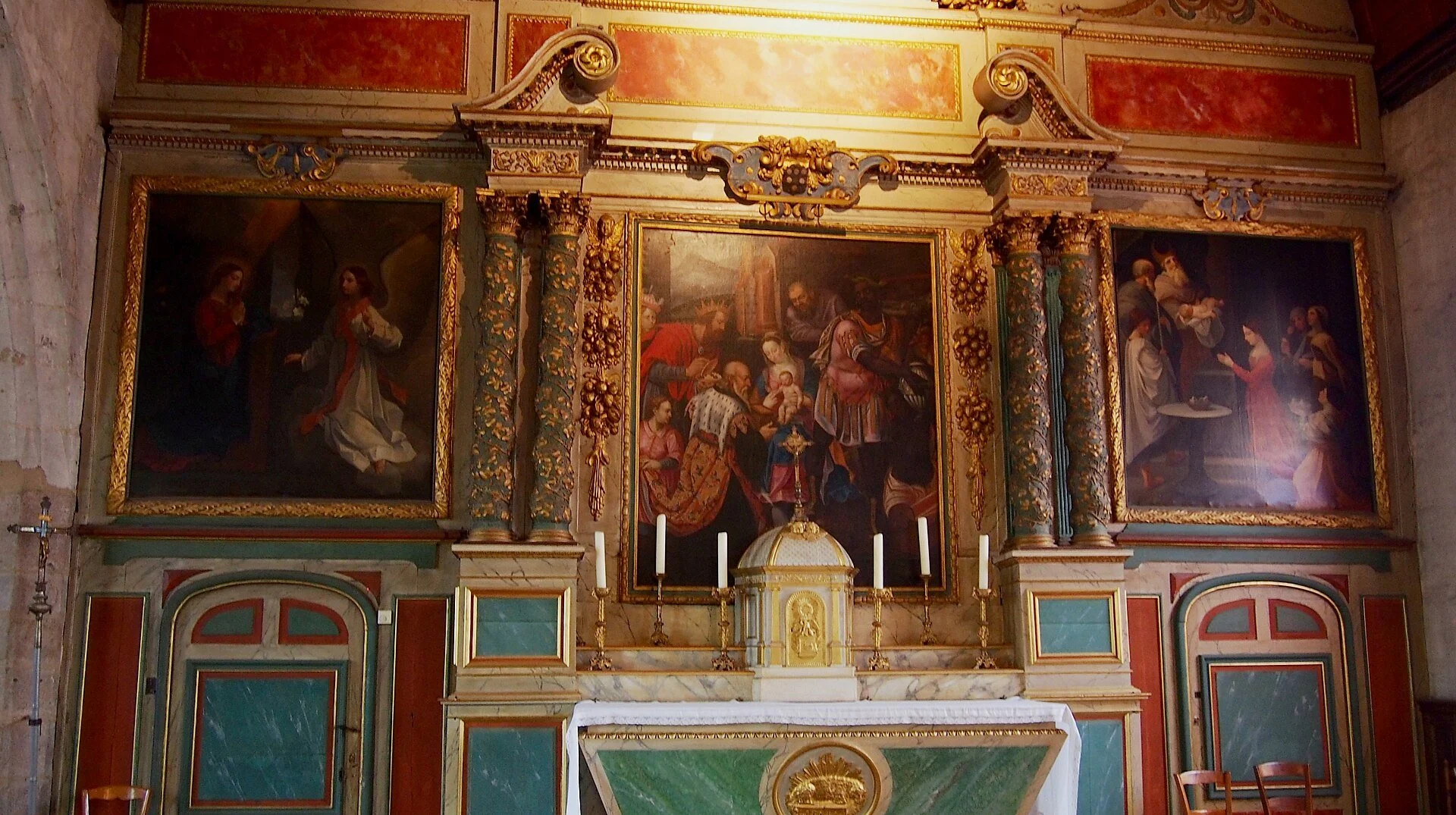
The 1646 high altar. The chancel houses an imposing baroque altarpiece with twisted columns; the central canvas is a Renaissance-style Adoration of the Magi flanked by panels of the Annunciation (left) and the Nativity (right). The crest carries the de la Vove coat of arms — six silver circles on a black shield — for the family that held the seigneury of Tourouvre for three centuries. The altarpiece was newly installed in the church at the time of Jean Creste's youth.
The Creste Family at Saint-Aubin, 1592–1632
The Creste family's documented presence at Saint-Aubin spans at least three generations before Jean's emigration. The earliest known patriarch — merchant Nicolas Martin Creste, born around 1500 and buried at Saint-Aubin — lived in the neighboring hamlet of Autheuil. By the time Jean's father Antoine was baptized in 1592, the family had moved to the small Tourouvre hamlet of Les Boullais, where they worked as carriage-makers and wheelwrights — the trade Jean himself would later carry to New France.
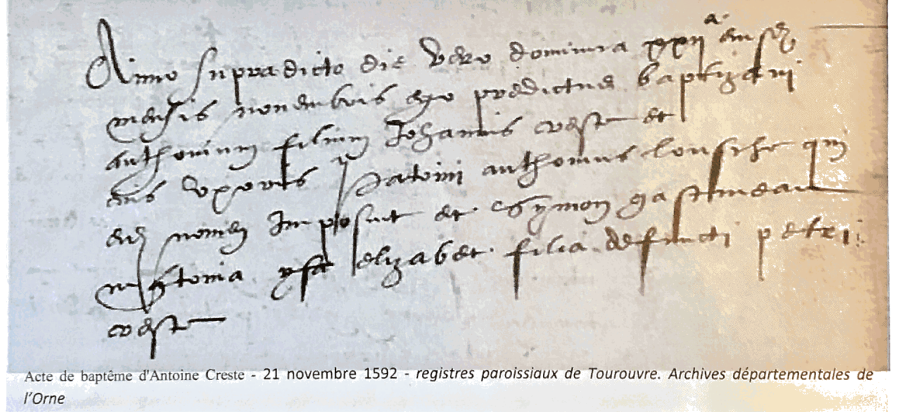
Antoine Creste
Parents: Jehan Creste (carriage maker) and an as-yet-unnamed mother (the record names only the father)
Godparents: Antoine Loyseau (godfather); a godmother named "Marie" and another woman whose name is partially obscured
Language of entry: Latin (Diocese of Chartres)
— Acte de baptême d'Antoine Creste, 21 novembre 1592, registres paroissiaux de Tourouvre. Archives départementales de l'Orne.
Antoine Creste & Jeanne Legrand
Groom: Antoine Creste, carriage maker, baptized at Saint-Aubin 21 November 1592
Bride: Jeanne Legrand, daughter of the merchant Noël Legrand of Tourouvre
Officiant: Guillaume Loyseau, priest and vicar
— Mariage de Antoine Creste et Jeanne Legrand, 29 octobre 1619, registres paroissiaux de Tourouvre. Archives départementales de l'Orne.
Jehan (Jean) Creste
Parents: Antoine Creste (carriage maker, Les Boullais) and Jeanne Legrand
Godfather: Sébastien Legrand, son of Noël Legrand (the bride's father; named on the Aux Canadiens plaque as another Tourouvre emigrant, baptized 7 March 1600)
Godmother: Marie Creste, wife of Jean Bouchigny, standing in for Agnès Legrand
— Acte de baptême de Jean Creste, 23 novembre 1626, registres paroissiaux de Tourouvre. Archives départementales de l'Orne.
The Period Spelling at Tourouvre
The Tourouvre register clerks of the early seventeenth century consistently wrote the surname as:
This is the same spelling that would carry across the Atlantic in 1649 and be used by Henry de Bernières and other Notre-Dame de Québec priests in every baptism, marriage, and burial entry through 1671 and beyond. The modern French Crête (with circumflex marking the place where the 's' once was) is a later evolution; the PRDH database renders it variously as Crete in summary records and Creste in transcribed entries. Throughout this Sacred Places series, we use Creste — the form Jean himself would have recognized.
Marie Creste
Parents: Antoine Creste and Jeanne Legrand
Godfather: Jean Legrand, brother of the mother (Jean's maternal uncle)
Godmother: Marie, wife of Jean Guiot
— Acte de baptême de Marie Creste, 28 avril 1632, registres paroissiaux de Tourouvre. Archives départementales de l'Orne.
The Indenture of 18 March 1649
Jean Creste was twenty-two years old in March 1649 when he walked into the office of the Tourouvre notary François Choiseau and signed an indenture that would change his life and the lives of all his descendants. The contract bound him to serve Michel Le Neuf, Sieur du Hérisson, in Trois-Rivières, New France, for three years at a salary of eighty livres per year. His father Antoine — by then fifty-seven years old, still working as a carriage-maker at Les Boullais — stood beside him at the notary's table as a witness. The signature of the son would be the last interaction between father and son recorded in the parish or notary archives of Tourouvre.
Date: 18 March 1649
Notary: François Choiseau, Tourouvre
Engagé (worker): Jean Creste, wheelwright, age 22, of Tourouvre
Employer: An agent representing Michel Le Neuf, Sieur du Hérisson, of Trois-Rivières, New France
Term: Three years
Wage: 80 livres per year
Witness: Antoine Creste (the engagé's father)
By the standards of the time, eighty livres per annum was a respectable wage for a skilled artisan — substantially above what Jean might have earned remaining in Tourouvre, particularly given the colony's chronic shortage of wheelwrights and carriage-makers. The three-year term was standard for engagement contracts to New France: long enough to recoup the cost of the Atlantic crossing for the engager, short enough to leave the engagé free to establish his own household in the colony afterward. Jean would do exactly that.
The Tourouvre notary archives — preserved at the Archives départementales de l'Orne — contain dozens of such contracts from the 1630s, 1640s, and 1650s. Together with the Saint-Aubin parish registers and the plaques inside the church, they form one of the richest single-village archives of the Percheron migration to New France anywhere in France. For Storyline researchers tracing seventeenth-century French-Canadian origins, the Choiseau notarial fonds and the Saint-Aubin parish books are the two essential resources to consult.
Aux Canadiens Baptisés à Tourouvre
On one of the interior walls of Saint-Aubin hangs a stone plaque, installed in the twentieth century to commemorate the baptisms at this church of the pioneers of New France. Two coats of arms anchor the plaque: at upper left, three buffalo heads above three maple leaves — the arms of the Société d'histoire of the Perche emigration; at lower left, a fess of three chevrons between two maple leaves. Between the arms, in two columns, are the names of the Tourouvre baptisms.
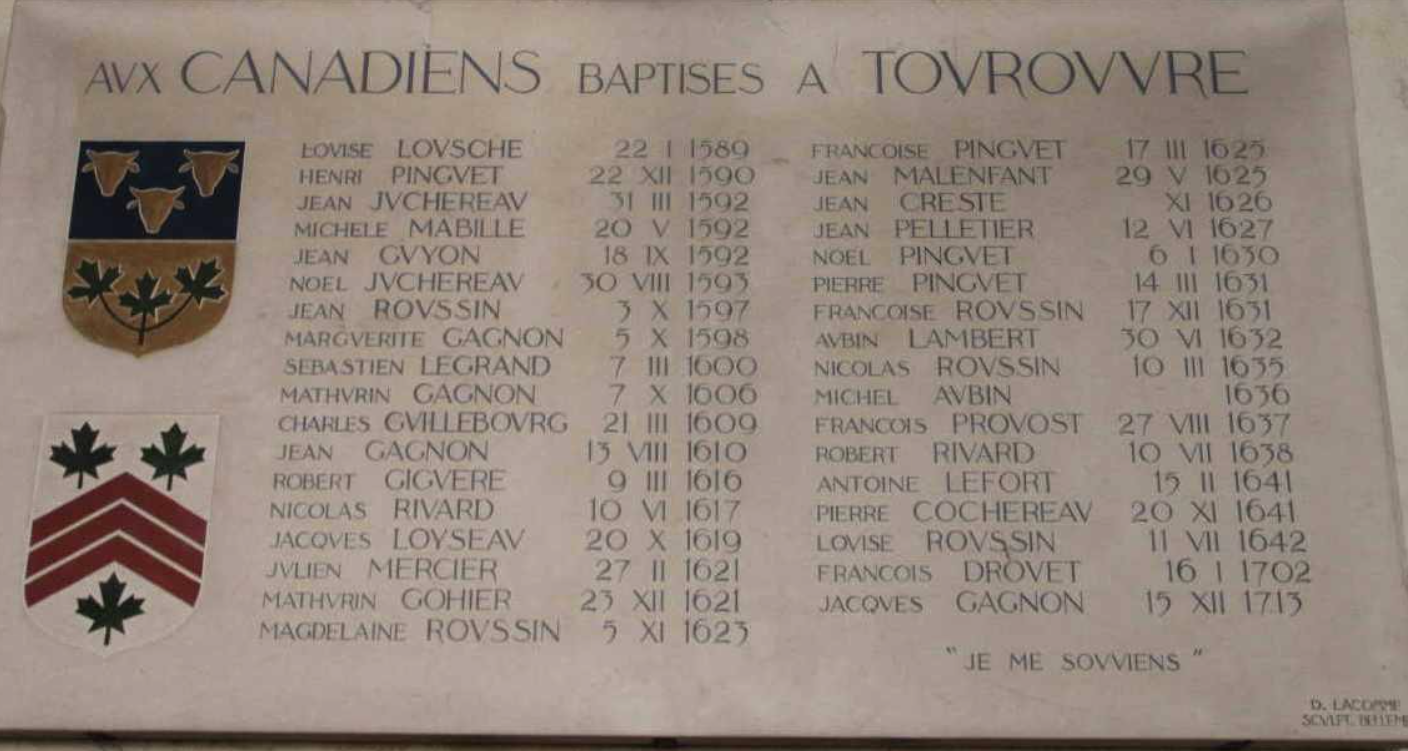
"Aux Canadiens baptisés à Tourouvre" — the commemorative plaque inside the church, with the carved Latinate spelling "Tovrovvre" (V for U, the Roman convention used decoratively here). Thirty-five baptisms recorded between 1589 and 1713, including Jean Creste in November 1626. The motto at the lower right reads Je me souviens — "I remember" — the official motto of Quebec.
The Tourouvre Canadiens
The plaque is more than a memorial. It is an act of mutual recognition between two parishes separated by an ocean — Saint-Aubin de Tourouvre, the place of departure, and the parishes of New France where these same pioneers became founding ancestors. Many of the families listed here intermarried in the colony: Juchereau, Pinguet, Mercier, Roussin, Gagnon, Giguère, Rivard, Mercier, Pelletier. The Creste name appears once in this column — and from this single twenty-two-year-old wheelwright descend the great majority of Crestes, Crêtes, and "Cretes" alive in North America today.
The Mercier Window
On one wall of the church, a tall stained-glass window in the late-nineteenth-century academic style depicts a scene of departure. A bearded man in a green coat stands at the right of the family group, raising his hat in farewell. A young woman in a red bodice clutches his hand. A small child stands between them. To the right, beyond a low stone harbor wall, a three-masted ship rides at anchor; small skiffs ferry baggage out to it; one barefoot porter, kneeling, secures a barrel; another shoulders a basket. Above the scene, a small figure of the Virgin Mary appears in glory among clouds. At the foot of the central figure rests a wooden trunk; on its side is painted the word CANADA, and a luggage tag bearing the name MERCIER.

The Mercier emigration window. Signed "LORIN CHARTRES 1892" — the work of the famous Lorin glass studios of Chartres. Installed in 1893. Funded by Honoré Mercier, Premier of Quebec from 1887 to 1891, in memory of his ancestor Julien Mercier — baptized at Saint-Aubin de Tourouvre on 27 February 1621, emigrated to New France in 1647. (Photo: Jean-Noël Mercier, via Wikimedia Commons)
In 1891, the Premier of Quebec, Honoré Mercier, travelled to France and made a pilgrimage to Tourouvre — the home parish of his ancestor Julien Mercier, who had emigrated to New France in 1647. The visit was a moment of considerable emotional and political weight: a Quebec premier returning to the soil of his ancestor's parish, two and a half centuries after the family had left. A second stained-glass window in the church commemorates this 1891 visit. (Local tradition notes, with a wink, that the window depicts the mayor and the vicar warmly greeting Mercier on his arrival, when in fact both were out of town that day — a small artistic improvement on the historical record.)
The emigration window itself was commissioned by Honoré Mercier shortly after this visit and installed in 1893, two years after the end of his term as Premier and one year before his death. Together, the two Mercier windows make Saint-Aubin de Tourouvre the most fully realized Franco-Canadian memorial in any French parish church.
Inside the Church
The interior of Saint-Aubin retains the strong horizontal lines of its medieval origins: the timber-paneled nave ceiling with exposed carpentry beams; the simple stone columns and Gothic vaulting of the northern aisle; the lateral chapels with their dedicated altars. The principal artistic focus, however, is the 1646 Louis XIII high altar — its twisted Solomonic columns wreathed with carved gilt grape clusters, its central canvas depicting the Adoration of the Magi, flanked by panels of the Annunciation and the Nativity. The crest bears the coat of arms of the de la Vove family, the local seigneurs.
The Recruiting Parish of the Percheron Migration
By any reasonable accounting, Saint-Aubin de Tourouvre was the single most important parish in the entire Percheron migration to New France. The numbers tell most of the story: more than thirty-five baptisms commemorated on its plaque, dozens more documented in the notarial records of Tourouvre, and the foundational lineages of an extraordinary proportion of French-Canadian families — Juchereau, Pinguet, Guyon, Roussin, Gagnon, Giguère, Mercier, Rivard, Pelletier, Provost — all traceable to baptisms or notarial acts at Tourouvre between roughly 1590 and 1650.
The principal recruiter of the Percheron migration was Robert Giffard de Moncel (c.1589–1668), a Norman apothecary-surgeon born at Autheuil — a village a few kilometers from Tourouvre. Giffard first crossed to New France in 1627, returned to France, and in 1634 sailed back with the first organized contingent of Percheron settlers to populate the seigneury of Beauport, granted to him by the Compagnie des Cent-Associés just east of Quebec City. Although Tourouvre was not strictly Giffard's parish of birth, it was the principal recruiting ground of his network throughout the 1630s and 1640s, and the notary archives at Tourouvre contain by far the largest concentration of New France engagement contracts of any single Norman village.
It is in this dense Tourouvre recruiting network — through neighbors, kin, and merchant intermediaries — that Jean Creste's 1649 indenture with Michel Le Neuf, Sieur du Hérisson, of Trois-Rivières was negotiated. Le Neuf was himself a Norman-born colonial officer who had taken up the seigneury of Trois-Rivières in the 1630s; his agents drew on the same recruitment circuits that Giffard had pioneered fifteen years earlier.
Timeline: The Church and the Family
From Tourouvre to Saint-Martin to Quebec
This is the third hinge in the Perche-to-Beauport story. Jean Creste was baptized here; Marguerite Gaulin was baptized at Saint-Martin-du-Vieux-Bellême the following May; they would meet and marry at Notre-Dame de Québec in 1654 and raise their family at Beauport, on the seigneury Robert Giffard had founded.
Visiting the Site
Location: Place de l'Église, 61190 Tourouvre-au-Perche, Orne, Normandie, France
Open: Daily, free admission. Guided tours arranged year-round through the Office de Tourisme des Hauts du Perche.
What to see: The 1646 Louis XIII altarpiece; the Mercier emigration window and the Honoré Mercier 1891 visit window; the Aux Canadiens baptisés à Tourouvre plaque; the four-hundred-year-old baptismal font where many of the listed Canadiens — Jean Creste among them — were baptized.
Nearby: The Musée de l'Émigration Française au Canada (Les Muséales de Tourouvre), directly adjacent to the church, holds an extensive collection of records, artifacts, and audiovisual exhibits documenting the Percheron migration. The Archives départementales de l'Orne in Alençon hold the original parish registers and the Choiseau notarial fonds.
Document Gallery
Questions about your own research? Begin a research inquiry.
