
Ann Lynch McKenna
Ann Lynch McKenna
On New Year's Day 1871, a widow walked into the office of Holy Cross Cemetery in Brooklyn and bought a plot large enough for a family. She had one daughter grown and another still a child. She had no husband. She had no money to spare. But she bought a plot, not a grave. One hundred and twenty years later, her great-great-granddaughter's aunt mailed a check from New Jersey to keep the grass cut.
Lett Row L, Plot 336
Holy Cross Cemetery · January 1, 1871The ground had been frozen since Christmas. George McKenney had died on the last day of 1870, of pulmonary tuberculosis, at their home on Schanck Street near Willoughby in Brooklyn's 7th Ward. He was forty-two years old. He had been in America twenty-nine years — which meant he had come as a boy of thirteen, almost certainly in the first years of Ireland's famine emigration. He left a widow and two daughters: Margaret, who was nineteen, and Mary, who was ten or eleven.
Ann Lynch McKenna was forty-eight years old and almost certainly could not read or write English. What she could do was think. She walked into the Holy Cross office the morning George was buried and she did not buy him a single grave. She bought a family plot — Section Letters, Row L, Plot 336 — and interred George in it that same day, January 1, 1871. The plot was large enough to hold the family that did not yet exist. Her daughter Margaret had not yet married. Her infant grandchildren had not yet been born or died. She had no way of knowing that in thirteen years she would bury her own daughter there, or that her granddaughter would be buried there sixty-two years later, or that the plot would still be receiving care checks in 1991.
She bought the ground anyway. Everything else in this series — every woman who stayed, every funeral that reunited the family — happened because Ann Lynch bought the ground on New Year's Day 1871.

Death Certificate No. 10660 — George McKenney, December 31, 1870. The pencil correction from "Flatbush" to "Holy Cross" appears in the original archive record and has been verified directly with the cemetery.
Ireland Before Brooklyn
What the Records Do Not SayAnn Lynch was born in Ireland around 1822. That is almost the only thing we know about her first twenty years. Every record that survives from her American life gives the same answer to every Irish question: Ireland. Not a county. Not a parish. Not a townland. Every census, every death certificate, every burial register says only that she was born in Ireland, and that her parents were born in Ireland.
If she came during the Great Famine — and the timeline suggests she did — she would have arrived in New York between roughly 1845 and 1852, landing at Castle Garden or one of the earlier Manhattan piers before Ellis Island existed. She was in her twenties. She must have crossed in steerage. She probably crossed alone. The records are silent on who she came with, whether anyone came with her, or what name she answered to at customs.
By the time the federal census found her in 1860, she was Ann McKenna, wife of George McKenna, living in Brooklyn's 7th Ward with a nine-year-old daughter Margaret and a seven-month-old daughter Mary. The 1860 census lists her as thirty years old — which is impossible if Margaret was born when Ann was nineteen or twenty, and if Ann herself was born in 1822. Ages in nineteenth-century census returns were a soft currency. Ann was almost certainly in her mid- to late thirties by 1860, not thirty.

1860 Census — George, Ann, Margaret, and infant Mary in Brooklyn's 7th Ward. The earliest documentary record of Ann's life in America.
There is a second candidate record from ten years earlier — the 1850 census for Brooklyn's 7th Ward, enumerated September 12, 1850, shows a George McKenny, 26, laborer, Ireland; Ann, 24, Ireland; John, 12, born New York. If this is the same couple, John is a son who would not appear in the 1860 enumeration. It could be a different family entirely — McKenna is not a rare surname in Brooklyn's Irish neighborhoods. It is listed here as a candidate, not as proof.
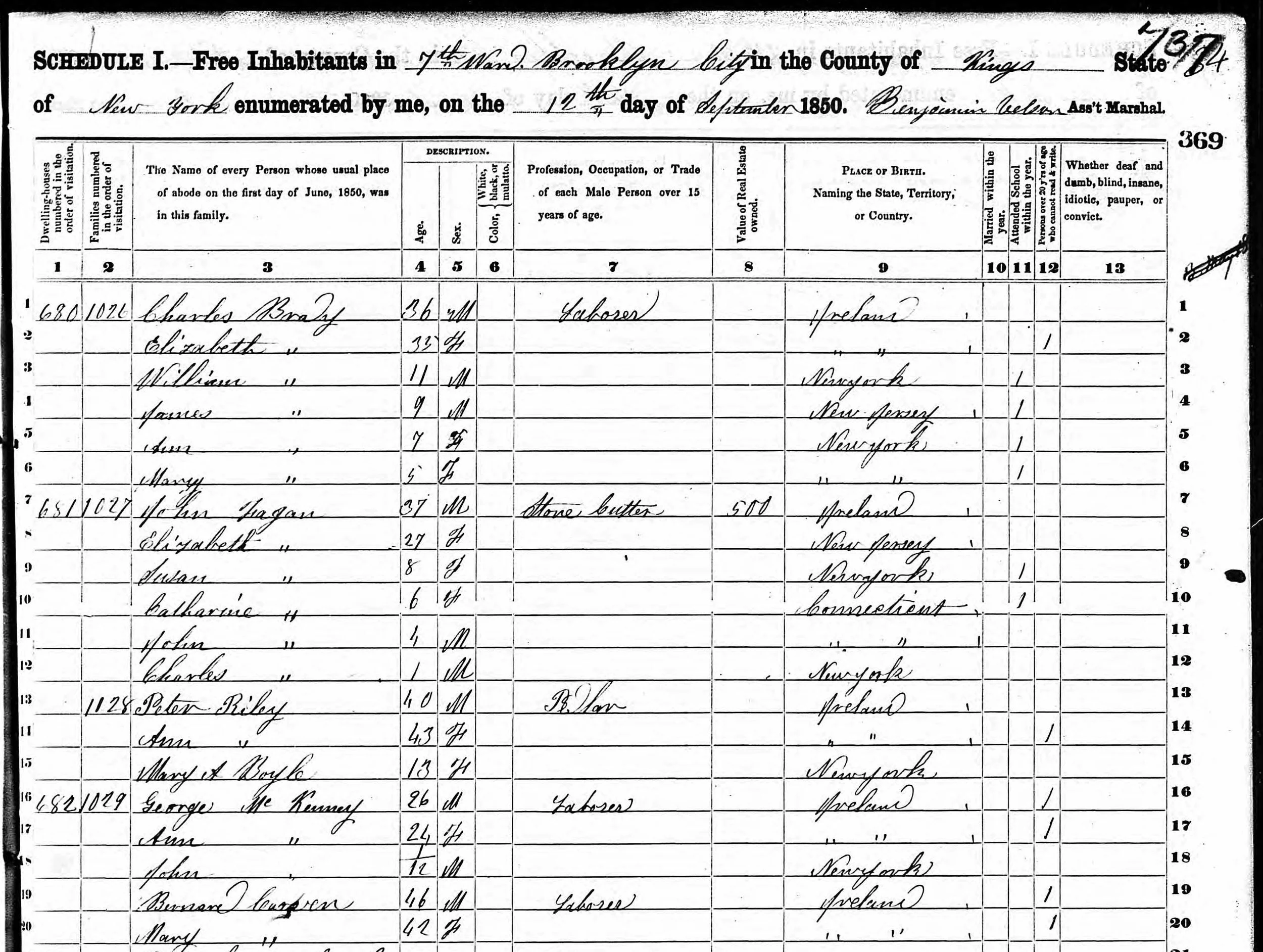
1850 Census — Candidate household. The presence of a son John, unaccounted for in later records, means this identification remains provisional.
Widowed at Forty-Eight
The Last Day of 1870George McKenney died at home on December 31, 1870, of pulmonary tuberculosis, after an illness of several years. His death certificate lists his occupation as laborer — the same word that had defined his twenty-nine American years. He left $50 in personal property (per the 1860 census) and no real estate anywhere in the records. He left Ann and Mary, age ten, at 367 Kent Avenue. Margaret was nineteen and still at home.
Ann had watched her husband die slowly. Tuberculosis in 1870 was the leading cause of death among Irish-American laborers in Brooklyn; the disease moved through tenement households with terrible predictability. She had months, maybe years, to understand what was coming. She had time to make plans.
One of those plans was the cemetery plot.
Seventeen Years a Widow
1871 – 1887 · Ward 7, BrooklynBetween George's death and her own, Ann Lynch McKenna lived for seventeen years as a widow. The records show her moving through three addresses in the same neighborhood — the 7th Ward of Brooklyn, a dense Irish Catholic enclave bounded by Myrtle Avenue to the north, Lafayette Avenue to the south, and Classon Avenue to the east. These were the blocks between the Wallabout Bay and the emerging middle-class neighborhoods further east. They were laborers' blocks. Ropemakers, washerwomen, mat weavers, day laborers — the 1870 census page where her family appears is a roll call of the Irish working poor.
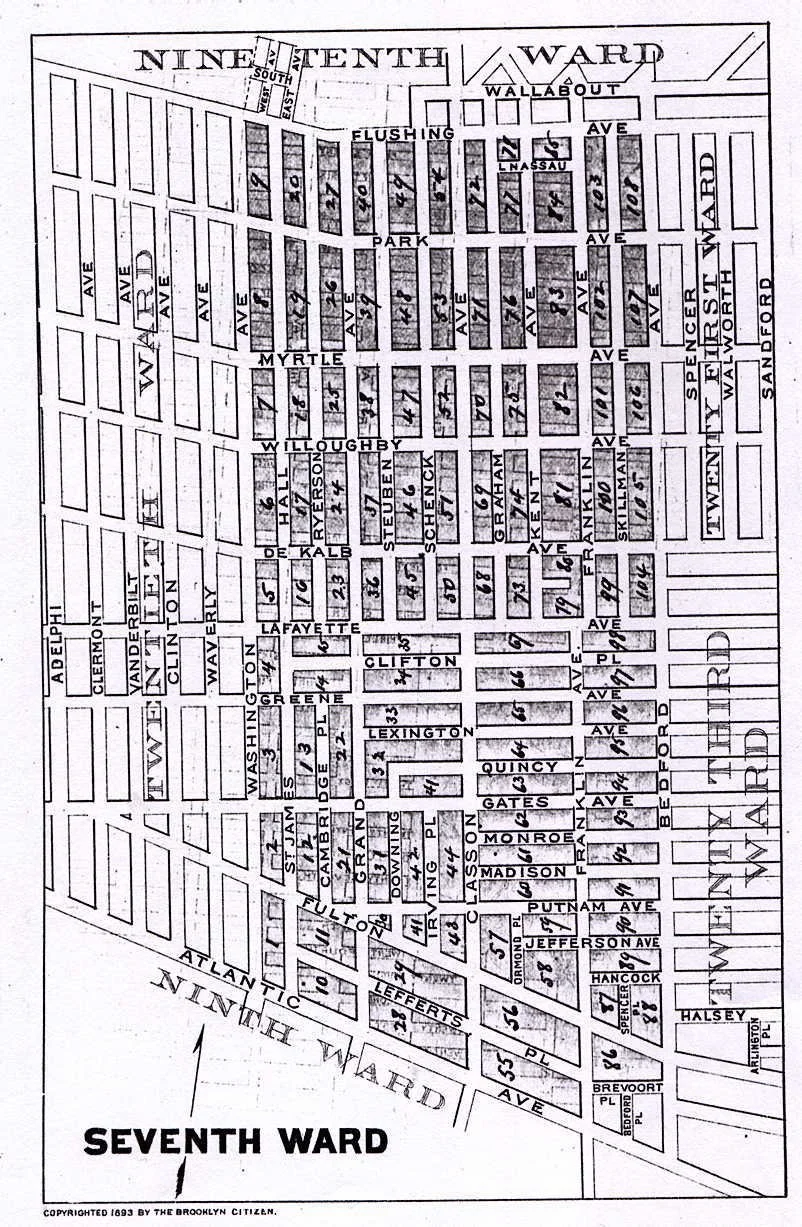
Ward 7 in 1893 — the single research tool that allowed the Kenny–McKenna–MacKinney family to be traced across four generations. Every documented address clusters within or just adjacent to this map.
1870: With George on Schanck Street
The 1870 census caught the family six months before George died. He was forty-eight on paper (though forty-two on his death certificate six months later). Ann — enumerated as "Mary," a transcription error the enumerator probably introduced himself — was forty. Margaret was eighteen. Mary was nine. They were at the address Schanck Street near Willoughby where George would die on December 31.

1870 Census — six months before George's death. The enumerator wrote "Mary" in the wife's name column; every other record identifies her as Ann.
1875: The New York State Census, Graham Street
Five years after George's death, the New York State census enumerator found Ann on Graham Street in the 7th Ward's Fifth Election District. She was listed as Ann McKinny, Ireland. With her: Margaret McKinny, daughter, Kings (New York). Mary McKinny, daughter, Kings. All three Irish spellings the family would cycle through over fifty years appear in successive records — McKenny, McKinny, McKenna, MacKinney. No surname variation ever settled. It never would.

1875 Census — five years after George's death.
1880: 367 Kent Avenue
By 1880 Margaret had married John Kenny and was living at 436 Park Avenue with him and their infant daughter Elizabeth. Ann remained with Mary — now about twenty — at 367 Kent Avenue. The 1880 federal census records them together, mother and unmarried daughter, the two of them alone in a household that had been four people ten years earlier.

1880 Census — Ann and Mary F. at 367 Kent Avenue. Mother and unmarried daughter, the household that would hold until Ann's death.
Margaret's Plot
May 24, 1884Thirteen years after Ann bought the plot, she needed it. Her daughter Margaret McKenny Kenny died on May 24, 1884, of pulmonary consumption — the same disease that had killed George — at 39 Nostrand Avenue. She was thirty-three years old. She left a widower (John Kenny) and two small daughters (Elizabeth, five, and Mary Agnes, one). She had just given birth to an infant daughter also named Margaret, who would follow her mother into the ground seven weeks later, on July 13, 1884, of cholera infantum at 39 Sanford Street.
Mother and infant were buried in Holy Cross Lett Row L Plot 336 — the plot Ann had purchased thirteen years earlier in anticipation, as it turned out, of exactly this. She did not know in 1871 that she was buying ground for her own daughter. She bought it anyway. Margaret and her infant lie in the ground Ann secured for them before they needed it.

Death Certificate No. 4937 — Margaret McKenny Kenny, Ann's older daughter. Buried in the plot Ann purchased in 1871.

Death Certificate No. 6859 — Infant Margaret, seven weeks after her mother. Both buried with Ann's foresight.
847 Kent Avenue
The Last Address · 1887 – 1888By 1887 Ann had moved — with Mary, now in her mid-twenties — to 847 Kent Avenue, a second-floor flat a few blocks north of 367 Kent. The building still stands today: a row of late-nineteenth-century walk-ups on a block that has been continuously inhabited for 140 years. Ann was sixty-five. Mary was approximately twenty-seven, unmarried, and working as a domestic servant when she could find placement.

847 Kent Avenue — Ann's final address. Mary nursed her here for six months.
In April 1887 — before Ann got sick — a classified advertisement appeared in the Brooklyn Eagle. It was placed from 847 Kent Avenue, and it was placed by Mary:
Mary was the "respectable strong young girl." She was twenty-seven, which was not young by nineteenth-century standards — "young girl" was a coded term meaning unmarried and available for placement. She was looking for live-out domestic work. She was the breadwinner of a two-woman household: herself and her mother.
November 1887: The Stroke
Six Months of DyingIn November 1887, Ann suffered a cerebral embolism — a stroke caused by a clot traveling to the brain. She was sixty-five. She did not recover. For the next six months she was bedridden at 847 Kent Avenue, cared for continuously by Mary. Her death certificate lists the attending physician as Eugene J. Cowdland, M.D., of 856 Bedford Avenue, who would state he attended her from November 10, 1887 to May 10, 1888 — six months to the day.
Mary could not leave to work. A stroke victim in 1887 required total care: feeding, turning, bathing, managing incontinence, preventing pressure sores. There was no income except what family brought in, what Mary could earn on brief placements, or what was borrowed. John Kenny, Ann's son-in-law, was himself in the late stages of tuberculosis by this point and could contribute little or nothing. The household at 847 Kent Avenue was a triage unit: a dying mother upstairs, a dying son-in-law somewhere in the family circle, and a young woman attempting to hold the line.
May 10, 1888
Certificate No. 6403Ann Lynch McKenna died on May 10, 1888, at approximately 4:00 A.M., in her second-floor flat at 847 Kent Avenue. She was sixty-six years old. She had lived in the United States twenty-five years (by her death certificate) — though this number conflicts with George's twenty-nine years and is probably under-counted. The attending physician, Eugene J. Cowdland, listed the cause of death as Cerebral Embolism and Asthenia (extreme weakness). She was buried at Holy Cross Cemetery on May 12, 1888, in Lett Row L Plot 336 — the plot she had purchased seventeen years earlier. Her undertaker was Thomas Tracy, who operated on Myrtle Avenue and who had also buried her husband in 1871.

Death Certificate No. 6403 — Ann McKenny, May 10, 1888. Buried May 12 in the plot she had purchased January 1, 1871.
Four months after her mother's death, and two months before John Kenny would die of tuberculosis and leave Elizabeth and Mary Agnes orphaned, Mary placed a second advertisement in the Brooklyn Eagle from the same address. She was still trying to find work. She did not yet know that in November 1888 she would become the sole guardian of two small girls.
The Plot Through Time
What Ann Bought in 1871 · 1871 – 1991The plot Ann purchased on January 1, 1871, received burial after burial over the next eighty years:
Seven people, across seventy-nine years, rest in Lett Row L Plot 336. Every one of them rests there because Ann Lynch McKenna walked into the Holy Cross office on January 1, 1871, and bought ground for a family that did not yet exist. George, her husband of unknown years, was the first. Elizabeth, her granddaughter, was the last.
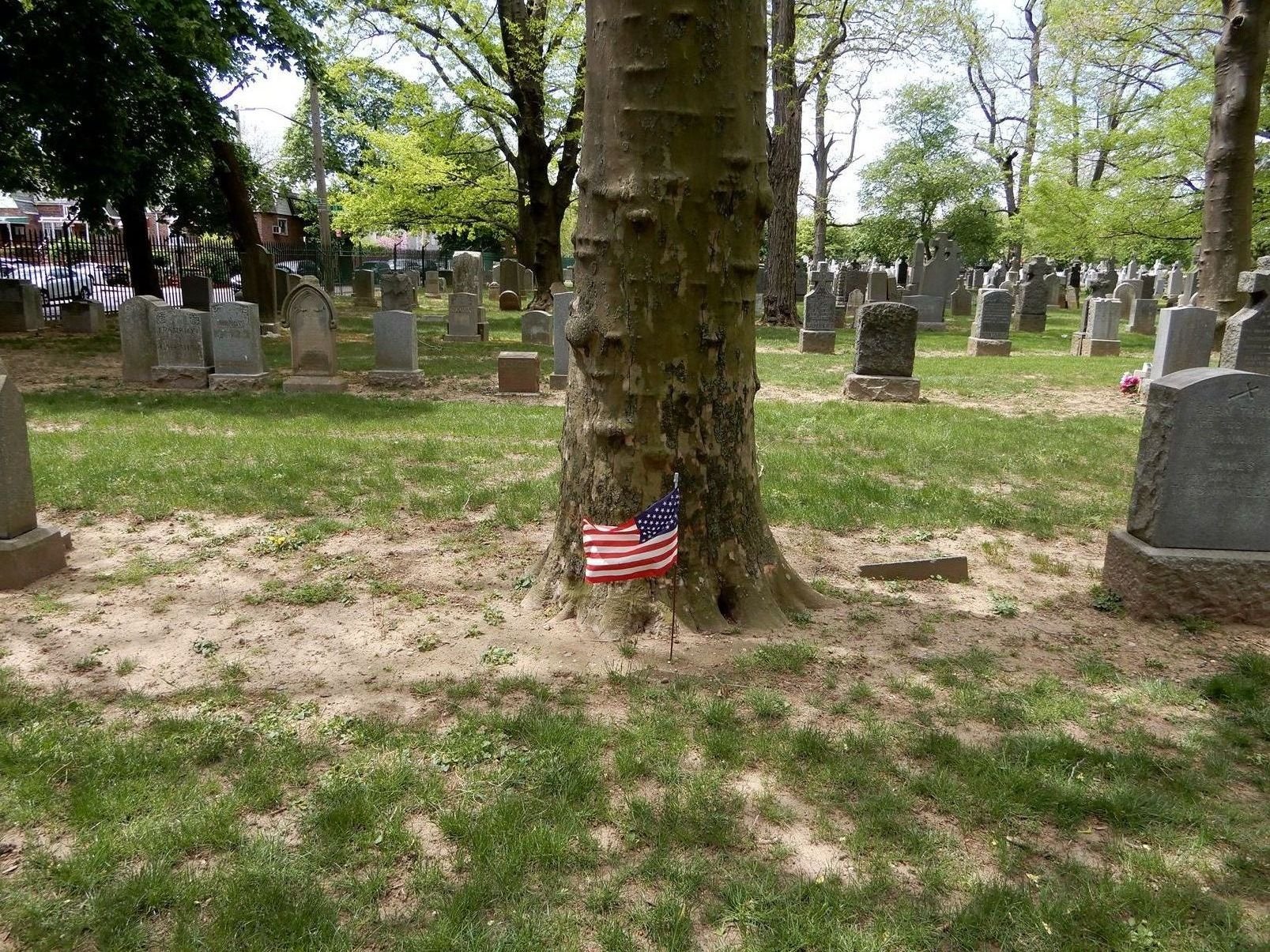
Holy Cross Cemetery — Lett Row L, Plot 336. The ground Ann bought on January 1, 1871. Seven family members beneath a single tree.
The Cemetery That Preserved the Family
Aunt Lillian's Notes · The Brick Wall BrokenFor decades, the McKenna–Kenny–MacKinney connection was a brick wall. The surname variations (McKenna, McKenny, MacKinney, McKinney), the transcription errors (Ann as "Mary" in 1870), the absence of an obituary for Ann herself, and the fact that most of the women in the family never appeared in their own right in any city directory — all of it conspired to scatter the documentary record. No one in the family's living memory could say with certainty who George McKenna was, when Ann came from Ireland, or how the Kenny, MacKinney, and Robertson families had been connected.
What broke the wall was the plot.
In the 1940s, Lillian Marie O'Brien — Elizabeth Kenny Corbett's niece, your mother's aunt Lillian — began visiting Brooklyn cemeteries on weekends from college. She took careful handwritten notes. On a single sheet of paper, she recorded seven burials at Holy Cross, Lett Row L Plot 336: George McKenna 1871, Margaret Kenny 1884, Margaret Kenny 1884 (infant), Ann McKenna 1888, Mary F. MacKinney 1935, John J. Corbett 1949, Elizabeth Corbett 1950. Birth dates. Ages at death. Burial dates. The record of the plot Ann bought.
That sheet of paper, passed down and preserved, became the foundation on which every subsequent discovery rested. The death certificates of Ann, George, Margaret, the infant, and Mary F. were located by working backwards from Aunt Lillian's cemetery notes. The 1880 and 1860 censuses were connected to the family because the cemetery told us they belonged together. Mary F. MacKinney's obituary — the document that names George and Ann Lynch MacKinney as her parents — was located because Aunt Lillian's notes had given her a burial date and her parents a plot.
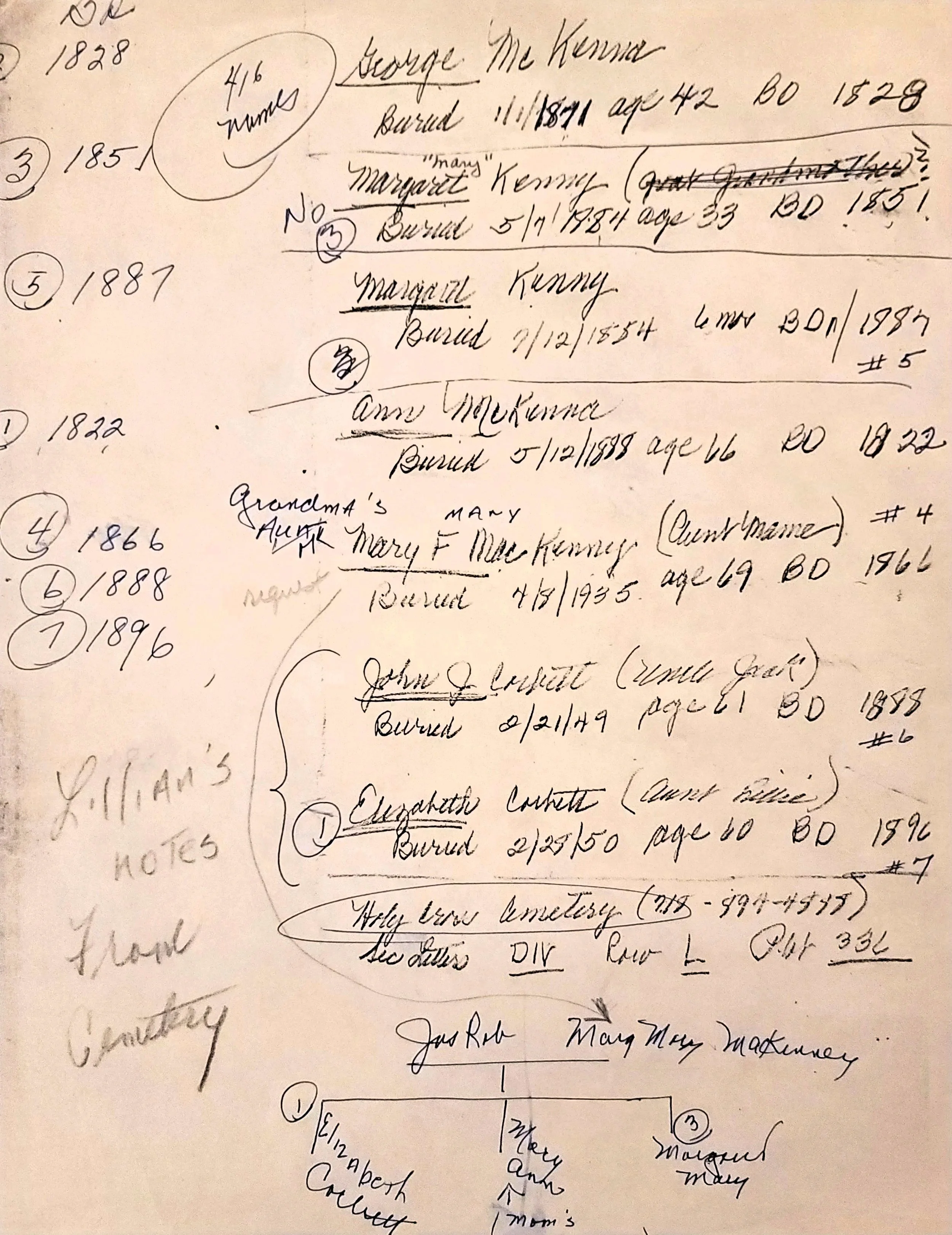
Aunt Lillian's notes — the key that unlocked everything. Seven burials, one plot, four generations.
The researcher's note: Without these cemetery records the family could not have been reconstructed. The death certificates, the obituaries, the age discrepancies for Mary F. and Elizabeth — every one of them was resolved by starting from Ann's plot and working outward. Ann Lynch McKenna did not know in 1871 that the plot she bought would preserve her family's identity a century and a half later. She bought it anyway.
The Caretakers
The Checks That Kept the Grass Cut · 1951 – 1991Ann was not the end of the story. The plot she bought in 1871 continued to be cared for long after every person buried in it was dead — paid for, by mail, by the women of the next generations, from addresses in New Jersey where none of them lived near Brooklyn anymore.
In August 1951, 1952, and 1953, Mrs. Lillian F. O'Brien — Elizabeth's niece, Mary Agnes's daughter, your grandmother — mailed annual care checks of two dollars from 58 Central Avenue, Caldwell, New Jersey, to Holy Cross Cemetery, 191 Joralemon Street, Brooklyn. The receipts survive. They are made out in the name of Ann McKenna, because Ann was the holder of the deed.

Annual care receipts, 1951–1953. Three consecutive years. Two dollars each. Paid by mail from New Jersey.
On November 1, 1991, Lillian M. Ambrosio — Lillian F. O'Brien's daughter, mailing from 318 Ernston Road, Parlin, New Jersey — paid a larger sum: perpetual care plus arrears on the Ann McKenna plot. Check number 105. The cemetery issued two receipts. The second, dated November 12, 1991, records the payment in detail: endowed care paid in full at $500, annual care $70, total $570, on account number 2-07509. The plot had passed through four generations of women: Ann, Mary F., Lillian F. O'Brien, and Lillian M. Ambrosio. None of them were buried in it by 1991. All of them were paying to keep it.
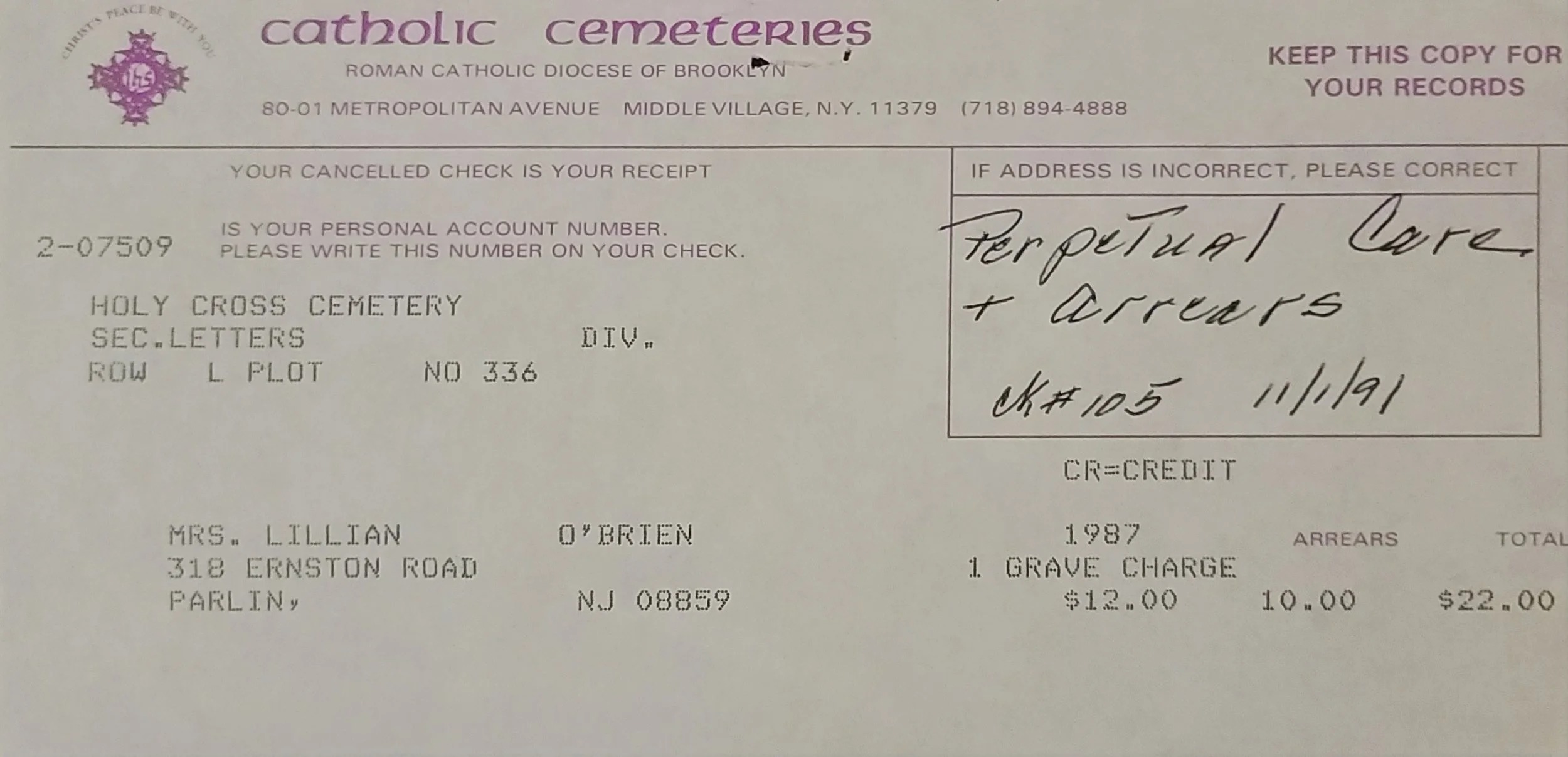
Receipt, November 1, 1991 — perpetual care plus arrears. Paid by Lillian M. Ambrosio just after her mother's death.
On November 12, 1991, Lillian M. Ambrosio paid the final settlement. $500 endowed care, $70 annual care, total $570. The plot was now in perpetual care — maintained in perpetuity by the cemetery under the original deed Ann Lynch McKenna had purchased one hundred and twenty years, ten months, and eleven days earlier.
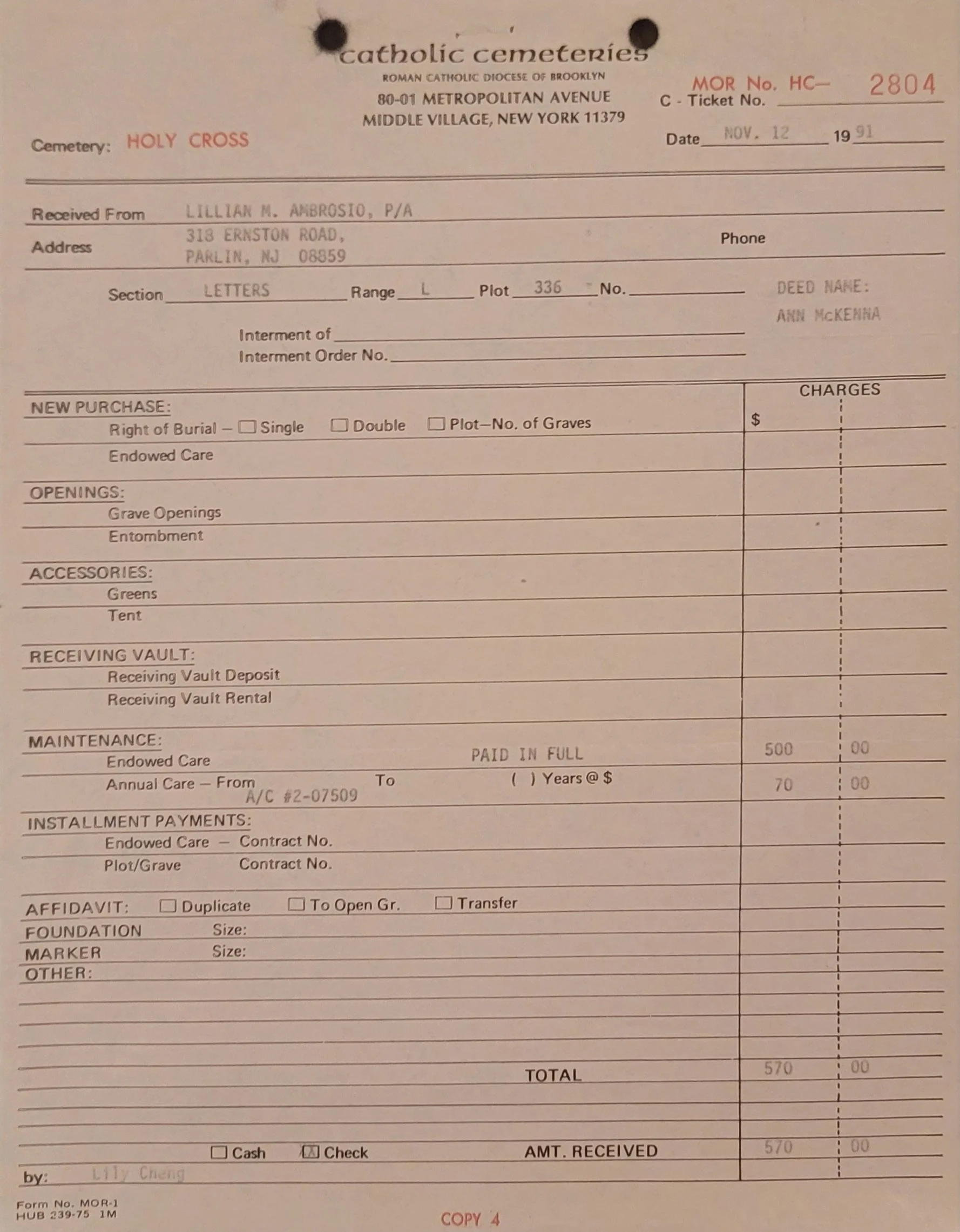
November 12, 1991 — endowed care paid in full. The deed still names Ann McKenna.
Ann Lynch McKenna
Vital Statistics| Born | c. 1822, Ireland (specific county, parish, and parentage unknown) |
| Emigrated | United States, approximately 1841–1850 (twenty-five years in U.S. per death certificate; twenty-nine per husband's certificate) |
| Married | George McKenney (c. 1828 Ireland – December 31, 1870 Brooklyn), date and place of marriage not yet located |
| Children | Margaret McKenny Kenny (1851–1884); Mary F. "Aunt Maime" MacKinney (c. 1860–1935); possibly John McKenny (per candidate 1850 census, identification pending) |
| Widowed | December 31, 1870, Brooklyn, New York, at approximately age 48 |
| Plot purchased | January 1, 1871, Holy Cross Cemetery, Brooklyn — Section Letters, Row L, Plot 336 |
| Residences | Schanck Street near Willoughby, 7th Ward (1870); Graham Street, 7th Ward (1875); 367 Kent Avenue, 7th Ward (1880); 847 Kent Avenue, 2nd floor, 7th Ward (1887–1888) |
| Final illness | Cerebral embolism, November 10, 1887; bedridden for six months; nursed by daughter Mary F. MacKinney at 847 Kent Avenue |
| Died | May 10, 1888, approximately 4:00 A.M., 847 Kent Avenue, Brooklyn, Ward 7; age 66; cause: Cerebral Embolism, Asthenia |
| Attending physician | Eugene J. Cowdland, M.D., 856 Bedford Avenue |
| Buried | May 12, 1888, Holy Cross Cemetery, Brooklyn, Section Letters, Row L, Plot 336 — the plot she purchased January 1, 1871 |
| Undertaker | Thomas Tracy, 607 Myrtle Avenue, Brooklyn |
| Legacy | Plot holds seven family members (1871–1950); placed in perpetual care November 12, 1991, 120 years after original purchase |
Ann Lynch McKenna was the great-great-great-grandmother of the researcher. Her daughter Margaret was the researcher's great-great-grandmother; her granddaughter Mary Agnes was the researcher's great-grandmother; her great-granddaughter Lillian F. O'Brien was the researcher's grandmother; her great-great-granddaughter Lillian M. Ambrosio was the researcher's aunt. Five generations of women preserved the plot Ann bought in 1871. The cemetery notes compiled by Aunt Lillian Marie O'Brien in the 1940s were the documentary key that broke the multi-generational brick wall and permitted every subsequent discovery in the Kenny–McKenna–MacKinney line. Research by Mary Hamall Morales, 2018–2026. Cemetery records confirmed directly with Holy Cross Cemetery, Brooklyn. Ireland-side research is ongoing; Ann's parish, townland, and parents remain unidentified.
Continue the Series
Six generations of women who stayed, kept, and remembered. One Brooklyn family, 1822–1942.
Return to Series Index Episode 1: Three Names, One Life Companion: The First LossDocument Gallery
Primary sources documenting Ann Lynch McKenna (c. 1822–1888) · Click any image to enlarge
1888 — Ann's Death Certificate
Cert. No. 6403, 847 Kent Avenue
1870 — George's Death Certificate
Cert. No. 10660, tuberculosis
Holy Cross Plot Today
Lett Row L, Plot 336

1850 — Candidate Census
Ward 7, identification pending
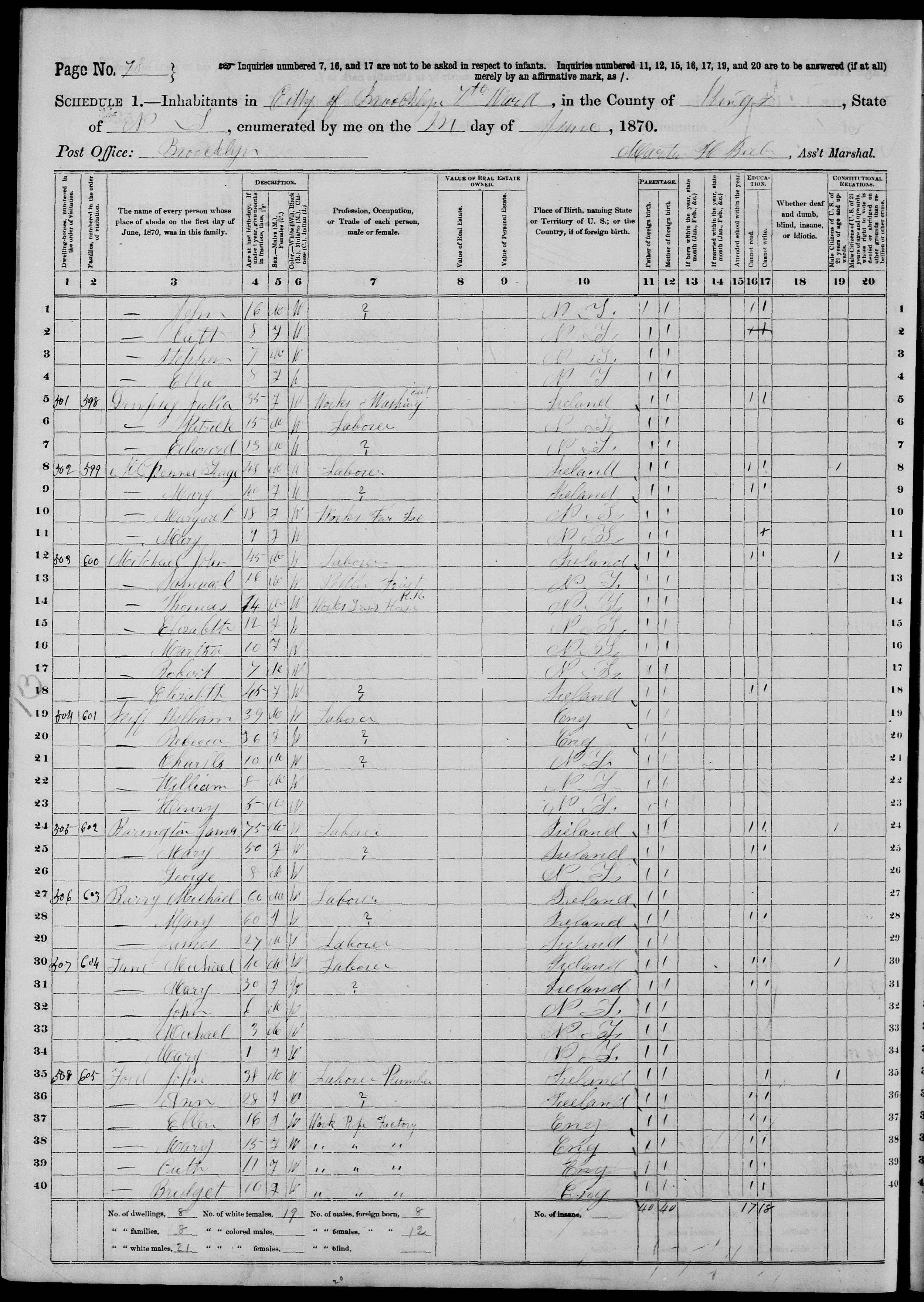
1860 & 1870 Census
Ward 7, Brooklyn — the family intact

1875 — NY State Census
Widow with two daughters, Graham St
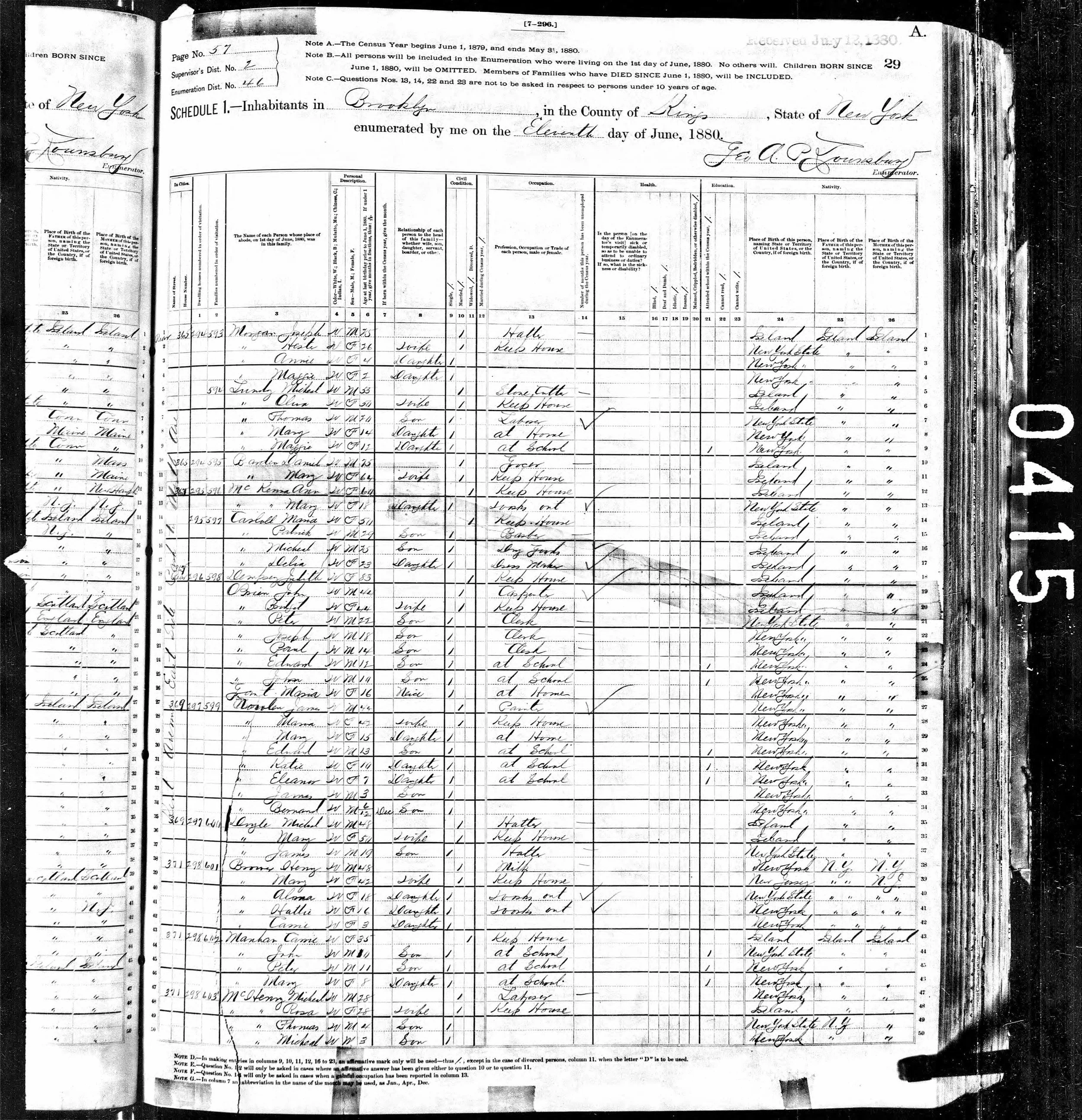
1880 — Federal Census
Ann and Mary F. at 367 Kent Avenue
1884 — Margaret's Death Cert
Daughter, age 33, consumption
1884 — Infant Margaret
Granddaughter, age ~6 months

April 1887 — Situation Wanted
Brooklyn Eagle, 847 Kent Avenue

Sep 1888 — Situation Wanted
Four months after Ann's death
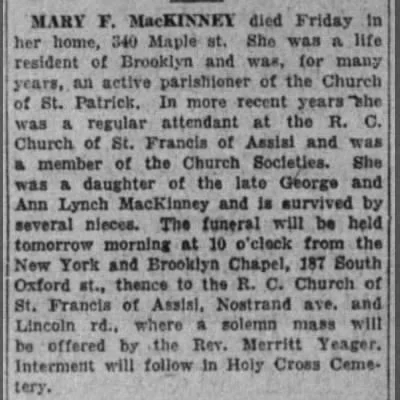
1935 — Mary F.'s Obituary
Names Ann Lynch as mother

1935 — Mary F.'s Death Cert
Parents: George & Ann Lynch
Ward 7 Map, 1893
Ann's Brooklyn neighborhood
847 Kent Avenue Today
The final address

Aunt Lillian's Cemetery Notes
The document that broke the brick wall
Lillian Ambrosio, 1991
The woman who paid perpetual care
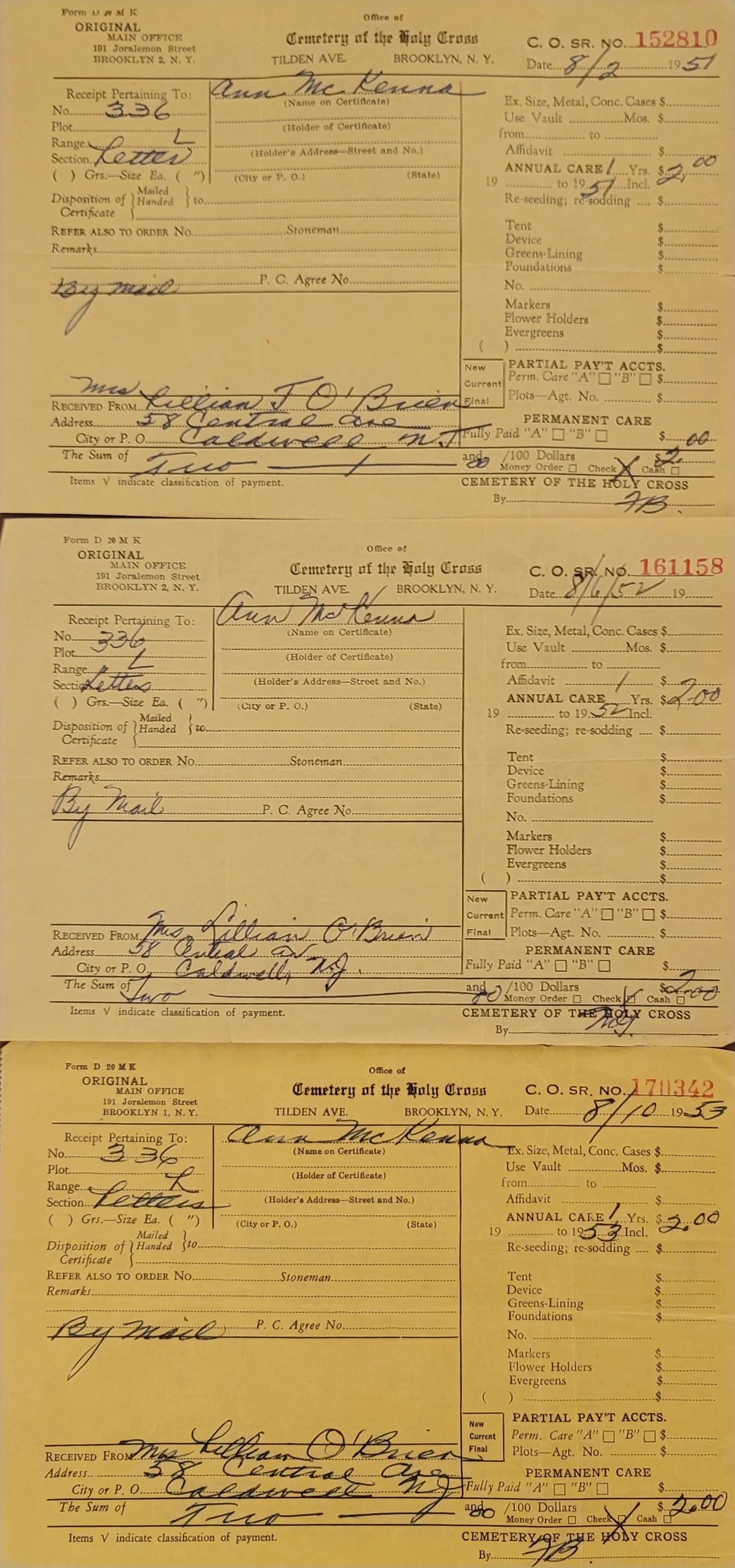
1951–1953 Care Receipts
Three years, paid by mail
1991 — Perpetual Care
120 years after Ann bought it
Are You Connected to the Kenny & McKenny Line?
If you descend from the Brooklyn Kenny family of the Mat Maker (also Kenney, Kinney; County Longford) or the McKenna / McKenny / MacKinney family of Ann Lynch and George McKenna — or from the connected Lynch, Corcoran, Heffernan, or Robertson lines — in Brooklyn, New Jersey, or Ireland, I’d like to compare notes. Documented trees, Brooklyn and Irish records, DNA matches, and old family photographs have all moved this research forward.
Get in Touch About This FamilyCousin connections are informal and reciprocal — no fee, no obligation, just shared work on shared ancestry.
Questions about your own research? Begin a research inquiry.
