
Marie Crête: The Daughter Who Carried the Line
Marie Crête
The Second Child, the Surviving Eldest Daughter
Marie Crête was born at Beauport on the sixth of October, 1657, and baptized at the parish church of Notre-Dame de Québec four days later. She was the second child of Jean Crête, master wheelwright, and Marguerite Gaulin, fille à marier of the Perche — born during the first decade of their forty-nine-year marriage, when the family was still expanding from one arpent of land at the Bourg de Fargy into the demi-seigneurial holdings that would mark her father's later years. She would live sixty-five years and three months, marry three men, bury six of her twelve children, sue her own brother-in-law for twelve hundred livres in 1700, and die at home in the Hôtel-Dieu epidemic that took her eldest daughter six weeks before her and her younger sister eight days after. She would be buried at Notre-Dame de Québec on November 10, 1722, the day after she died.
Her life sits at the documentary crossing of the Crête and Pepin lines on this site, and through her, the Bridault line that follows. The descent passes not through her first marriage to the master slate-roofer Robert Pepin, nor through her third to the Parisian Pierre Jourdain dit Bellerose, but through her second marriage to the Parisian master carpenter Jean Bridault — and specifically through the eldest daughter of that union, Marie Anne Bridault, baptized at Notre-Dame de Québec on July 26, 1688. The eleven-generation chain that runs from Marguerite Gaulin to the researcher of these notes passes through Marie Crête as its second link.
Three Marriages, Twelve Children: Marie Crête's documentary footprint is one of the densest in the early Canadian record for a non-elite woman. She is named in two notarial marriage contracts (1669 Vachon, 1705 Chambalon), three parish marriage acts (1670, 1687, 1706), twelve baptismal registers between 1675 and 1698, four separate civil lawsuits she initiated or pursued between 1700 and 1702 in the Provost's Court of Quebec, a 1707 surveyor's land partition near the Hôtel-Dieu of Quebec, a 1712 receipt for seigneurial dues paid to the Crown's farmer-general, and finally her own burial register entry of November 10, 1722. The portrait that emerges from these records is of a financially literate, legally assertive, and twice-widowed habitant woman who navigated three social class transitions — from rural Beauport farm wife to urban Quebec bourgeois household head to the wife of a soldier of the Marine — across the course of a single life.
The Baptism of October 10, 1657
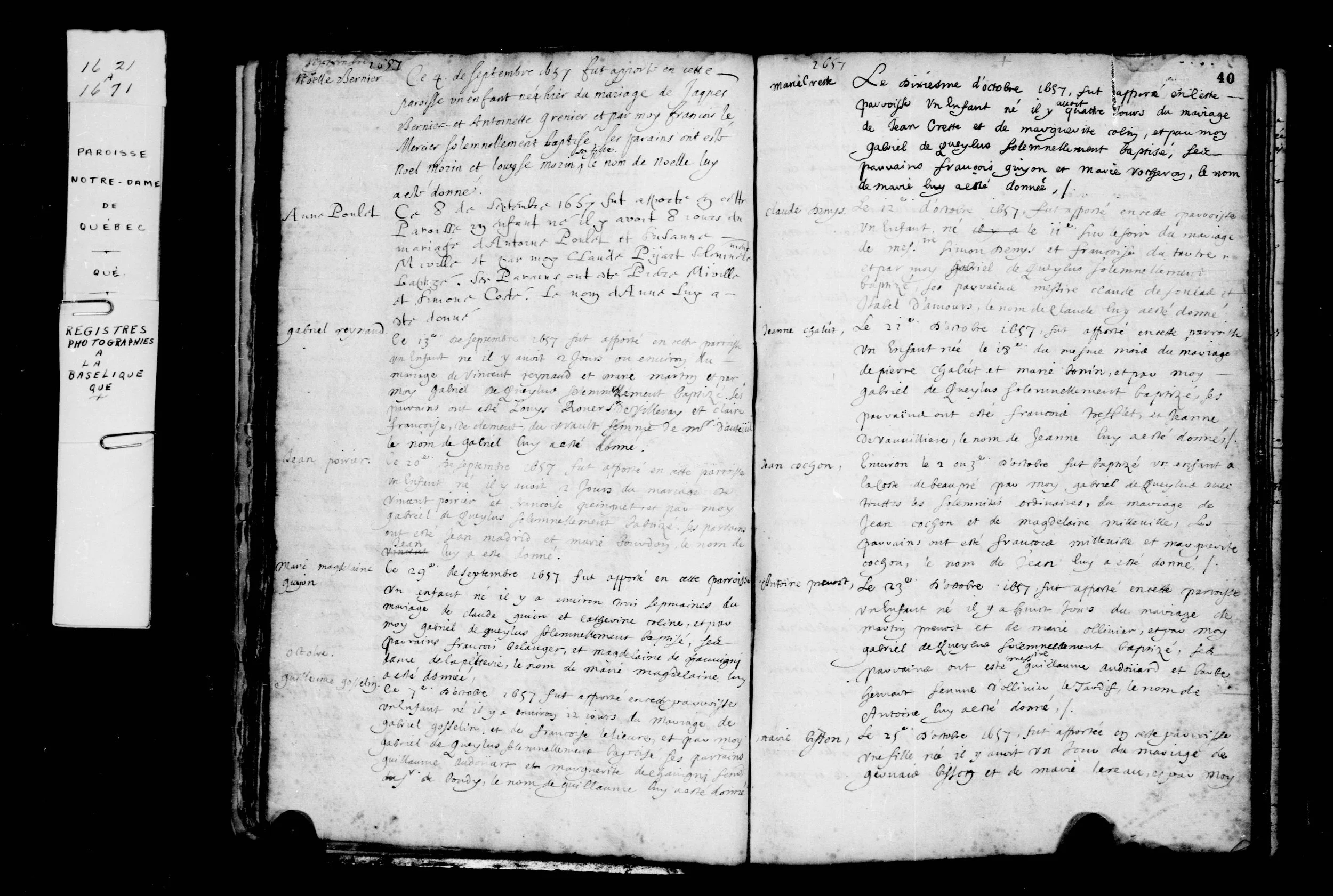
Marie Crête's baptism took place at the parish church of Notre-Dame de Québec four days after her birth — a rapid turnaround that reflected the standard infant-mortality precaution of seventeenth-century New France, where unbaptized children who died were believed to be barred from heaven. The officiating priest, Father Gabriel de Queylus, was no parish curate. A Sulpician, he had been named Vicar Apostolic of New France earlier in 1657 by the Archbishop of Rouen, in the long jurisdictional dispute with the Jesuits and the Bishop of Quebec that would not be settled until Bishop François de Laval's arrival in 1659. That a member of the Sulpician hierarchy presided over the baptism of an habitant's daughter at Notre-Dame de Québec was not unusual for the period — at this date the Jesuits and Sulpicians shared sacramental duties at the parish — but it set Marie's baptism within an ecclesiastical politics that would define the early Quebec church for a generation.
The register entry is brief, formal, and complete:
| Role in the act | Name as recorded | Note |
|---|---|---|
| Child baptized | Marie Creste | Born 6 October 1657; baptized four days later |
| Father | Jean Creste | Master wheelwright of Beauport |
| Mother | Marguerite Colin | Register rendering of Gaulin; the act does not use the Gaulin spelling |
| Godfather | François Guyon | Early settler of the Beauport district |
| Godmother | Marie Rocheron | Later Marie's aunt by marriage to François Gaulin |
| Officiant | Gabriel de Queylus | Recorded with the occupational designation prêtre |
Abstracted from the parish register entry and cross-checked against Programme de recherche en démographie historique (PRDH-IGD), baptism record no. 57636, Québec (Notre-Dame-de-Québec), 10 October 1657. The surname of the mother is given in the act as "Colin," a phonetic rendering of Gaulin that recurs across the family's early Beauport entries; the standardized form "Gaulin" is used in the narrative here and the register form retained in this abstract.
The godparents named in the entry both have documentary weight. François Guyon was an early settler of Beauport whose family was tightly woven into the Giffard seigneurial circle through which Marie's father had been integrated since his arrival on the Saint-Laurent. Marie Rocheron, more consequentially, would become Marie Crête's aunt by marriage. In the spring of 1657 — six months before this baptism — she had been a young unmarried woman of the Beauport district; she would not marry Marguerite Gaulin's brother François Gaulin until later in the decade, but the social bond was already in place. When Marie Crête's mother carried her infant daughter to the font at Notre-Dame de Québec, the godmother holding her was a woman who would become a Crête-Gaulin in-law by the time the child was old enough to remember her name. This pattern — godparenthood prefiguring kinship — is one of the documentary signatures of the Crête-Gaulin household in the first decade of its existence.
A Beauport Childhood, 1657–1669
Marie Crête's first twelve years are documentable only through the household around her — through the two royal censuses taken in 1666 and 1667, the baptisms of the eight siblings born after her, the notarial transactions her father conducted with neighbors, and the persistent appearance of the Giffard seigneurial family at the family's sacramental milestones. She herself does not appear in any document by name until the eve of her marriage at the age of eleven, when the notary Paul Vachon drew up her marriage contract at the Bourg de Fargy on June 29, 1669.
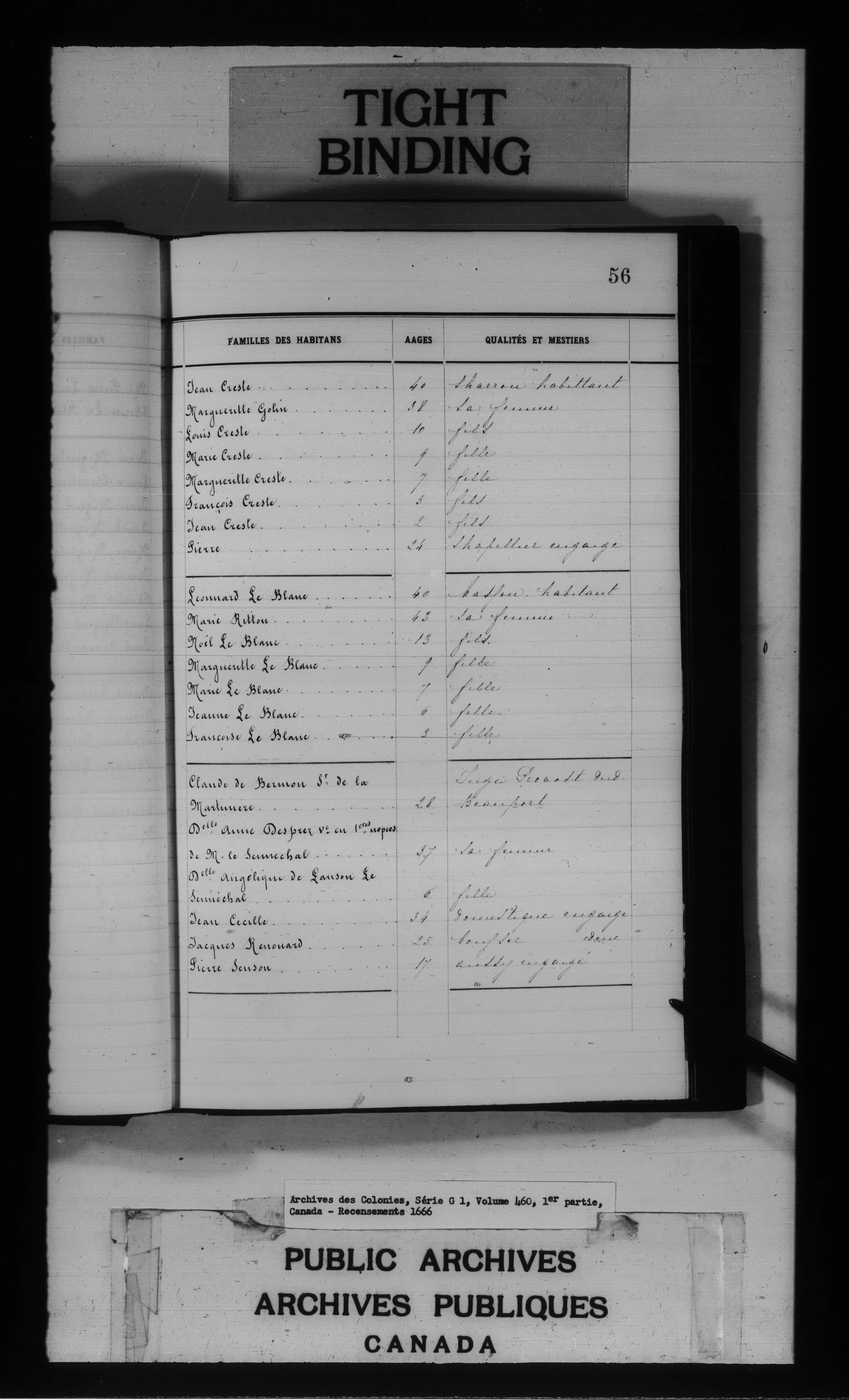
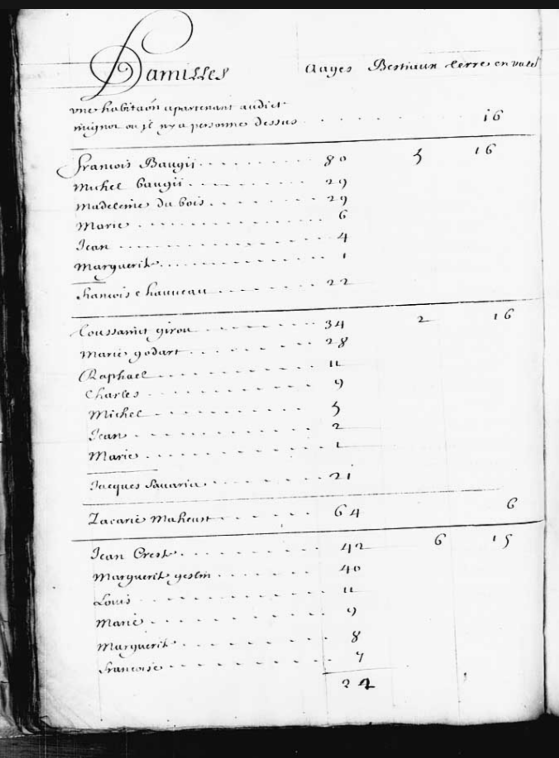
Of the household environment in which she grew up, however, much can be said. By the time of the 1666 royal census taken when Marie was nine, the Crête household at Beauport had become substantial enough to keep an indentured worker — Pierre Chapelier, age twenty-four, listed as chapellier engagé. The 1666 enumeration shows the household as follows: Jean Crête 40 (charron habitant), Marguerite Golin 38 (his wife), and five surviving children — Louis 10, Marie 9, Marguerite 7, "François" 5 (the census-taker's misrecording of Françoise, who would be correctly enumerated the following year), and Jean 2. One year later, the 1667 census added the infant Joseph at age one, recorded six head of livestock, and tallied fifteen arpents of cleared land — the working figures of a small mixed-husbandry farm.
Marie's siblings during her childhood years included her elder brother Louis (born 1656), her younger sister Marguerite the elder (born 1659 and baptized at the Giffard manor house by Father Paul Ragueneau S.J.), her younger sister Françoise (born 1660 and emergency-baptized at home by Robert Giffard himself, the seigneur of Beauport, when the infant lay in danger of death), and the younger brothers Jean II (born 1664) and Joseph (born 1666). The baptism of Joseph in May of 1666 was attended by the highest Beauport social circle of the period: officiated by Charles de Lauson de Charny, Grand Vicar of Bishop Laval; the godfather was Nicolas Juchereau Sieur de Saint-Denis, a Juchereau lord married into the Giffard family; the godmother was Michelle Thérèse Nau, wife of Joseph Giffard the seigneur. The Crête household by the end of Marie's first decade was networked into the Beauport seigneurial elite at the level of named children and godparent sponsorship — a position into which she herself would marry on the eve of her twelfth birthday.
The Marriage Contract of June 1669
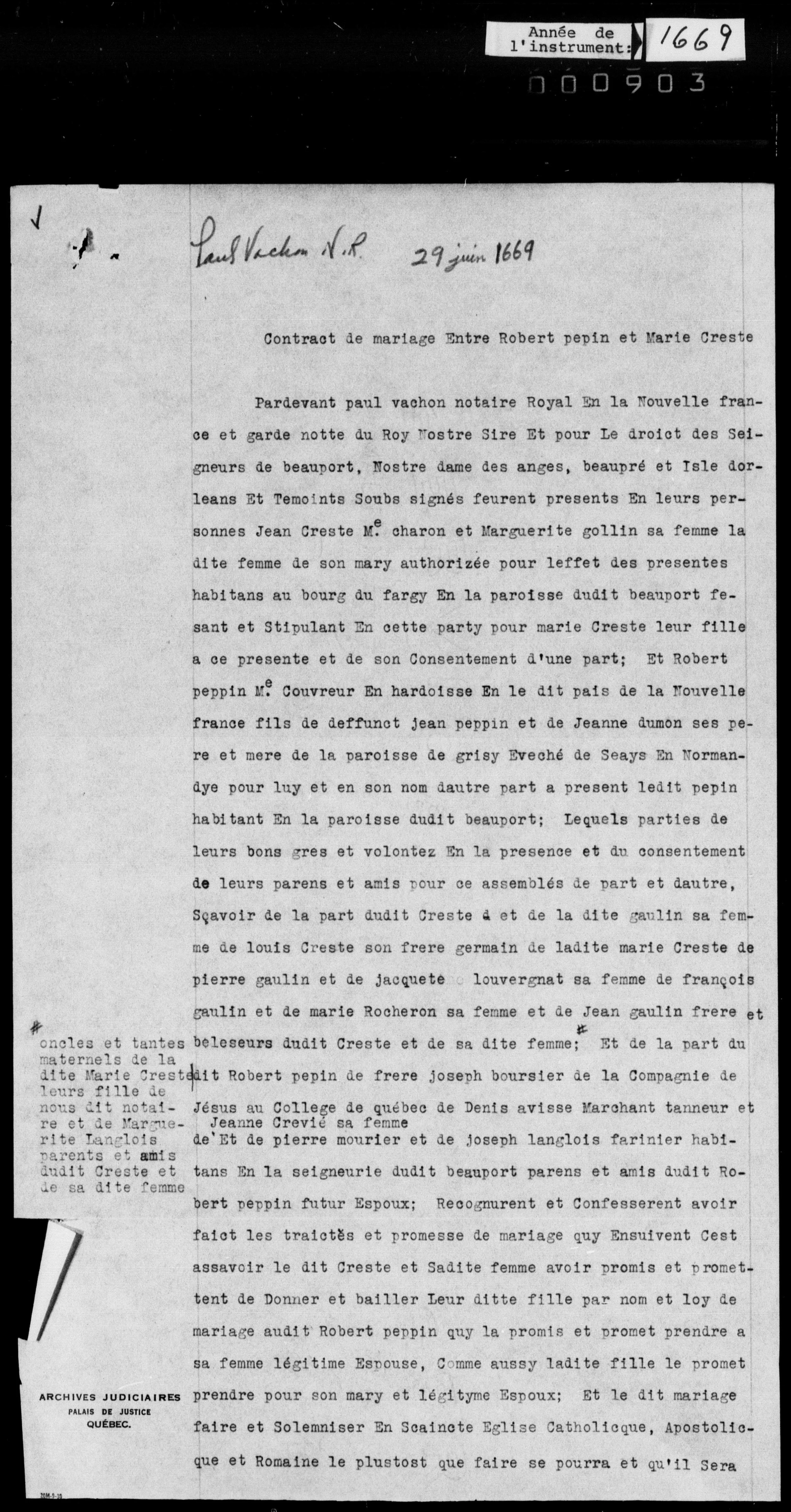
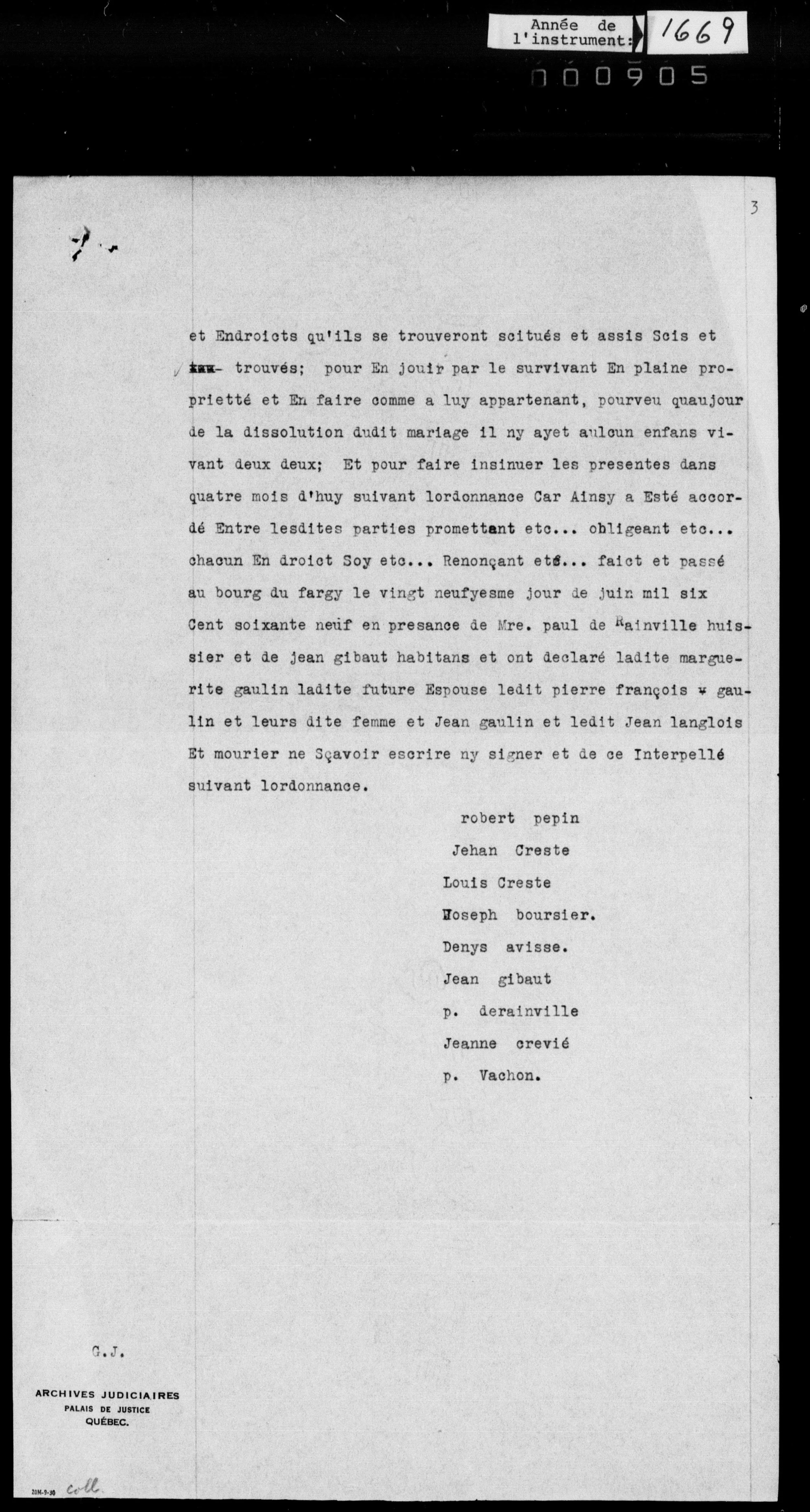
On the twenty-ninth of June, 1669, in the presence of Notary Paul Vachon at the Bourg de Fargy — the principal settlement of the seigneurie of Beauport, named through an inversion of "Giffard" — Marie Crête's marriage contract was drawn up. She was eleven years old, eight months and three weeks past her eleventh birthday, and would not turn twelve until the following October. The bridegroom, Robert Pepin, was a master slate-roofer of New France — described in the contract as M[aîtr]e Couvreur En hardoisse En le dit pais de la Nouvelle France — son of the late Jean Pepin and Jeanne Dumont of the parish of Grisy (St-Brice) in the diocese of Sées in Normandy. The Fichier Origine project of the Fédération québécoise des sociétés de généalogie identifies his birthplace more precisely as Grisy in the commune of Vendeuvre, department of Calvados, and places his first documented presence in New France in 1662, at approximately twenty-three years of age.
The contract is unusually rich in documentation of the wider Crête-Gaulin kin network. From the bride's side, named explicitly as witnesses and family of Marie Crête, are:
- Louis Creste, her elder brother (called son frere germain)
- Pierre Gaulin, her maternal uncle, and his wife Jacquette Louvergnat
- François Gaulin, her maternal uncle, and his wife Marie Rocheron — the woman who had been Marie Crête's own godmother at her 1657 baptism, and who in the interval had become her aunt by marriage
- Jean Gaulin, her maternal uncle (the third Gaulin brother who emigrated to New France)
From the bridegroom's side, the contract names Frère Joseph Pepin, identified as boursier de la Compagnie de Jésus au Collège de Québec — a Jesuit brother at the College of Quebec, Robert's own brother. Also named are the merchant-tanner Denys Avisse and his wife Jeanne Crevié, and the millers Pierre Mourier and Joseph Langlois of the seigneurie of Beauport — the cluster of "parents et amis" in support of the future groom.
The dowry items themselves form one of the most detailed material descriptions of an habitant household economy in the contract's period. From Jean Crête and Marguerite Gaulin, the bride received:
The Custom of Paris marriage regime was specified — community of property in movables, with a douaire préfix of six hundred livres tournois for the future wife. The promise to "feed and shelter their daughter for two years after her marriage" was added, a recognition that Marie at twelve was still a child by any reasonable standard, and that consummation and household formation would wait. Robert Pepin's brother Joseph Pepin, the Jesuit at the Quebec college, was present and signed the contract — the only literate member of either family party other than the notary and the witness Paul de Rainville himself. The contract closes with the marks and signatures of those present: Robert Pepin signed; Jean Crête signed; Louis Creste signed; the Jesuit Joseph Boursier signed; Denys Avisse signed; Jean Gibaut signed; Paul de Rainville signed; Jeanne Crevié signed; Paul Vachon as notary signed. Marguerite Gaulin and the bride Marie Crête declared they could not write or sign.
The sixteen-month interval between this contract and the eventual church wedding of November 4, 1670 is unusually long for the period and almost certainly reflects the parties' decision to wait for the bride to reach a more conventional age. Lebel and Laforest, writing in Our French-Canadian Ancestors Volume 3, observe that Marie's first surviving child Jean would not be born until September 1675 — five years after the wedding — and conclude that the marriage was probably not consummated for the first two years of its sacramental existence, in keeping with the parental promise of food and shelter recorded in the contract.
The Wedding of November 4, 1670
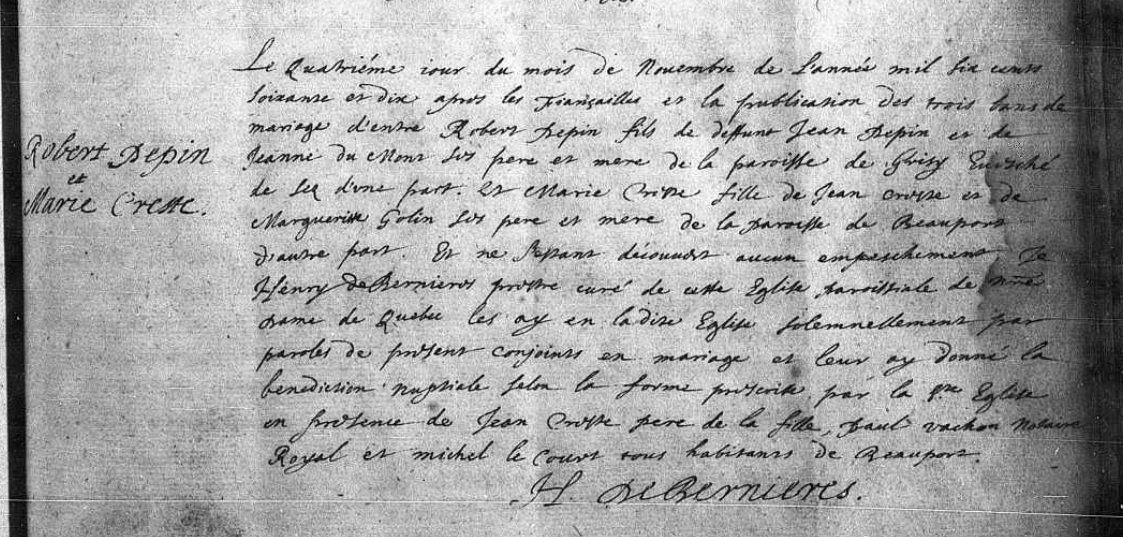
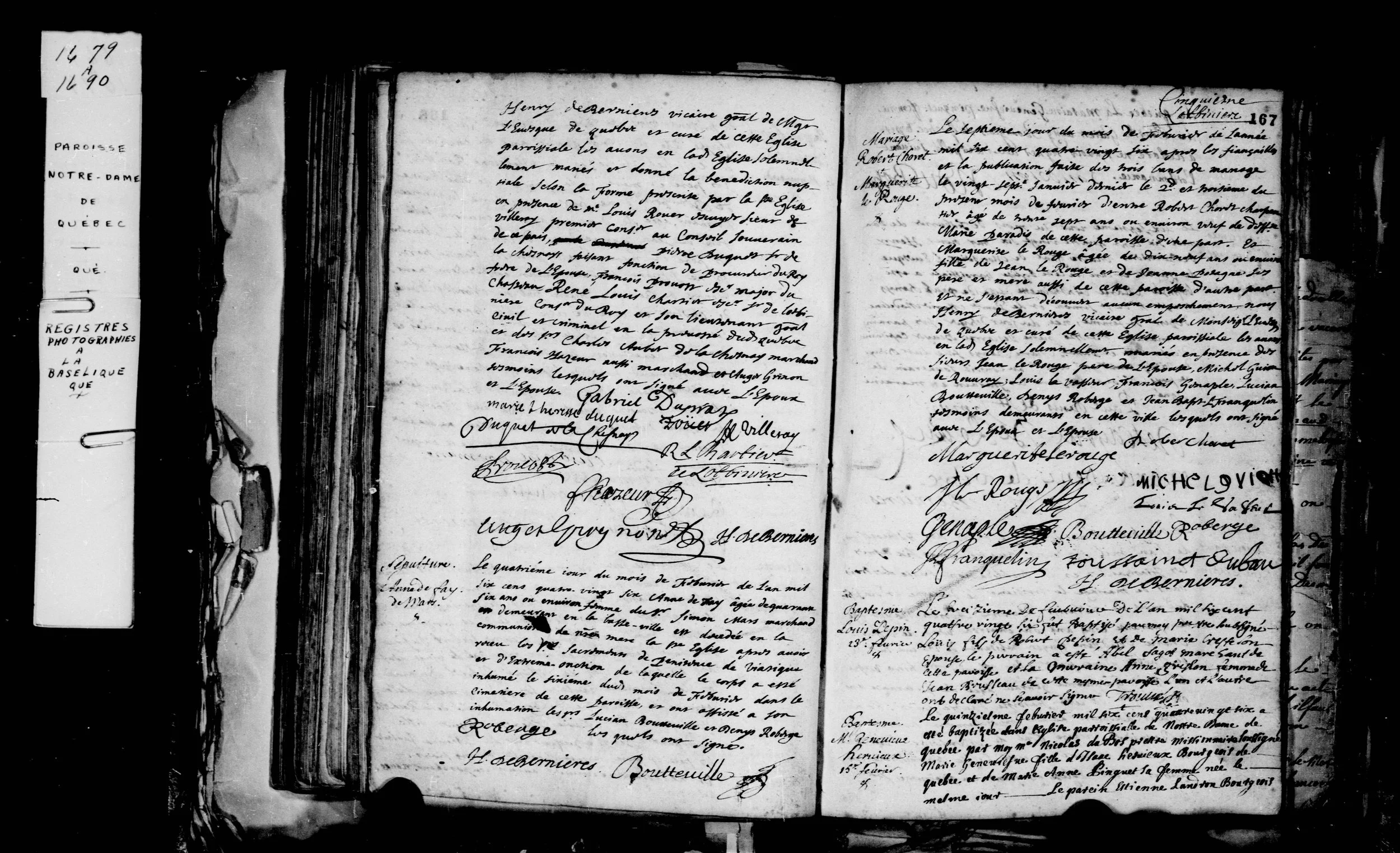
Sixteen months after the contract was signed, the church marriage of Robert Pepin and Marie Crête took place at the parish church of Notre-Dame de Québec on Tuesday, November 4, 1670. The officiating priest was Father Henri de Bernières, the curé of Notre-Dame and first superior of the Séminaire de Québec — the same priest who six years earlier had baptized Marie's brother Jean Crête II, and who would in the next two decades baptize most of the Pepin children. The witnesses named in the register were Paul Vachon, the Royal Notary of Beauport (who had drawn up the marriage contract); Michel Le Court, an habitant of Beauport; and Jean Creste — the bride's own father, who, the register specifies, was père de la fille. The latter detail is notable: in seventeenth-century French marriage acts, parental presence as a witness was not invariably named, and Jean Crête's explicit inclusion in the witness register marks the ceremony as a family event of formal significance.
The Notre-Dame de Québec register entry reads:
Marie was thirteen years old. Her husband was thirty-one, two and a half decades her senior. The age difference was unremarkable for the period — Robert Pepin, a master tradesman established in his profession, was at the standard age to begin family formation, and Marie at thirteen was at the lower boundary of marriageable age under both ecclesiastical and customary law. The early years of the marriage, as her parents had stipulated in the 1669 contract, were spent under the continuing protection of the Crête household at Beauport. Marie would not bear her first child until she was approaching her eighteenth birthday.
The Pepin Household, 1670–1686
Robert Pepin was a master tradesman whose profession is one of the more documentable specialties of the early Quebec building economy. The Fichier Origine record identifies his trade as maître couvreur d'ardoises — master slate roofer — and Lebel and Laforest in their 1979 chapter give a vivid description of him climbing the roofs of Quebec with "agile and firm step," covering the planks of the city with the slate that he had been trained to work in his native Calvados. His workshop was based at Beauport in the early years of the marriage, but as commissions accrued and his clientele extended into the parish of Notre-Dame de Québec proper, the household moved into the urban precinct. By the time of the 1681 royal census, Robert and Marie are listed in the upper town of Quebec rather than at Beauport, with two sons at home (Jean and Robert) and a servant named Nicolas living in.
His commissions across the 1670s and early 1680s — documented in the notarial protocols of Romain Becquet, Pierre Duquet, Michel Fillion, Gilles Rageot, and François Genaple — included work for the Ursulines of Quebec, the Récollets, the Fabrique of Notre-Dame-des-Anges at Beauport, and private contracts with figures including Élie Jean, Henri Delaunay (Marie's brother-in-law after 1679), Noël Boissel, Mathieu Ranuyer, Nicolas Brouillon, Adrien Sédillot dit Brisval, François Hazeur, Jean Gibaut, Pierre Dron, and Philippe Gaultier de Comporté. On December 12, 1674, Robert received a land grant from the Ursulines themselves; on December 20, 1682, he worked for the Récollets. The household was prosperous and rising.
The six children of the union were baptized between 1675 and 1686 — a relatively late start to childbearing, consistent with Marie's young age at marriage, but a typical interval thereafter. Of the six, four would survive to marry and have families; two would die in infancy.
| Child | Born / Baptized | Marriage | Death |
|---|---|---|---|
| Jean Pepin | 10 September 1675 · Notre-Dame de Québec | Marie Marguerite Moreau, 10 October 1695 · Notre-Dame de Québec | 30 December 1752 · Charlesbourg (St-Charles-Borromée) |
| Robert Pepin | circa 1678 · Beauport (Nativité-de-Notre-Dame) — register gap | (1) Marie Élisabeth Isabelle Royer, 16 November 1700 · St-Jean, Île d'Orléans; (2) Marie Anne Delasse | 12 May 1754 · Pierrefonds (Ste-Geneviève) |
| François Pepin (I) | 24 February 1680 · Beauport (Nativité-de-Notre-Dame) | — | 10 December 1680 · Beauport (age ~10 months) |
| François Pepin (II) | 3 January 1682 · Notre-Dame de Québec | — | 3 November 1684 · Notre-Dame de Québec (age ~22 months) |
| Marie Rose Rosalie Pepin | 3 June 1684 · Notre-Dame de Québec | Pierre Élie Breton, 5 July 1700 · Notre-Dame de Québec | 22 October 1721 · St-Vallier (St-Philippe-et-St-Jacques) |
| Louis Pepin | 13 February 1686 · Notre-Dame de Québec | Marie Anne Élisabeth Boutin, 17 November 1710 · L'Ancienne-Lorette (Notre-Dame-de-l'Annonciation) | 1 February 1774 · Charlesbourg (St-Charles-Borromée) |
Compiled from the Notre-Dame de Québec and Beauport (Nativité-de-Notre-Dame) parish registers, with dates and places of the children's later marriages and deaths verified against PRDH-IGD couple record no. 3460 (Pepin × Crête). The baptismal date of the second son Robert is not preserved; PRDH assigns the year 1678 as a reconstruction from a gap in the Beauport register, and it is carried here as an estimate rather than a documented date.
The two losses in the middle of the sequence — François the elder dying at ten months in December 1680, François the younger dying at twenty-two months in November 1684 — bear particular note. The second François had been named for the first, as was customary in seventeenth-century Catholic Quebec when an earlier-born child of the same name had died; the death of the second François at twenty-two months meant that Marie buried two sons of the same name within four years. The baptism of Louis in February 1686 came less than four months after the burial of the second François. The timing of the closing of the family — Louis would be Marie's last Pepin child — was determined not by her own choice but by the death of her husband that followed Louis's baptism by no more than six months.
The First Widowhood: February to August 1686
The death of Robert Pepin is one of the more precisely datable losses in Marie Crête's biographical record, despite the absence of his burial register entry from the surviving copies of the Notre-Dame de Québec sepultures. The Fichier Origine identification establishes the death window as falling between February 13, 1686 — the day after Louis's baptism, at which Robert appears as the living father — and August 11, 1686. Lebel and Laforest narrow this still further: on August 14, 1686, the notary Gilles Rageot drew up the posthumous inventory of Robert Pepin's property "for the heirs," which establishes that Robert had died no later than mid-August. The cause of death is not preserved in the surviving record. He was approximately forty-seven years old.
Marie Crête was twenty-eight. She had five living children — Jean, age ten; Robert, age eight; Marie Rosalie, age two; and Louis, age six months at the time of his father's death. Of the five, Jean and Robert were old enough to assist with chores; Marie Rosalie and Louis were dependent infants. The household economy that depended on Robert Pepin's slate-roofing commissions came to a halt with his death. Without inheritance documentation we cannot reconstruct the precise financial state of the household at his loss, but the Rageot inventory of 14 August 1686 — drawn for the heirs — suggests the standard procedure of separating Robert's personal estate from the marital community before any remarriage could occur.
The Origin Question: Two Databases Compared
Robert Pepin's Norman origin is recorded in two independent reference databases, and the two do not agree in every particular. Because the discrepancy has been reported elsewhere in a simplified form, the two readings are set side by side here.
| Element | PRDH-IGD no. 61361 | Fichier Origine no. 380055 |
|---|---|---|
| Status | Immigrant | Immigrant (researcher: Denise Gravel) |
| Birth year | Circa 1643 | Circa 1639 |
| Birthplace | Grisy, diocese of Sées, Normandy — with the arrondissement given as Caen, Calvados | Grisy (St-Brice), commune of Vendeuvre, Calvados |
| Parents | Jean Pepin and Jeanne Dumont | Jean Pepin and Jeanne Dumont, married 5 July 1633 at Grisy (St-Brice) |
| Trade at arrival | Not stated | Maître couvreur d'ardoises (master slate roofer) |
| Siblings | Not stated | An unnamed brother baptized at Grisy 8 September 1634; a brother Louis Pepin, who married Catherine Campron |
| First mention in Canada | Not stated | 1662 |
| Marriage to Marie Creste | 4 November 1670, Québec (Notre-Dame-de-Québec) | Not the subject of the record |
| Death | Not stated | Between 13 February and 11 August 1686 |
The two sources agree on the parish (Grisy) and on the department (Calvados) — PRDH already carries the Calvados arrondissement alongside the ecclesiastical diocese of Sées, so Fichier Origine refines rather than contradicts the location, adding the commune of Vendeuvre and the St-Brice dedication. The genuine divergence is the birth year: 1643 in PRDH against circa 1639 in Fichier Origine. The Fichier Origine reading is preferred here because it rests on direct examination of the French parish register, including the parents' 1633 marriage act; the PRDH year is a reconstruction from stated ages in Canadian records. Neither figure has been verified against the Grisy baptismal register by this researcher, and the birth year is accordingly carried as approximate.
Marie did not remain a widow long. By the autumn she was negotiating her second marriage; on October 6, 1686 — less than two months after the Rageot inventory — the notary François Genaple drew up the marriage contract for her engagement to a master carpenter recently arrived from Paris. The interval between Robert's death (between mid-February and mid-August 1686) and the Brideau contract (October 6, 1686) was at most six months and may have been considerably less. The church wedding would follow seven months later, in April 1687.
The relative speed of the remarriage reflected economic necessity rather than haste of feeling. A young widow with four dependent children, in a colonial economy in which widowhood without male support was structurally precarious, had every practical reason to remarry within the customary year of mourning. The Genaple contract and the subsequent wedding were not a betrayal of Robert's memory; they were the standard pattern of a frontier society in which the loss of a male provider required immediate replacement to keep a household intact.
The Bridault Marriage of April 1687
The second husband of Marie Crête was Jean Bridault (variously rendered Brideau, Bridau, Bridaut in the surviving registers), a master carpenter and immigrant from the parish of Saint-Martin du Pont in the town of Montmorency, in the diocese of Paris. Born around 1659 — making him approximately twenty-seven at the time of the contract, two years younger than Marie at twenty-nine — he was the son of Jean Brideau, also a charpentier of Montmorency, and the late Marthe du Clos. His occupational status as charpentier at the time of marriage would, over the eleven years of the union, ascend through colonial Quebec's social hierarchy into the formal designation of bourgeois by the time of Louise Catherine's baptism in January of 1698.
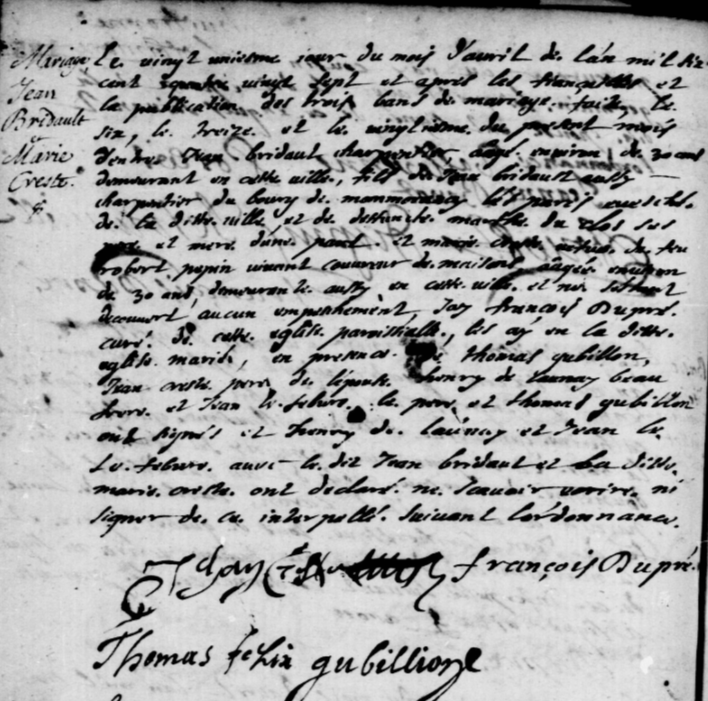
The marriage contract of October 6, 1686 was drawn up by the notary François Genaple at Quebec, six weeks after the posthumous inventory of Robert Pepin. The church wedding followed on April 21, 1687, at the parish of Notre-Dame de Québec, officiated by Father François Dupré, the parish curé in the post-Bernières period. The witnesses named in the register include Thomas Gubillon, Henri de Launay (named explicitly as beau-frère of the bride — her brother-in-law through her sister Françoise's 1679 marriage), and Jean Lefebvre (who would marry Marie's younger sister Marie II two years earlier in 1685, making him also her brother-in-law). The Crête sibling network was present as the structural framework of the wedding.
Marie was thirty (twenty-nine and a half, in fact — six months past her twenty-ninth birthday); Jean was approximately thirty. Both were at the standard age for first or second marriage in the colonial demographic structure. Marie brought to the marriage four surviving Pepin children — Jean age eleven, Robert age nine, Marie Rosalie age three, Louis age one — together with whatever portion of the Pepin estate had not been claimed by Robert's heirs in the August 1686 settlement.
The household established at the marriage was initially at Beauport, where Louis Pepin had been born. Over the eleven years of the union, however, it would shift definitively to the upper town of Quebec. The 1691 baptism of their daughter Marie names the residence as "Haute Ville"; the 1698 baptism of Louise Catherine names Jean Bridault as "Bourgeois" rather than "Charpentier." The transition from artisan to bourgeois — from a man identified by his hand-trade to a man identified by his urban civil status — completed itself during the eleven years of Marie's second marriage.
The Bridault Children, 1688–1698
Six children were born of the Crête-Bridault union across the eleven years of the marriage — a slightly denser interval than the Pepin sequence, reflecting Marie's full reproductive maturity. Of the six, five would survive infancy; one would not.
| Child | Born / Baptized | Marriage | Death |
|---|---|---|---|
| Marie Anne Bridault (descent line) | 26 July 1688 · Notre-Dame de Québec | Joseph Morin, 4 November 1704 · Notre-Dame de Québec | 23 September 1722 · Québec (Hôtel-Dieu) |
| Marie Bridault | 25 May 1691 · Notre-Dame de Québec (Haute-Ville) | Claude Vandandaigue Gadbois, 5 November 1708 · Beauport (Nativité-de-Notre-Dame) | 30 March 1776 · Laval (St-François-de-Sales) |
| Jean Hilaire Bridault | 28 August 1692 · Notre-Dame de Québec | Marie Josephe Paquet Pasquier, 3 September 1716 · Notre-Dame de Québec | 5 May 1757 · St-François-de-la-Rivière-du-Sud |
| Jean Baptiste Bridault | 30 September 1694 · Notre-Dame de Québec | — | 20 October 1694 · Notre-Dame de Québec (age 3 weeks) |
| Marie Françoise Jeanne Bridault | 25 October 1695 · Notre-Dame de Québec | Raymond Guay Castonguay, 10 June 1716 · Notre-Dame de Québec | 23 November 1723 · Notre-Dame de Québec |
| Louise Catherine Bridault | 28 January 1698 · Notre-Dame de Québec | Charles Remoneau Tourangeau, 24 July 1717 · Notre-Dame de Québec | 29 August 1744 · Notre-Dame de Québec |
Compiled from the Notre-Dame de Québec parish registers, with the children's later marriages and deaths verified against PRDH-IGD couple record no. 5885 (Bridault × Crête). Two cautions on that record: its English-language interface renders the second daughter's given name as "Married" and the fourth child's as "John the Baptist," both machine artifacts of the display rather than readings of the act; and it normalizes the youngest daughter to "Marie Louise" where the baptismal register gives Louise Catherine. The register forms are used here.
The eldest child of the union, Marie Anne Bridault, is the daughter through whom the line descends. Born at Quebec in July 1688, she would marry Joseph Morin on November 4, 1704, in a wedding at which her half-brother Jean Pepin — Marie Crête's eldest son from her first marriage, then twenty-nine — stood explicitly as witness alongside her uncle Pierre Crête. The Morin-Bridault couple would produce twelve children of their own across an eighteen-year marriage before Marie Anne's own death in September 1722 at the age of thirty-four — six weeks before the death of her mother.
The fourth child, Jean Baptiste Bridault, lived only three weeks. He had been baptized at Notre-Dame de Québec on September 30, 1694, with Marie Crête's eldest son Jean Pepin — then nineteen — standing as his godfather. The pairing is a documentary moment of significance: Marie's eldest surviving son from her first marriage sponsoring his half-brother from her second marriage, the two boys nineteen years apart in age. Three weeks later, the infant Jean Baptiste died and was buried at the parish on October 20, 1694. He was the only Bridault child Marie would bury.
The naming of the youngest child of the union, Louise Catherine — for the godparents Jacques Thierry, secretary to the officers of the Compagnie, and Louise Catherine Denys of the Denys colonial-administration family — reflects the social ascent of the Bridault household by January 1698. The 1698 baptism is the one in which Jean Bridault is for the first time identified in the register as bourgeois rather than charpentier. The household had moved from artisan to urban civil status.
Second Widowhood and Legal Agency, 1699–1706
On the seventh of June, 1699, Jean Bridault died at the Hôtel-Dieu de Québec, the colony's principal hospital. He was forty years old. The PRDH-IGD burial extract (no. 73007) renders him as Xxxxx Brido, age forty — the placeholder "Xxxxx" being the database's convention for a given name not stated in the act itself — and places the burial at the Hôtel-Dieu. Marie was forty-one. She had six surviving children, ranging from Marie Anne age eleven to Louise Catherine age sixteen months. The Bridault household — by then prosperous urban bourgeois — was again decapitated by the loss of its male head.
What followed across the next six and a half years is one of the most documentarily rich portraits of a widow's agency in the seventeenth-century Quebec record. Where most habitant widows of the period vanish from the surviving registers between their husband's death and their remarriage, Marie Crête appears repeatedly in the civil court records of the Provost's Court of Quebec, the seigneurial bailiwick of Notre-Dame-des-Anges, and the notarial protocols of the period. She is plaintiff, not defendant, in every case; she is named with her own legal standing as veuve de feu Jean Bridault; and she is pursuing money owed to her with unmistakable persistence.
The Delaunay Litigation, December 1700
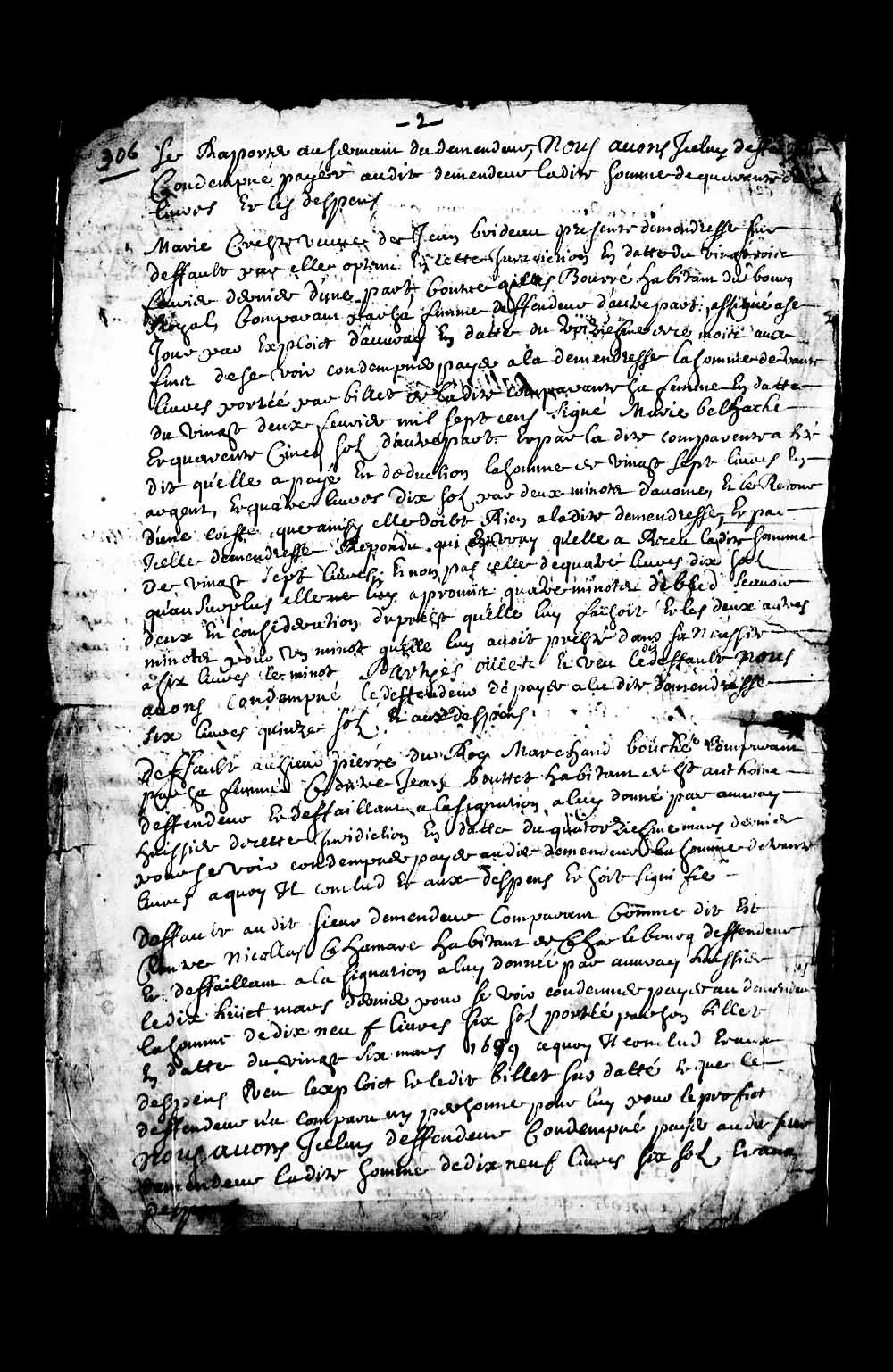
On December 4, 1700 — eighteen months after Jean Bridault's death — Marie Crête caused a summons to be served upon Henri Delaunay (de Launay), her own brother-in-law through her sister Françoise's marriage of 1679. The summons concerned twelve hundred livres tournois — twice the value of Marie's original 1669 douaire préfix, and a substantial sum by the standards of the colonial economy. The bailiff served the writ on Delaunay at his Quebec residence, demanding his appearance before the Lieutenant General of the Provost's Court of Quebec.
The case was heard ten days later, on December 14, 1700. The Lieutenant General — sitting at the Provost's Court of Quebec — dismissed the parties from court with an order of "prohibitions against mistreating and slandering each other" (défenses de se maltraiter et de se diffamer). The phrasing of the dismissal is telling: it implies that the dispute between the brother-in-law and the widowed sister-in-law had reached a level of mutual verbal hostility severe enough that the court required a judicial restraint. The three-page order, preserved at the BAnQ across recto and verso of two folios in the Fonds Cour de la Prévôté de Québec, captures the proceedings of a longer sitting at which several disputes were heard in sequence — the Crête/Delaunay matter appearing in the middle of the day's docket alongside cases involving Gabriel Dupré, Alexandre Pirot, and others. Marie's portion of the order is centered on the second page, in the clerk's notation: "Marie Crette veufve de Jean Bridault demande[ress]e, Henry de Launay clerc[?] deffendeur, attendu que par exploit de mercredy [4 décembre] dernier..." The court then sets the parties to swearing their respective accounts within three days and dismisses both with the mutual prohibition. The merits of the 1200-livre claim are not resolved in the surviving documentation; what is preserved is the procedural conclusion that the parties be sent home with mutual gag orders and a recitation of accounts. (Original BAnQ instruments: TL5, D277-120 for the summons of December 4, two pages; TL5, D277-125 for the December 14 order, three pages.)
The Bourret Judgments, 1702
The Delaunay matter unresolved, Marie next turned her legal attention to Gilles Bourret, a resident of Bourg-Royal owing her a smaller debt. On February 27, 1702, the Provost Judge Michel Lepailleur granted Marie Crête a default judgment against Bourret — the latter having failed to appear at the appointed sitting (BAnQ TL5, D2788-1). Three months later, on May 31, 1702, the matter proceeded to a substantive ruling: a judgment for Marie Crête, the court ordering Bourret (through his wife, who appeared on his behalf) to pay her six livres and fifteen sols (BAnQ TL5, D2785-5).
The Bourret sum was financially modest — about a week's wages for an unskilled laborer — but the procedural sequence is striking. Marie pursued the case from initial filing through default judgment to final adjudication across three months of court appearances, all in her own name as widow of Jean Bridault, and emerged with a court order compelling payment. Considered alongside the 1200-livre Delaunay matter, the two cases together establish Marie as an active litigant in the Provost's Court of Quebec across 1700–1702 — taking the legal initiative, naming defendants by name, pursuing claims of varying scale, and willing to take her own kin to court.
The Pepin Estate Settlement, June 1705
By the spring of 1705, Marie was forty-seven years old and beginning to prepare for a third marriage. Before that marriage could proceed, however, the residual estate of her first husband — Robert Pepin, dead nineteen years — required final settlement among his surviving children. On June 10, 1705, in the offices of the notary Chambalon at Quebec, a formal arbitration was concluded between Marie Crête and the heirs of the late Robert Pepin. The arbitration finalized the accounts of the Pepin marital community, settled the surviving children's claims to their father's estate, and freed Marie to remarry without continuing obligation to the Pepin succession.
The Third Marriage: Pierre Jourdain dit Bellerose, January 1706
Marie's third and final husband was Pierre Jourdain dit Bellerose, a Parisian-born soldier of the colonial Marine. Born about 1676 in the parish of Saint-Jacques-de-la-Boucherie in the fourth arrondissement of Paris, he was the son of Pierre Jourdain and Catherine Dupuis. He had arrived in the colony probably in his late teens or early twenties as a soldier in the Compagnies franches de la Marine, the regular military force maintained in New France under the authority of the Ministry of the Marine. By 1706 he had reached the rank of caporal and was stationed at Quebec.[1]
Pierre Jourdain came to the marriage with one prior child of his own, born outside wedlock five years before he met Marie. Marie Rose Rosalie Jourdain, born December 31, 1701, and baptized at Montreal (Notre-Dame), was acknowledged by Pierre as his natural daughter in the PRDH-IGD record (no. 37271). She would survive, marry Joseph Savaria at Varennes (Sainte-Anne) on October 3, 1718, and live until November 17, 1760, dying at Verchères. Marie Crête, then forty-eight, took on by marriage not only her new husband's surname but the structural fact of his prior parental responsibility.
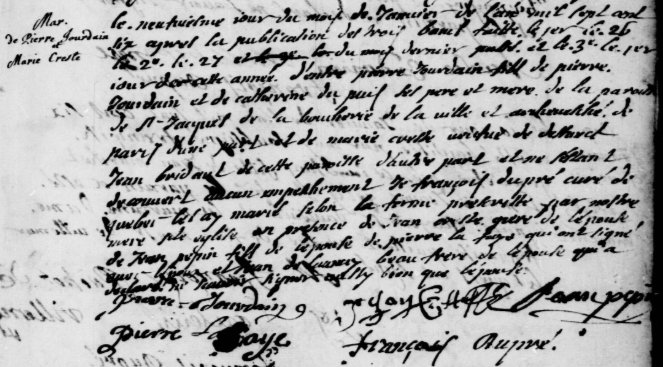
The marriage contract was signed on December 20, 1705, before a royal notary at Quebec — the contract an earlier research log had read in part as carrying the family name "Soudain"; the PRDH marriage extract (no. 67784), the Notre-Dame de Québec register itself, the surviving signatures of Pierre Jourdain in the 1707 land partition and the 1712 lots-et-ventes receipt, and the secondary work of Lebel and Laforest all consistently render the name as Jourdain, and that reading is here adopted as authoritative. The church wedding followed on January 9, 1706 — twenty days after the contract — at Notre-Dame de Québec, officiated again by Father François Dupré, the same priest who had married Marie to Jean Bridault nineteen years earlier and would bury her sixteen years later.
The witness clause names Jean Pepin — Marie's eldest son, then thirty years old, married eleven years, father of his own family — standing at his mother's third wedding as the principal family witness on her side. The pattern of Jean Pepin's continuous presence at his mother's documentary milestones, established at the 1694 baptism of his half-brother Jean Baptiste Bridault and the 1704 wedding of his half-sister Marie Anne Bridault, completed itself here at Marie's own third marriage. The eldest son from the first marriage stood at every major sacrament of his mother's life across the second and third marriages — the connective tissue of a family across three husbands and twelve children.
Marie was forty-eight. Pierre was approximately thirty — eighteen years her junior. The age difference was not unusual for a marriage between an older widow with established property and a younger soldier in need of household stability, but it was the inverse of the age structure of her first marriage thirty-five years earlier, when she had been thirteen and Robert Pepin had been thirty-one. The two unions bracketed her life in mirror image.
Property and Continuity, 1706–1722
The sixteen and a half years of Marie Crête's third marriage produced no children of her own — Pierre Jourdain was eighteen years her junior, but Marie was past childbearing age at forty-eight — but they did produce a continuous documentary footprint of urban property ownership, seigneurial dues, and family business across the closing chapters of her life. Two documents in particular establish the household's property position during the Jourdain years: the 1707 surveyor's land partition near the Hôtel-Dieu, and the 1712 receipt for seigneurial dues paid to the Crown's farmer-general.
The 1707 Land Partition: Marie and the Pepin Heirs
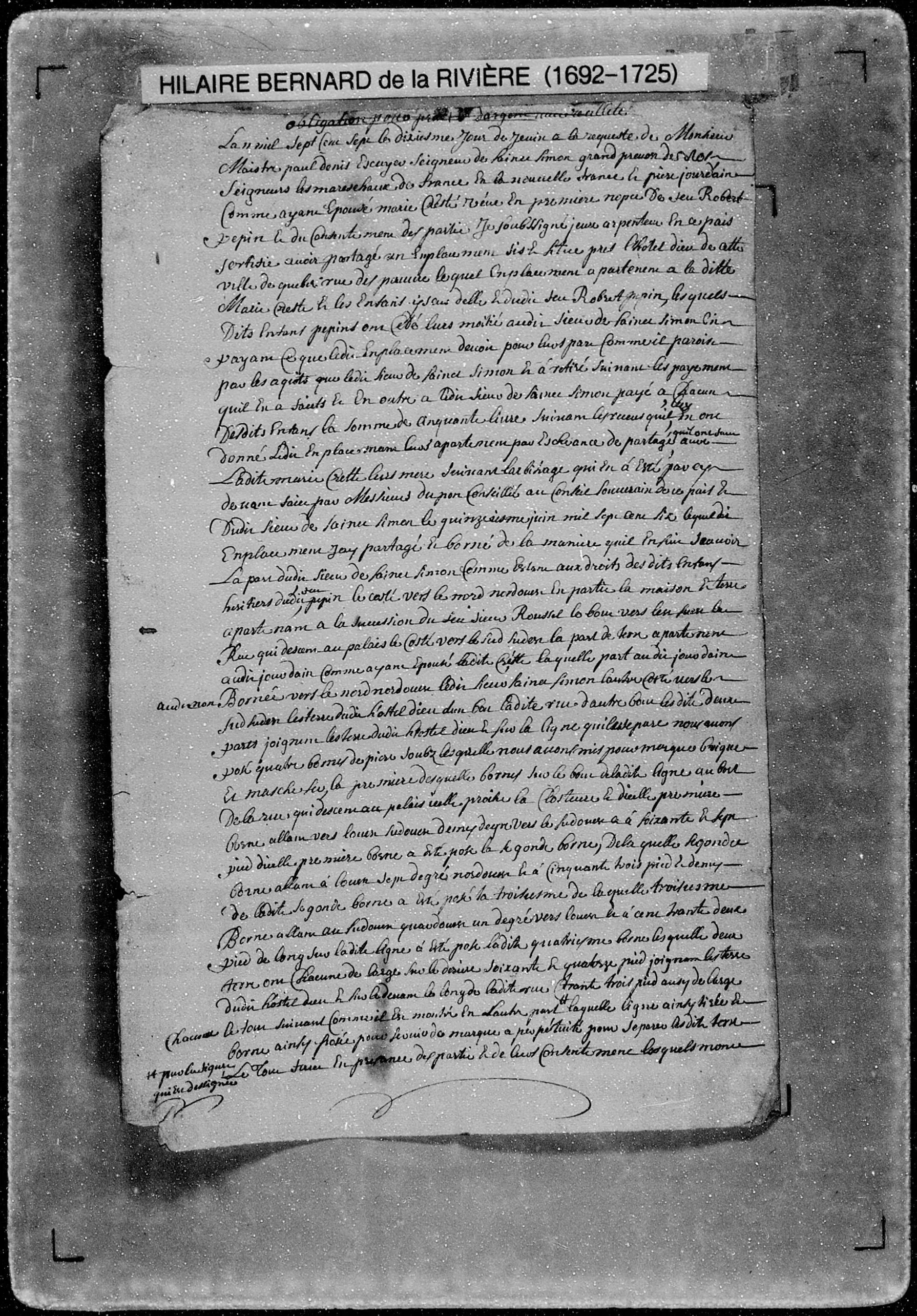
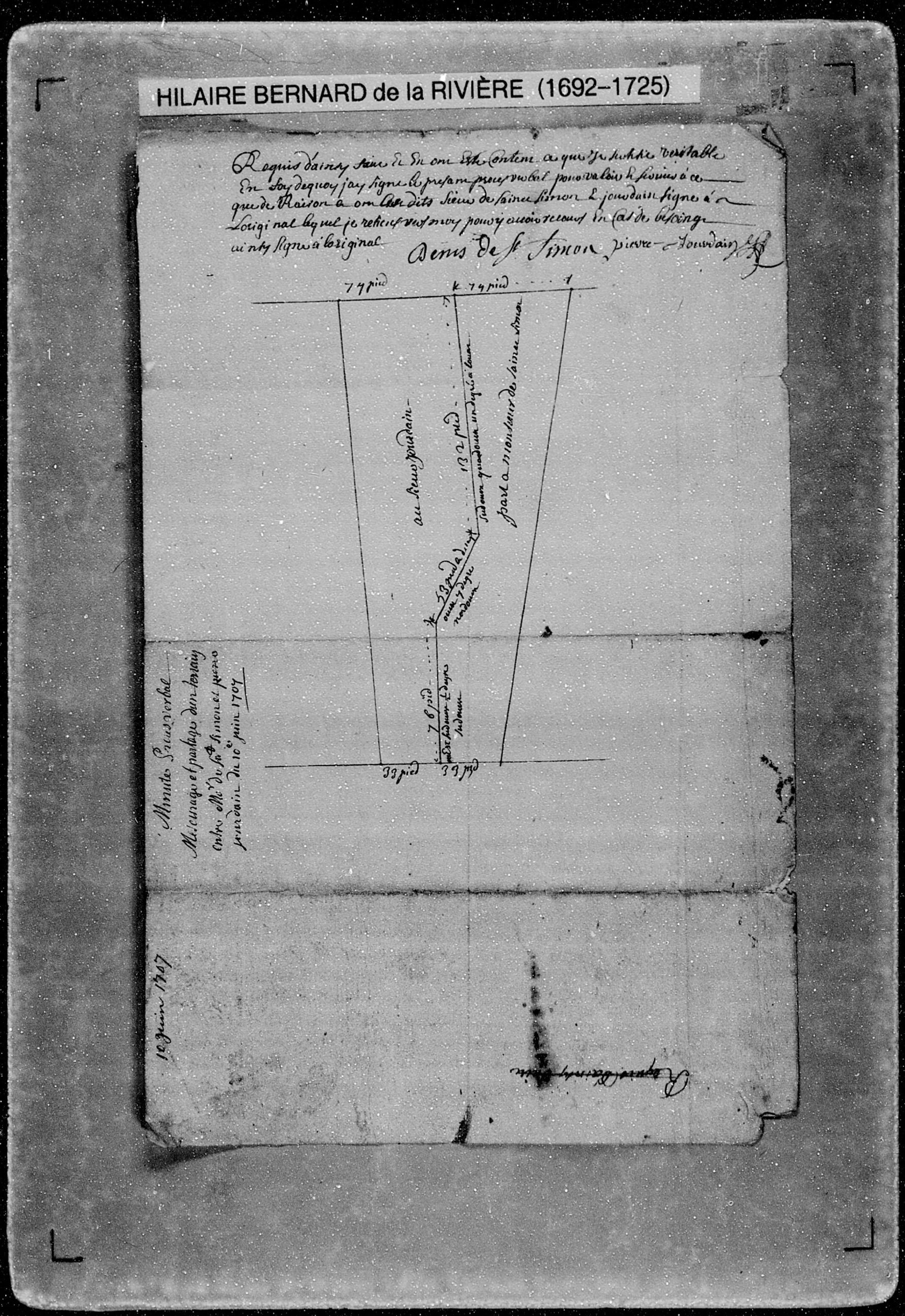
On June 10, 1707, the surveyor Hilaire Bernard de la Rivière drew up a formal partition (procès-verbal de partage) of an urban property lot at Quebec, located near the Hôtel-Dieu de Québec, on the Rue des Pauvres and the street descending to the Palais. The lot had been the property of Marie Crête and the children of her late first husband Robert Pepin — the Pepin children's residual share in the marital community of their parents. By the time of the 1707 partition, the Pepin children had collectively sold their half-interest in the lot to Master Paul Denis, Esquire, Sieur de Saint-Simon, Grand Provost of the Marshals of France in New France — one of the more elevated civil officers of the colonial administration. Saint-Simon had paid each of the four surviving Pepin heirs the sum of fifty livres for their share, and the 1707 partition served to bound and measure the resulting two parcels.
The surveyor's hand-drawn map (preserved in the BAnQ Greffes d'arpenteurs, CA301, S56, P149) shows the lot as two roughly trapezoidal parcels separated by a boundary line, with Pierre Jourdain's portion (76 pieds frontage) bordered on one side by the lands of the Hôtel-Dieu and on the other by Saint-Simon's portion (132 pieds frontage). The boundary stones were laid in the surveyor's presence; the parties — Pierre Jourdain "as having married the said Crête" and the Sieur de Saint-Simon "as exercising the rights of the said Pepin heirs" — signed the partition.
The document is structurally important for the Marie Crête biography in three ways. First, it establishes that Marie owned urban Quebec property at the time of her third marriage — property she had inherited as the surviving member of the Pepin marital community, separate from the Bridault marital community that had been settled at Jean's death in 1699. Second, it establishes that Marie's Pepin children had been bought out of the lot in or around 1706, around the time of her third marriage — likely as part of the broader Pepin estate settlement that the Chambalon arbitration of June 1705 had also concluded. Third, it establishes that after 1706 the lot was jointly owned by Marie and her third husband — the urban property record of the Jourdain household sits on top of the Pepin inheritance Marie carried into her third marriage.
The 1712 Receipt for Seigneurial Dues
Five years later, on October 24, 1712, Pierre Jourdain and Marie Crête appeared before the office of the Fermier-Général des Domaines d'Occident — the Crown's farmer-general for the Western Domains, the Crown agent who collected the seigneurial dues on property transactions in royal lands. They paid the sum of sixty livres plus accessory fees for the lots et ventes (the seigneurial transfer tax) and the droits de saisie (seizure fees) on an urban property they had recently acquired from André Arnaud and his wife Marie Charlotte Arnaud. The receipt is preserved at the BAnQ (E1, S4, SS1, D224, P3) and represents the Crown's acknowledgment of payment for the transfer of the Arnaud property into the Jourdain-Crête marital community.
The 1712 receipt thus extends the property-record of the Jourdain marriage by an additional acquisition: beyond the lot near the Hôtel-Dieu that Marie had carried into the marriage from her Pepin first union, the couple had also acquired the Arnaud property and paid the Crown's transfer tax on it. Marie was an active urban property owner across her third marriage, jointly with Pierre Jourdain.

The Mortality of 1722: A Mother and Her Daughter, Seven Weeks Apart
The closing months of Marie Crête's life sit inside a documented mortality crisis in the colony — a disease wave at Quebec during the autumn of 1722 that has been variously attributed by historians to typhus or to a returning smallpox outbreak, the precise pathogen not securely identifiable from the surviving parish records. What is securely identifiable is that within seven weeks of that autumn, Marie Crête and her eldest daughter both died: Marie Anne Bridault at the Hôtel-Dieu de Québec on 23 September, and Marie herself at Quebec on 9 November.
The first to die was Marie Anne Bridault, Marie Crête's eldest daughter and the descent-line carrier. She died at the Hôtel-Dieu on September 23, 1722, at the age of thirty-four. She left behind eight surviving children of her own — the eldest, Marie Anne the younger, was fourteen years old; the youngest, Mary Magdalene, was six months old, having been baptized at L'Ancienne-Lorette on March 20, 1722. Her widower Joseph Morin would remarry on February 2, 1724.
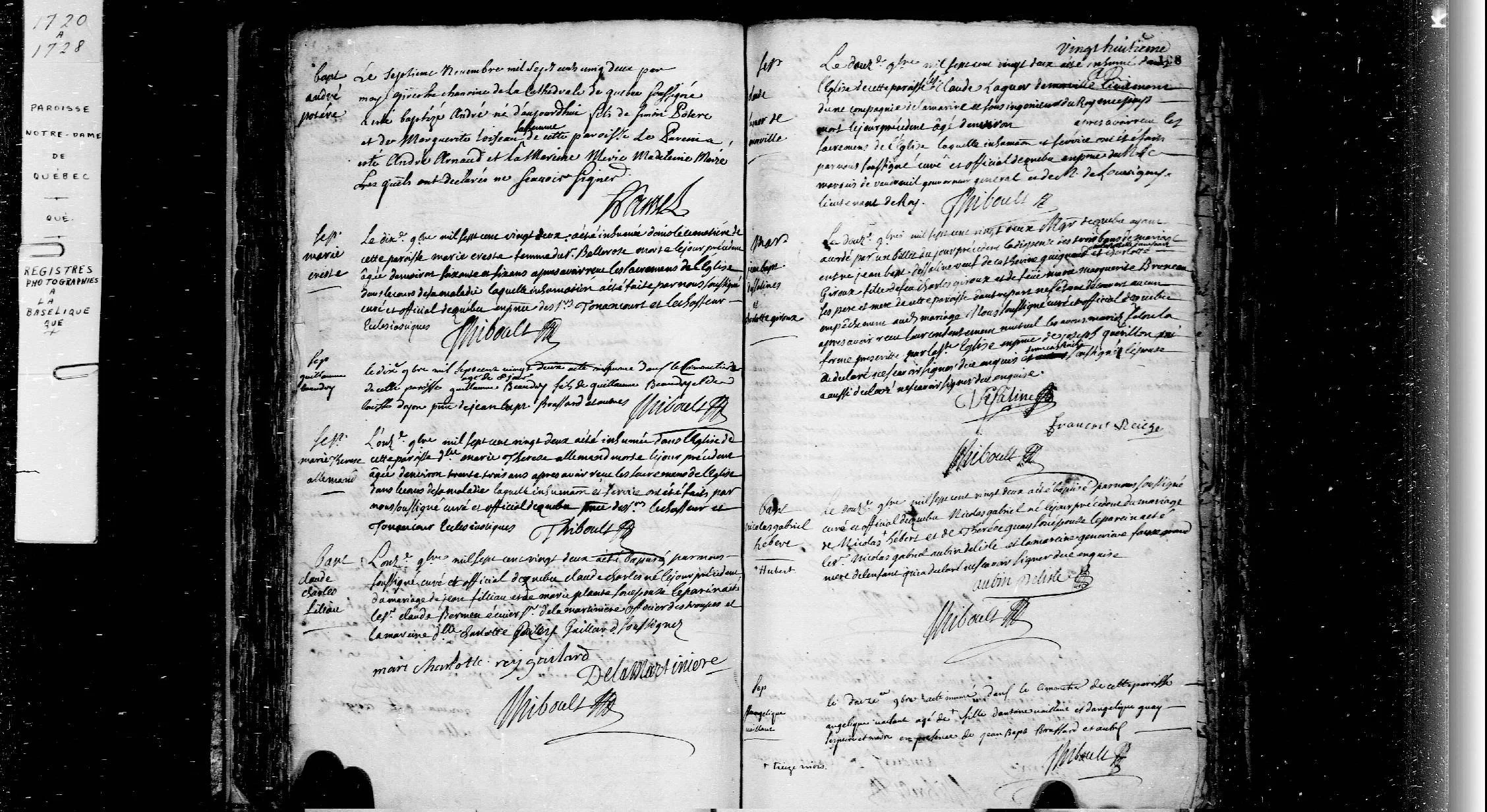
Marie Crête herself died at Quebec on November 9, 1722 — forty-six days after her eldest daughter. She was sixty-five years and one month old. She was buried the following day at Notre-Dame de Québec. The PRDH-IGD burial extract (no. 71919) records her age as "066," rounded upward in the database's convention; the parish register itself, read against her October 1657 birth, gives the more accurate age of sixty-five. She had been married to Pierre Jourdain dit Bellerose for sixteen years and ten months at the time of her death.
| Role in the act | Name as recorded | Detail |
|---|---|---|
| Deceased | Marie Creste | Died 9 November 1722; buried 10 November; age given as about sixty-six |
| Surviving spouse | Bellerose | Given name not stated in the act; identified elsewhere as Pierre Jourdain dit Bellerose |
| Witness | Tonancourt | Ecclesiastic; given name not stated |
| Witness | Lechasseur | Ecclesiastic; given name not stated |
| Officiant | Thiboult | Curé and official of Québec (Notre-Dame-de-Québec) |
Abstracted from the parish register entry and cross-checked against PRDH-IGD burial record no. 71919. Three of the five persons named in the act appear without given names, and the database carries them with a placeholder; the omission is the priest's, not the database's. The stated age of about sixty-six is a rounding: measured against the baptismal act of 10 October 1657, Marie was sixty-five years and one month at death.
The officiating priest was Father Thiboult, the curé and official of Quebec — a different priest from the François Dupré who had married Marie to her second and third husbands. Two ecclesiastics, Tonancourt and Lechasseur, attended as witnesses. The phrase "sous le cours de sa maladie" — "during the course of her illness" — signals that her death was a relatively brief end to a documented illness, consistent with the epidemic pattern of the autumn of 1722 at Quebec.
Marie's younger sister Marie Françoise Crête — wife of Henri Delaunay, the same brother-in-law Marie had summoned to the Provost's Court in 1700 over twelve hundred livres — had died twenty years before this, on 29 November 1702, at the Hôtel-Dieu de Québec. She was forty-two. The patient register of the Hôtel-Dieu du Précieux-Sang records her admission on the twentieth of that month and her death nine days later; PRDH-IGD individual record no. 19407 gives the same date for her death and burial. Her death belongs to the smallpox winter of 1702–1703, seven weeks before her mother Marguerite Gaulin's own death at Beauport in January 1703, and is treated in the Marguerite Gaulin biography.
Pierre Jourdain dit Bellerose, widowed at approximately forty-six, did not remarry quickly by the standards of the colonial economy — but neither did he wait long. On April 3, 1723, less than five months after Marie's burial, he married a twenty-year-old woman named Marie Catherine Aide Crequy at Neuville (Saint-François-de-Sales), upriver from Quebec. The age gap of his second marriage — twenty-six years — mirrored in inverse the eighteen-year gap of his first marriage to Marie Crête. He would father several children with his second wife and live until March 15, 1738, when he died at Quebec at the age of approximately sixty-two and was buried the following day at Notre-Dame de Québec — the same parish where his first wife had been buried fifteen years earlier.
Direct Descent: Marie Crête to the Guilbault Line
The line passes through Marie Crête's second marriage to the master carpenter Jean Bridault and the eldest daughter of that union, Marie Anne Bridault. The first marriage to Robert Pepin produced four surviving children but none in the descent line; the third marriage to Pierre Jourdain dit Bellerose produced no children. Marie Crête is the documentary anchor of the chain that links the Gaulin emigration of the mid-seventeenth century to the Hamall line of the twentieth century.
What the Documentary Record Carries
The portrait that emerges from sixty-five years of registers, contracts, censuses, lawsuits, and notarial protocols is not a portrait of a woman whose interior voice we can recover. Marie Crête, like her mother before her, could not write her name; she signed neither the 1669 marriage contract nor the 1705 third-marriage contract; the records that document her life were drawn by other hands — by Notary Vachon, Father Henri de Bernières, Father François Dupré, Notary Genaple, Notary Rageot, the surveyor Hilaire Bernard de la Rivière, the Lieutenant General of the Provost's Court, the parish curé Thiboult. What can be recovered from those records, with discipline, is the shape of her decisions across the choices the surviving documents preserve.
She was married at thirteen and bore her first child at seventeen and a half. She raised six children with her first husband across sixteen years; she buried two of them as infants. Widowed at twenty-eight, she remarried within six months. She bore six more children with her second husband across eleven years; she buried one of them at three weeks. Widowed for the second time at forty-one, she carried her household for six and a half years without male partnership — buying a property near the Hôtel-Dieu, pursuing her brother-in-law for a 1200-livre debt in the Provost's Court, taking another debtor to a final judgment for six livres and fifteen sols, and settling her first husband's residual estate before her third marriage. At forty-eight she married a Parisian soldier eighteen years her junior who had a four-year-old natural daughter, and she lived sixteen and a half years with him in urban Quebec before dying in the autumn epidemic of 1722.
Her eldest son from her first marriage — Jean Pepin, who would live to seventy-seven and die at Charlesbourg in 1752 — stood as the structural witness across all three of her marriages. He was nineteen when he sponsored his half-brother's baptism in 1694; he was twenty-nine when he witnessed his half-sister's marriage in 1704; he was thirty when he witnessed his mother's third marriage in 1706. The pattern of his appearance is the documentary signature of a son's continuing connection to a mother whose household had been remade twice across his lifetime.
Of the twelve children she bore between 1675 and 1698, nine reached adult marriage; three did not. The descent line that runs through the eldest daughter of her second marriage — Marie Anne Bridault, who died six weeks before her mother at the same Hôtel-Dieu — is the slender thread by which her name has reached the present. She is the second link in the chain that begins with her mother Marguerite Gaulin in the Perche of 1627 and reaches the compiler of these notes in the twenty-first century. The Crête-Bridault-Morin-Guilbault descent that runs through her is the line by which everything that has followed has followed.
Note on the Name "Jourdain"
[1] The third husband's surname has been variously rendered "Jourdain" and "Soudain" across secondary sources. The earlier published reference of Lebel and Laforest (1979) gives the name as Jourdain; the 1705 marriage contract drawn by the royal notary at Quebec has been read by some interpreters as Soudain. The preponderance of primary documentation — the PRDH marriage record no. 67784, the PRDH individual record no. 37271 (where the surname is given as "Pierre Jourdain Bellerose"), the Notre-Dame de Québec marriage register margin entry, the 1707 surveyor's land partition (where Pierre signs his own name "Pierre Jourdain"), the 1712 receipt of seigneurial dues paid to the Crown's farmer-general (where the surname is again rendered Jourdain), and the consistent secondary attribution by Lebel and Laforest — all converge on the reading Jourdain. The reading "Soudain" appears to be a single contestable interpretation of the marriage contract's calligraphy, contradicted by the husband's own subsequent signatures across the next two decades. The reading "Jourdain" is here adopted as authoritative; the reading "Soudain" is noted as a working interpretation of the contract pending re-examination of the Chambalon protocol. ↩
Case Study Summary
A portfolio-grade overview of the research arc behind this biography — sources catalogued, three marriages reconstructed, judicial and notarial records integrated to BCG standards.
View the Case Study →Document Gallery
Original records only — parish registers, censuses, notarial minutes, judicial filings, and surveyors' plans examined in image form. Database entries consulted in the course of this research are listed by record number in the Sources section below rather than reproduced here.





Sources
Primary Sources — Parish Registers
Notre-Dame de Québec (Basilique). Baptism register, page 40, entry of 10 October 1657, Marie Creste, daughter of Jean Creste and Marguerite Gaulin; officiant Gabriel de Queylus, Sulpician; godparents François Guyon and Marie Rocheron. Marriage register, page 381, entry of 4 November 1670, Robert Pepin and Marie Creste; officiant Henri de Bernières, curé; witnesses Paul Vachon (notary), Michel Le Court, and Jean Creste (father of bride). Marriage register, entry of 21 April 1687, Jean Bridault and Marie Creste; officiant François Dupré, curé; witnesses Thomas Gubillon, Henri de Launay (brother-in-law), Jean Lefebvre. Marriage register, entry of 9 January 1706, Pierre Jourdain and Marie Creste; officiant François Dupré; witnesses Pierre Lafaye and Jean Pepin (son of bride). Burial register, entry of 10 November 1722, Marie Creste, wife of "the said Bellerose"; officiant Thiboult, curé and official; ecclesiastical witnesses Tonancourt and Lechasseur. Register images consulted in the Drouin Collection, Institut Généalogique Drouin, via genealogyquebec.com.
Notre-Dame de Québec baptism register, ten Pepin and Bridault children, 1675–1698: Jean Pepin (10 September 1675), Robert Pepin (circa 1678, Beauport register gap), François Pepin I (24 February 1680, Beauport), François Pepin II (3 January 1682), Marie Rose Rosalie Pepin (3 June 1684), Louis Pepin (13 February 1686); Marie Anne Bridault (26 July 1688), Marie Bridault (25 May 1691, Haute-Ville), Jean Hilaire Bridault (28 August 1692), Jean Baptiste Bridault (30 September 1694, died 20 October 1694), Marie Françoise Jeanne Bridault (25 October 1695), Louise Catherine Bridault (28 January 1698).
Hôtel-Dieu du Précieux-Sang de Québec. Register of patients and domestics, 1698–1709, roll opening "Les malades et domestiques qui se trouvent à l'hostel dieu de Quebec le pr novembre 1702." Entry of 20 November 1702 with the marginal notation morte: Françoisse Crette, wife of Delauné, aged 43, of Quebec, died the 29th of November. Registres photographiés à l'hôpital.
Primary Sources — Census
Recensement de la Nouvelle-France, 1666. Archives des Colonies, Série G1, Volume 460, 1re partie, folio 56; Library and Archives Canada. Consulted on FamilySearch microfilm 008126224, image 68 of 883 (ark:/61903/3:1:3Q9M-CSVK-Y952-4); not indexed at the time of consultation. Beauport entry, Crête household: Jean Creste 40, charron et habitant; Margueritte Golin 38, sa femme; Louis 10; Marie 9, fille; Margueritte 7, fille; François 5, fils (mis-recorded; Françoise per the 1667 census and the 1660 baptism); Jean 2, fils; and a Pierre, 24, entered in the qualités et métiers column as chapellier engagé, with no surname given.
Recensement de la Nouvelle-France, 1667. Beauport entry. Marie Creste age 9 alongside parents and siblings Louis 11, Marguerite 8, Françoise 7 (correctly recorded), Jean 4, Joseph 1; six livestock, fifteen arpents under cultivation. LAC.
Primary Sources — Notarial Records
Marriage contract of Robert Pepin and Marie Creste, drawn at Bourg de Fargy by Notary Paul Vachon, 29 June 1669, three pages. Archives Judiciaires, Palais de Justice, Québec.
Posthumous inventory of Robert Pepin, drawn for the heirs by Notary Gilles Rageot, 14 August 1686. BAnQ Greffe de Québec.
Marriage contract of Jean Bridault and Marie Creste, drawn by Notary François Genaple, 6 October 1686. BAnQ Greffe de Québec.
Notarial arbitration of the Pepin family estate among Marie Crête and the Pepin heirs, drawn by Notary Chambalon, 10 June 1705. BAnQ Greffe de Québec.
Marriage contract of Pierre Jourdain and Marie Creste, drawn at Quebec by a royal notary, 20 December 1705. BAnQ Greffe de Québec.
Procès-verbal de partage between Pierre Jourdain (as husband of Marie Crête), the heirs of Robert Pepin, and Master Paul Denis Sieur de Saint-Simon, surveyor Hilaire Bernard de la Rivière, 10 June 1707, with hand-drawn map. BAnQ, Fonds Cour supérieure, District judiciaire de Québec, Greffes d'arpenteurs, CA301, S56, P149.
Receipt for lots et ventes and seizure fees paid by Pierre Jourdain and Marie Crête, sa femme, to François Bachant, Fermier-Général des Domaines d'Occident, 24 October 1712, two pages. BAnQ, Fonds Intendants, E1, S4, SS1, D224, P3.
Primary Sources — Judicial Records
Summons to appear served on Henri Delaunay at the request of Marie Crête, widow of Jean Bridault, concerning a sum of 1200 livres, 4 December 1700, two pages. BAnQ, Fonds Cour de la Prévôté de Québec, TL5, D277-120.
Order of the Lieutenant General of the Provost's Court of Quebec in the lawsuit between Marie Crête (plaintiff) and Henri Delaunay (defendant), dismissing the parties with prohibitions against mistreating and slandering each other, 14 December 1700, three pages. BAnQ, TL5, D277-125.
Default judgment granted by Provost Judge Michel Lepailleur to Marie Crête, widow of Jean Bridault, against Gilles Bourret of Bourg-Royal, February 1702. BAnQ, TL5, D2788-1.
Judgment in favor of Marie Crête, widow of Jean Bridault, against Gilles Bourret for six livres fifteen sols, 31 May 1702. BAnQ, TL5, D2785-5.
Database Sources
Programme de recherche en démographie historique (PRDH-IGD), Université de Montréal. The records below were consulted as finding aids and as a check against the parish registers; where the two differ, the register governs and the divergence is noted in the Methodological Note. prdh-igd.com
| Record no. | Type | Subject | Event date and place |
|---|---|---|---|
| 57636 | Baptism | Marie Creste | 10 October 1657 · Québec (Notre-Dame-de-Québec) |
| 59264 | Baptism | Jean Pepin | 10 September 1675 · Notre-Dame de Québec |
| 75933 | Baptism | François Pepin I | 24 February 1680 · Beauport |
| 60018 | Baptism | François Pepin II | 3 January 1682 · Notre-Dame de Québec |
| 60176 | Baptism | Marie Rose Rosalie Pepin | 3 June 1684 · Notre-Dame de Québec |
| 60282 | Baptism | Louis Pepin | 13 February 1686 · Notre-Dame de Québec |
| 75916 | Baptism (partial) | Robert Pepin II | circa 1678 · Beauport — register gap |
| 60468 | Baptism | Marie Anne Bridault | 26 July 1688 · Notre-Dame de Québec |
| 60745 | Baptism | Marie Bridault | 25 May 1691 · Notre-Dame de Québec |
| 60888 | Baptism | Jean Hilaire Bridault | 28 August 1692 · Notre-Dame de Québec |
| 61128 | Baptism | Jean Baptiste Bridault | 30 September 1694 · Notre-Dame de Québec |
| 61265 | Baptism | Marie Françoise Jeanne Bridault | 25 October 1695 · Notre-Dame de Québec |
| 61542 | Baptism | Louise Catherine Bridault | 28 January 1698 · Notre-Dame de Québec |
| 66961 | Marriage | Robert Pepin × Marie Creste | 4 November 1670 · Notre-Dame de Québec |
| 67327 | Marriage | Jean Bridault × Marie Creste | 21 April 1687 · Notre-Dame de Québec |
| 67763 | Marriage | Joseph Morin × Marie Anne Bridault | 4 November 1704 · Notre-Dame de Québec |
| 67784 | Marriage | Pierre Jourdain × Marie Creste | 9 January 1706 · Notre-Dame de Québec |
| 71919 | Burial | Marie Creste | 10 November 1722 · Notre-Dame de Québec |
| 19407 | Individual | Marie Françoise Crête | b. 20 July 1660 · d. and bur. 29 November 1702 · Québec (Hôtel-Dieu) |
| 73007 | Burial | Jean Bridault | 7 June 1699 · Québec (Hôtel-Dieu) |
| 3460 | Couple | Robert Pepin and Marie Crete | Six children, 1675–1686 |
| 5885 | Couple | Jean Brideau and Marie Crete | Six children, 1688–1698 |
| 9486 | Couple | Joseph Morin and Marie Anne Bridault | Twelve children, 1705–1722 |
| 8774 | Individual | Jean Bridault | b. circa 1659 Montmorency · d. 7 June 1699 |
| 8776 | Individual | Marie Anne Bridault | b. 1688 · d. 23 September 1722 |
| 37271 | Individual | Pierre Jourdain Bellerose | b. circa 1676 Paris · d. 1738 |
| 53903 | Individual | Joseph Morin | Husband of Marie Anne Bridault |
| 61361 | Individual | Robert Pepin | b. circa 1643 Grisy, Calvados · Immigrant |
Fichier Origine, Fédération québécoise des sociétés de généalogie. Record no. 380055 for Robert Pepin: born circa 1639 at Grisy (St-Brice), commune de Vendeuvre, Calvados; parents Jean Pepin and Jeanne Dumont married 5 July 1633 at Grisy (St-Brice); first mention in Quebec 1662; occupation at arrival "Maître couvreur d'ardoises"; death between 13 February and 11 August 1686. Researcher: Denise Gravel. fichierorigine.com
Published References
Lebel, Gérard, and Thomas John Laforest (trans.). Our French-Canadian Ancestors, Chapter 22: "Robert Pépin," pages 199–205. The chapter establishes Robert as a "master slater" practicing his trade in New France until his unexpected death in 1686; documents the Becquet act of 9 September 1668 as the first known record of his presence in Canada; describes the 29 June 1669 marriage contract before Notary Paul Vachon in detail, including the dowry items; identifies the Pepin children (with the correction that Tanguay's attribution of a "Jacques Pepin 1674" to Robert was an error — that Jacques was the son of Antoine Pépin dit Lachance); and gives the 14 August 1686 Gilles Rageot inventory date as the latest possible date of Robert's death.
Tanguay, Cyprien. Dictionnaire généalogique des familles canadiennes, Volume 1, page 472, and Volume 7, page 576. Used for general onomastic variants of the Pepin surname.
Methodological Note
This biography follows the standards of the Board for Certification of Genealogists (BCG): conclusions are sourced to primary documents wherever those documents survive, with secondary references cited as such; discrepancies among published and database sources are identified and resolved against the primary record; and language is calibrated to distinguish documented fact from probable inference. Compiled database entries are treated as finding aids and as derivative evidence, not as documentation; their record numbers are cited so that any reader may retrieve them, and the substance of each is restated here in the compiler's own tabulation rather than reproduced in facsimile.
The biographical reconstruction integrates eighteen baptism and burial register acts, three marriage register acts, two marriage contracts, six other notarial protocols, four judicial filings of the Provost's Court of Quebec, two royal censuses, and the Fichier Origine identification of Robert Pepin's natal parish. Specific source discrepancies resolved by primary-source examination include: Robert Pepin's birth year (Fichier Origine gives circa 1639 against PRDH's circa 1643; the Fichier Origine figure rests on direct examination of the French parish register and is preferred, though neither has been verified against the Grisy baptismal act by this researcher); Robert Pepin's place of birth (both sources place him at Grisy in Calvados — PRDH carries the ecclesiastical diocese of Sées with the arrondissement of Caen, and Fichier Origine refines this to the commune of Vendeuvre and the St-Brice dedication; the two are complementary rather than contradictory, and an earlier draft of this page overstated the difference as a correction); the third husband's surname (preponderance of primary evidence reads Jourdain, contradicting the secondary reading of "Soudain" — see footnote on the name); the baptismal name of the youngest Bridault daughter (parish register: Louise Catherine, against the PRDH couple record's normalization to Marie Louise); display artifacts in PRDH couple record no. 5885 (its English-language interface renders the second daughter's given name as "Married" and the fourth child's as "John the Baptist"; both are machine artifacts, and the register forms Marie and Jean Baptiste are used here); Marie Crête's age at death (the burial act and the PRDH extract give about sixty-six; measured from the 1657 baptism she was sixty-five years and one month); the death date of Marie's younger sister Marie Françoise Crête (29 November 1702 per the patient register of the Hôtel-Dieu du Précieux-Sang and PRDH individual record no. 19407, placing her death in the smallpox winter of 1702–1703 rather than the epidemic autumn of 1722); and the spelling of Marie's name (the parish registers and PRDH consistently render "Creste" with the modern standardization "Crête," with the prior secondary attribution of the middle name "Josephte" being unsupported by any primary source and accordingly omitted here). The full corpus of source documentation, complete discrepancy resolution table, and chronological research log are available on the companion case study page.
Questions about your own research? Begin a research inquiry.
