
When the War Burned the Records
When the War Burned the Records
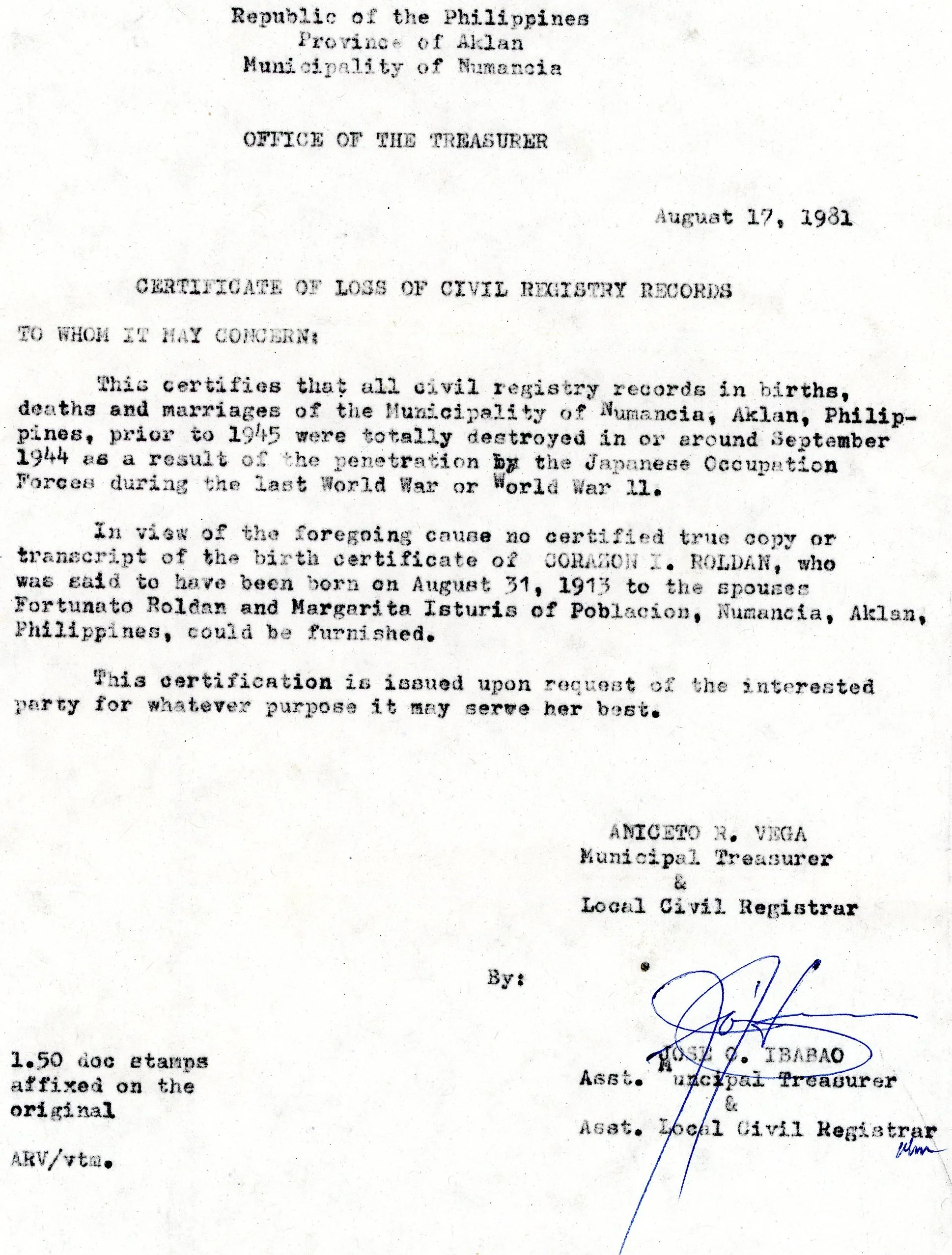
Every record in our episode on the American era carried the same wound. The marriage of Jose Tamayo and Maria Corazon Roldan; the birth of Corazon herself; the births of the Morales children—each one survives today only because a town official, decades later, signed a paper certifying that the original had been destroyed. In Numancia, Aklan, the civil registry from before 1945 simply does not exist. It was, in the words the certificates repeat again and again, “totally destroyed in or around September 1944.”
This is not a Numancia problem. It is a Philippine problem. The Battle of Manila in 1945 and countless provincial fires consumed a staggering share of the nation's civil and parish records—by frequently cited estimates, well over half—though no single authoritative count exists, and the loss was always uneven from town to town. ContextFor the genealogist, the practical reality is what matters: in much of the country, the document you most want to see was burned eighty years ago. The work, then, is not to find the missing record. It is to rebuild what it would have said, from everything that survived around it.
The Record That Says the Records Are Gone
The first lesson is counterintuitive: the certificate of loss is itself a genealogical document. When a family went to the municipal treasurer or the parish priest after the war and asked for a birth certificate that no longer existed, what they received in its place—a sworn Certificate of Loss of Civil Registry Records, or a parish certification from the “salvage” books—was not a dead end. It named the person, the claimed date, the parents, and the place, and it fixed in an official hand the fact and cause of the loss. In genealogy this is negative evidence, and it is evidence all the same.
Principle
A record's absence is a finding to be documented, not a wall to stop at. Before concluding that a record “does not exist,” establish why—and capture the official instrument that says so. A certificate of loss, paired with two or three independent sources that corroborate the same facts, can carry a conclusion that the original record, if it survived, would simply have confirmed.
The Strategy Stack: Six Places to Look When the Registry Is Ash
No single substitute replaces a lost civil registry. Reconstruction works by convergence—assembling many partial sources until they agree. These are the six layers that rebuilt the Morales-Tamayo family, in roughly the order they tend to pay off.
Church records before civil registries
Civil registration only became mandatory in 1930; the Catholic Church had kept baptisms, marriages, and burials since the Spanish era. Stone parish walls often outlasted the municipal hall. Where a parish itself burned, its diocesan archive or its reconstructed “salvage” books may still answer.
In our case: the Parish of St. Joseph in Numancia certified the births of two Morales children and a Tamayo daughter from its salvage books.Pin down the exact town
Destruction was local. Identify the precise municipality and you can target the parishes and provincial offices that survived, instead of the central archives that didn't. The 1849 Clavería decree—which assigned blocks of surnames to specific towns—can point a distinctive surname back to its place of origin.
In our case: fixing the family to Numancia (then Capiz, now Aklan) is what made every later record findable.Notarial & land records
Property and legal instruments were kept separately from vital records and often survived. Notarial registers (the Spanish-era protocolos and their American-era successors), deeds, mortgages, and estate divisions name parties, spouses, ages, and whole webs of heirs.
In our case: Mamerto Morales's own notarial register and a 1953 deed citing his 1938 act anchored his life—and a 1951 mortgage proved his widow.WWII military & guerrilla files
Filipinos who served in the Commonwealth Army, the Philippine Scouts, or recognized guerrilla units generated records now held largely in the U.S. The National Archives' Philippine Archives Collection, and the millions of post-war guerrilla recognition and veterans'-benefit applications, contain birth dates, affidavits, and family detail—even when a claim was denied.
Worth a sweep for any ancestor of military age in 1941–1945.Delayed & late registration
Because so much was lost, the post-war government permitted vast waves of delayed registration. An ancestor born in 1910 may have filed a late registration of birth in the 1950s or '60s to obtain a passport or pension—and those filings required sworn affidavits from older relatives, supplying ready-made genealogical branches.
Where to ask: the Philippine Statistics Authority (PSA) for delayed civil records.DNA, when the paper ends
When the trail goes cold, genetic genealogy offers an empirical link. Test with a major provider, then build out matches—uploading where permitted to GEDmatch or comparing on MyHeritage—to find the clusters that confirm a relationship the burned registry can no longer prove.
Best used to corroborate a documentary hypothesis, not to replace one.The Émigré Became the Archive
There is a seventh layer, and in this family it was decisive. When relatives emigrate, they carry their proof with them—and they keep it. The very act of leaving the Philippines for the United States required assembling a personal archive: documents to satisfy foreign immigration authorities, and then the federal paperwork of settling and naturalizing. For a family whose home-country records had burned, the émigré's own files became the most complete record that survived.
ConfirmedIn the Morales-Tamayo line, that archivist was Dr. Hally R. Tamayo (1932–2017), the physician daughter who carried the line to America. She preserved everything—her own medical-school transcripts and her applications for U.S. medical licensure—and, crucially, she kept documents for her siblings who emigrated as well, including affidavits of support and proofs of their birth. Decades later, that preserved trove turned out to hold the cleanest evidence of a family the Numancia fires had erased. The papers gathered to leave the country became the papers that reconstructed it.
OralThe reach of the burned registry is best measured by who it touched. Even Patrocinio Gonzales Morales—the matriarch who never settled abroad—had, at nearly seventy, to reconstruct her own 1905 birth by the sworn testimony of two aged neighbors, in the document her family remembers her needing to join her children and grandchildren in the United States. Forty years after the fire, and an ocean away, the missing record still had to be answered.
These émigré sources fall into three tiers, each richer than the last:
Pre-departure & identity records
Assembled at home to prove identity abroad: affidavits of loss detailing how the originals were destroyed; certified church extracts of baptism and marriage from the local priest; and affidavits of identity from village elders and older relatives attesting birth date, place, and parentage.
In our case: the certificates of loss and the Joint Affidavit of Birth for Patrocinio Gonzales are exactly these.Border-entry & visa files
Generated the moment an ancestor met the U.S. immigration system: ship manifests and passenger lists giving exact birthplace, last municipality, and nearest relative left behind; and Alien Registration Files (A-Files), which can hold original Philippine photographs, letters, and ancestral-background forms.
In our case: an Affidavit of Support from a Roldan cousin underwrote a Tamayo sibling's passage.Settlement & naturalization
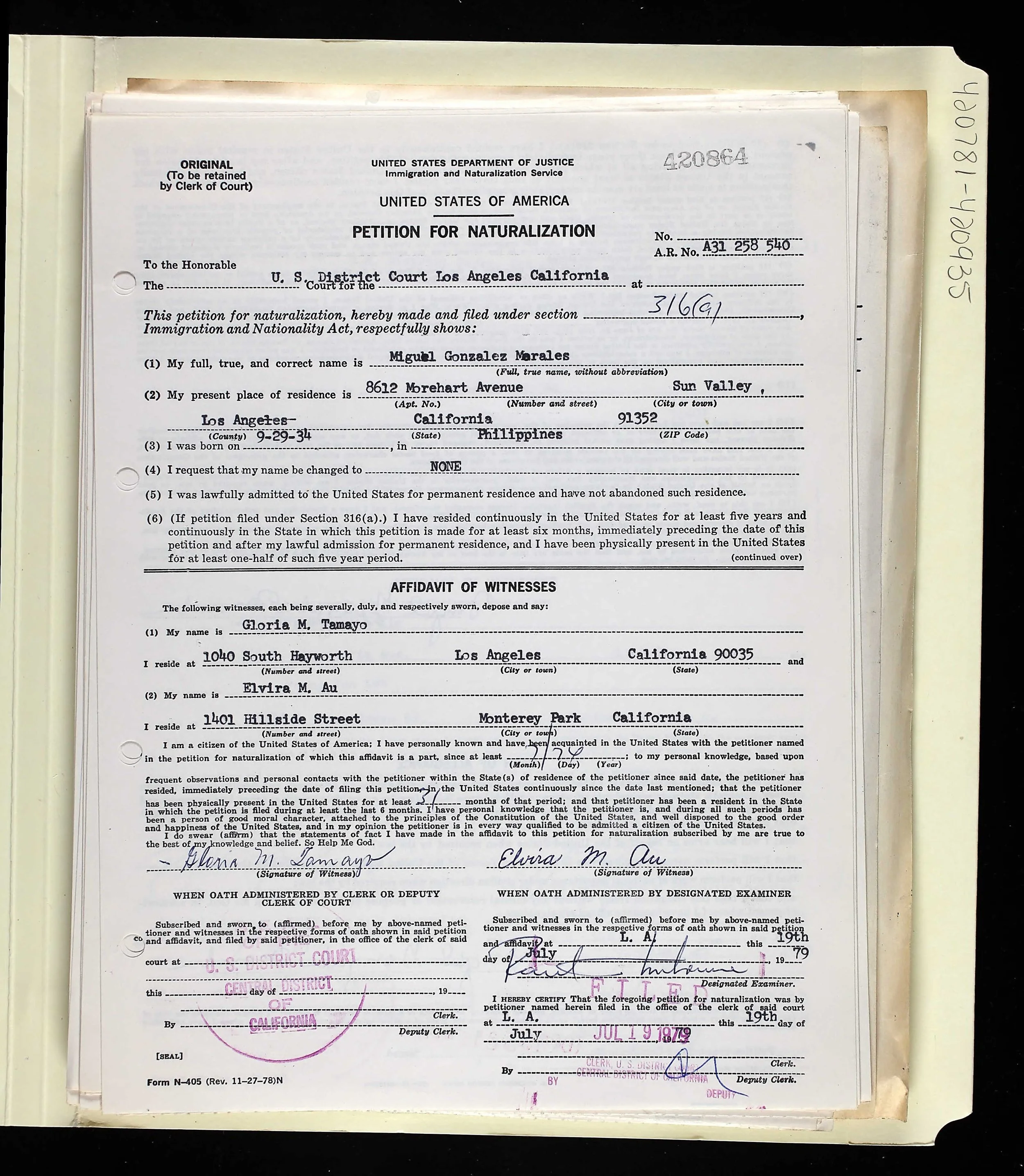
The federal trail of becoming American: the Declaration of Intention (“first papers”), listing birth date and port of entry; the Petition for Naturalization, naming spouse, marriage, and every child; and the SS-5 Social Security application—hand-written, naming the applicant's father and mother's maiden name.
In our case: a 1979 naturalization petition and a Social Security record independently confirmed Mamerto and Patrocinio as parents.Why the émigré's box of papers matters most
A burned town leaves a hole exactly where a person began. The relative who emigrated fills it from the other side—because a foreign government, unlike the lost local registry, demanded proof and then kept it. One preserved family collection in California did more to rebuild a Numancia household than any surviving record in Aklan.
Requesting the Two Crown-Jewel U.S. Records
Two American records repay the effort more than any others, because the immigrant supplied the answers personally. Both are obtainable, and both require proof that the person has died.
The Social Security Application (Form SS-5)
The prize: your ancestor's own hand, naming their birthplace, father, and mother's maiden name.
The Alien Registration File (A-File)
For anyone who immigrated after 1940 — a jacket that can hold original photos, visas, and affidavits of identity.
The Discipline of Reconstruction
Rebuilding a family from substitutes is not guesswork; it is the careful, documented assembly of converging evidence. A few principles hold the work together:
Document the loss before you mourn it. Capture the certificate or certification that records the destruction; it is a source, not a void.
Require convergence. No single substitute proves a fact. Two or three independent sources that agree—a parish salvage entry, a notarial citation, a U.S. naturalization petition—can carry a sound conclusion.
State every fact at its true tier. Confirmed, corroborated, or remembered: say which. A reconstructed date is honest only when its evidence is named.
Follow the family that left. The relative who emigrated is often the strongest witness to the home a fire erased.
The fire took the records. It did not take the family. They were waiting in a parish salvage book, a notary's ledger, a cousin's affidavit, and a daughter's carefully kept box of immigration papers—in every archive but the one that burned.
Primary Sources


Questions about your own research? Begin a research inquiry.
