
The Storyline
Real families. Real discoveries. Real stories.
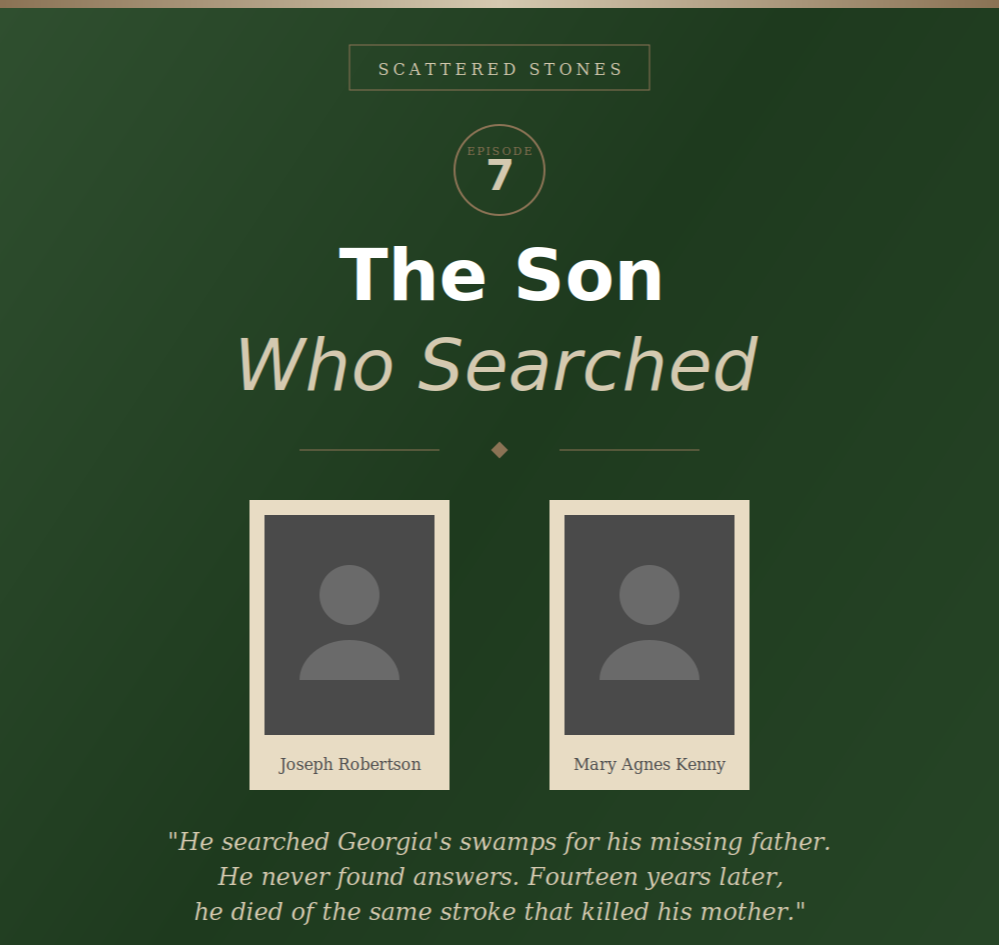
Scattered Stones: The Son Who Searched
Scattered Stones: Episode 7
In February 1910, Joseph Robertson traveled to Georgia searching for his missing father—the stone cutter who had vanished into the swamps. He never found answers. Fourteen years later, Joseph died of the same stroke that killed his mother. Twelve days after that, his wife Mary Agnes—daughter of Brooklyn's mat maker John Kenny—followed him to the grave. Their three children were orphaned within two weeks. This is where two Brooklyn families meet, and where my grandmother's story begins.
Part of the Storyline Genealogy series : Documentary Biographies
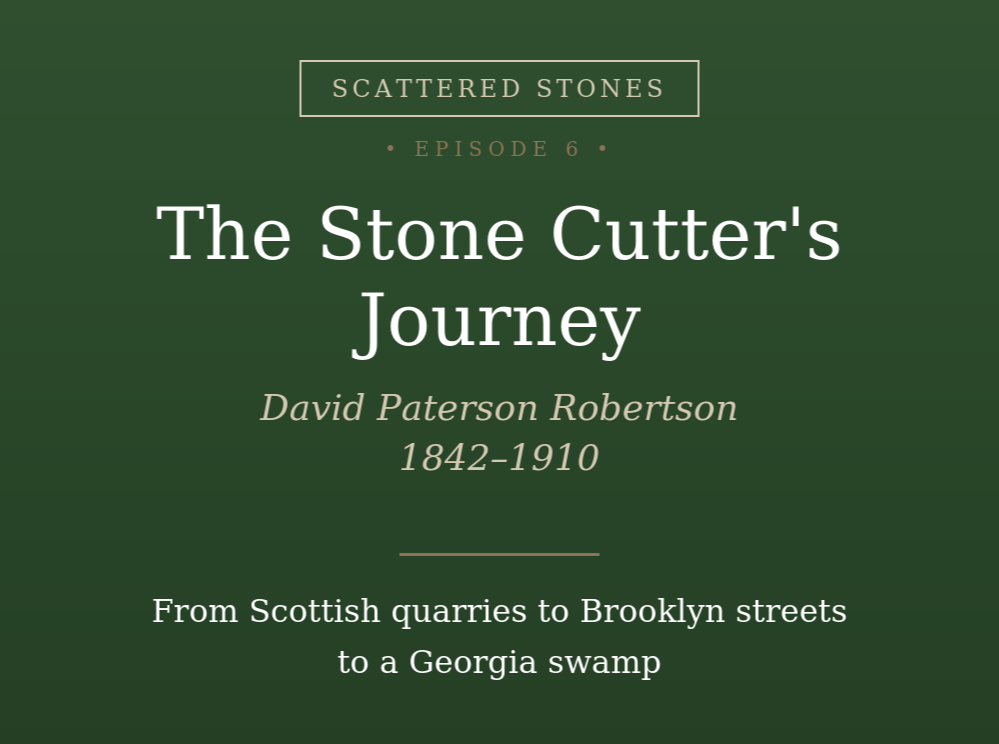
Scattered Stones: The Stone Cutter’s Journey
Scattered Stones: Episode 6
Of all the children of George Robertson and Margaret Paterson, David was the pioneer—the first to cross the Atlantic, the first to establish the family name in America. For forty years he built a life in Brooklyn, cutting stone, raising eleven children. Then, at sixty-three, newly widowed, he reinvented himself as a game trapper in Georgia. In February 1910, he vanished. His boat was found swamped. His body was never recovered. This is the story of David Paterson Robertson—and the son who traveled from Brooklyn to Georgia searching for answers that never came.
Part of the Storyline Genealogy series : Documentary Biographies
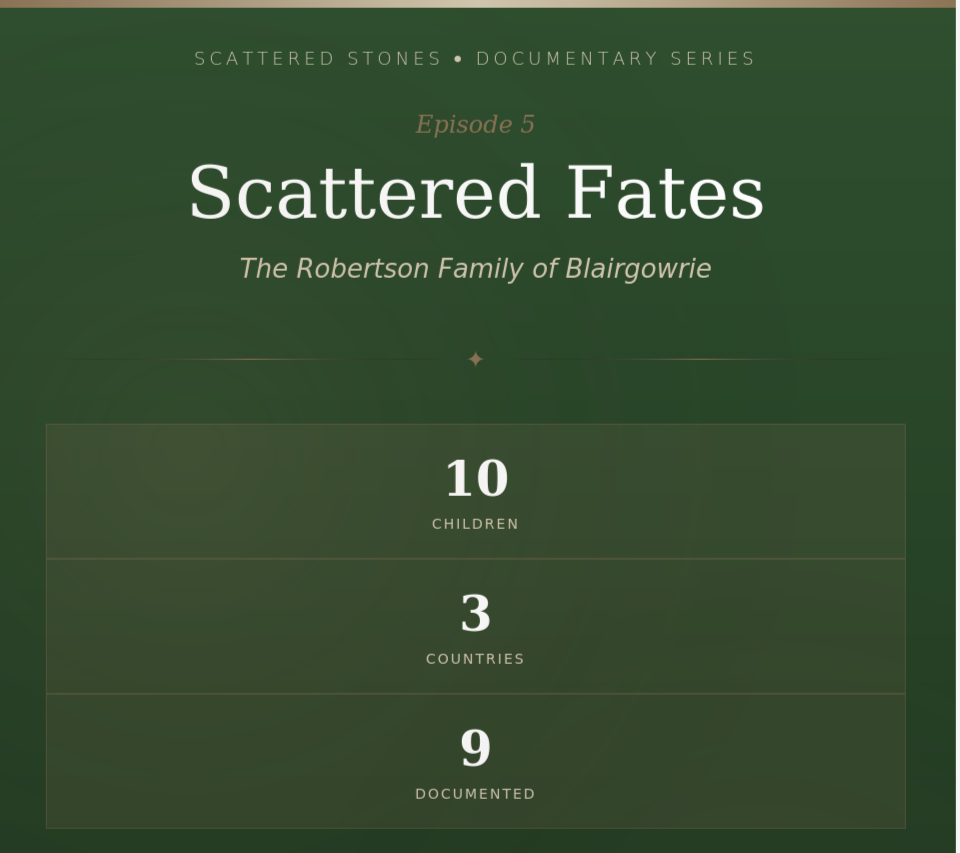
Scattered Stones : Scattered Fates
Scattered Stones: Episode 5
They scattered like seeds in the wind — some taking root in Brooklyn's granite, others drifting to Liverpool's docks, still others clinging to the Scottish soil where they were born. John married in Dundee; his grandson's gravestone still stands in Rattray. Margaret worked as a tablemaid in Blairgowrie. James became a gamekeeper in Liverpool after passing through Canada. And Mary Ann — the firstborn — wandered from Nova Scotia to Saskatchewan before dying in New Jersey in 1921, the last survivor of all ten children.
Part of the Storyline Genealogy series: Documentary Biographies
Scattered Stones: The Brooklyn Robertsons
Scattered Stones: Episode 4
Robertson, Margaret, wid. Geo. 119 Hamilton av" — For twenty years, Margaret Paterson Robertson was defined by loss. The Brooklyn city directories traced her through the decades, always listed as "wid. Geo." But Margaret was more than a widow. She was the anchor of a family scattered across an ocean. Around her, the surviving children married, had children of their own, and established themselves in skilled trades. Then 1892 took everything — Margaret in July, her daughter Clementina just four months later. They lie together now at Evergreens Cemetery, in unmarked graves.
Part of the Storyline Genealogy series: Documentary Biographies
Scattered Stones: The Great Emigration
Scattered Stones: Episode 3
How long resident in this City: 5 days." Those words on George Robertson's death certificate tell the story of a journey that ended almost before it began. In 1869, his son David boarded the steamship Europa for Brooklyn. In 1872, George followed — only to die of sunstroke in the brutal July heat, just five days after arriving. His widow Margaret would spend the next twenty years in Brooklyn, always identified as "wid. Geo." in the city directories. They lie together in unmarked graves at Evergreens Cemetery.
Part of the Storyline Genealogy series: Documentary Biographies
Scattered Stones: The Mason’s Household
Scattered Stones: Episode 2
In the summer of 1839, George and Margaret Robertson welcomed their first child at Couttie, near Blairgowrie. Over the next twenty-one years, they would baptize ten children in this Perthshire town — including twins named William Fraser and Clementina Stewart Ramsay, whose distinctive names hint at connections yet to be uncovered. Four Scottish censuses captured this growing family before the great emigration scattered them across two continents.
Part of the Storyline Genealogy series: Documentary Biographies
Scattered Stones: Roots in Perthshire
Scattered Stones: Episode 1
In 1786, a weaver named Duncan Robertson married Jean Angus in Bendochy parish, Perthshire. Over the next two decades, they raised seven children in the townland of Myreridges — including a youngest son, George, born when both parents were nearly fifty. George would leave weaving behind to become a mason, marry a local woman, and eventually die just five days after arriving in America. This is where his story begins.
Part of the Storyline Genealogy series: Documentary Biographies
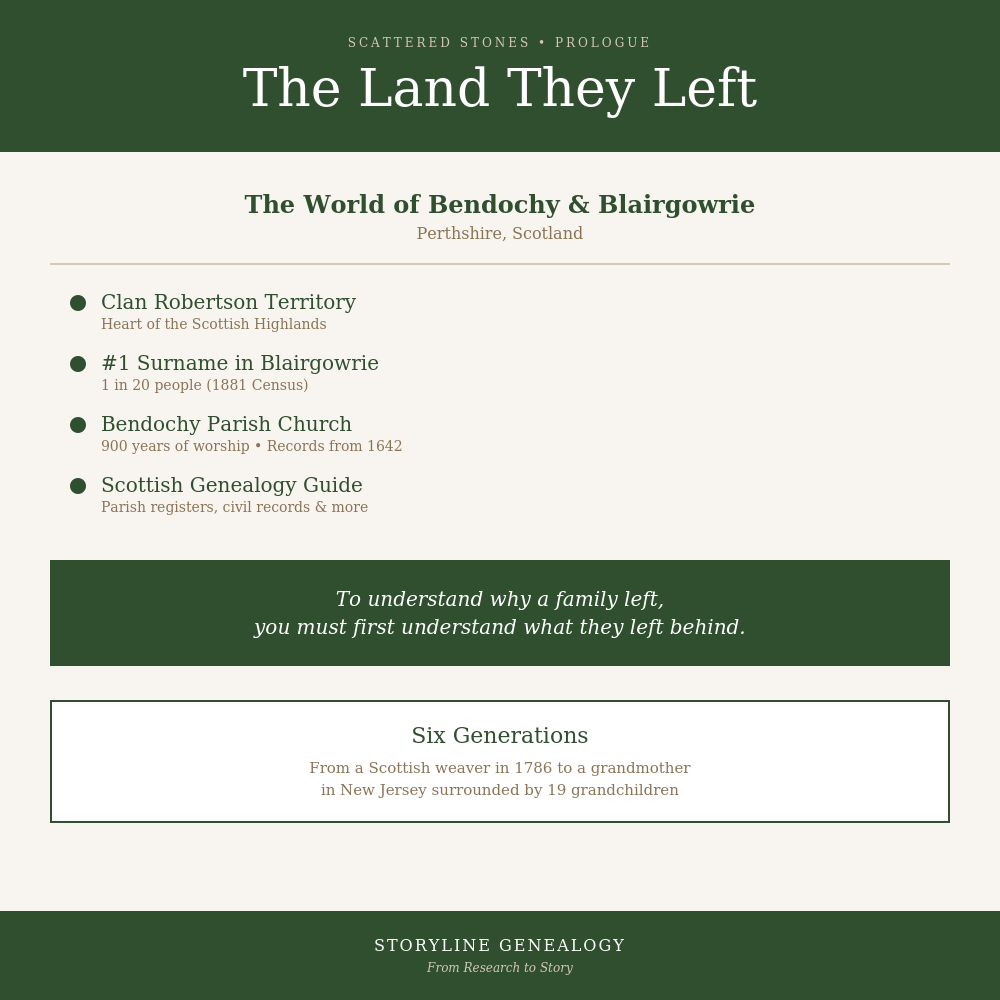
Scattered Stones Prologue: The Land They Left
Scattered Stones: Prologue
To understand why a family left, you must first understand what they left behind.
In the heart of Clan Robertson territory, where the Highlands meet the Lowlands, lies the parish of Bendochy—one of the oldest ecclesiastical sites in Scotland. Its parish registers begin in 1642. Two miles away, the market town of Blairgowrie sits at the edge of Strathmore valley, where rivers carve through ancient rock and the name Robertson appears in one of every twenty households.
Before we follow Duncan Robertson's descendants across the Atlantic—through Brooklyn and Georgia and New Jersey, across six generations—we must begin where they began.
Part of the Storyline Genealogy series: Documentary Biographies
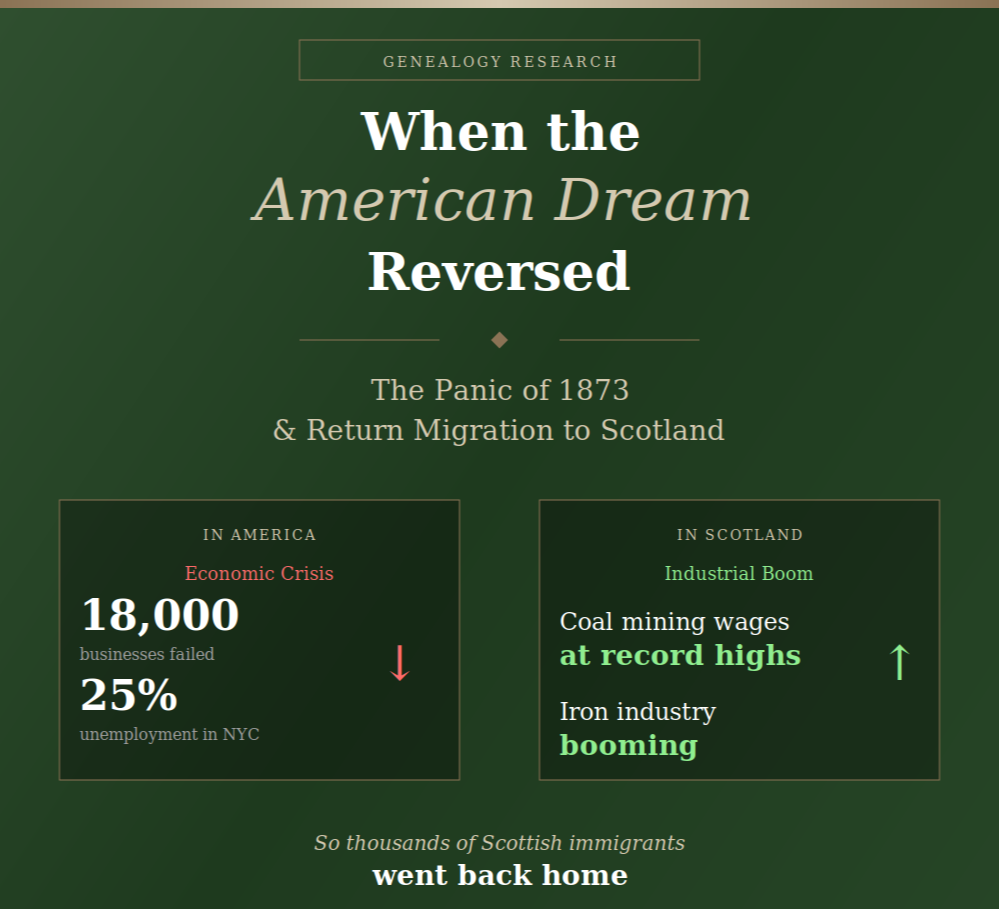
When the American Dream Reversed: The Panic of 1873
In the 1870s, thousands of Scottish immigrants made an unexpected choice: they went home. The Panic of 1873—America's first Great Depression—triggered mass unemployment while Scotland's coal and iron industries boomed. New research from the 1881 Scottish census reveals over 1,100 return migrants, including families like the Robertsons of our Scattered Stones series. This is the story of when the tide turned both ways.
Part of the Storyline Genealogy series: Scattered Stones: The Robertson Family of Blairgowrie
Marie Lorgueil: A Family in Court
Between 1683 and 1738, Marie Lorgueil's family appeared in colonial courts six times across three generations. They sued neighbors, defended against criminal charges, fought for orphaned children, and—in the most extraordinary case—a seventy-year-old daughter named Françoise demanded separation from her abusive husband Jean Charpentier. This is the story of how one immigrant woman's strategic pragmatism became a family legacy of legal agency.
Part of the Storyline Genealogy series: Documentary Biographies
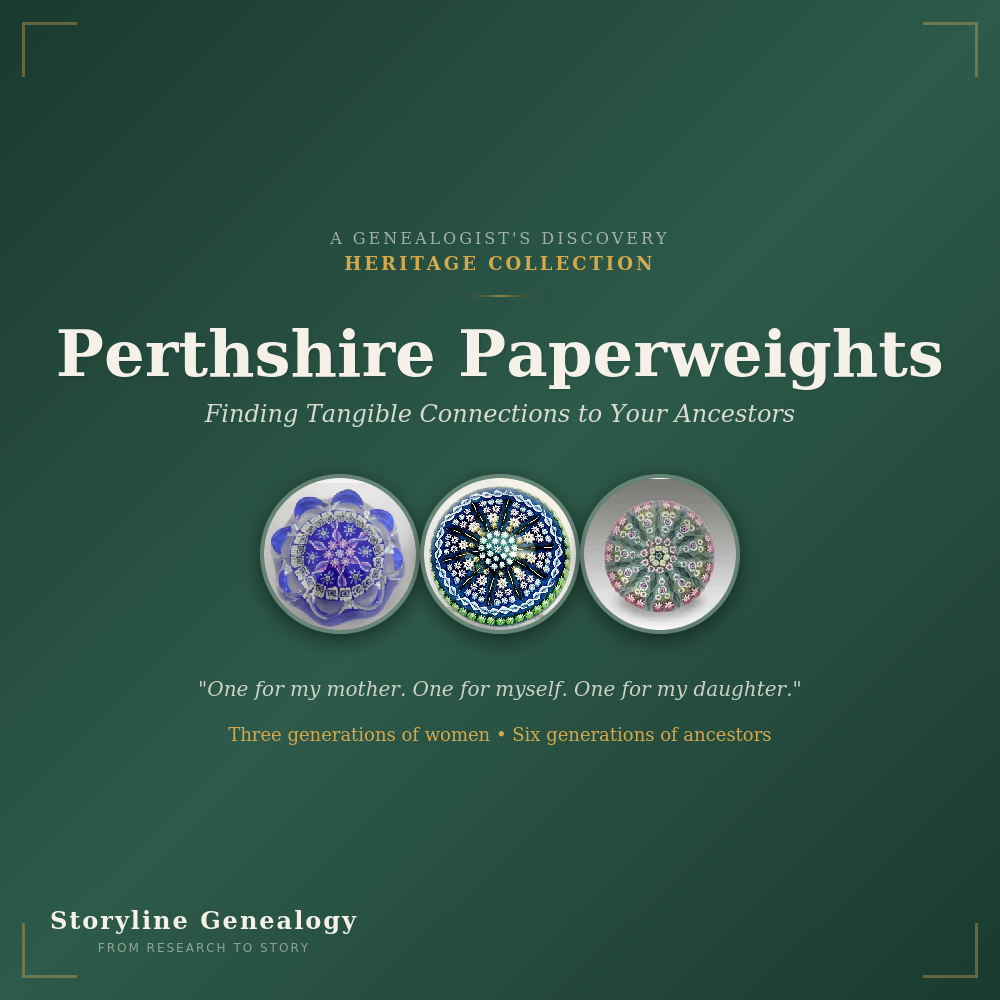
Perthshire Paperweights: A Genealogists Discovery
A Genealogists Discovery
Genealogical research fills notebooks with names and dates, census entries and vital records. But sometimes, in the midst of all that documentation, you find something unexpected—something you can hold in your hands.
When we pinpointed Bendochy, Perthshire as the Robertson family homeland, I went searching for a tangible connection to that place. What I discovered was extraordinary: Perthshire Paperweights—intricate millefiori designs encased in crystal-clear glass, created just 25 miles from where George Robertson was born in 1809.
I purchased three: one for my mother, one for myself, and one for my daughter. Three generations of women, connected to six generations of ancestors, through a piece of Scottish glass art.
Part of the Storyline Genealogy series: Documentary Biographies
Marie Lorgueil: Fighting a Baron
On September 13, 1690, Gabriel Dumont, Baron de Blaignac, ran Marie Lorgueil's husband through with a sword and fled into the wilderness. Marie was 56, widowed, with eight children and mounting debt. She filed suit against the nobleman—then sold her legal rights for 520 livres and debt forgiveness. This is the story of an impossible choice, and what it reveals about justice, power, and survival in colonial New France.
Part of the Storyline Genealogy series: Documentary Biographies
Marie Lorgueil: The Documented Legacy
From her 1634 baptism in Bordeaux to her 1700 burial in Montreal, we've assembled 40+ documents tracing Marie Lorgueil's complete life. This is not typical—this is extraordinary. Most 17th-century women exist only in fragments. Marie's complete documentary arc reveals strategic intelligence, colonial resilience, and women's agency across 66 years and an ocean. Episode 4 concludes the series synthesizing what this remarkable documentation achievement means for family historians.
Part of the Storyline Genealogy series: Documentary Biographies
Marie Lorgueil: The Widowhood Years
In 1690, after 36 years of marriage, Toussaint Hunault died, leaving Marie a widow at age 56. Through legal documents from 1691 and the framework of the Custom of Paris, we examine how Marie navigated widowhood with agency and competence. She wasn't a helpless dependent—she was a legally capable woman who participated in estate settlements, protected her dower rights, and maintained dignity. Episode 3 of Marie Lorgueil's complete documented life (1634-1700).
Part of the Storyline Genealogy series: Documentary Biographies

Marie Lorgueil: Building a Family on the Frontier
In 21 years, Marie Lorgueil bore 10 children and raised 8 to adulthood—an extraordinary 80% survival rate in an era when half of all children died young. The 1666 census captures a perfect snapshot: all six children living, ages matching baptism records exactly. Through systematic analysis of baptism records, birth spacing, and documentary gaps, we reconstruct Marie's achievement as a frontier mother. Episode 2 of Marie Lorgueil's complete documented life (1634-1700).
Part of the Storyline Genealogy series: Documentary Biographies
Marie Lorgueil: The Girl Who Lied About Her Age
In 1654, Marie d'Orgueil crossed the Atlantic to New France and strategically misrepresented her age by four years. This wasn't desperation—it was calculated intelligence. Through baptism records, marriage documents, and census data, we resolve conflicting evidence and discover a family pattern: her daughter would employ the exact same strategy 22 years later. Episode 1 of Marie Lorgueil's complete documented life (1634-1700).
Part of the Storyline Genealogy series: Documentary Biographies
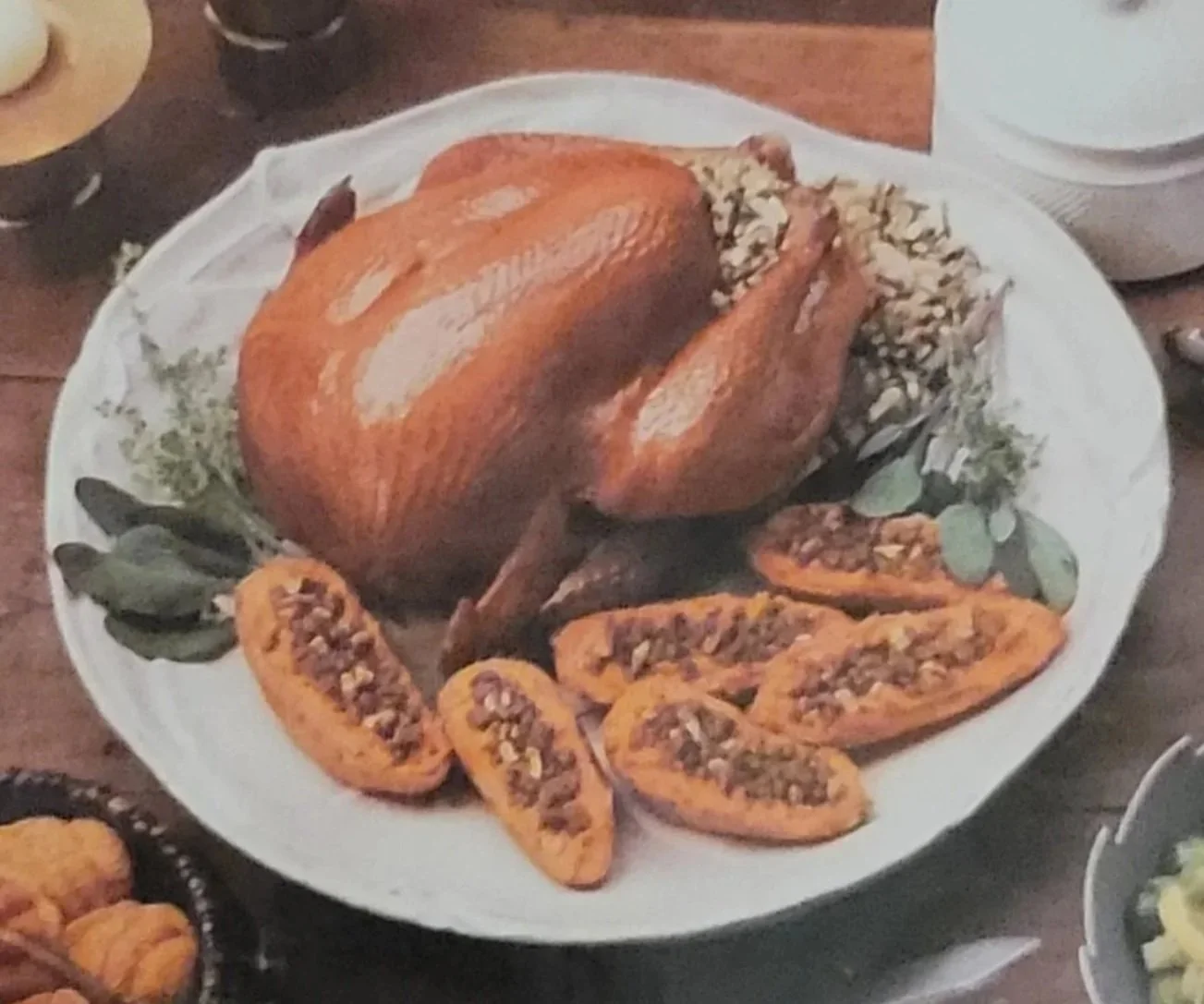
Thanksgiving Treasures from the Recipe Box
Every family has them—those yellowed recipe clippings tucked into cookbooks, handwritten cards passed down through generations. This Thanksgiving, I'm sharing favorites from my own collection, from the wild rice stuffing that's been on our table since 1986 to memories of Grandmother O'Brien's mashed turnips.
Part of the Storyline Genealogy series: From Research to Story
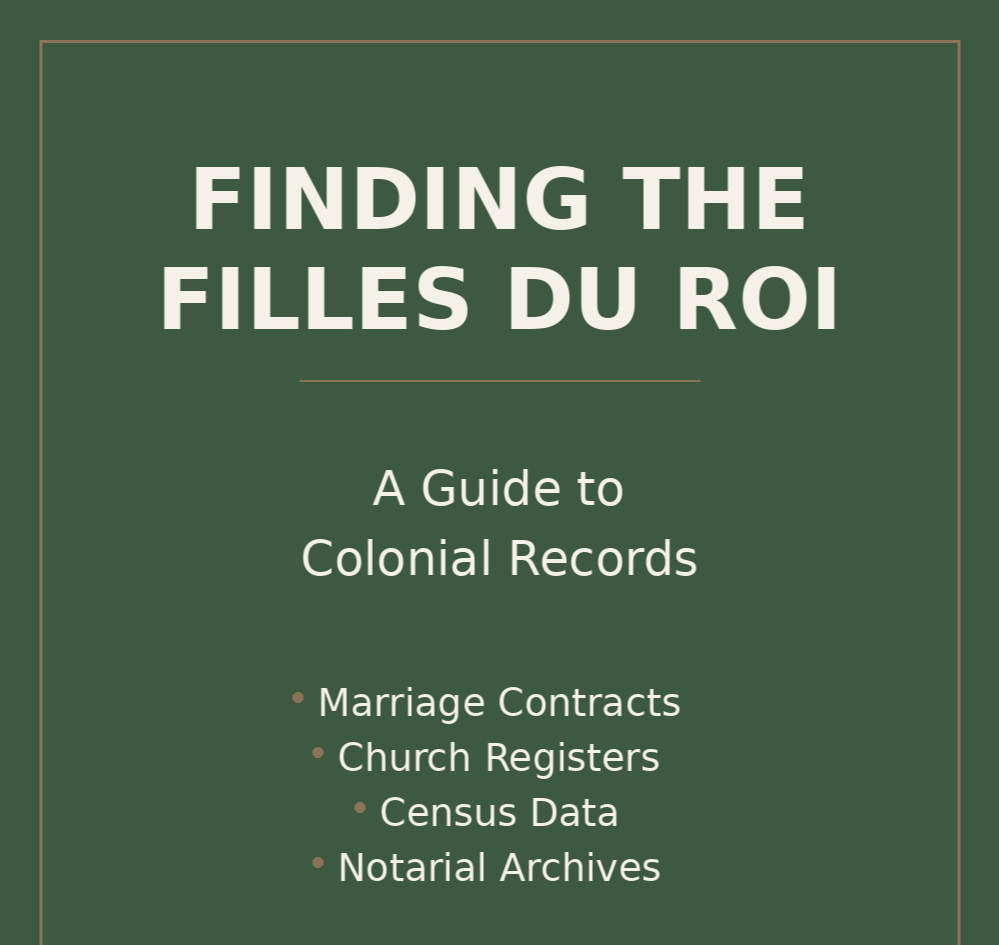
Finding the Filles du Roi in Colonial Records
The Filles du Roi left no personal diaries, but their lives are documented across colonial New France's archives. From marriage contracts to baptismal records, here's where to find the paper trail of the King's Daughters—and what those records can and cannot tell us.
Part of the Storyline Genealogy series: From marriage contracts to baptismal records—the documentary trail of the King's Daughters.
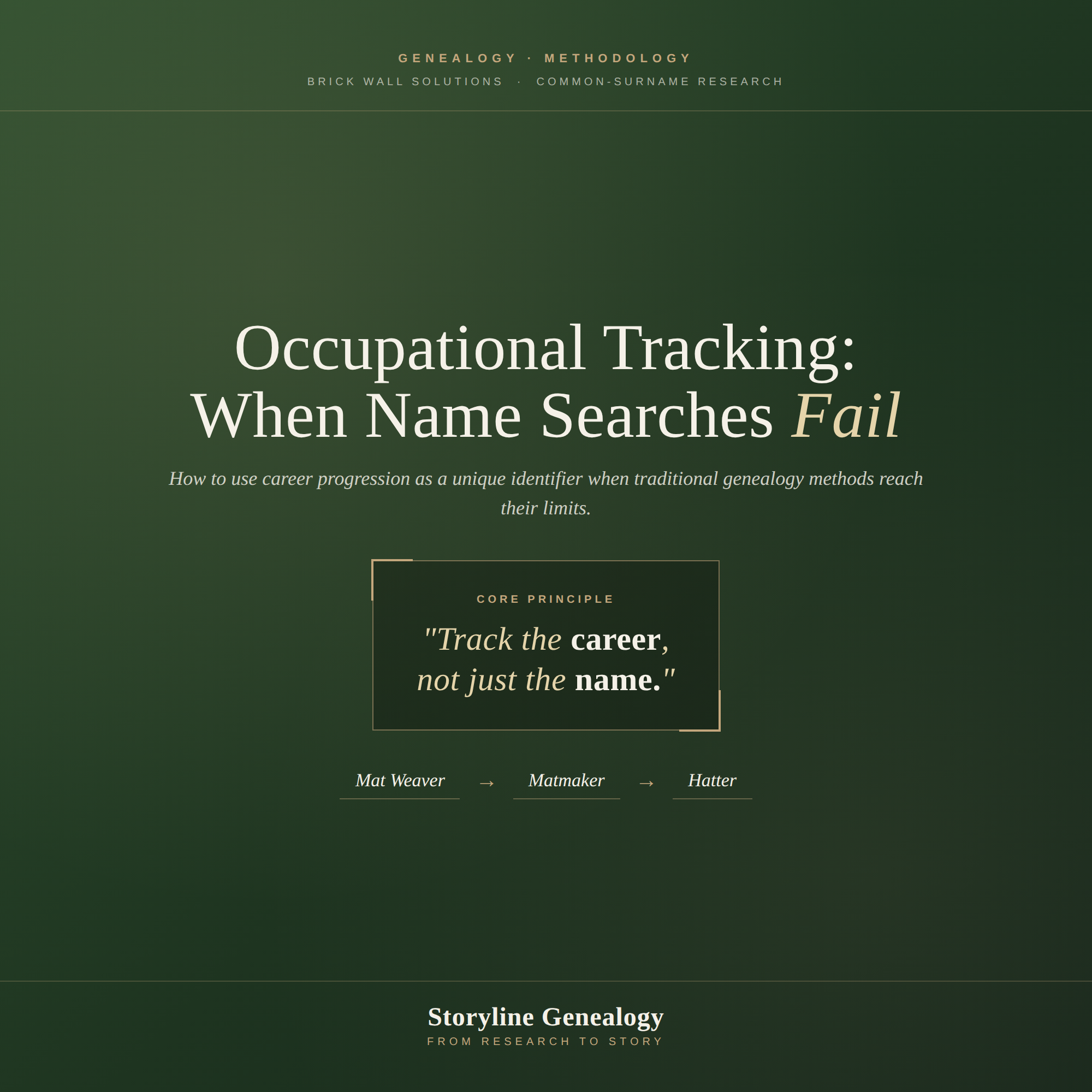
Occupational Tracking: When Name Searches Fail
You've searched every census. You've scoured city directories. You've analyzed DNA matches until your eyes crossed. But when your ancestor has one of the most common surnames in a city of 800,000 people—John Smith, Mary Jones, James Kelly—traditional name-based genealogy hits a wall.
For seven years, I searched for John Kenny among dozens of Brooklyn mat makers with virtually identical names. Traditional genealogy methods couldn't distinguish between them. But occupational tracking methodology could—and did. Learn how to use career progression as a unique identifier when name searches fail. This technique helped me solve a research problem that had stymied family historians for generations.
Part of the Storyline Genealogy Methodology Series: Because your ancestor's career tells a story when their name cannot.
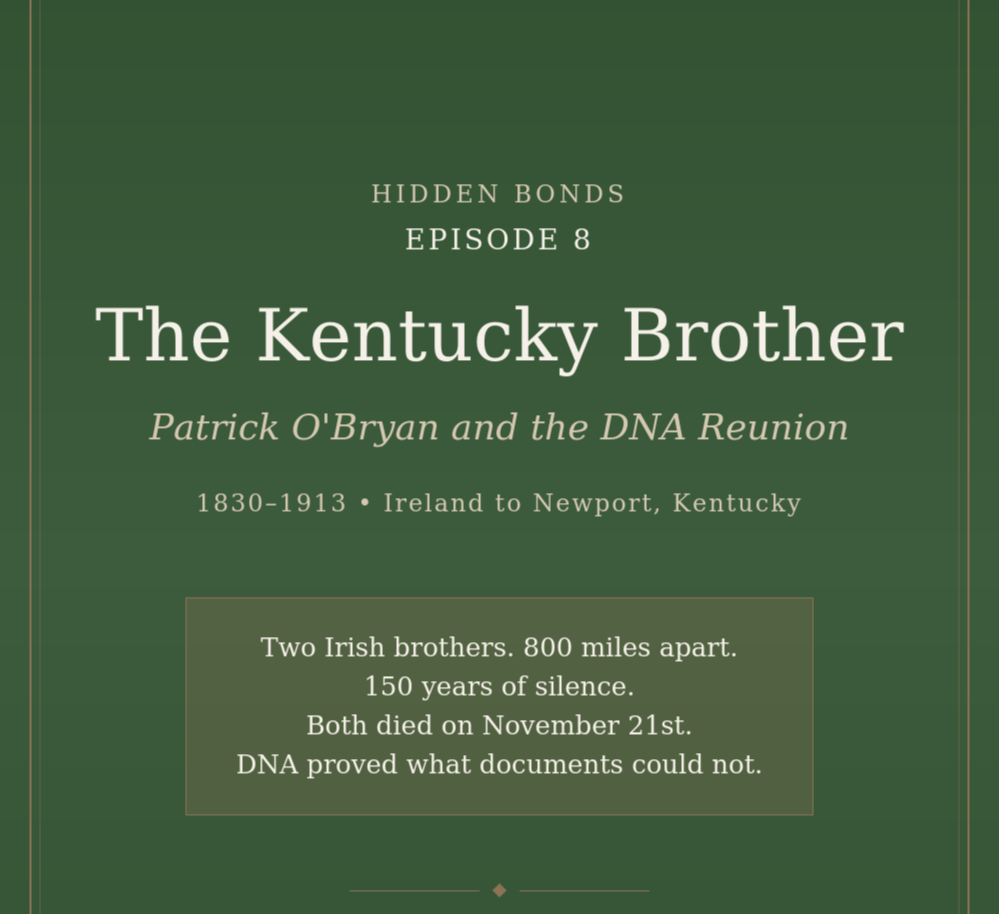
Hidden Bonds: The Kentucky Brother
For 150 years, a single line in a probate document was the only evidence that Terrence O'Brien had a brother: "Uncle Patrick O'Brien in Newport, Kentucky." Traditional genealogy hit dead ends. The surname was spelled differently. The families lived 800 miles apart. Then descendants of both lines took DNA tests—and science proved what documents could not. Even more remarkable: both brothers died on November 21st, exactly 39 years apart.
Part of the Storyline Genealogy series: Documentary Biographies From Research to Story