
Scattered Stones: The Great Emigration
The Great Emigration
David Leads the Way. Mary Ann Follows. George Has Only Days to Live.
"How long resident in this City: 5 days." — George Robertson's death certificate, July 2, 1872
The 1871 Scotland census captured George Robertson's household one final time. He was sixty-two years old, still living in Blairgowrie, still listed as a labourer. Margaret was fifty. Most of their children had grown and gone—some married, some working, some already contemplating the ocean crossing that would scatter the family across two continents.
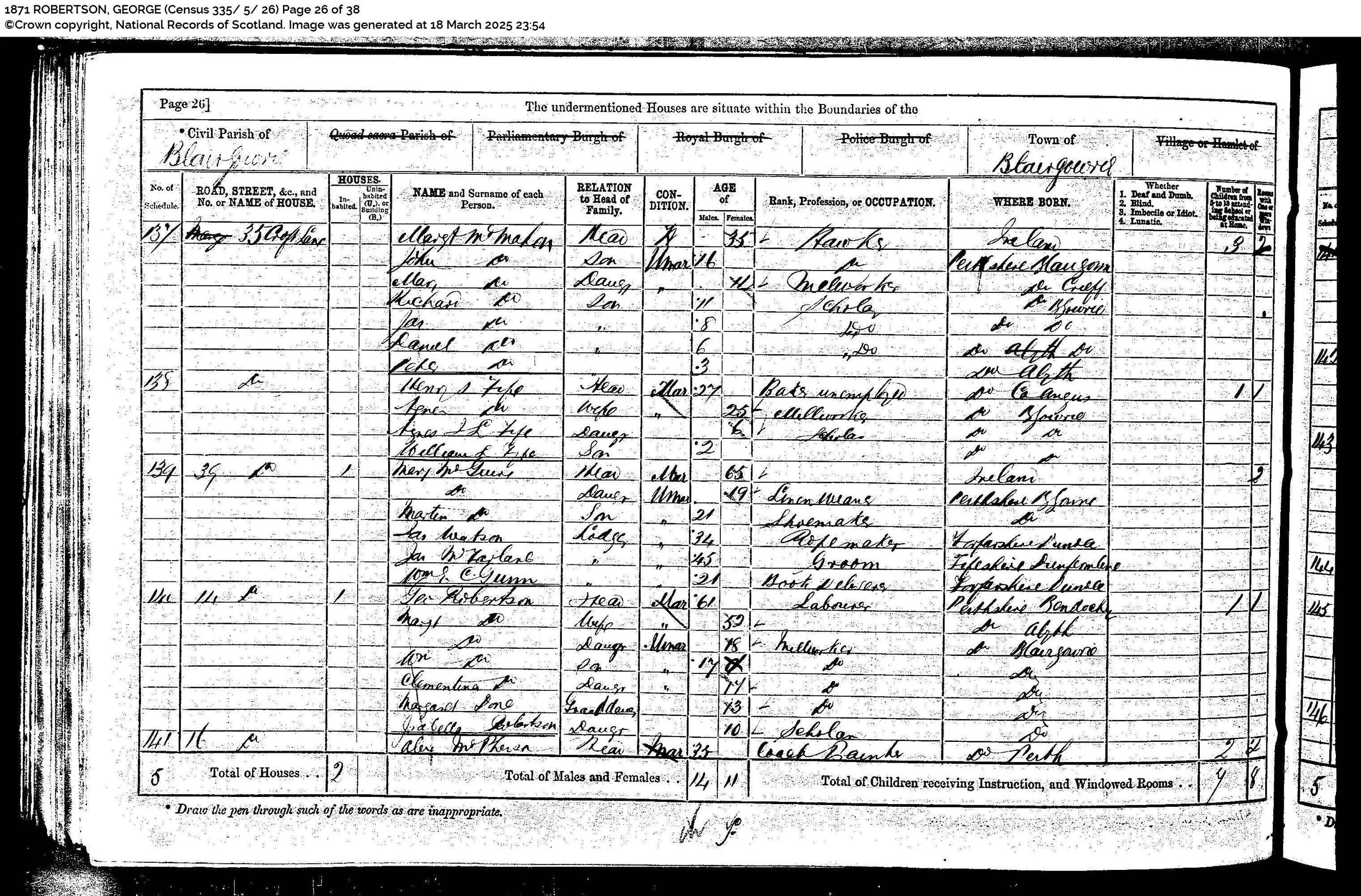
But the household was not empty. Living with George and Margaret was a thirteen-year-old girl named Margaret—their granddaughter, born in 1858 under circumstances the family preferred not to discuss. Her birth certificate, registered that year in Blairgowrie, listed her as illegitimate. Grandmother Margaret Paterson had been present at the birth, and the family had quietly absorbed the child into the household. By 1871, young Margaret was simply another member of George and Margaret's home—the last child they would raise together in Scotland.
This census would be the final record of George Robertson in his native country. Within eighteen months, he would board a ship bound for America. He would never return.
David Leads the Way
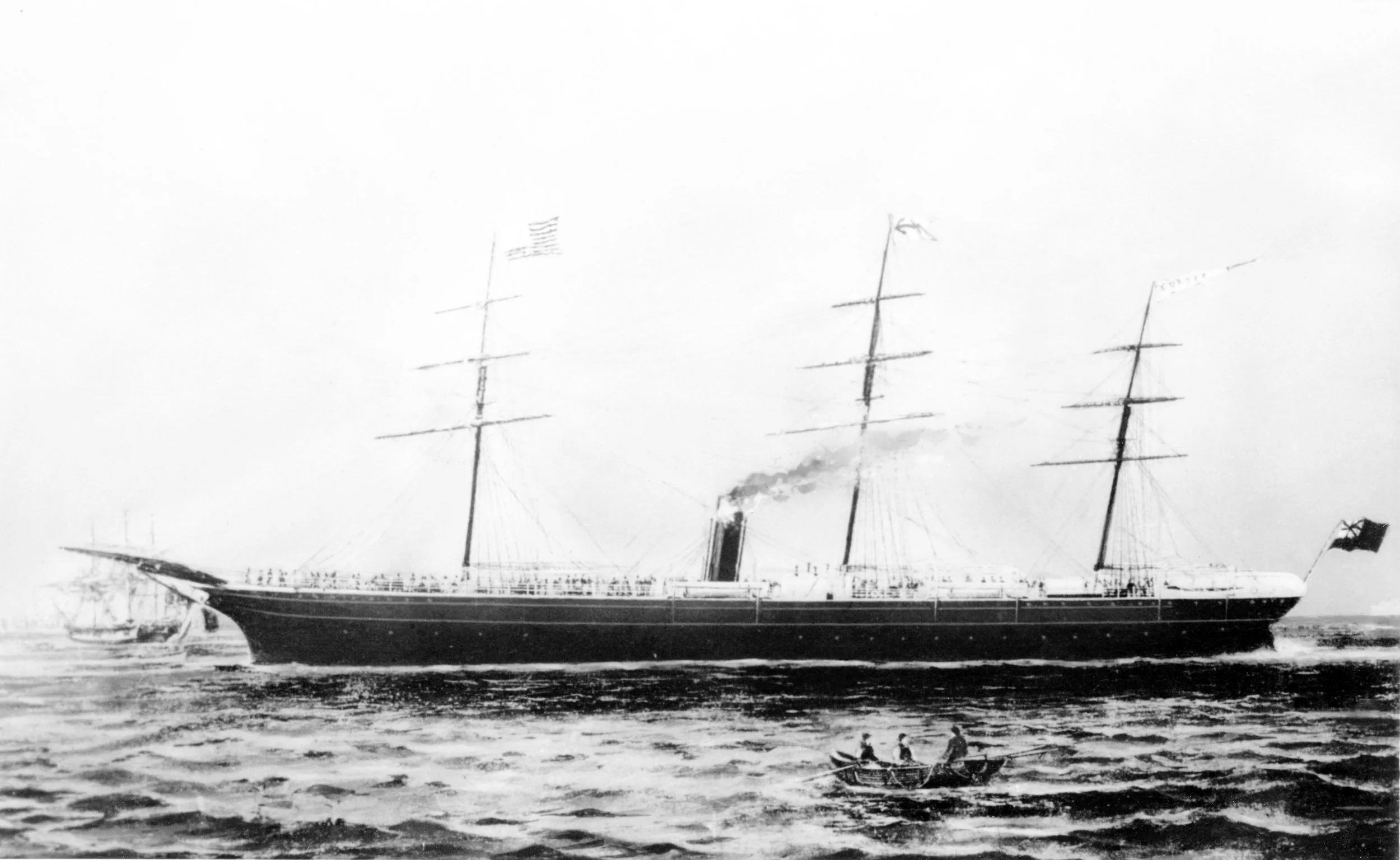
On March 27, 1869, David Paterson Robertson boarded the steamship Europa bound for New York. He was twenty-six years old, listed on the passenger manifest as a mason—the same trade his father had practiced for decades in Blairgowrie. The Europa was a Cunard liner, one of the vessels that carried thousands of emigrants across the Atlantic in the post-Civil War years when America's appetite for skilled labor seemed insatiable.
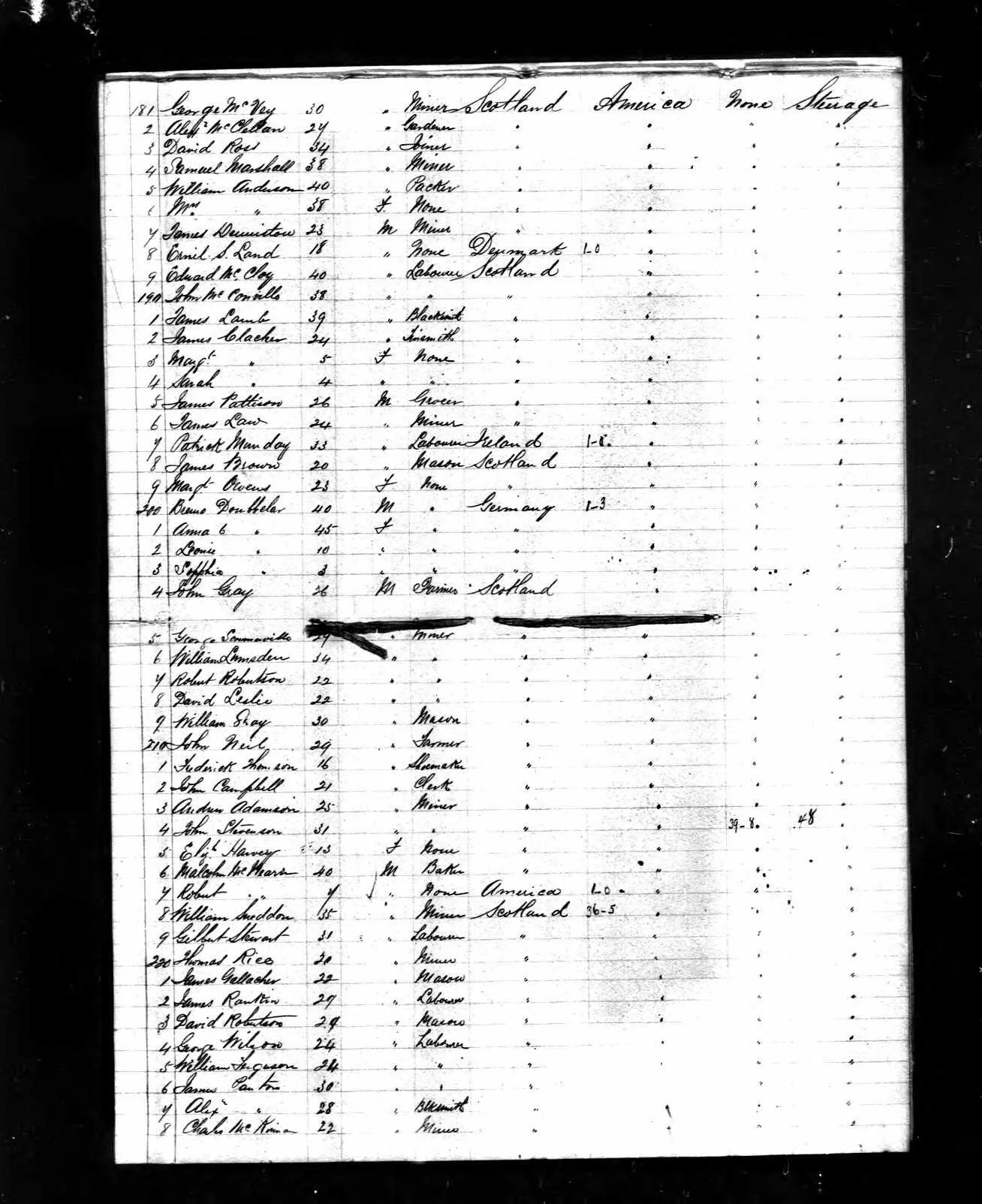
Why David? Perhaps he was the most ambitious, or the most restless. Perhaps he saw opportunities in America that Scotland could never offer. The building trades were booming in New York and Brooklyn; a skilled stone cutter could find steady work at wages far exceeding anything available in Perthshire.
David was not a young bachelor seeking his fortune. He had married Elizabeth Gray in Dundee on June 23, 1866—we know this because the date and place appear on their son William's birth record the following April, where David is listed as a stone mason. By the time David boarded the Europa in March 1869, he was a married man with a young child.
But when the 1870 U.S. census was taken, something had changed. David was living in Brooklyn's 12th Ward, working as a stone cutter. Elizabeth, age twenty-two, was keeping house. Two daughters were recorded: Margaret, age one, and Elizabeth, just seven months old—both born in New York. But there was no William. The Scottish-born son, who would have been three years old, was absent from the household. Whether he died in Scotland before the crossing, during the voyage, or in those first difficult months in Brooklyn, the records do not say. His absence is noted only by his silence in the census columns.
Despite this loss, David and Elizabeth were building a new life—establishing the beachhead that other family members would follow.
Mary Ann's Winding Path
Mary Ann Robertson McNab, the eldest of George's children, took a different route to America—one that wound through the vastness of Canada before finally reaching New Jersey.
She had married Alexander McNab in Blairgowrie in April 1865, with her brother David signing as witness. Sometime after 1871, Mary Ann and Alexander emigrated—but not directly to the United States. Their journey took them first to Canada, where they would spend years moving across the country.
A child was born in Nova Scotia. Another, Ellen Elizabeth McNab, was born in Ontario in June 1877. By the 1881 Canadian census, Mary Ann and Alexander were living in Manitoba. They would later appear in Saskatchewan in 1906, living with the Coleman family. Only eventually did they settle in Harrison, New Jersey—not far from where her siblings had established themselves in Brooklyn.
Mary Ann's wandering path across Canada stands in contrast to the direct crossings of her siblings. Perhaps Alexander found work opportunities that kept them moving westward across the Canadian provinces. Perhaps they were following the frontier, always seeking better land or better prospects. Whatever the reason, Mary Ann Robertson McNab would spend decades in Canada before finally rejoining her family in the New York area.
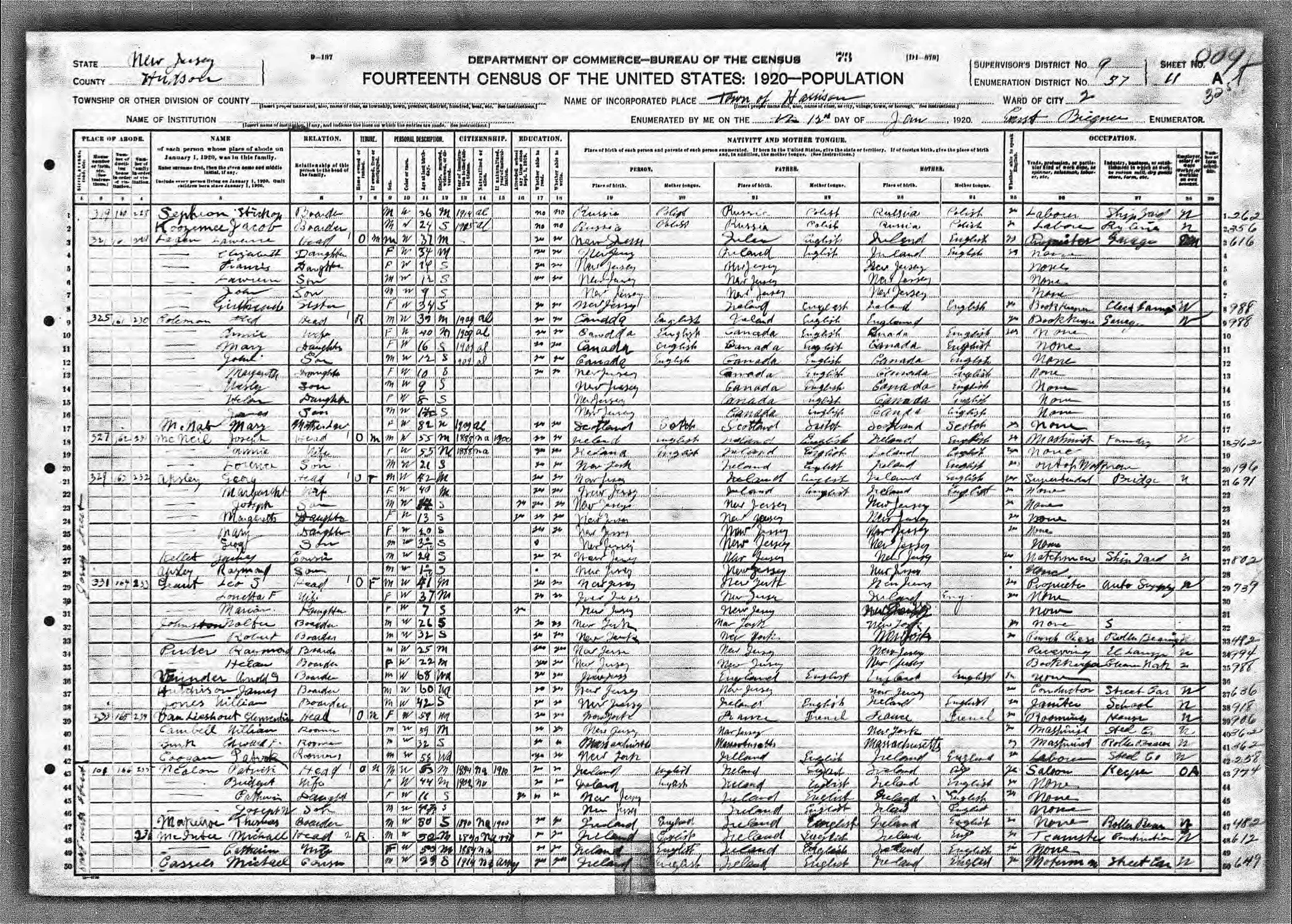
She would outlive nearly all of them. The 1920 census found her in Harrison, New Jersey, age eighty-one, a widow. She died in 1921—the last survivor of George Robertson's ten children, passing away more than eighty years after her baptism in Blairgowrie.
George's Crossing
In the early summer of 1872, George Robertson made his own crossing. He was sixty-three years old—elderly by the standards of the day, old for such a journey. But his son David was established in Brooklyn, working as a stone cutter. Perhaps George hoped to join him in the trade, to spend his final working years in America where wages were higher and opportunities seemed limitless.
No passenger list has been found for George's voyage. We know only that he arrived in New York on or about June 27, 1872. The ship that carried him, the route it took, the conditions of the crossing—all are lost to history.
What we know comes from the document that ended his American journey almost before it began.
Five Days
The summer of 1872 was brutal. A heat wave gripped the eastern seaboard, with temperatures in New York City climbing into the nineties day after day. For a man who had spent his entire life in the cool highlands of Scotland, where summer temperatures rarely exceeded seventy degrees, the shock must have been profound.
George Robertson died on July 2, 1872, at 144 Wolcott Street in Brooklyn's 12th Ward—the same ward where his son David lived. The death certificate tells the story in stark detail:

Name of the Deceased: George Robertson
Age: 63 years, 6 months
Occupation: Stone Cutter
Birthplace: Bendochy, Scotland
How long resident in this City: 5 days
Cause of Death: Apoplexy Sun Stroke from Heat
Time from Attack till Death: Four Hours
The Brutal Arithmetic of Loss
Five days. George Robertson had been in America for five days when the heat killed him. Four hours from the onset of sunstroke to death. A man who had spent thirty years cutting stone in Scotland, who had raised ten children, who had watched his eldest son emigrate and then followed him across the ocean—dead before he could even begin his American life.
He was buried the next day, July 3, 1872, at Evergreens Cemetery in Brooklyn. The grave was in an area called Pathside—an unmarked section with no headstones, no monuments, no way for future generations to find the spot where George Robertson was laid to rest.
The Widow
What happened to Margaret Paterson Robertson in the immediate aftermath of her husband's death? Did she receive word in Scotland and make her own crossing as a widow? Or had she traveled with George, arriving in Brooklyn only to watch him die within days?
The records do not tell us when Margaret arrived in America. Her 1892 death certificate states she had been in the United States for twenty years—which would place her arrival in 1872, the same year George died. Perhaps they crossed together. Perhaps she was there when he collapsed in the July heat, when the doctors could do nothing, when he was buried the very next day in an unmarked grave.
By 1874, Margaret was established in Brooklyn. The city directory for that year lists her plainly:

"Robertson, Margaret, wid. Geo. 119 Hamilton av"
Widow of George. Those three words would define her for the next two decades. She would move through the years, appearing in subsequent directories—347 Hoyt Avenue by 1880—always identified by her relationship to the man who had died five days after arriving in America.
Twenty Years a Widow
Margaret Paterson Robertson would live another twenty years in Brooklyn, surrounded by her children and grandchildren, maintaining the family connections that had been scattered across an ocean. She died on July 22, 1892, at 194 Nelson Street—almost exactly twenty years after her husband's death in the same brutal month of July.
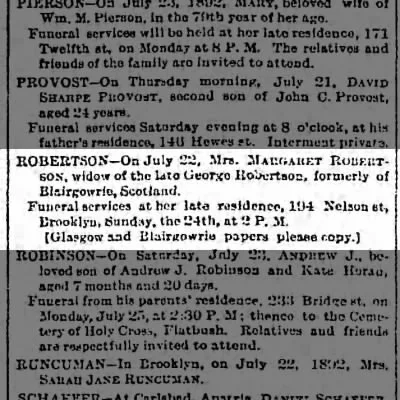
Her obituary, published in the Brooklyn newspapers, requested that the "Glasgow and Blairgowrie papers please copy." Even after two decades in America, Margaret wanted people back home to know. She was still, in some essential way, a woman of Blairgowrie—the widow of the late George Robertson, formerly of Scotland.
She was buried at Evergreens Cemetery on July 24, 1892, in the same unmarked Pathside section where George had been laid to rest twenty years before. In death, as in life, they remained together—though no stone marks the spot where they lie.
The Story Continues: Stone cutters and iron moulders, widows and working women—the Robertson siblings build lives in Brooklyn while their mother Margaret maintains the family connections across two decades of widowhood. Episode 4: The Brooklyn Network (1872–1900).
Evidence Analysis
The emigration of the Robertson family is documented through multiple record types across three countries—Scotland, Canada, and the United States. Correlating these sources reveals the timing, routes, and consequences of the family's dispersal.
David's Timeline
The 1867 birth record of son William in Dundee provides crucial evidence: it names both parents (David Robertson, Stone Mason, and Elizabeth Gray) and records their marriage date and place as June 23, 1866, in Dundee. The 1869 passenger list shows David's arrival in Brooklyn. The 1870 census lists David with wife Elizabeth and two American-born daughters—but Scottish-born William, who would have been three, is absent. His fate remains unknown.
George's Five Days
The death certificate's notation "How long resident in this City: 5 days" is unusually precise and devastatingly brief. Combined with "Birthplace: Bendochy"—the parish of his baptism sixty-three years earlier—the document spans George's entire life in a few stark lines.
Margaret's Arrival
Margaret's 1892 death certificate states she had been in the U.S. for "20 years," placing her arrival in 1872—the same year George died. Whether she traveled with George or came after receiving news of his death remains unknown; no passenger list has been located for either of them.
Mary Ann's Canadian Detour
Canadian census and vital records trace Mary Ann's path across the country: children born in Nova Scotia and Ontario, census appearances in Manitoba (1881) and Saskatchewan (1906). Her late settlement in New Jersey suggests the family maintained contact across vast distances.
The Illegitimate Grandchild
The 1858 birth of Margaret Ann Robertson, with grandmother Margaret Paterson present, and the child's appearance in the 1871 census living with George and Margaret, suggests a family quietly absorbing the consequences of an unmarried daughter's pregnancy. Whose child this was remains unclear from the records.
Evergreens Cemetery
Both George (1872) and Margaret (1892) were buried in the Pathside section of Evergreens Cemetery—an unmarked area without headstones. This suggests limited financial resources or simply the common practice of economical burial among working-class immigrants.
Primary Source Documents
The following documents trace the Robertson family's emigration from Scotland to America—and the tragedy that struck within days of George's arrival.




Sources
1871 Scotland Census, Blairgowrie (George Robertson household). National Records of Scotland.
Statutory Registers, Blairgowrie 335/ Births (1858 birth of Margaret Ann Robertson). National Records of Scotland.
Passenger Lists of Vessels Arriving at New York, 1820-1897; SS Europa, March 27, 1869. National Archives.
Statutory Registers, Dundee 282/1 Births (1867 birth of William Robertson, son of David Robertson and Elizabeth Gray, noting parents' marriage June 23, 1866). National Records of Scotland.
1870 U.S. Census, Brooklyn Ward 12, Kings County, New York (David Robertson household).
Certificate of Death, George Robertson, July 2, 1872, Kings County, New York. NYC Municipal Archives.
Brooklyn City Directory, 1874 (Margaret Robertson, widow); 1880 (Margaret Robertson, widow).
Certificate of Death, Margaret Robertson, July 22, 1892, Kings County, New York. NYC Municipal Archives.
"Mrs. Margaret Robertson" [obituary], Brooklyn newspaper, July 1892.
Ontario Vital Records, Births (1877 birth of Ellen Elizabeth McNab, Whitby).
1881 Census of Canada, Manitoba (Mary Ann McNab household); 1906 Census of Canada, Saskatchewan.
1920 U.S. Census, Harrison, Hudson County, New Jersey (Mary Ann McNab). Index of Deaths in New Jersey, 1920-1924, Harrison Town (McNab, Mary Ann).
Are You Connected to the Robertson Line?
If you descend from the Robertson family of Blairgowrie, Bendochy, or Rattray in Perthshire — from George Robertson and Margaret Paterson or any of their ten children, the Brooklyn stone cutter David Paterson Robertson, or the connected Paterson, Craig, Anderson, McNab, McIntyre, Ferguson, Nisbet, or Lockhart lines — in Scotland, Brooklyn, New Jersey, or Liverpool, I’d like to compare notes. Documented Scottish trees, DNA matches, family papers, and even half-remembered stories have all moved this research forward.
Get in Touch About This FamilyCousin connections are informal and reciprocal — no fee, no obligation, just shared work on shared ancestry.
Every Family Has a Story Worth Telling
Whether you're just beginning your research or ready to transform years of work into a narrative your family will treasure, I'd love to help.
LET'S TALK ABOUT YOUR FAMILY