
Scattered Stones: Roots in Perthshire
Roots in Perthshire
"6th March Duncan Robertson & Jean Angus both in this Parish have entered their names here to be proclaimed in order to Marriage." — Bendochy Parish Register, 1786
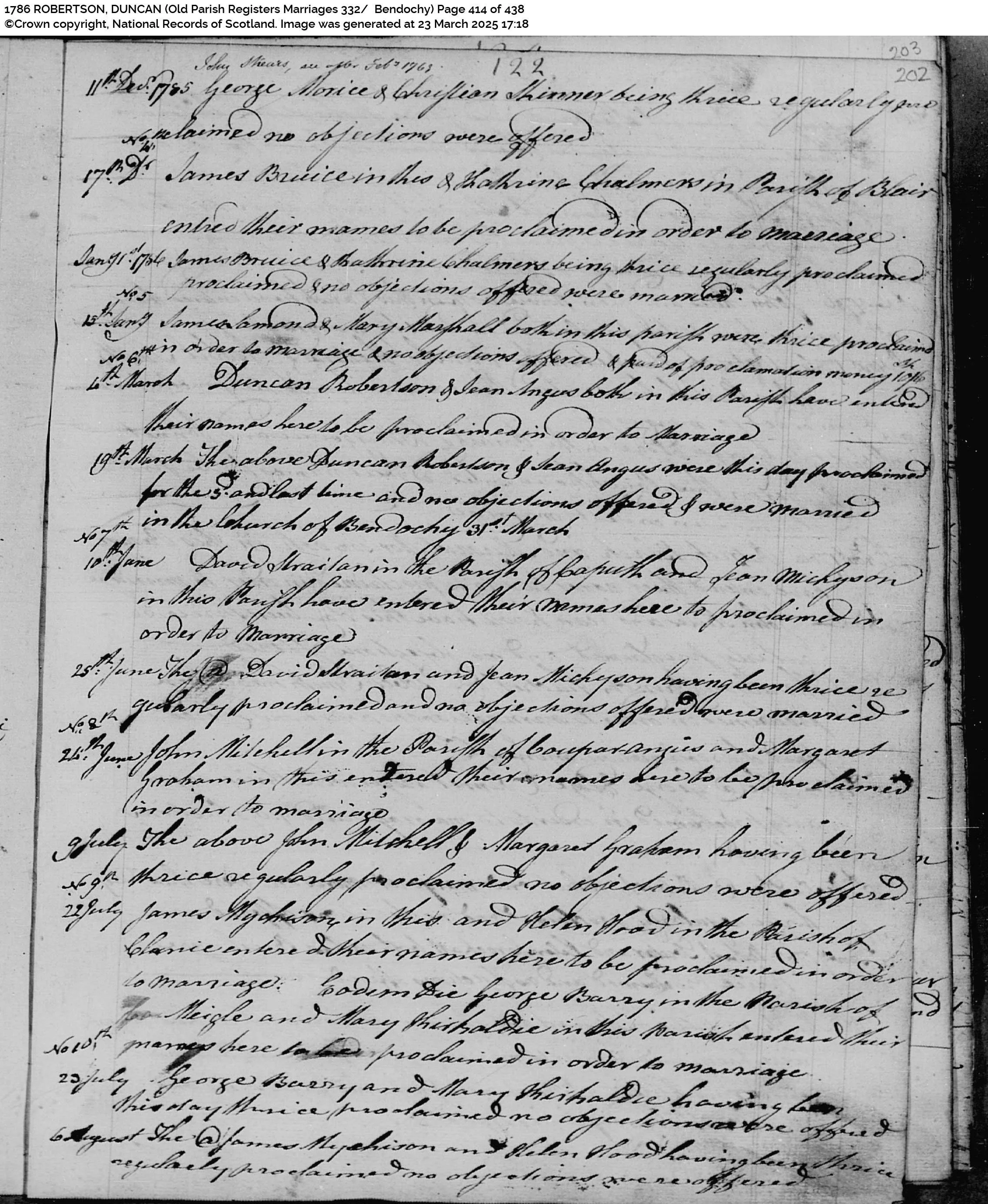
The entry in the Bendochy parish register is brief, written in the flowing script of an eighteenth-century clerk. Two weeks later, on March 25, 1786, Duncan Robertson and Jean Angus stood in the Church of Bendochy and were married—the fifth couple wed there that month.
They could not have known that their union would produce children whose descendants would scatter across three continents—from the Scottish highlands to Brooklyn tenements, from Liverpool docks to the Canadian prairie, from New Jersey factories to the wilds of Georgia.
But that story was still decades away. In the spring of 1786, Duncan Robertson was simply a young man from the townland of Myreridges, marrying a local woman named Jean Angus in the parish where both their families had roots.
The Weaver of Myreridges
Bendochy was a small rural parish in Perthshire, nestled in the fertile Strathmore valley of eastern Scotland. The townland of Myreridges (spelled variously as Mayridges, Myriggs, or Myreridges in the records) lay within its bounds—a farming community where families like the Robertsons had worked the land for generations.
Duncan Robertson made his living as a weaver, part of the textile tradition that defined much of rural Scottish life in the late eighteenth century. The work was skilled and demanding: transforming raw flax or wool into cloth on a hand loom, often working by candlelight in the long Scottish winters. It was also increasingly precarious work, as the first stirrings of industrial mechanization began to threaten the livelihoods of handloom weavers across Britain.
But Duncan earned more than his weaving income. By 1799, the parish records identify him as "Church Officer"—a position of respect within the community. The Church Officer assisted the minister with parish duties, maintained the church building, and helped keep order during services. It was a mark of Duncan's standing in Bendochy that he was entrusted with this role.
Seven Children in Myreridges
Over the next two decades, Duncan and Jean raised a large family in Myreridges. The parish registers record at least seven children baptized to the couple:
There may have been other children—infant mortality was common, and not every birth was recorded—but these seven names appear in the Bendochy registers, spanning twenty-two years from James in 1787 to George in 1809.
The Youngest Son
George Robertson arrived late in his parents' lives. When he was baptized in January 1809, his eldest brother James was already twenty-two years old—nearly old enough to be George's father. The gap of eight years between Janet (1801) and George (1809) suggests either lost children in between, or simply the natural slowing of fertility as Jean Angus aged.

Growing up as the baby of a large family shaped George in ways we can only imagine. His older brothers were already learning trades and courting wives by the time he was a child. William married Betsey Stewart in June 1809—just five months after George's baptism. John would marry Catherine Spankie in 1824, when George was fifteen. The household George knew was likely smaller than the bustling home of his parents' earlier years.
What we know is that George followed his brother William into the mason's trade. Whether he learned from William directly, or from another master, or simply saw the opportunity that stonework offered compared to his father's increasingly precarious weaving, the records don't say. But by the time George married, he was firmly established as a mason—a skilled tradesman who worked with the stone that gave Perthshire its character.
The Next Generation Begins
As Duncan and Jean's children came of age, they began to scatter—a pattern that would repeat itself even more dramatically in the next generation.
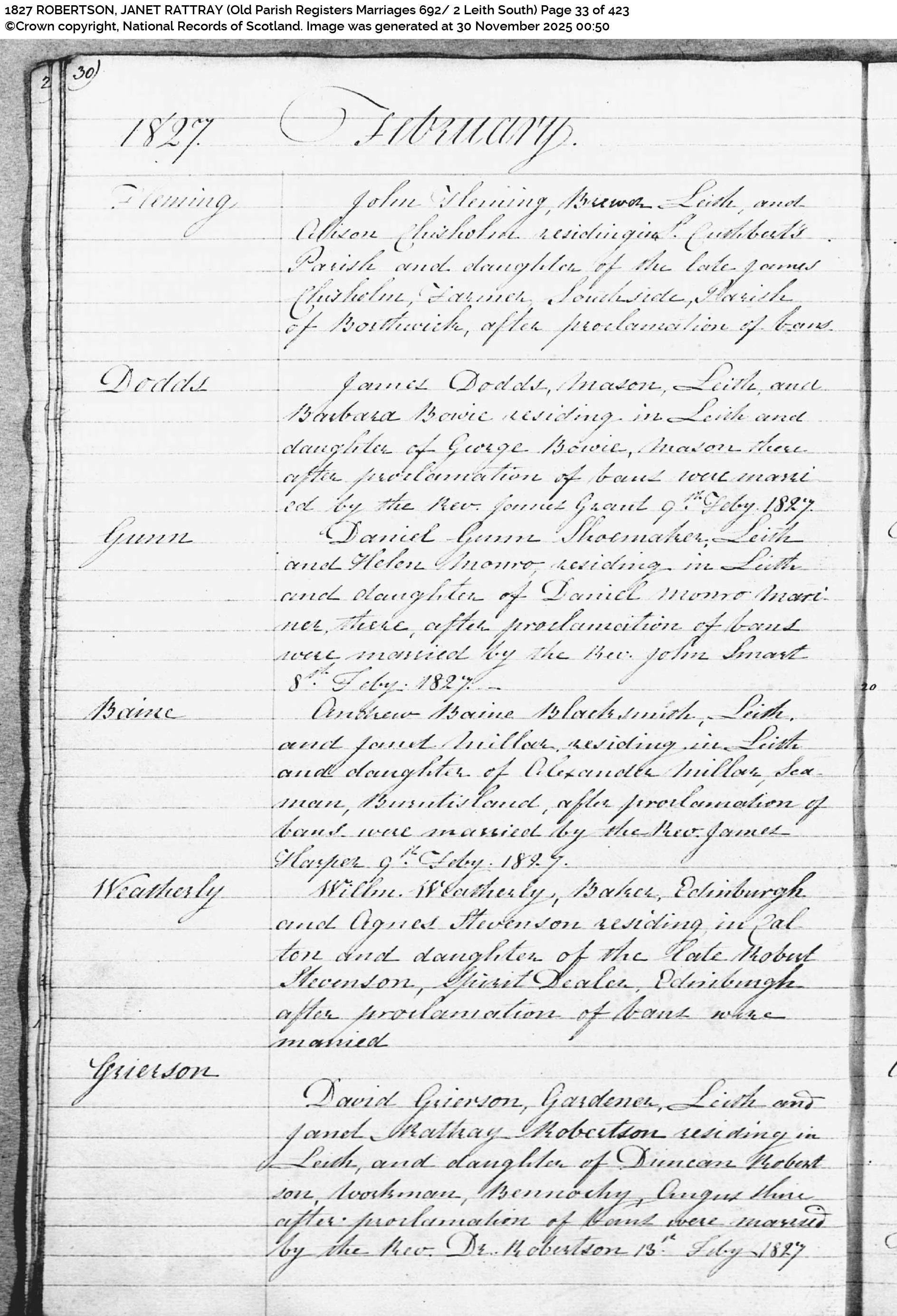
William, the mason, married at Blair Atholl in 1809 and likely remained in Perthshire. John married Catherine Spankie in 1824 and appears in the 1841 census as a quarrier—still working in stone, like his brother William and his younger brother George. Janet left for Leith, marrying the gardener David Grierson in 1827 and eventually settling in Edinburgh after her husband's death.

James, Charles, and Margaret Rattray disappear from the records after their baptisms—whether they died young, emigrated, or simply moved beyond the reach of the documents that survive, we cannot say. The fragmentary nature of Scottish records before civil registration began in 1855 leaves many such gaps.
An Elderly Weaver: The 1841 Census
The 1841 census—the first detailed census of Scotland—captures Duncan Robertson at a remarkable age. He was eighty-one years old, still living in Myreridges, and still listed as a "Weaver." After more than half a century at the loom, the old Church Officer was still practicing his trade.
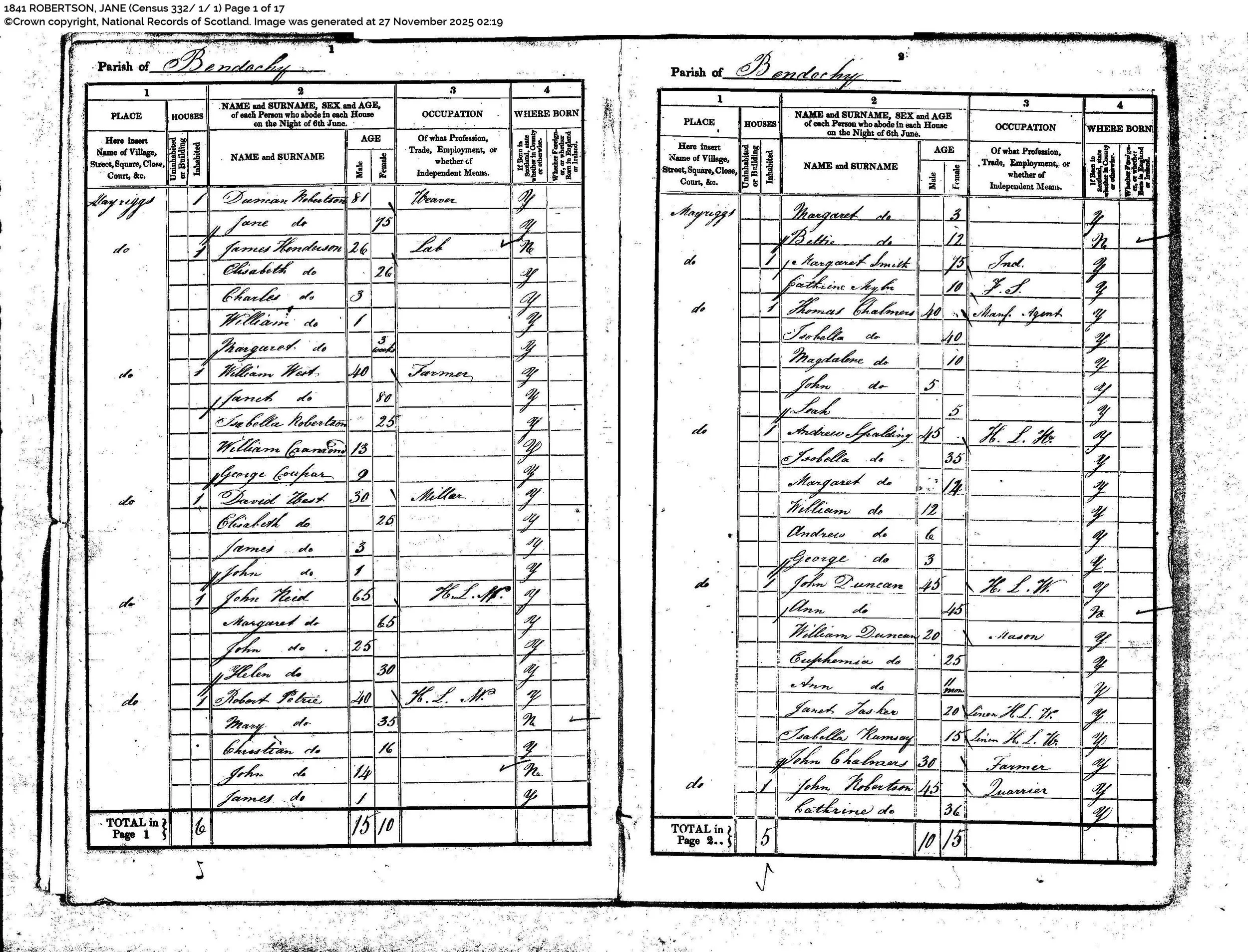
Jean Angus, listed as "Jane" on the census, was seventy-five. The couple had been married for fifty-five years. Living with them were James Henderson, age 26, a labourer, with his wife Elizabeth and their young children Charles, William, and infant Margaret—possibly relatives or lodgers helping to support the elderly couple.
Nearby in the same townland lived their son John Robertson, age 45, working as a quarrier with his wife Catherine. Their daughter Isabella Robertson, age 25, also appears in Myreridges. The family remained rooted in the land where Duncan and Jean had begun their life together more than half a century before.
Duncan Robertson likely died in the early 1840s, though no death record survives from before civil registration. Jean Angus probably followed him within a few years. They lie in unmarked graves in Bendochy churchyard—the weaver and his wife, who raised seven children in the townland of Myreridges and watched them scatter across Scotland.
A Mason's Courtship
On August 19, 1838, George Robertson and Margaret Paterson appeared before the session clerk of Bendochy parish to have their intention to marry proclaimed. George was twenty-nine years old, a mason by trade, following the path his brother William had taken before him. Margaret was seventeen, the daughter of David Paterson.

The marriage took place in November 1838, in the same parish where George's parents had wed fifty-two years earlier. It was a return to roots for George—or perhaps he had never really left. The Bendochy registers had recorded his baptism, and now they recorded his marriage.
George and Margaret would settle in the nearby market town of Blairgowrie, where George found steady work as a mason. Over the next twenty-two years, Margaret would bear ten children—Mary Ann, James, David, John, Margaret, the twins Clementina and William Fraser, Alexander, Jean, and Isabella. It was a large family even by Victorian standards, and it would not stay together.
But in 1838, as George and Margaret began their life together, the future was unwritten. They were simply a mason and his young wife, building a household in Blairgowrie, connected by blood and parish to the weaver still working his loom in Myreridges.
The Story Continues: George and Margaret's household in Blairgowrie—ten children, four censuses, and the calm before the crossing—is told in Episode 2: The Mason's Household (1839–1871).
Evidence Analysis
Establishing the Family Unit
The identification of Duncan Robertson and Jean Angus as George Robertson's parents rests on a chain of evidence beginning with the 1786 marriage proclamation and extending through baptism records, census returns, and marriage records of their children. Each document reinforces the others: the consistent location (Myreridges/Mayriggs in Bendochy parish), the consistent parentage listed in children's baptisms, and the 1841 census showing the elderly couple still living in the townland where they raised their family.
The Rattray Connection
The distinctive "Rattray" middle name given to both Margaret (1799) and Janet (1801) raises intriguing questions. Rattray is both a surname and a place name—Old Rattray lies just outside Blairgowrie, where George would later raise his own family. The name may honor a godparent, a maternal connection, or a family tie to the Rattray area. Significantly, George's grandson (also named George) would be buried at Rattray in 1944, completing a geographic circle that spans two centuries.
Masonry as a Family Trade
The discovery that both William (married 1809) and John (1841 census) worked in stone trades transforms our understanding of George's career choice. William was explicitly identified as a "Mason" in his marriage record; John was working as a "Quarrier" by 1841. George wasn't simply a weaver's son who happened to become a mason—he was following a family tradition. This trade would pass to George's own son David, who worked as a stone cutter in Brooklyn.
Duncan's Parish Role
The 1799 baptism record identifying Duncan as "Church Officer" establishes his position of respect within Bendochy parish. This role, combined with his remarkable longevity (still weaving at age 81), suggests a man of standing in his community—not wealthy, but respected.
Limitations
Scottish records before civil registration (1855) are incomplete. Parish registers depended on individual ministers' diligence, and not all births, marriages, or deaths were recorded. The fates of James, Charles, and Margaret Rattray after their baptisms remain unknown—they may have died young, emigrated, or simply lived and died without leaving traces in the surviving documents.
Primary Source Documents




Sources
Old Parish Registers, Bendochy 332/, Marriages 1786 (Duncan Robertson and Jean Angus). National Records of Scotland.
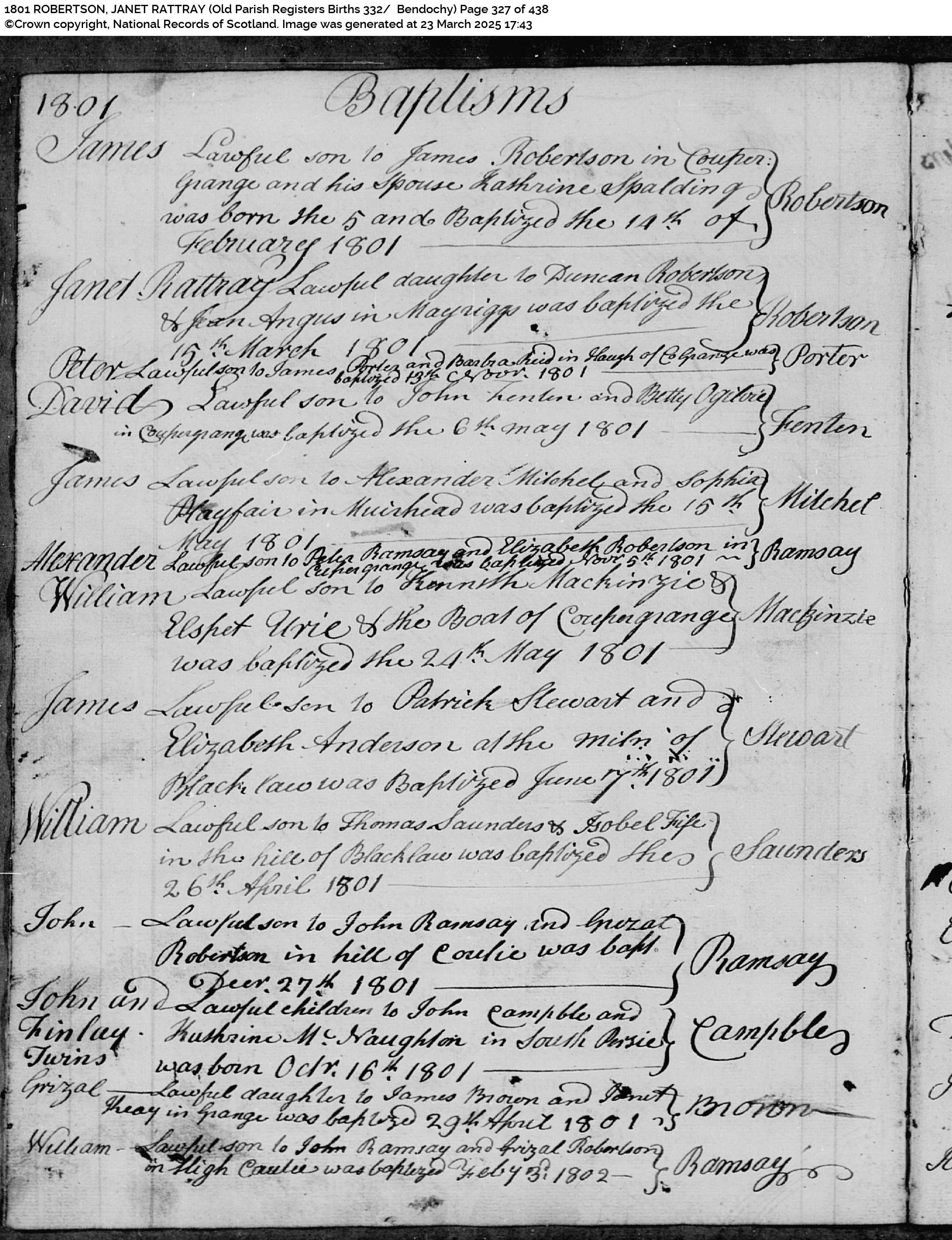
Old Parish Registers, Bendochy 332/, Births 1787, Page 298 (James Robertson baptism); 1789, Page 301 (John Robertson baptism); 1791, Page 307 (William Robertson baptism); 1795, Page 315 (Charles Robertson baptism); 1799, Page 322 (Margaret Rattray Robertson baptism); 1801, Page 327 (Janet Rattray Robertson baptism); 1809 (George Robertson baptism). National Records of Scotland.
Old Parish Registers, Blair Atholl 334/, Marriages 1809, Page 321 (William Robertson and Betsey Stewart). National Records of Scotland.
Old Parish Registers, Kinnaird 368/, Marriages 1824 (John Robertson and Catherine Spankie). National Records of Scotland.
Old Parish Registers, Leith South 692/2, Marriages 1827, Page 33 (David Grierson and Janet Rattray Robertson). National Records of Scotland.
Old Parish Registers, Bendochy 332/, Marriages 1838, Page 71 (George Robertson and Margaret Paterson). National Records of Scotland.
1841 Scotland Census, Bendochy Parish 332/1/1, Page 1 (Duncan Robertson household, Mayriggs; John Robertson household). National Records of Scotland.
1861 Scotland Census, St Cuthbert Parish, Edinburgh, 685/1 87/1, Page 1 (Janet Grierson household). National Records of Scotland.
Are You Connected to the Robertson Line?
If you descend from the Robertson family of Blairgowrie, Bendochy, or Rattray in Perthshire — from George Robertson and Margaret Paterson or any of their ten children, the Brooklyn stone cutter David Paterson Robertson, or the connected Paterson, Craig, Anderson, McNab, McIntyre, Ferguson, Nisbet, or Lockhart lines — in Scotland, Brooklyn, New Jersey, or Liverpool, I’d like to compare notes. Documented Scottish trees, DNA matches, family papers, and even half-remembered stories have all moved this research forward.
Get in Touch About This FamilyCousin connections are informal and reciprocal — no fee, no obligation, just shared work on shared ancestry.
Every Family Has a Story Worth Telling
Whether you're just beginning your research or ready to transform years of work into a narrative your family will treasure, I'd love to help.
LET'S TALK ABOUT YOUR FAMILY