
Scattered Stones: The Stone Cutter’s Journey
The Stone Cutter's Journey
From Scottish Quarries to Brooklyn Streets to a Georgia Swamp
"Of all the children of George Robertson and Margaret Paterson, David was the pioneer—the first to cross the Atlantic, the first to establish the family name in America. For forty years he built a life in Brooklyn, with one mysterious sojourn back to Scotland. Then, at sixty-seven, newly widowed, he vanished into the swamps of Georgia. His body was never found."
The Third Child
David Paterson Robertson was born in September 1842 in Blairgowrie, Perthshire, the third child and second son of George Robertson, mason, and Margaret Paterson. He grew up watching his father shape stone, learning the trade that would define his own life. His middle name honored his mother's family—the Patersons of Bendochy.
By his early twenties, David had moved to Dundee, the industrial port city on the Tay. There, amid the jute mills and shipyards, he met a young woman from the northeast of Scotland.
Elizabeth Gray of Monymusk
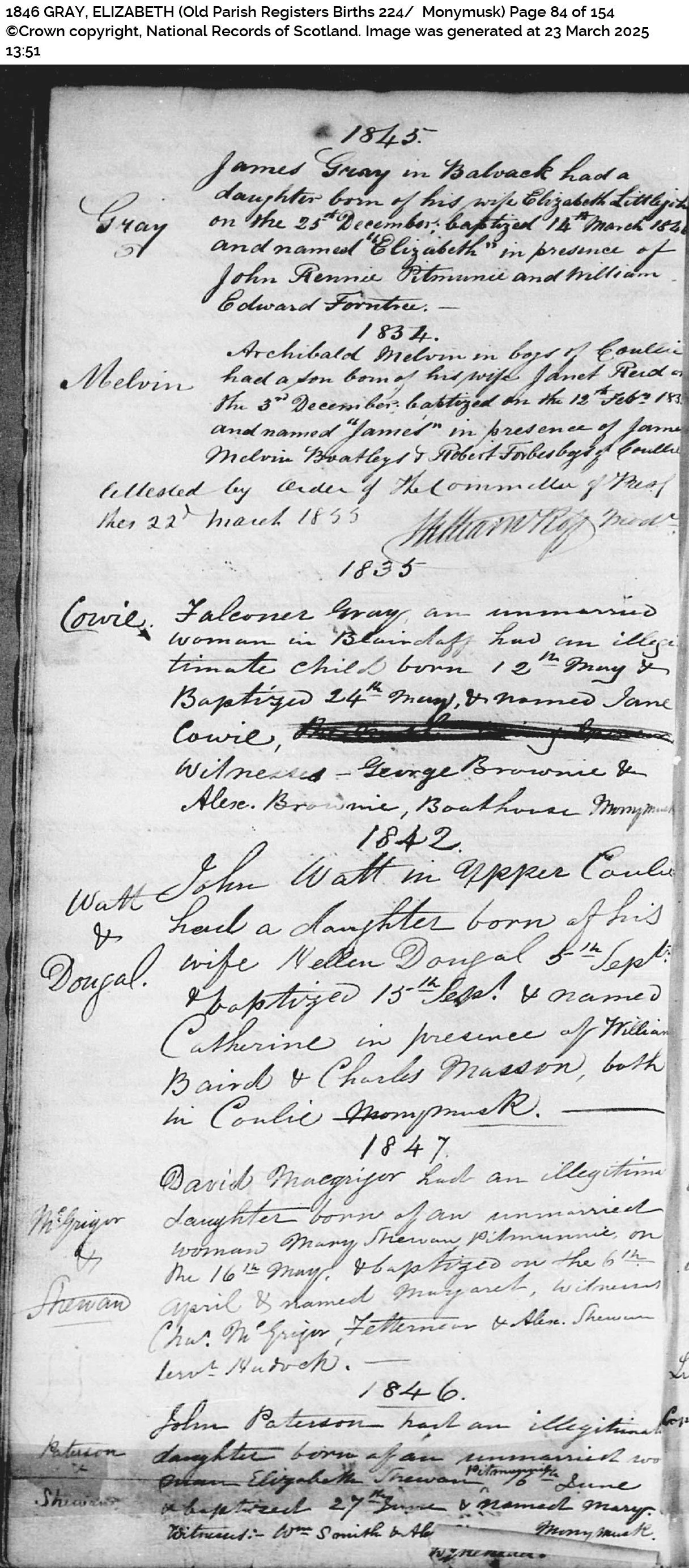
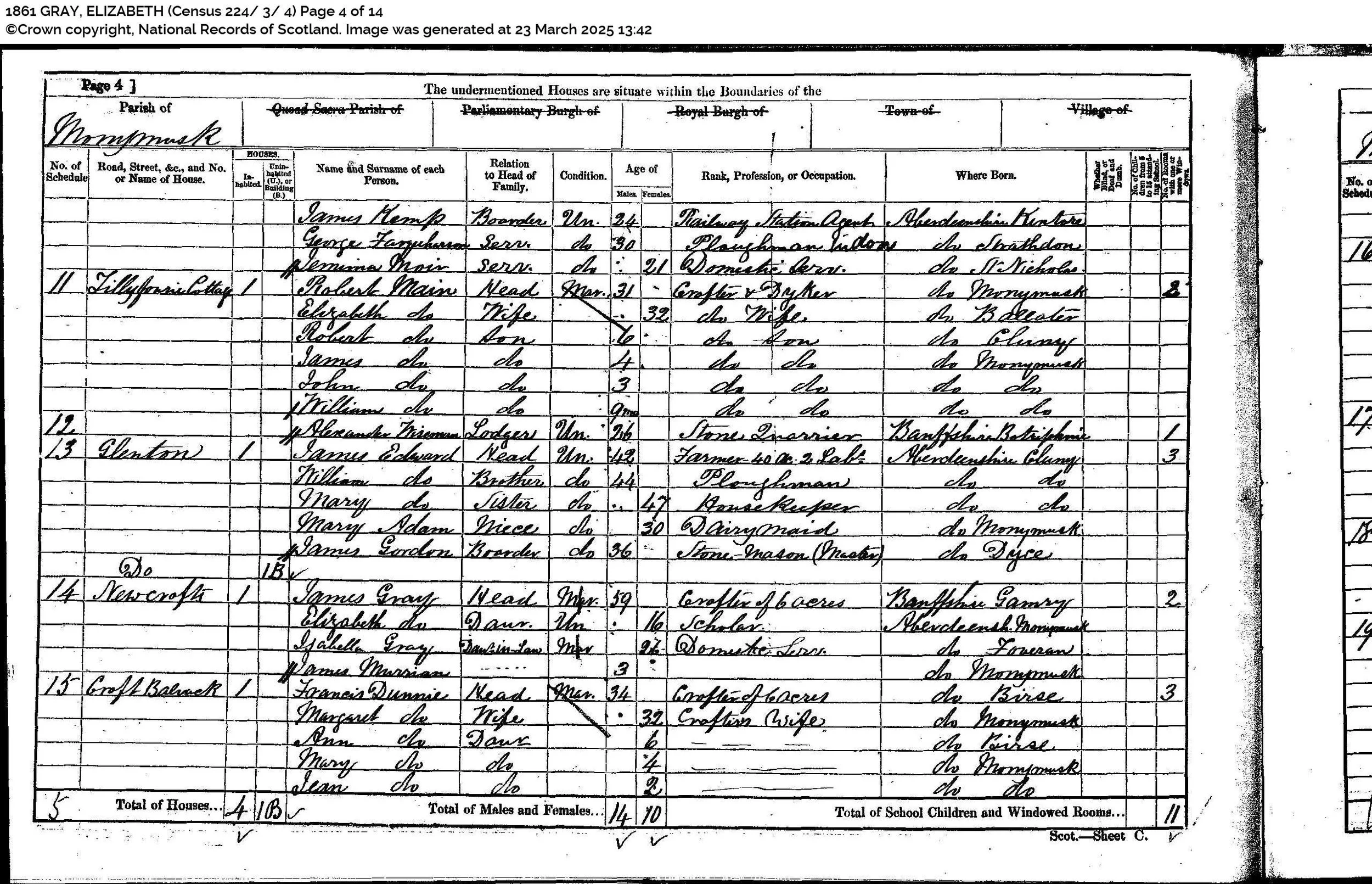
Elizabeth Gray was born on Christmas Day, 1845, in Monymusk, a small parish in Aberdeenshire. Her father James Gray was a crofter—a small tenant farmer working six acres of Scottish soil. By the 1861 census, fifteen-year-old Elizabeth was living with her father at Newcroft, listed as a "Scholar," still in school.
How she came to meet David Robertson in Dundee remains unknown. Perhaps she went into service there. Perhaps family connections drew her south. What we know is that on June 23, 1866, David Robertson, stone mason, and Elizabeth Gray were married in Dundee.

The First Crossing
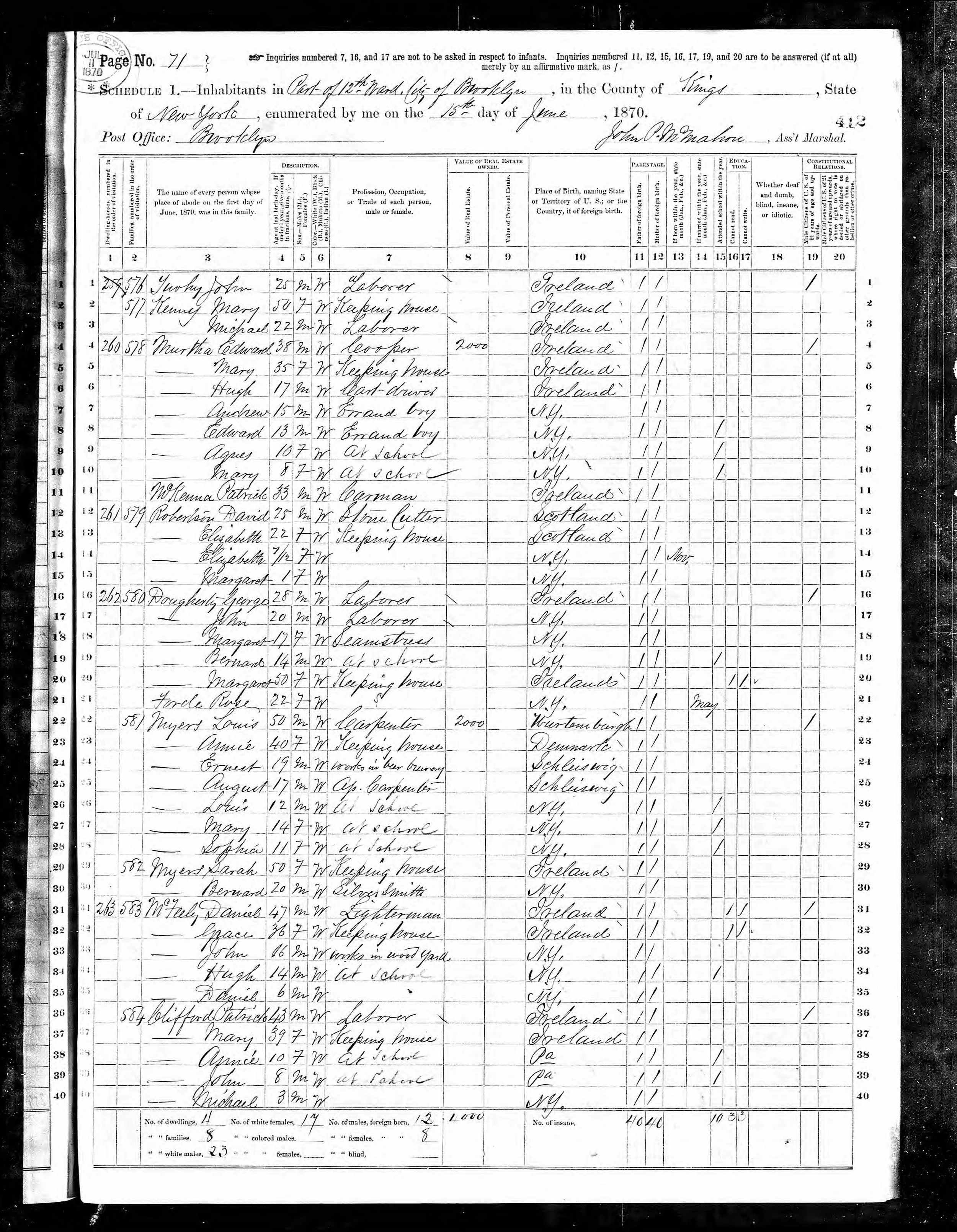
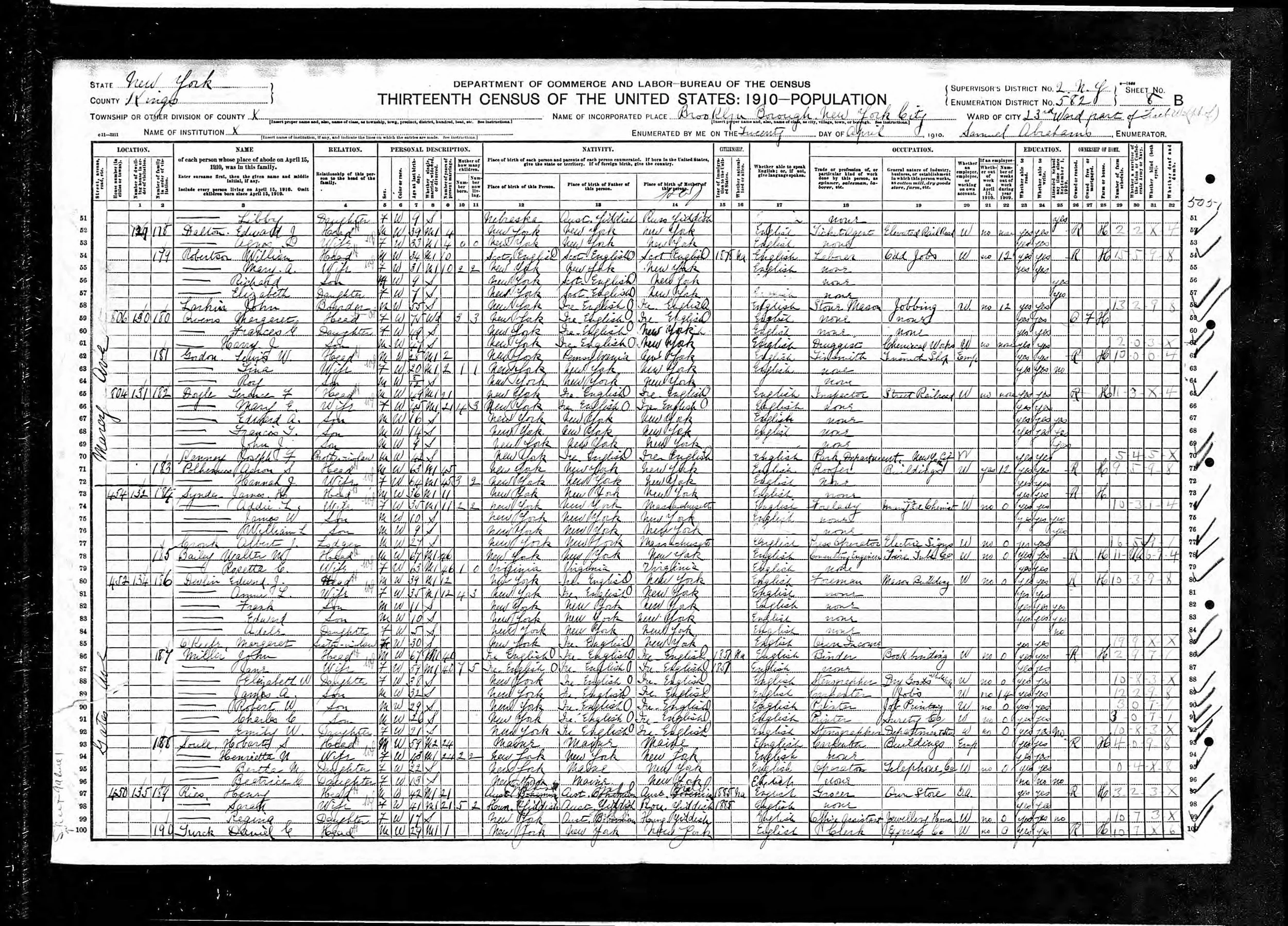
Sometime between William's birth in April 1867 and the 1870 census, David and Elizabeth Robertson crossed the Atlantic with their young family. They settled in Brooklyn, New York—specifically in the 12th Ward, near the waterfront where stone was constantly needed for the growing city.
David was the first of George Robertson's children to make this journey. His siblings would follow: Clementina, William Fraser, Isabella. But David was the pioneer, establishing the Robertson name in America while his father George still lived in Blairgowrie.
The Mysterious Return to Scotland
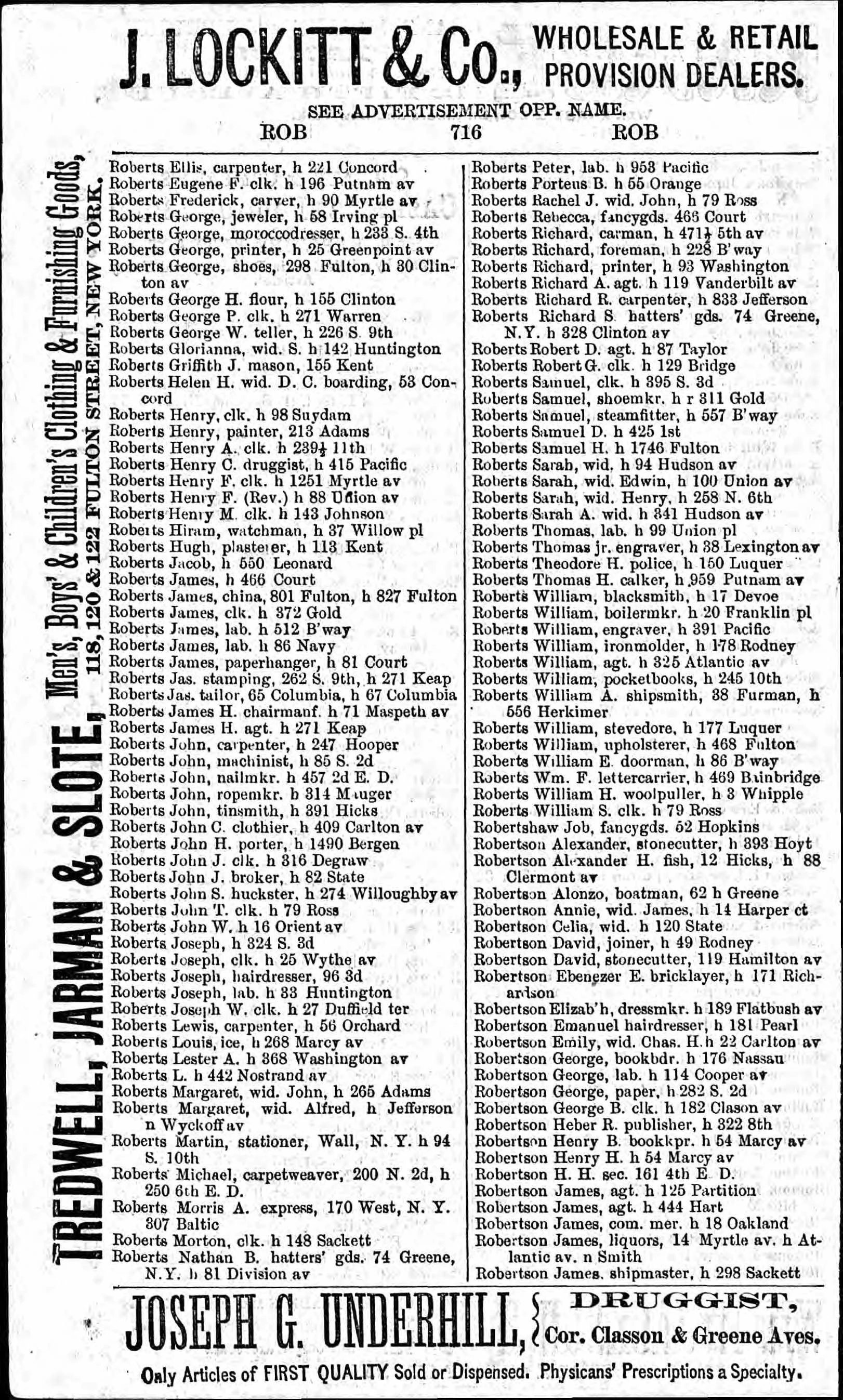
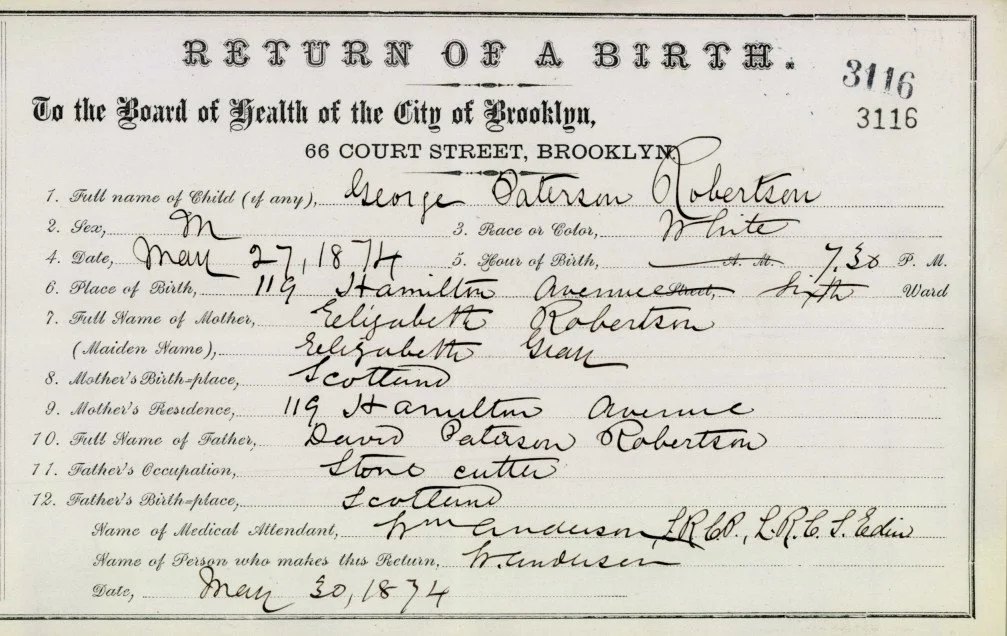
The 1874 Brooklyn city directory shows David Robertson, stonecutter, at 119 Hamilton Avenue—the same address as his recently widowed mother Margaret. His father George had died in Brooklyn in July 1872, and David was helping support his mother.
Then the family vanishes from American records.
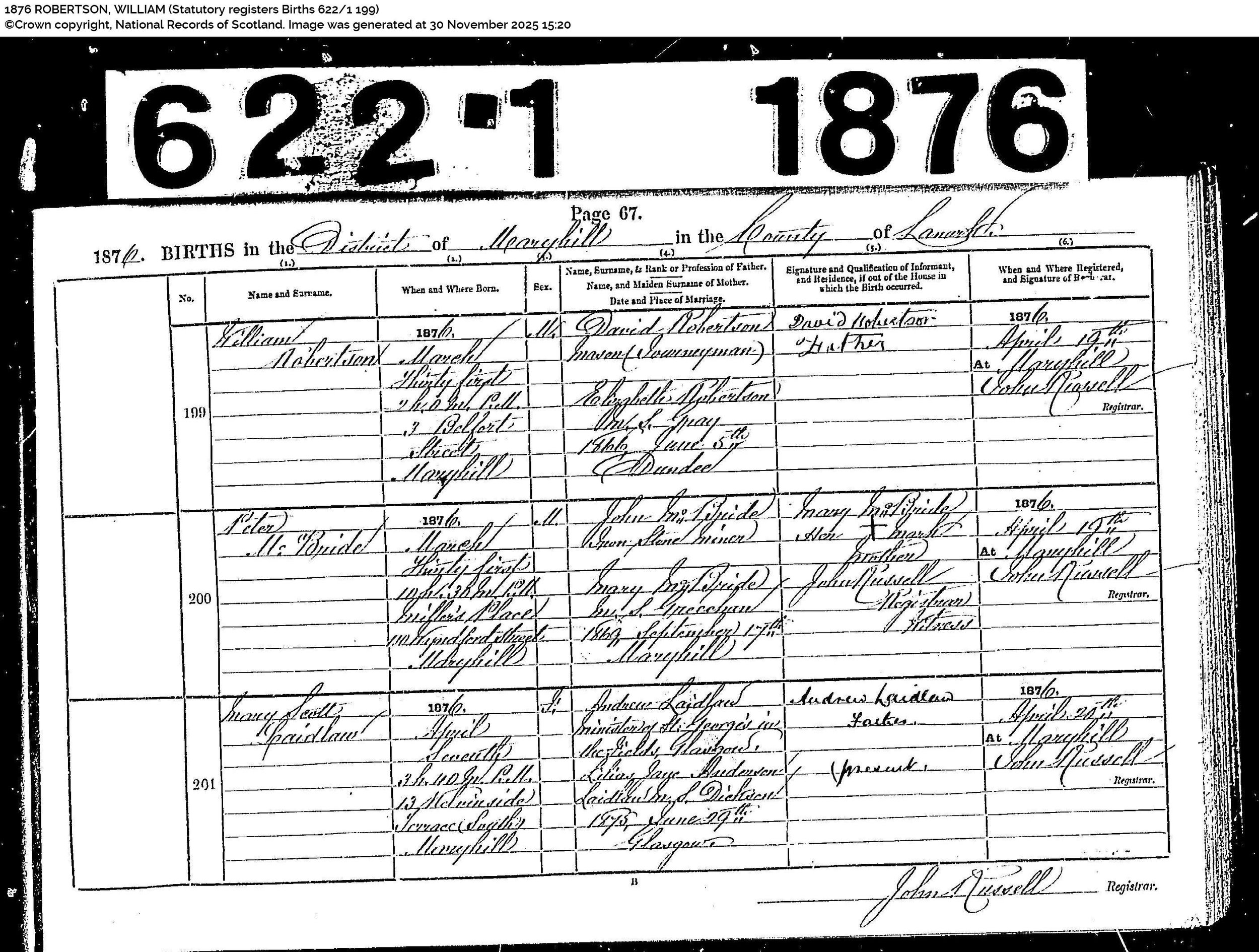
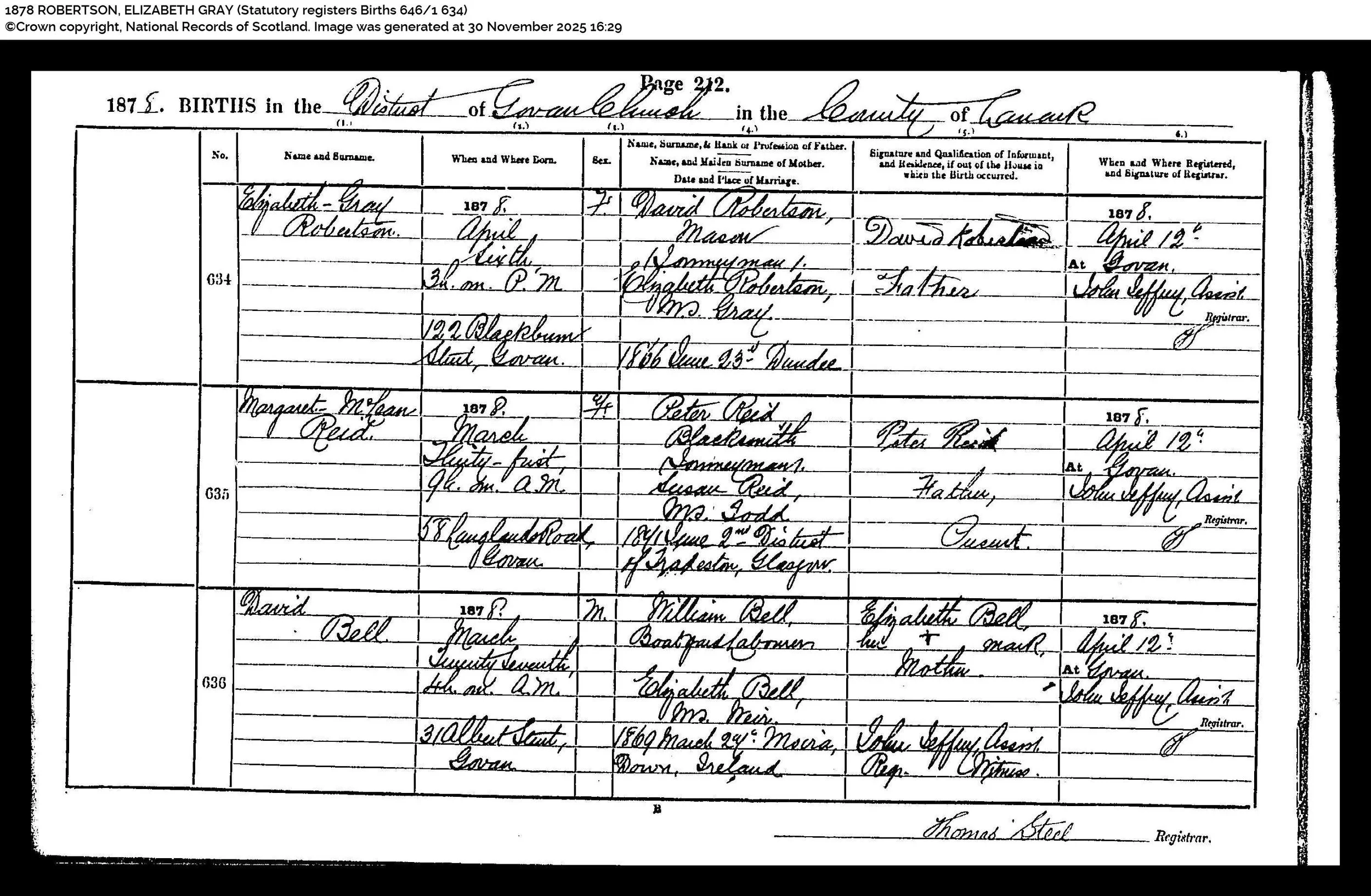
Scottish birth records reveal what happened: sometime around 1875, David and Elizabeth took their children back across the Atlantic to Scotland. They settled not in Dundee or Blairgowrie, but in the Glasgow area—the industrial heart of Scotland.
Children Born in Scotland During the Return
| Name | Birth Date | Location | Father's Occupation |
|---|---|---|---|
| William | March 31, 1876 | 3 Belfort Street, Maryhill, Glasgow | Mason (Journeyman) |
| Elizabeth Gray | April 6, 1878 | 122 Blackburn Street, Govan, Glasgow | Mason (Journeyman) |
Both birth records confirm parents' marriage: "1866 June 23rd Dundee"
Why did the family return to Scotland for three years? The records don't say. Perhaps economic hardship in post-Civil War America. Perhaps family obligations—aging parents or sick relatives. Perhaps simply homesickness for the land they'd left behind. Whatever the reason, by late 1878 they were ready to try America again.
Tragically, both children born during this Scottish sojourn—William and Elizabeth Gray—would not survive to adulthood. The first Elizabeth, born in Brooklyn around 1868, had likely already died, prompting them to name the 1878 baby Elizabeth Gray after her mother. This second Elizabeth also died young. Only the 1876 William would survive, carrying his name into the next century.
Building a Life in Brooklyn
The 1880 Brooklyn city directory confirms David's return: "Robertson David, stonecutter, 119 Hamilton av." He was back at his mother's address, ready to rebuild his American life.
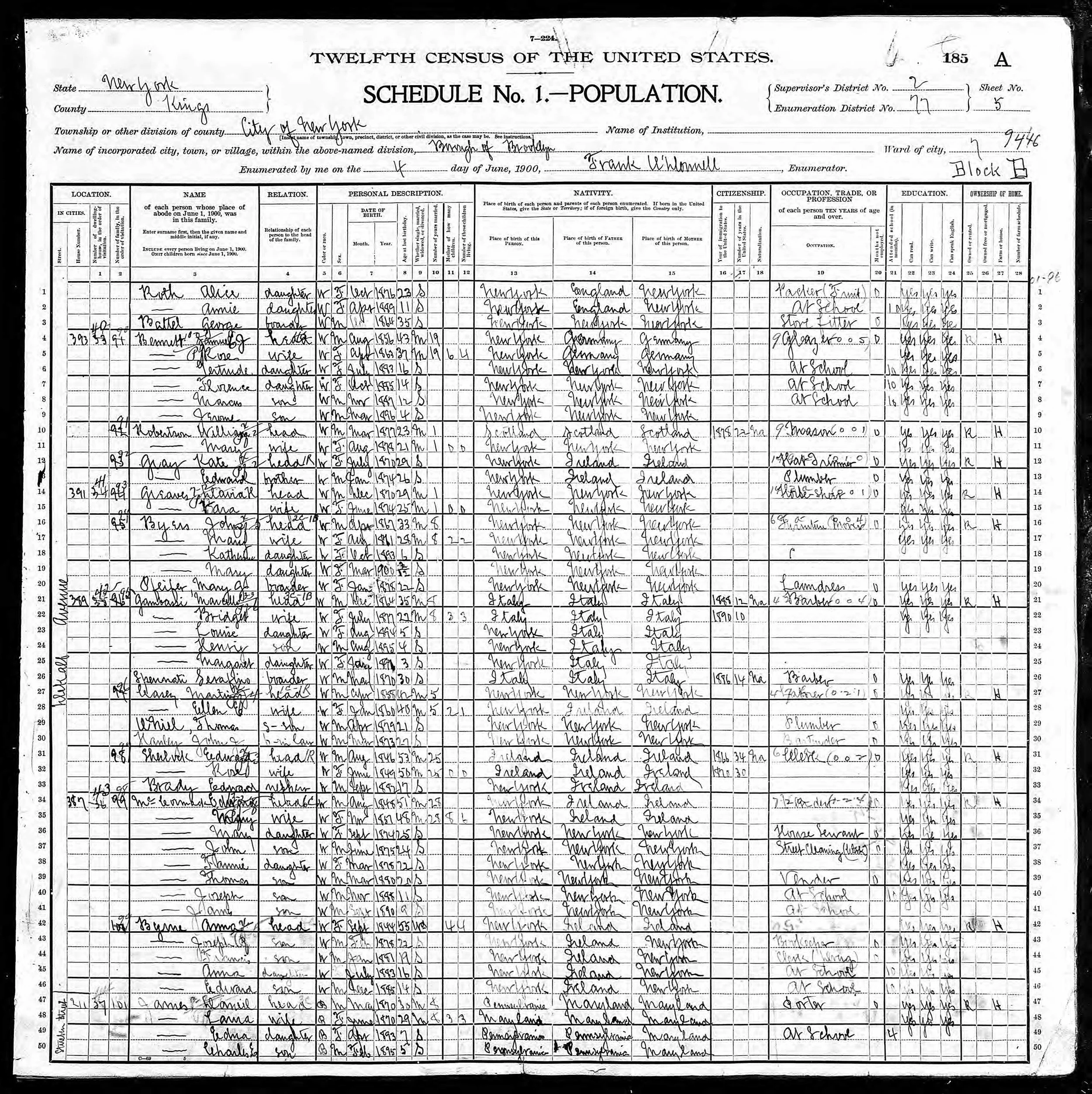
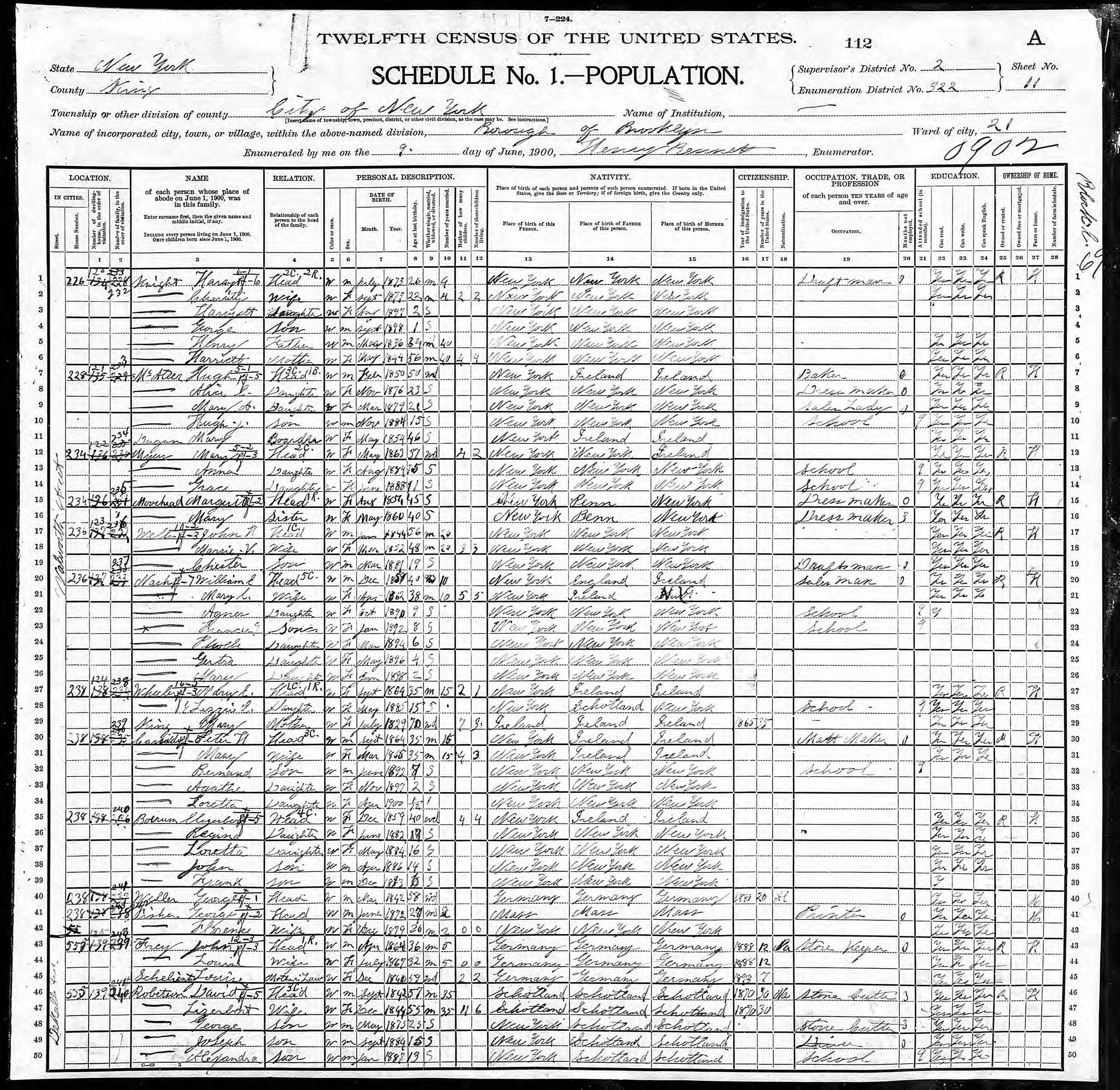
For the next twenty-five years, David Robertson cut stone in Brooklyn. City directories track his steady presence: 145 Wolcott Street in 1880, 16 4th Street in 1882, various addresses through the decades, always listed as "stonecutter" or "stone cutter." By 1898, the family had settled at 555 DeKalb Avenue.
Elizabeth bore eleven children across two continents. Only six survived to adulthood—a devastating loss rate even by Victorian standards. The 1900 census records this stark arithmetic: "Children born: 11. Children living: 6." Five children lie somewhere in Brooklyn's and Glasgow's earth, their brief lives marked only by this census notation and the Scottish birth records that prove two of them existed.
The Six Children Who Survived
| Name | Born | Died | Notes |
|---|---|---|---|
| Margaret Elizabeth | c. 1869, Brooklyn | June 18, 1929 | Married Gustave Johnson; buried Evergreens Cemetery |
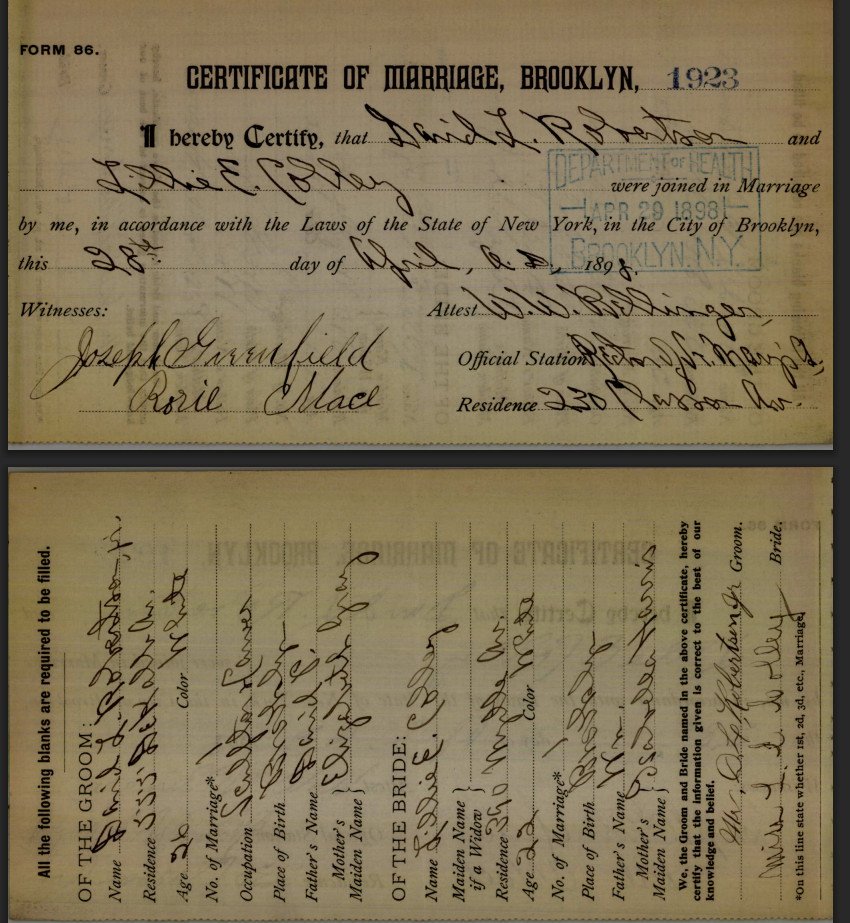
| David Lincoln | c. 1873, Brooklyn | Unknown | Married Lillie Elizabeth Colley 1898; son Walter Lincoln (1903-1992) |
| George Paterson | George Paterson | May 27, 1874, Brooklyn | Laborer; married Essie Joy Allen; son Howard Patterson (1903-1990) |
| William | March 31, 1876, Scotland | March 29, 1948 | Mason; married Mary Agnes McNulty (Durnion?-needs review); buried Green-Wood with mother |
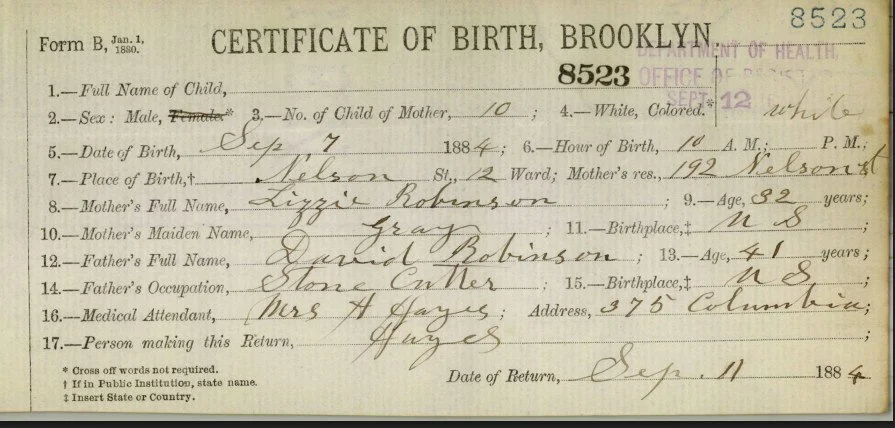
| Joseph | Sept 7, 1884, Brooklyn | Jan 14, 1924 | Salesman; searched for father 1910; buried Green-Wood |
| Alexander | c. 1887, Brooklyn | March 29, 1910 | Stone cutter; married Frances Elizabeth Barling; buried Holy Cross |
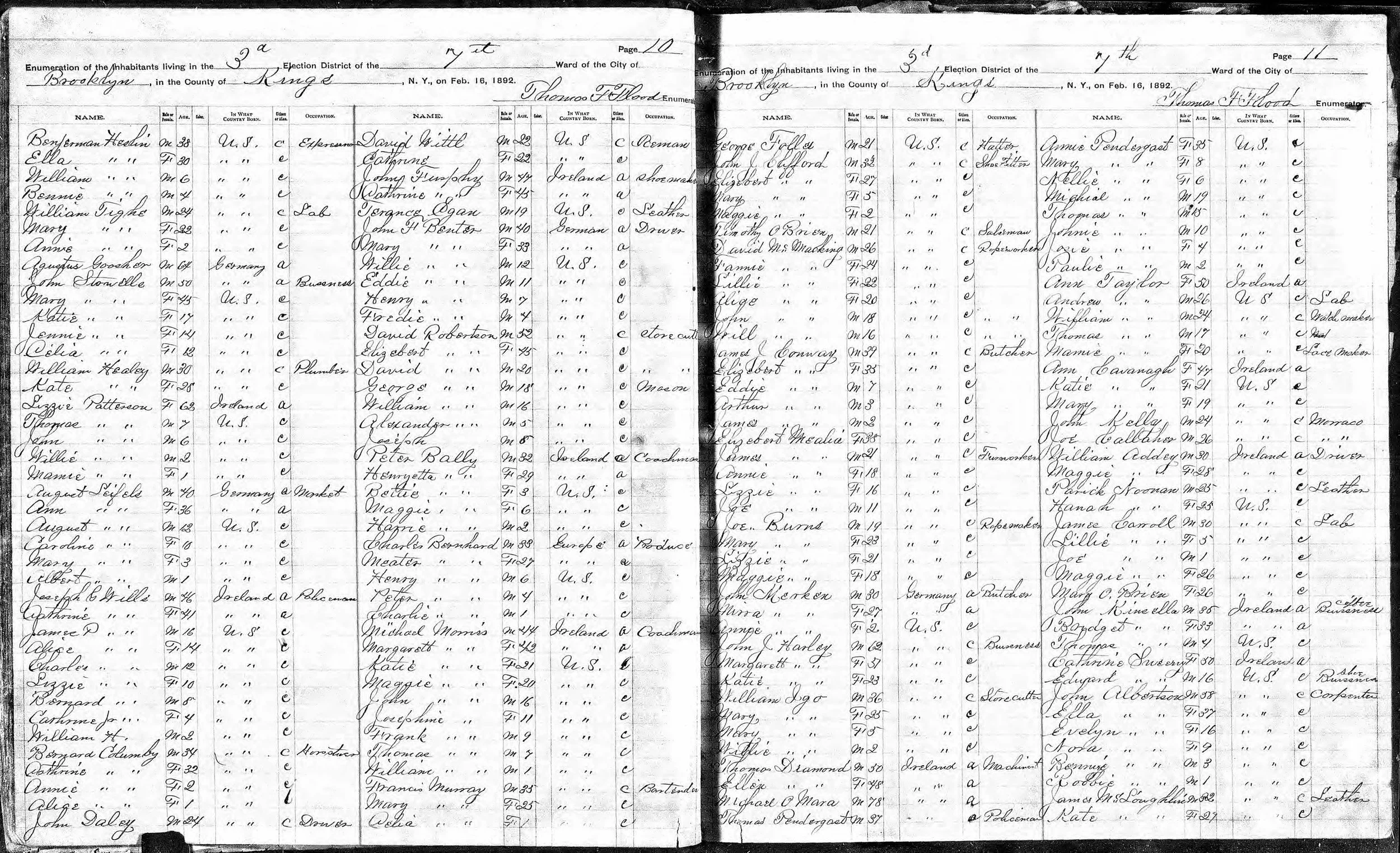
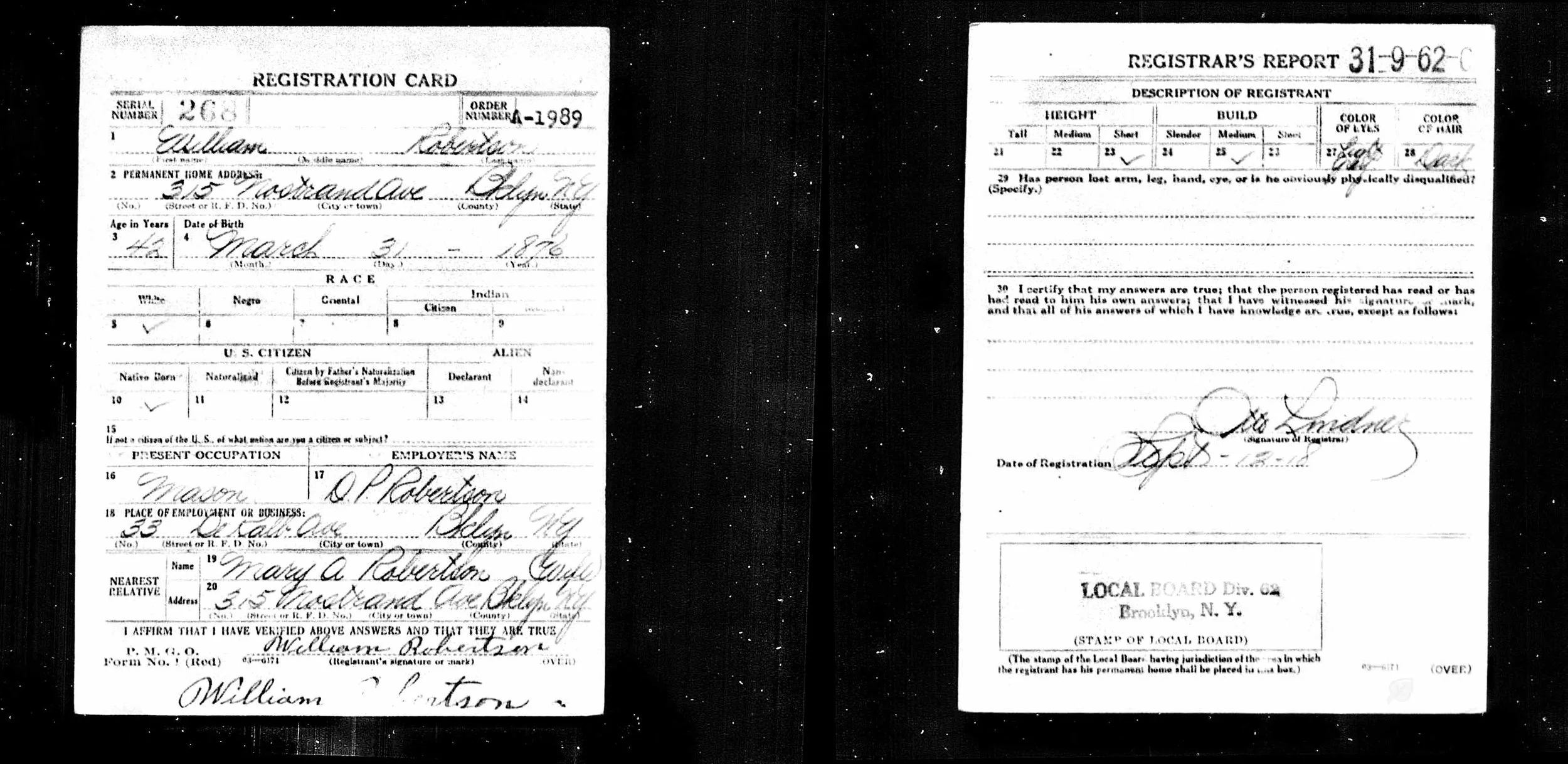
The stone cutting trade passed to the next generation. The 1892 census shows George, at eighteen, already working as a mason. By 1900, he was a stone cutter like his father. Alexander followed the same path. William, born in Scotland, worked as a mason for his brother David Lincoln's business. The 1918 WWI draft registration shows William Robertson, mason, employed by "D.P. Robertson" at 33 DeKalb Avenue—brothers working together in the family trade.
Independence Day, 1902
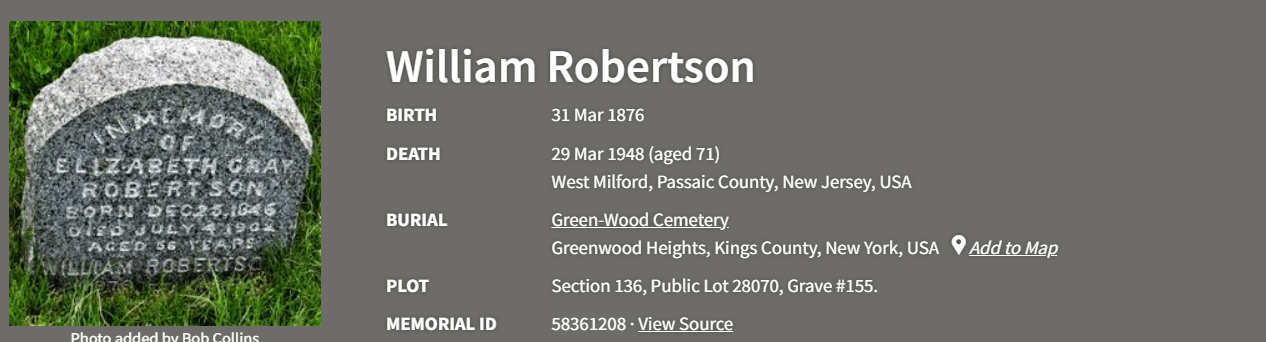
Elizabeth Gray Robertson died on July 4, 1902, of cerebral apoplexy—a stroke. She was fifty-six years old, having been born on Christmas Day and dying on Independence Day. She was buried at Evergreens Cemetery three days later, on July 7; David filed the probate papers on July 17.
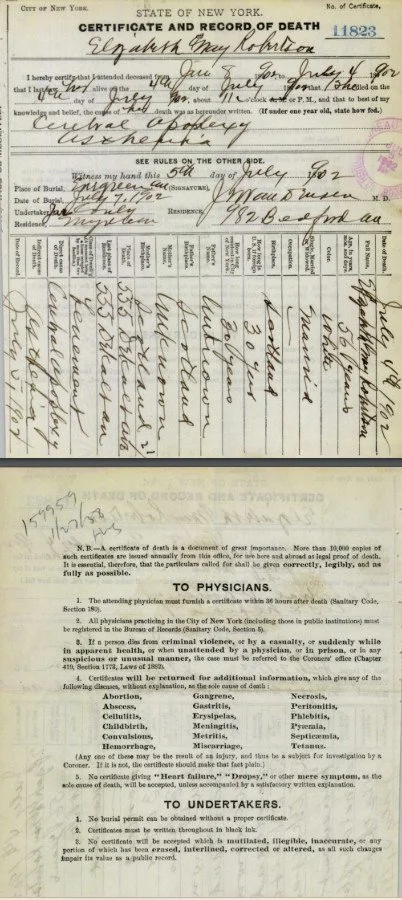
The probate documents name all six surviving children and their ages: Margaret Johnson, 31; David Lincoln Robertson, 29; George P. Robertson, 28; William Robertson, 27; Joseph Robertson, 17; Alexander Robertson, 16. Elizabeth left personal property valued at $1,200.
She was initially buried at Evergreens Cemetery in Brooklyn, near her father-in-law George Robertson who had died thirty years earlier in 1872. But in October 1902, just three months later, she was reinterred at Green-Wood Cemetery.
IN MEMORY OF
ELIZABETH GRAY
ROBERTSON
BORN DEC 25, 1846
DIED JULY 4, 1902
AGED 56 YEARS
The stone's carver wrote 1846—but the stone corrects itself. "Aged 56 Years" at her death on July 4, 1902, computes only from the December 25, 1845 birth recorded in the Monymusk register.
Her sons William and Joseph would eventually join her in the Green-Wood plot
The Widower
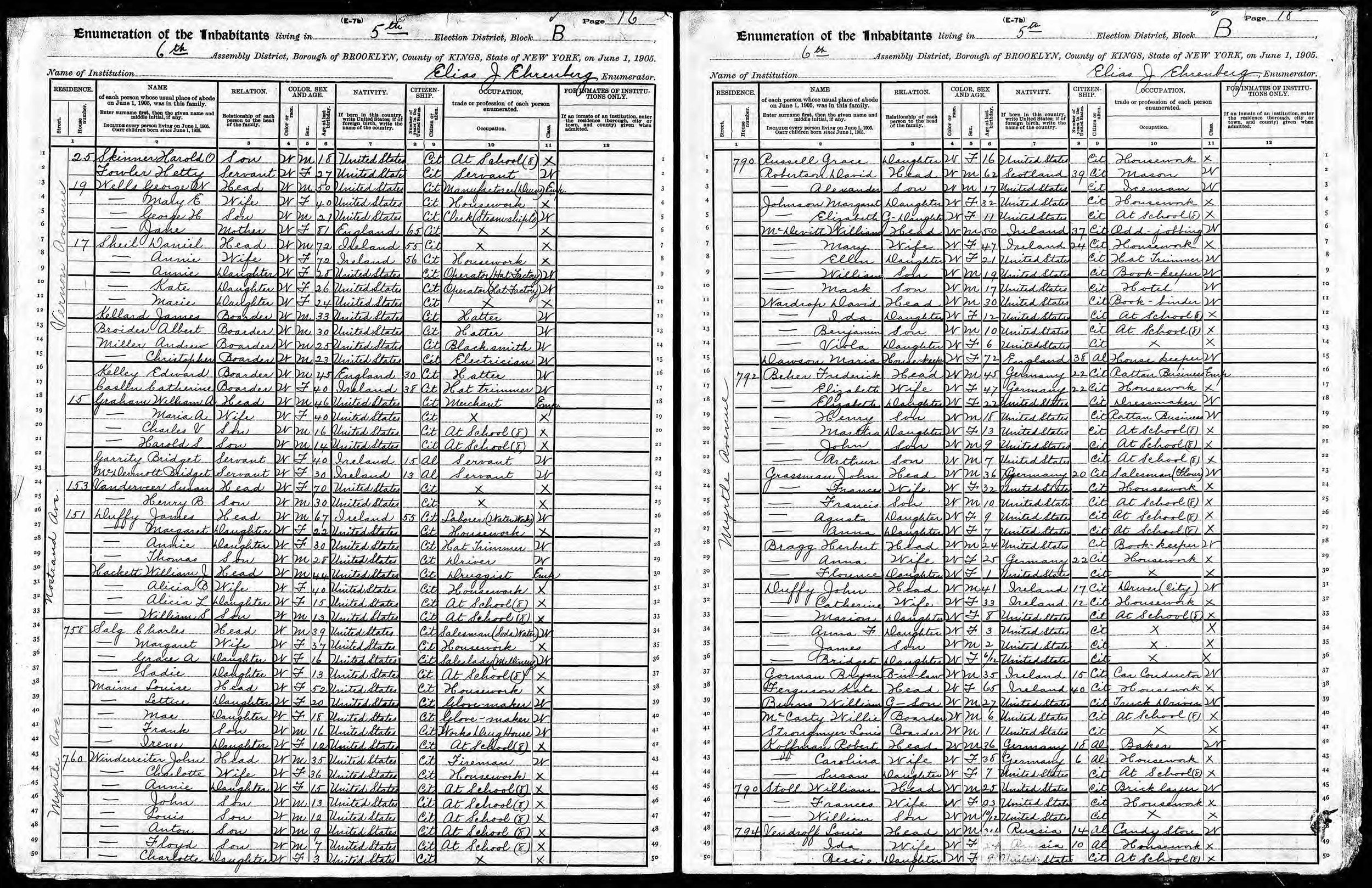
The 1905 New York State Census finds David, now 63, still at the DeKalb Avenue address. He is listed as a widower, occupation "Mason," living with his daughter Margaret Johnson (35) and son Alexander (17). is older sons had married and moved on—David Lincoln in 1898, George would marry Essie Joy Allen.
Then something changed. Sometime around 1906, David Paterson Robertson, who had cut stone in Brooklyn for nearly four decades, left New York for Georgia. At an age when most men were slowing down, he reinvented himself as a game trapper in the swamps near Savannah.
Why Georgia? Why game trapping? The records don't say. Perhaps the stone dust had damaged his lungs. Perhaps he sought warmth for aging joints. Perhaps, after forty years of shaping stone and losing Elizabeth, he wanted something completely different—open air, wild country, independence.
He settled near Ways Station in the Savannah area, working the swamps and waterways as a trapper. By all accounts, he was successful enough. He was known to carry money. And that, perhaps, was his undoing.
The Disappearance: February 1910
In February 1910, David Paterson Robertson disappeared. He had gone out in his boat, as he often did. The boat was later found swamped. His body was never recovered.
Back in Brooklyn, his family was frantic. His son Joseph, 25 years old and working as a salesman, traveled to Georgia to search for his father. For months he investigated, questioned locals, searched the waterways. He exhausted his resources and his leads.
In desperation, Joseph turned to the newspapers. On October 1, 1910, the Macon Telegraph published his appeal:
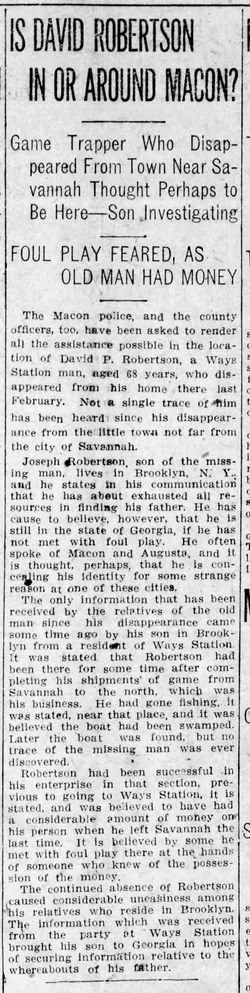
IS DAVID ROBERTSON IN OR AROUND MACON?
"David Robertson, aged 68, height five foot 8 inches, grey hair, last heard from at Ways Station Savannah. Was a game trapper. Disappeared last February. Boat was found swamped. Any information will be thankfully received by his son, Joseph Robertson."
No information came. David Robertson was never found.
The Double Tragedy: March 1910
While Joseph was searching for his father in Georgia, tragedy struck again in Brooklyn. On March 29, 1910—just one month after David's disappearance—Alexander Robertson died at St. Mary's Hospital. He was twenty-three years old.
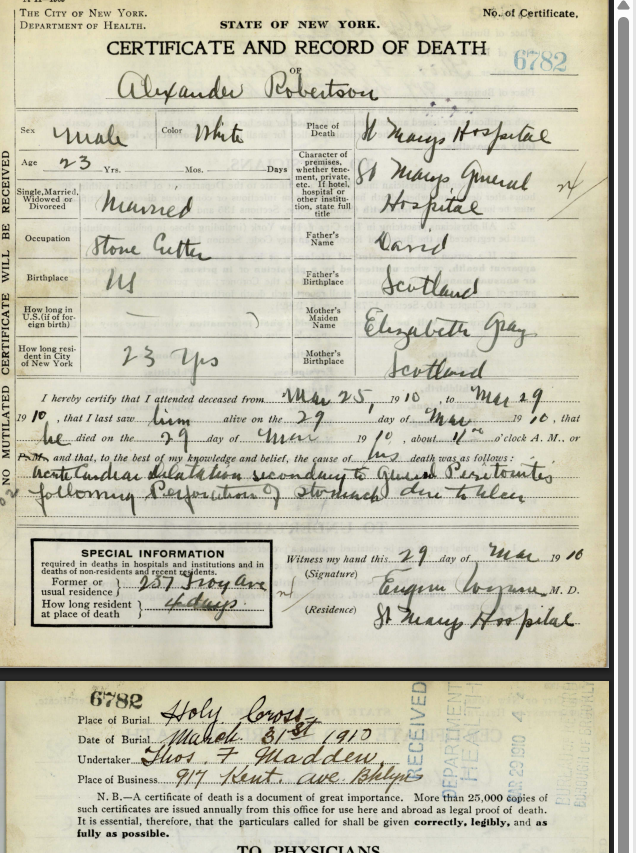
The death certificate records the cause: "Acute Cardiac dilatation secondary to General Peritonitis following Perforation of Stomach due to Ulcer." Alexander had been a stone cutter, like his father and brother. He had been admitted to the hospital on March 25 and died four days later.
Alexander left behind a young widow, Frances Elizabeth Barling, just twenty-two years old, and an infant daughter, Frances, less than a year old. Frances would never know her father or her grandfather. Her mother eventually remarried a man named Rohrberg, and little Frances grew up with her stepfather's name.
Did the stress of his father's disappearance contribute to Alexander's death? A perforated ulcer can be triggered or worsened by extreme stress. We cannot know for certain, but the timing is haunting: the youngest son dying just weeks after the father vanished, leaving a widow and infant daughter behind.
Alexander was buried at Holy Cross Cemetery—a Catholic cemetery, suggesting either he or his wife Frances was Catholic. He rests apart from his Protestant family.
What Remains
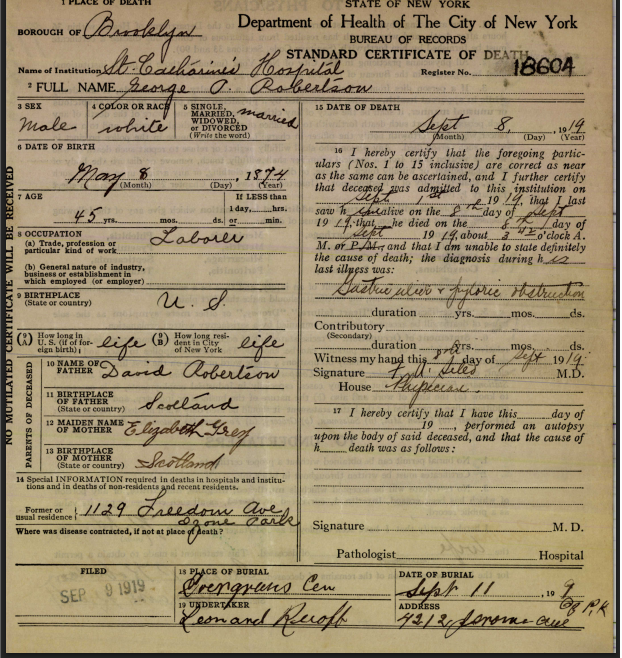
George P. Robertson outlived his father by nine years, dying September 8, 1919, at St. Catherine's Hospital in Brooklyn. He was forty-five, his death caused by gastric ulcer and pyloric obstruction—stomach troubles like his brother Alexander. He was buried at Evergreens Cemetery.
Joseph Robertson, who had searched so desperately for his father in 1910, died on January 14, 1924, in Glen Ridge, New Jersey. He was only thirty-nine. The cause: cerebral hemorrhage—the same type of stroke that had killed his mother Elizabeth twenty-two years earlier. He was buried at Green-Wood Cemetery, reunited with his mother.
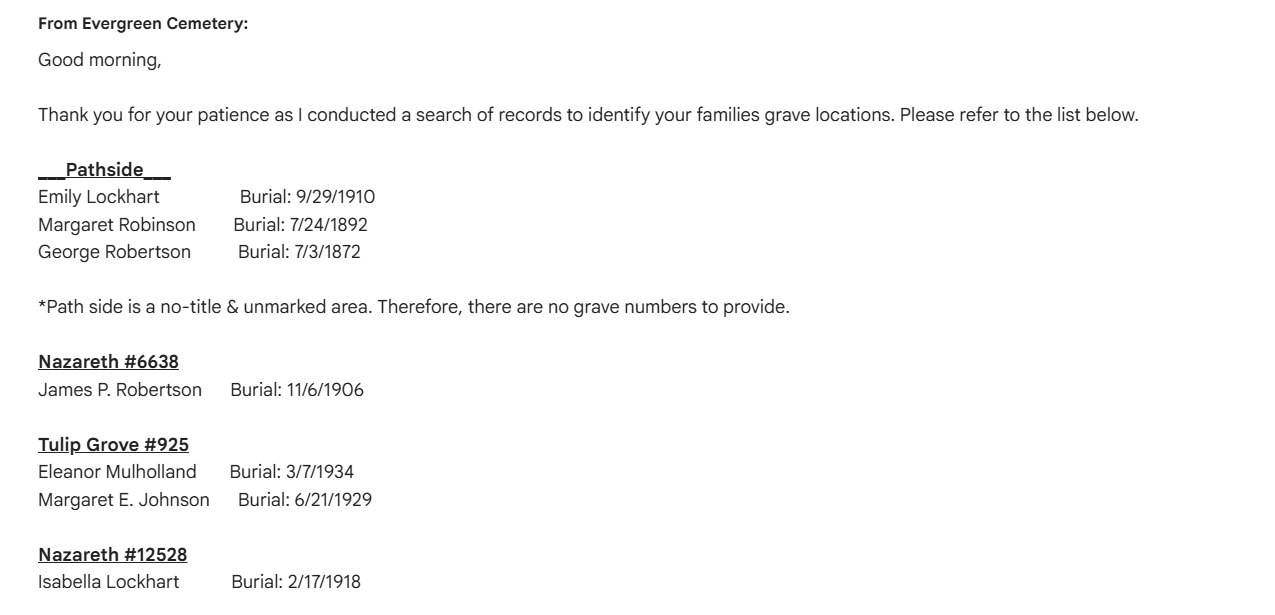
Margaret Elizabeth Robertson Johnson died June 18, 1929, in Queens. She was buried at Evergreens Cemetery in the Tulip Grove section, where her granddaughter Eleanor Mulholland would later join her.
William Robertson, born in Maryhill, Scotland, during the family's mysterious return, outlived all his siblings. He died March 29, 1948, in West Milford, New Jersey—exactly thirty-eight years to the day after his brother Alexander. He was buried at Green-Wood Cemetery with his mother Elizabeth and brother Joseph.
David Lincoln Robertson's son Walter Lincoln lived until 1992, carrying the family into the modern era. George P.'s son Howard Patterson Robertson lived until 1990. The family David and Elizabeth founded in Brooklyn continues.
Where They Rest
| Green-Wood Cemetery, Brooklyn | |
|---|---|
| Elizabeth Gray Robertson | 1846-1902 (reinterred October 26, 1902) |
| Joseph Robertson | 1884-1924 |
| William Robertson | 1876-1948 |
| Evergreens Cemetery, Brooklyn | |
| George Robertson (patriarch) | 1809-1872, Pathside, unmarked |
| Margaret Paterson Robertson | c.1812-1892, Pathside, unmarked |
| George P. Robertson | 1874-1919 |
| Margaret E. Johnson | c.1869-1929, Tulip Grove #925 |
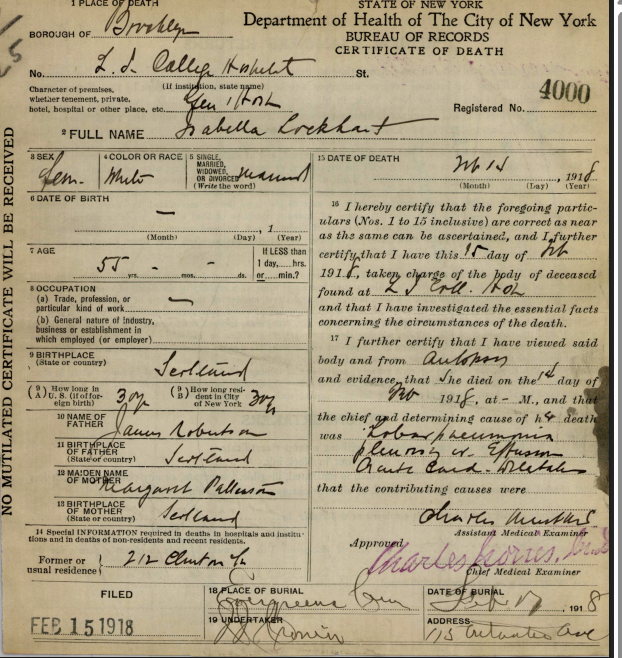
| Isabella Robertson Lockhart | 1860-1918 (David's sister), Nazareth #12528 |
| Holy Cross Cemetery, Brooklyn (Catholic) | |
| Alexander Robertson | c.1887-1910 |
| No Known Burial | |
| David Paterson Robertson | 1842-1910 — Body never recovered, Georgia swamps |
The Mystery Endures
David Paterson Robertson—the pioneer, the stone cutter, the game trapper—remains lost. His boat was found swamped in a Georgia waterway in February 1910. His body was never recovered. Foul play was suspected—he was known to carry money.
115 years later, the mystery endures.
Timeline
Evidence Analysis
Elizabeth Gray's Scottish Origins
The 1884 birth certificate for Joseph—completed by the attending midwife, not the family—recorded the surname as "Robinson" and both parents' birthplaces as "U.S." Taken at face value, it would sever the family's Scottish origins entirely. Multiple documents informed by the family themselves confirm Elizabeth was from Monymusk, Aberdeenshire, Scotland: 1846 baptism record, 1861 Scottish census, 1867 birth record for son William, and Brooklyn death certificates from 1919 and 1929 all stating "Scotland." The register also resolves her birth year: the entry stands under the 1845 heading—born December 25, 1845, baptized March 14, 1846—confirmed by the gravestone's own "Aged 56 Years.
The Scotland Return (1875-1878)
Scottish birth records prove the family returned to Scotland for approximately three years. William was born in Maryhill (March 1876) and Elizabeth Gray in Govan (April 1878)—both in the Glasgow industrial area. The 1874 Brooklyn directory places David at 119 Hamilton Ave; the 1880 directory shows him back at the same address. The reason for this return remains unknown.
The Eleven Children
The 1900 census records Elizabeth as having borne 11 children with 6 surviving. We can now identify at least nine: William #1 (1867, Dundee, died young), Elizabeth #1 (c.1868-69, Brooklyn), Margaret (c.1869), David Lincoln (c.1873), George (1874), William #2 (1876, Scotland), Elizabeth Gray #2 (1878, Scotland, died young), Joseph (1884), Alexander (c.1887), plus two unidentified children who died young.
The Double Tragedy of 1910
David disappeared in February 1910; his son Alexander died March 29, 1910, leaving a 22-year-old widow (Frances Elizabeth Barling) and infant daughter (Frances, b. 1909). Both Alexander and his brother George P. later died of stomach ulcer complications—a possible hereditary condition or occupational hazard of the stone cutting trade.
Three Cemeteries
The family is buried across three Brooklyn cemeteries: Green-Wood (Elizabeth, William, Joseph), Evergreens (George patriarch, Margaret matriarch, George P., Margaret Johnson, Isabella Lockhart), and Holy Cross (Alexander—Catholic cemetery, suggesting his wife Frances was Catholic). David himself has no grave—his body was never recovered from the Georgia swamps.
Research Opportunities
Georgia newspapers 1910; Georgia death records 1910-1912; Chatham County court records; DNA analysis connecting modern descendants; Ways Station area historical records; Glasgow area records 1875-1878 for additional context on the Scotland return.
Primary Source Documents
28 documents spanning 1846-1948, tracing David Paterson Robertson's journey from Scotland to Brooklyn to Georgia.
🏴 Scotland Origins — 1846-1867
🇺🇸 First Brooklyn Period — 1870-1874
🏴 The Scotland Return — 1876-1878
🇺🇸 Second Brooklyn Period — 1880-1905

🔍 The Disappearance & Aftermath — 1910
📜 The Next Generation — 1918-1948
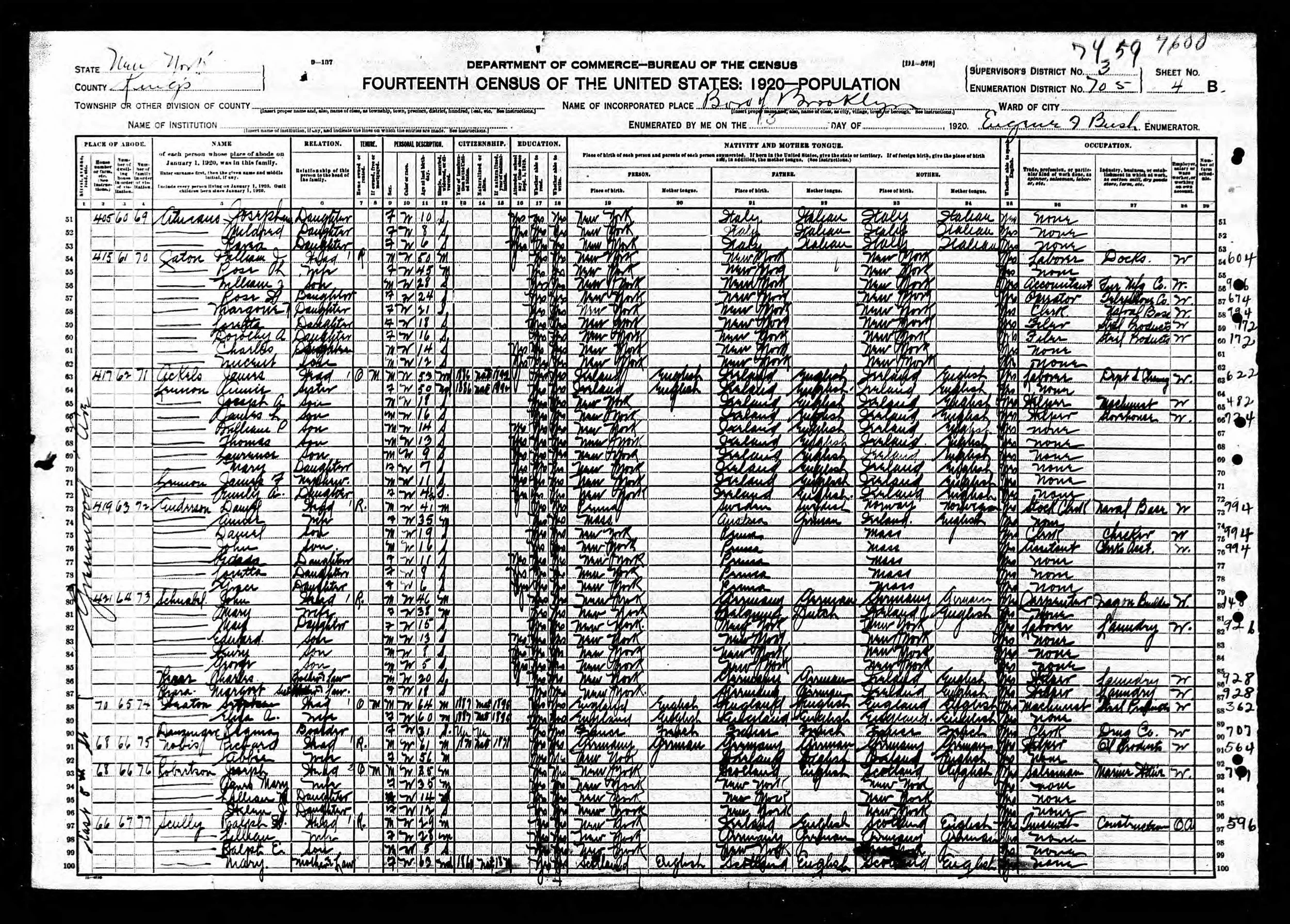
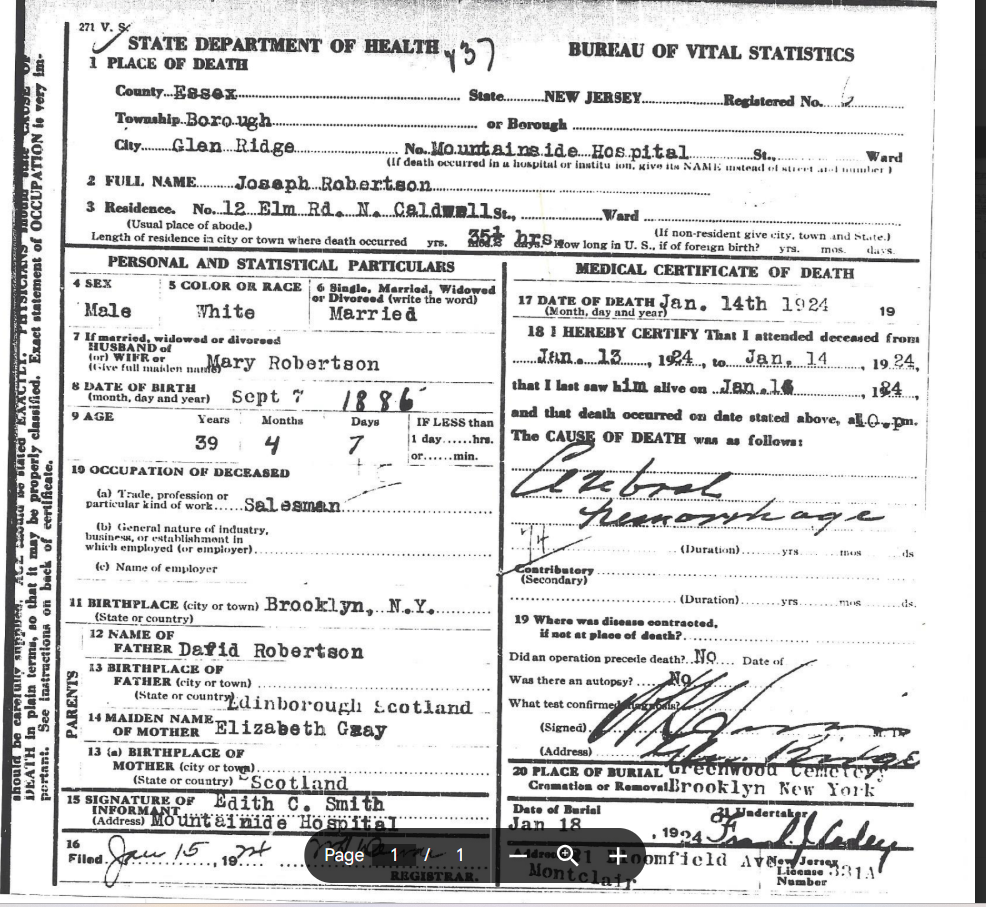
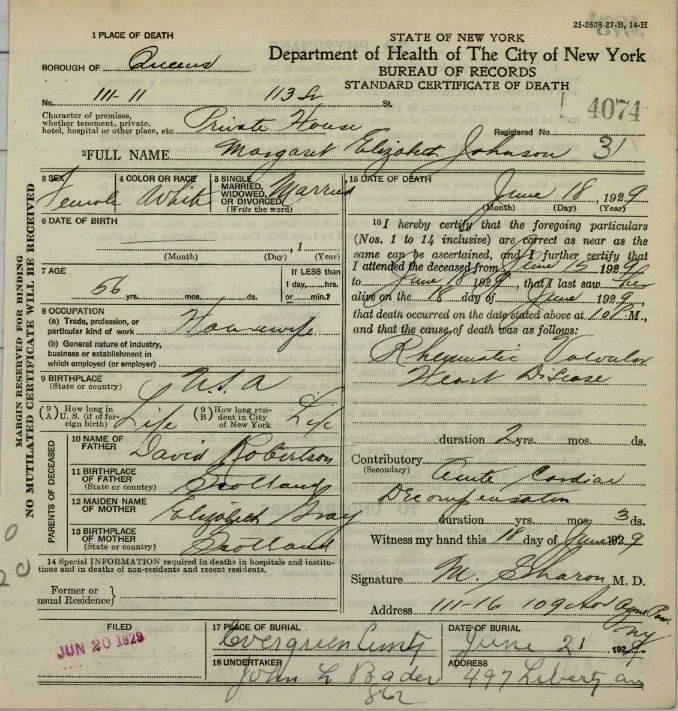
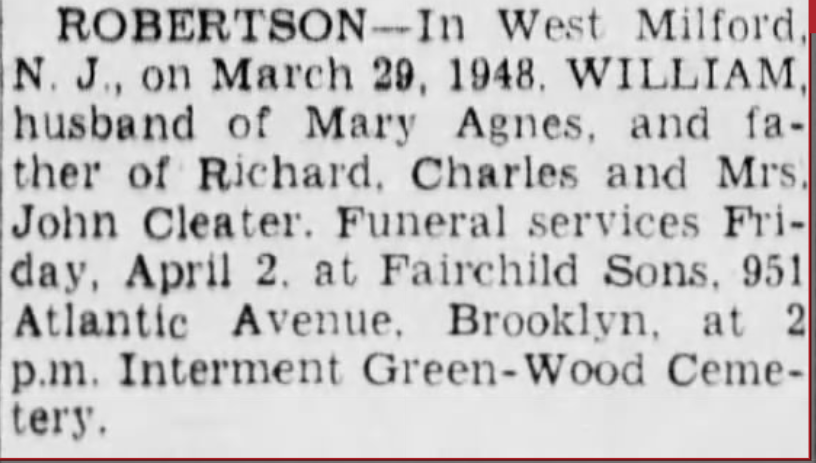
🪦 Cemetery Records
Sources
Scottish Records:
1846 Baptism, Monymusk, Aberdeenshire (Elizabeth Gray). Scotland, Select Births and Baptisms, 1564-1950. Ancestry.com, 2014.
1851 Scotland Census, Blairgowrie, Parish: Blairgowrie; ED: 8; Page: 13; Line: 19; Roll: CSSCT1851_72. Ancestry.com Operations Inc, 2006.
1861 Scotland Census, Blairgowrie, Parish: Blairgowrie; ED: 5; Page: 19; Line: 5; Roll: CSSCT1861_47. Ancestry.com Operations Inc, 2006.
1867 Birth Register, Dundee (William Robertson, son of David Robertson and Elizabeth Gray). National Records of Scotland.
1876 Birth Register, Maryhill, Glasgow (William Robertson), Statutory registers Births 622/1 199. National Records of Scotland.
1878 Birth Register, Govan, Glasgow (Elizabeth Gray Robertson), Statutory registers Births 646/1 634. National Records of Scotland.
American Census Records:
1870 U.S. Federal Census, Brooklyn Ward 12, Kings, New York; Roll: M593_953; Page: 412A. Ancestry.com Operations, Inc., 2009.
1900 U.S. Federal Census, Brooklyn Ward 21, Kings, New York; Page: 11; Enumeration District: 0322; FHL microfilm: 1241057. Ancestry.com Operations Inc, 2004.
New York Vital Records:
New York, New York, Index to Birth Certificates, 1866-1909. New York City Department of Records & Information Services. Ancestry.com, 2020.
New York, New York, Index to Death Certificates, 1862-1948. New York City Department of Records & Information Services. Ancestry.com, 2020.
City Directories:
U.S. City Directories, 1822-1995. Ancestry.com Operations, Inc., 2011.
Passenger Lists:
New York, Passenger and Crew Lists (including Castle Garden and Ellis Island), 1820-1957. Year: 1869; Arrival: New York, New York; Microfilm Serial: M237, 1820-1897; Microfilm Roll: Roll 307; Line: 43; List Number: 255. Ancestry.com Operations, Inc., 2010.
Newspapers:
"Is David Robertson in or Around Macon?" The Macon Telegraph, October 1, 1910. Newspapers.com.
Cemetery Records:
David Paterson Robertson memorial. Find A Grave. https://www.findagrave.com/memorial/280975211/david_paterson-robertson
Elizabeth Gray Robertson gravestone, Green-Wood Cemetery, Brooklyn, New York.
Evergreens Cemetery records, Brooklyn, New York.
Acknowledgment
Special thanks to Judy Robertson Apicella for discovering the 1910 Macon Telegraph article that revealed the circumstances of David's disappearance.
The Story Continues: Joseph Robertson searched desperately for his father in 1910, traveling to Georgia and publishing newspaper appeals. His story—and the family's ongoing quest to understand David's fate—continues in Episode 7: The Son Who Searched.
Are You Connected to the Robertson Line?
If you descend from the Robertson family of Blairgowrie, Bendochy, or Rattray in Perthshire — from George Robertson and Margaret Paterson or any of their ten children, the Brooklyn stone cutter David Paterson Robertson, or the connected Paterson, Craig, Anderson, McNab, McIntyre, Ferguson, Nisbet, or Lockhart lines — in Scotland, Brooklyn, New Jersey, or Liverpool, I’d like to compare notes. Documented Scottish trees, DNA matches, family papers, and even half-remembered stories have all moved this research forward.
Get in Touch About This FamilyCousin connections are informal and reciprocal — no fee, no obligation, just shared work on shared ancestry.
Every Family Has a Story Worth Telling
Whether you're just beginning your research or ready to transform years of work into a narrative your family will treasure, I'd love to help.
LET'S TALK ABOUT YOUR FAMILY