
Scattered Stones: The Mason’s Household
The Mason's Household
Ten Children. Four Censuses. A Family on the Eve of Transformation.
"In the space of twenty-one years, George and Margaret Robertson would baptize ten children in Blairgowrie — a family captured in remarkable detail across four Scottish censuses."
Less than a year after their August 1838 marriage, George and Margaret Robertson welcomed their first child. The baptismal record, entered in the registers of Blairgowrie parish, captures the moment:
"Mary Ann lawful daughter of George Robertson and Margt Paterson, Couttie, was born 12th and baptized 14th July 1839."

Mary Ann Robertson entered the world at Couttie, a small settlement near Blairgowrie. She would live to see her eighty-second year, outlasting all of her siblings, dying in New Jersey in 1921 as the last survivor of George and Margaret's ten children. But in the summer of 1839, she was simply the first of what would become a very large family.
The First Census: Lochside, 1841
By the time of the 1841 Scotland census, George and Margaret had moved to Lochside, just outside Blairgowrie. George was thirty-two years old, working as a mason—the trade he had chosen instead of following his father into weaving. Margaret was approximately twenty, caring for two small children.
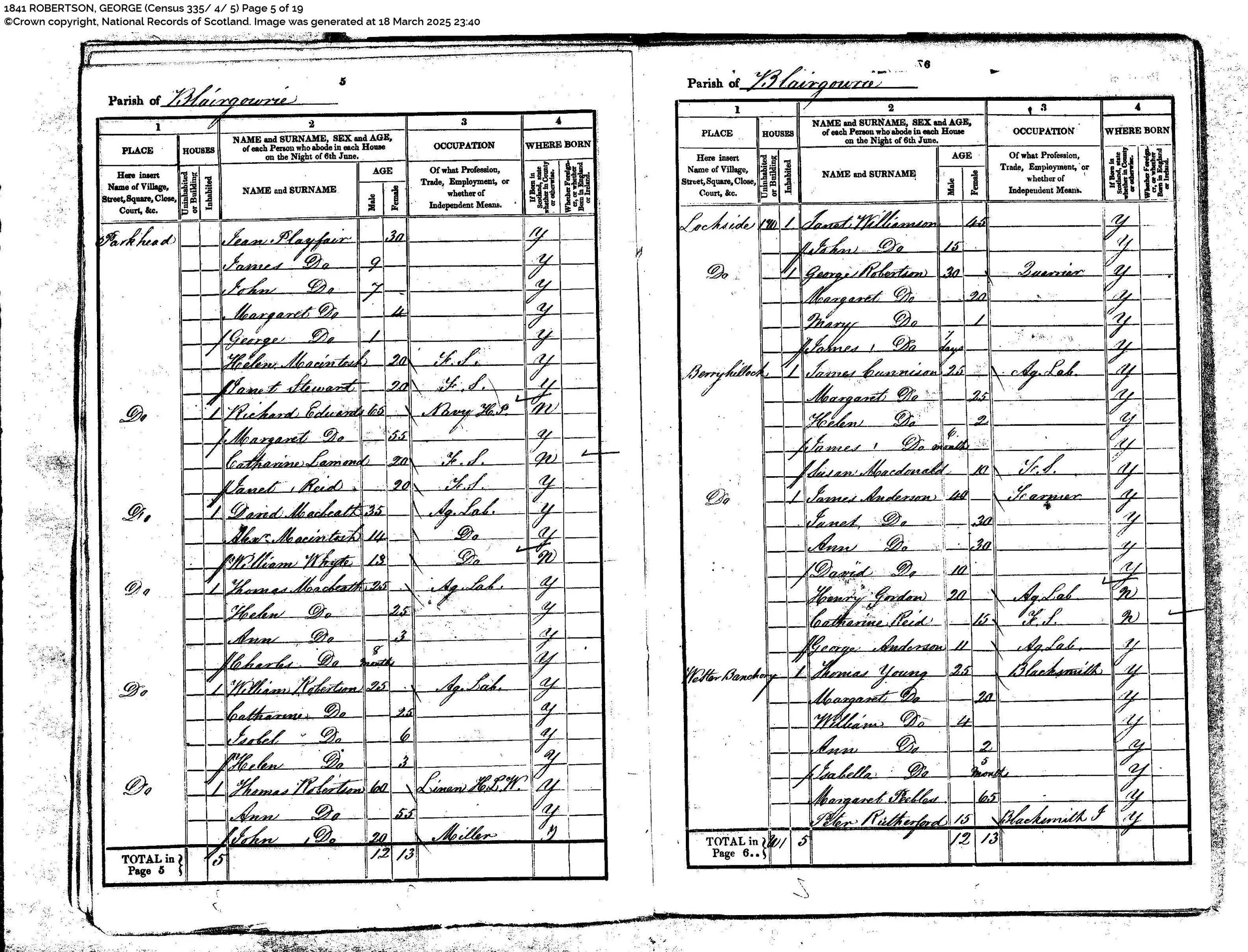
The census enumerator recorded the household: George Robertson, age 30 (census ages were typically rounded down to the nearest five years); Margaret, age 20; Mary Ann, age 2; and James, an infant. It was a modest household at the start of what would become three decades of family life in this Perthshire town.
James had been baptized just weeks before the census, on May 31, 1841. The parish register recorded:
"George Robertson Lochside and his Spouse Margaret Paterson had a child born on the 21st inst, baptized named James Robertson."
James—whose full name was James Penmuire Patterson Robertson, as later records would reveal—seemed to vanish after his 1841 baptism. For decades, his fate remained unknown. But he had not disappeared: he had emigrated to Canada, specifically Ontario, and eventually made his way to Liverpool, England, where he worked as a gamekeeper and herbalist. By 1875, he was raising a family at 59 Gill Street, Liverpool; by 1886, widowed, he married Martha Williamson Bates; and by 1901, he was listed as a gamekeeper "on his own account" with a house full of children. James's unexpected path—Scotland to Canada to Liverpool—would not be discovered until genealogical research connected the scattered records more than a century later.
A Growing Family
Through the 1840s and into the 1850s, children continued to arrive with regularity. David Paterson Robertson was born in September 1842—though no baptismal record has been found for him, his existence is confirmed by later census records and his prominent role in the family's American chapter.
John followed around 1846. He would marry Ellen McIntyre in Dundee in 1865, and their son George—born 1866 in Broughty Ferry—would return to the family's ancestral territory at Rattray, where his gravestone still stands today, commemorating four generations of Robertsons from 1942 to 1997.
Margaret arrived around 1851. By 1881, she was working as a tablemaid in Blairgowrie, unmarried at age thirty—one of those who stayed in Scotland while her siblings scattered across the Atlantic.
Then, on November 17, 1853, Margaret Paterson Robertson gave birth to twins.
The parish register entry is remarkable not just for recording a twin birth—always a notable event—but for the distinctive names George and Margaret chose for their children:
"George Robertson, Blairgowrie and his Spouse Margaret Paterson had twins born on the 17th inst, baptized and named William Fraser Robertson and Clementina Stuart Ramsay Robertson."

William Fraser. Clementina Stuart Ramsay. These were not ordinary names drawn from family tradition—they were statements, markers of connection to someone or something significant. The Fraser and Ramsay families were prominent in the Blairgowrie area; whether these names honored employers, benefactors, or family friends remains a mystery worth investigating.
The twins would take very different paths. William Fraser Robertson would become an iron moulder, marry Mary Ann Nisbet in 1878, and father at least eleven children. He was still in Brooklyn in 1900; his death date and location remain unknown. Clementina would marry Thomas Ferguson, bear children in Brooklyn, and die of chronic endocarditis in 1892—the same devastating year that claimed her mother.
The Later Children
Three more children arrived in the late 1850s and 1860, all recorded in the civil registration system that Scotland introduced in 1855.
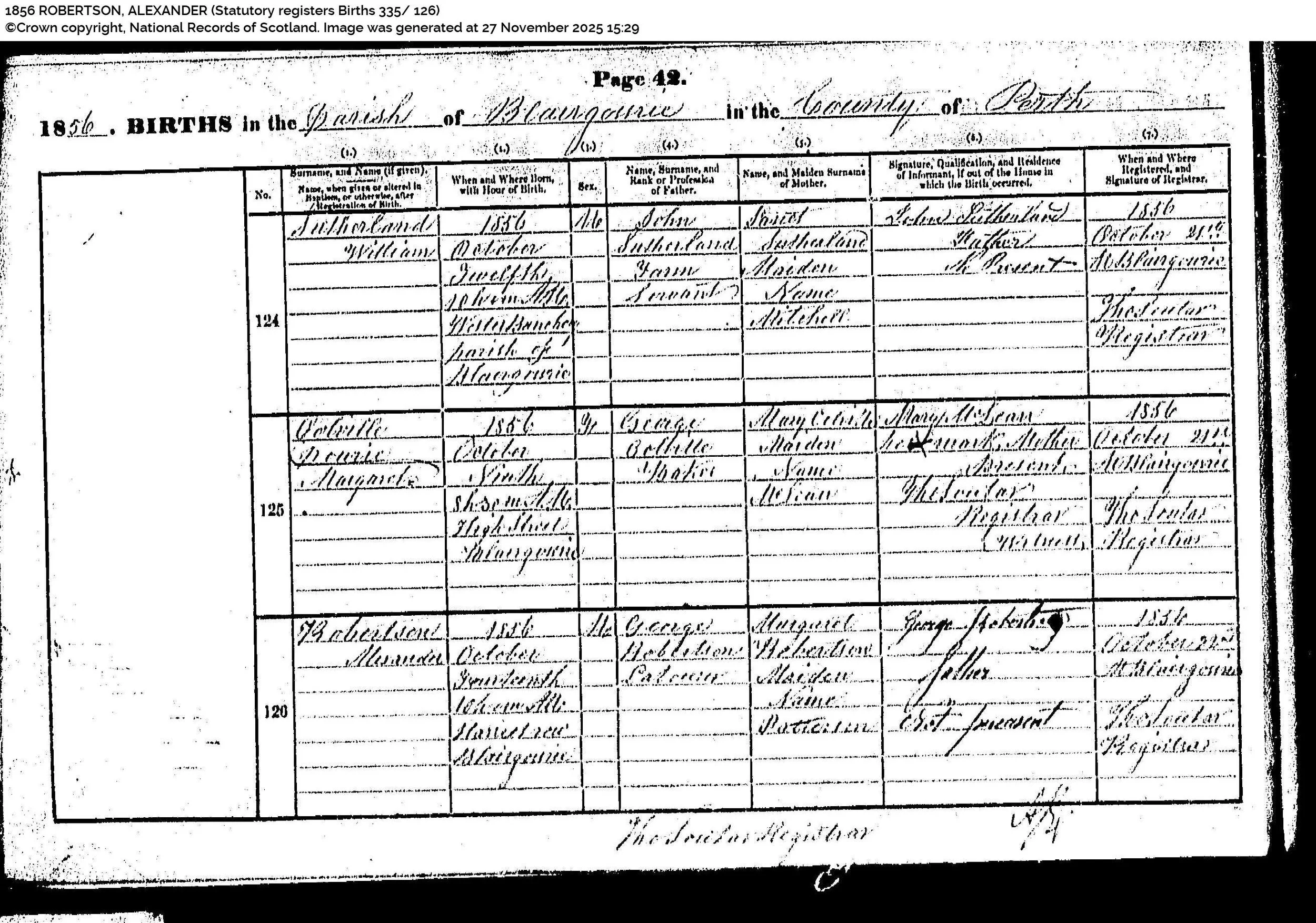
Alexander Robertson was born October 14, 1856, at Marlee Lane, Blairgowrie. His birth certificate lists his father as "George Robertson, Labourer"—a change from the "mason" designation of earlier records. Alexander would be the only one of George's children to remain in Scotland permanently, dying alone in Perth in April 1901, just three months after being enumerated in the census as a factory tenter in Dundee.
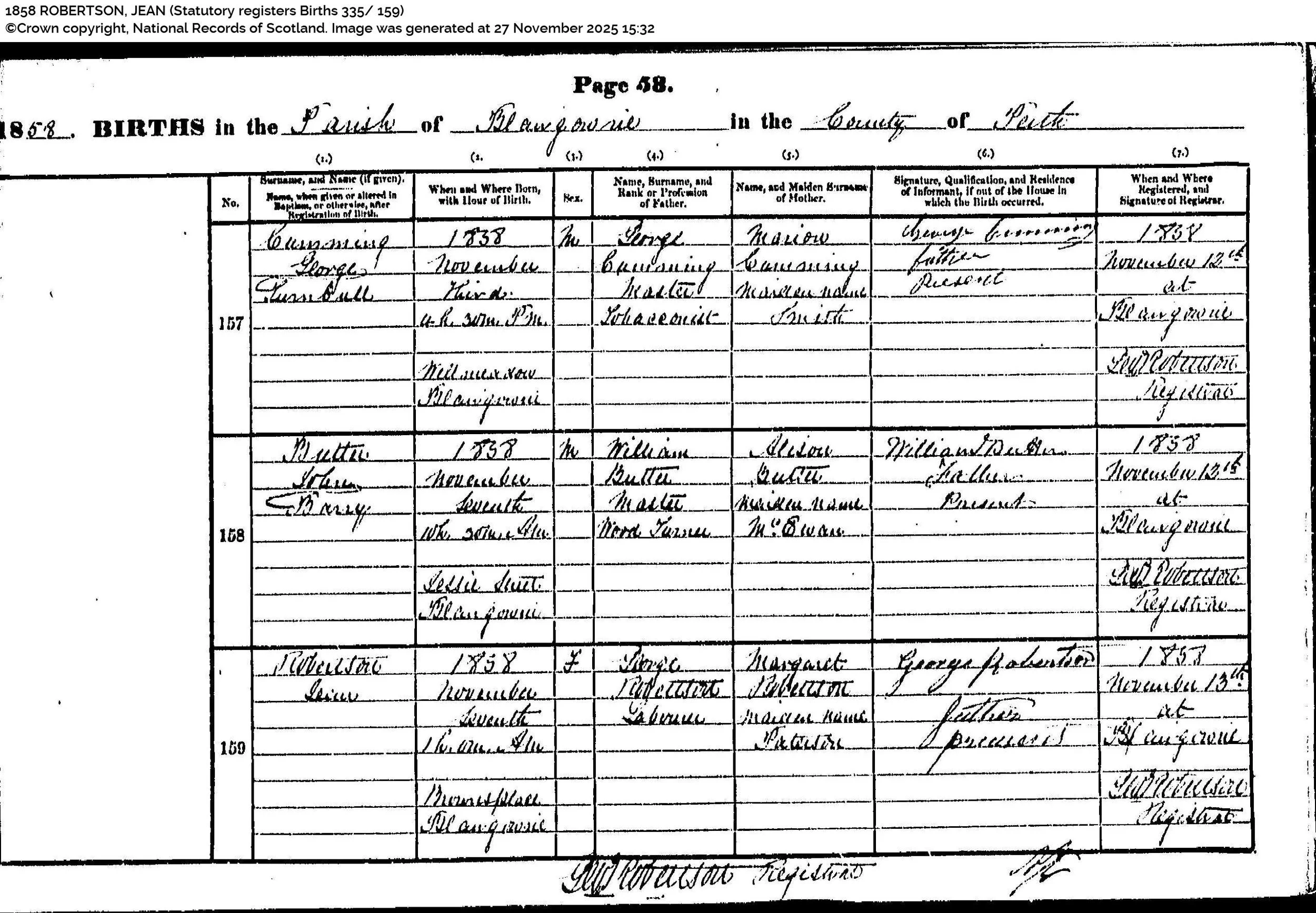
Jean Robertson was born November 7, 1858. Again, George is recorded as a labourer. Jean's fate after childhood remains the family's enduring mystery—she appears in the 1861 and 1871 censuses, then vanishes completely. No marriage, death, or emigration record has been found.
Isabella Campbell Robertson, the youngest, was born April 14, 1860. Like her siblings with their distinctive middle names—James Penmuire Patterson, William Fraser, Clementina Stewart Ramsay—Isabella bore "Campbell," suggesting another meaningful connection. She would marry John Lockhart in Brooklyn in 1891 and is buried at Evergreens Cemetery, where her father George had been laid to rest nearly two decades earlier.
Four Censuses, One Family
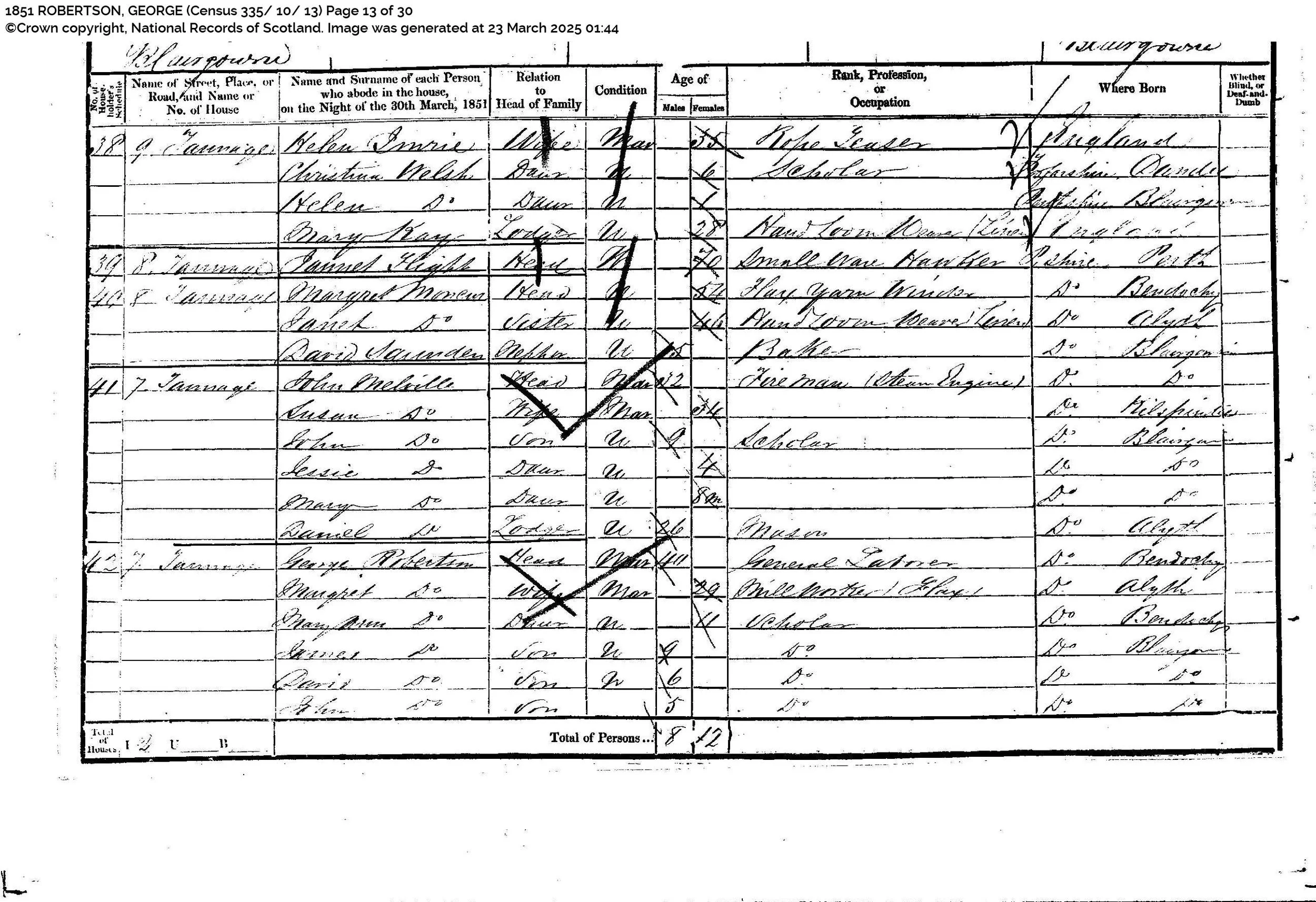
The Scottish censuses of 1841, 1851, 1861, and 1871 provide four snapshots of George Robertson's household across three decades. Each reveals the family at a different stage—growing, changing, and eventually beginning to disperse.

And in 1871, the household was beginning to thin. George was sixty-two, Margaret fifty. Some children had already left—David to Brooklyn, Mary Ann to Canada after her 1865 marriage. The great emigration was about to begin.
The First to Leave
On April 22, 1865, Mary Ann Robertson married Alexander McNab at Blairgowrie. She was twenty-five years old, working as a domestic servant. Her father George, listed as a labourer, was present at the ceremony, as was her brother David, who signed as a witness.

What the marriage record doesn't mention is that Mary Ann had already borne a child out of wedlock. In 1858, she had given birth to a daughter, Margaret Ann, with her mother Margaret Paterson Robertson present at the birth—a grandmother witnessing the arrival of an illegitimate grandchild, a moment of family support in what must have been difficult circumstances.
The marriage record captures a family still intact, still rooted in Blairgowrie. George Robertson, the mason's son who had become a mason himself and then a labourer, watching his eldest daughter marry. David Robertson, the third child, standing as witness for his sister—not yet knowing that within four years he would be living in Brooklyn, the first of George's children to cross the Atlantic.
Mary Ann and Alexander McNab would embark on an extraordinary journey: Nova Scotia, Ontario, Manitoba, Saskatchewan—wandering across Canada before Mary Ann finally settled in Harrison, New Jersey, where she died in 1921 as the last surviving child of George and Margaret Robertson.
On the Eve of Change
By the late 1860s, the pull of America was growing stronger. David Paterson Robertson, now in his mid-twenties with a wife and young son, made the crossing sometime around 1869. By the 1870 U.S. census, he was living in Brooklyn's 12th Ward, working as a stone cutter—the same trade his father had practiced in Scotland.
David's departure marked the beginning of a transformation that would scatter George Robertson's children across three continents. The family that had been so carefully documented in Blairgowrie's parish registers and census returns—ten children baptized, four censuses recorded—was about to disperse to Brooklyn, Liverpool, Canada, and beyond.
George Robertson was now in his early sixties. He had spent more than thirty years in Blairgowrie, watching his children grow from infants to adults. The 1871 census would show a smaller household, children grown and gone. And within a year, George himself would board a ship bound for New York, following his children to a country he would never truly see.
He would arrive on June 27, 1872. Five days later, he would be dead.
But that tragedy belongs to the next chapter. For now, in the final years of the 1860s, George Robertson was still the patriarch of a Blairgowrie family, still attending his daughter's wedding, still watching his grandchildren being baptized, still hoping—perhaps—that America would offer his family opportunities that Scotland could not.
The scattering was about to begin.
The Story Continues: David leads the way in 1869. Mary Ann follows. Then George himself boards a ship in the summer of 1872, never knowing he has only days to live. Episode 3: The Great Emigration (1869–1872).
Evidence Analysis
Reconstructing George and Margaret Robertson's family requires correlating multiple source types: parish registers (before 1855), civil registrations (after 1855), and census returns (1841, 1851, 1861, 1871). Each source has strengths and limitations.
The Ten Children
We can document baptisms or birth registrations for seven of the ten children: Mary Ann (1839), James Penmuire Patterson (1841), the twins William Fraser and Clementina Stewart Ramsay (1853), Alexander (1856), Jean (1858), and Isabella Campbell (1860). David Paterson (1842), John (c.1846), and Margaret (c.1851) appear in census records but their baptisms have not been located.
Occupational Shift
George Robertson's occupation changes across the records. In the 1841 census, he is listed as "Mason." By the 1856 and 1858 birth registrations, he appears as "Labourer." This shift may reflect economic changes in the building trades, seasonal work patterns, or simply how George chose to identify himself to different record-keepers.
Distinctive Naming Patterns
The unusual middle names—James Penmuire Patterson, William Fraser, Clementina Stewart Ramsay, Isabella Campbell—suggest deliberate honoring of specific individuals or families. Research into the Fraser, Ramsay, Campbell, and Penmuire connections in Blairgowrie might reveal the relationships George and Margaret were marking.
The Liverpool Connection
The discovery that James emigrated to Canada and then settled in Liverpool as a gamekeeper demonstrates the value of searching beyond expected locations. His 1886 marriage record identifies his father as "George Robertson, Gentleman"—confirming the connection while using an elevated term for a man who died a labourer.
Untraced Children
Jean (1858) remains completely untraced after the 1871 census—she may have died young, emigrated under a married name, or simply eluded documentation. Further research in death records, emigration lists, and marriage indexes may yet reveal her fate.
Primary Source Documents
The following documents trace George and Margaret Robertson's family through thirty years in Blairgowrie—from their first child's baptism in 1839 to their eldest daughter's marriage in 1865.


Sources
Old Parish Registers, Blairgowrie 335/ Births (1839 baptism of Mary Ann Robertson; 1841 baptism of James Robertson; 1853 baptism of William Fraser Robertson and Clementina Stewart Ramsay Robertson). National Records of Scotland.
Statutory Registers, Blairgowrie 335/ Births (1856 birth of Alexander Robertson; 1858 birth of Jean Robertson; 1860 birth of Isabella Campbell Robertson); Marriages (1865 marriage of Mary Ann Robertson and Alexander McNab). National Records of Scotland.
Scotland Census Returns: 1841 (Blairgowrie, Lochside); 1851 (Blairgowrie); 1861 (Blairgowrie); 1871 (Blairgowrie). National Records of Scotland.
Liverpool Parish Church Marriages, 1886, Page 220, Entry 439 (James Penmuire Patterson Robertson and Martha Williamson Bates). Liverpool Record Office.
England Census Returns: 1891 (Liverpool, RG12/2946); 1901 (West Derby, Liverpool, RG13/3502). The National Archives.
Are You Connected to the Robertson Line?
If you descend from the Robertson family of Blairgowrie, Bendochy, or Rattray in Perthshire — from George Robertson and Margaret Paterson or any of their ten children, the Brooklyn stone cutter David Paterson Robertson, or the connected Paterson, Craig, Anderson, McNab, McIntyre, Ferguson, Nisbet, or Lockhart lines — in Scotland, Brooklyn, New Jersey, or Liverpool, I’d like to compare notes. Documented Scottish trees, DNA matches, family papers, and even half-remembered stories have all moved this research forward.
Get in Touch About This FamilyCousin connections are informal and reciprocal — no fee, no obligation, just shared work on shared ancestry.
Every Family Has a Story Worth Telling
Whether you're just beginning your research or ready to transform years of work into a narrative your family will treasure, I'd love to help.
LET'S TALK ABOUT YOUR FAMILY