
Perthshire Paperweights: A Genealogists Discovery
A STORYLINE GENEALOGY DISCOVERY
Perthshire Paperweights
A Genealogist's Discovery
Finding Tangible Connections to Ancestral Homelands
"Part of my process of researching ancestors is that when I discover their location of origin, I search for some type of historical map or artifact or art from that area as a tangible connection to them."
Genealogical research fills notebooks with names and dates, census entries and vital records. But sometimes, in the midst of all that documentation, you find something unexpected—something you can hold in your hands, something beautiful that connects you to the place your ancestors called home.
For us, that discovery was Perthshire Paperweights.
The Discovery
We had been researching the Robertson family for years—tracing them back through Brooklyn, across the Atlantic, into the Scottish census records of the 1800s. Then came the breakthrough: George Robertson, born January 1809, baptized in Bendochy Parish, Perthshire, Scotland.
We had a location. Not just "Scotland" or even "Perthshire," but a specific parish—a 900-year-old church beside the River Isla where Duncan Robertson had married Jean Angus in 1786, where their children were baptized, where generations of Robertsons had lived and worked and worshipped.
As I always do when I pinpoint an ancestral location, I began searching for something tangible—a piece of art, a craft, a tradition from that place that I could hold in my hands. And that's when I discovered the extraordinary world of Scottish glass paperweights.

A Perthshire paperweight purchased for my mother—
a tangible connection to the homeland of her Robertson ancestors.
I had never seen anything like them. Intricate patterns of colored glass—millefiori canes arranged in precise geometric designs, encased in crystal-clear domes that magnified every detail. And they came from Perthshire—the very county where George Robertson was born, where his father Duncan wove cloth, where generations of our family had lived before the great emigration of the 1870s.
It felt like a gift from the ancestors themselves.
A Scottish Tradition
The history of Scottish glassmaking stretches back to the medieval period, when skilled artisans in monastic communities produced rudimentary glass objects for religious purposes. By the 17th century, the craft was flourishing in Edinburgh and Leith. George Hay established the first recorded glassworks in Scotland in 1610, near Holyrood Palace, producing bottles, flasks, and window panes that earned him favor with the royal court.
Throughout the 18th and 19th centuries, Scottish glassmakers refined their techniques. Coal-fired furnaces enabled larger-scale production. Improvements in glassblowing technology allowed for greater precision and intricacy. Notable centers emerged in Glasgow, Aberdeen, and Perth—the very region where the Robertson family lived.
But the story of Perthshire paperweights specifically begins with a single family: the Ysarts.
The Ysart Legacy
The birth of Scottish paperweight making is credited to Salvador Ysart, a Spanish glassmaker who moved his family to Crieff, Scotland, in 1922. Working at John Moncrieff Ltd., the Ysarts began producing the earliest Scottish paperweights—bringing continental techniques to the Scottish Highlands.
In 1946, Salvador and his sons Augustine and Vincent founded Ysart Brothers Glass, producing glassware under the Vasart label. The company evolved, eventually becoming Strathearn Glass, owned by Teacher's Whisky.
Then came the pivotal moment. In 1967, Stuart Drysdale—who had been hired to manage Strathearn—was sent a magazine article about antique French paperweights. Inspired, he set out to produce weights comparable to those 19th-century masterpieces. In 1968, he and several glassworkers left Strathearn to found Perthshire Paperweights in Crieff.

"The Art of the Paperweight: Perthshire" by Lawrence H. Selman—
one of several books we purchased to learn about this beautiful craft.
For more than thirty years, Perthshire Paperweights produced consistently high-quality work—intricate millefiori patterns, lampworked flowers and animals, all encased in crystal-clear glass. Their designs were inspired by traditional European techniques but carried a distinctly Scottish character. When the company closed in January 2002, skilled craftsmen like Peter McDougall (who had been head craftsman) and John Deacons continued the tradition by establishing their own studios in Crieff.
The Art of the Paperweight
My mother particularly enjoyed learning how these beautiful objects were created. The process is painstaking, requiring both technical skill and artistic vision.
Creating a Perthshire Paperweight
1. Creating the Canes: Artisans start with colored glass rods, heating and shaping them, adding layers and patterns, then stretching the resulting mass into long, thin rods called "canes." These can be simple or extraordinarily complex, containing multiple patterns within a single rod. The canes are then cut into short lengths.
2. Lampworked Elements: Alternatively, artisans use a torch to "lampwork" individual elements—flowers, animals, fruits—forming them from strands of molten glass before sealing them into the design.
3. Assembling the Design: A glassblower gathers molten glass onto a pontil rod, then presses it into a template where the chosen canes or lampworked pieces have been arranged. The design adheres to the hot glass.
4. Encasing and Shaping: Additional layers of clear molten glass are applied over the design. The craftsman shapes the glass into a sphere using wooden blocks and a marver (flat iron plate). A final gather of clear glass forms the dome.
5. Annealing: The finished paperweight is slowly cooled in an annealing oven to prevent cracking—a process that can take many hours.
6. Finishing: For faceted weights, skilled technicians cut and polish facets into the cooled glass. The base is ground flat and polished to a crystal-clear finish.
Three Generations, Three Paperweights
When I discovered Perthshire paperweights, I knew immediately that I had to share this connection with my family. These weren't just beautiful objects—they were tangible links to the homeland of our ancestors, created by artisans in the very county where George Robertson was born.
I purchased three paperweights: one for my mother, one for myself, and one for my daughter. Three generations of women, connected to six generations of Robertson ancestors, through a piece of Scottish glass art.

Purchased for myself
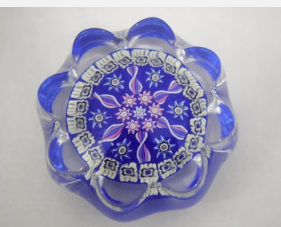
Purchased for my daughter
We thought it was amazing—these exquisite objects, unlike anything we had ever seen, were created just miles from the small village where our Robertsons lived. While George Robertson was working as a mason in Blairgowrie, while his children were being born and baptized in Bendochy, the tradition of fine glassmaking was already flourishing in Perthshire.
The paperweights themselves became more than decorative objects. They became conversation starters, teaching moments, tangible proof that our ancestors came from a real place with a real history and real traditions. When my mother holds her paperweight, she's holding a piece of Perthshire—the same county where her great-great-grandfather George Robertson was baptized in 1809.
The Robertson Connection
Blairgowrie & Bendochy — Where George Robertson was born (1809) and raised his family
↕ ~25 miles ↕
Crieff — Where Perthshire Paperweights was founded (1968) and the Ysart tradition began (1922)
Same county. Same heritage. Same Perthshire.
Finding Your Own Tangible Connection
I encourage every genealogist to look for these tangible connections. Once you've pinpointed an ancestral location, ask yourself:
- What crafts or trades flourished in that region?
- What art forms are associated with that place?
- Are there historical maps, prints, or photographs you could frame?
- What traditional foods, textiles, or objects came from there?
- Are there artisans today continuing traditional crafts from that region?
The object doesn't need to be expensive or rare. It needs to be meaningful—a physical link between your present and your ancestors' past, something you can see and touch and share with the next generation.
For us, Perthshire paperweights became exactly that: small globes of colored glass that contain, in their intricate patterns, a connection to a 900-year-old parish beside the River Isla, to a weaver named Duncan and a mason named George, to a family that would one day scatter like stones across two continents.
Continue the Robertson Story
Scattered Stones: Series Overview — The complete Robertson family documentary
Prologue: The Land They Left — Understanding Perthshire and Scottish genealogy
Episode 1: Roots in Perthshire — Duncan Robertson and Jean Angus
Storyline Genealogy
From Research to Story
Want to Know When New Stories Are Published?
Subscribe to receive updates on new family history research—no spam, just meaningful stories when there's something worth sharing.
SUBSCRIBE TO OUR NEWSLETTEREvery Family Has a Story Worth Telling
Whether you're just beginning your research or ready to transform years of work into a narrative your family will treasure, I'd love to hear your story.
BEGIN YOUR RESEARCH INQUIRY