
The Storyline
Real families. Real discoveries. Real stories.
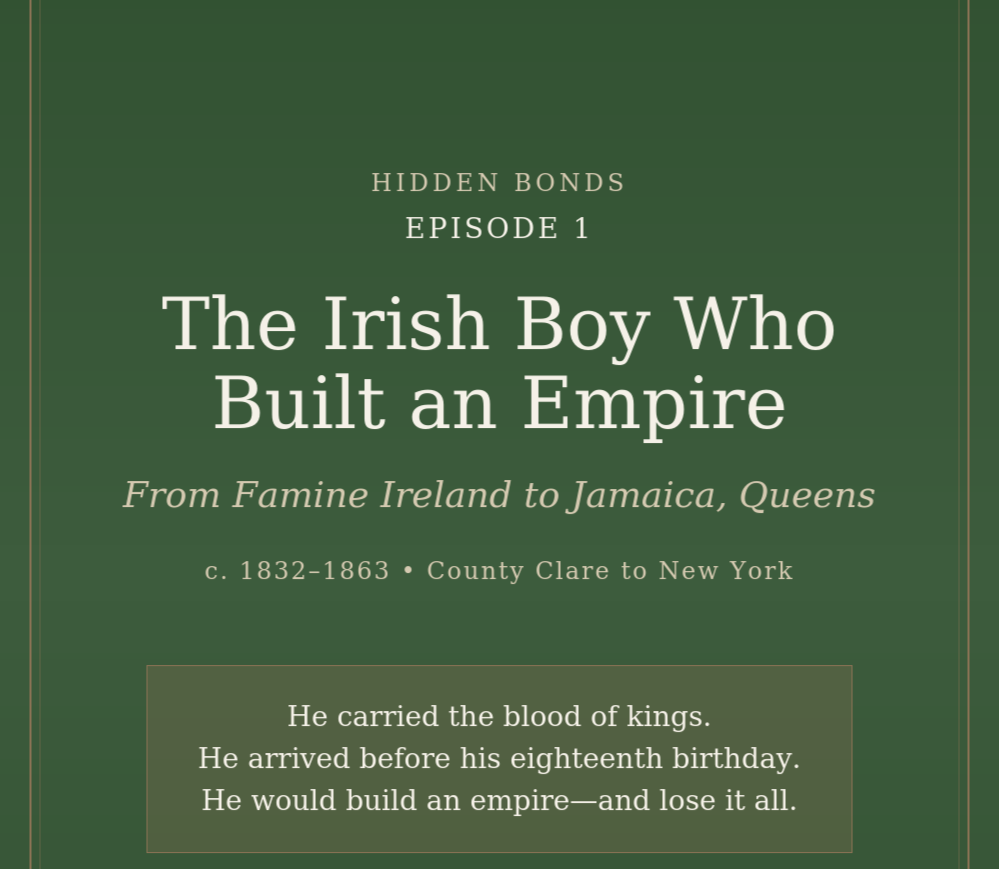
Hidden Bonds: The Irish Boy Who Built an Empire
DNA has proven what history forgot: Terrence O'Brien, who arrived in America as a famine refugee before his eighteenth birthday, carried the genetic signature of Brian Boru, High King of Ireland. The Catholic branch of the Royal House of Thomond—thought to have died out centuries ago—survived in the bloodline of a stable hand who built himself into a hotel empire in Jamaica, Queens. This is the origin story of a hidden prince.
Part of the Storyline Genealogy series: Documentary Biographies From Research to Story
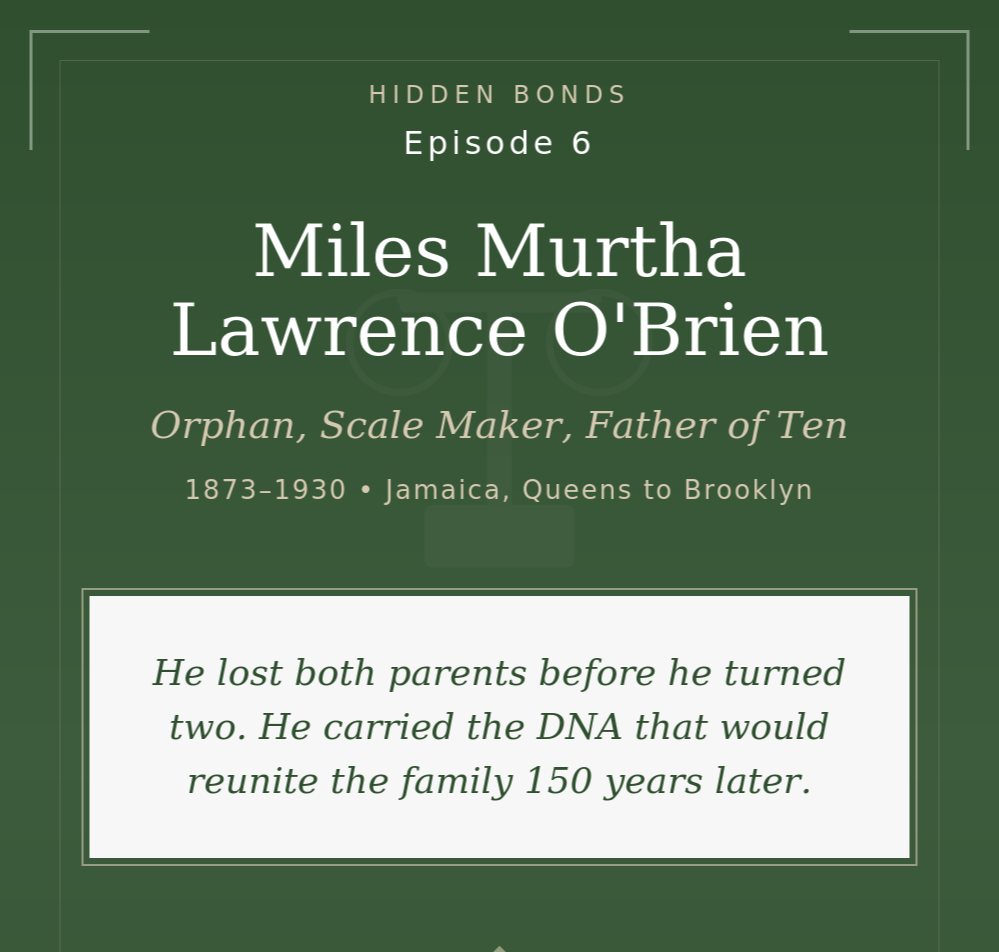
Hidden Bonds: Orphan, Scale Maker, and Father of Ten
Miles Murtha Lawrence O'Brien lost both parents before he turned two. In 1874, four O'Brien children were scattered to different relatives — the three older children to their mother's family, the Higginses; baby Miles to his mother's family, the Bedells. They had no shared maternal relatives to hold them together. Against all odds, Miles and his half-brother James Henry reconnected as adults. James became a U.S. Congressman and founded a scale company in Brooklyn. Miles became his scale maker. Two marriages. Ten children. And the DNA that would reunite the family 150 years later.
Part of the Storyline Genealogy series: Documentary Biographies
From Research to Story

Hidden Bonds: The Carpenter Who Built with Double Vision
Miles Murtha O'Brien fell from a scaffold in an elevator shaft. The family believes it was during construction of the Chrysler Building—the timing fits, and the story has been passed down for nearly a century. He survived with only bruises—and permanent double vision. He never worked on a crew again. Instead, he spent the next fifty years as a solo carpenter, building medical offices, renovating kitchens, and raising six children with his wife Lillian. This is the story of a man who lost his mother at two, fell from a scaffold at twenty-five, and kept working until the end.
Part of the Storyline Genealogy series: Documentary Biographies From Research to Story
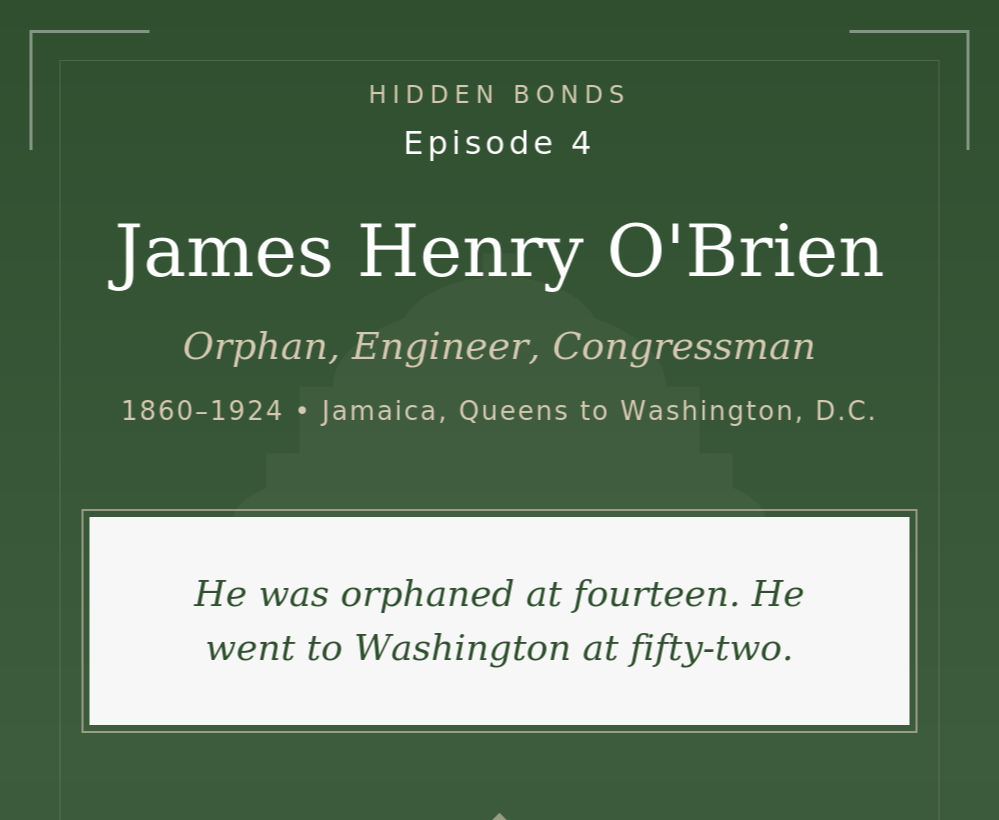
Hidden Bonds: Orphan, Engineer, and Congressman
James Henry O'Brien lost his mother at four and his father at fourteen. The four O'Brien children were scattered to different relatives — James sent to another state, his baby half-brother Miles placed with grandparents. They had no shared maternal family to hold them together. Against all odds, James built himself into a U.S. Congressman. He founded the J.H. O'Brien Scale & Supply Company, a Brooklyn institution that lasted over 60 years. And he found his half-brother Miles, hiring him at the family business. When James remarried in 1902, Miles stood beside him as witness. The bond between them would shape both families for generations.
Part of the Storyline Genealogy series: Documentary Biographies
From Research to Story
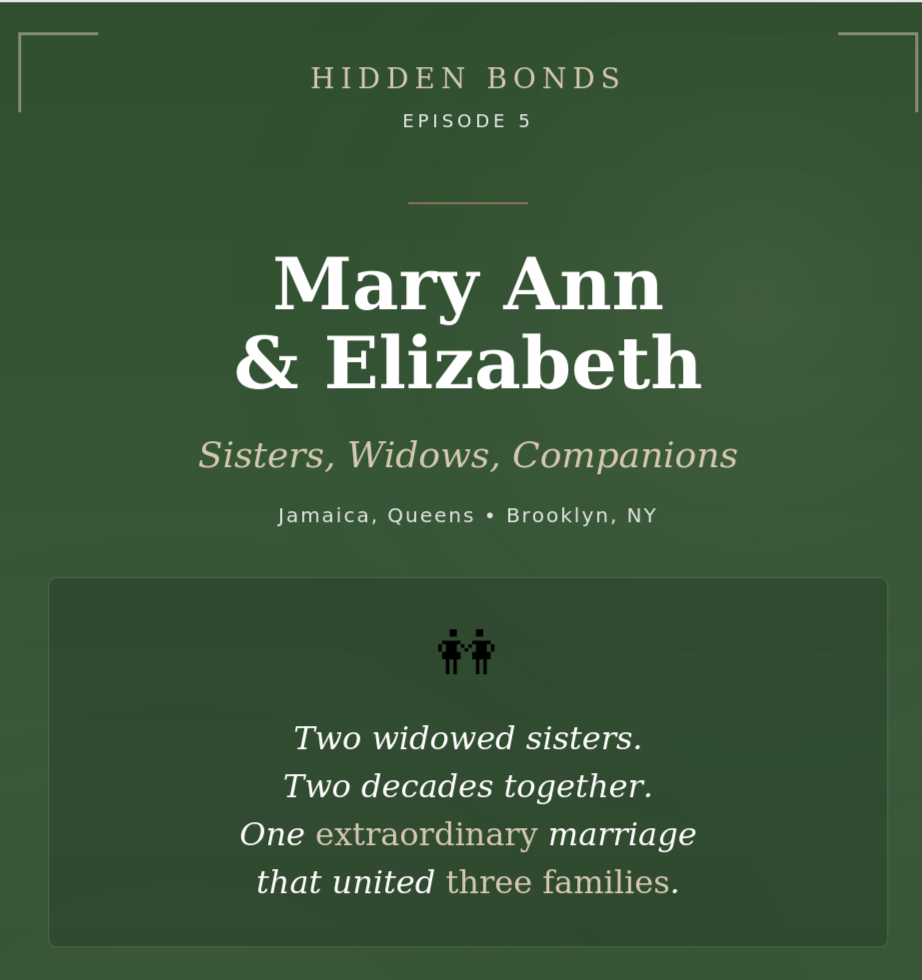
Hidden Bonds: Sisters, Widows, and Companions
Mary Ann O'Brien Smith and Elizabeth O'Brien Foley were sisters who weathered widowhood together. After losing their husbands, they shared a Brooklyn home for over two decades. But the most remarkable twist came in 1937, when Mary Ann's son Thomas—a New York Fire Captain—married Rose Higgins, the daughter of Thomas J. Higgins, who had served as executor of their brother Terrence O'Brien's estate. Two families already bound by legal trust became bound by blood. Today, three surnames—Higgins, Smith, and O'Brien—are inscribed on a single gravestone in Queens.
Part of the Storyline Genealogy series: Documentary Biographies From Research to Story
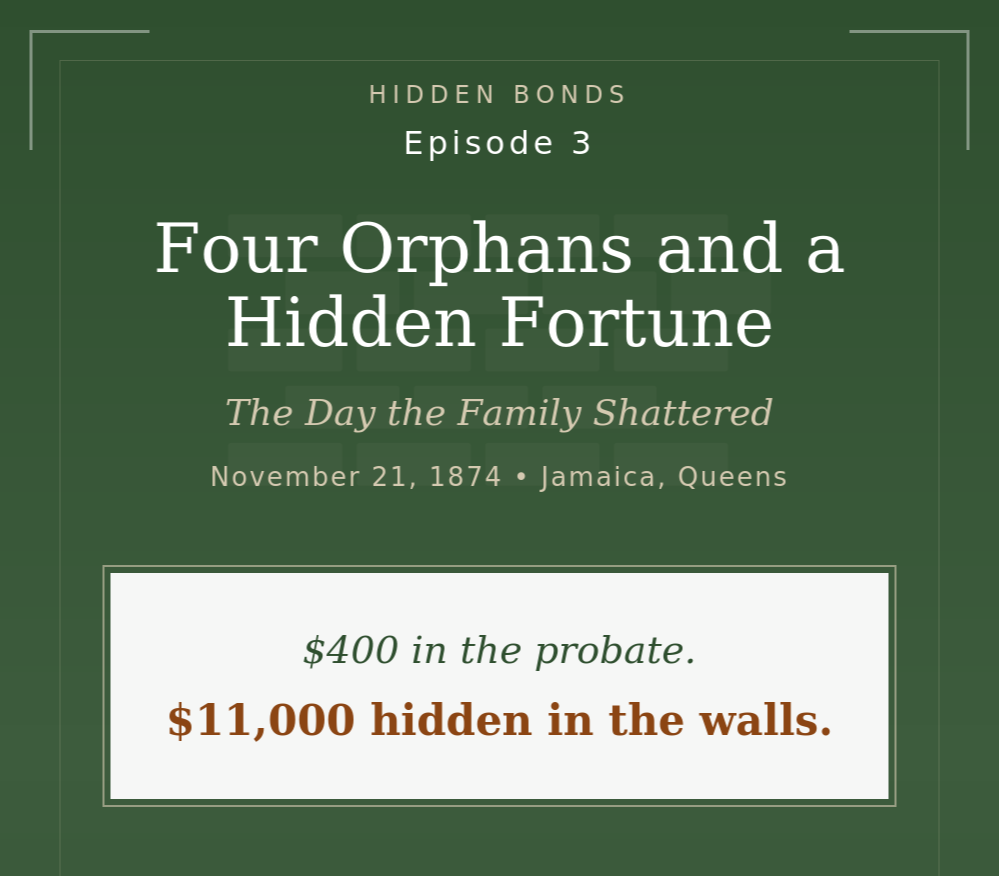
Hidden Bonds: Four Orphans and a Hidden Fortune
When Terrence O'Brien died on November 21, 1874, his four children were scattered to relatives across three states. James Henry, age 14, was sent to his uncle Patrick in Newport, Kentucky. Mary Ann and Elizabeth stayed in Jamaica with their maternal uncle Thomas Higgins. Baby Miles, just 18 months old, went to his great aunt Mrs. Madden. The probate listed the estate at just $400. Years later, $11,000 in government bonds was discovered hidden in the kitchen wall of the hotel Terrence had once owned — a fortune that could have kept the family together. The bonds hidden in the wall may have been lost. But the bonds between the siblings endured.
Part of the Storyline Genealogy series: Documentary Biographies From Research to Story
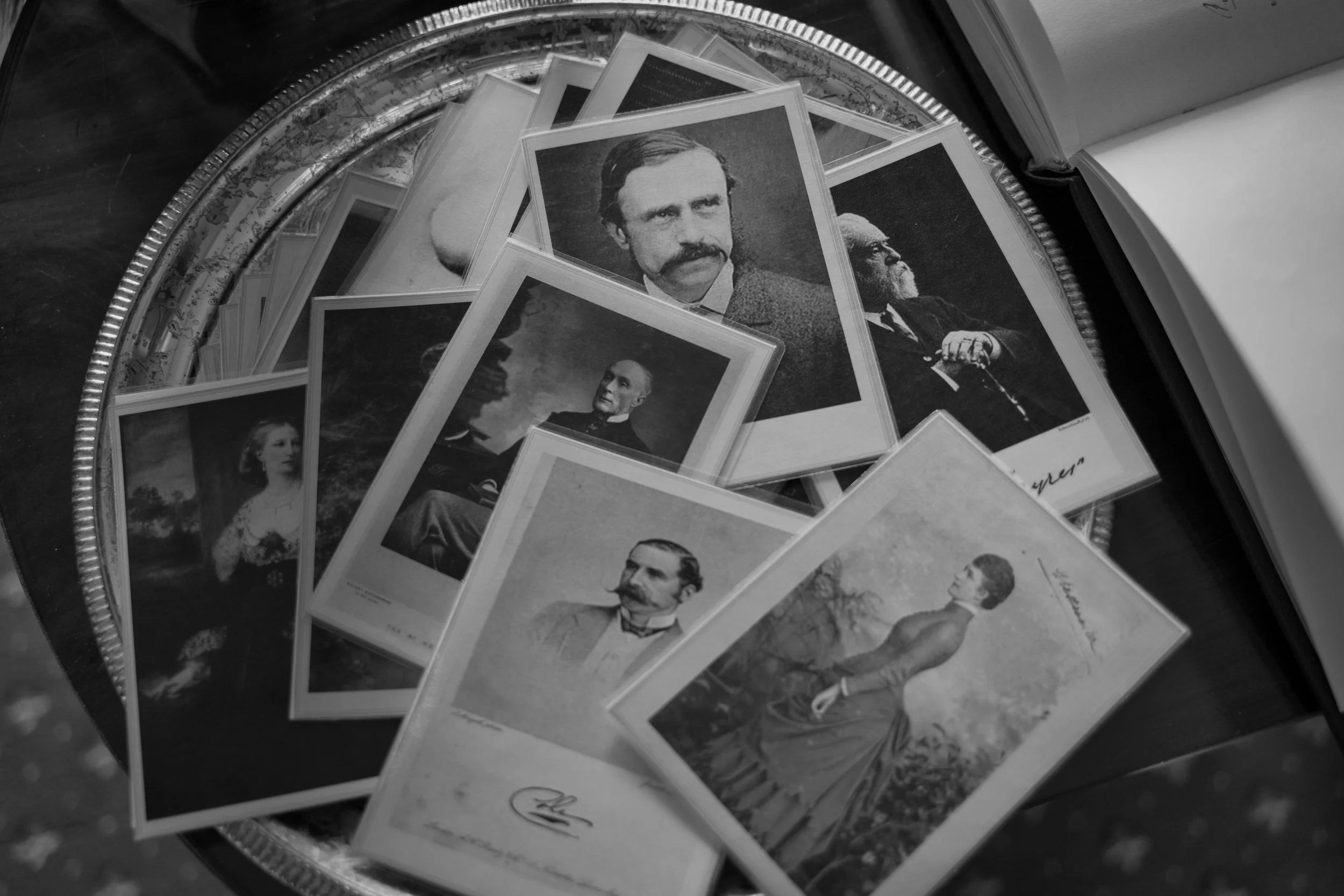
Why Your Family Tree Matters More Than Ever: Finding Ourselves in Our Ancestors
Why does your family tree matter? Because understanding where you came from helps you understand who you are. Your ancestors survived incredible hardships—and their strength lives in you. This piece explores how genealogy connects us to our past, reveals that we're all family, and reminds us that every single one of us descends from immigrants. It's time to honor their stories before they're lost forever.
Part of the Storyline Genealogy Series: Because every family story deserves to be told
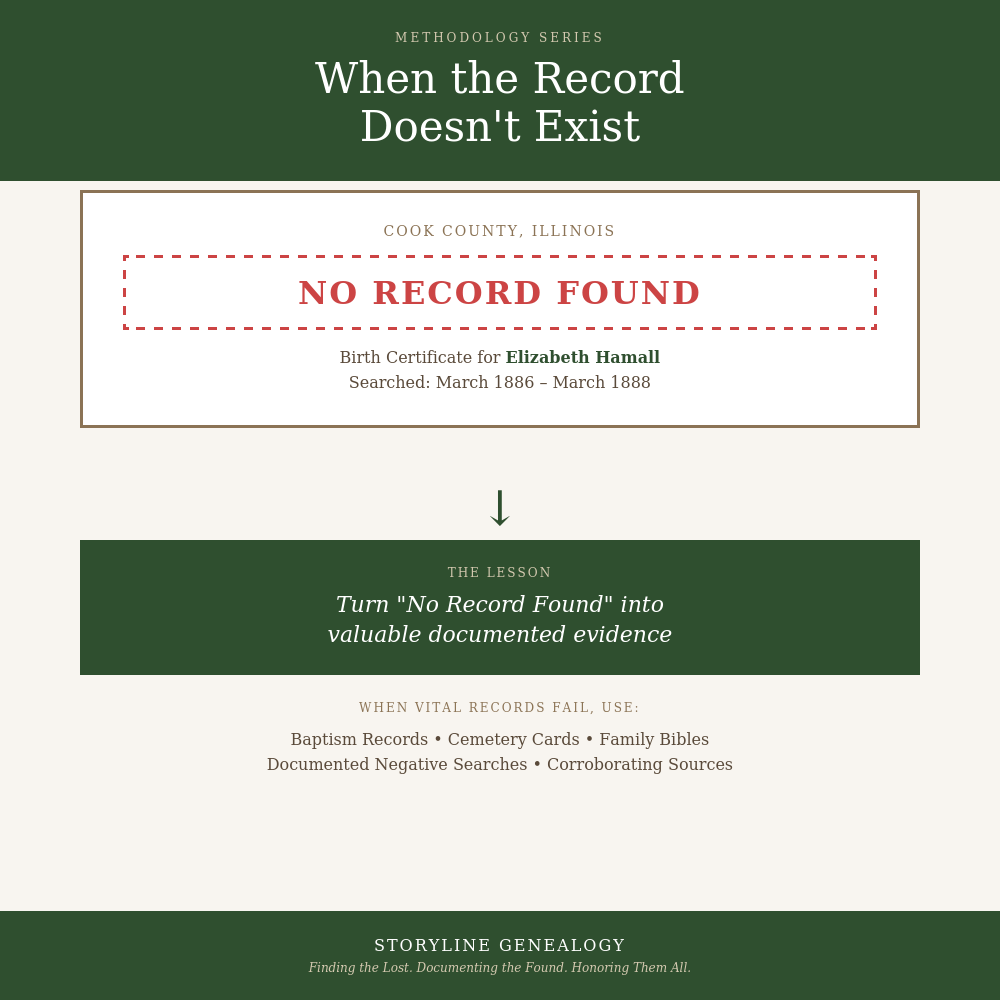
When the Record Doesn’t Exist: A Lesson in Documenting Negative Evidence
Learn how to turn "No Record Found" into valuable evidence. This case study follows Elizabeth Hamall's missing 1887 Chicago birth certificate, showing how baptism records, cemetery cards, and documented negative searches tell a complete story when vital records don't exist. A professional genealogy methodology lesson.
Part of the Storyline Genealogy Series: Finding the Lost. Documenting the Found. Honoring Them All.

Three Generations of Shrinking and Expanding
The Hamall family nearly died out. From Kate's six children in the 1880s, the Thomas Henry Hamall line eventually narrowed to just one great-grandchild—Thomas Kenny. And then he had six children. That's how close this family came to extinction. That's how much one generation can change everything.
Part of the Storyline Genealogy Series: proving that the stories worth telling are the ones that can be proven true.

The Father Who Tried
The wedding photo proves he was there. The Miami records show he moved 1,200 miles to be in the same city as his son. The newspaper clippings prove he rebuilt his life after devastating loss. They were together in the early 1950s—father and son, both adults, both working in Miami. Then in 1957, a career transfer moved his son away. The distance wasn't abandonment—it was logistics, career mobility, and the complications of life. And the pocket watch with the initials TEH, worn to every daughter's wedding, proves the connection endured. This is the story of Thomas Eugene Hamall—the father who tried.
Part of the Storyline Genealogy Case Studies Series: Three Thomas Hamalls – Examining how economic devastation, career mobility, and geographic distance shaped a father-son relationship across decades—and how a pocket watch tells the story effort and connection endured.
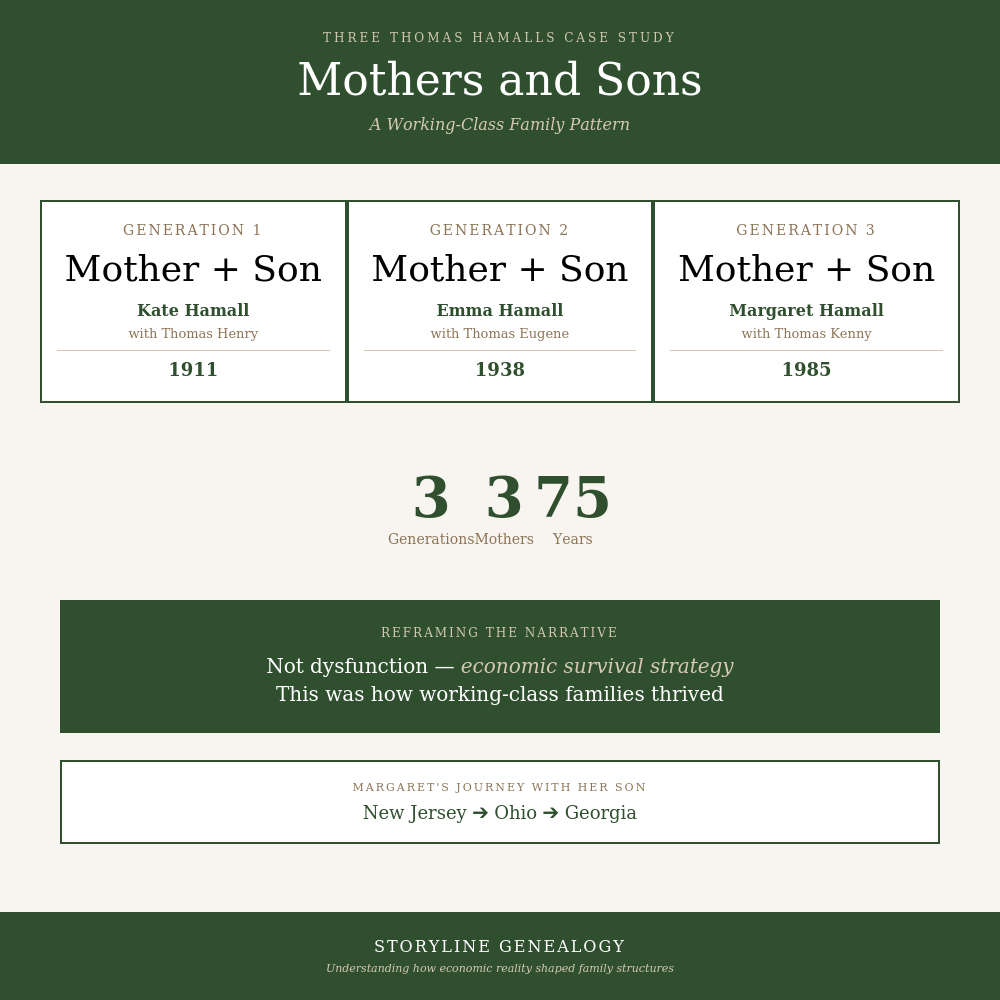
Mothers and Sons: A Working-Class Family Pattern
Three generations. Three mothers. Three sons. Three households built together. From Kate Hamall in 1911 to Margaret Kenny Hamall in 1985, a pattern repeated across 75 years—not because of dysfunction, but because this was how working-class families survived. Understanding multi-generational households as economic strategy, not pathology.
Part of the Storyline Genealogy Case Studies Series: Three Thomas Hamalls – Examining how economic reality shaped family structures across three generations of working-class Chicago families.
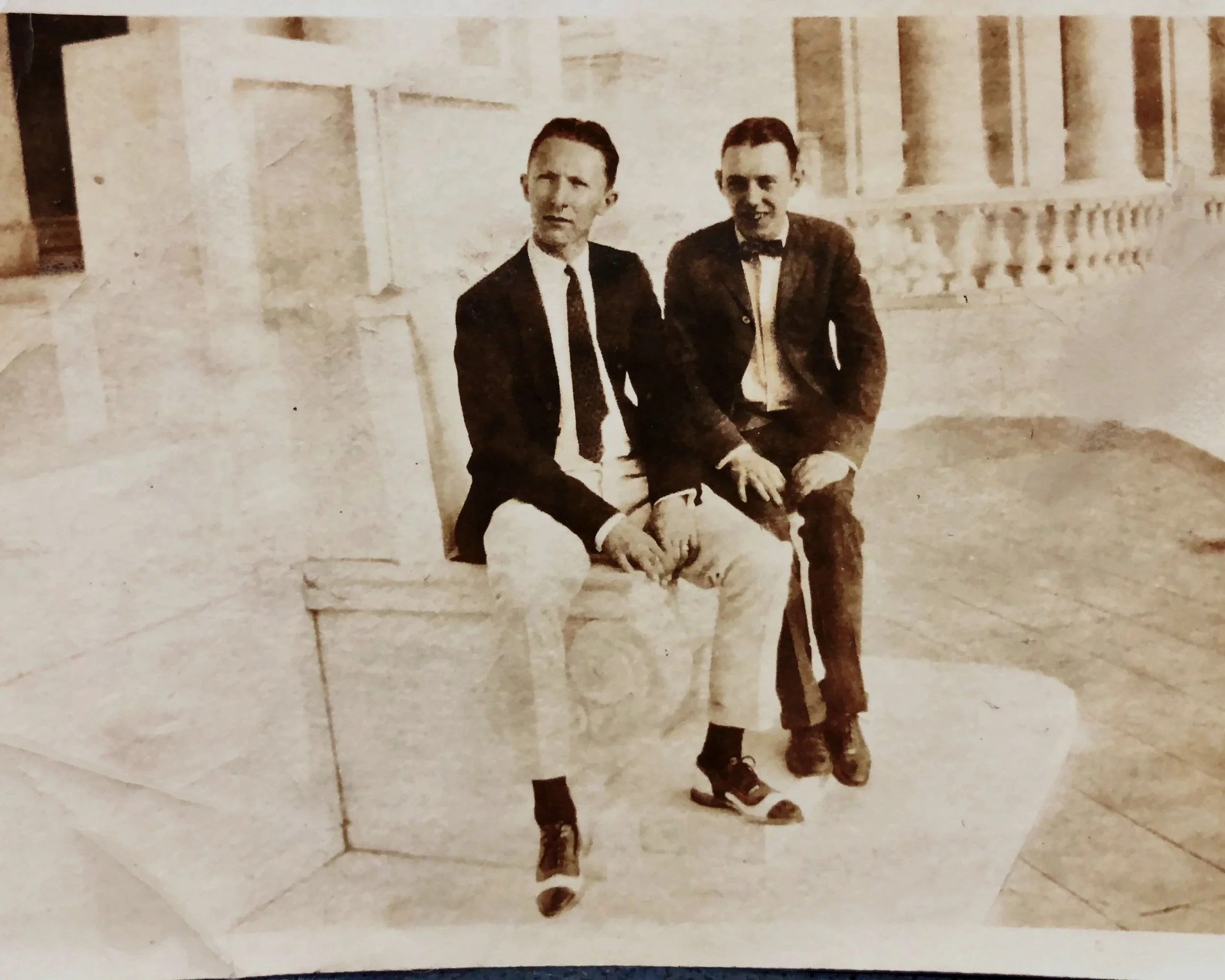
The Mystery Man: Photo Analysis
In a 1947 photograph, two men sit together at the US Capitol—one is Thomas Eugene Hamall, age 43. The other remained unidentified for 75 years. Through forensic photo analysis, family tree reconstruction, and a 1968 high school yearbook, we finally discovered who he was—and uncovered a poignant story about family connections maintained across three fractured generations.
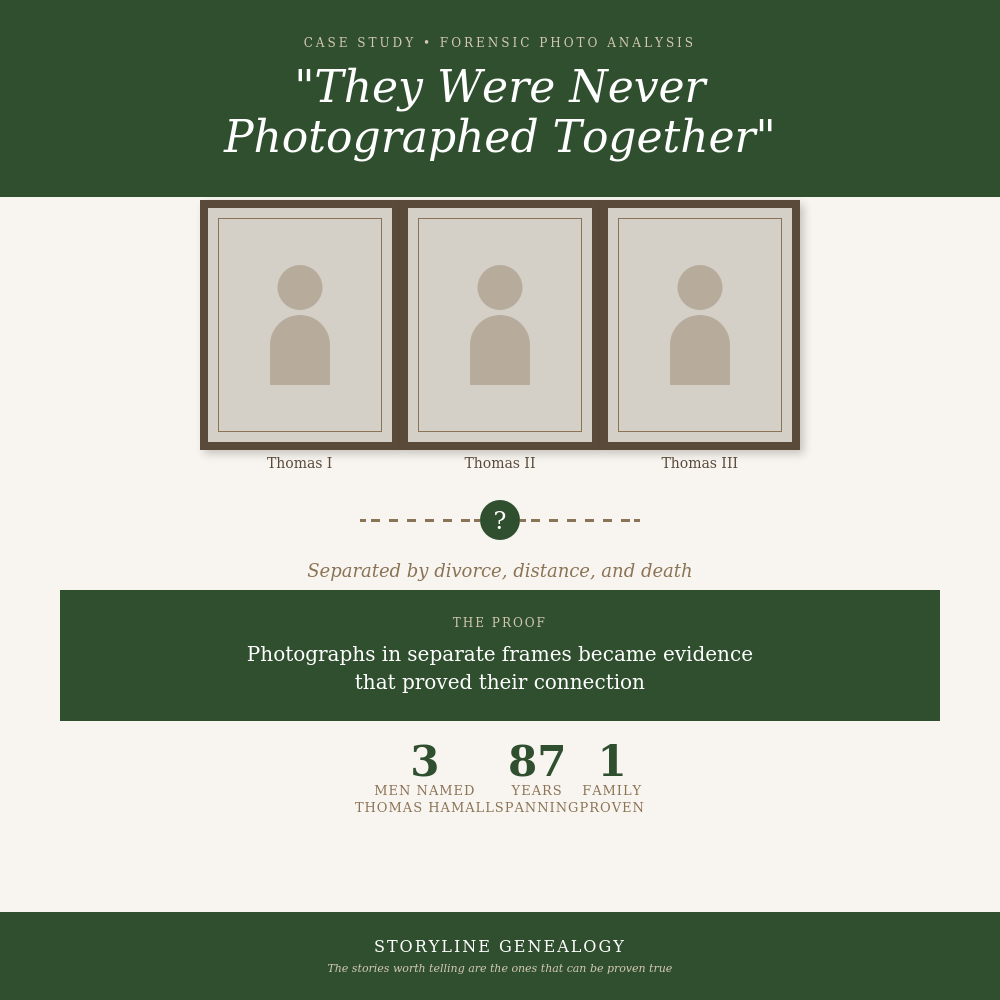
They Were Never Photographed Together
They were never photographed together—but forensic analysis proved they were there. When three men named Thomas Hamall were separated by divorce, distance, and death, photographs in separate frames became the evidence that proved their connection across 87 years.
Part of the Storyline Genealogy Series: proving that the stories worth telling are the ones that can be proven true.

The Property War: A Mill Worker's Legal Victory That Still Protects Families
Emma divorced Thomas on October 18, 1907. Five days later, she married another man in Indiana.
Five. Days.
She literally fled across state lines to remarry as quickly as possible, using Indiana's "quickie marriage" laws like a 1900s version of Las Vegas. Meanwhile, Thomas was left financially ruined, homeless, and owing $4 every week in child support – equivalent to $150 weekly in today's money.
But Thomas had a secret weapon: his mother Kate, who loaned him $400 in 1911 to buy a cottage in Riverside, Illinois. It seemed like a fresh start. Then came the deal that would change everything.
In 1914, Thomas and Emma thought they were being clever. He'd pay her $25 cash and deed his property to a friend "in trust" for their son Thomas Eugene. She'd give up all future child support claims. Everyone wins, right?
Wrong.
Ten years later, Emma filed a shocking lawsuit demanding $2,500 in "unpaid" child support – despite their agreement. She wanted to seize Thomas's cottage to satisfy the debt. What followed was a four-year legal war that went all the way to the Illinois Supreme Court, creating precedent that still protects homeowners today.
This isn't just another property dispute. This is the story of how one working-class father's promise to his son became a legal victory that would protect countless American families for generations...
Part of the Storyline Genealogy series: Uncovering the dramatic human stories behind legal history, one family at a time.
The Widow Who Never Lost: Marie Chapelier's Legal Victory
Marie Chapelier arrived in New France as a penniless widow in 1649. She could read and write—a rare skill that would prove decisive 44 years later. When her stepdaughter challenged her property rights in 1693, Marie fought back through five levels of colonial courts. The final score: 9-0. She died undefeated three months after her final victory. This is the story of strategic survival, legal warfare, and one woman's refusal to be defeated.
Part of the Storyline Genealogy series: From marriage contracts to courtroom victories—one widow's signature tells a 48-year story of literacy, strategy, and undefeated determination.
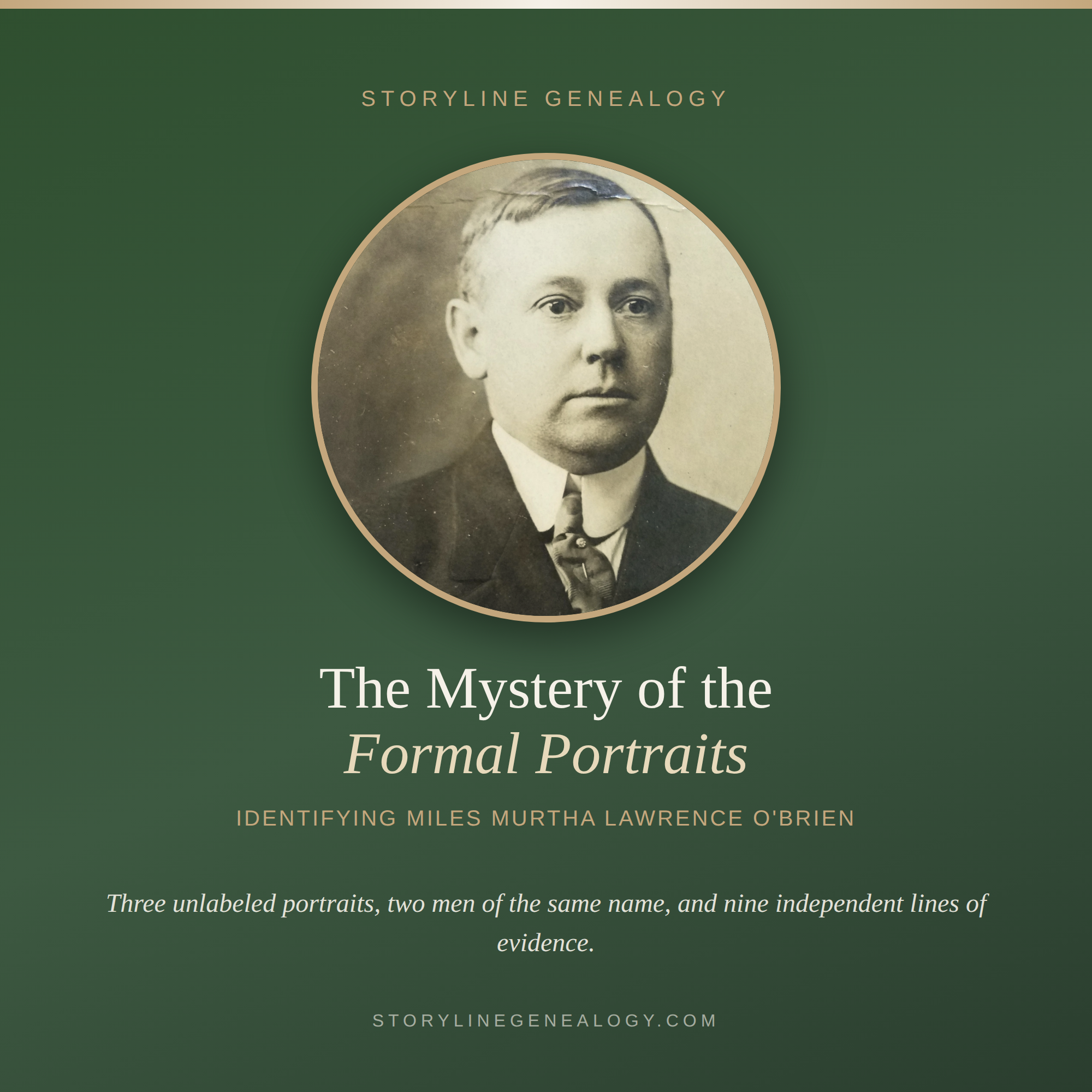
The Mystery of the Formal Portraits
When three generations share the same name, how do you know which Miles you're looking at? I had three unlabeled formal portraits from the early 1900s and two men named "Miles M. O'Brien" living in Brooklyn during the same era—a grandfather and his son. The only clue was a severely degraded photo with faint handwriting: "Dad's Father - Died 1930."
This is the story of how I identified Miles Murtha Lawrence O'Brien through fashion dating, WWI draft card records, and the convergence of nine independent lines of evidence. It's also the story of a Brooklyn Irish-American family that rose from immigrant roots to prominence—one man a US Congressman, another a skilled scale maker working for his half-brother's business.
When photographs outlive memory, detective work brings our ancestors back. Join me as I solve a 95-year-old mystery, one clue at a time.
Part of the Storyline Genealogy Series-Uncovering Your Family Story and Preserving Your Legacy
The Damaged Graduation Portrait
You know that box—the one with the damaged photos, cracked and creased and faded, faces that stared death in the face and lived to tell about it. For years I looked at one in particular: a man in graduation robes I first took to be about thirty-nine, with a steady gaze and quiet dignity. The family said it was "Lolo Mamerto," from his graduation, and we long dated it to 1939. But how could we be certain, when the man died fleeing Japanese soldiers in 1942 and so many records were lost? This is the detective work of photo identification—how photographic technology, academic regalia, apparent age, a wartime damage pattern, family memory, and one decisive record reset the date: because a notary had to be a lawyer, his law degree had to predate his 1933 commission, placing the portrait in the early 1930s, about a decade before his death.
Part of the Storyline Genealogy Series: From Research to Story—transforming fragmented memories into complete family narratives

The Tintype in the Box: Photo Mystery
How I identified a nameless 1870s tintype using photo dating, fashion analysis, and family records—and discovered the tragic story of Margaret Mary McKenny.
When photographs outlive memory, detective work brings our ancestors back.
Part of the Storyline Genealogy Series- Uncovering the Stories Behind the Names and Images
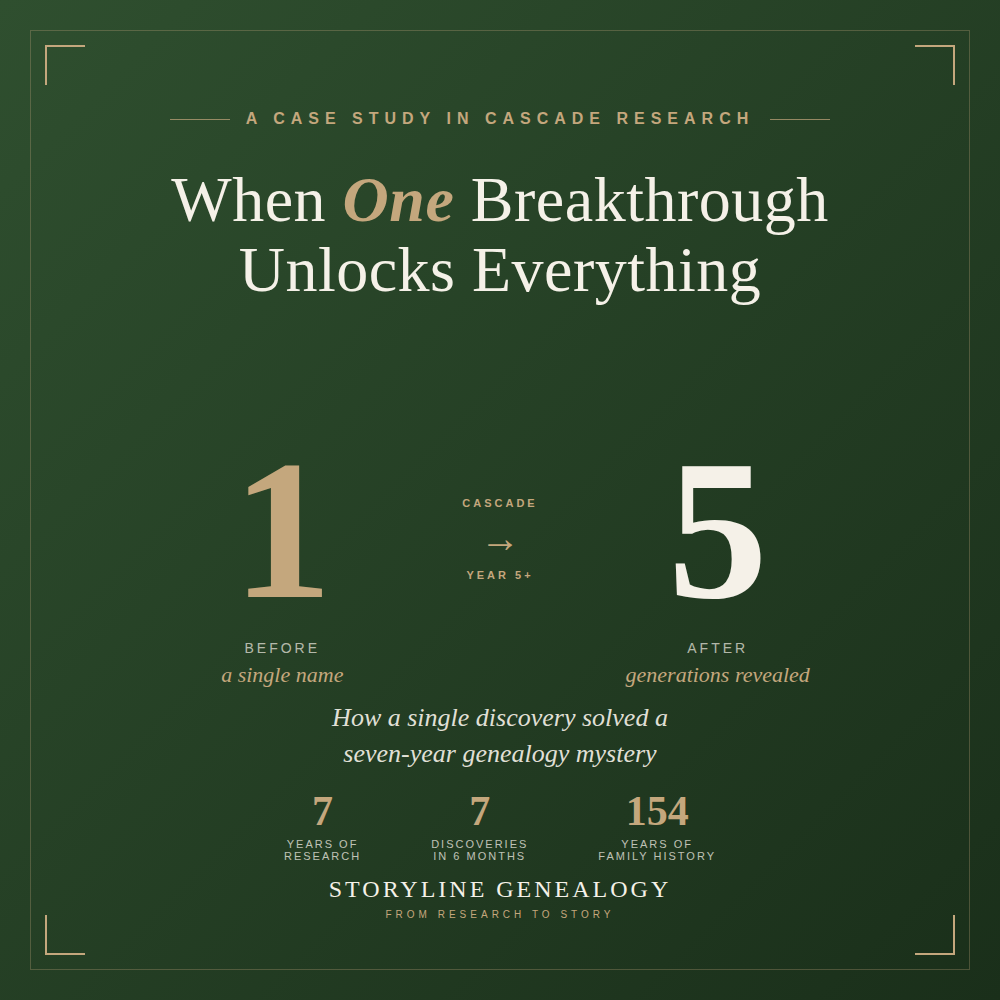
When One Breakthrough Unlocks Everything
The breakthrough came in Year 5. After seven years of searching for John Kenny among dozens of other John Kennys in Brooklyn, the answer appeared when we stopped asking "Which John Kenny?" and started asking "What made THIS John Kenny unique?" That single shift—from name-based searching to occupational tracking—unlocked seven major discoveries in six months and revealed five generations spanning 154 years.
Part of the Storyline Genealogy series: When traditional research methods fail, innovative approaches unlock the impossible cases that define professional genealogy.
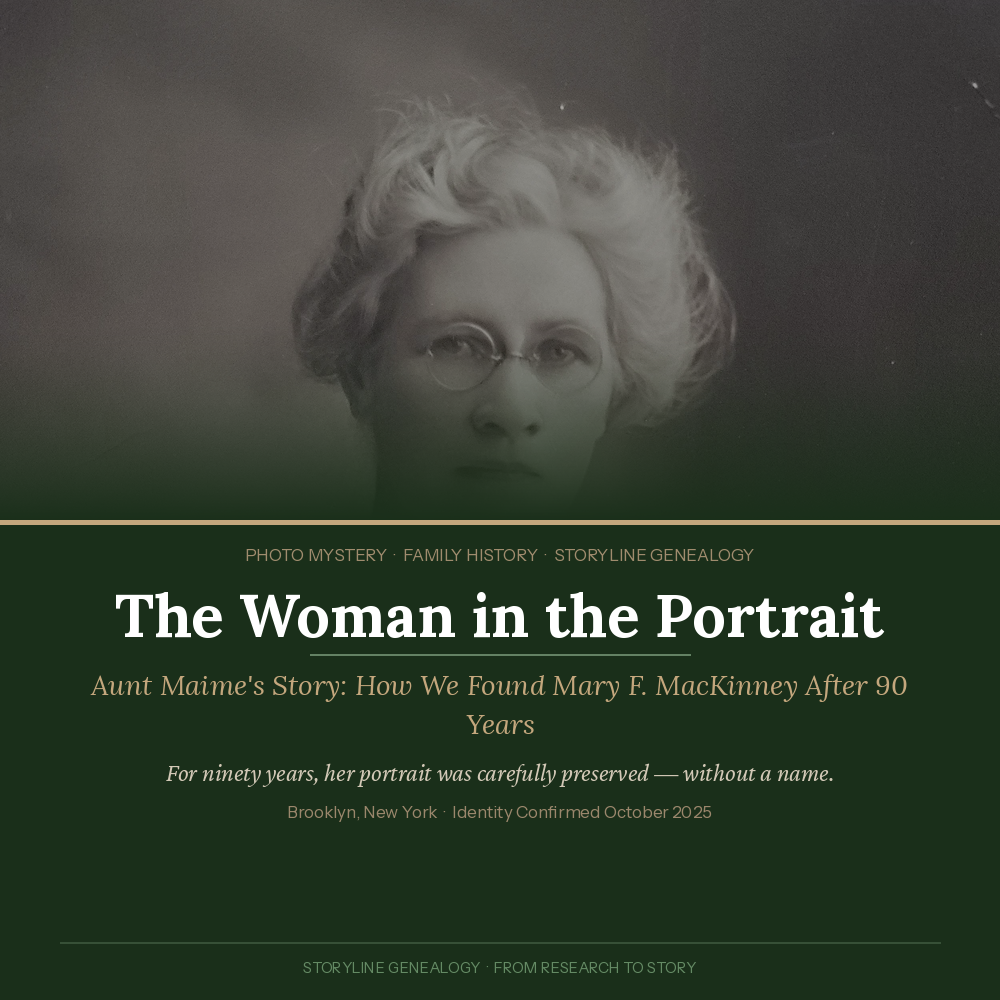
The Woman in the Portrait: Aunt Maime’s Story
For 90 years, her portrait was preserved but unlabeled. Through death certificates, census records, and a 7-year search, we finally discovered Aunt Maime's extraordinary story of sacrifice and survival.
Part of the Storyline Genealogy Series- Uncovering the Stories Behind the Names