
The Storyline
Real families. Real discoveries. Real stories.
They Were Never Photographed Together
Three sets of photographs, three claims to test, and three different answers. Two men in formal dress at the same Riverside bridge in the year one of them married there. A dog on a lawn chair at a cottage, in two frames taken the same season. A father and a son at the same Capitol balustrade in 1947. One case holds, one fails at the last step, and one is settled as to the event but open as to the journey — and saying which is which is the whole method. A shared element can put two photographs in one place. It cannot put a person there.
Part of the Storyline Genealogy Series: From Research to Story

The Property War
Four years of litigation, two courts and an appeal to the Supreme Court of Illinois — over a cottage measuring twenty-four feet by twenty-four. Read from the decision itself rather than from family memory, the case turns out to run the other way round: Thomas Hamall was the one who sued, his former wife was the one who appealed, and the court expressly declined to decide the point of law the family has long believed it settled.
Part of the Storyline Genealogy series: Uncovering the human stories behind legal history, one family at a time.
The Widow Who Never Lost: Marie Chapelier's Legal Victory
Marie Chapelier arrived in New France as a penniless widow in 1649. She could read and write—a rare skill that would prove decisive 44 years later. When her stepdaughter challenged her property rights in 1693, Marie fought back through five levels of colonial courts. The final score: 9-0. She died undefeated three months after her final victory. This is the story of strategic survival, legal warfare, and one woman's refusal to be defeated.
Part of the Storyline Genealogy series: From marriage contracts to courtroom victories—one widow's signature tells a 48-year story of literacy, strategy, and undefeated determination.
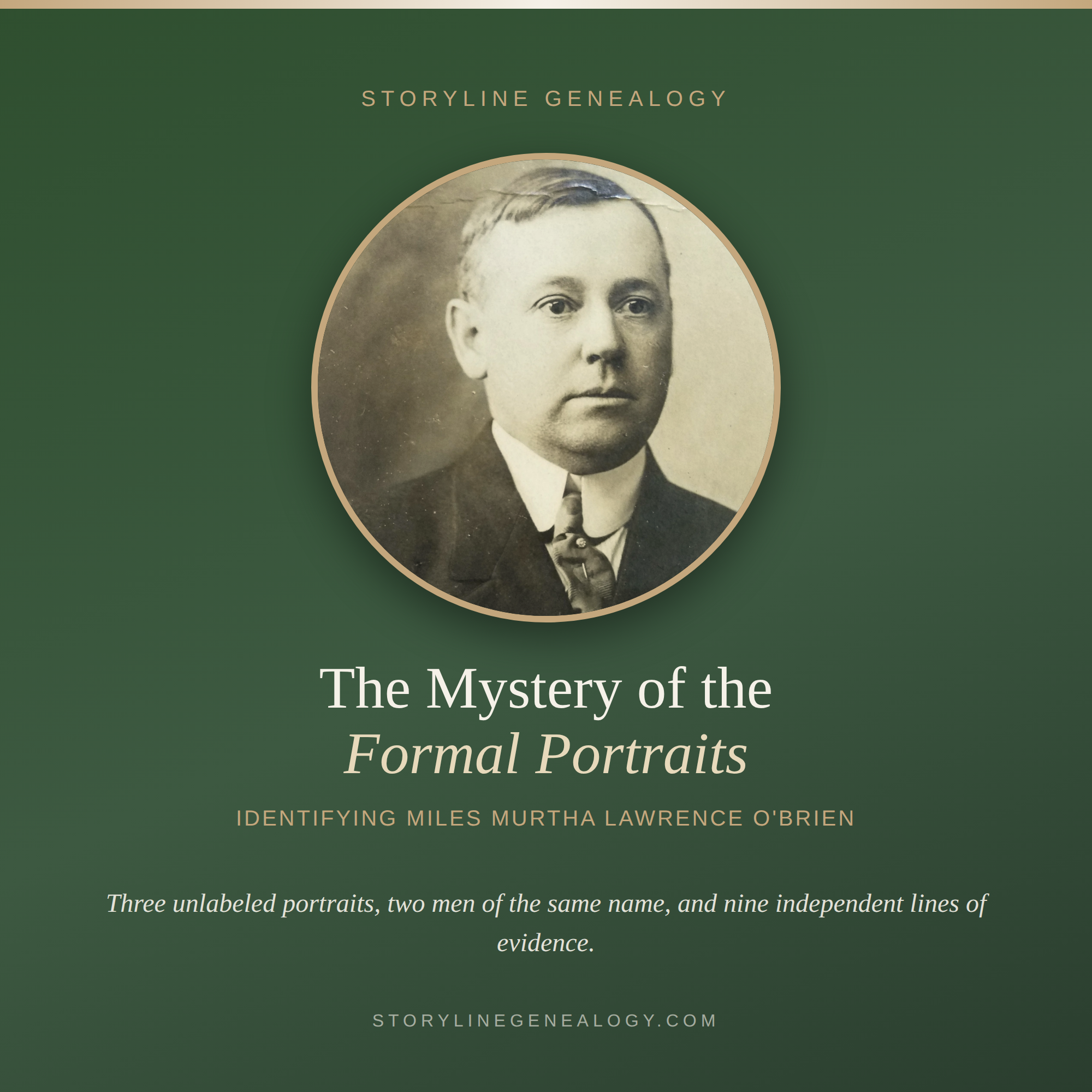
The Mystery of the Formal Portraits
When three generations share the same name, how do you know which Miles you're looking at? I had three unlabeled formal portraits from the early 1900s and two men named "Miles M. O'Brien" living in Brooklyn during the same era—a grandfather and his son. The only clue was a severely degraded photo with faint handwriting: "Dad's Father - Died 1930."
This is the story of how I identified Miles Murtha Lawrence O'Brien through fashion dating, WWI draft card records, and the convergence of nine independent lines of evidence. It's also the story of a Brooklyn Irish-American family that rose from immigrant roots to prominence—one man a US Congressman, another a skilled scale maker working for his half-brother's business.
When photographs outlive memory, detective work brings our ancestors back. Join me as I solve a 95-year-old mystery, one clue at a time.
Part of the Storyline Genealogy Series-Uncovering Your Family Story and Preserving Your Legacy
The Damaged Graduation Portrait
You know that box—the one with the damaged photos, cracked and creased and faded, faces that stared death in the face and lived to tell about it. For years I looked at one in particular: a man in graduation robes I first took to be about thirty-nine, with a steady gaze and quiet dignity. The family said it was "Lolo Mamerto," from his graduation, and we long dated it to 1939. But how could we be certain, when the man died fleeing Japanese soldiers in 1942 and so many records were lost? This is the detective work of photo identification—how photographic technology, academic regalia, apparent age, a wartime damage pattern, family memory, and one decisive record reset the date: because a notary had to be a lawyer, his law degree had to predate his 1933 commission, placing the portrait in the early 1930s, about a decade before his death.
Part of the Storyline Genealogy Series: From Research to Story—transforming fragmented memories into complete family narratives

The Tintype in the Box: Photo Mystery
How I identified a nameless 1870s tintype using photo dating, fashion analysis, and family records—and discovered the tragic story of Margaret Mary McKenny.
When photographs outlive memory, detective work brings our ancestors back.
Part of the Storyline Genealogy Series- Uncovering the Stories Behind the Names and Images
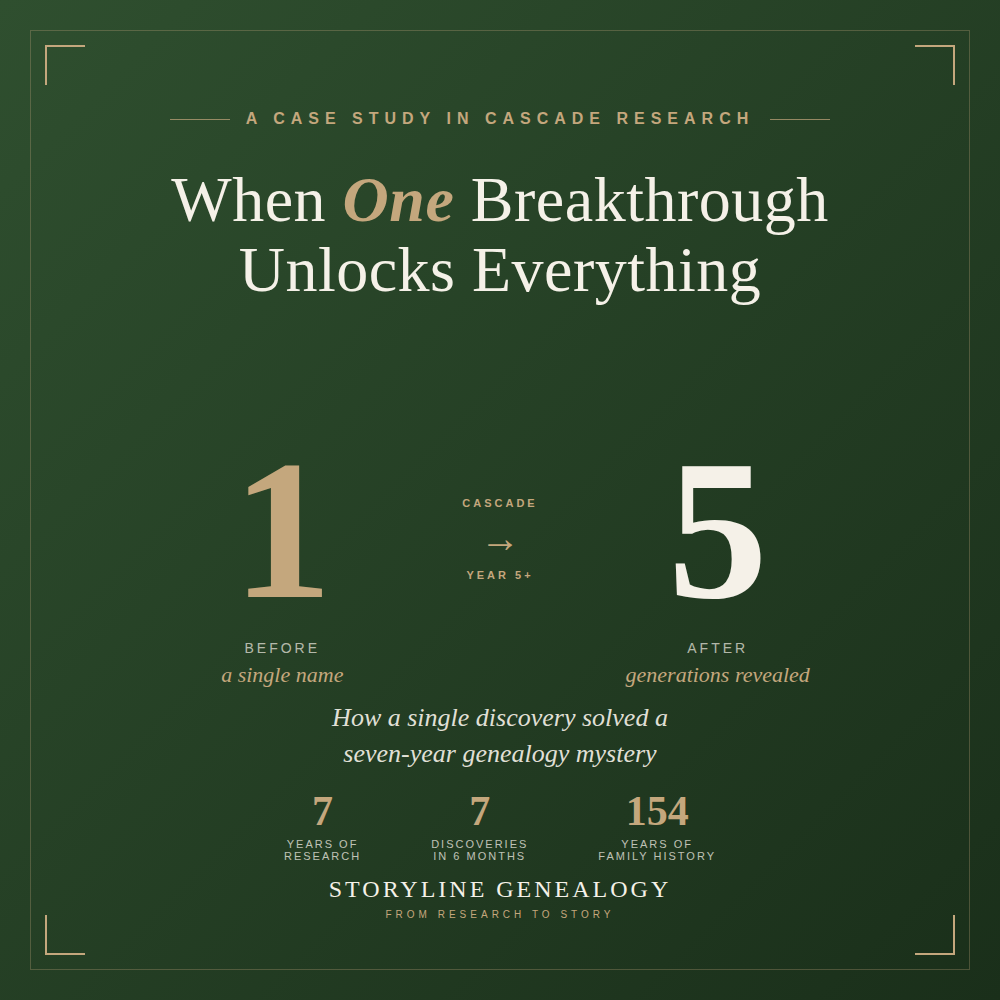
When One Breakthrough Unlocks Everything
The breakthrough came in Year 5. After seven years of searching for John Kenny among dozens of other John Kennys in Brooklyn, the answer appeared when we stopped asking "Which John Kenny?" and started asking "What made THIS John Kenny unique?" That single shift—from name-based searching to occupational tracking—unlocked seven major discoveries in six months and revealed five generations spanning 154 years.
Part of the Storyline Genealogy series: When traditional research methods fail, innovative approaches unlock the impossible cases that define professional genealogy.
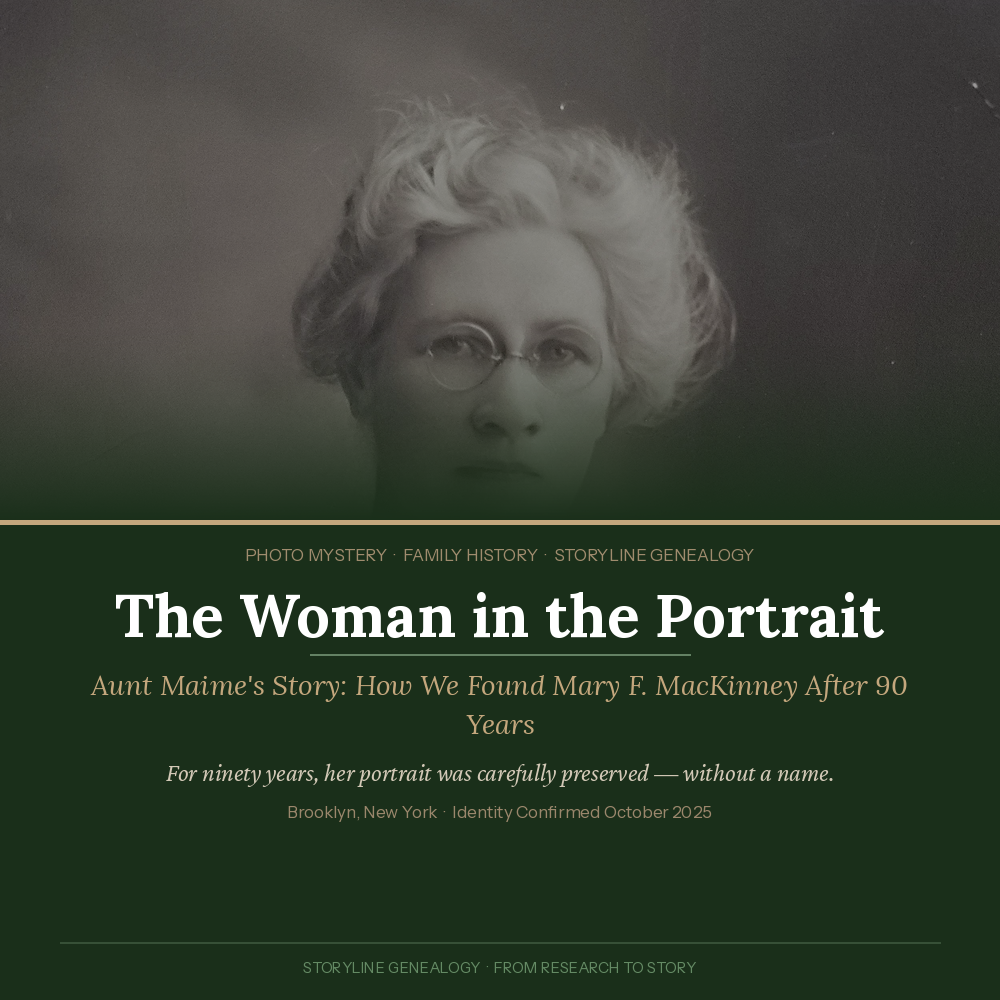
The Woman in the Portrait: Aunt Maime’s Story
For 90 years, her portrait was preserved but unlabeled. Through death certificates, census records, and a 7-year search, we finally discovered Aunt Maime's extraordinary story of sacrifice and survival.
Part of the Storyline Genealogy Series- Uncovering the Stories Behind the Names
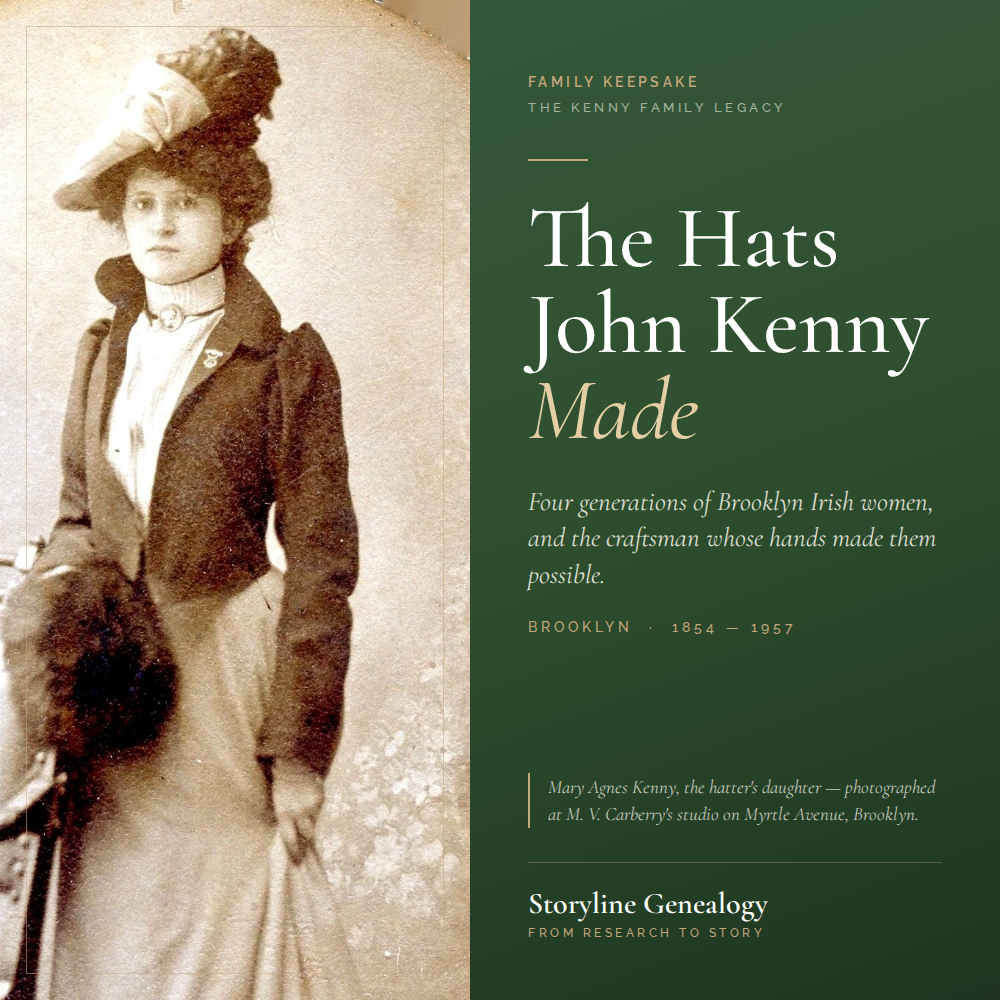
Four Generations in Hats: A Brooklyn Story of Resilience
After seven years of research into Brooklyn's mat maker John Kenny, one discovery changed everything: the hats weren't just about his craft—they were about survival. From 1888 to 1957, four generations of Kenny women wore elaborate hats in family photographs. Each hat told a story: Mary Agnes Kenny, circa 1900, twelve years after her father's death. Lillian and Helen as toddlers in luxury millinery. Lillian's timeless taupe hat at her daughter's 1957 wedding—so stylish it would turn heads 61 years later. But the real story wasn't the hats themselves. It was the network of devoted women—Aunt Maime, Aunt Lillian, grandmother Ann—who kept the family together through impossible tragedy. John Kenny's craftsmanship created more than fashion. It created a legacy that four generations of women would carry forward with dignity, resilience, and style.
Part of the Storyline Genealogy series: When one craftsman's legacy becomes four generations of resilience—the stories objects can tell.
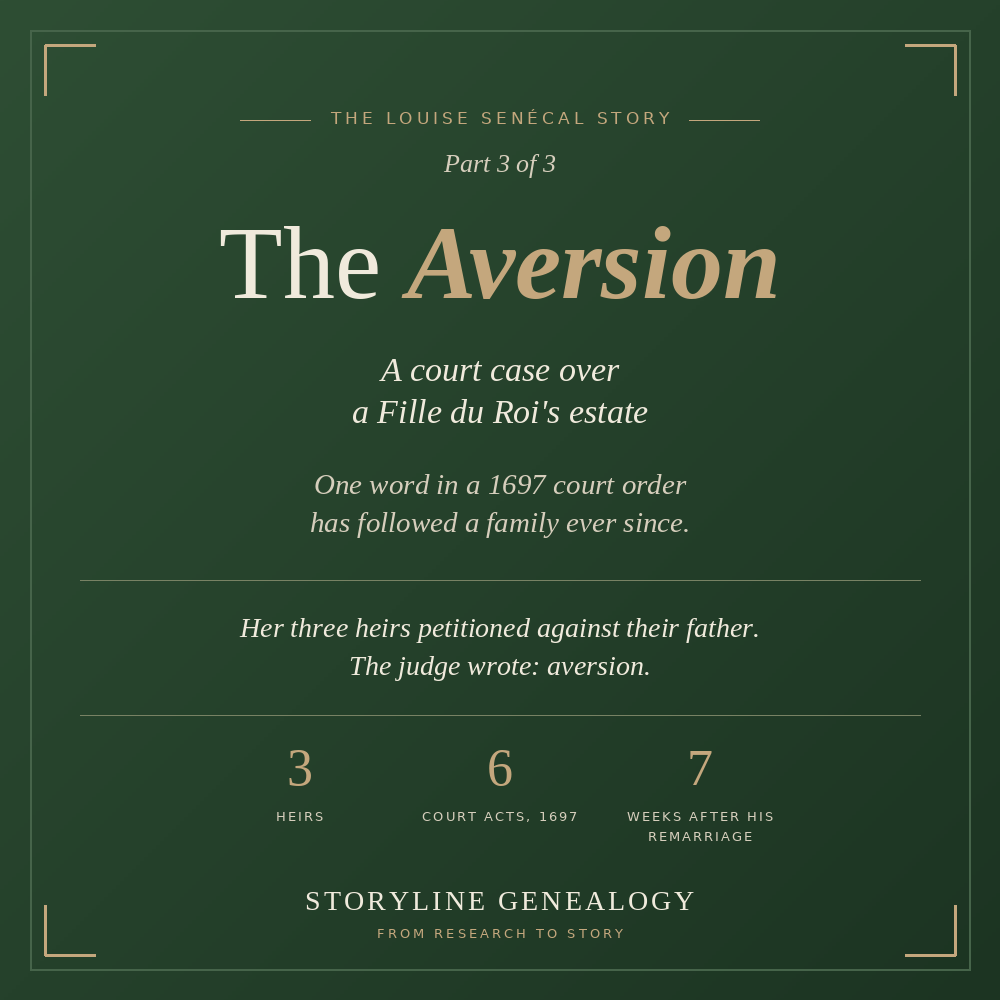
The Aversion: A Family War Over a Fille du Roi's Estate
Louise Senécal crossed from Rouen to New France, married Pierre Guilbault in 1667, and died before April 1693. Four years later her three heirs took their father before the seigneurial court of Notre-Dame-des-Anges — seven weeks after his second wedding — and the judge wrote a single word into his order: aversion. Part 3 of The Louise Senécal Story, told from the court file itself.
Part of the Storyline Genealogy series: Uncovering the extraordinary stories hidden in ordinary family histories, one ancestor at a time.
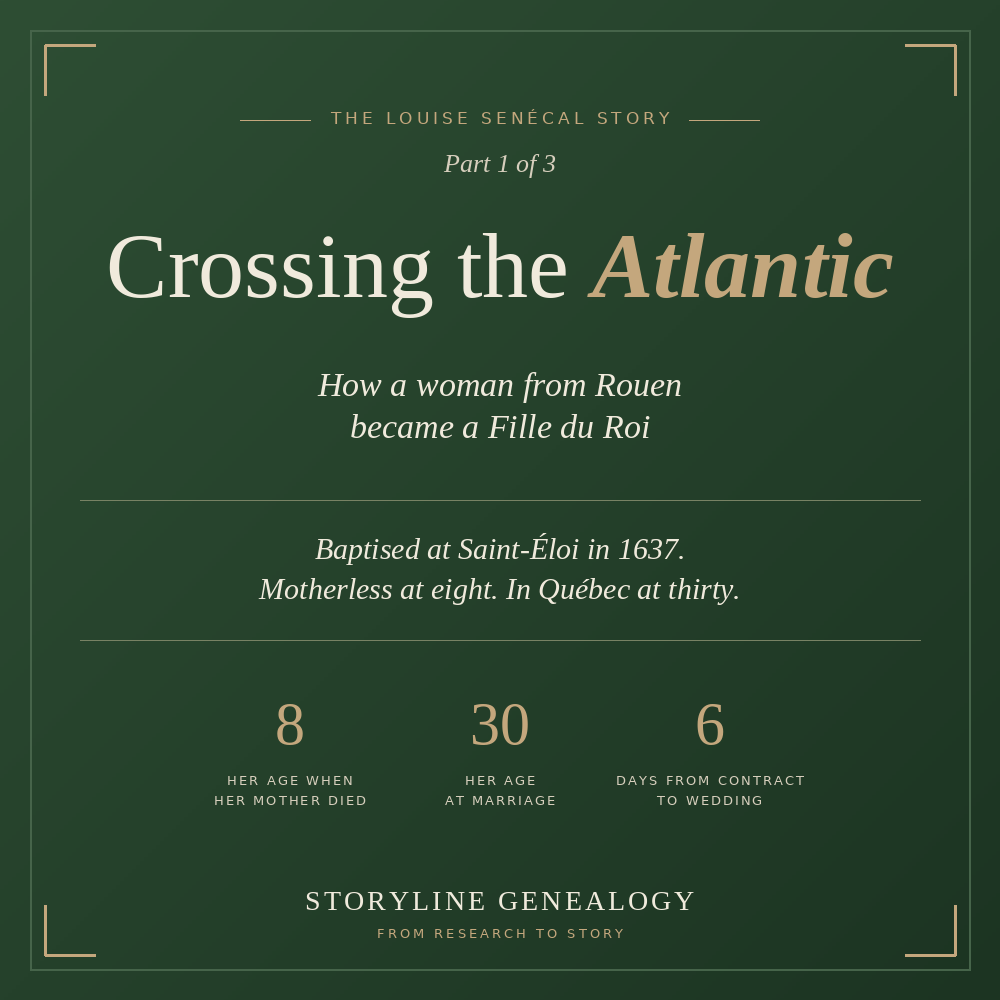
Crossing the Atlantic
Louise Senécal was baptised at Saint-Éloi in Rouen in 1637 and lost her mother at eight. Thirty years later she stood in a Québec notary's study beside Pierre Guilbault, a habitant of Charlesbourg who had twice contracted to marry before — and neither of them could sign. Part 1 of The Louise Senécal Story follows the records from Rouen to the wedding at Notre-Dame-de-Québec, and says plainly where they stop.
Part of the Storyline Genealogy series: Uncovering the extraordinary stories hidden in ordinary family histories, one ancestor at a time.
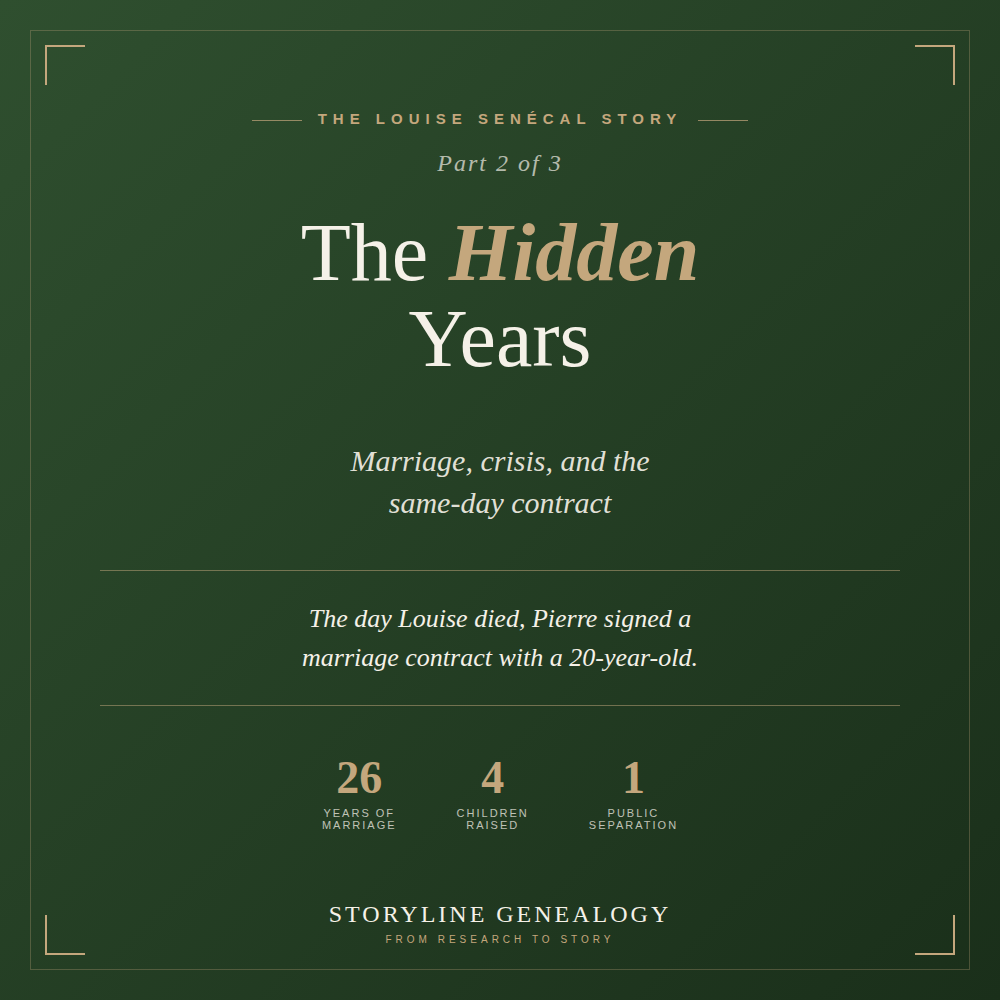
The Hidden Years
Pierre Guilbault appeared before a notary on April 13, 1693, to sign a marriage contract with 20-year-old Jeanne Morin. It was the same day his wife Louise died. The shocking timing—documented in colonial records—reveals the tensions that had been building in a marriage that survived separation, reconciliation, and 26 years of frontier life, only to end in a family war over Louise's estate.
Part of the Storyline Genealogy series: Uncovering the extraordinary stories hidden in ordinary family histories, one ancestor at a time.
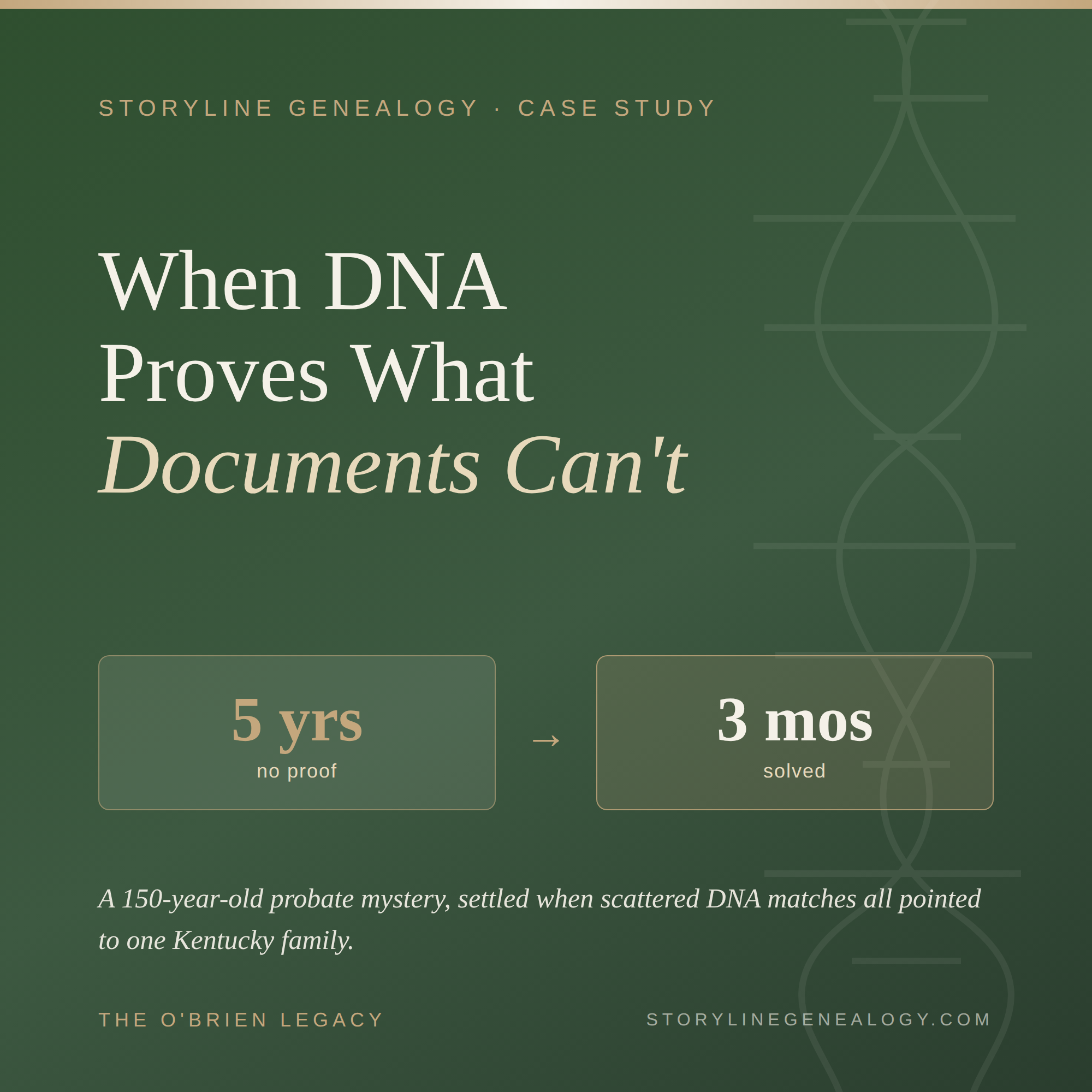
When DNA Proves What Documents Can’t
After five years of research found no proof, DNA testing solved a 150-year-old mystery in three months. The breakthrough came when seemingly unrelated matches all pointed to the same Kentucky family.
Part of the Storyline Genealogy series: How DNA testing solved a brother relationship that five years of traditional research couldn't confirm
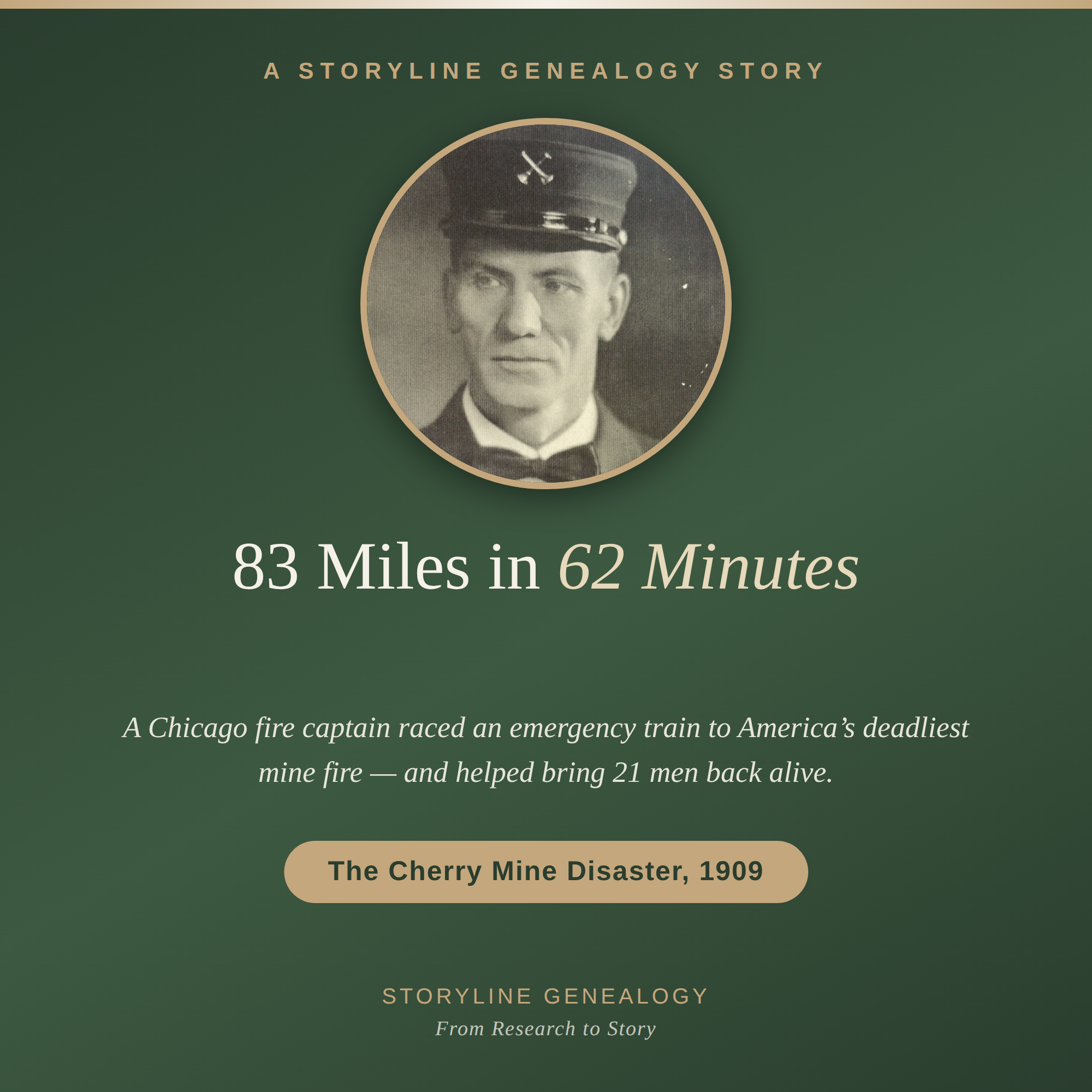
Hero in the Depths: Cherry Mine Disaster
In November 1909, Captain Thomas P. Kenny of the Chicago Fire Department received an urgent call that would define his 44-year career. Racing 83 miles by emergency train in just 62 minutes, Kenny and his specialized crew arrived at the Cherry Mine disaster - America's deadliest mine fire. His technical expertise in fighting underground blazes helped create the conditions that enabled one of the most miraculous rescues in industrial history: 21 miners found alive after eight days entombed underground.
Part of the Storyline Genealogy series: Uncovering the extraordinary stories hidden in ordinary family histories, one ancestor at a time.

The Missing Brother Mystery
Sometimes the most puzzling genealogical mysteries hide in plain sight. One census entry proved particularly haunting: 'Thornton Hammil' listed as Owen Hamall's brother in 1880 Chicago—but no such person seemed to exist anywhere else in the historical record. The breakthrough came where it often does in immigrant family research: in the margins of church records, where community relationships revealed themselves through acts of faith and mutual support.
Part of the Storyline Genealogy series: When mysterious census entries unlock complex family stories that span continents and generations
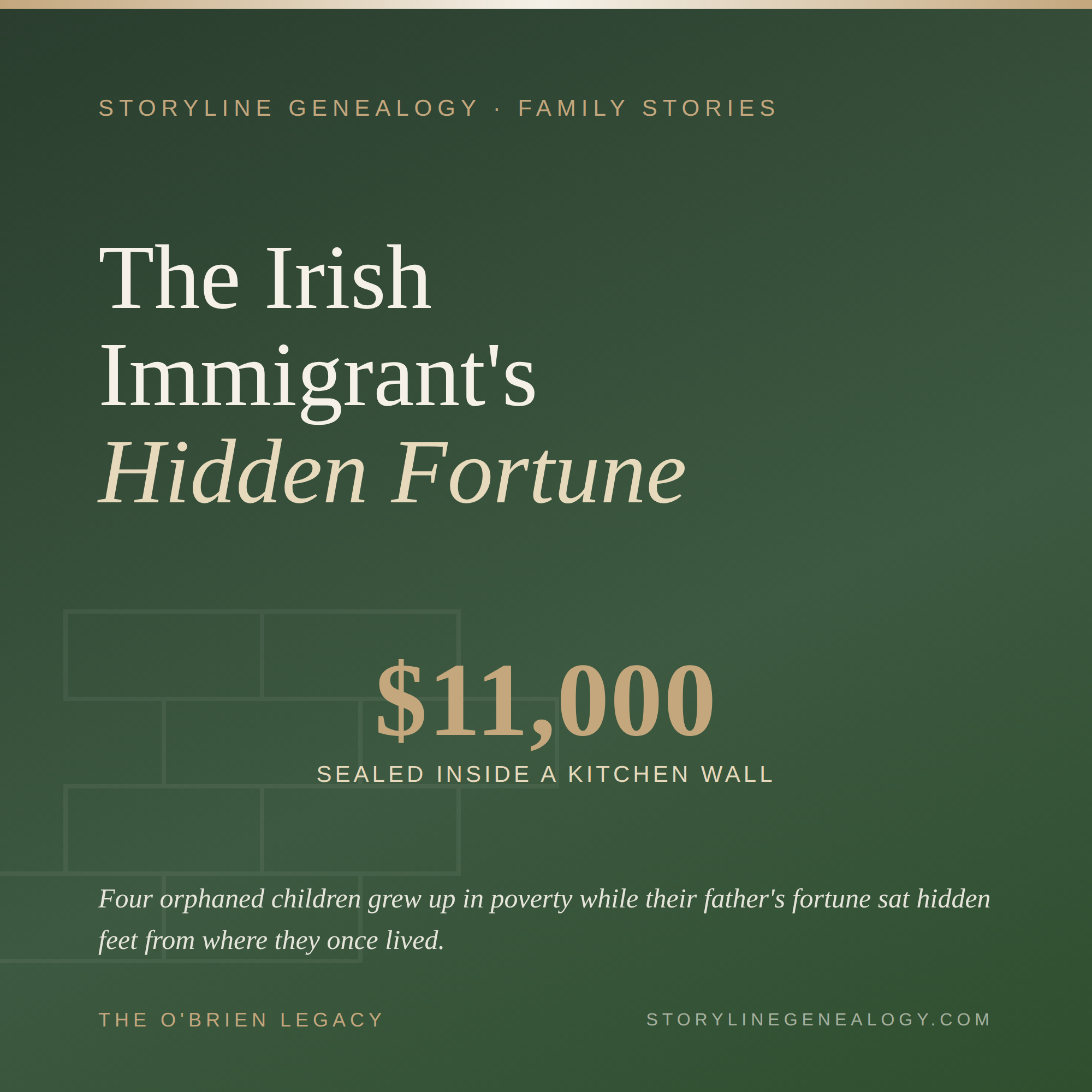
The Irish Immigrant’s Hidden Fortune
When I first began researching my own O'Brien family line, I expected the usual Irish immigrant story: poverty, hard work, gradual success. What I discovered was far more extraordinary—a tale of innovative marketing, federal criminal prosecution, and a cruel twist of fate that left four orphaned children impoverished while a fortune worth $250,000 in today's money sat hidden in the walls of their former home.
Part of the Storyline Genealogy series: Uncovering the extraordinary stories hidden in ordinary family histories, one ancestor at a time.
The Fire in Your Blood
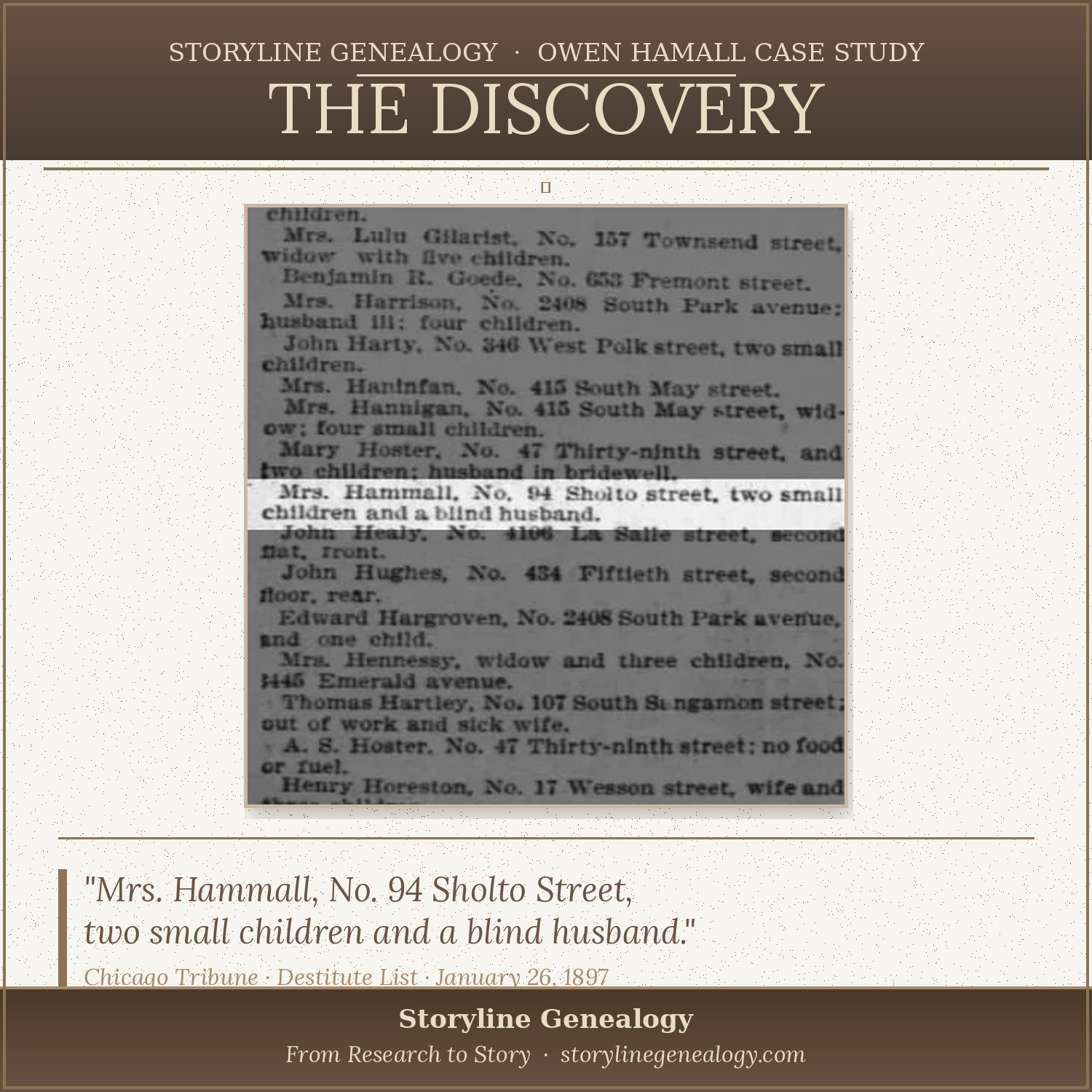
When Owen Hamall died of meningitis in 1898, he left behind more than just a grieving family—he left behind a story of resilience that would echo through generations. This story was discovered not through grand family legends, but through a single newspaper clipping that reduced his family's struggle to twenty-three stark words: "Mrs. Hammall, 94 Sholto Street, two small children and a blind husband."
This entry in the Chicago Tribune's "Destitute List" from January 26, 1897, could have been just another piece of historical data. Instead, it became the foundation for understanding what it truly meant to be a Hamall descendant—and why some family stories deserve to be told as letters of strength to future generations.
Part of the Storyline Genealogy series: When family tragedies become letters of strength to future generations.
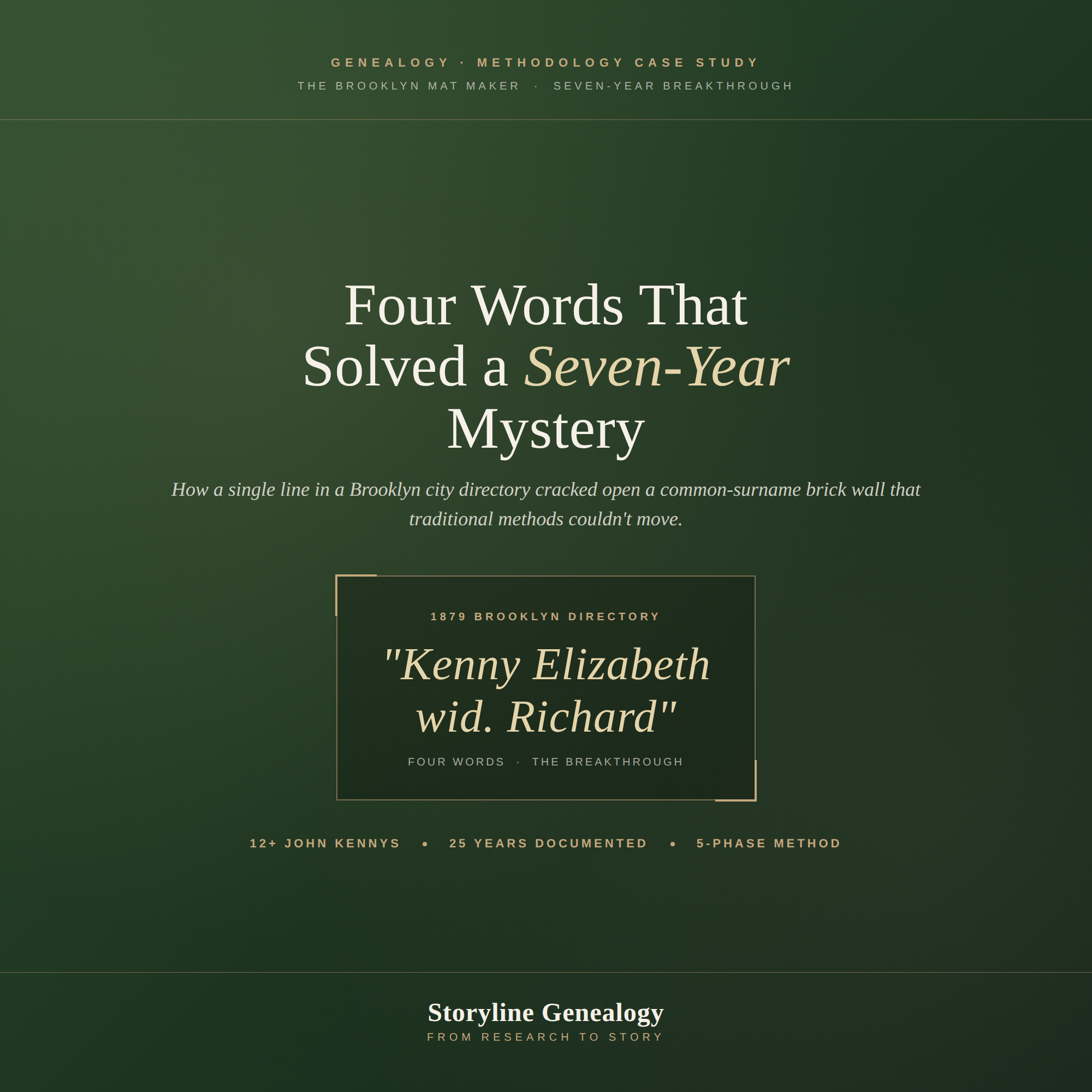
Four Words That Solved a Mystery
After seven years of failed research attempts with dozens of John Kennys in Brooklyn records, a single city directory entry changed everything. Discover how 'Kenny, Elizabeth, wid. Richard' unlocked an impossible genealogical puzzle and revealed an innovative research methodology.
Part of the Storyline Genealogy series: When traditional research methods fail, innovative approaches unlock the impossible cases that define professional genealogy.
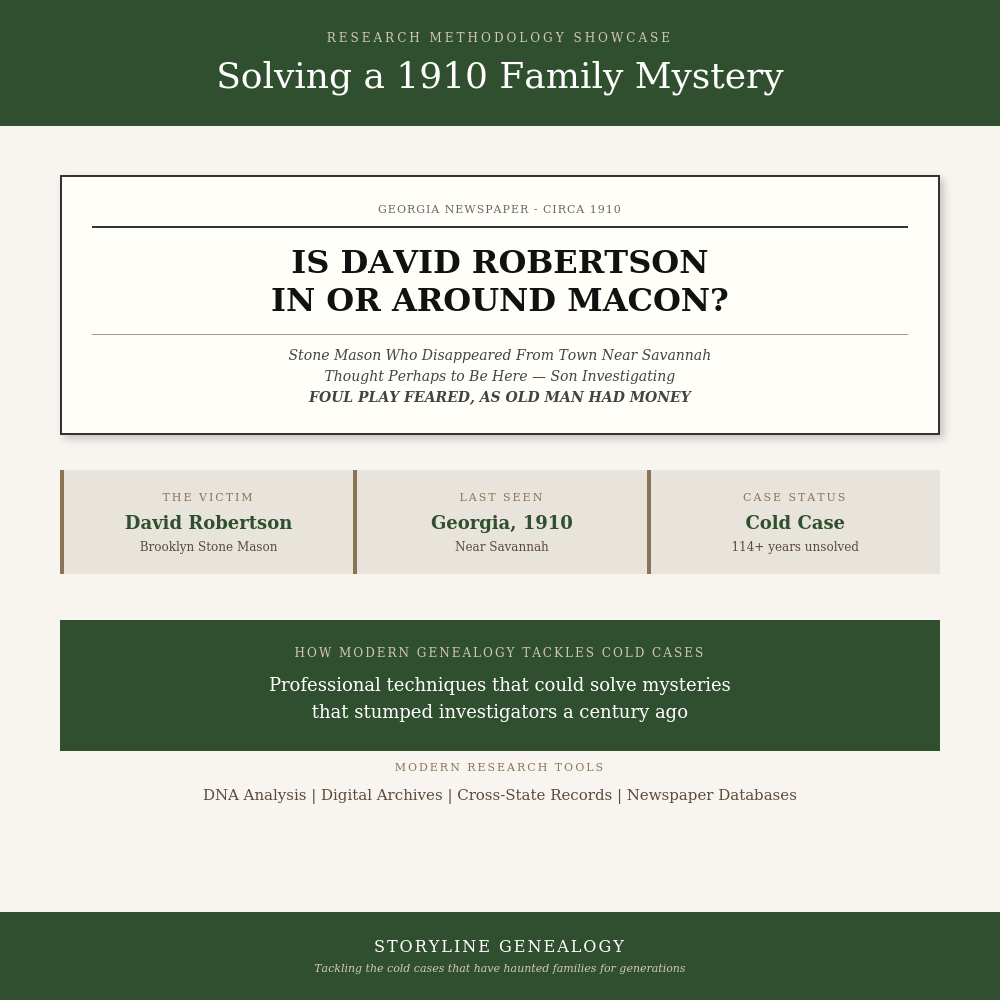
The Stone Cutter Who Vanished in Georgia
A Brooklyn stone mason vanished in Georgia in 1910, sparking a cross-state search by his devoted son. This cold case illustrates how modern DNA analysis, digital archives, and professional genealogy techniques could solve family mysteries that stumped investigators over a century ago.
Part of the Storyline Genealogy series: When professional research tackles the cold cases that have haunted families for generations.
Hidden in Plain Sight: Philippine Research Barriers
Have you ever hit a brick wall researching your Filipino heritage? For years, the Tamayo family of Aklan was a classic dead end—a marriage, an immigration trail to the United States, and almost nothing else. Then, in 2024, FamilySearch launched Full Text Search, a tool that reads the actual text inside digitized documents rather than just indexed names. A single query—"Tamayo" + "Aklan, Philippines"—surfaced a multi-generational paper trail that had been invisible for decades: a patriarch's 1936 residence certificate, the 1938 deeds that settled his estate and named his widow and children, and the property his son and daughter-in-law accumulated into the 1960s. This is how modern technology is making "impossible" Philippine genealogy possible.
Part of the Storyline Genealogy series: From Aklan to America | From Research to Story