
The Fire in Your Blood
Narrative Transformation:
"The Fire in Your Blood"
How twenty-three words in a Chicago newspaper became a legacy letter — and a template for professional genealogical storytelling
Twenty-Three Words. One Family's Entire Story.
Traditional genealogy might have stopped at the facts: Owen Hamall, born 1847 in County Monaghan, Ireland. Arrived in America during the Great Famine. Worked as an iron molder in Chicago. Died of meningitis, 1898.
But one entry in the Chicago Tribune's "Destitute List," dated January 26, 1897, transformed those facts into something far more profound. Among the hundreds of families appealing to police for emergency aid, a single line described the Hamall household:
Mrs. Hammall, No. 94 Sholto Street, two small children and a blind husband.
Chicago Tribune · Destitute List · January 26, 1897
Twenty-three words. A skilled ironworker who had survived the Famine, crossed an ocean, and spent thirty years feeding molten metal in Chicago's foundries — reduced to a public charity list, blind, with two small children depending on his wife Kate's determination to keep the family together.
This single document became the foundation for "The Fire in Your Blood" — a letter imagined from Owen to his descendants, transforming his documented struggles into a living legacy of resilience.
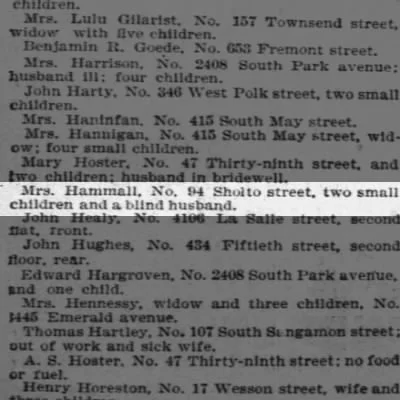
Chicago Tribune, January 26, 1897. The Hammall household appears in the police-reported Destitute List — one of hundreds of families appealing for emergency aid during a brutal Chicago winter.
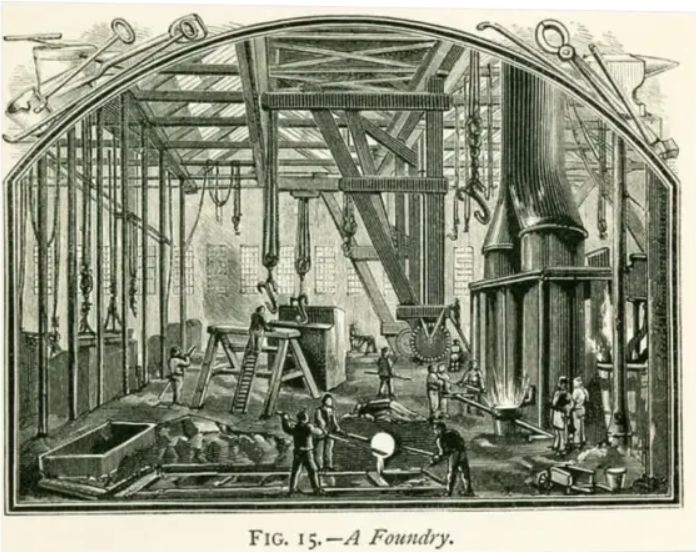
A typical 1870s iron foundry. Owen Hamall worked as an iron molder in Chicago's industrial district for decades — skilled, dangerous, and physically demanding work that likely contributed to his eventual blindness.
The Man Behind the Record: Iron Molder, Famine Survivor, Father
Iron molding in Chicago's foundries was brutal, skilled work. Men like Owen spent their days surrounded by superheated metal, sand molds, and choking fumes. The physical toll over decades was profound — eye damage from flying sparks and radiant heat was an occupational reality.
That Owen appears as "blind" by 1897 in the Destitute List, after thirty years in the foundries, places his disability in devastating historical context. This was not abstract suffering — it was the documented cost of building industrial Chicago.
Understanding this context transforms genealogical data into lived human experience. The research doesn't just document what happened to Owen Hamall. It reveals why — and makes his story resonate with descendants across generations.
From Destitute List to Death Certificate: The Complete Arc
Owen Hamall died of meningitis on July 6, 1898 — just eighteen months after his family appeared on the Destitute List. His grave at Calvary Cemetery carries no inscription visible today, a quiet echo of the hardship that defined his final years.
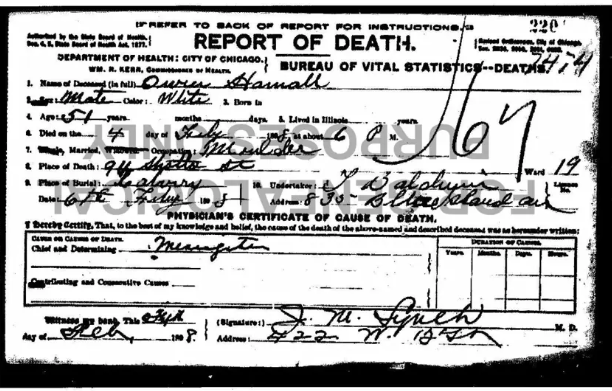
Owen Hamall's Report of Death documents meningitis as the cause of death on July 6, 1898 — eighteen months after his family's desperate appearance in the Tribune's Destitute List. He was 51 years old. His wife Kate had only two surviving children: Thomas Henry, age 18, and Mary, age 13.

Calvary Cemetery, Chicago. The grave marker stands today, weathered and largely unreadable — a physical monument to a man who crossed an ocean, built a life in America's industrial heartland, and whose story endures in the DNA and family memory of his descendants.
The Letter He Never Had the Chance to Write
"The Fire in Your Blood" imagines Owen speaking directly to his descendants — not as a historical figure frozen in records, but as a great-great-grandfather who wants his family to understand what they have inherited from him.
You come from people who understand that sometimes the world takes everything from you — your homeland, your children, your sight, your ability to provide. And still, you get up. Still, you find a way to face the next day.
That is not weakness. That is the Hamall way. It has always been the Hamall way — from the rocky fields of Donaghmoyne to the foundry floors of Chicago. When you face your own impossible moments, remember: you carry the same fire in your blood.
— Imagined from Owen Hamall, County Monaghan 1847 · Chicago 1898
When Research Becomes Legacy: The Framework
This narrative transformation follows a defined methodology that can be applied to any well-documented family history case. Here is how the research behind Owen's story was structured — and the five core components that made it work.
Ideal Candidates for This Approach
Multi-generational immigrant families with gaps in documentation — where detective work reconstructs the human experience behind the records
Common surnames requiring unique identifier strategies — where occupational tracking, geographic clustering, and DNA all converge
Families with migration across multiple jurisdictions — Ireland to Montreal to Chicago — where each archive adds a new dimension
Cases where traditional genealogy has reached dead ends — and narrative transformation creates meaning from what is known
Clients seeking narrative legacy creation beyond basic family trees — who want their ancestors to speak across generations
Systematic Source Categorization by Jurisdiction & Time Period
Every document is catalogued by jurisdiction — Irish civil and church records, Montreal Catholic registers, Chicago city directories, Illinois vital statistics — enabling coherent cross-border narrative construction.
Evidence Quality Assessment for Each Document Type
BCG-standard evaluation distinguishes original vs. derivative sources and direct vs. indirect evidence. The Destitute List clipping, for example, is both a primary source and an indirect evidence item that required corroboration.
Timeline Correlation Across Multiple Record Systems
The 1897 Destitute List, death certificate, census records, and city directories are mapped into a single chronological framework, revealing the precise arc of Owen's final years with documentary precision.
Network Analysis to Identify Family Associates & Community Connections
The reciprocal baptismal sponsorship between Owen and William Thornton in 1883 — proof of their half-brother relationship — emerged only through systematic network analysis of Chicago Catholic parish records.
Narrative Integration to Create Meaningful Family Legacy
Documented facts about foundry conditions, immigrant poverty, and 1890s Chicago are woven into the narrative — grounding Owen's imagined letter in historical accuracy while making his experience immediate and resonant.
Explore the Complete Owen Hamall Case Study
Seven years of research, three countries, and a family mystery solved
Read "The Fire in Your Blood" Family Narrative
See how this genealogical research transformed into an inspiring family legacy story
Read the Narrative →Read "The Missing Brother Mystery"
When mysterious census entries unlock complex family stories that span continents and generations
Explore the Mystery →View Our Professional Services
Comprehensive genealogical research and narrative storytelling for your family
Learn More →Begin Your Research Inquiry
I'll respond within five business days with a written preliminary assessment
Contact →Explore the Complete Owen Hamall Case Study
This story is part of a comprehensive BCG-compliant case study with methodology, evidence analysis, document gallery, and timeline.
View Complete Case Study →Want to see what happened next? Explore the Three Thomas Hamalls case study—the three generations that followed Owen's son Thomas Henry.
