
Four Generations in Hats: A Brooklyn Story of Resilience
The Hats John Kenny Made
How one Irish immigrant's craftsmanship created a legacy of female resilience that sustained four generations across sixty-nine years of triumph and tragedy.
In the decades following the Great Famine, Brooklyn became a thriving hub for Irish immigrant craftsmen in the textile trades. The neighborhood's proximity to Manhattan's wholesale district, combined with waterfront access for imported materials, created ideal conditions for skilled workers to advance from basic textile work into specialized crafts.
The progression from mat weaving to hat making represented more than occupational advancement — it symbolized the American dream in action. Mat weavers worked with coarse materials, producing utilitarian floor coverings. Hatters, by contrast, were skilled artisans who shaped fine felt and straw into fashion items that signaled social status. The journey from one to the other required years of skill development, access to better materials, and integration into professional networks.
This specific progression — documented across multiple city directories and census records — became the key identifier that distinguished John Kenny from dozens of other Irish immigrants with the same name living in Brooklyn during the same period. But the true significance of his craft would only become apparent in the decades after his death.
after John's death
(1888 — 1957)
by one craftsman's
legacy
to raising her sister's children
and grandchildren (1888 — 1935)
The Tragedies That Made the Legacy
Margaret Kenny Dies of Tuberculosis
On May 24, 1884, Margaret McKenny Kenny died at age thirty-three of pulmonary consumption at 39 Nostrand Avenue, Brooklyn. She left behind her husband John and three daughters: Elizabeth, age five; Mary Agnes, age one; and infant Margaret Mary, about three months old.
Seven weeks later, on July 12, 1884, baby Margaret Mary died of cholera infantum at 39 Sandford Street. John was now a widower with two surviving daughters. Both grandmothers — Eliza Kenny, John's mother, and Ann Lynch MacKinney, Margaret's mother — helped support the family.
In the 1880s, tuberculosis was the leading cause of death in America, and cholera infantum killed thousands of babies each summer in crowded urban tenements. The Kenny family tragedy was, heartbreakingly, commonplace among Irish immigrants in Brooklyn.
John Kenny Raises His Daughters
For four years, John Kenny continued working as a hatter while raising Elizabeth and Mary Agnes with help from both grandmothers. City directories track his progression from matmaker to hatter during this period — evidence of continued skill development even while managing single parenthood in an era with no support systems for widowed fathers.
Then the losses accelerated. In 1887, his mother Eliza Kenny died. On May 10, 1888, his mother-in-law Ann Lynch MacKinney died at age sixty-six. John had now lost his wife, infant daughter, mother, and mother-in-law within four years.
John Kenny Dies; His Daughters Left Alone
On November 30, 1888 — just six months after losing his mother-in-law — John Kenny died at approximately age thirty-six. His death certificate listed his occupation as "Hatter," representing the culmination of nearly two decades of skill development from mat weaver to master craftsman.
Elizabeth, age nine, and Mary Agnes, age five, were now completely orphaned. Both parents dead, both grandmothers dead. The only family member left was their aunt, Mary F. "Maime" MacKinney, who herself had just lost her mother six months earlier.
The Kenny family lost five people: Margaret, baby Margaret, Eliza, Ann, and John. Two little girls faced complete orphanhood with no living parents, no living grandparents, and uncertain futures in an era when orphanages were the typical solution. This is where Aunt Maime's extraordinary devotion begins.
Aunt Maime Raises Her Sister's Daughters
Mary F. "Aunt Maime" MacKinney — unmarried and living in Brooklyn — took in her orphaned nieces and raised them for the next thirty-two years. Both girls remained in her household through their childhoods, teenage years, and into adulthood. Elizabeth did not marry until age forty-one in 1920, still living with Aunt Maime at the time of her wedding.
This wasn't charity — it was the Irish immigrant survival strategy that kept families together through impossible circumstances. Aunt Maime's devotion would span forty-seven years, eventually extending to her great-nieces and great-nephews.
The Inheritance, in Photographs
Mary Agnes Kenny — The Hatter's Daughter

Mary Agnes Kenny, circa 1900, photographed at M. V. Carberry's studio, Myrtle Avenue, Brooklyn. Twelve years after her father's death, John Kenny's younger daughter wears an elaborate feathered hat with a large ostrich plume — expensive even by middle-class standards.
A studio portrait captures Mary Agnes Kenny at about seventeen, wearing an elaborate hat with a large plume. The card is imprinted with the name of photographer M. V. Carberry of Myrtle Avenue, Brooklyn; Maurice V. Carberry appears as a photographer on Myrtle Avenue in the 1900 Brooklyn city directory, and her clothing (a pompadour under the hat, a high collar with brooch, a short fitted jacket, a fur muff and a long flared skirt) fits the same years. The quality and style of the hat — expensive even by middle-class standards — suggests either family creation using her father's professional network, or prosperity sufficient to purchase luxury millinery.
Twelve years after John Kenny's death, his daughter wears a hat that represents everything he worked toward: skill, status, and beauty. This photograph is visual proof that his craftsmanship created lasting value for his children.
John Kenny's Granddaughters
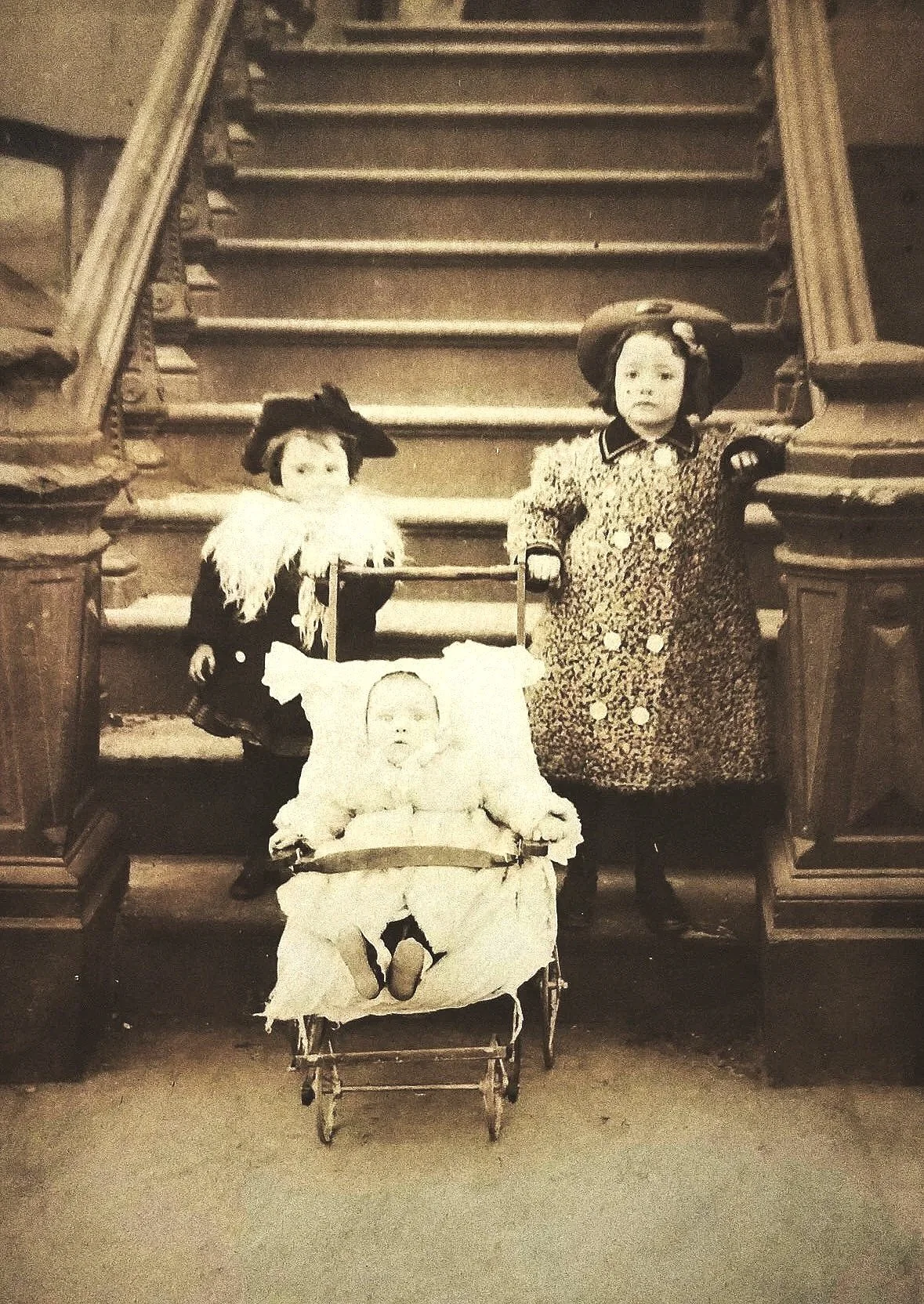
Lillian Robertson (left, age three), Helen Gladys (in ornate carriage, age one), and a Robertson cousin (right). Twenty-one years after John Kenny's death, his granddaughters are photographed in luxury millinery.
A professional studio photograph shows three young girls: Lillian Robertson, age three; her sister Helen Gladys, age one, in an ornate baby carriage; and a Robertson cousin. All three wear expensive hats and clothing. The elaborate feathered hats, white fur accessories, and professional photography session represent significant family investment.
Twenty-one years after John Kenny's death, his granddaughters are photographed in luxury that would have been unimaginable to an Irish mat weaver in the 1870s. The hats they wear symbolize three generations of advancement — from survival to prosperity.
Mary Agnes and Joseph Robertson Die
Within two weeks of each other, both Mary Agnes Kenny Robertson and her husband Joseph died, leaving three children: Lillian, age eighteen; Helen, age sixteen; and Joseph, age four. Once again, the female survival network activated.
Lillian, barely an adult, became guardian to her younger siblings. Supporting her were both aunts: Mary F. "Aunt Maime" MacKinney — now in her seventies, the woman who had raised Lillian's mother — and Elizabeth "Aunt Lillian" Corbett, Lillian's mother's sister, age forty-five, a WWI Navy Yeomanette.
The female resilience network that saved Mary Agnes and Elizabeth in 1888 now saves their children in 1924. Thirty-six years of mutual support and female devotion keeps the family intact through another devastating loss.
Helen Gladys Robertson
Helen Gladys Robertson, younger daughter of Mary Agnes Kenny Robertson and sister to Lillian — the baby in the ornate carriage in the 1909 photograph above. Orphaned at age sixteen in 1924 when both parents died within two weeks. Raised alongside her siblings by Aunt Maime and Aunt Lillian Corbett. Helen died in 1942, continuing the family's pattern of tragic early losses but having lived to see her family's prosperity and dignity preserved.
Lillian Marries Miles O'Brien
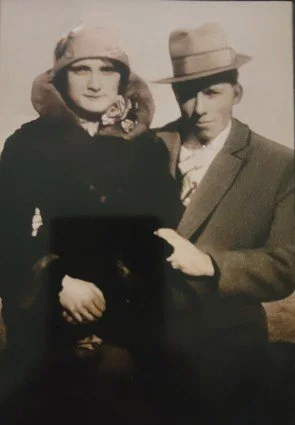
Lillian Josephine Robertson and Miles O'Brien, circa 1930. Married January 28, 1928 — Lillian in a stylish cloche hat and fur-collared coat, Miles in a quality fedora and suit.
On January 28, 1928, Lillian Josephine Robertson married Miles O'Brien. A portrait from approximately 1930 shows the couple well-dressed and prosperous: Lillian in a stylish cloche hat and fur-collared coat, Miles in a quality fedora and suit. The professional studio portrait indicates continued economic stability.
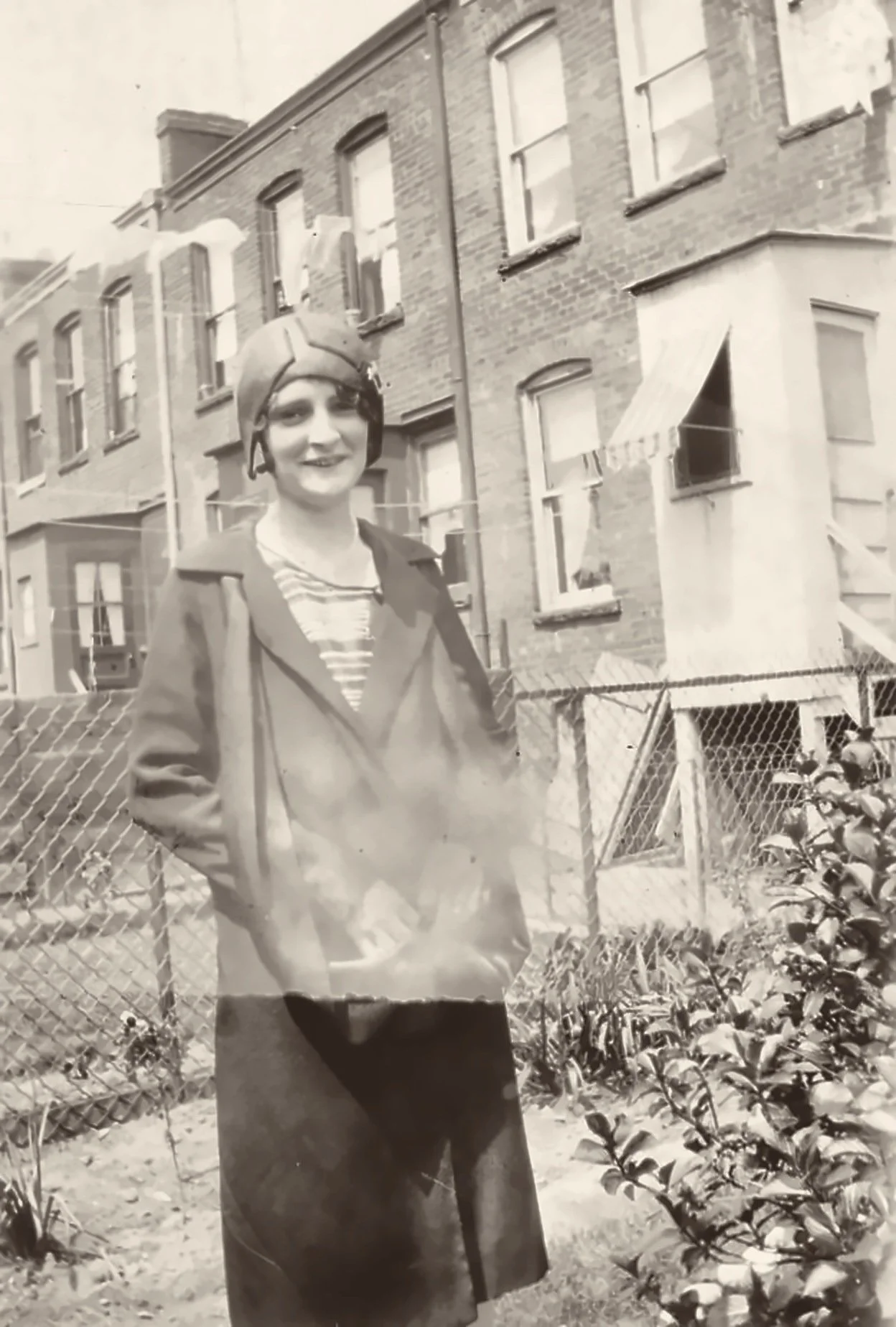
Lillian Robertson O'Brien in a Brooklyn backyard, May 1929. Her brimless, helmet-style cloche is built from shaped panels, with a small ornament at one temple and side pieces curving down over her ears, pulled low over a bobbed cut with curls at the cheek. She wears a long wrap coat over a striped top. Behind her are the backs of brick rowhouses, with laundry on the line and a striped awning. Five years after she was orphaned, she is smiling.
Forty years after John Kenny's death, his granddaughter — orphaned at eighteen, raised by elderly aunts, responsible for younger siblings — achieves the stability and prosperity that her grandfather's craftsmanship made possible.
A Life Built Together
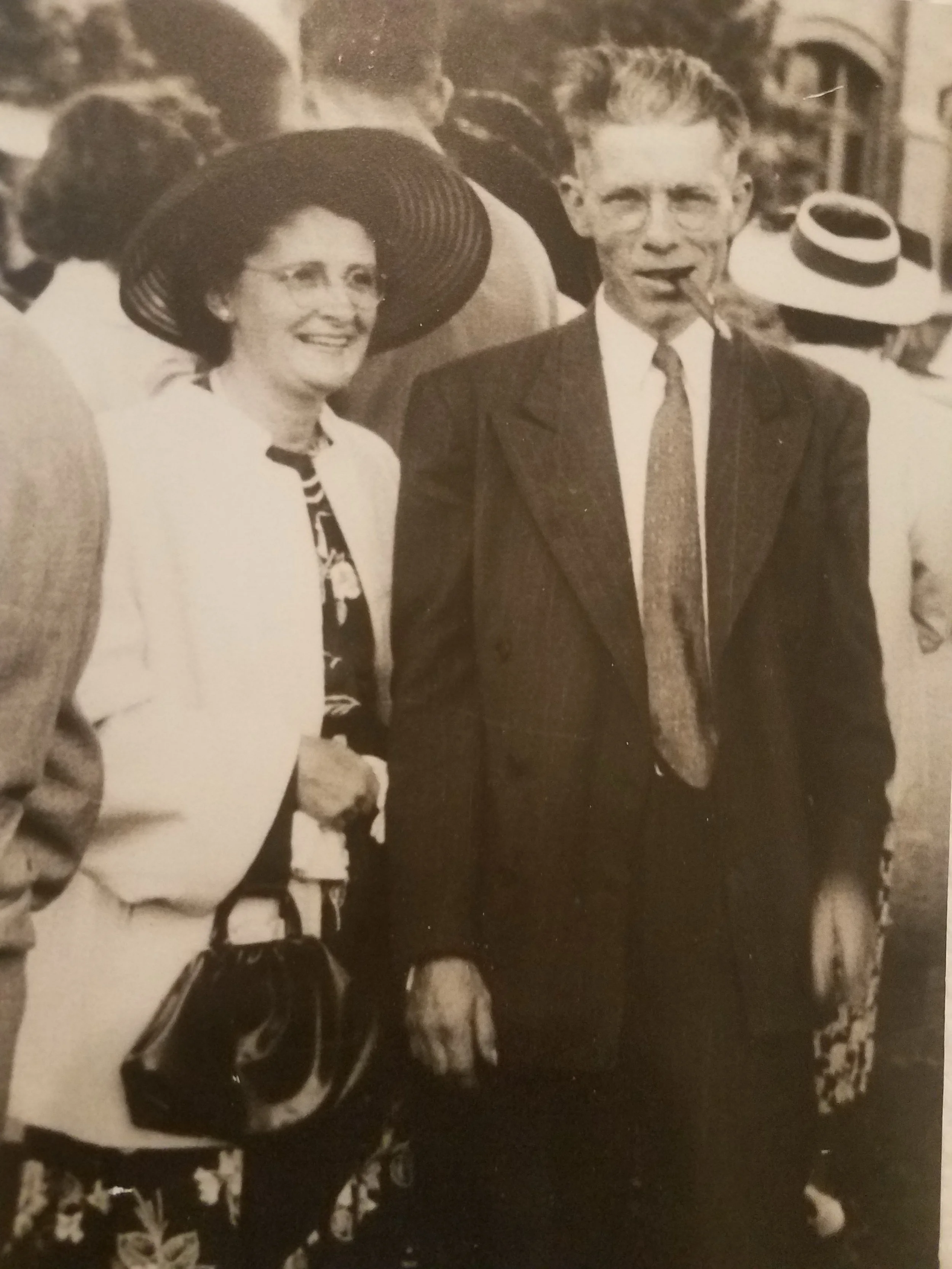
Lillian and Miles O'Brien in their mature years — Lillian in her signature stylish hat. The enduring partnership that sustained them through Depression, war, and family losses.
Lillian and Miles O'Brien in their mature years, showing the enduring partnership that sustained them through Depression, war, and family losses. Both impeccably dressed — Lillian in her signature stylish hat. This couple, who married when Lillian was recovering from the trauma of orphanhood, built a life of stability that John Kenny's craftsmanship made possible decades earlier.
The O'Brien Family — Hats on Every Generation

The O'Brien family, 1942. Lillian and Miles seated in the front row with Helen between them, each parent holding one of the twins — Michael and Miles Jr. — and both little ones in their own stylish hats. In the back row: daughter Jeanne, with ten-year-old Barbara (center) and oldest daughter Lillian (far right), both in stylish hats of their own. Four generations of style, dignity, and resilience.
A family photograph captures multiple generations gathered around a backyard bench: Lillian with her husband Miles in the front row, Helen seated between her parents while each holds one of the twins — Michael and Miles Jr. — both little boys wearing stylish hats of their own. In the back row: daughter Jeanne, and two more stylish hats: ten-year-old Barbara Ann, center, and the oldest daughter, Lillian, far right. All are well-dressed, the home comfortable, the family thriving.
Fifty-four years after John Kenny's death, his great-granddaughter Barbara wears a hat at age ten — the fourth generation to carry forward the legacy of style and dignity that began with a mat weaver in Ward 7 Brooklyn. The tradition continues unbroken from the 1870s to the 1940s, and even the twins in their father's arms are wearing hats.
Helen Gladys O'Brien in Caldwell

Helen Gladys O'Brien with her mother, Lillian Robertson O'Brien, on a backyard bench in Caldwell, New Jersey, April 17, 1947. Laundry on the line, bare spring trees — and Helen in a brimmed hat and buttoned coat. One of the few photographs of Helen that survive.
Five years after the family portrait, Helen Gladys O'Brien sits on a backyard bench in Caldwell, New Jersey, with her mother's arm around her and her mother's hands folded over hers. Helen carries the same two names as her aunt, Helen Gladys Robertson — the girl in the baby carriage in 1909. And like every girl before her in this story, she is wearing a hat.
The Hat That Transcends Time
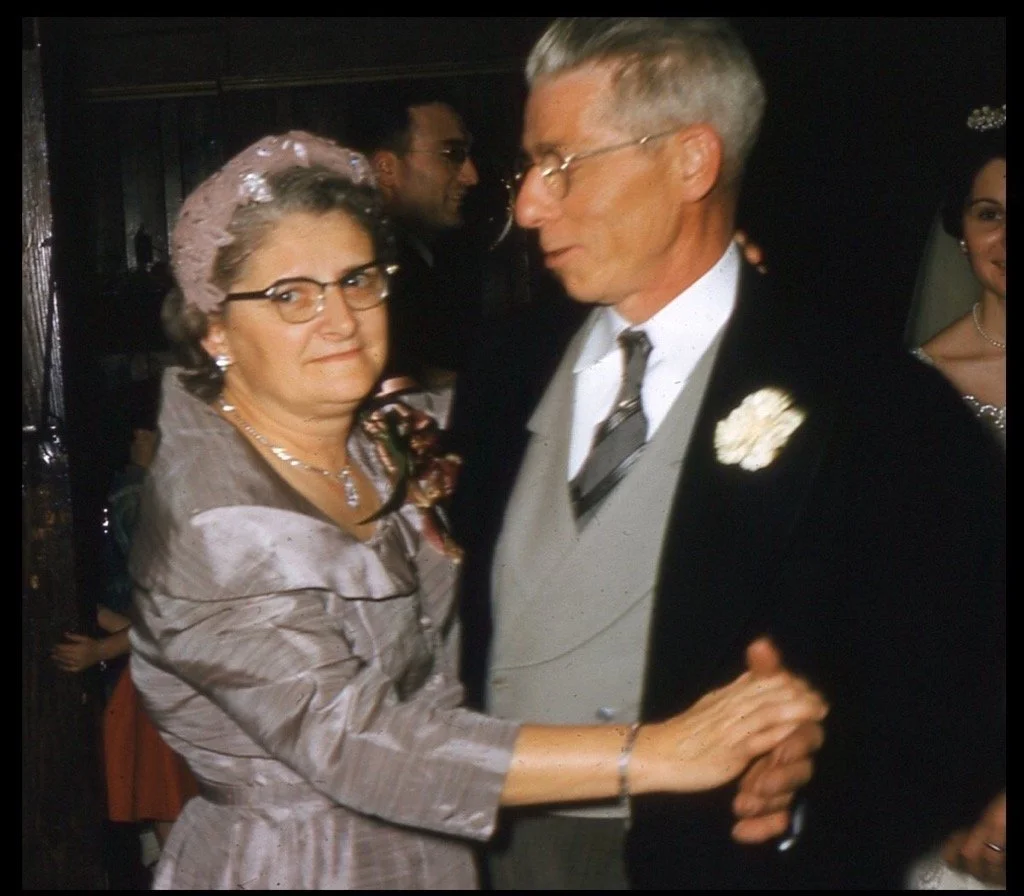
Lillian and Miles O'Brien at daughter Barbara's wedding to Thomas K. Hamall, 1957. Lillian wears a sophisticated taupe hat — so timeless it would still look stylish sixty-one years later when discovered in 2018.
On her daughter Barbara's wedding day to Thomas K. Hamall, Lillian wore a sophisticated taupe hat that would be considered stylish even sixty-one years later when her granddaughter discovered the photograph in 2018. The timeless elegance of that taupe ensemble — modern, refined, impeccably chosen — captures everything the Kenny family legacy represents.
Sixty-nine years after John Kenny died, his granddaughter — orphaned at eighteen, raised by aunts, survivor of Depression and tragedy — stands at her daughter's wedding wearing a hat so stylish it could grace a modern fashion magazine. From mat weaver to master hatter to four generations of women who understood that dignity, beauty, and resilience are inseparable: this is the legacy John Kenny made.
The Female Survival Network
Widowed in 1870 when husband George McKenna died. Mother of Margaret — who married John Kenny — and Mary F. "Maime" MacKinney. Helped care for her orphaned granddaughters after Margaret's death in 1884. Died May 10, 1888, age sixty-six, just six months before John Kenny's death. Her daughter Maime continued her legacy of family devotion.
Unmarried, no children of her own. Took in orphaned nieces Mary Agnes, age five, and Elizabeth, age nine, in 1888 after their father John Kenny died. Raised both girls for thirty-two years until Elizabeth married at forty-one. When Mary Agnes died in 1924, helped raise her orphaned grandchildren. Devoted forty-seven years of her life to her sister Margaret's descendants. Died April 5, 1935.
Orphaned at age nine, raised by Aunt Maime. WWI Navy Yeoman (Female), Brooklyn Navy Yard, 1918. Married John Corbett at age forty-one; no children. When sister Mary Agnes died in 1924, became surrogate mother to orphaned nieces and nephew. Provided stability and family continuity for twenty-six years until her death in 1950. Beloved aunt to Lillian, Helen, and Joseph.
Born in Brooklyn, where her grandfather John Kenny worked. Orphaned at age eighteen when both parents died within two weeks in 1924. Became guardian to sister Helen, sixteen, and brother Joseph, four — supported by Aunt Maime and Aunt Lillian Corbett. Married Miles O'Brien January 28, 1928. Raised her family through the Depression. Carried the family legacy forward to the next generation.
Keeper of the Story
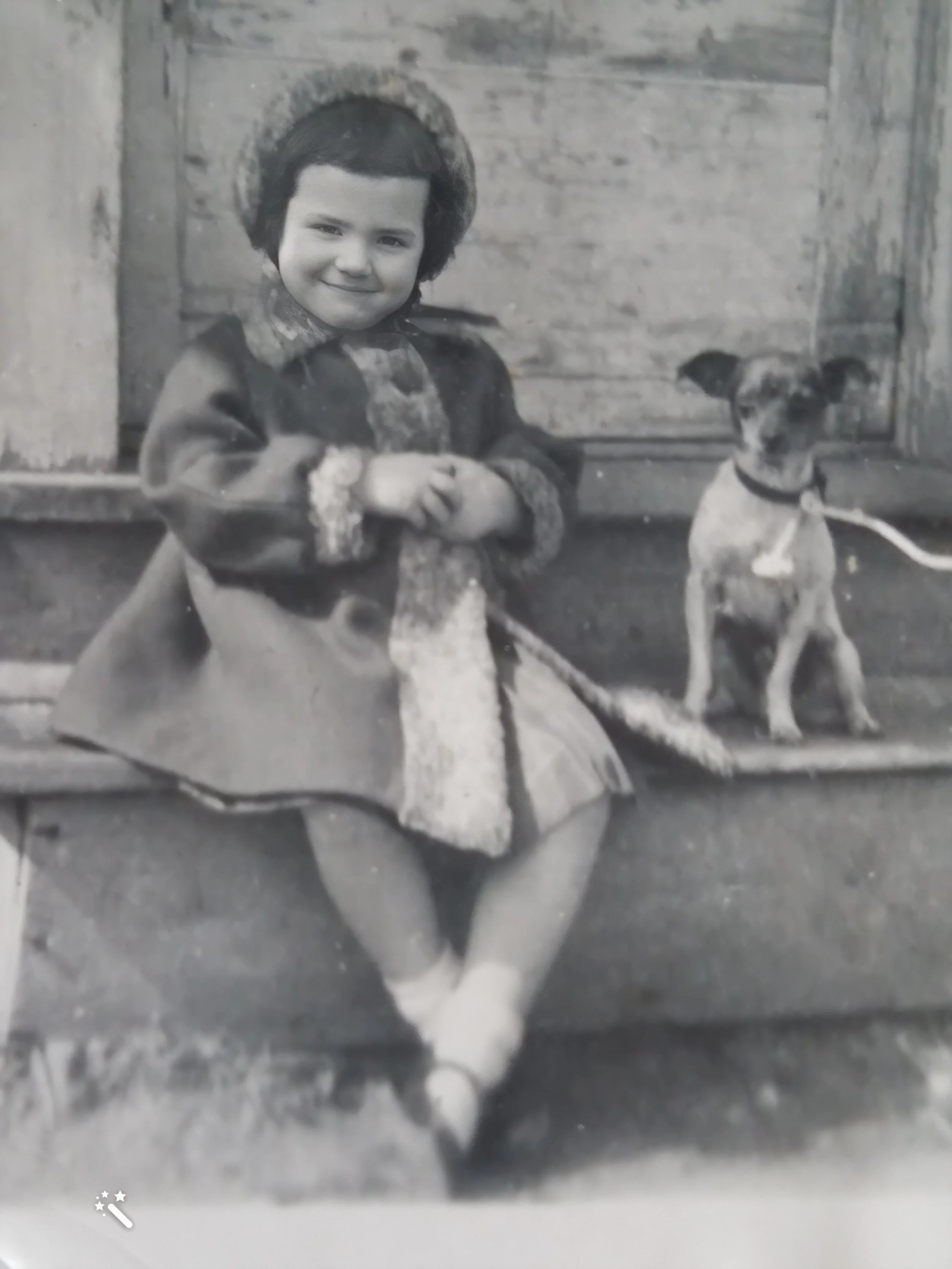
Judy as a young girl in Montclair — the fur-trimmed bonnet continuing a family tradition of hats on every generation.
Judith Ann Robertson was born January 7, 1949, in Montclair, New Jersey — the only child of Joseph Jay Robertson and Ellen Marie Hansen. She grew up on Valley Road in Montclair, in the house where her mother had been raised from sixth grade onward. She attended Montclair High School, graduating in 1967, and went on to earn her bachelor of arts degree from Montclair State College, majoring in mathematics and joining Delta Alpha Chi sorority.
Judy spent twenty-one years teaching mathematics at Randolph Middle School in Randolph, New Jersey, retiring on July 1, 2011.
Beyond the classroom, Judy has been the essential keeper of the Robertson family history. She and Don made the trip to the New Jersey State Archives in Trenton, to Immaculate Conception Cemetery in Upper Montclair, and to cemeteries across Brooklyn in pursuit of the Robertson and Kenny lines. The letters and telegrams her father sent home from the Navy were preserved among the belongings of Barbara O'Brien Hamall — and found their way to Judy when Mary Hamall Morales shared them with her. She has corresponded across years, correcting records, sharing documents, and building the bridge between the three orphans of January 1924 and the grandchildren of today.
The hats were never just about fashion. They were about dignity, resilience, and the promise that tragedy doesn't have to end your story. From a widow's determination to a craftsman's skill to four generations of women who refused to let their family fall apart — every hat was a declaration: we survived, we thrived, we honored those who came before us.
Scattered Stones: The Women Who Stayed · Related Stories
← Series Hub: Scattered Stones The complete series — documentary biographies of the women who held the Kenny and Robertson families together across four generations of loss and resilience. Margaret McKenny Kenny (1851 — 1884) · The First Loss John Kenny's wife — the tuberculosis death that set everything in motion. Mary F. MacKinney "Aunt Maime" (c. 1860 — 1935) · The One Who Stayed Forty-seven years of devotion — the unmarried aunt who raised two orphaned nieces and, a generation later, their orphaned children. Elizabeth Kenny Corbett (1879 — 1950) · Three Names, One Life John Kenny's elder daughter — Navy Yeomanette, bridge between generations, the niece Aunt Maime raised from age five.Are You Connected to the Kenny & McKenny Line?
If you descend from the Brooklyn Kenny family of the Mat Maker (also Kenney, Kinney; County Longford) or the McKenna / McKenny / MacKinney family of Ann Lynch and George McKenna — or from the connected Lynch, Corcoran, Heffernan, or Robertson lines — in Brooklyn, New Jersey, or Ireland, I’d like to compare notes. Documented trees, Brooklyn and Irish records, DNA matches, and old family photographs have all moved this research forward.
Get in Touch About This FamilyCousin connections are informal and reciprocal — no fee, no obligation, just shared work on shared ancestry.
Questions about your own research? Begin a research inquiry.
