
The Hidden Years
The Hidden Years
Twenty-odd years of a marriage that left almost no words of its own — and the one line in a baptismal register that says more than all the rest.
On 6 October 1667, at Notre-Dame-de-Québec, Louise Senécal married Pierre Guilbault. She was thirty. Six days earlier, before the notary Pierre Duquet, Pierre had settled on her a douaire préfix of 200 livres, and the contract recorded that she brought 100 livres of her own into the community. Neither of them could write or sign.
Pierre was already a habitant of Charlesbourg. Twice before, in 1665 and in July 1667, he had been party to a marriage contract that was not followed by a wedding.
What came after survives in scattered pieces: baptisms, two censuses, a handful of notarial acts — and one line in a priest's hand in December 1679.
The First Years
The census of 1667 found the new household at the Côte de Notre-Dame-des-Anges, in the Jesuits' seigneury behind Québec: Pierre Guillebaud, 26; Louise Senécal, 24, with two arpents under cultivation. Louise was thirty; the census taker's figure, from whoever gave it to him, was six years short.
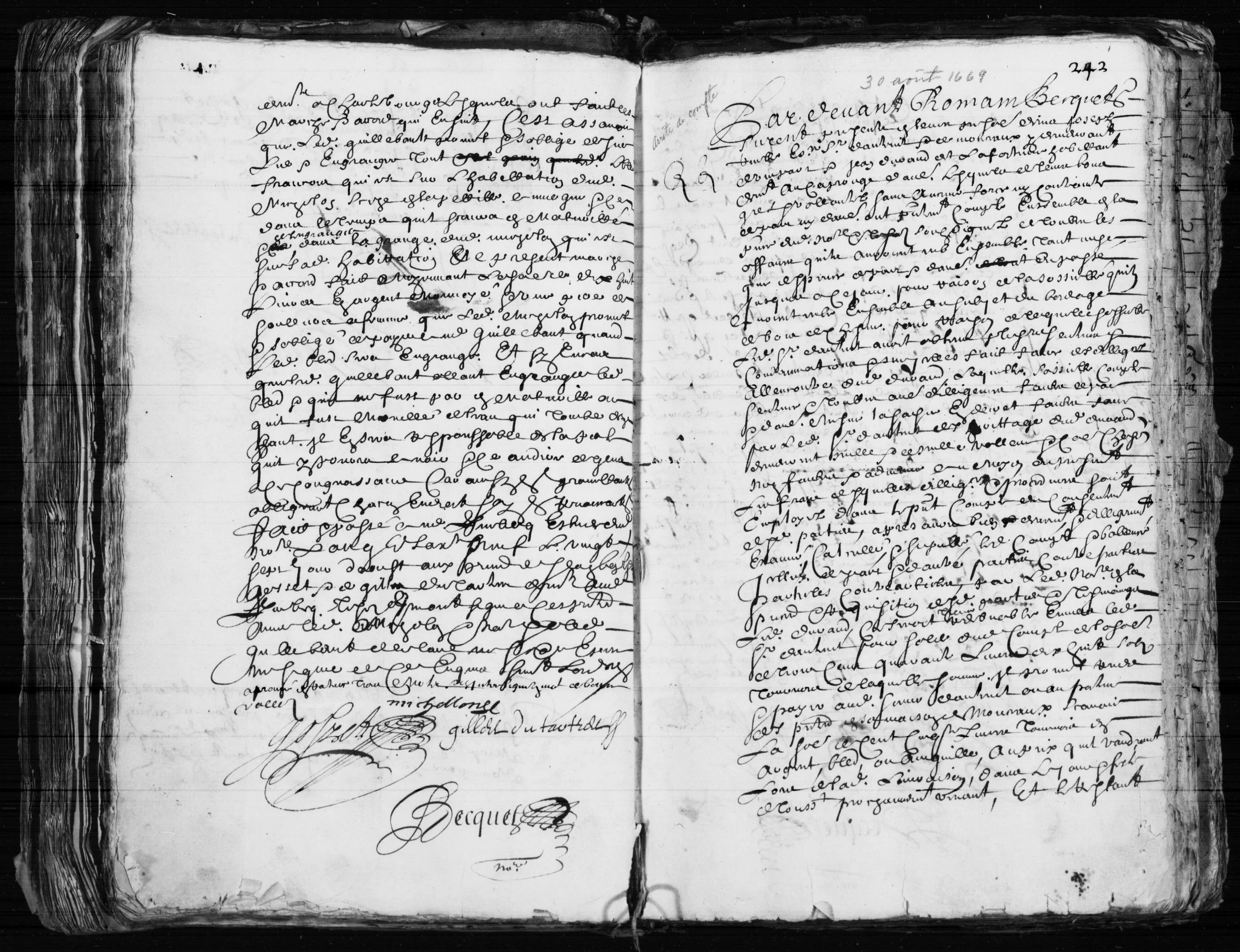
Pierre worked for other men as well as on his own land. On 27 August 1669, before the notary Romain Becquet, he agreed to bring in the grain standing on the habitation of Adrien Michelon and house it in Michelon's barn, to be paid once it was under cover. Michelon — who had been present at two of Pierre's earlier marriage contracts and had signed Louise's — signed the agreement. Pierre declared he could not.
Three children were born in these years, all baptised at Notre-Dame-de-Québec: Marie in September 1668, Joseph Olivier on 18 March 1672, and Étienne on 15 February 1675.

December 1679
Elisabeth Guilbault was born on 16 December 1679 and baptised the next day, not at Charlesbourg but in the parish church of Québec, by Charles Glandelet, a priest of the Seminary.
The priest named her mother as Louyse Senecal demeurante en la parroisse de Charlebourg, wife of Pierre Guilbaut, habitant of Charlesbourg — and then added a clause:
"…et à ce qu'elle dit dudit Pierre Guilbaut son mary, duquel elle est séparée."
…and, by her own account, of the said Pierre Guilbaut her husband, from whom she is separated.Two things are recorded there. The child's father was entered on Louise's word. And Louise was separated from Pierre. Pierre is not recorded as present. The godfather, a Michel called La Ferté who was in the service of the Intendant, signed Laferté; the godmother, Jacqueline Héron, wife of Jacques Galarneau of Charlesbourg, could not sign.
What the entry does not say matters as much. It does not say whether the separation had been pronounced by a court — a séparation de corps or de biens — or whether husband and wife were simply living apart. It does not say how long it had lasted, who had left, or why. No proceeding for a separation has yet been found.
It is tempting to fill that silence with reasons — a hard pregnancy at forty-two, the strain of a farm, a quarrel. The records give none of them, and this story does not supply them.


Together Again in 1681
Two years later the census taker came to la Petite Auvergne and entered them in one household: Pierre Guillebeault, 37; Louise Sénécal sa femme, 40, with thirty arpents under cultivation, eight head of cattle, two horses and one gun. How and when the separation ended, no record says.
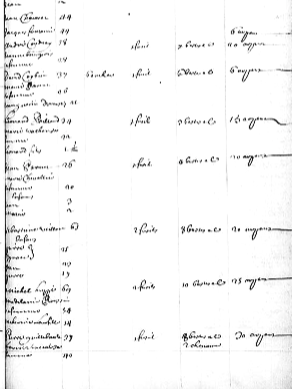
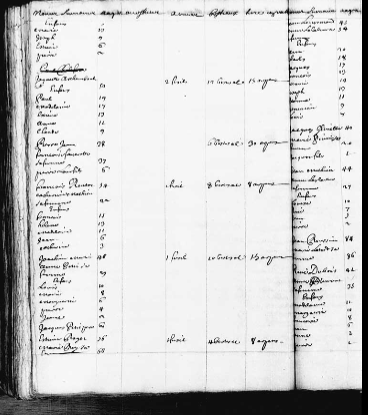
The census lists four children: Marie 13, Joseph 9, Étienne 6 — and Pierre, 2. No son Pierre appears in the parish registers. Elisabeth would have been two. Whether the census entered her under the wrong name, or whether this is some other child, the records gathered do not yet show. No burial for Elisabeth has been found, and she is not among her mother's heirs in 1697.
A Lot on the Rue Saint-Nicolas
On 7 September 1692, before the notary François Genaple, Louis Bédard of la Petite Auvergne sold Pierre Guillebaud, habitant of Charlesbourg, a building lot twenty-four feet wide and thirty-four deep on the rue Saint-Nicolas, backing onto land of the Jesuit fathers and lying in the King's censive. The price was eighty livres, half paid down, with ten livres a year in rent to the Jesuits.
Pierre bound himself to the house he would build there, and to keep up, between his lot and the Jesuits' land, a fence of cedar pickets huict pieds hors terre, appointés par le haut — eight feet out of the ground and pointed at the top. Seller and buyer both declared they could not write or sign.
Louise is not named in the act. Whether she was still living in September 1692, it cannot tell us.

April 1693: A Widower's Contract
When Louise Senécal died, and where she was buried, has not been found. PRDH carries no death or burial for her, and none has turned up in the registers of Charlesbourg, Québec or the Hôtel-Dieu. The last record gathered here that names her alive is the census of 1681.
The first record that names her dead is a marriage contract. On 13 April 1693, before the royal notary Louis Chambalon, Pierre Guillebault veuf en premières noces de Louise Senecal, habitant of Charlesbourg, contracted to marry Jeanne Morin, daughter of André Morin of Saint-Bernard and the late Marguerite Moreau.
Standing with Pierre, the notary recorded, were his son-in-law François Dubois, masson, and his daughter Marie. No marriage followed.

Four years later, that same son-in-law and daughter would be among the heirs who took Pierre before the court.
The Second Marriage
Louise's half of the community she had built with Pierre remained undivided. Before he could marry again, the law required Pierre to have his minor son given a guardian and the community inventoried.
On 3 January 1697, on Pierre's own petition, a family council named him guardian of Étienne, then twenty-one, with Pierre Mortrel as subrogate guardian. The inventory followed on the 4th and 5th.
On Monday 7 January 1697, at St-Charles-Borromée in Charlesbourg, the priest Alexandre Doucet married Pierre Guillebo… veuf en premières noces de Louise Senecal to Françoise Le Blanc, daughter of Jacques Le Blanc, habitant of Saint-Claude, and Suzanne Rousselin. Pierre Le Febvre and Thomas Pajot, among the friends of the groom, signed; the bride's father and her brothers Julien and Jacques Le Blanc were there and could not sign. The clerk who wrote the heading in the margin began Pierre Guillebo et Louise, then crossed out Louise and wrote Françoise.
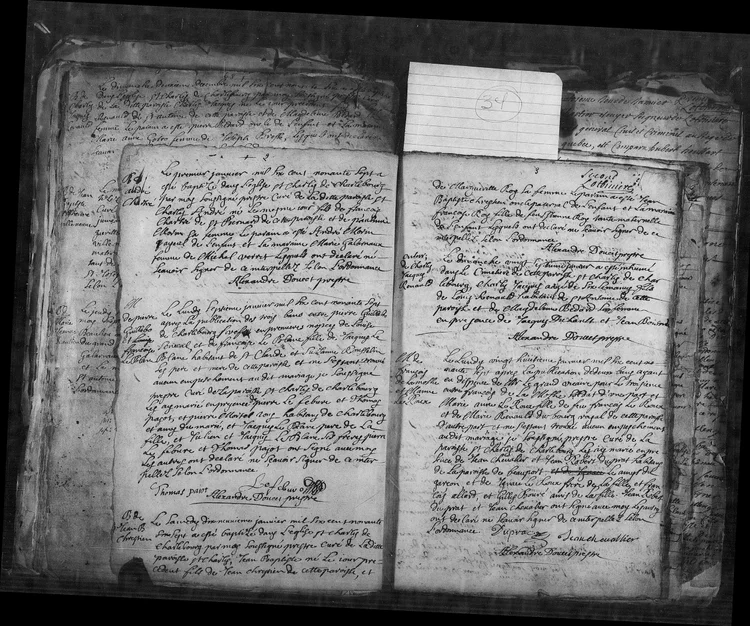

The same day, in Québec, Étienne petitioned the Sovereign Council for letters of emancipation. Seventeen days later he, his brother Joseph and François Dubois for Marie asked the court to close the inventory and divide their mother's estate. That story is told in Part 3, "The Aversion."
The End
Pierre Guilbault died on 5 October 1697 at the Hôtel-Dieu de Québec, nine months after his second wedding, and was buried there the same day. The hospital's register of patients gives him a single line: le 3 pierre guillebaut agé de 50 ans de charle Bourg, mort le 5.

On 10 November his widow, Françoise Le Blanc, made an accord before Chambalon with Louise's heirs — Joseph and Étienne Guillebault, and François Dubois with Marie.
Of the marriage between Louise Senécal and Pierre Guilbault, the records keep a contract she could not sign, four baptisms, two census entries, and one clause in a priest's hand. Of its end, they keep a notary's word: veuf.
The court case over Louise's estate is told in Part 3: The Aversion. Her early life and voyage are in Part 1: Crossing the Atlantic.
The Legacy Continues
Louise's elder son, Joseph Olivier Guilbault, married Marie Anne Pageot at Charlesbourg on 3 May 1694 — a year after his father's contract with Jeanne Morin, and while Louise's estate still lay undivided. Their line runs through their son Charles François to the voyageur Gabriel Guilbault, who married Marie Josephte Abitakijikokwe, a Saulteaux (Ojibwe) woman.
Denis Beauregard's Genealogy of the French in North America estimates Louise Senécal's descendants at between 210,000 and 630,000 Quebecers, and records twelve generations of them in its own database.

Sources
- Parish registers: Notre-Dame-de-Québec — marriage, 6 October 1667; baptisms of Marie (1668), Joseph Olivier (1672), Étienne (1675) and Elisabeth (17 December 1679). St-Charles-Borromée de Charlesbourg — marriages of Joseph Guilbault and Marie Anne Pageot, 3 May 1694, and of Pierre Guilbault and Françoise Le Blanc, 7 January 1697.
- Notarial acts, Archives nationales à Québec: marriage contract of Pierre Guillebault and Louise Sénécal, 30 September 1667, greffe Pierre Duquet (CN301,S95); marché with Adrien Michelon, 27 August 1669, greffe Romain Becquet; sale by Louis Bédard, 7 September 1692, greffe François Genaple (CN301,S114); marriage contract with Jeanne Morin, 13 April 1693, greffe Louis Chambalon (CN301,S58).
- Court records, Archives nationales à Québec: tutelle of Étienne Guilbault, 3 January 1697, bailliage of Notre-Dame-des-Anges (TL5,D2769-110).
- Censuses of New France, 1667 and 1681; Library and Archives Canada.
- Hôtel-Dieu de Québec, register of patients, 1697; PRDH-IGD burial no. 72950.
- Map: Plan de la seigneurie de Notre-Dame-des-Anges, 1754, copied 1788; Archives nationales à Québec (E21,S64,SS5,SSS17,P58).
- Compiled: PRDH-IGD, individual 30657 and family 2198; Denis Beauregard, Genealogy of the French in North America, family 965.
Full citations, and a list of what has not yet been found — Louise's burial, any record of the 1679 separation, and the 1697 inventory — are in the case study methodology.
Document Gallery
The records behind the narrative above. Click any image to view the original at full resolution.


The Hidden Years
Marriage, the separation of 1679, and a widower's contract.
Are You Connected to the Guilbault Line?
If you descend from the Guilbault (Guilbeau, Guilbeault) family of Charlesbourg and the Quebec parishes, from the children of Marie Josephte Abitakijikokwe, or from the founding families of the line — Senécal, Séguin dit Ladéroute, Morin, Couillaud dit Roquebrune, Gaulin — I’d like to compare notes. Documented trees, DNA matches, family papers, and even half-remembered stories have all moved this research forward.
Get in Touch About This FamilyCousin connections are informal and reciprocal — no fee, no obligation, just shared work on shared ancestry.
Every Family Has a Story Worth Telling
Whether you're just beginning your research or ready to transform years of work into a narrative your family will treasure, I'd love to hear your story.
BEGIN YOUR RESEARCH INQUIRY