
Hidden Bonds: The Carpenter Who Built with Double Vision
Hidden Bonds: The O'Brien Family of Jamaica, Queens
Episode 7
Miles Murtha O'Brien
The Carpenter Who Built with Double Vision
1904–1984 · Brooklyn, NY to Caldwell, NJ
A brick fell. He fell. He worked alone for fifty more years.
In January 1928, Miles Murtha O'Brien married Lillian Robertson on his twenty-fourth birthday. Two years later, a brick struck him in the head on a Manhattan scaffold and knocked him through an elevator shaft. He survived. He kept his trade. He saw two of everything for the rest of his life — and somehow, impossibly, kept nailing boards straight.
In June 1905, a census taker came to 174 Milford Street in Brooklyn and found a household still intact: Miles Murtha Lawrence O'Brien, scale maker, age 33; his wife Margaret, also 33, born in Ireland; and their five young children, the youngest not yet one year old. All living. All present. The family was whole.
Eight months later, on February 16, 1906, Margaret Mary Egan O'Brien was dead. She was 34 years old. The cause: heart failure brought on by acute lobar pneumonia. She left behind five children between the ages of one and six.
Miles was two years old when he lost his mother.
The loss echoed something older. His father had been orphaned at nearly the same age — losing his own mother Cornelia Bedell at eighteen months, and his father Terrence just six months after that. Now the pattern repeated itself: a toddler left motherless, a father left to raise young children alone, in a Brooklyn row house, without much margin for grief. (See Episode 6: The Youngest Orphan)
His father remarried within a few years, to Anna Theresa Maguire. By the 1915 census, the household at Milford Street had transformed. Miles, now eleven, was one of ten children — five from his mother Margaret, and five from his stepmother Anna. The house was full. His father called them all his own.
The Ten Children at Milford Street
Margaret Mary Egan's children (1871–1906)
Grace Marie · Josephine Agnes · James Henry · Miles Murtha · Margaret Mary
Anna Theresa Maguire's children (1878–1940)
Anna Helena · Raymond Gerard · Vincent Francis · Rita Marie · Thomas Woodrow Miles ("Uncle Woody")
What it was like to grow up in that household — to be the boy whose mother died when he was two, surrounded by half-siblings who never knew the absence he had always carried — is not recorded anywhere. Miles didn't speak of such things. He was, by all accounts, not a man given to talking about the past.
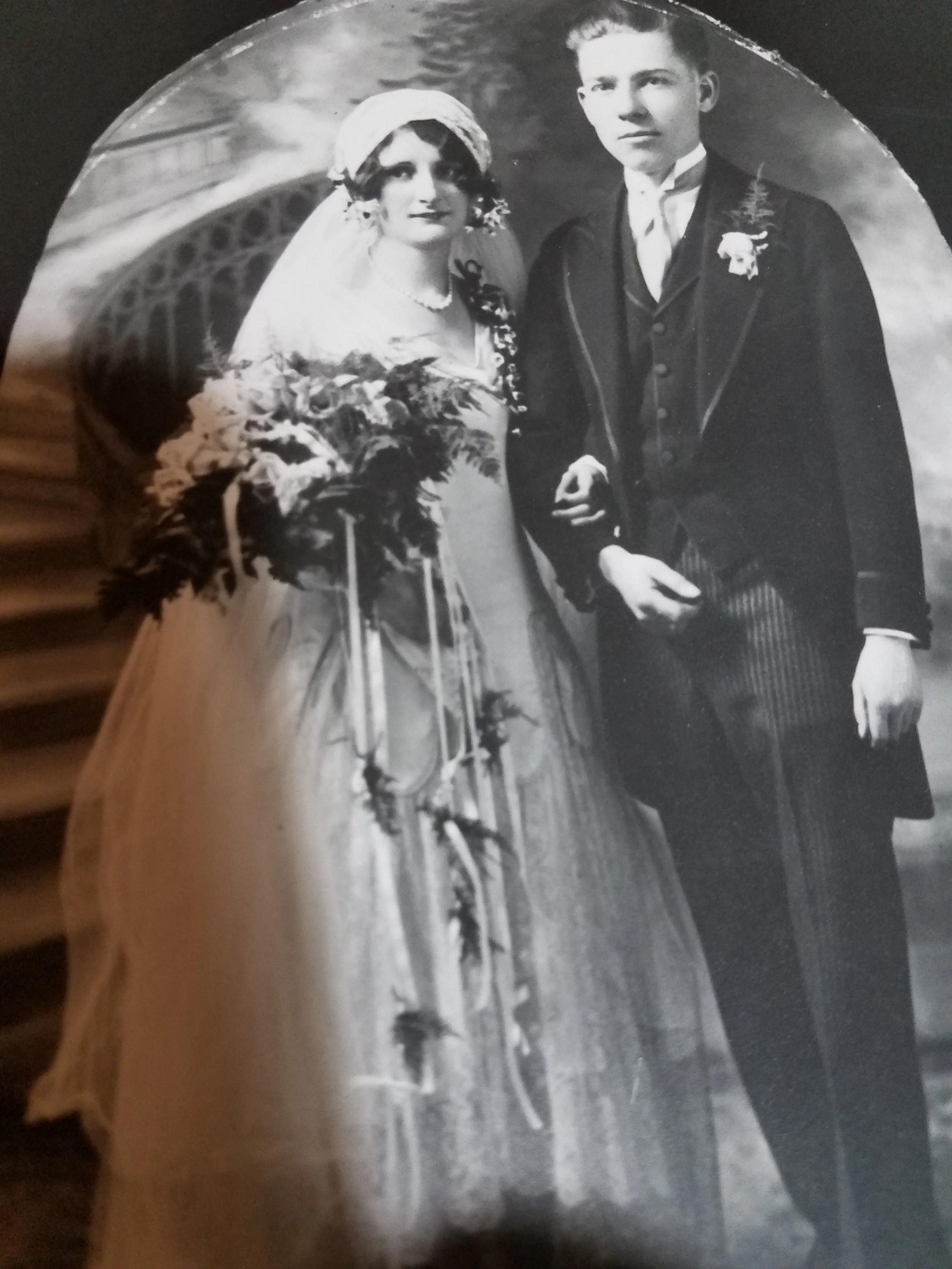
Miles and Lillian on their wedding day — January 28, 1928, his twenty-fourth birthday. St. Gabriel's R.C. Church, Brooklyn.
On January 28, 1928 — his twenty-fourth birthday — Miles married Lillian Josephine Robertson at St. Gabriel's R.C. Church in Brooklyn. The marriage certificate recorded his occupation as "Carpenter." Both lived at 376 Melford Avenue. His brother James served as witness.
The marriage united two immigrant family lines. The O'Briens traced back to Terrence O'Brien of Jamaica, Queens, a hotel proprietor whose hidden fortune and tragic death in 1874 had scattered his children across America. The Robertsons traced back to George Robertson, a stone cutter from Blairgowrie, Scotland, who died five days after arriving in New York. Miles and Lillian had each descended from men who had not survived their new country's welcome — and each had grown up shaped by that absence. (Read Lillian's story in Scattered Stones, Episode 8)
Their first daughter, Lillian Marie, was born in 1928. Miles was working construction during one of the most ambitious building booms in American history. Manhattan was rising — the Chrysler Building, the Empire State Building, dozens of Art Deco towers climbing toward the sky. A young carpenter with a new wife and a baby daughter had every reason to keep climbing with them.
And then someone dropped a brick.
The Fall
Miles was working on the Chrysler Building when it happened. He was on a scaffold in an elevator shaft — a worksite with no safety gear and no temporary gates blocking the floor openings of the elevator. Someone above him dropped something. A brick, or a concrete block. It struck him in the head. He was knocked unconscious. He fell several stories before his body came to rest.
When they reached him, it seemed like a miracle. Nothing was broken. But he was battered beyond easy description — purple and black from shoulder to hip. He was taken to the hospital. They wrapped him in Burow's solution, an aluminum acetate compound used to reduce swelling, and they gave him time. Time was the only medicine available in 1930 for a man who had fallen through a building and lived.
He could not work for weeks, perhaps months. A lawsuit followed, grounded in the absence of safety standards — no harnesses, no protective barriers, nothing between a worker and a fatal drop. The court ruled in Miles's favor. The family memory of that ruling, and what it meant, was passed down through his children and kept alive across generations.
From that day forward, Miles saw two of everything.
Two nails. Two boards. Two hammers. Permanent double vision, for the rest of his life.
He never spoke of the accident. Not to his children, not to his grandchildren. It was Barbara who told the story, always returning to the same bewildered question she could never quite answer:
"How did he hammer a nail when he saw two of them?"
His grandchildren asked the same question. No one ever got a good answer.
He just did.
The 1930 census, taken just months after the accident, records his occupation as "Carpenter, New Buildings." He was back on the job — but everything had changed. The court ruling that had compensated him had also made him, in the eyes of the industry, a liability. His employer could not keep him. Other construction companies would not take him on; a worker who had won a lawsuit was a financial risk no foreman wanted to carry. The court award gave him another path: he had the means to work for himself.
And so he did. From that point forward, Miles O'Brien worked alone. No crew, no partners, no employer who could let him go. Just himself, his tools, his Dodge 100 pickup truck, and his doubled vision — a one-man operation for the next fifty years.
Self-employed from the start. The 1942 draft registration: "Self-Employed, Carpenter Contractor." The 1950 census: "Carpenter, Private Building." His death certificate, fifty years after the fall: "Self-Employed, Carpenter."
In 1938, the family moved from Brooklyn to Caldwell, New Jersey — to 58 Central Avenue, the address that would remain Miles's home for the rest of his life. Together, Miles and Lillian had six children:
Their Children
Lillian Marie (1928–1995) — married Dr. Severino Ambrosio
Jeanne (1930–1993)
Barbara Ann (1935–2022)
Helen Gladys (1940–1948)
Michael Joseph (1946– ) — twin; retired Lieutenant Colonel, USAF
Miles Murtha Jr. (1946– ) — twin; retired Colonel, USAF
Helen died at eight years old — another loss in a life already shaped by loss. She does not appear on the 1950 census. The family kept going, as families do.
Among Miles's projects were the medical offices he built for his son-in-law, Dr. Severino Ambrosio, in Parlin, New Jersey — and the kitchen he renovated for his daughter Barbara in Plainfield, a painstaking job in an old house with plaster lath, the kind of work that requires a carpenter who has learned patience the hardest possible way. Barbara's daughter wept when the family moved to Ohio just after he finished it.
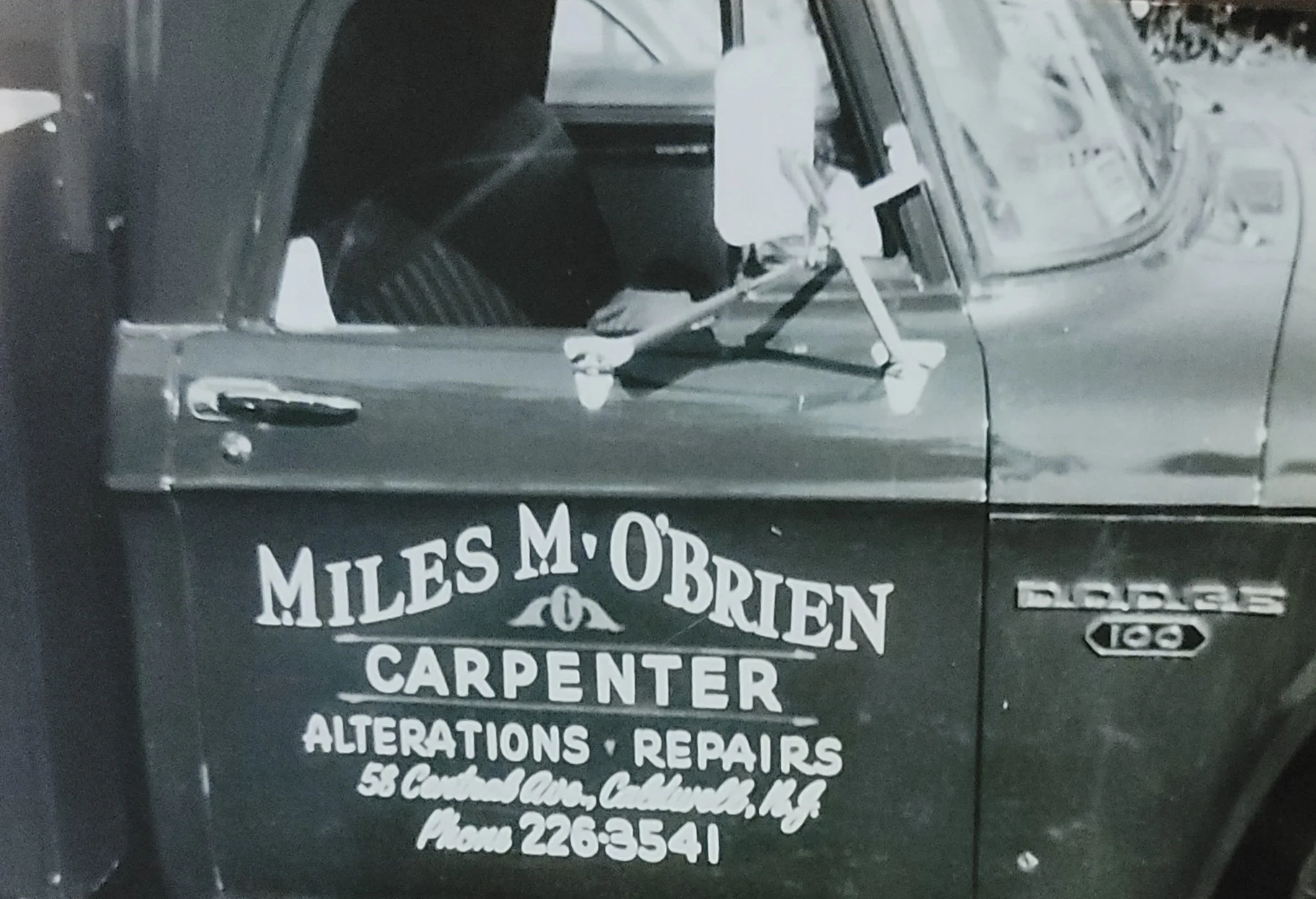
"Miles M. O'Brien — Carpenter — Alterations · Repairs · 58 Central Ave, Caldwell, N.J."
The Dodge 100 was a fixture in the West Essex area for decades.
The grandchildren thought he was gruff. He would come home from work, settle into his chair in the alcove, light his pipe, and read the Wall Street Journal. If you walked past him, he might try to catch you between his legs — startling you — and then pull out a caramel candy. He was, in truth, a pussycat.
And he was shrewd. Despite the carpenter's overalls and the calloused hands, he did quite well in the stock market. The Wall Street Journal was not casual reading.
Family Story
One afternoon, Miles walked into Woodruff Jewelers in Montclair, New Jersey, still in his work clothes. He wanted to purchase a complete silver set for Lillian. The store staff tried to dismiss him — a man in overalls could not possibly afford such things.
He plunked down cash.
It gave him great satisfaction, and he enjoyed telling that story for years. The silver — still in its original purple Woodruff Jewelers cloth bag — was eventually inherited by his granddaughter.
He also collected coins with the same quiet dedication he brought to everything — purchasing new proof sets every year, American coins and gorgeous international series. At his death, his children divided the collection among the grandchildren.
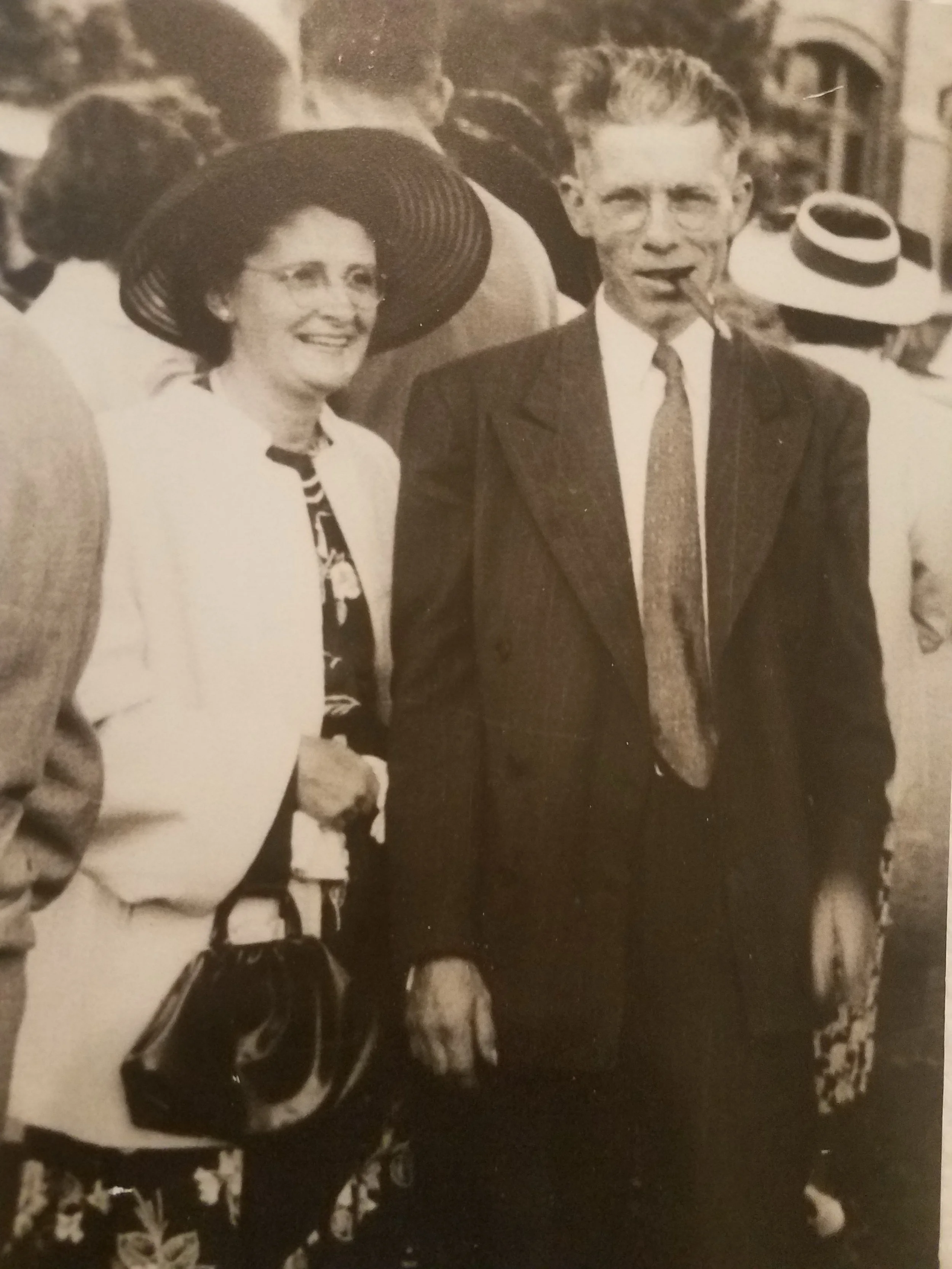
Miles and Lillian, c. 1940s. The pipe was a constant companion — its smell still lingers in family memory decades later.
In 1978, Miles and Lillian celebrated their 50th wedding anniversary. All five surviving children were present. Seventeen of nineteen grandchildren gathered around them. Someone handed Miles a knife to cut the cake — and he reached for his carpenter's saw instead. A photograph survives of the moment, and the faces around the table say everything.
Fifty years from that wedding day at St. Gabriel's. Fifty years from the young carpenter in Brooklyn. Fifty years of building things alone, in doubled light, with a steadiness no one has ever fully explained.
Miles Murtha O'Brien died on Monday, January 16, 1984, at his daughter Lillian's home in Parlin, New Jersey. He was 79 years old. A Mass was offered at St. Aloysius Church, where he had long been a member of the Holy Name Society. He was buried at Gate of Heaven Cemetery in East Hanover. Lillian followed him seven years later, in 1991.
He was survived by his wife; two sons, both career Air Force officers; three daughters; his brother Vincent and sister Margaret; nineteen grandchildren; and two great-grandchildren.
The Inheritance
Miles Murtha O'Brien lost his mother at age two. He was raised in a blended family of ten children. He fell through an elevator shaft and spent the rest of his life seeing double. He lost a daughter at eight years old. He worked alone, with damaged vision, for fifty years. He never spoke of any of it.
And yet. The wedding portrait shows a young man in love. The anniversary photograph shows an old man still in love. The family dinner photograph shows a grandfather cutting a birthday cake with his carpenter's saw, surrounded by grandchildren who thought he was gruff until he slipped them caramels from his pocket.
The coins were divided. The silver was inherited. The smell of the pipe faded. But the stories remain — passed from Barbara to her children, from them to theirs, growing slightly more bewildered and more awed with each telling.
The story did not end with Miles. It kept building.
Miles's lawsuit was argued on the grounds that there were no safety standards protecting workers — no harnesses, no barriers, nothing between a man on a scaffold and the shaft below. He won. The industry, slowly, changed. Decades later, a descendant of his would carry that change forward in a way he could not have imagined: working as a senior field executive for one of the country's major construction groups, responsible for employee safety on major projects — including a new national museum at a military installation in Virginia. Under his watch, not one fatality on any of his sites. The safety kit Miles never had — harness, safety line, hard hat, steel-toed boots — is now standard. Required. Enforced.
Miles fell without any of it. His descendant builds to make sure no one falls the way he did.
Almost ten years after his death, his children sent the grandchildren a portion of his coin collection — and a letter.
"Enclosed are a few mementoes from the many years of your Grandfather O'Brien's coin collecting. We do hope you enjoy them as much as your Grandfather enjoyed collecting them.
It has been almost 10 years since your grandfather saw you last. Hopefully as you look at and handle these items, special memories of your Grandpa and Grandma O'Brien will be recalled and these treasures will give you many years of peace and enjoyment.
Always keep your Grandparents O'Brien in your hearts and remember how much they loved and cherished each one of you."
— In loving memory of Grandpa and Grandma O'Brien,
From "The Kids" — Lillian, Jeanne, Barbara, Miles Jr., and Mike
Hidden Bonds · Episode 7 · Storyline Genealogy
For Descendants of Miles & Lillian O'Brien
Family Archive
The primary documents, family photographs, and heirloom images that support this biography are available in a password-protected archive for family members.
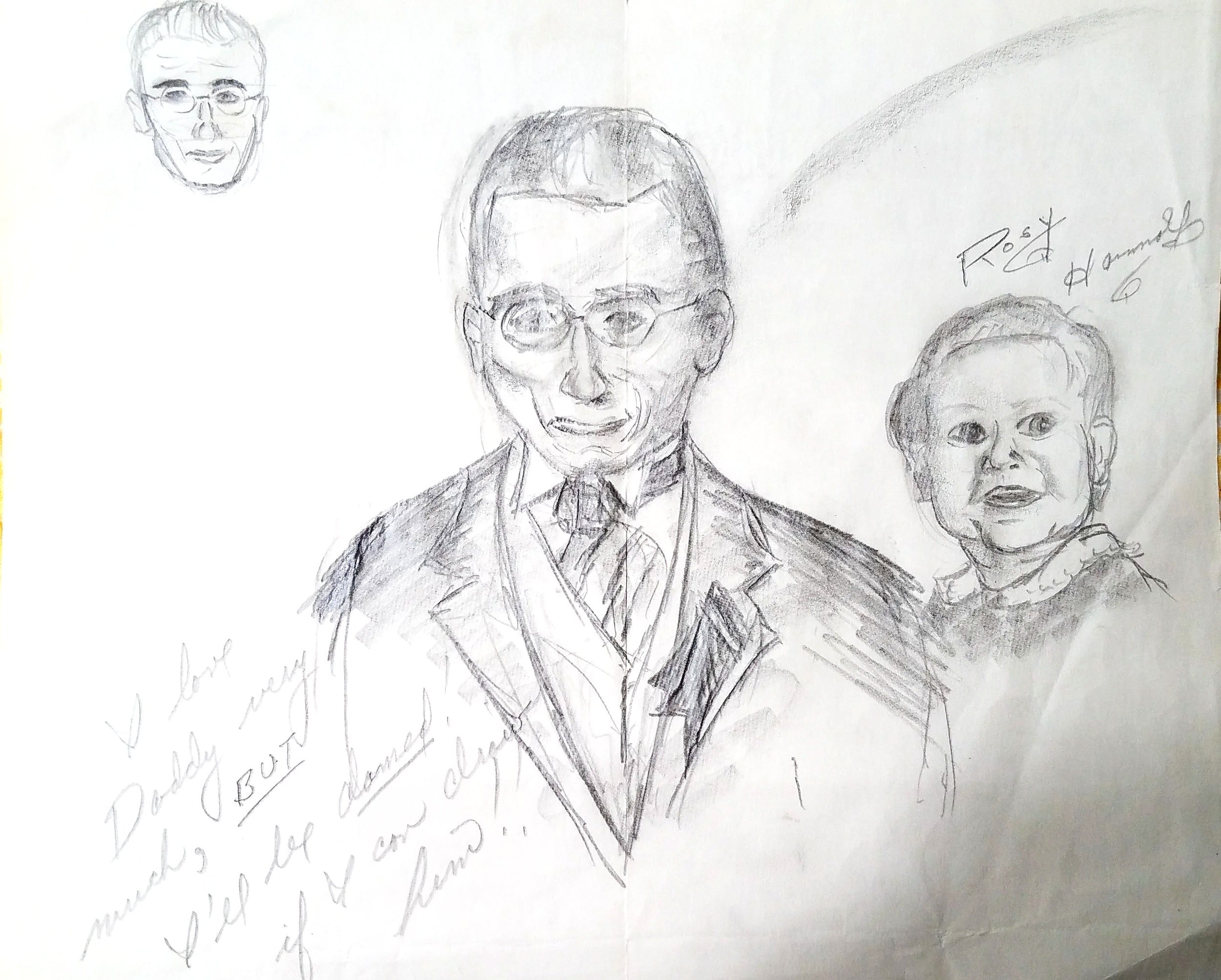
Pencil sketch of Miles by his son Miles Murtha Jr., with the inscription: "I love Daddy very much BUT I'll be damned if I can draw him!!"
Available in the family archive.
Archive Contents
Birth CertificateJanuary 28, 1904 — Brooklyn, NY
Marriage CertificateCertificate No. 1410, January 28, 1928
Mother's Death CertificateMargaret Mary Egan O'Brien, 1906
Mother's ObituaryFebruary 1906
1905 NY State CensusFamily intact, before the loss
1915 NY State CensusBlended household, 10 children
1930 Federal CensusBrooklyn — "Carpenter, New Buildings"
1942 WWII Draft Card"Self-Employed, Carpenter Contractor"
1950 Federal CensusCaldwell, NJ — with the twins
Death Certificate & ObituaryJanuary 16, 1984 — Parlin, NJ
50th Anniversary Photos1978 — "All My Children"
Heirloom Photos & ObjectsSilver, coins, letter to grandchildren
This archive is password-protected and maintained for the descendants of Miles and Lillian O'Brien. If you are family and need the password, please contact Mary.
🔒 Enter Family ArchiveCommemorative Poem
"Cutting Straight"
For the carpenter who fell from a scaffold and spent fifty more years working alone, with double vision, cutting straight.
Read the Poem →Legacy Essay
"What He Built"
A granddaughter's reflection on a grandfather who showed her everything without saying much — through candy in his pocket, silver in a purple bag, and a birthday cake cut with a saw.
Read the Essay →This episode is part of the Hidden Bonds series. Miles married Lillian Josephine Robertson, whose story is told in Scattered Stones Episode 8: The Orphan's Journey. Their marriage united two families — the O'Briens of Jamaica, Queens and the Robertsons of Brooklyn, descended from stone cutters in Perthshire, Scotland. Both had grown up in the shadow of early loss. Together, they built a family of six children and nineteen grandchildren.
Are You Connected to the O'Brien Line?
If you descend from Terrence O'Brien of Jamaica, Queens or his brother Patrick O'Bryan of Newport, Kentucky — under any spelling of O'Brien, O'Bryan, O'Bryen, or O'Brian — or from the connected Higgins, Bedell, McNamara, or Kentucky Kuptz, Lyhan, Powell, or Browne lines, I’d like to compare notes. Documented trees, DNA matches, family papers, and even half-remembered stories have all moved this research forward.
Get in Touch About This FamilyCousin connections are informal and reciprocal — no fee, no obligation, just shared work on shared ancestry.
