
Hidden Bonds: Four Orphans and a Hidden Fortune
Four Orphans and a Hidden Fortune
The Day the Family Shattered
November 21, 1874 | Jamaica, Queens County, New York
$400 in the probate. $11,000 hidden in the walls.
This episode is part of the Hidden Bonds series. When Terrence O'Brien died in 1874, his four children were scattered to relatives across three states. The probate listed his estate at $400. Years later, $11,000 in government bonds was discovered hidden in his kitchen wall. This is the story of how a family was torn apart — and the secret fortune that could have changed everything.
"In December, 1874, Terence O'Brien, of Jamaica, L.I., a hotel keeper, died, as it was believed, almost a pauper. He was nothing of the kind, however, for $11,000 worth of bonds have just been discovered in the kitchen wall of the premises he occupied."
— Newspaper clipping, date unknownThe Hotel Keeper of Jamaica
Terrence O'Brien was a well-known man in Jamaica, Queens County. An Irish immigrant, he had built himself up from nothing — first as chief stableman at Remsen's Hotel, where his knowledge of horses and attention to business made him many friends among the Brooklyn drivers who passed through.
When he acquired some money, he opened a hotel of his own: the "Railroad House." Succeeding in this enterprise, he opened a larger house, known as the "Union Hotel." At his peak, neighbors believed him to be a man worth in the neighborhood of $30,000.
He married twice. His first wife, Ann Higgins, bore him three children before her death in 1864: James Henry, Mary Ann, and Elizabeth. His second wife, Cornelia Bedell, gave him one son: Miles Murtha Lawrence, born March 28, 1873.
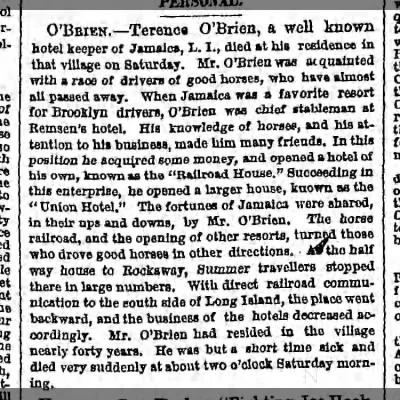
Obituary for Terrence O'Brien, November 1874. "A well known hotel keeper of Jamaica, L.I.... His knowledge of horses, and his attention to his business, made him many friends."
But the fortunes of Jamaica were shared, in their ups and downs, by Mr. O'Brien. The horse railroad and the opening of other resorts turned good horses in other directions. Summer travelers stopped at Rockaway instead. The business of the hotels decreased accordingly.
His hotel property passed into the hands of Bill Hastings for debts contracted in the purchase of liquors. Hastings was badly fleeced — there was a mortgage on the property, and O'Brien had received liquor equal to the full cash value of the premises.
By the time he died, everyone believed Terrence O'Brien had lost everything.
1874: The Year of Loss
The year 1874 brought tragedy upon tragedy to the O'Brien household.
First, on May 12, 1874, Cornelia Bedell O'Brien died. She was just 23 years old. Her son Miles was 13 months old — too young to remember his mother's face.
Then, six months later, Terrence himself fell ill. His condition was not supposed dangerous at all until the middle of the day before his death, when he began to sink rapidly. He sent for Father Farley, the pastor of St. Monica's Catholic Church, who gave him the consolation of the church.
According to newspaper accounts, Terrence imparted to Father Farley the information that he had some valuables which he wished to place in his hands for the benefit of his children, and it was arranged that the priest should return at a specified time to receive them.
But before the priest could return, on Saturday, November 21, 1874, at about two o'clock in the morning, Terrence O'Brien sat up in bed, asked for a drink, and when being restored to rest on the pillows, his life went out in an instant without the nurse being aware of it.
He was 41 years old. He had resided in the village nearly forty years. And whatever secret he had intended to share with Father Farley died with him.
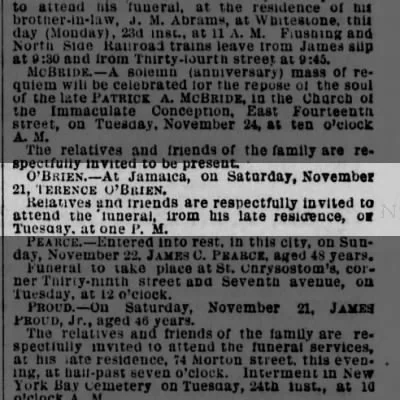
Death notice, November 1874. "O'BRIEN.—At Jamaica, on Saturday, November 21, TERENCE O'BRIEN. Relatives and friends are respectfully invited to attend the funeral, from his late residence, on Tuesday, at one P.M."
The Scattering
Then his relatives were sent for, and a search was made of the house for whatever of value there might be. They found almost nothing. The man everyone had believed to be worth $30,000 appeared to have died a pauper.
On January 5, 1875, Thomas Higgins — the brother of Terrence's first wife Ann — appeared before the Queens County Surrogate's Court to petition for administration of the estate. The document he filed tells us exactly what happened to the four orphaned children:

Queens County Surrogate's Court, January 5, 1875. The probate petition for Terrence O'Brien, deceased intestate. This document reveals where each of the four orphaned children was placed.
The Probate Record: Where the Children Went
The January 5, 1875 probate petition, filed by Thomas Higgins, states that Terrence O'Brien died on "the twenty first day of November in the year one thousand eight hundred and seventy four" and that he:
"possessed of personal property in the State of New York the value whereof does not exceed the sum of about Four hundred dollars"
The document then names each child and their placement:
The Four Orphans:
James Henry O'Brien (age 14) — "a minor over 14 years and resides in Newport Kentucky with his uncle Patrick O'Brien, and has no general guardian"
Mary Ann O'Brien (age 8) and Elizabeth O'Brien (age 4) — "minors under 14 years residing in Jamaica aforesaid with your Petitioner [Thomas Higgins] who is also their general guardian"
Miles O'Brien (age 18 months) — "a minor under 4 years of age residing in Jamaica aforesaid with his great Aunt Mrs Madden and has no general guardian"
In one document, we see a family shattered. The three older children — James Henry, Mary Ann, and Elizabeth — were full siblings, children of Ann Higgins. Baby Miles was their half-brother, the only child of Cornelia Bedell. Each set of children went to their own mother's relatives.
James Henry, the eldest, was sent the farthest — all the way to Newport, Kentucky, to live with his uncle Patrick O'Brien. He would grow up hundreds of miles from his siblings.
Mary Ann and Elizabeth stayed in Jamaica with Thomas Higgins, their maternal uncle.
Miles, the baby, went to "Mrs. Madden," his great aunt. By 1880, he would be living with his maternal grandparents, the Bedells.
The half-siblings had no shared maternal family to hold them together. They were scattered to three different households across two states.
And all of them believed their father had died a pauper, leaving them nothing.
The Hidden Fortune
But Terrence O'Brien had a secret.
Years after his death — the exact date is unclear from surviving records — someone made a discovery in the hotel Terrence had once owned. Hidden in the kitchen wall of the premises he had occupied, they found $11,000 worth of government bonds.
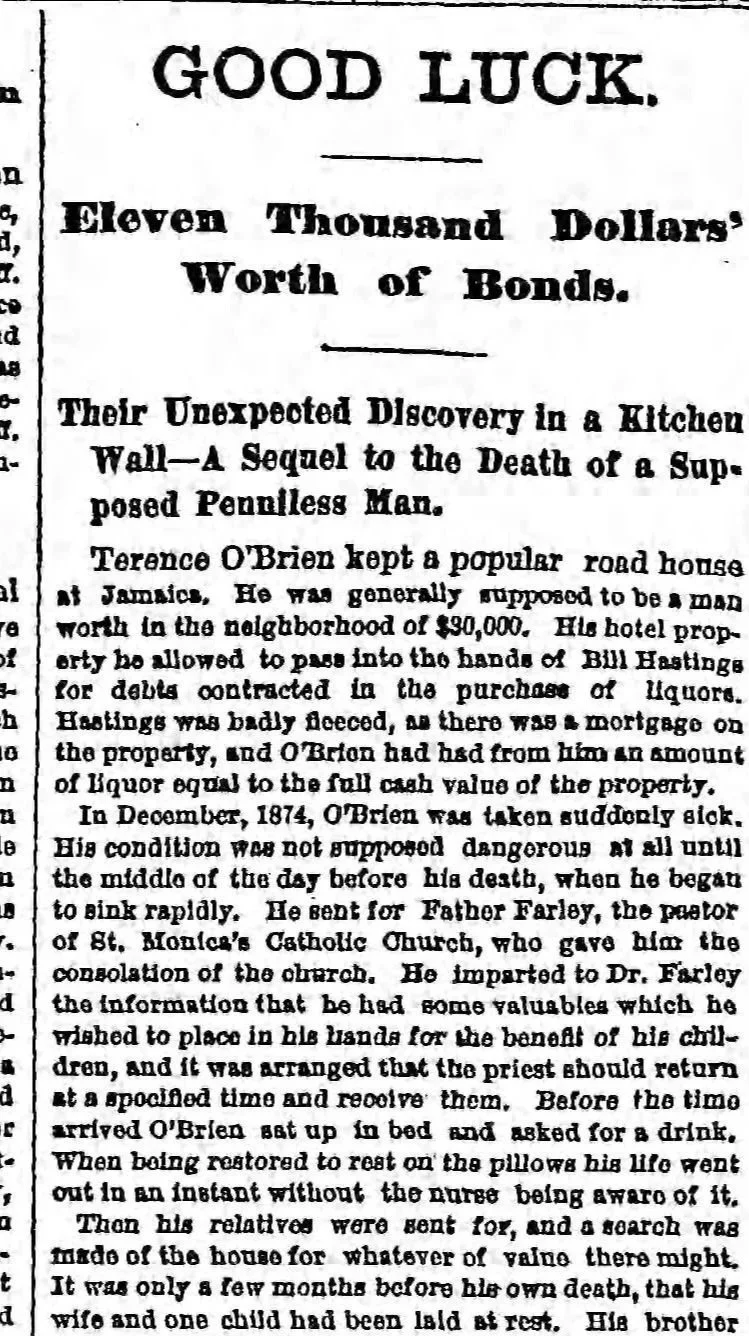
"GOOD LUCK. Eleven Thousand Dollars' Worth of Bonds. Their Unexpected Discovery in a Kitchen Wall — A Sequel to the Death of a Supposed Penniless Man."
Eleven thousand dollars in 1874 would be worth approximately $300,000 today. It was a fortune — hidden in the walls while the children were scattered to relatives, while James Henry was sent to Kentucky, while baby Miles was passed to his great aunt because there was "nothing" left.
This was what Terrence had intended to tell Father Farley. This was the secret that died with him when he asked for a drink and slipped away before the priest could return.
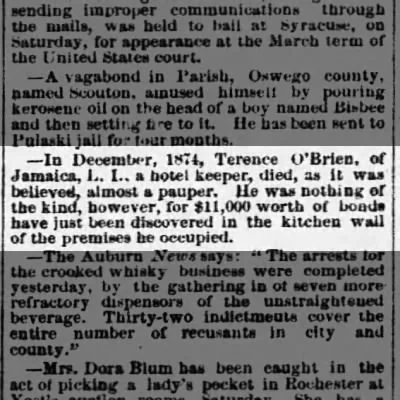
"In December, 1874, Terence O'Brien, of Jamaica, L.I., a hotel keeper, died, as it was believed, almost a pauper. He was nothing of the kind, however, for $11,000 worth of bonds have just been discovered in the kitchen wall of the premises he occupied."
The Legal Battle
The discovery of the bonds sparked a legal battle. A man named Thomas Slowey, who had apparently acquired the property, claimed the bonds were his. The O'Brien heirs disagreed.
The case came before Surrogate Haynes of Queens County. Slowey denied that he found the securities in the O'Brien house, claiming instead that he procured them "somewhere in Westchester County."
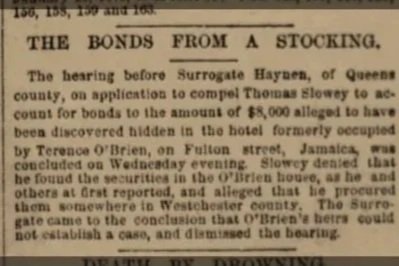
"THE BONDS FROM A STOCKING. The hearing before Surrogate Haynes, of Queens county, on application to compel Thomas Slowey to account for bonds to the amount of $8,000 alleged to have been discovered hidden in the hotel formerly occupied by Terence O'Brien, on Fulton street, Jamaica, was concluded on Wednesday evening."
The Surrogate came to the conclusion that O'Brien's heirs could not establish a case, and dismissed the hearing.
Whether the children ever received any of their father's hidden fortune remains unclear from surviving records. What is clear is that they spent their childhoods scattered and poor — while thousands of dollars in government bonds sat hidden in a kitchen wall, waiting to be found.
What They Inherited Instead
The four O'Brien orphans did not inherit their father's hidden fortune. But they inherited something else: each other.
Against all odds, the scattered siblings found their way back together. James Henry, sent to Kentucky at fourteen, returned to Brooklyn as an adult. He built a successful business — the J.H. O'Brien Scale & Supply Company — and eventually went to Congress. When he remarried in 1902, his half-brother Miles stood beside him as witness.
Miles, the baby who was "under 4 years of age" with "no general guardian," grew up to work at his half-brother's company for over twenty years. He married twice, raised ten children, and maintained his connection to the siblings he barely knew as an infant.
Mary Ann married and became Mrs. Mary Smith. Elizabeth married and became Mrs. Elizabeth Foley. Both sisters were listed in James Henry's obituary in 1924 — fifty years after they had been separated.
The bonds hidden in the wall may have been lost. But the bonds between the siblings endured.
150 Years Later: The Proof
In 2018, genealogical research began to unravel the mystery of the O'Brien family. The 1875 probate document — with its single reference to "Uncle Patrick O'Brien in Newport, Kentucky" — provided a crucial lead.
Systematic Kentucky genealogical research located Patrick O'Bryan's family in Newport. And then DNA analysis confirmed what the documents had suggested: a large cluster of matches sharing common ancestors Patrick O'Bryan and Mary McNamara.
The genetic evidence proved that the 150-year-old probate document was accurate. Patrick was indeed Terrence's brother. The Kentucky cousins and the New York descendants were one family — separated for over a century, now reunited through DNA.
The hidden bonds — both the government securities in the wall and the family connections across the miles — had finally been found.
Document Gallery
1874 — Detailed Obituary
"A well known hotel keeper"
Obituary
1874 — Death Notice
November 21, 1874
Death
1875 — Probate Petition
January 5, 1875
Probate
"Died Almost a Pauper"
Bonds discovered in wall
Newspaper
"GOOD LUCK"
$11,000 discovery
Newspaper
"Bonds From a Stocking"
Surrogate Haynes hearing
CourtEvidence Analysis
PRIMARY SOURCE: 1875 Probate Petition
This document is the key to reconstructing the family's scattering. Filed by Thomas Higgins on January 5, 1875, it names all four children and their placements. The mention of "Uncle Patrick O'Brien in Newport, Kentucky" — a single line in a legal document — would prove crucial 150 years later when DNA testing confirmed the Kentucky connection.
PRIMARY SOURCE: "Good Luck" Newspaper Article
This article provides the most detailed account of the hidden fortune discovery. It confirms that Terrence intended to tell Father Farley about "some valuables which he wished to place in his hands for the benefit of his children" — but died before he could complete the arrangement. The contrast between the $400 probate and the $11,000 discovery illustrates the tragedy of the situation.
PRIMARY SOURCE: "The Bonds From a Stocking"
This article documents the legal aftermath. Thomas Slowey, who apparently acquired the property, claimed the bonds as his own. The Surrogate's Court hearing ended with the O'Brien heirs unable to "establish a case." Whether the children ever received any portion of their father's hidden fortune remains unclear.
PRIMARY SOURCE: Detailed Obituary (November 1874)
The longer obituary provides crucial biographical details: Terrence's career progression from stableman to hotel owner, the rise and fall of his business fortunes, and the circumstances of his sudden death. The phrase "his life went out in an instant without the nurse being aware of it" captures the tragedy of a man who died with secrets still untold.
Are You Connected to the O'Brien Line?
If you descend from Terrence O'Brien of Jamaica, Queens or his brother Patrick O'Bryan of Newport, Kentucky — under any spelling of O'Brien, O'Bryan, O'Bryen, or O'Brian — or from the connected Higgins, Bedell, McNamara, or Kentucky Kuptz, Lyhan, Powell, or Browne lines, I’d like to compare notes. Documented trees, DNA matches, family papers, and even half-remembered stories have all moved this research forward.
Get in Touch About This FamilyCousin connections are informal and reciprocal — no fee, no obligation, just shared work on shared ancestry.
Every Family Has a Story Worth Telling
Whether you're just beginning your research or ready to transform years of work into a narrative your family will treasure, I'd love to help.
LET'S TALK ABOUT YOUR FAMILY