
The Storyline
Real families. Real discoveries. Real stories.
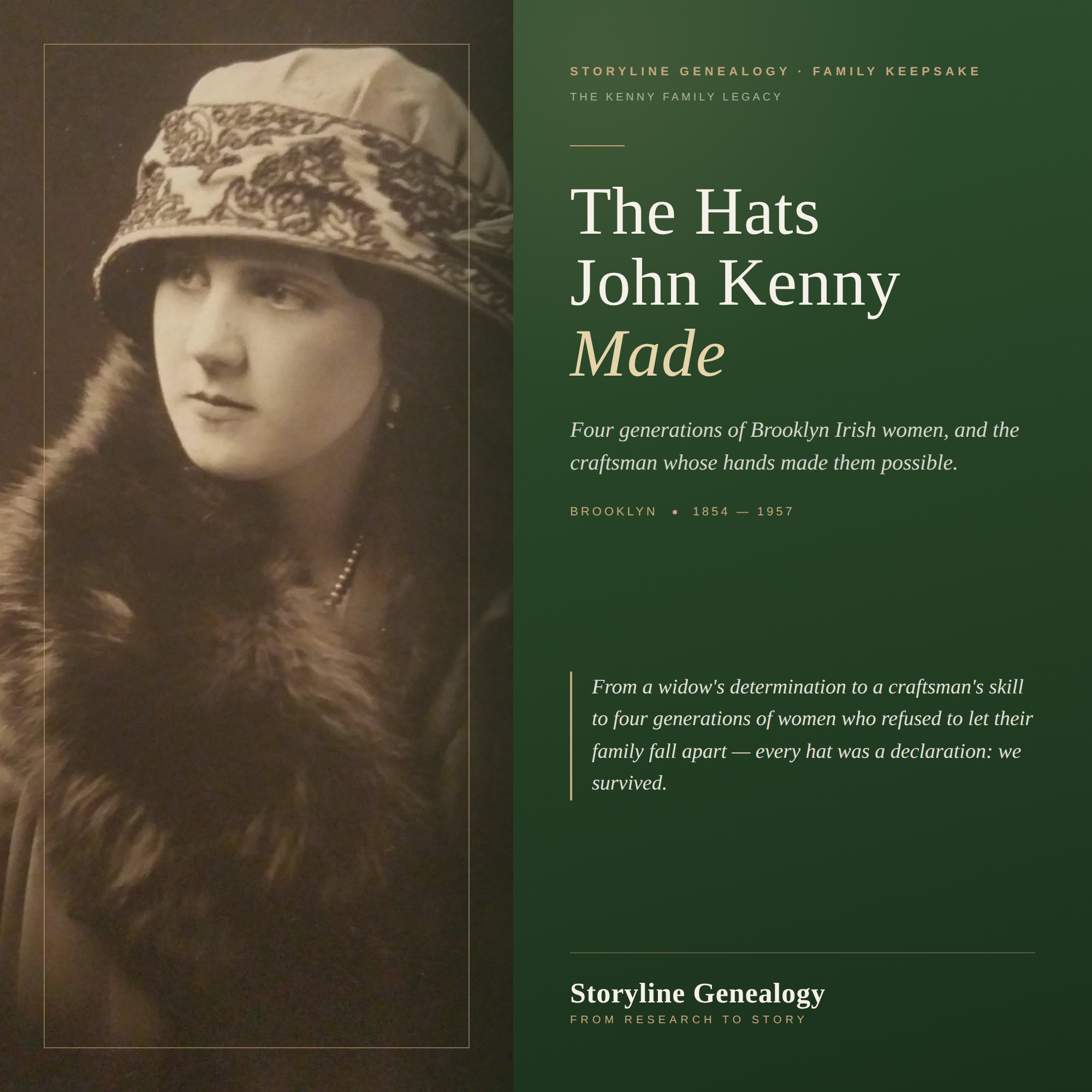
Four Generations in Hats: A Brooklyn Story of Resilience
After seven years of research into Brooklyn's mat maker John Kenny, one discovery changed everything: the hats weren't just about his craft—they were about survival. From 1888 to 1957, four generations of Kenny women wore elaborate hats in family photographs. Each hat told a story: Mary Agnes at age 12, seven years after her father's death. Lillian and Helen as toddlers in luxury millinery. Lillian's timeless taupe hat at her daughter's 1957 wedding—so stylish it would turn heads 61 years later. But the real story wasn't the hats themselves. It was the network of devoted women—Aunt Maime, Aunt Lillian, grandmother Ann—who kept the family together through impossible tragedy. John Kenny's craftsmanship created more than fashion. It created a legacy that four generations of women would carry forward with dignity, resilience, and style.
Part of the Storyline Genealogy series: When one craftsman's legacy becomes four generations of resilience—the stories objects can tell.
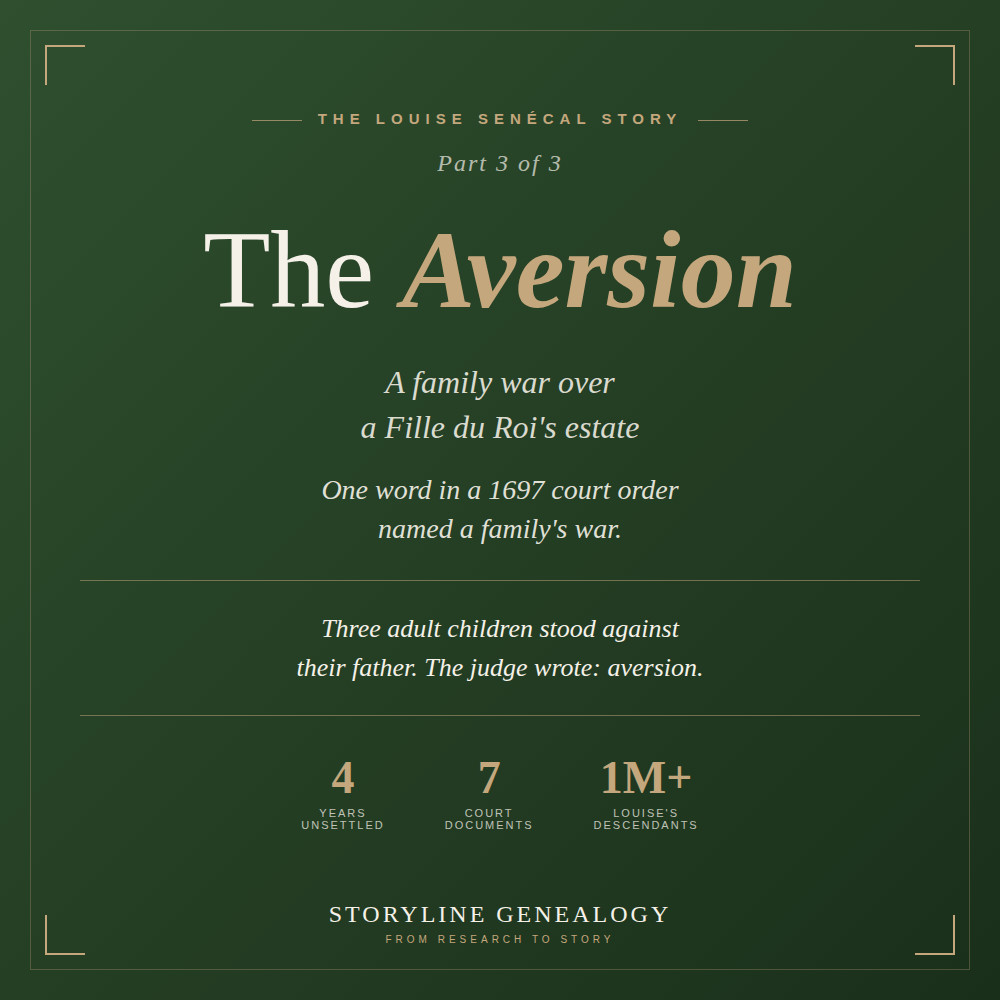
The Aversion: A Family War Over a Fille du Roi's Estate
On February 28, 1697, Provost Judge Guillaume Roger wrote a word that changed everything: "aversion." He wasn't describing a mild disagreement—he was documenting hostility so severe that normal legal proceedings couldn't work.
Who were these people who hated each other so intensely? A 52-year-old widowed farmer named Pierre Guilbault and his three adult children: Marie (29), Joseph (25), and Étienne (22).
What were they fighting over? Their dead mother's estate.
Louise Senécal arrived in Quebec in 1667 as a Fille du Roi—a King's Daughter sponsored by Louis XIV. She married in eleven days, raised four children, and built a prosperous farm over 26 years. When she died in 1693, her husband tried to remarry immediately and refused to settle her estate.
Her children waited nearly four years. Then they struck.
This is the story of how three siblings used the 17th-century court system to honor their mother's memory—and how primary sources documented a family war that would end in death, division, and justice.
Part of the Storyline Genealogy series: Uncovering the extraordinary stories hidden in ordinary family histories, one ancestor at a time.
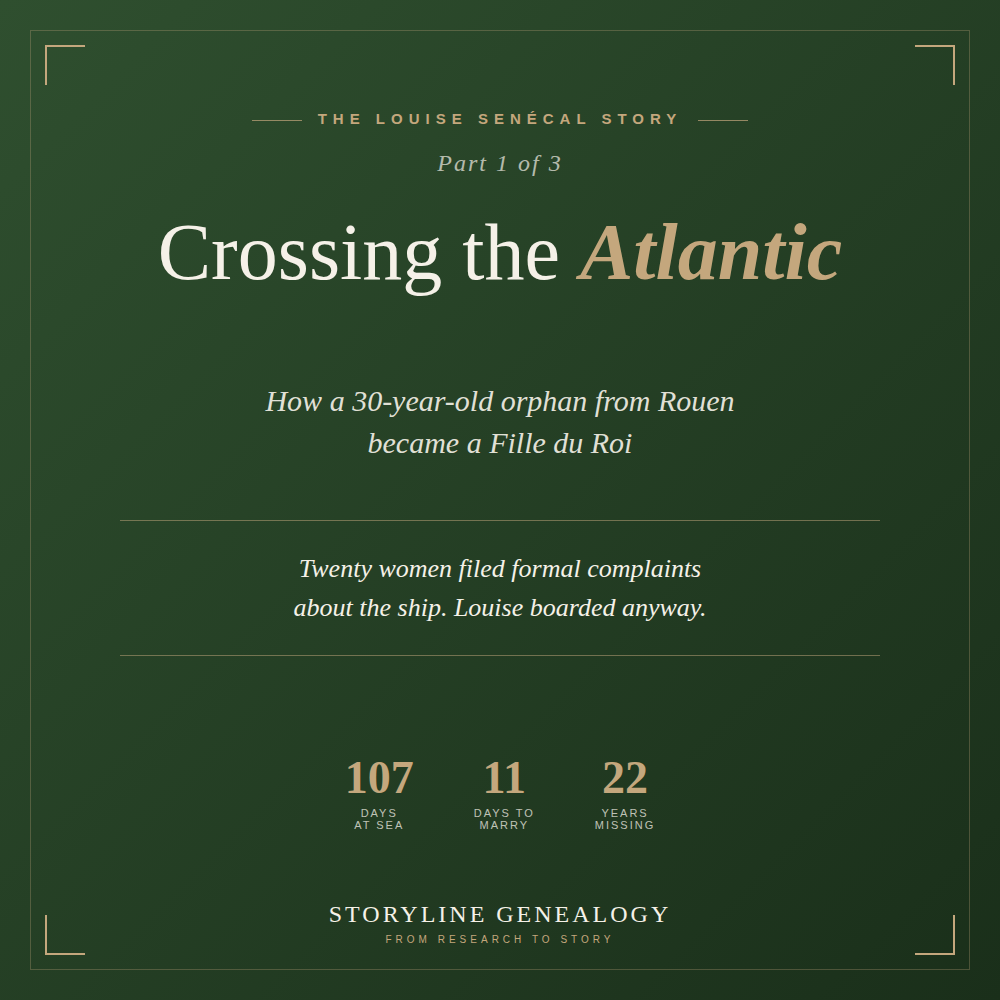
Crossing the Atlantic: How Louise Senécal Became a Fille du Roi
Before the family war that required judicial intervention, there was a ship. Louise Senécal ignored the warnings of 20 women who filed formal complaints about conditions aboard the St. Louis de Dieppe. She crossed the Atlantic anyway, survived 107 days at sea, and married a man who had failed twice before to secure a bride. Eleven days after stepping off the ship, she became Louise Guilbault of Charlesbourg.
Part of the Storyline Genealogy series: Uncovering the extraordinary stories hidden in ordinary family histories, one ancestor at a time.
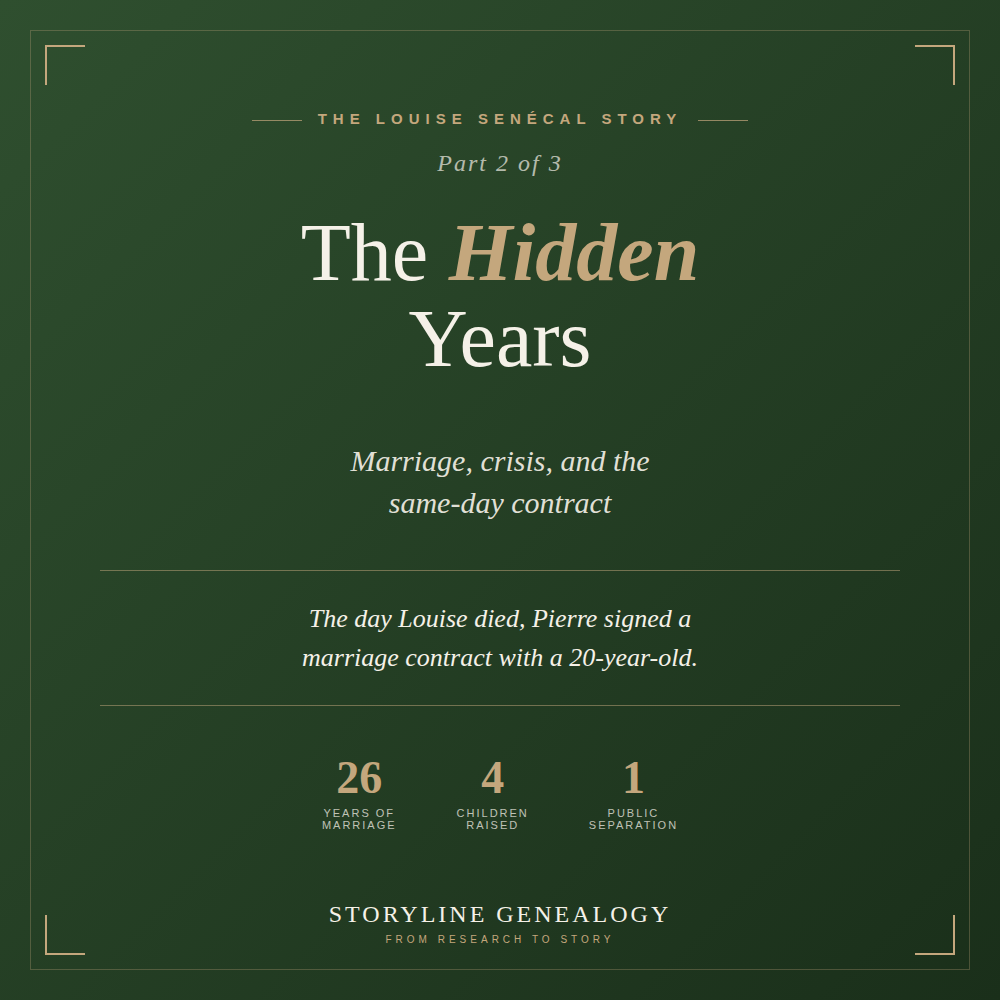
The Hidden Years: Marriage, Crisis and the Same-Day Contract
Pierre Guilbault appeared before a notary on April 13, 1693, to sign a marriage contract with 20-year-old Jeanne Morin. It was the same day his wife Louise died. The shocking timing—documented in colonial records—reveals the tensions that had been building in a marriage that survived separation, reconciliation, and 26 years of frontier life, only to end in a family war over Louise's estate.
Part of the Storyline Genealogy series: Uncovering the extraordinary stories hidden in ordinary family histories, one ancestor at a time.
When DNA Proves What Documents Can’t
After five years of research found no proof, DNA testing solved a 150-year-old mystery in three months. The breakthrough came when seemingly unrelated matches all pointed to the same Kentucky family.
Part of the Storyline Genealogy series: How DNA testing solved a brother relationship that five years of traditional research couldn't confirm
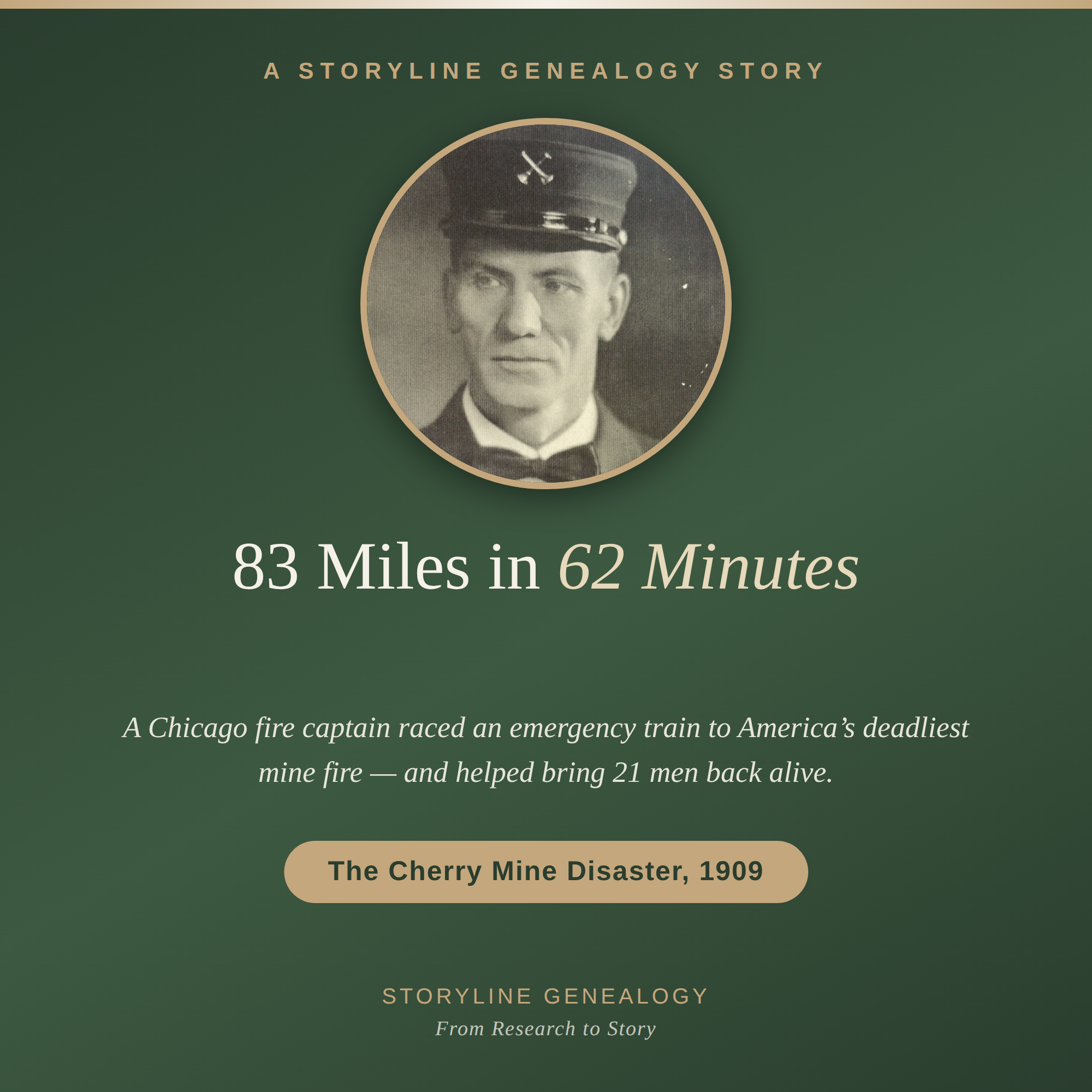
Hero in the Depths: Cherry Mine Disaster
In November 1909, Captain Thomas P. Kenny of the Chicago Fire Department received an urgent call that would define his 44-year career. Racing 83 miles by emergency train in just 62 minutes, Kenny and his specialized crew arrived at the Cherry Mine disaster - America's deadliest mine fire. His technical expertise in fighting underground blazes helped create the conditions that enabled one of the most miraculous rescues in industrial history: 21 miners found alive after eight days entombed underground.
Part of the Storyline Genealogy series: Uncovering the extraordinary stories hidden in ordinary family histories, one ancestor at a time.

The Missing Brother Mystery: How One Census Entry Unlocked a Three Country Family Story
Sometimes the most puzzling genealogical mysteries hide in plain sight. One census entry proved particularly haunting: 'Thornton Hammil' listed as Owen Hamall's brother in 1880 Chicago—but no such person seemed to exist anywhere else in the historical record. The breakthrough came where it often does in immigrant family research: in the margins of church records, where community relationships revealed themselves through acts of faith and mutual support.
Part of the Storyline Genealogy series: When mysterious census entries unlock complex family stories that span continents and generations
The Irish Immigrant’s Hidden Fortune
When I first began researching my own O'Brien family line, I expected the usual Irish immigrant story: poverty, hard work, gradual success. What I discovered was far more extraordinary—a tale of innovative marketing, federal criminal prosecution, and a cruel twist of fate that left four orphaned children impoverished while a fortune worth $250,000 in today's money sat hidden in the walls of their former home.
Part of the Storyline Genealogy series: Uncovering the extraordinary stories hidden in ordinary family histories, one ancestor at a time.
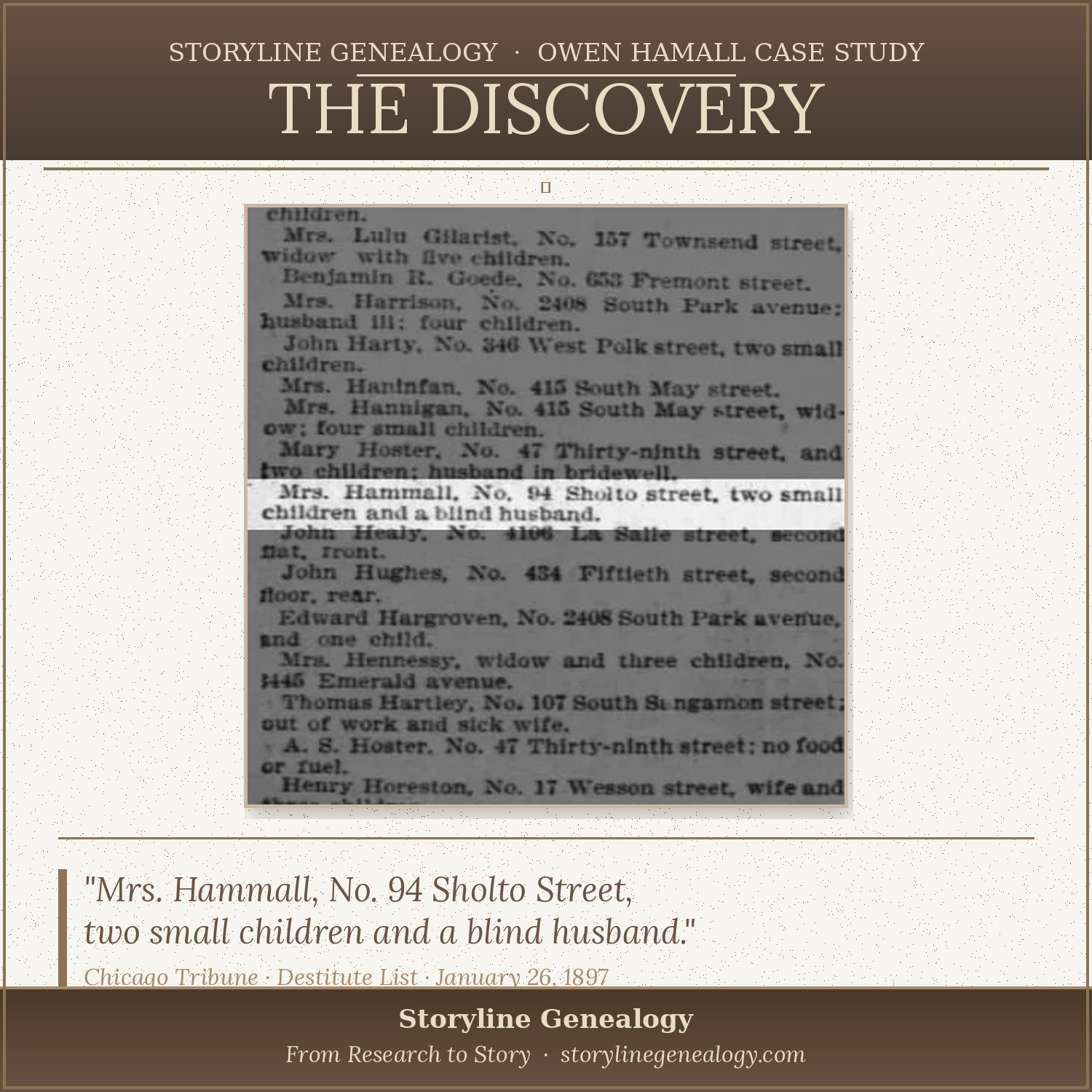
The Fire in Your Blood: From Chicago's Destitute List to Family Inspiration
When Owen Hamall died of meningitis in 1898, he left behind more than just a grieving family—he left behind a story of resilience that would echo through generations. This story was discovered not through grand family legends, but through a single newspaper clipping that reduced his family's struggle to twenty-three stark words: "Mrs. Hammall, 94 Sholto Street, two small children and a blind husband."
This entry in the Chicago Tribune's "Destitute List" from January 26, 1897, could have been just another piece of historical data. Instead, it became the foundation for understanding what it truly meant to be a Hamall descendant—and why some family stories deserve to be told as letters of strength to future generations.
Part of the Storyline Genealogy series: When family tragedies become letters of strength to future generations.

Four Words That Solved a Mystery
After seven years of failed research attempts with dozens of John Kennys in Brooklyn records, a single city directory entry changed everything. Discover how 'Kenny, Elizabeth, wid. Richard' unlocked an impossible genealogical puzzle and revealed an innovative research methodology.
Part of the Storyline Genealogy series: When traditional research methods fail, innovative approaches unlock the impossible cases that define professional genealogy.
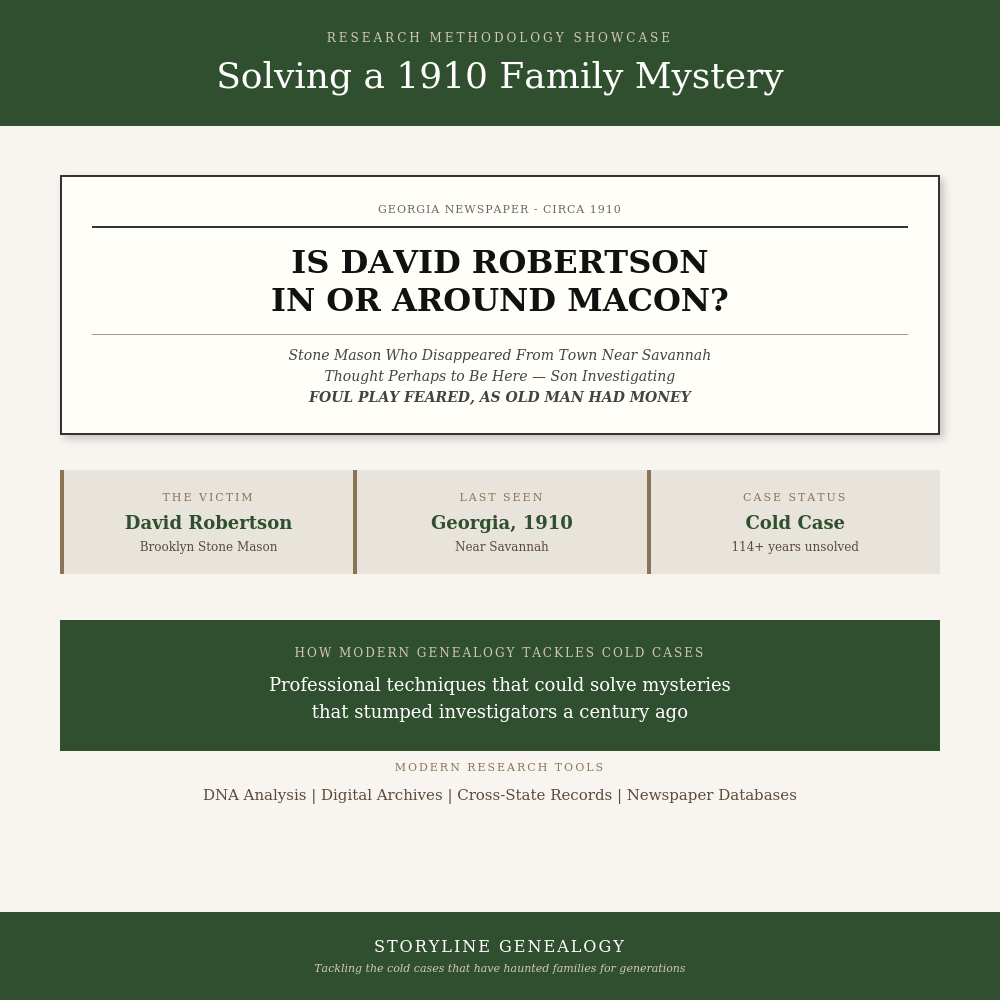
The Stone Cutter Who Vanished in Georgia
A Brooklyn stone mason vanished in Georgia in 1910, sparking a cross-state search by his devoted son. This cold case illustrates how modern DNA analysis, digital archives, and professional genealogy techniques could solve family mysteries that stumped investigators over a century ago.
Part of the Storyline Genealogy series: When professional research tackles the cold cases that have haunted families for generations.
Hidden in Plain Sight: Philippine Research Barriers
Have you ever hit a brick wall researching your Filipino heritage? For years, the Tamayo family of Aklan was a classic dead end—a marriage, an immigration trail to the United States, and almost nothing else. Then, in 2024, FamilySearch launched Full Text Search, a tool that reads the actual text inside digitized documents rather than just indexed names. A single query—"Tamayo" + "Aklan, Philippines"—surfaced a multi-generational paper trail that had been invisible for decades: a patriarch's 1936 residence certificate, the 1938 deeds that settled his estate and named his widow and children, and the property his son and daughter-in-law accumulated into the 1960s. This is how modern technology is making "impossible" Philippine genealogy possible.
Part of the Storyline Genealogy series: From Aklan to America | From Research to Story
From Agtawagon Hill to Hollywood: Three Generations of the Morales Family
There's a photograph from 1968 that captures pure joy: a young lawyer and his dietician bride at their wedding reception. But what it doesn't show is the weight this man carried—the memory of a father who disappeared on a Philippine mountainside in 1942, carrying rice. This is the story of three generations of the Morales family, spanning from wartime Aklan to the stages of Paris Fashion Week.
Part of the Storyline Genealogy series: From Aklan to America | From Research to Story
The Story of Mamerto Morales and Agtawagon Hill
Picture a young man in 1939, standing proudly in graduation robes, his eyes bright with the promise of a future that would never come. This is Mamerto Morales—a notary public in Kalibo, Aklan, trusted by his neighbors with their most important transactions. Three years later, when the Japanese invaded the Philippines, educated men like him became targets. In 1942, fleeing into the steep mountains of Balete toward Agtawagon Hill, Mamerto carried a heavy sack of rice to feed his children—and on those brutal slopes, his back gave out. His sons preserved every detail of that day for over seventy years. This is the story of how one family's tragedy reveals the hidden connections between individual lives and the sweeping currents of Philippine history.
Part of the Storyline Genealogy series: From Aklan to America | From Research to Story
Captain Lucas: The Land Builder
Discover how Captain Lucas Gonzales built a lasting family legacy in colonial Philippines through strategic land acquisition, surviving Spanish rule, revolution, and American occupation from 1835-1928.
Part of the Storyline Genealogy series. When historical titles hint at broader stories, comprehensive research reveals how military leaders transformed their service into community building and economic development.
Commemorative Poem: The Working Woman
"Do not judge her." A commemorative poem for Elisabeth Emma Guilbault, who was divorced on a Thursday and married on a Tuesday—five days to cross the Indiana line with a three-year-old and a need to survive.
Part of the Storyline Genealogy series: A Commemorative Poem for Elisabeth Emma Guilbault, The Working Woman (1883-1970)
Legacy Letter : Janvier Souliere
“You are the stones I laid for the future." A legacy letter imagining what Janvier Soulière—father of nineteen, husband to three wives, mason for sixty years—might say to the descendants who carry his name.
Part of the Storyline Genealogy Series : Letter to the Generations Who Carry My Name
Commemorative Poem: The Woman Who Was Remembered
Before Canada was a nation, she was born. Marie Louise Soulière married a voyageur who paddled away and never came back. She crossed the border with three small children, built a life in Chicago, buried two husbands, and lived to ninety-one. At ninety, she fished in the Florida sun beside a grandson too young to know her story—but he remembered her, told his daughter, and now we know. A commemorative poem from the Tranchemontagne documentary biography series.
From the Storyline Genealogy series: A Commemorative Poem for Marie Louise Soulière (1854-1945)
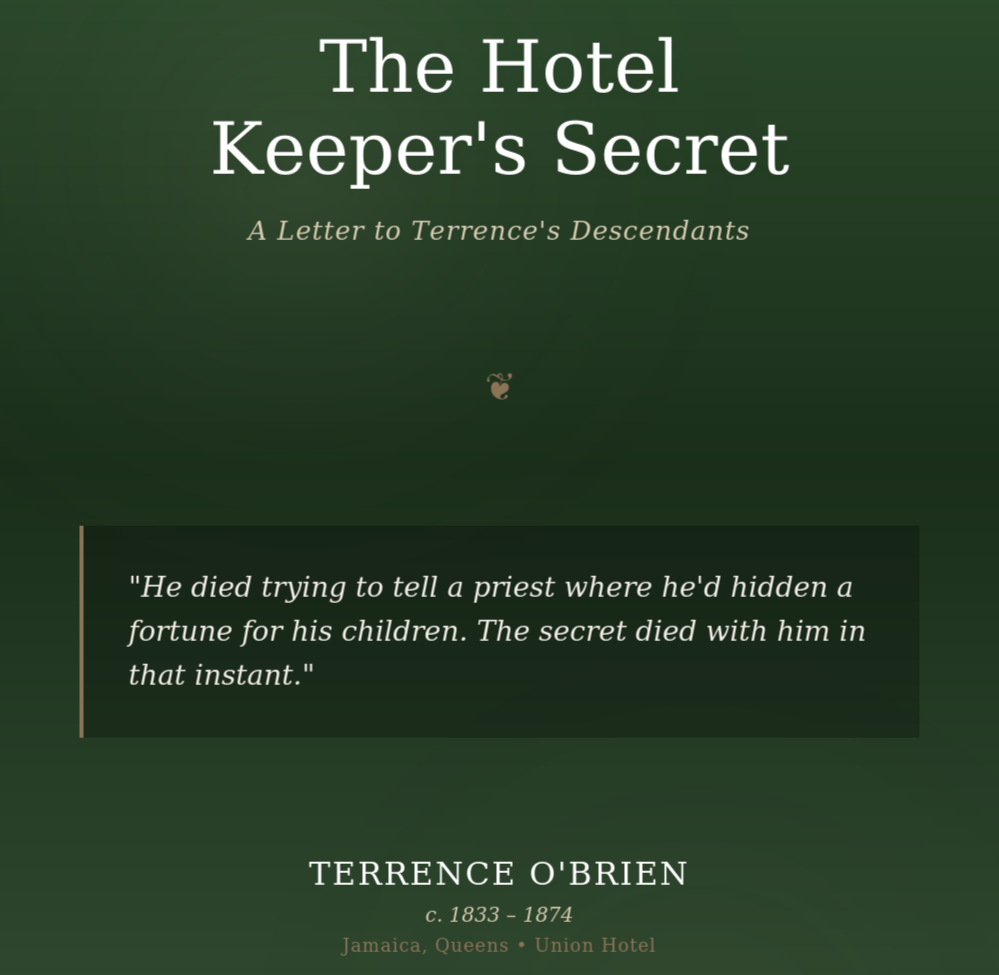
Legacy Letter : The Hotel Keeper’s Secret
A letter from Terrence O'Brien to his descendants — written in his voice, sharing what he wants them to know about ambition, loss, and the legacy he left hidden in the walls. Part of the Hidden Bonds documentary biography series.
Part of the Storyline Genealogy series: Legacy Keepsakes From Research to Story

Legacy Letter: The Fire in Your Blood
A letter from Owen Hamall to his descendants — written in his voice, sharing what he wants them to know about courage, loss, and the fire that started burning in County Monaghan in 1847.
Part of the Storyline Genealogy series: When family tragedies become letters of strength to future generations.