
Hidden Bonds: The Irish Boy Who Built an Empire
The Irish Boy Who Built an Empire
From Famine Ireland to Jamaica, Queens
c. 1832–1863 | County Clare, Ireland to Jamaica, Queens, New York
He carried the blood of kings. He arrived in America before his eighteenth birthday. He would build an empire—and lose it all.
This episode is part of the Hidden Bonds series. Before the hidden fortune, before the scattered orphans, before the DNA that would reunite a family after 150 years—there was a boy who fled famine Ireland carrying the genetic legacy of kings. This is the origin story of Terrence O'Brien, descendant of Brian Boru, who would transform himself from stable hand to hotel empire builder in the village of Jamaica, Queens.
"You are very closely related to the Royal O'Brien Line and Sir Conor Myles O'Brien in particular... The connection would be about 1400. The Clare Line—Catholic—they were thought to have died out, but through DNA we know they did not."
— Dennis O'Brien, Administrator, O'Brien Surname Project at FTDNAThe Blood of Kings
Our story begins over a thousand years ago with a man named Brian Bóramha—Brian Boru—who lived from 942 to 1014. He wasn't just any Irish chieftain. Brian Boru was the High King who united all of Ireland and died a hero's death at the Battle of Clontarf in 1014, defeating the Viking invaders even as he gave his life for his country.
Brian Boru founded what would become the Royal House of Thomond, and for centuries, his descendants ruled as kings and princes from their strongholds in County Clare and Limerick. They were the O'Briens—our O'Briens.
Around 1500, religious and political upheaval tore the royal family apart. The official royal line—the Inchiquin Line—converted to Protestant Christianity to keep their titles under English rule. But another branch—the Clare Line, the Catholic branch—refused to convert. These Catholic O'Briens were persecuted, taxed for their faith, and their records were deliberately destroyed. History lost track of them.
The Lost Line
For centuries, scholars believed this senior Catholic line had died out completely. They were wrong.

The Royal House of Thomond Y-DNA Descendants' Tree. The R-L226 haplogroup traces back to Brian Boru (941-1014). Our O'Brien family carries the R-FTE90337 marker, placing us within the Clare Line—the Catholic branch thought to have died out.
The DNA Proof
In the 21st century, descendants of Terrence O'Brien—Michael and Miles O'Brien—took advanced DNA tests. What they discovered changed everything we thought we knew about our family.
Their DNA carried a marker called R-FTE90337, which scientists have proven descends directly from R-DC782—the genetic signature of Brian Boru himself, dating to around 900 CE. This isn't speculation or wishful thinking. It's peer-reviewed science, published in the Journal of Genetic Genealogy after 20 years of research involving nearly a thousand O'Brien family members worldwide.
The closest DNA match to Michael and Miles is Kit #603927, a tester in Chicago whose family came from Ennis in County Clare—the heart of the ancient O'Brien kingdom. The DNA project administrator believes their ancestors "may have been brothers or cousins."
They also match Sir Conor Myles John O'Brien, who passed away as the 18th Baron of Inchiquin and the documented 32nd descendant of Brian Boru. The genetic distance between our family and his proves we share the same royal ancestor.
Royal Connection Confirmed
Out of 94 people worldwide who carry Brian Boru's genetic signature, our family is among them.
The Dál gCais and the Great Famine
The Dál gCais originated as a powerful 10th-century Gaelic clan associated with the Kingdom of Thomond, now County Clare. The O'Briens were the most prominent of the Dalcassian septs, producing the High King Brian Boru himself.
By the mid-19th century, an Anglo-Irish Protestant landowning elite dominated Ireland. The Gaelic dynasties had largely disappeared into obscurity, and most of the Gaelic Irish were illiterate peasants living in wretched poverty. Then came the Great Famine.
The Great Irish Potato Famine (1845–1852) ravaged County Clare. British laissez-faire policies exacerbated the crisis, leading to widespread death and destitution. Over a million people fled Ireland, with many families from County Clare joining the exodus—including, we believe, the family of a boy named Terrence O'Brien.
Bridget and Her Sons
The matriarch of the American O'Brien family was Bridget O'Brien, born around 1802 in Ireland. She would live to age sixty-seven, dying in 1869 at the residence of her son Terrence in Jamaica, Queens. But her early life—her maiden name, her birthplace, her husband's identity—remains shrouded in the deliberate destruction of Catholic Irish records.
What we know is that Bridget raised at least two sons: Terrence, who settled in Jamaica, Queens, New York, and Patrick, who settled in Newport, Kentucky. Whether the brothers emigrated together and later separated, or emigrated at different times to different destinations, remains unknown. But DNA testing 150 years later would prove definitively that Patrick O'Bryan of Kentucky was indeed Terrence's brother—validating a single line in an 1875 probate document that mentioned "Uncle Patrick O'Brien in Newport, Kentucky."
Our first documented evidence of Bridget in America comes from June 1866, when the Long Island Farmer listed "O'Brien, Mrs. Bridget" among letters remaining unclaimed at the Jamaica, N.Y. post office. She lived with her son Terrence at the Union Hotel, where she played an active role in the household—a story that continues in Episode 2.

Long Island Farmer, June 5, 1866: "O'Brien, Mrs. Bridget" listed among letters remaining unclaimed at the Jamaica, N.Y. post office. Our first documented evidence of Terrence's mother in America.
The Boy Who Arrived Before Eighteen
Terrence O'Brien was born in Ireland around 1832. He would later testify, under oath, that he arrived in the United States before attaining his eighteenth year—meaning before 1850, at the height of the Great Famine. He was one of millions of Irish who fled starvation and disease for the promise of America.
He settled in Jamaica, Queens County, New York—a village that would become his home for nearly forty years. According to his obituary, Terrence had lived in Jamaica "from almost his childhood days."
On October 10, 1856, at age twenty-three, Terrence stood before the Queens County Court to become a naturalized citizen. His witnesses were Denis Moloney—a fellow Irishman—and Bernardus Hendrickson, a name that suggests Terrence had already built connections within Jamaica's Dutch-descended establishment. He renounced his allegiance to "Victoria, Queen of Great Britain & Ireland" and swore to support the Constitution of the United States.

Naturalization Declaration, October 10, 1856, Queens County Court. Terrence testified that "at the time he so arrived in the United States he had not attained his eighteenth year."
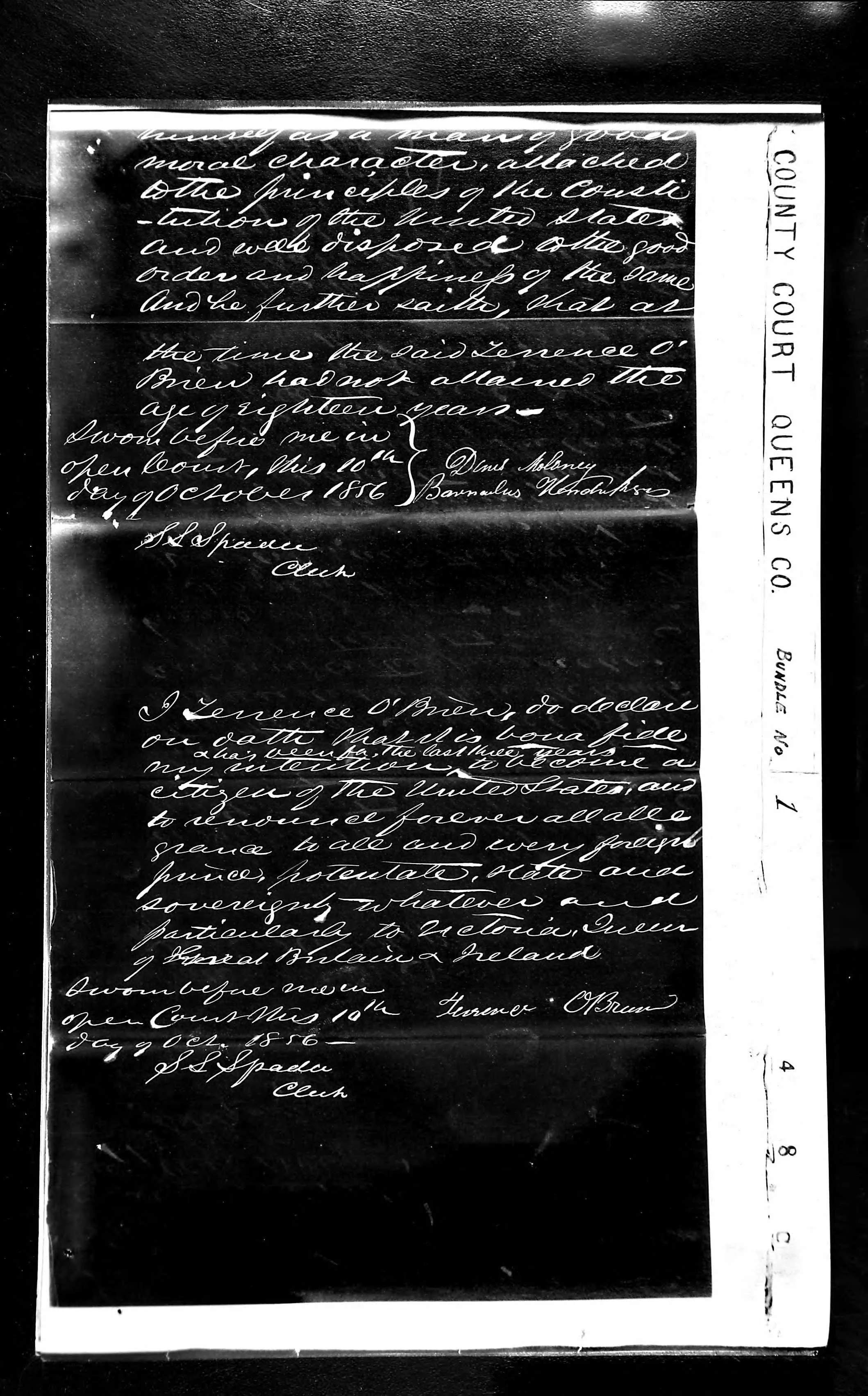
Page 2: Witnesses Denis Moloney and Bernardus Hendrickson testified to Terrence's good moral character. He declared his intention "to become a citizen of the United States, and to renounce forever all allegiance... particularly to Victoria, Queen of Great Britain & Ireland."
From Stable Hand to Hotel Proprietor
Terrence started at the absolute bottom—mucking horse stalls as a stable hand at Remsen's Hotel. But he possessed something rare: the ability to see opportunity where others saw only work. His obituary would later note that "his knowledge of horses, and his attention to his business, made him many friends." In this position, he "acquired some money" and opened a hotel of his own.
By 1859, "T. O'Brien R.R. Hotel" appeared on the village map—the Railroad House, strategically positioned near the Long Island Rail Road depot. The descendant of Irish kings was now a hotel proprietor.

1859 map of Jamaica, Queens County. The business directory lists "T. O'Brien — R.R. Hotel" among the village's established hotels. At twenty-six, the former stable hand now operated his own establishment.
The 1860 census captured Terrence at age twenty-seven. Interestingly, the census still lists his occupation as "Laborer"—perhaps a transcription error, or perhaps he was downplaying his success. But his assets told the real story: $2,000 in real estate and $1,000 in personal property. This was substantial wealth for a young Irish immigrant.

1860 Federal Census, Jamaica, Queens County. Line 5: Terence O'Brien, age 25, "Laborer," Ireland. $2,000 in real estate, $1,000 in personal property. Living with him: two women named Ann O'Brien (wife and sister? sister-in-law?).
The Civil War
When the Civil War erupted, Terrence enlisted in Company G of the 31st New York Infantry on May 27, 1861. He was about twenty-eight years old, a hotel proprietor with a wife and young son. He served for over two years, mustering out on June 4, 1863.
A month later, on July 1, 1863, the provost marshal conducted a draft registration of all men subject to military duty. Terrence appeared on the list for Jamaica, Queens County—now recorded as "O'Brien Terrence," age 31, occupation: "Inn Keeper." The census designation of "Laborer" was gone. His true profession was now on the record.
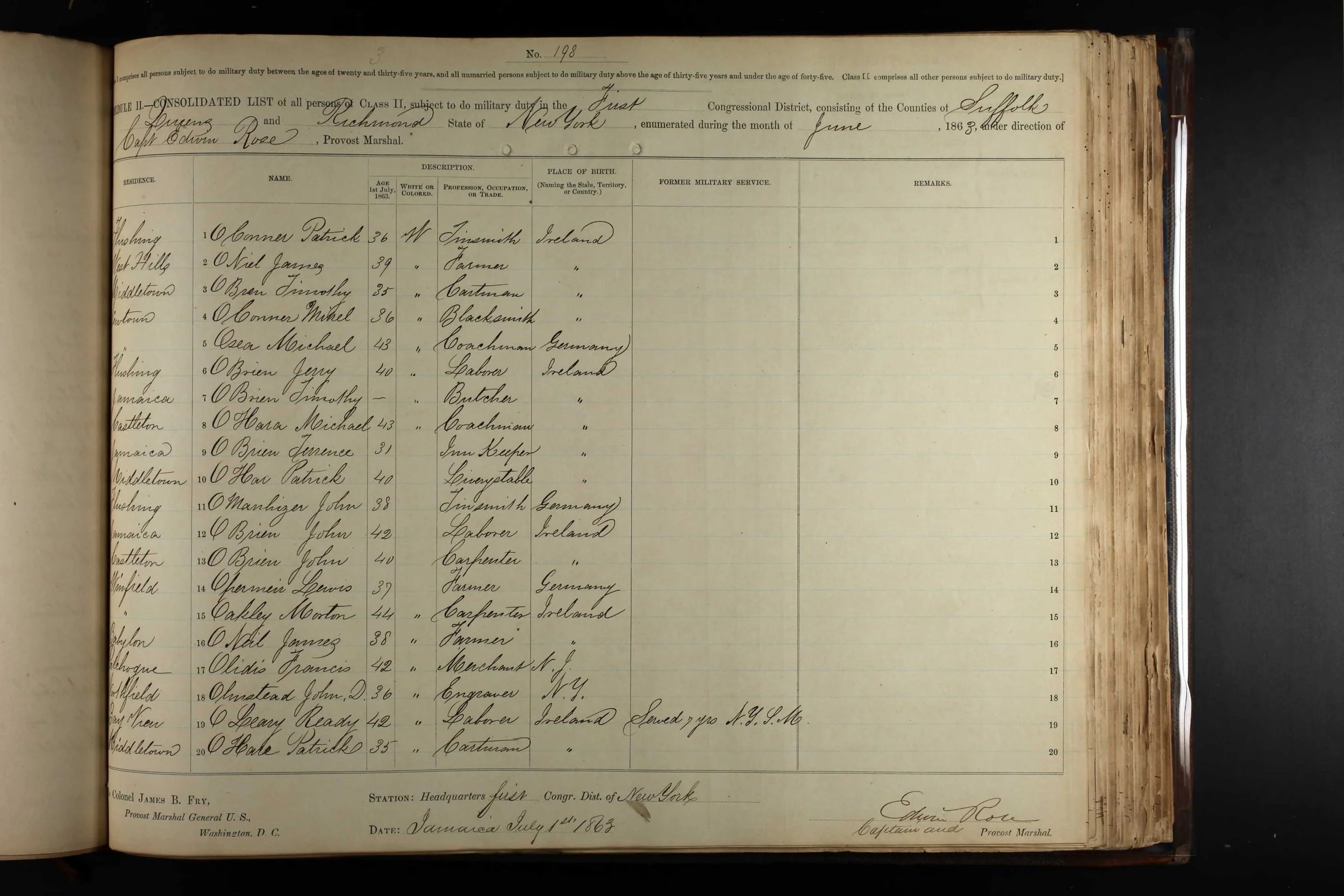
Civil War Draft Registration, Jamaica, July 1, 1863. Line 9: "O'Brien Terrence," age 31, "Inn Keeper," born Ireland. Class II registration indicated his married status.
Terrence returned to Jamaica a veteran, ready to expand his business. He would soon acquire the Union Hotel at the corner of Fulton and Church Streets—the prime location in Jamaica. He would marry twice, father four children, face federal prosecution, and die with secrets hidden in his kitchen wall.
But that is the story of the next episode.
The Living Legacy
Today, there are fewer than 100 people on Earth who carry Brian Boru's genetic signature. Terrence O'Brien's descendants are among them.
Terrence O'Brien may have died in 1874 never knowing he carried royal blood. But his descendants—through DNA science—now know the truth. They carry forward the genetic legacy of the king who united Ireland, making them living, breathing members of Irish royalty.
The blood of kings flows in their veins. Science has proven it. History confirms it.
Welcome to the Royal House of Thomond
You've been a member all along.
Evidence Analysis
PRIMARY SOURCE: 1856 Naturalization Declaration
This document establishes Terrence's immigration timeline. His sworn testimony that he "had not attained his eighteenth year" when he arrived places his emigration before 1850—during the Great Famine. The witnesses—Denis Moloney (Irish) and Bernardus Hendrickson (Dutch)—show he had built connections across Jamaica's ethnic communities within a decade of arrival.
PRIMARY SOURCE: 1859 Jamaica Map
The map's business directory lists "T. O'Brien — R.R. Hotel" alongside established Jamaica businesses. This contradicts the 1860 census listing of "Laborer" and proves Terrence was already operating an independent hotel by age twenty-six—just three years after naturalization.
PRIMARY SOURCE: 1863 Draft Registration
This record captures Terrence one month after mustering out of the 31st New York Infantry. His occupation is now officially listed as "Inn Keeper"—the first federal record confirming his hotel proprietor status. The Class II registration indicates his married status, consistent with his marriage to Ann Higgins.
PRIMARY SOURCE: Royal House of Thomond Y-DNA Analysis
The O'Brien Surname Project at FTDNA, developed over 20 years with nearly 1,000 participants, established the R-L226 haplogroup as the genetic signature of the Dál gCais clan. Our family's R-FTE90337 marker places us within the Clare Line—the Catholic branch—with our closest match being a descendant of O'Briens from Ennis, County Clare. The project administrator confirmed: "You are very closely related to the Royal O'Brien Line."
PRIMARY SOURCE: 1866 Post Office Listing
This document provides our first evidence of Bridget O'Brien in America. The post office listing confirms she was in Jamaica by June 1866, living with her son Terrence at the Union Hotel. Her role in the household—and her character—would be documented further in newspaper accounts of that year's hotel fire, detailed in Episode 2.
Document Gallery
Royal House of Thomond
Y-DNA Descendants' Tree
DNA
1856 Naturalization
Declaration Page 1
Naturalization
1856 Naturalization
Declaration Page 2
Naturalization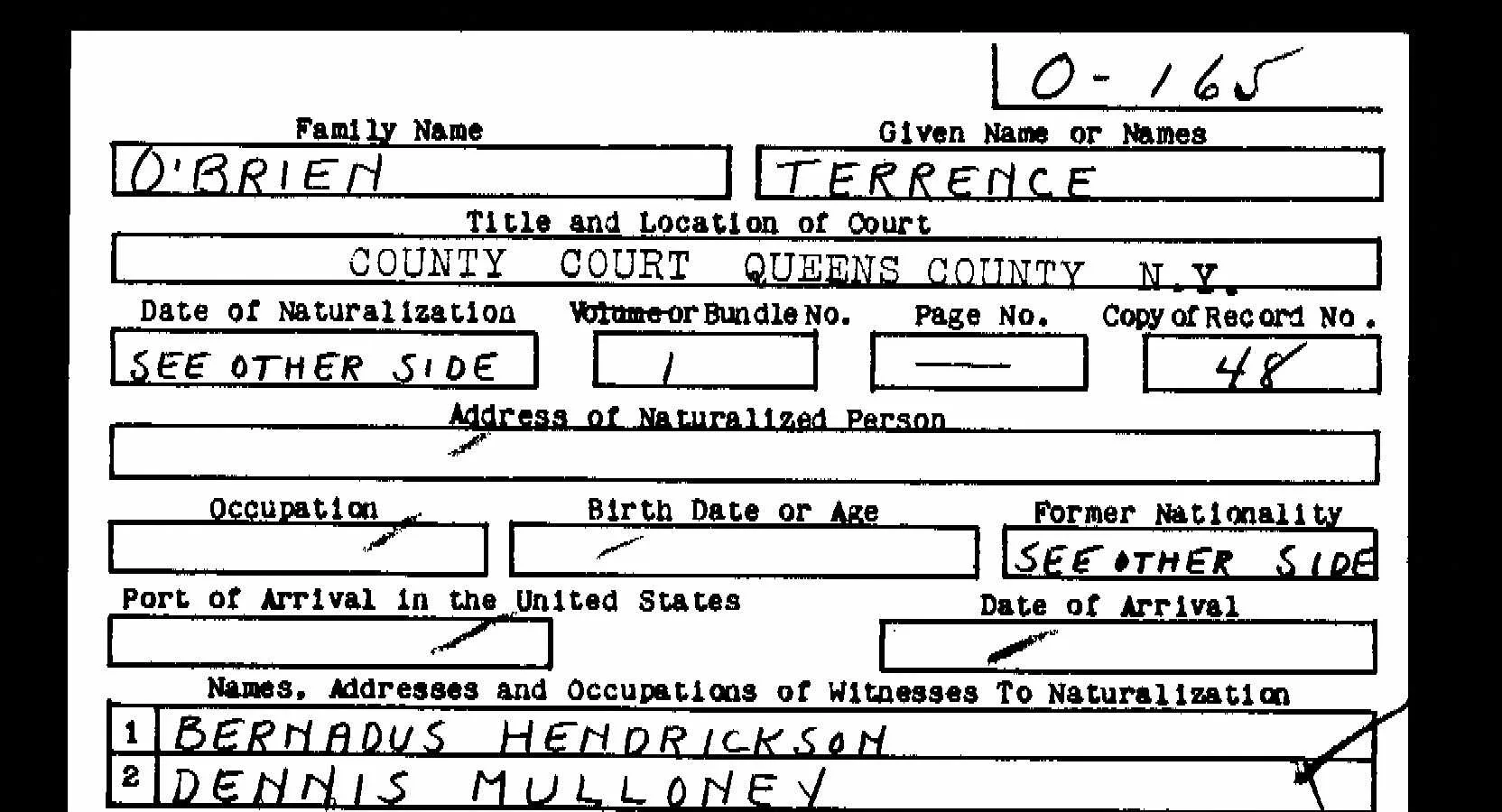
Naturalization Index
Record #48, Queens County
Naturalization
1859 Jamaica Map
"T. O'Brien — R.R. Hotel"
Map
1860 Federal Census
$2,000 real estate, $1,000 personal
Census
1863 Draft Registration
"Inn Keeper" — Civil War
Military
1866 Post Office Listing
"O'Brien, Mrs. Bridget"
NewspaperContinue the Story
← Hidden Bonds: Series Overview Episode 2: A Colorful Life and a Secret Untold → The Union Hotel years, the legal troubles, and the hidden fortune Episode 3: Four Orphans and a Hidden Fortune The day the family shattered Episode 8: The Kentucky Brother Patrick O'Bryan and the DNA reunionAre You Connected to the O'Brien Line?
If you descend from Terrence O'Brien of Jamaica, Queens or his brother Patrick O'Bryan of Newport, Kentucky — under any spelling of O'Brien, O'Bryan, O'Bryen, or O'Brian — or from the connected Higgins, Bedell, McNamara, or Kentucky Kuptz, Lyhan, Powell, or Browne lines, I’d like to compare notes. Documented trees, DNA matches, family papers, and even half-remembered stories have all moved this research forward.
Get in Touch About This FamilyCousin connections are informal and reciprocal — no fee, no obligation, just shared work on shared ancestry.
Every Family Has a Story Worth Telling
Whether you're just beginning your research or ready to transform years of work into a narrative your family will treasure, I'd love to hear your story.
BEGIN YOUR RESEARCH INQUIRY