
Pierre Morin & Catherine Lemesle
The documentary biography draws on a curated selection of primary source images. The complete research inventory below holds all 101 — including nine notarial acts from two greffes, the rent roll of the seigneurie in which this family farmed, 10 Archiv-Histo page references, PRDH individual records for all eight children, detail transcriptions, examined-but-excluded evidence, and every claim this practice has withdrawn, recorded with its dated rationale.
What changed, and why this file is worth reading now
For most of a year this site stated that Pierre Morin served in the La Noraye company of the Carignan-Salières Regiment. That claim rested on a single line in the 1668 muster roll — a line that carries a name and nothing else. Two specialist compilations now assign it to two different men, and there were four soldiers named Morin in the regiment. The service is recorded here as unproven. Not disproven — unproven.
What has taken its place is a documented working life. Nine notarial acts across twenty years and the rent roll of the seigneurie of Saint-Ignace now establish where this man held land, from whom, on what terms, alongside whom, and at what trade. He was a censitaire of the Augustines of the Hôtel-Dieu from July 1670, owing them forty-eight sols and two live capons every Christmas; he took a second holding across the river at Lauzon in 1675 with the same partner he had farmed beside since the beginning; and in 1690 a notary called him a carpenter, the only occupation recorded for him anywhere.
Twenty-one claims previously published across these pages have been withdrawn or corrected — the dit name, the captain's identity, the family's residence, a reading of the marriage contract that had them both literate when neither could sign, and one working conclusion of this practice's own that a finding aid caused it to reach in error. All of it is kept visible. The research file is where the failures are documented in full, and it is the most useful thing in this collection for anyone working the same ground. Read the case study →
Document Preview
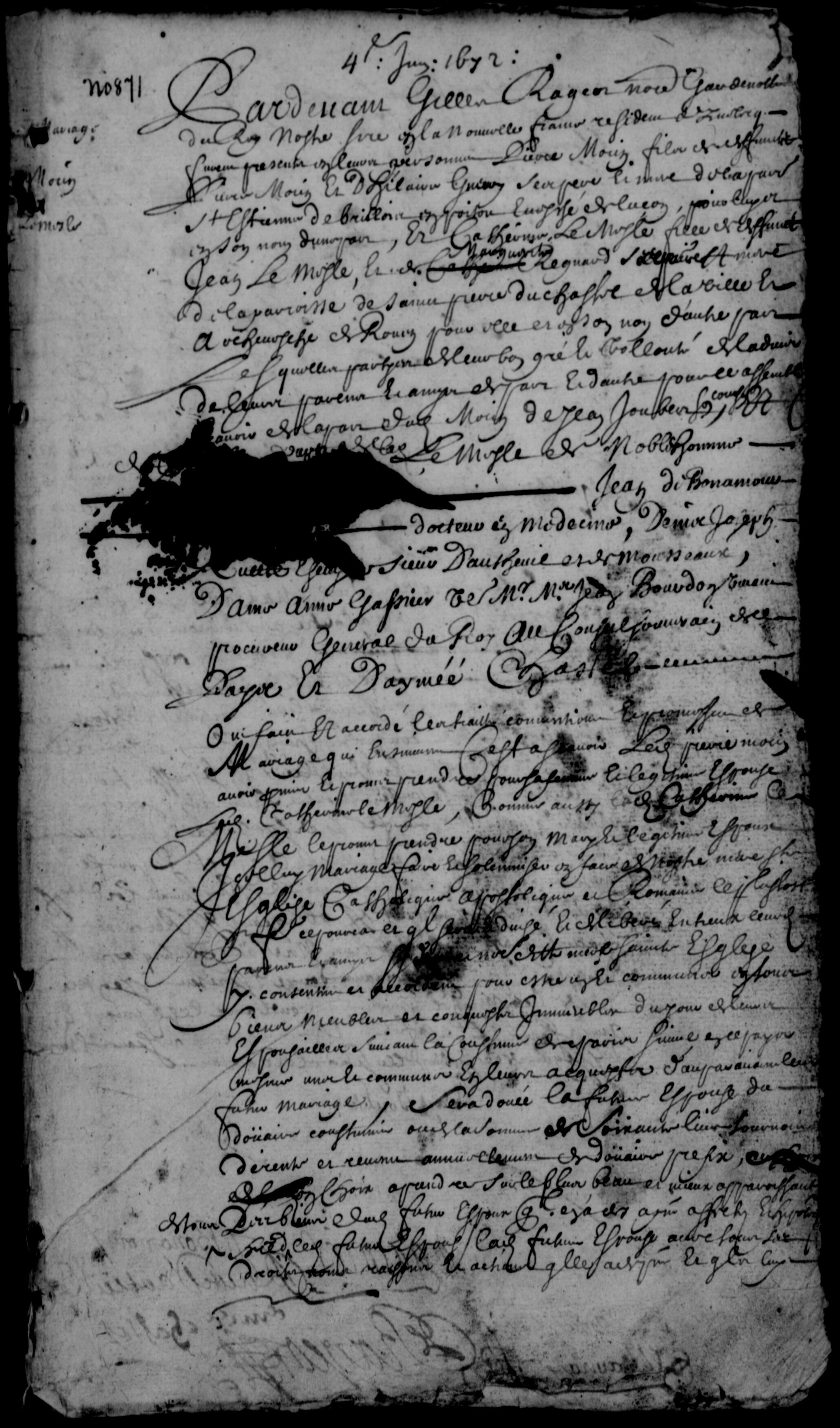

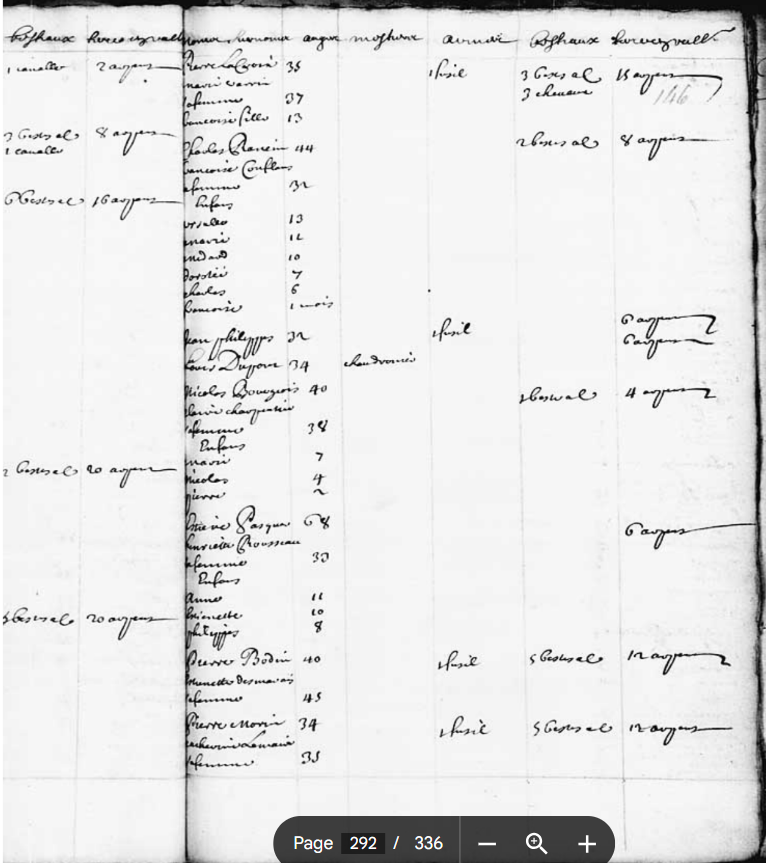
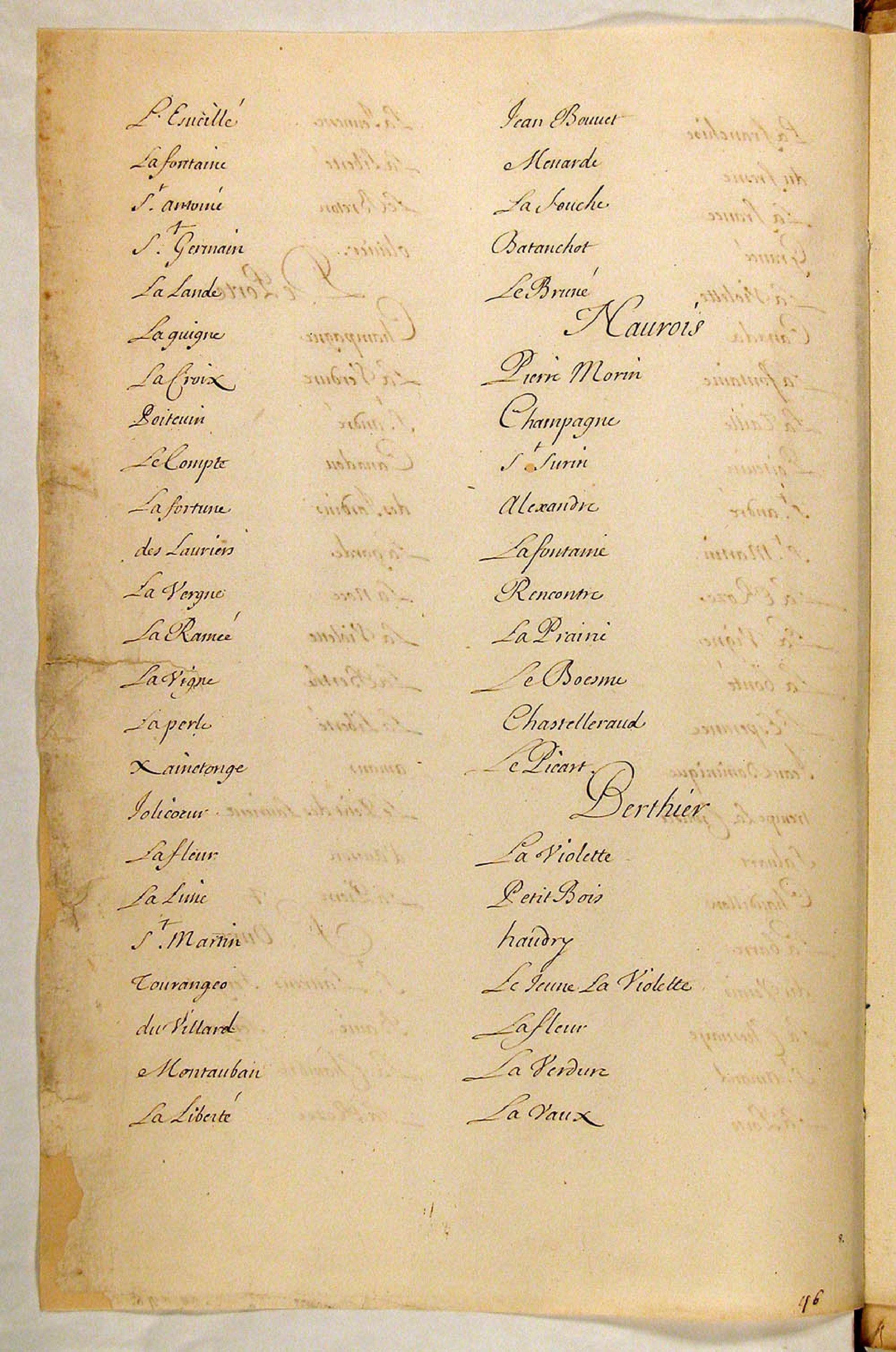
What's Included in the Complete Research File
Document Inventory
| Notarial acts — greffe of Gilles Rageot (S238) | 14 images | Eight acts + finding aids |
| Notarial acts — greffe of Paul Vachon (S266) | 12 images | Two concessions + répertoire |
| Seigneurial records — terrier of Saint-Ignace | 4 images | Folios 3, 4, 11 + tenanciers |
| Marriage records (contract, register, banns) | 11 images | Complete |
| Census records (1681 Petite Auvergne + 1667) | 3 images | Complete |
| Death, burial & Hôtel-Dieu medical records | 6 images + 10 refs | Complete |
| Children's baptisms, burials & PRDH records | 22+ images | All 8 children |
| Catherine Lemesle origin records | 4 images | Complete |
| Military attribution sources | 10 images | Unresolved |
| Examined & excluded evidence | 1 image | Cataloged per BCG |
| Additional deployment images & lineage charts | 5 images | Complete |
| TOTAL | 101 images + 10 refs |
Access the Complete Research File
Choose how you'd like to view the full document inventory
Are You a Descendant of Pierre Morin & Catherine Lemesle?
With an estimated 560,000 to 980,000 living descendants, Pierre and Catherine's family tree is one of the largest in Québec. If your ancestry passes through the Deguise dit Flamand, Guilbault, Bridault, Payant, Legris Lépine, or Bezeau families, you may descend from this couple. Three documents are actively sought: the land cession at Batiscan recorded by Langlois without a citation; the two concessions of 29 July 1670 granted to Jacques Gauthier and to Simon Chardieu, under which Pierre held his land; and anything disposing of the Lauzon half-share taken in 1675. If you hold any of them — or any notarial act naming Pierre Morin between 1665 and 1672 — please make contact. Get in touch.
About This Research
This file is the complete evidentiary foundation for the Pierre Morin documentary biography. His origin — Saint-Étienne-de-Brillouet, diocese of Luçon, Poitou — is stated in four separate documents spanning 1672 to 1706. Those are four independent records, though not four independent informants: each traces back to Pierre or his household telling a scribe where he came from, and no French register has been located to verify it. That distinction is drawn explicitly throughout the file. All eight children's records have been located and documented.
His military service is a separate question, and an open one. The 1668 muster roll names a Pierre Morin under the Naurois company; whether that is this man is disputed between two specialist compilations, and no document has been produced that settles it. The file records what each source contains, what it does not, and where this practice's own reasoning went wrong.
His landholding is now the best-documented part of his life, and the file sets out both what the records establish and what they do not yet reconcile. In September 1671 he sold a concession held of the Hospitalières; the seigneurial roll nonetheless shows him holding both his 1670 parcels and paying dues on them through 1690. No page on this site asserts an unbroken chain of tenure until that is resolved.
The inventory follows BCG evidence standards, including transparent documentation of searched-but-not-found records, examined-but-excluded evidence, withdrawn claims kept visible with dated rationale, and clearly identified remaining research leads. Read the full methodology →
Pierre Morin dit Champagne & Catherine Lemesle
This documentary biography draws on a curated selection of 48 primary source images. The complete research inventory below includes 71 Squarespace images — including the 1668 muster roll listing Pierre Morin by name under the Naurois company — 10 Archiv-Histo page references, PRDH individual records for all 8 children, detail transcriptions, examined-but-excluded evidence (including the Chambly confirmation), and full source citations for every document consulted.
Document Preview
What's Included in the Complete Research File
Document Inventory
| Marriage records (contract, register, banns) | 11 images | Complete |
| Census records (1681 + 1667 probable) | 3 images | Complete |
| Death, burial & Hôtel-Dieu medical records | 6 images + 10 refs | Complete |
| Children's baptisms, burials & PRDH records | 22+ images | All 8 children |
| Catherine Lemesle origin records | 4 images | Complete |
| Military identification | 10 images | Confirmed |
| Examined & excluded evidence | 1 image | Cataloged per BCG |
| Additional deployment images & lineage charts | 5 images | Complete |
| TOTAL | 71 images + 10 refs |
Access the Complete Research File
Choose how you'd like to view the full document inventory
Are You a Descendant of Pierre Morin dit Champagne?
With an estimated 560,000 to 980,000 living descendants, Pierre and Catherine's family tree is one of the largest in Québec. If your ancestry passes through the Deguise dit Flamand, Guilbault, Bridault, Payant, Legris Lépine, or Bezeau families, you may descend from this soldier and his Fille du Roi bride. Get in touch — we'd love to hear your family's story.
About This Research
This research file represents the complete evidentiary foundation for the Pierre Morin dit Champagne documentary biography. Pierre's military service is confirmed by the 1668 muster roll — the official list of soldiers who became inhabitants of New France — which lists him by name under the Naurois company (Library and Archives Canada, Colonies D²ᶜ 47). His origin — Saint-Étienne-de-Brillouet, diocese of Luçon, Poitou — is confirmed by four independent primary documents: the 1672 marriage contract, the 1672 marriage banns, the 1706 Hôtel-Dieu admissions registry, and the 1706 burial register. All eight children's records have been located and documented.
The inventory follows BCG (Board for Certification of Genealogists) evidence standards, including transparent documentation of searched-but-not-found records, examined-but-excluded evidence (the Chambly confirmation), and clearly identified remaining research leads. Read the full methodology →