
Philibert Couillaud dit Roquebrune
The Subject
Philibert Couillaud was born around 1641 in the diocese of Nevers, Nivernais. He arrived with the Carignan-Salières Regiment in 1665, was confirmed at Chambly in 1669, and by 1675 had settled permanently in the Seigneurie de Contrecoeur. He married Catherine Laporte dit Saint-Georges — daughter of Jacques de Laporte dit Saint-Georges and Nicole Duchesne — around the fall of 1675. He died sometime before 8 March 1701, leaving no burial record. Together with Catherine, he fathered eleven children across roughly a quarter-century. Their descendants bear the surnames Larocque, Roquebrune, Larock, Rock, Rockburn, and more than a dozen variants.
His name appears in the documentary record in at least nine distinct spellings: Couillaud, Couillaut, Couillat, Coulleau, Caillou, Rocbrune, Rocquebrune, Roquebrune, and Larocque. He could not read or write. He left no birth record and no death record. His marriage contract has never been found. What remains is a scattered archive of civil records, notarial obligations, lawsuits, and legal proceedings generated by his presence — and by his absence.
This methodology documents how the facts of his life were established from these fragments, what evidence was examined and excluded, and how the legal documents generated after his death paradoxically provide the most specific information about his life — including the terms of the marriage contract that does not survive.
| Full Name | Philibert Couillaud dit Roquebrune (also Larocque) |
| Born | c. 1641, diocese of Nevers, Nivernais, France |
| Parents | Unknown. No primary document names his parents. |
| Arrived New France | 1665, with the Carignan-Salières Regiment |
| Confirmed | 21 May 1669, Chambly (Saint-Joseph), by Mgr de Laval. PRDH #403509, rank 05 of 8 |
| Marriage | c. fall 1675. PRDH records the marriage as "avant 1677, lieu indéterminé (au Québec)." No marriage record survives. |
| Spouse | Catherine Laporte dit Saint-Georges (baptized 12 Oct 1663, Notre-Dame-de-Montréal; buried 11 Apr 1737, Varennes) |
| Spouse's Parents | Jacques de Laporte dit Saint-Georges & Nicole Duchesne — recorded by deduction, not from a filiation clause |
| Children | 11 documented (PRDH Family #4480); 13 proposed by Larocque analysis |
| Death | Before 8 March 1701. No burial record survives. |
| PRDH Individual # | 38853 |
| PRDH Family # | 4480 |
| FrancoGene # | [16026] |
| Dit Name Origin | Roquebrune / Rocbrune — toponymic in form, from roc brun (brown rock); first attested 1667 |
PRDH-IGD Individual Record #38853
| Name as recorded | Philibert Larocque Rocbrune Couillau |
|---|---|
| Status | Immigrant |
| Birth | Vers 1641 — év. Nevers, Nivernais (Nièvre) |
| First marriage | Avant 1677, lieu indéterminé (au Québec) |
| Spouse | Catherine Laporte Stgeorge |
| Her father | Jacques Laporte Stgeorge |
| Her mother | Nicole Duchene |
FrancoGene Record [16026]
| Name as recorded | Couillaud dit Larocque et Rocquebrune, Philibert |
|---|---|
| Occupation | Soldier, Contrecoeur company, Carignan regiment |
| Birth | About 1641 (from the 1681 census) — Nevers, diocese (Nièvre: 58194) |
| Marriage | Before 1676, from Contrecoeur (queried in the source) |
| Spouse's parents | Jacques de Laporte dit Saint-Georges & Nicole Duchesne [409] — noted "from deduction" |
| Children listed | 11 |
| Bibliography | PRDH-RAB |
Both compilations are derivative. PRDH-IGD and FrancoGene draw on the same underlying repertoire of Québec parish registers (PRDH-RAB), which means agreement between them is not independent corroboration. Where they differ — in name forms, in dates, in the rendering of dit names — the difference is recorded in this methodology rather than reconciled silently, and the original register or notarial act governs.
Both also flag Catherine's parentage as a deduction rather than a filiation drawn from her baptism entry. That qualification is carried forward wherever her parents are named.
Why Direct Proof Was Systematically Unavailable
Establishing the facts of Philibert Couillaud's life confronts three compounding evidentiary obstacles that do not appear in most colonial genealogical cases: a fraudulent noble pedigree embedded in the secondary literature, two separate fires that destroyed parish records, and a subject who was illiterate and left no autograph documents. Each obstacle required a distinct methodological response.
The Fraudulent Noble Pedigree
For generations, a segment of the genealogical literature placed Philibert as a son of the alleged noble Bernard de Laroque and Marie de Marsilly, connecting him to southern French aristocracy. This lineage was fabricated by Robert de Roquebrune (1889–1978) — a Québec novelist, journalist and archivist who invented a noble pedigree for his own family. It was published in the review Nova Francia in 1929 under the pseudonym Pierre Gauthier, which is what allowed a claim about its author's own ancestry to circulate as though it came from a disinterested third party. The fabrication persisted because de Roquebrune held archival credentials and wrote for a general readership, and because researchers then had little means of testing claims about pre-1665 French records.
The fiction has no evidentiary foundation. No primary document — French or Canadian — names Philibert's parents. The only contemporaneous record identifying his origin is the 1669 confirmation register at Chambly, which states explicitly: "Philbert Couilliau de Nevers." Nevers is in the Nivernais — not the south of France, not a region associated with the fictional Bernard de Laroque, and not a location consistent with any element of the fabricated genealogy.
The Two Fires: The 14.5-Year Documentary Void
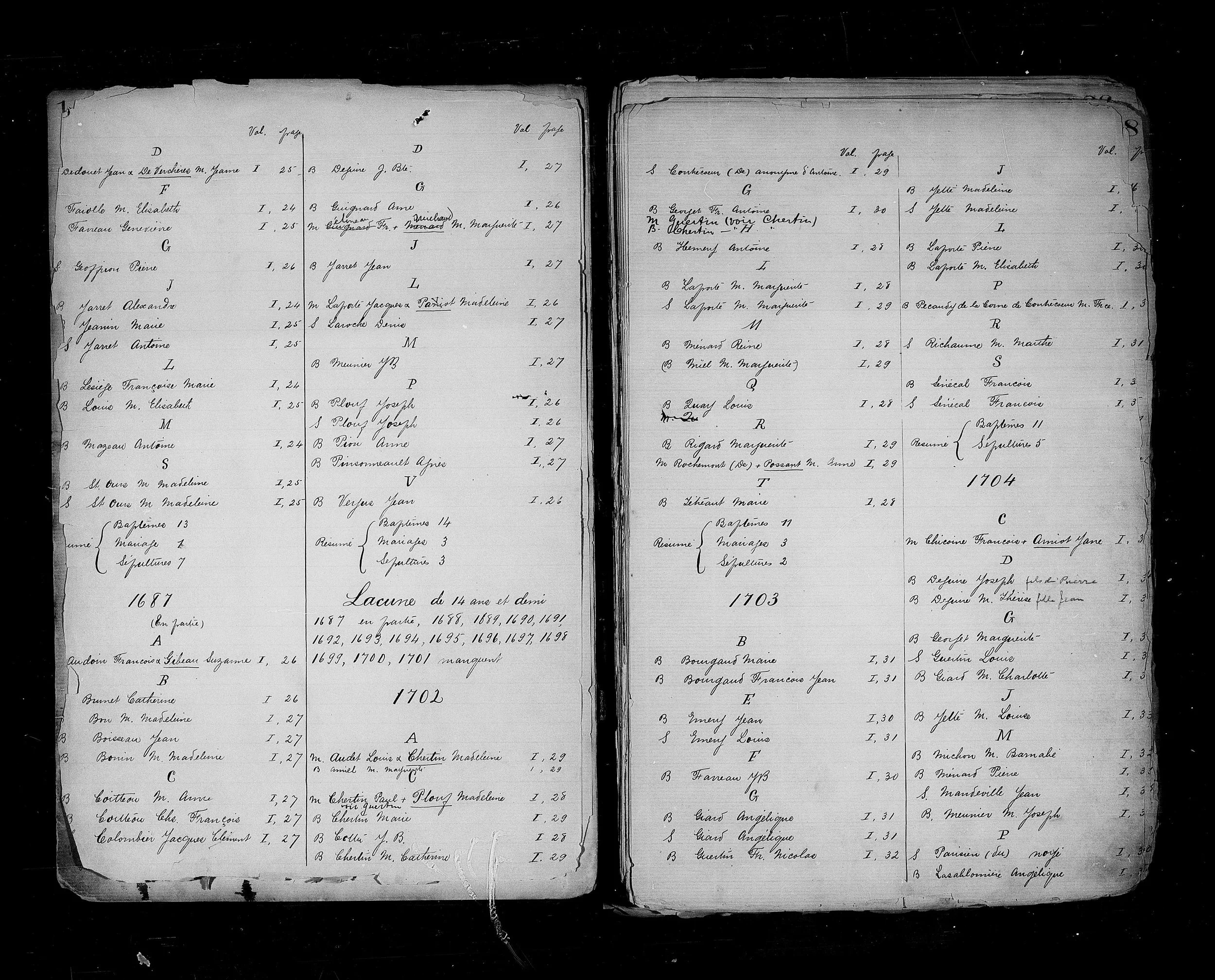
Contrecoeur is among the few Quebec parishes to have lost its registers twice. The first loss covered roughly 2.5 years (June 1678 through January 1681) — the result of a fire at the home of surgeon Jean Bouvet dit Lachambre, who housed the visiting missionary priest and kept the registers. A compiler's note in the surviving volume documents this explicitly.
The second and far more consequential gap spans 14.5 years: 1687 en partie through all of 1701 (manquent). The register index names each missing year. This gap encompasses four of Philibert's eleven children — Michel, Marie Hilaire, Philibert fils and Marie Barbe — as well as the period of his own death. Louis, whose birth PRDH places at c. 1679, falls instead inside the earlier loss. No baptism, burial or marriage records from Contrecoeur survive for the second period. Every fact about the family during those years must be established from sources outside the parish register.
The Illiterate Subject
The 18 May 1688 notarial obligation before Royal Notary Claude Maugue records, in formal legal notation: déclarant n'scavoir écrire ny signer, selon l'ordonnance — "declaring he did not know how to write or sign, according to the ordinance." In place of a signature: an X. This means Philibert never wrote a letter, signed his name, or left a document in his own hand. Every record of him was created by someone else — a notary, a priest, a census-taker, a judge. The researcher is entirely dependent on others' transcriptions of what he said and did.
The Earliest Use of the Dit Name: The 1667 Land Sale
A land sale of 24 September 1667 before notary Bénigne Basset, by Urbain Baudereau and Mathurine Juillet to Pierre Pigeon, conveys a property on the Côte-Saint-Martin at 470 livres tournois. A clause reserves "la jouissance d'un Arpent que lesd Vendeurs ont Baillé pour trois ans aux Nommez Rocbrune, le Vallon… Soldats de la Compagnie du Sieur de Contrecoeur, aux charges seulement de la culture et labour à Pioche" — one arpent, leased for three years, on condition of cultivation by hoe. The greffe records the land as originally conceded by the governor of Montréal in November 1665, the year the regiment arrived.
Page two of the document reads: "Aux Nommés Rocbrune, le Vallon" — two soldiers identified by their dit names. This is the earliest attested appearance of Rocbrune in New France, eight years before Philibert's marriage, and it matters because it establishes that Roquebrune was not a name assigned by later genealogists or derived from his children's usage. Someone was already being called it in 1667.
The Identification Problem
The act names Rocbrune. It does not name Couillaud, and it gives no given name. The identification of this man as Philibert Couillaud is therefore an inference, and this methodology records it as one.
Three things support it. The act itself calls the named men soldiers of the Company of Contrecoeur — the company in which Philibert served — so the grouping is documented rather than inferred; the other man is Joseph Denis dit Le Vallon. Massicotte's published list of the colonists of Montréal, 1642–1667, independently places Philibert in Montréal in the winter of 1666–67. And Roquebrune is his continuous, documented identifier in every act from 1679 onward.
What has not been done is a negative search of stated extent: an examination of the Basset greffe and contemporary Montréal notarial records for any other bearer of the name Rocbrune in this period. Until that search is completed and its extent recorded, the 1667 act is treated here as the earliest surviving use of the name — not as proof of Philibert's presence at Ville-Marie in 1667. The distinction matters because this act is otherwise the foundation of the dit-name chronology.
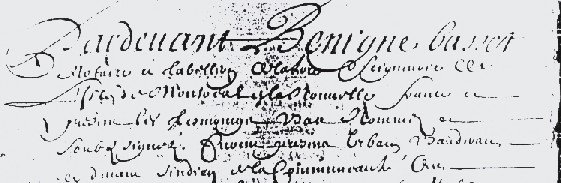
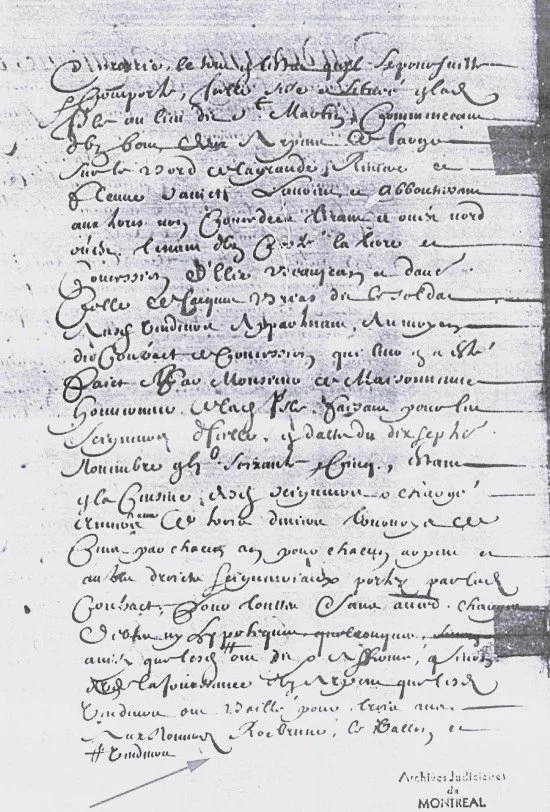

The 1667 land sale establishes the dit name Rocbrune in the earliest possible contemporaneous document — two years after the regiment's arrival, eight years before the marriage. Its identification with Philibert Couillaud is well supported but not documented, and is carried in this research file as an inference pending a negative search of stated extent.
Three later notarial acts deepen the evidentiary portrait and rest on no such inference, because all three name him in full. On 8 September 1679, Philibert served as a formal witness to an annulment before Notary Pierre Mesnard at Contrecoeur, identified as habitant dudit Contrecoeur and with his illiteracy formally noted — a year and a half before the 1681 census. On 12 February 1680, he purchased a 60-arpent concession (2 arpents frontage × 30 arpents depth) directly from Seigneur Anthoine de Pecaudy before Notary Adhémar (No. 481), which resolves the previously open question of the primary concession document and explains the 5 arpents under cultivation recorded thirteen months later. That deed is also the earliest known instance of the abbreviated form Laroque, written by the notary himself in Philibert's own lifetime. Two days later, on 14 February 1680, he appeared again as a witness before Mesnard for a debt assignment, his illiteracy noted a second time.
Origin Confirmed in His Own Era: The 1669 Confirmation Register
The single most authoritative document in this research file is a confirmation register entry from Chambly on 21 May 1669. Bishop François de Montmorency-Laval — the first Bishop of New France — confirmed eight soldiers of the Carignan-Salières Regiment at Fort Saint-Louis (Chambly). Philibert appears fifth in the list as "Philbert Couilliau de Nevers" — the surname recorded phonetically, the origin recorded precisely.
This document has several exceptional qualities. It is contemporaneous, created in Philibert's own lifetime, four years after his arrival, by a representative of the highest religious authority in the colony. The origin statement is direct and unambiguous: de Nevers. Every man in the entry carries an origin — Angoulême, Rouen, Xaintes, Chartres, Rennes, Cornouailles, Périgueux — so the register's practice is demonstrably to record provenance rather than to guess at it, and Philibert is the only one of the eight from Nevers. It is the only document in the research file that records his origin in a hand contemporary with his life.
One qualification is worth stating precisely. That he is the only Nevers man in the group makes the origin statement unambiguous; it does not by itself identify the individual. The identification rests on the surname, the regiment, and the date, as it does elsewhere in this file. Against this evidence, the claim that he descended from southern French nobility has no standing.
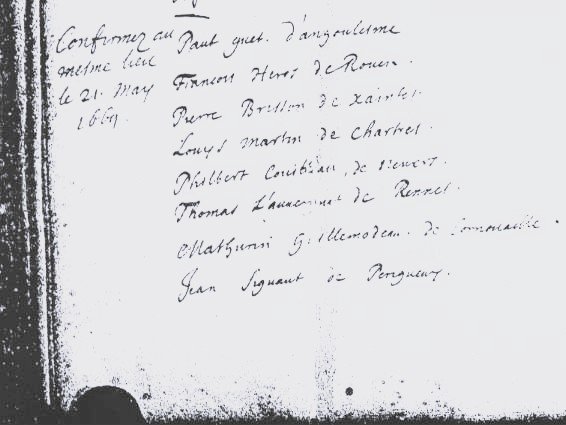
PRDH-IGD Confirmation Record #403509
| Parish | Chambly (St-Joseph) |
|---|---|
| Date | 21 May 1669 |
| Region | MRC La Vallée-du-Richelieu / Montérégie |
| 01 | Paul Guet — origin Angoulesme |
| 02 | Francois Heros — origin Rouen |
| 03 | Pierre Brisson — origin Xainctes |
| 04 | Louis Martin — origin Chartres |
| 05 | Philibert Couilleau — origin Nevers |
| 06 | Thomas Lauvergnat — origin Rennes |
| 07 | Mathurin Guillemodeau — origin Cornouailles |
| 08 | Jean Siguaut — origin Perigueux |
The 1669 confirmation register is the foundational origin document. "Philbert Couilliau de Nevers" — written in his own era, by a notary of the Bishop of New France, at a ceremony that specifically gathered soldiers of the Carignan-Salières Regiment — is the authoritative statement of his geographic origin. It eliminates the fraudulent noble pedigree, confirms the Nivernais origin, and places him precisely in the post-demobilization period when soldiers were settling in the colony.
Established in Contrecoeur: The 1675 Church Construction Contract
On 1 December 1675, Philibert Couillaud appears as a witness to the construction contract for Contrecoeur's first chapel — negotiated between master carpenter Jean Duval and Antoine Emery dit Coderre, a soldier of the same Company of Contrecoeur in which Philibert had served. This is the earliest documented civil act in Contrecoeur, and Philibert's presence as a witness confirms he was already settled in the seigneurie at this date.
The evidentiary significance extends beyond simple presence. The chapel contracted in December 1675 is very probably the chapel where Philibert and Catherine Laporte were married. Catherine had reached the canonical age for marriage — twelve years — on 12 October 1675, seven weeks before this contract. The fall of 1675 is therefore the earliest date the marriage could have occurred, and Michel Larocque places it there on the reasoning that a settlement of this size would have married its new couples at the earliest liturgically permissible opportunity.
That reasoning is plausible but it is reasoning, not record. PRDH places the marriage only "avant 1677, lieu indéterminé," and FrancoGene gives "before 1676, from Contrecoeur" with a query attached. Neither database supports a specific date or place. Appearing as a witness to the chapel's construction contract, at the moment the marriage was probably being arranged, is the closest the documentary record comes to placing Philibert at his own wedding — and it is worth being clear that this is proximity, not attestation.
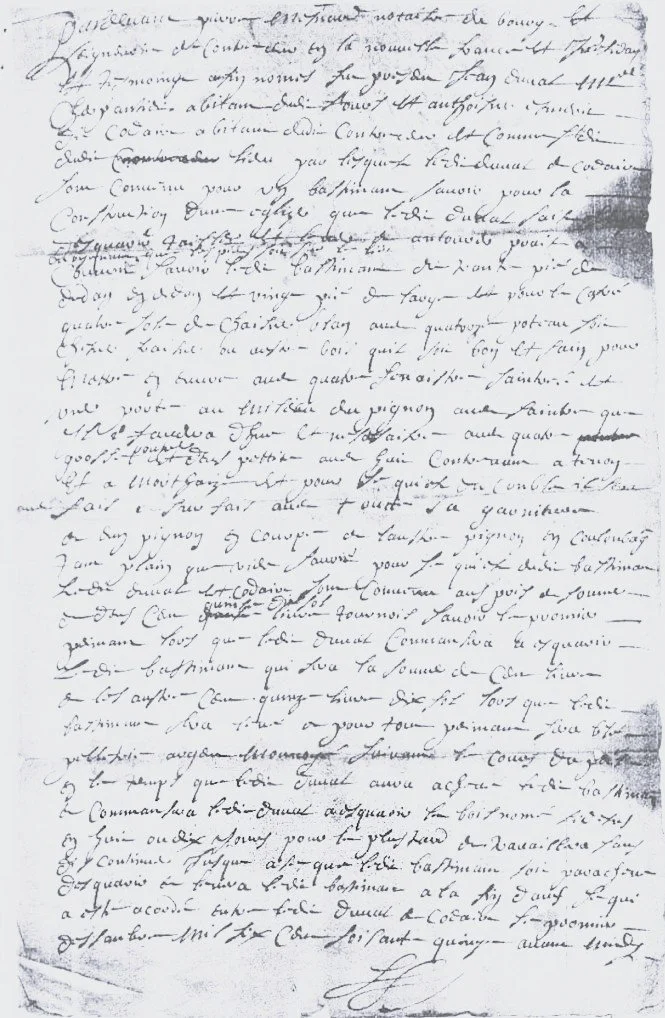
The 1675 church contract establishes Philibert's settlement in Contrecoeur at the period in which the marriage to Catherine Laporte is believed to have occurred. It is the earliest Contrecoeur document in the research file and the foundation for all subsequent Contrecoeur-based evidence. His standing as a witness — not a party — confirms he was already a recognised member of the community by this date. The marriage itself remains undocumented.
The Family Established: The 1681 Census of New France
The 1681 Census of New France is the only surviving snapshot of Philibert Couillaud's household taken during his lifetime. The original manuscript records the household head at forty, his wife at seventeen, children, one musket, five head of cattle, and five arpents under cultivation.
His is the third household entered in the seigneurie, immediately after seigneur Antoine Pécaudy de Contrecoeur and his family. Fourteen pioneer households totalling sixty-nine persons are enumerated. It should be said plainly that enumeration order records the route the census-taker walked, not the standing of the households along it; the sequence places Philibert among the seigneur's near neighbours and establishes nothing further about his rank in the community.
What the Census Records — and What It Omits
The manuscript entry gives three sons beneath the parents: Jean, aged five; Baptiste, aged three; and Jean François, aged two, entered under a different surname and without any filiation to the household head. The name of the third reads Juzoil in a direct examination of the manuscript, and a later compiler rebuilding the lost 1680 Contrecoeur births from this same census entered him as "Couilleau dit Roquebrune Jean Frs. Juzoil." PRDH's structured card renders the surname Gazail and the age as one.
He was not a son of the house. PRDH couple #2540 gives Jean Gazaille dit Saint-Germain and Jeanne Touze, married at Québec in October 1668, with a son François born about 1680 who lived to marry in 1711 and was buried at St-Denis-sur-Richelieu in 1760. Jean Gazaille was a corporal in the Company of Contrecoeur — Philibert's own company — and the Gazaille household's 1681 entry lists only three daughters, with no boy of one or two. The child was enumerated with the Couillauds and belonged to the neighbours. PRDH's structured reading — the surname Gazail, and no filiation to the household head — is correct, and the compiler who rebuilt him from this census as "Couilleau dit Roquebrune Jean Frs. Juzoil" was mistaken. The name on the manuscript is a rendering of Gazaille; the age of one or two is consistent with a birth about 1680 either way. He is excluded from the children's table below, and this methodology no longer treats the question as open.
Louis Is Not in This Census
PRDH displays Louis's birth as c. 1679. A child born in 1679 should appear in a November 1681 enumeration at age two. No such entry stands in his name.
PRDH's own record note reads: "Due to the loss of Contrecoeur's earliest records in a fire, it is possible that his baptism took place after François's in 1686. His age at death is not very informative due to the notorious inaccuracy of the very older age statements." François was baptized 6 December 1686, so the database itself allows a birth inside the second register gap and sets aside the burial age as uninformative. The two positions are therefore not rival authorities: the displayed figure of c. 1679 is a working value, and the later dating chooses among possibilities PRDH leaves open.
This is the strongest evidence available for the later birth year proposed by Michel Larocque, and unlike the inter-birth interval reasoning it rests on a primary document rather than on a demographic model. It is set out here because the census transcription and the children's table both appear in this methodology, and a reader is otherwise left to notice the conflict unaided.
It is not decisive, and the counter-argument is fatal if correct. Bertrand Desjardins, whose reconstruction underlies the PRDH record, reads the son entered as Baptiste, aged three as Louis himself, with the entry recorded as Jean, aged five standing for Jean-Baptiste. On that reading Louis is present in the household and the argument from absence falls entirely. Assessing it properly requires Desjardins's own words in French, which this research file does not yet hold.
One point tells against neither dating. Both candidate years fall inside a documented Contrecoeur register loss — c. 1679 inside the first, c. 1689 inside the second. The gaps account for the missing baptism equally well either way and discriminate between the two positions not at all.
Jean, Aged Five — and What Follows From Him
Jean appears in PRDH's enumeration and in FrancoGene's, sourced to this census. He has no baptism, no marriage and no burial record. Since Jean-Baptiste was baptized at Sorel in 1677 because the Contrecoeur chapel was not yet in service, a Jean born c. 1676 should be sought in the Sorel register. That search has not been made.
Two difficulties attach to him, and this methodology states both rather than carrying him unqualified.
The first is internal to PRDH. Desjardins's reading of the census — the reading that produces the c. 1679 date for Louis — identifies the entry recorded as Jean as Jean-Baptiste. On his own analysis there is no separate son Jean at all. The database that lists eleven children including Jean and the analyst whose reconstruction underlies it do not agree, and a page cannot follow his dating for Louis while keeping a child his reasoning dissolves.
The second is demographic. Catherine Laporte was baptized on 12 October 1663. Jean-Baptiste was born on 15 October 1677 — fourteen years and three days later, and documented rather than inferred, since PRDH #83227 names Catherine as his mother and present at the ceremony. If a separate Jean was also born to her about 1676, she bore two children between her twelfth and fourteenth birthdays. That is the precise combination Desjardins declares impossible when he uses it to reject Jetté's reconstruction. Applied consistently, the objection tells against his own.
Catherine Laporte's recorded age of seventeen is consistent with her baptism on 12 October 1663 — she was seventeen for most of 1681. Philibert at forty places his birth c. 1641, consistent with a man of military service age in 1665.

PRDH-IGD Census Record #98944
| Place | Contrecoeur (Ste-Trinité), around 1681 |
|---|---|
| Region | MRC Marguerite-D'Youville / Montérégie |
| 01 | Philibert Couillaut — age 040 — married — occupation: resident |
| 02 | Catherine Laporte — age 017 — married |
| 03 | Jean Couillaut — age 005 — son of 01 |
| 04 | Baptiste Couillaut — age 003 — son of 01 |
| 05 | Jean Francois Gazail — age 001 — no filiation recorded · identified as François Gazaille, son of the neighbours (PRDH couple #2540) |
The 1681 census is the only surviving contemporaneous record of Philibert's household during his lifetime. It confirms the marriage, names two sons, and establishes his holdings — one musket, five cattle, five arpents cleared, consistent with a man who bought sixty arpents of raw concession thirteen months earlier. The 1688 obligation corroborates the census geography from an independent act.
A Man in Full: The 1688 Notarial Obligation Before Royal Notary Claude Maugue
The notarial obligation of 18 May 1688, drawn up before Royal Notary Claude Maugue in Montréal, is the richest single document in the research file. In a single two-page act it records three distinct findings unavailable elsewhere: the location of Philibert's property, the men he dealt with, and the most intimate fact of his biography — that he could not read or write. In the place of a signature, he made an X.
These three findings come from one document. They are distinct, but they are not independent: a single act is a single witness, and its internal consistency is not corroboration. Where the findings are confirmed elsewhere — the property geography against the 1681 census, the illiteracy against the 1679 and 1680 Mesnard acts — that is stated explicitly below.
The obligation records Philibert ("Rocbrune") borrowing 118 livres 18 sols 10 deniers from Montréal merchant Charles de Couagne, "pour augment et merchandize." The debt was substantial and was never repaid. After Philibert's death, Catherine faced it alongside a 150-livre obligation to Marguerite Sédillot contracted in February 1687 and a third of 145 livres to Pierre Lamorche — at least 413 livres in documented obligations.
The Property Location
The act describes the mortgaged property as "l'habitation à luy appartenant… au lieu de Contrecoeur," lying between the holding of "Sr george" and, on the other side, that of Louis Laporte. This is the most specific geographic statement in the research file and it corroborates the 1681 census independently.
The wording repays care. Maugue gives the first neighbour no surname, and he records no relationship between either man and Philibert. That these were his wife's father and brother is this research file's reconstruction of the Laporte family, not the notary's statement, and it is set out as an open question below.
The Witnesses
Two witnesses appear: François Bailly, physician, and Nicolas Droissy, master pastry baker (maître pâtissier). Both were established Montréal figures. Their presence confirms that Philibert travelled to Montréal for this transaction — a reminder that Contrecoeur settlers maintained commercial ties to the colonial capital even in the late 1680s, when the seigneurie was barely fifteen years old.
The Illiteracy Notation
Page two records the most personal line in the research file, in the formal notation used by all notaries of the period when a party could not sign: déclarant n'scavoir écrire ny signer, selon l'ordonnance. Philibert placed his mark — an X — in the space reserved for his signature. The same formula appears in the chapel construction contract of 1 December 1675 — where the notary Mesnard records "m + dudit Rocbrune" — and again in the 8 September 1679 annulment, the 12 February 1680 concession and the 14 February 1680 transport. Five acts across thirteen years, so this is a thoroughly corroborated finding rather than a single attestation. It transforms every other document in the file: the census was filled out by a census-taker, the obligations read to him by a notary, the lawsuits conducted after his death by his widow. He never read a word written about him.


Catherine's parents are recorded as Jacques de Laporte dit Saint-Georges and Nicole Duchesne. The 1683 Boucherville baptism of her son Antoine names as godparents Antoine and Angélique Laporte, entered there as children of Georges Laporte and Nicole Duchesne — the same mother's name. The 1688 obligation names a neighbouring landholder only as "Sr george," with no surname at all.
The likeliest reading is that these are one family and one father, and that Saint-Georges — the Laporte dit name — is being written as a given name. A notary distinguishing two men of the same house might reasonably identify one by his dit and the other by his given name. If that holds, Antoine and Angélique Laporte are Catherine's own brother and sister, which would answer the standing question of why the family travelled to Boucherville in 1683 to have a child baptized.
The inventory of Jacques Laporte's estate, made at the fort of Contrecoeur on 16 July 1698 and registered on 12 August, lists those present and names "paul Laporte fils, et philibert Couliaux gendre" — Philibert Couillaud, son-in-law. Catherine's father was Jacques Laporte dit Saint-Georges, and the relationship is stated in words in a notarial act. The same inventory describes Jacques's own concession at Contrecoeur as bounded "du costé du sudouest a Celle de Philibert Coulliaux" — adjoining Philibert's land on the southwest.
The brother is documented too. An engagement of 24 March 1709 before Antoine Adhémar records Louis Couillaud dit Roquebrune of Contrecoeur — Philibert and Catherine's son — as living with Louis Laporte Saint-George, son oncle. PRDH independently gives Louis Laporte as a son of Jacques and Nicole Duchesne, born about 1667, resident at Contrecoeur at his marriage contract of 1695.
And "Sr george" in the 1688 obligation is Jacques himself. Catherine's own baptism entry of 1663 calls her father "Georges De la Porte dit St Georges"; her son's 1683 baptism calls him Georges; Maugue calls him Sieur George in 1688. Three clerks across twenty-five years wrote the same man's dit name where his given name should have stood. He had a son called Georges, baptized in 1662, but that son was twenty-six and unmarried in 1688 and it is the father's land the inventory places against Philibert's.
The 1698 inventory sets out the order of the concessions along the river: the land Jacques and Nicole had given their daughter Suzanne, married to the notary Pierre Mesnard, then Jacques's own, then Philibert's on the southwest. A donation by the widowed Nicole Duchesne in September 1702 repeats it, describing her concession as lying between Mesnard's and that of "sa fille Catherine de Laporte, la veuve de Philibert Couillaud." That the Louis Laporte of 1709 is the same man as the 1688 neighbour still rests on name, seigneurie and period rather than on any act joining the two.
A smaller connection falls out of the same inventory: Jacques and Nicole's daughter Suzanne Laporte married Pierre Mesnard, the notary before whom Philibert witnessed in September 1679 and February 1680. The choice of notary was a family one.
The 1688 Maugue obligation yields three distinct findings from a single act: the property's location within the seigneurie, Philibert's commercial connections in Montréal, and definitive evidence of illiteracy — the X mark that serves as both evidence and epitaph. The property finding is corroborated by the 1681 census; the illiteracy by three earlier notarial acts. No other document in the research file contains this density of biographical information.
Death and the Legal Cascade: 1701–1728
Philibert Couillaud left no death record and no burial record. The register that would have contained them does not exist. Yet the legal documents generated after his death are the most information-dense sources in the entire research file. Through three separate proceedings spanning twenty-seven years, they establish his death terminus, document his debts, recover the terms of his lost marriage contract, and trace the disposition of his land through his widow and children.
The Death Terminus: 8 March 1701
On 8 March 1701, Joseph Aubuchon came before Jacques Alexis de Fleury Deschambault, écuyer, conseiller du Roy and Lieutenant Général of the Royal Jurisdiction of the Island of Montréal. He acted "pour luy et pour ses frères et soeurs héritiers de deffunte Marguerite Sédillot leur mère," and appeared through Me Antoine Adhémar, notaire royal — the same notary who twenty-one years earlier had drawn the deed by which Philibert bought his land from the seigneur.
The claim was narrow: that an obligation of 150 livres, "passé devant Maugue nore le vingt cinquiesme febvrier mil six cent quatre vingt sept, par deffunt Philibert Couillau dit Roquebrune vivant habitant de Contrecoeur," be declared enforceable against the widow. The phrase deffunt — the late — is legally precise. Philibert was dead before 8 March 1701. He was alive for some portion of the 14.5-year register gap; how long is not recoverable. The terminus post quem is the last surviving Contrecoeur register entry, December 1686.
The Aubuchon Proceeding (BAnQ TL4,S1,D480): 1701–1707
Catherine was named in two capacities: in her own name for the community of goods she had held with her husband, and "comme mère et tutrice naturelle et légitime administresse des biens et enfans mineurs" — establishing that some children were still legally minors in 1701.
Her answer survives, and it is the most human passage in the file. She said her husband had made several payments against the debt, offered to prove them, and consented to pay whatever remained. Then, "comme elle n'est pas en état de payer" — since she was not in a position to pay — she offered to pay the interest instead.
The court ruled the same day. The 1687 obligation was declared executory against her; she was to pay 150 livres less whatever she could prove had been paid, with interest from 27 February and costs. The judgment was sealed on 8 March 1701 and the wax survives on the page.
The following day, 9 March 1701, Catherine appeared before Antoine Adhémar and contracted a new obligation to Charles de Couagne. The act itself has not been located; its existence is documented by an entry in the published inventory of Adhémar's minutes, which records the parties and the date but not the sum.
Six years then pass with nothing in the file. In that interval Catherine remarried, at Varennes, on 9 October 1706. In October 1707 the huissier Cabazié came to Contrecoeur to enforce the judgment. He served her as "veuve de Philibert Couillau dit Roquebrune, habitante de Contrecoeur, y demeurant" — still described as a widow and as resident there, a year after her second marriage. She was not present; he spoke to Louis Delaporte, son fermier, the tenant working her land. Money, wheat, peas and oats in his hands were seized into the King's hand, with a request that they be sold at public auction, and Catherine was summoned for Tuesday 9 November.
The file ends there. Four pages, a summons, and no recorded outcome. BAnQ's date range for the dossier closes at 21 October 1707 because that is the last dated act in it, not because the matter was concluded. Whether the grain was sold, whether Catherine appeared that November, and whether the Sédillot heirs recovered their 150 livres are not established by any document in this research file.

The 1711 Land Auction (BAnQ TL4,S1,D1280)
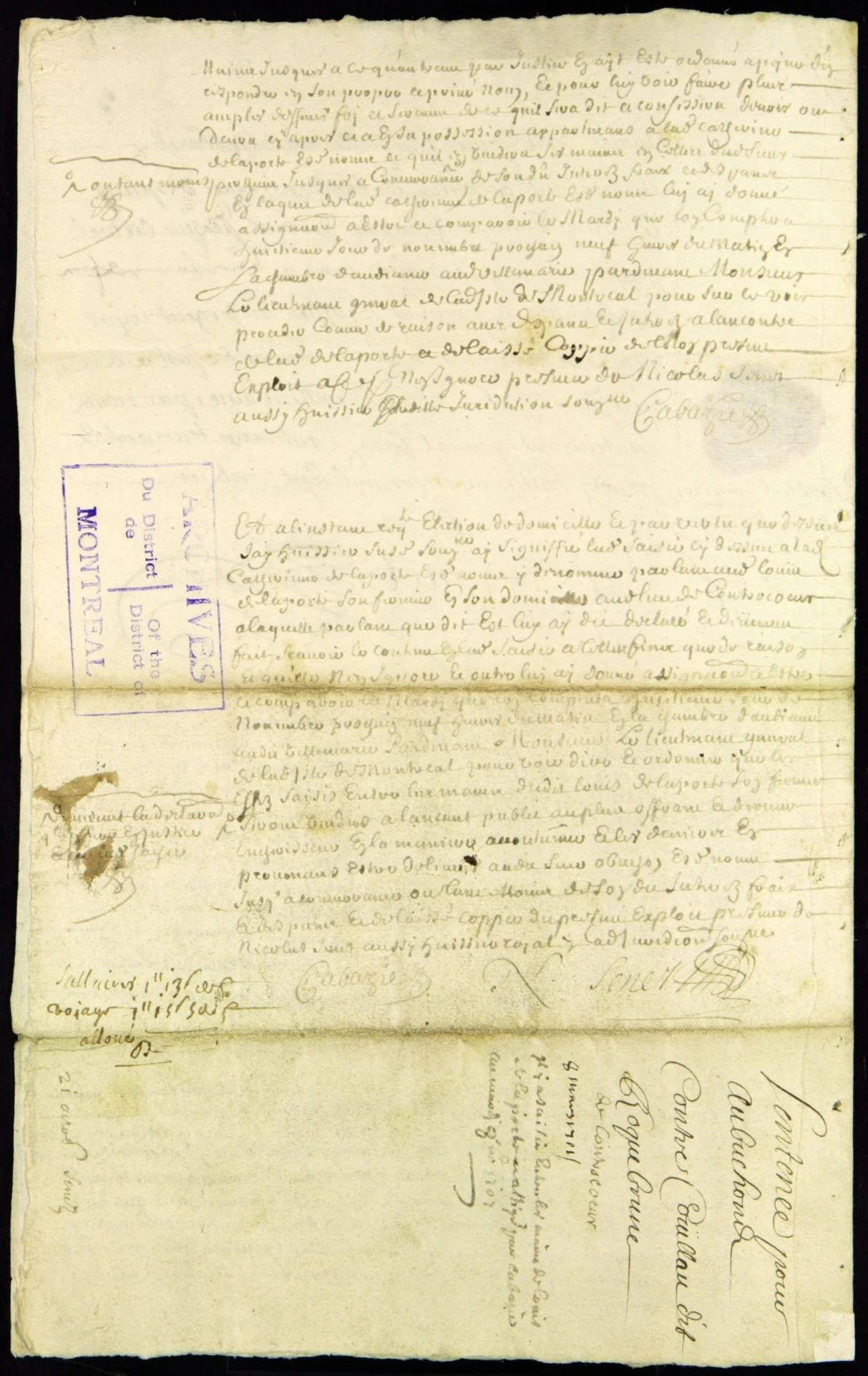
By 1711 the Contrecoeur concession had been abandoned. The seigneur, Antoine Pécaudy, petitioned the Royal Jurisdiction to have it sold, noting that neighbours were burdened with ditch maintenance the heirs were not performing. The land did not leave the family at that auction: Antoine bought it and the heirs held it until 1735, when it was sold outside the line. The complete judicial file — sixteen pages — documents six sequential events: the seigneur's petition; the permission to sell, read publicly at the Contrecoeur church door on 29 March 1711 by bailiff Bourdon; public notices affixed at Notre-Dame in Montréal on 17, 24 and 30 May by bailiff Meschin; the initial auction, at which Antoine Couillaud bid 214 livres; Antoine's formal opposition invoking the douaire préfix of his mother's marriage contract; the adjudication at 278 livres; and the distribution of proceeds.
Antoine's opposition is the critical legal act. By invoking the dower right established in the marriage contract, he raised the price and secured his mother's claim. He was the highest bidder at his own intervention: he purchased his father's land, addressed his mother's dower, and kept the concession in the family. The 1711 file is also the first documentary evidence that the marriage contract contained a douaire préfix clause at all.
The 1728 Donation: The Marriage Contract's Ghost
On 15 October 1728, Philibert Couilleau fils appeared at the Montréal sitting before Michel Le Pailleur, substitut of the King's Procurator, sitting in the absence of the Lieutenant Général. He presented for registration an act of "donnation pure, simple et irrevocable entre vifs," passed before Dubreuil, royal notary at Québec, on 10 April 1728, made in his favour by Jean Charpentier and Catherine Laporte his mother, of the rente of her dower "qui luy est deub depuis trente ans, à raison de quinze livres par année, suivant le contrait de mariage d'entre feu…"
This is not a dispute. Earlier accounts of this document in the research file described it as litigation between two of Philibert's sons; the manuscript shows a gift from mother and stepfather to son, walked into court by the son for registration. Antoine is not named on the page.
Two points of wording matter. The rente is described as owed depuis trente ans — for thirty years past — at fifteen livres a year. That is a statement of arrears, not of a contractual term of thirty years' duration, and any total derived by multiplying the two figures is unsupported. And if the arrears genuinely run from Philibert's death, they would begin around 1698, which would narrow a terminus the register gap otherwise leaves fourteen years wide. Round numbers in a legal recital are frequently approximate, so this is recorded here as a possibility to be tested against the underlying Dubreuil act, which has not yet been examined.

Antoine invoked the douaire préfix at the 1711 auction, and the raised adjudication price is understood in this research file to have addressed it. Why a rente on the same dower was still owed in 1728 — and owed, on the deed's own wording, for thirty years — is not explained by any document examined.
Possible readings: that 1711 secured the capital and 1728 concerns the annual rente; that the opposition preserved Catherine's right without discharging it; or that the two proceedings concern different portions of the estate. The documents support the question and not yet an answer. It is recorded here rather than smoothed over.
The three proceedings of 1701, 1711 and 1728 form a cascade that begins with a death and ends with the recovery of the lost marriage contract's terms. Together they establish Philibert's death terminus (before 8 March 1701); his documented debts (150 livres to Sédillot, 118 livres 18 sols 10 deniers to Couagne, 145 livres to Lamorche); the existence of a douaire préfix clause in the marriage contract; the dower figure of fifteen livres a year; and the disposition of the land through his son Antoine. The legal record created by his absence is more detailed than most of the evidence created by his presence.
The Register Gap: Documentary Proof of the Documentary Void
The 14.5-year gap in the Contrecoeur parish register is not an inference — it is explicitly documented in the register itself, in three archival components that survive in the same volume.


The Surviving Children's Baptism Records
Five of the eleven documented children have surviving baptism records. Three are in the Contrecoeur register; two were baptized in neighbouring parishes — an unusual fact that itself carries evidentiary weight. Each is documented below with the original parish register entry and, where the database adds structured detail, a transcription of the PRDH record.
A note on the transcriptions that follow. The PRDH records list each participant by rank with the spousal links between them, but do not print the roles of godfather and godmother. Those roles are stated in the parish register entries themselves and are cited to the register, not to the database.
1. Jean-Baptiste (Sorel, 1677): Confirming the Pre-Chapel Period
Jean-Baptiste Couillaud was born 15 October 1677 and baptized 20 October 1677 at Sorel (Saint-Pierre-de-Sorel) — not at Contrecoeur. The reason is straightforward: Contrecoeur's first chapel had been contracted only on 1 December 1675 and would not have been in regular liturgical use by October 1677. The nearest established parish was Sorel.

PRDH-IGD Baptism Record #83227
| Parish | Sorel (St-Pierre) |
|---|---|
| Baptism | 20 October 1677 |
| Birth | 15 October 1677 |
| 01 | Jean Baptiste Couleau — child |
| 02 | Philibert Couleau — father of 01, spouse of 03 |
| 03 | Catherine Delaporte — mother of 01, spouse of 02 |
| 04 | Jean Coittou Stjean |
| 05 | Catherine Platte — spouse of 06 |
| 06 | Pierre Charron — spouse of 05 |
| 07 | Benoit Duplein — prêtre |
2. Marie-Anne (Contrecoeur, 1681): First Baptism at the New Chapel
Marie-Anne Couillaud was born 3 October 1681 and baptized 4 October 1681 at Contrecoeur (Ste-Trinité) — the first surviving baptism of a Couillaud child at Contrecoeur, confirming the chapel was in regular liturgical service by 1681.
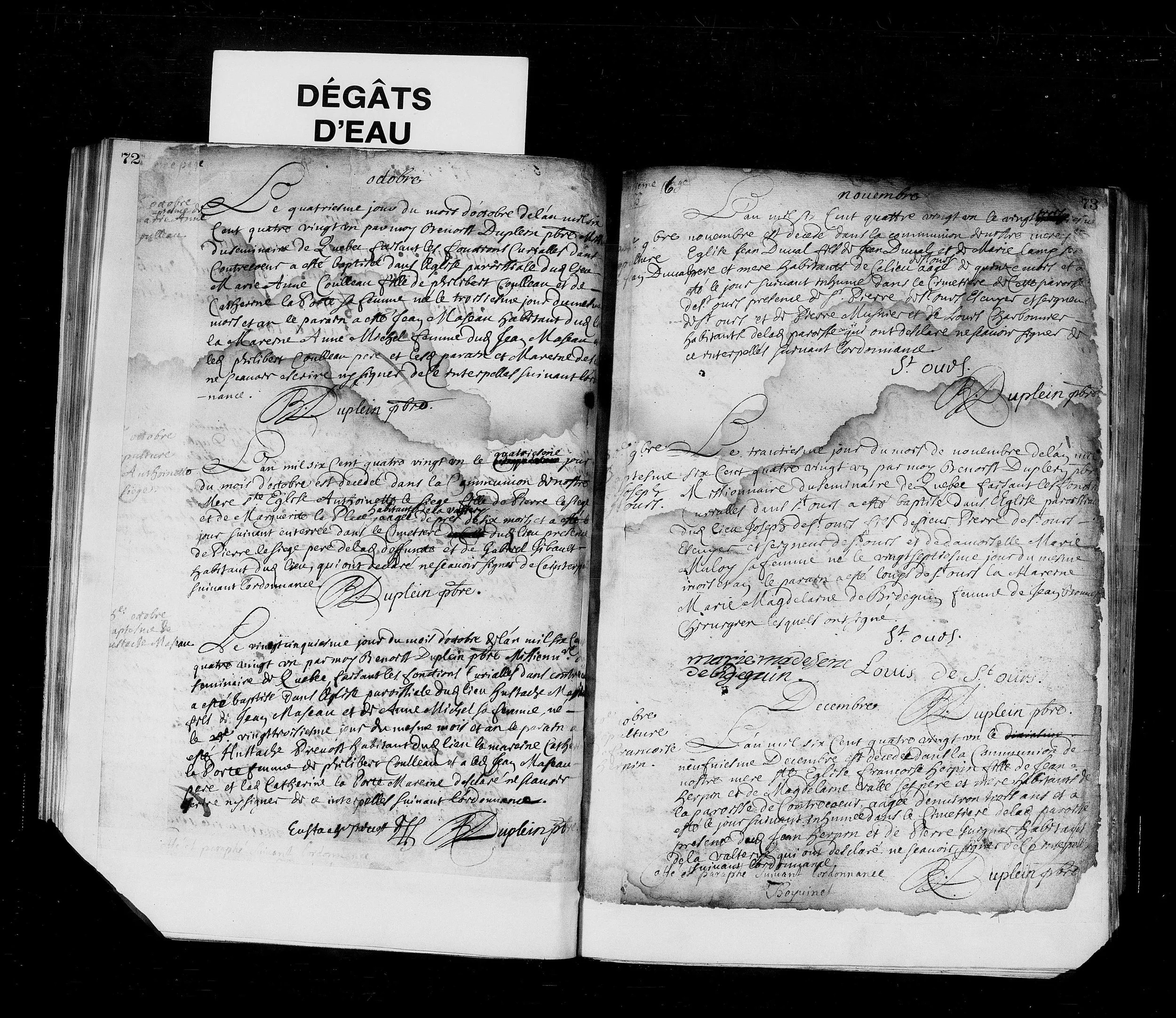
PRDH-IGD Baptism Record #89942
| Parish | Contrecoeur (Ste-Trinité) |
|---|---|
| Baptism | 4 October 1681 |
| Birth | 3 October 1681 |
| 01 | Marie Anne Coulleau — child |
| 02 | Philibert Coulleau — father of 01, spouse of 03 |
| 03 | Catherine Laporte — mother of 01, spouse of 02 |
| 04 | Jean Maseau — spouse of 05 — resident Contrecoeur |
| 05 | Anne Michel — spouse of 04 — resident Contrecoeur |
| 06 | Benoit Duplein — priest, missionary of the Seminary of Quebec, parish priest |
3. Antoine (Boucherville, 1683): An Unexplained Parish Choice
Antoine Couillaud was born 6 November 1683 and baptized 7 November 1683 at Boucherville (Ste-Famille) — not at Contrecoeur, where the chapel was by then established. Why the family travelled to Boucherville remains an open research question. The godparents are the strongest lead: Antoine and Angélique Laporte, entered as children of Georges Laporte and Nicole Duchesne of Boucherville. If the reading set out in Evidence Line 5 holds and Georges is Catherine's father under his dit name, these are her own brother and sister, and the journey is explained.
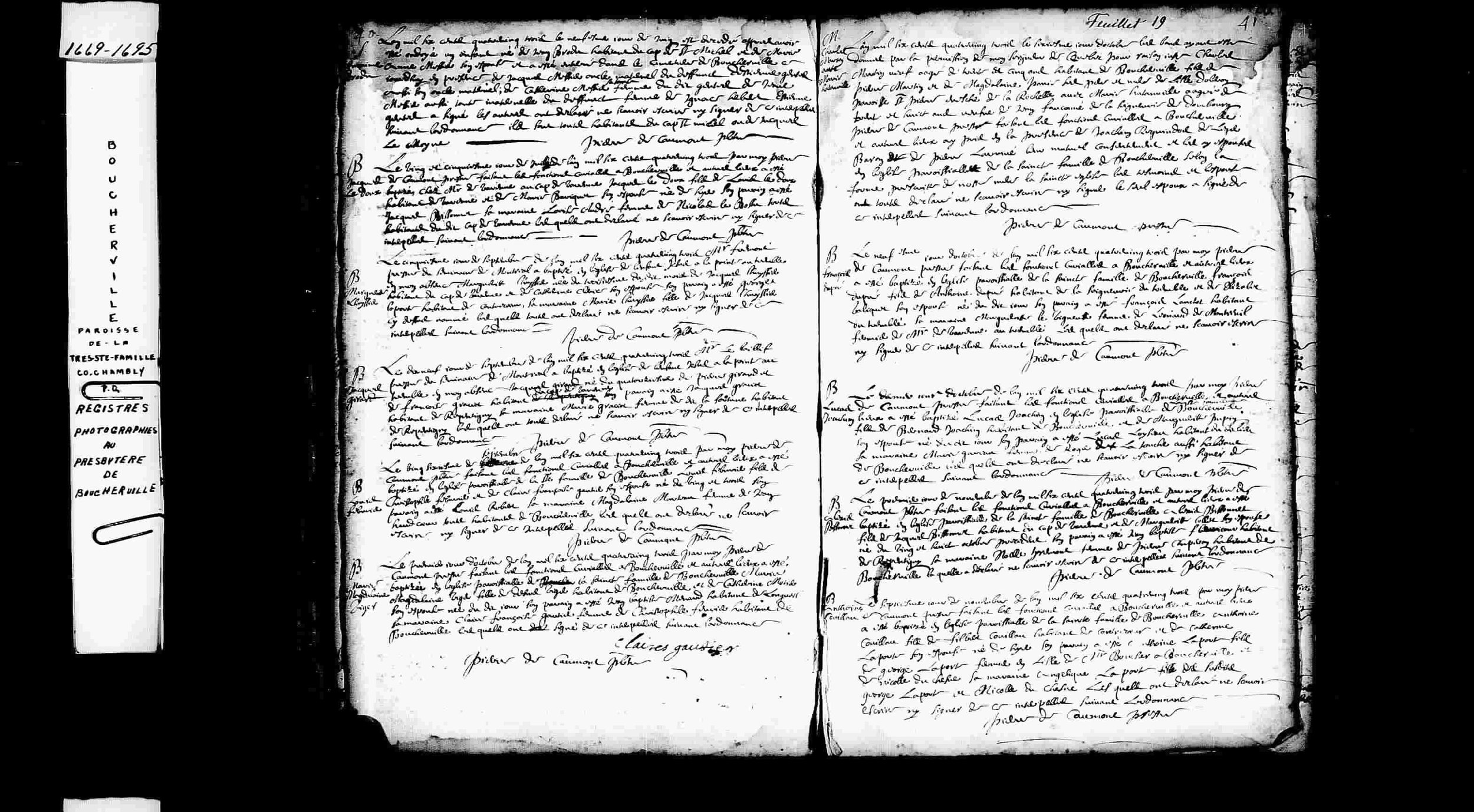
PRDH-IGD Baptism Record #2223
| Parish | Boucherville (Ste-Famille) |
|---|---|
| Baptism | 7 November 1683 |
| Birth | 6 November 1683 |
| 01 | Antoine Couillau — child — residence Contrecoeur |
| 02 | Philibert Couillau — father of 01 — residence Contrecoeur |
| 03 | Catherine Laporte — mother of 01 — residence Contrecoeur |
| 04 | Antoine Laporte — godfather — residence Boucherville |
| 05–06 | Georges Laporte & Nicole Duchesne — parents of 04 |
| 07 | Angélique Laporte — godmother — daughter of 05/06 |
| 08 | Pierre Decaumont — priest |
4. Catherine (Contrecoeur, 1685)
Catherine Couillaud was born and baptized on 12 January 1685 at Contrecoeur (Ste-Trinité).
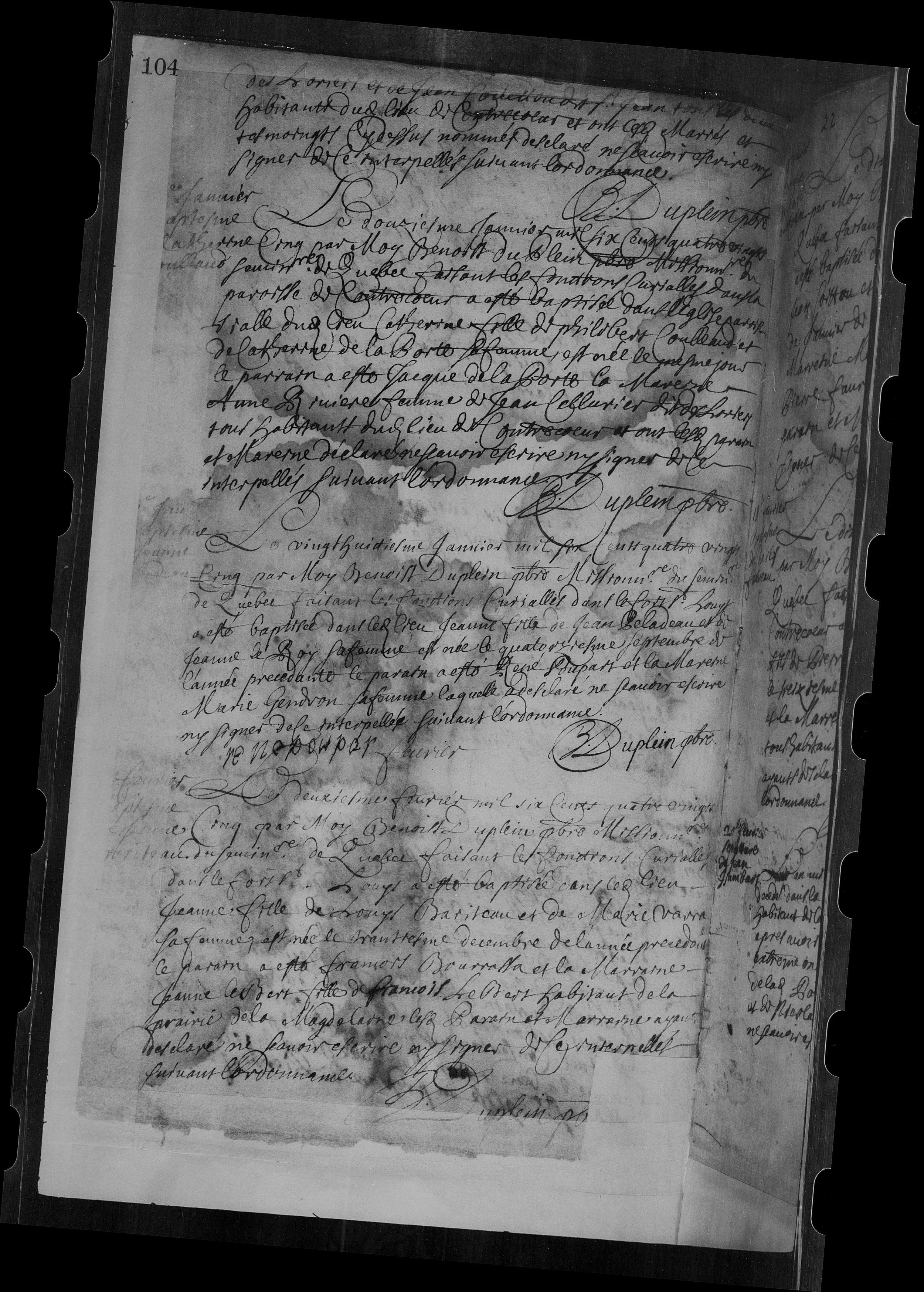
PRDH-IGD Baptism Record #90008
| Parish | Contrecoeur (Ste-Trinité) |
|---|---|
| Baptism | 12 January 1685 |
| Birth | 12 January 1685 |
| 01 | Catherine Coulleaud — child — residence Contrecoeur |
| 02 | Philibert Coulleaud — father of 01, spouse of 03 — residence Contrecoeur |
| 03 | Catherine Delaporte — mother of 01, spouse of 02 — residence Contrecoeur |
| 04 | Jacques Delaporte — residence Contrecoeur |
| 05 | Anne Riviere — spouse of 06 — residence Contrecoeur |
| 06 | Jean Cellurier Desloriers — spouse of 05 — residence Contrecoeur |
| 07 | Benoit Duplein — prêtre du Séminaire de Québec |
5. François (Contrecoeur, 1686): The Last Record Before the Gap
François Couillaud was born 3 December 1686 and baptized 6 December 1686 at Contrecoeur — the last surviving baptism record before the 14.5-year register gap. The next Contrecoeur record after this entry is from 1701.
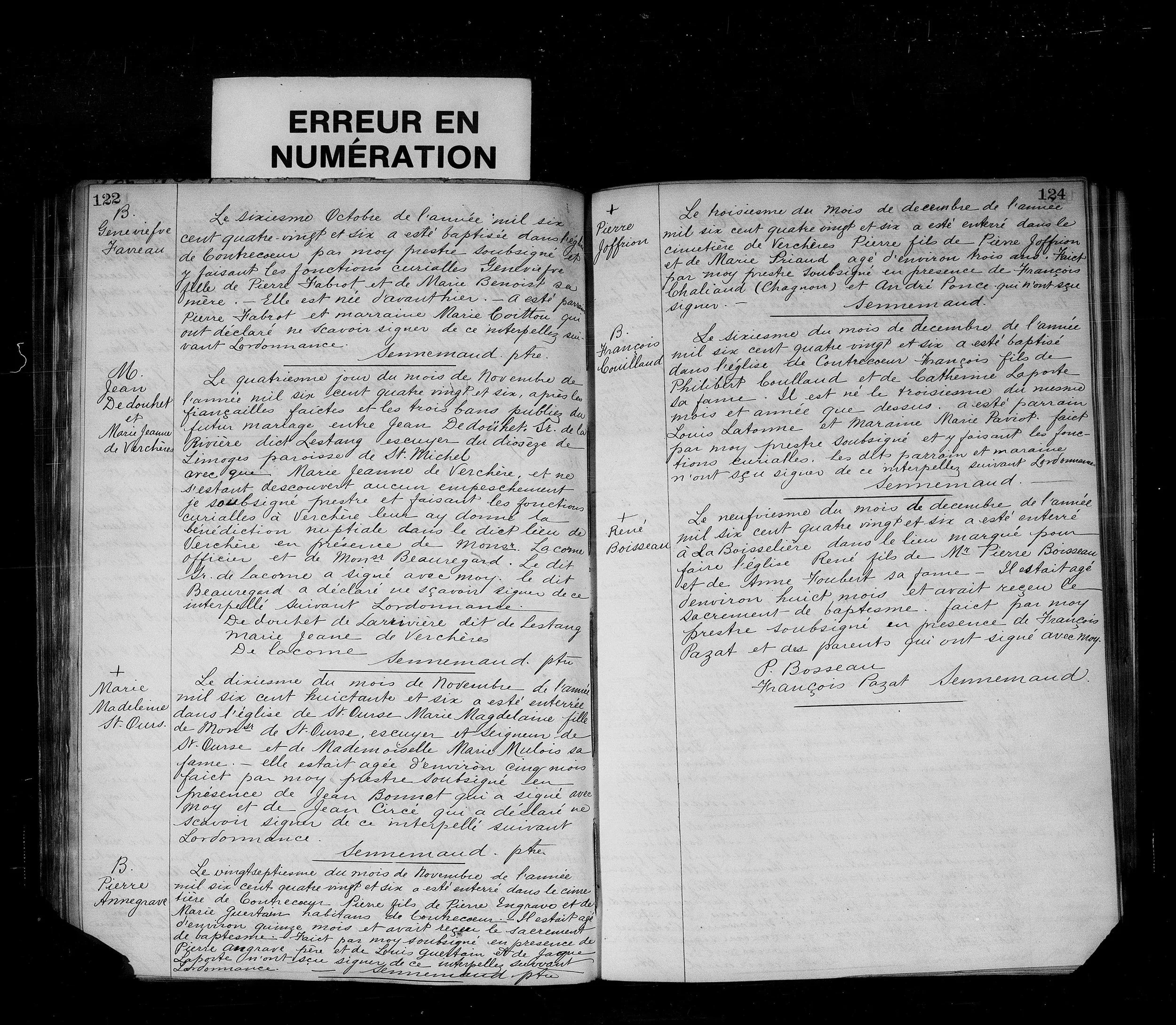
PRDH-IGD Baptism Record #90038
| Parish | Contrecoeur (Ste-Trinité) |
|---|---|
| Baptism | 6 December 1686 |
| Birth | 3 December 1686 |
| 01 | Francois Coullaud — child |
| 02 | Philibert Coullaud — father of 01, spouse of 03 |
| 03 | Catherine Laporte — mother of 01, spouse of 02 |
| 04 | Louis Latonne |
| 05 | Marie Paviot |
| 06 | Sennemaud — prêtre — residence Contrecoeur |
The Fraudulent Noble Pedigree: Bernard de Laroque
A claim circulates in some genealogical databases and online family trees that Philibert Couillaud was the son of Bernard de Laroque, a southern French noble. This lineage, if true, would provide Philibert with noble parentage, a documented French father, and a connection to aristocratic families of the Languedoc. It is entirely fabricated.
The claim was constructed by Robert de Roquebrune (1889–1978) — a Québec-born novelist, journalist, archivist and writer of romanticized Quebec history. He published it in Nova Francia in 1929 under the pseudonym Pierre Gauthier. The pseudonym matters to the assessment: it presented an account of the author's own ancestry as though written by someone with no stake in it, and it is the mechanism by which the claim acquired the appearance of independent testimony. The account was accepted by some mid-twentieth-century genealogists because his archival position lent it authority and because researchers then had limited ability to verify claims about pre-1665 French records.
Any tree or database giving Philibert's parents as Bernard de Laroque and Marie de Marsilly is repeating this fabrication. The names circulate widely under the form "Larocque de Roquebrune."
Why It Was Rejected
The rejection rests on a single evidentiary principle: the 1669 Chambly confirmation register records "Philbert Couilliau de Nevers" — not de Laroque, not de Roquebrune, and not any southern province. Nevers is the seat of the Nivernais, a landlocked region of central France entirely unconnected to the southern French aristocracy to which the fabricated pedigree would attach him. No primary document, French or Canadian, names Philibert's parents. No baptism record for him has been found in France. The 1669 confirmation is the only contemporaneous statement of origin in his entire file, and it gives Nevers.
The fraudulent pedigree is documented here for methodological transparency, because it continues to appear in published genealogies and online trees. Researchers who encounter the claim of noble Bernard de Laroque parentage should note that it originates with a twentieth-century novelist, contradicts the only contemporaneous origin document, and has no primary evidentiary support.
The Bernard de Laroque noble pedigree is rejected on two grounds, both documentary. First, no primary document — French or Canadian, and none predating Robert de Roquebrune's twentieth-century writings — names Philibert's parents; research analyst Michel Larocque, who has investigated the question independently, likewise found no corroborating evidence in any French or Canadian archive, and every instance of the claim traces back to de Roquebrune as its source. Second, the only contemporaneous origin record, the 1669 Chambly confirmation register, identifies his origin as Nevers, a region incompatible with the claimed southern French noble lineage. Arguments from Philibert's illiteracy and indebtedness are not relied upon here: they describe what a man's circumstances make likely, not what the documents establish, and the two documentary grounds are sufficient without them.
Birth Dates Beyond the Gap: What the Record Can and Cannot Tell Us
Five of Philibert and Catherine's eleven documented children have surviving baptism records, all from before the 14.5-year register gap. Four — Michel, Marie Hilaire, Philibert fils and Marie Barbe — were born during the gap and have no primary baptism documentation, and almost certainly never will: the Contrecoeur register that would have recorded them does not exist. Louis, whose birth PRDH places at c. 1679, falls inside the earlier register loss of 1678–1681. Jean, aged five in the 1681 census, has no baptism record either; on the PRDH dating he would have been born c. 1676, within the surviving portion of the register, which makes his absence from it a question worth pursuing in the Sorel register.
What survives for the gap children are adult records: marriage acts, burial entries and census returns that state ages — all subject to the recording inaccuracies typical of 17th- and early 18th-century colonial New France. PRDH acknowledges this directly in Louis's record, noting the problem of age statements in older individuals. Any birth year derived from a stated age in a marriage or burial act is an estimate, not a confirmed date.
Michel is the clearest illustration. His burial is recorded at 100 years old, which would place his birth in 1672 — a figure PRDH itself flags as unreliable. His marriage act of 2 February 1718 states he was 24, placing his birth c. 1694. The marriage age is the better instrument, and it is the one used here.
A second caution applies to the database rather than to the registers. Jean-Baptiste's burial entry of 5 July 1753 reads environ quatre vingt six ans; his baptism survives, so his true age was seventy-five years and nine months, and the register's figure overstates it by about a decade. PRDH's card for that burial renders the age as 090 — four years adrift from what the register says. Age figures shown on PRDH cards are the database's own and are not transcriptions: they may round an open statement, and they may simply be wrong. Names displayed on the cards follow the register wording and may be cited through the card; ages must be taken from the register itself.
The table of children below follows PRDH Family Record #4480. Birth years for children born during the register gap are estimates derived from adult age statements. Louis's birth year is specifically disputed: PRDH gives c. 1679; Michel Larocque prefers c. 1689 on the reasoning that the earlier date produces a first-marriage age of about 37, well above the colonial average of 27, and leaves an eight-year interval in Catherine's childbearing between 1686 and 1694. Researchers should treat all gap-period birth years as approximate.
The Thirteen-Child Hypothesis
Michel Larocque, working from age statements, marriage dates and inter-birth interval analysis in a set of unpublished analytical spreadsheets held in the Larocque family archive and consulted for this research file, proposes thirteen children rather than eleven. His model adds a child at the end of 1679 — inside the first register loss — and another at the end of 1691, inside the second, and moves Louis from c. 1679 to c. 1689. The result is an average inter-birth interval of 24 to 26 months across roughly twenty-five years, with no eight-year hiatus, which he argues is the more plausible demographic pattern for a woman aged 23 to 31 in this period.
Neither model can be confirmed. The two additional children are inferred from the shape of the intervals, not from any record naming them, and the register losses that would have documented them are precisely the reason no such record exists. This methodology follows the PRDH enumeration of eleven as the documented count and records the thirteen-child analysis as a competing reconstruction, both in the research file.
The Eleven Documented Children of Philibert and Catherine
PRDH Family Record #4480 documents eleven children. Five have surviving baptism records. Four were born during the 14.5-year register gap with no surviving primary baptism documentation. Where PRDH and FrancoGene render a name or a spouse's dit name differently, both forms are given.
| Jean (c. 1676) — existence open | Carried by PRDH and FrancoGene, sourced to the 1681 census, which lists a son of five. No baptism, marriage or burial record, and no known descendants. Desjardins's own reading of the census identifies that entry as Jean-Baptiste, which would leave no separate Jean; and if he did exist, Catherine bore two children between her twelfth and fourteenth birthdays. See Evidence Line 4. The Sorel register has not been searched for him. |
| Jean-Baptiste (1677) | Born 15 Oct, baptized 20 Oct 1677, Sorel (St-Pierre). Died 4 Jul 1753; buried 5 Jul 1753, Varennes. Married 11 Sep 1704, Varennes — Marie Anne Jeanne Célerier Deslauriers. 6th great-granduncle of the researcher. PRDH #38748. |
| Louis (c. 1679 displayed; c. 1689 argued) | No baptism record; birth falls in a register loss and the year is disputed, with PRDH's own note allowing a baptism after December 1686. Buried 5 Jun 1764, Oka. Married 21 May 1716, Pointe-Claire — Marie Madeleine Sabourin. 6th great-grandfather of the researcher. PRDH #38856. |
| Marie-Anne (1681) | Born 3 Oct, baptized 4 Oct 1681, Contrecoeur. Married before 1700, Léonard Girault Lachaume. Accused of his murder in February 1702; fled to New England with Pierre Viau dit Larose; reportedly tried in absentia, condemned and executed in effigy. PRDH #32586 gives her status as died outside Québec. The execution in effigy is a specific judicial act and would be recorded in the Jugements et délibérations du Conseil souverain or the Montréal royal jurisdiction registers; this research file has not yet located that record, and the claim is reported here rather than asserted. |
| Antoine (1683) | Born 6 Nov, baptized 7 Nov 1683, Boucherville (Ste-Famille) — the date given by PRDH #2223 and by Audet's Contrecoeur (1940); Michel Larocque gives 17 November. Died 15 Jan 1749; buried 16 Jan, St-Denis-sur-Richelieu. Married 21 Jun 1723, Bécancour — Marie Madeleine Chedevergne dit Larose; and 15 Nov 1728, Contrecoeur — Marie Anne Georget dit Briand. Purchased his father's land at the 1711 auction. PRDH #38645. |
| Catherine (1685) | Born and baptized 12 Jan 1685, Contrecoeur. Died 26 Oct 1750; buried 27 Oct, St-Denis-sur-Richelieu. Married before 1700, Noël Boulier — recorded with the dit name Lafosse by PRDH and Lasolaye by FrancoGene; and 4 Feb 1709, Contrecoeur, Louis Quay dit Dragon. PRDH #5592. |
| François (1686) | Born 3 Dec, baptized 6 Dec 1686, Contrecoeur. Last surviving baptism before the 14.5-year gap. Married Nov 1717, Sorel — Marie Josèphe Greslon dit Laviolette. Dead before 11 Jan 1762. PRDH #38855. |
| Michel (c. 1694) | Born during the gap; no baptism record. Burial recorded at 100 years old, which PRDH flags as unreliable; his 1718 marriage act states 24, giving c. 1694. Married 2 Feb 1718, Ste-Anne-de-Bellevue — Marie Josèphe Pinel. Died 22 Oct 1772; buried Sainte-Geneviève de Pierrefonds. |
| Marie Hilaire (c. 1696) | Born during the gap; no baptism record. Recorded as Marie Hilaire by PRDH and as Marie by FrancoGene. A son, Louis, born out of wedlock 26 Dec 1715, Varennes; the father is identified in the Larocque research as Louis Viau dit Lespérance. A marriage contract with Jacques Copillaut, 25 May 1722 before Dubreuil, was later cancelled. Married 25 Jun 1722, Montréal — Jean Baptiste Scofen dit Lépine (Schofield in PRDH). Died c. 1727. PRDH #38859. |
| Philibert fils (c. 1697) | Born during the gap. Age statements give 22 at his 1721 marriage (c. 1699), 27 in 1724 testimony (c. 1697), and 54 at death (c. 1697). Died 8 Oct 1751; buried 9 Oct, Montréal. Married 30 Sep 1721, Ste-Anne-de-Bellevue — Jeanne Brunet dit Bourbonnais. Presented the 1728 dower donation for registration. PRDH #38858. |
| Marie Barbe (c. 1700) | Born during the gap; no baptism record. A son, François, born out of wedlock 23 Mar 1721, St-Sulpice; the father is identified in the Larocque research as Louis Gabriel Ledoux, against whom her brother Antoine brought a complaint. Three marriages, all at Notre-Dame-de-Québec: 2 Nov 1723, Julien Gardet; 4 May 1731, Jean Louis Roger dit Saint-Jean; 4 Nov 1765, Léonard Joseph Borel dit Clermont. Died 24 Nov 1770; buried 25 Nov, St-Joseph-de-Beauce. PRDH #74820. |
The Dit Name: Roquebrune, Larocque, and Their Descendants
Researchers encounter a family identified by two primary names — Couillaud dit Roquebrune and Larocque — plus at least seven additional variants. Understanding how these names relate to each other and to the documentary record is essential for accurate identification across the family's multiple lines.
Rocbrune / Roquebrune / Rocquebrune is the form used in all documents associated with Philibert himself: the 1667 land sale (Rocbrune), the 1679 annulment (Roquebrune), the 1688 obligation (Rocbrune), the 1701 proceeding (Rocquebrune), the 1711 auction, the 1728 registration. This is his name in his own era.
Larocque — a simplified, Gallicized derivative of roc, rock — became dominant in the generation after his death. The transition was not clean: some lines used one form and some the other simultaneously in the early eighteenth century. The abbreviated Laroque is attested earlier still, in the hand of Notary Adhémar on the 1680 concession deed, which shows the shortening was already in official notarial usage during Philibert's lifetime.
The origin of the name is toponymic in form: roc brun, brown or dark rock — the kind of nickname given for a landscape feature, a place of origin, or a man's appearance or bearing. This is consistent with habitual dit-name practice in New France. Whether it referred to somewhere in the Nivernais, to a landmark near Nevers, or to something acquired in the regiment cannot be determined; no primary document explains the choice, and the derivation should not be pressed further than the form of the words allows.
English orthography in the nineteenth and twentieth centuries produced further variants: Larock, Rock, Rockburn, Rockbrune, Roque. Estimates of the proportion of North American Larocques descending from Philibert circulate widely; none rests on a published calculation that this research file has been able to examine, and none is repeated here.
Assessment of Proof
The reconstruction of Philibert Couillaud dit Roquebrune's life rests on six converging evidence lines, built sequentially across a documentary record spanning 1667 to 1728. Each line establishes something the others cannot; together they provide a BCG-compliant preponderance of evidence for the central facts of his biography despite the absence of a birth record, a marriage record and a death record.
- The 1667 land sale (Basset greffe, BAnQ-Montréal): the earliest attested use of the dit name Rocbrune, eight years before the marriage. Its identification with Philibert is an inference, recorded as such.
- The 1669 Chambly confirmation (PRDH #403509): the sole contemporaneous origin document. "Philbert Couilliau de Nevers" — fifth of eight men confirmed by Bishop de Laval, and the only one from Nevers. Eliminates the fraudulent noble pedigree.
- The 1675 church construction contract (BAnQ): settlement in Contrecoeur at the period of the probable marriage.
- The 1681 census (Library and Archives Canada): the only living-era household record. Confirms the marriage, names two sons, documents his holdings.
- The 1688 Maugue obligation (ANQ, Montréal): the single richest document. Property location, commercial connections, and the illiteracy notation with the X mark, in one two-page act.
- The legal cascade of 1701–1728 (BAnQ TL4,S1,D480 and D1280; Archives du District de Montréal): death terminus established; debts documented; the 1711 auction confirming the marriage contract's dower clause; the 1728 donation recovering its figure.
Three matters are recorded as unresolved rather than concluded. The identification of the 1667 Rocbrune with Philibert awaits a negative search of stated extent. The relationship between Philibert and the Laporte landholders named in the 1688 act is a reconstruction of the family, not a statement in any document examined. And the dower rente still owed in 1728, seventeen years after Antoine's opposition at the auction, is not reconciled by any document in the file. One item was examined and rejected outright: the Bernard de Laroque noble pedigree.
The identification of Philibert Couillaud as a soldier of the Carignan-Salières Regiment, settler of the Seigneurie de Contrecoeur, husband of Catherine Laporte dit Saint-Georges, and father of eleven documented children is established by a preponderance of evidence meeting BCG standards. The evidence chain runs from 1667 to 1728 — sixty-one years of documentary record across six archival collections. No primary document contradicts any element of this reconstruction. The central gap — the 14.5-year void that consumed his death and four of his children's baptisms — cannot be filled with existing evidence. The chain that surrounds it is documented, evaluated, and holds.
Philibert Couillaud arrived in New France as one of more than a thousand soldiers sent by Louis XIV to garrison a colonial frontier. He stayed. He cleared five arpents of land in Contrecoeur, raised eleven children, borrowed money he never repaid, and died unrecorded in a parish that had lost its own registers to fire. He left an X where his name should have been. This is the full account of what can be established about his life — and of how it was established.
This methodology accompanies the Philibert Couillaud dit Roquebrune case study and documentary biography. For the complete evidence inventory with all primary source images organized by category, see the research file.
Case Study Summary → Documentary Biography → Complete Research File →