
Philibert Couillaud dit Roquebrune
This research file documents the six converging evidence lines used to reconstruct Philibert Couillaud's life across a 14.5-year documentary void. It includes every primary source consulted, transcriptions of the most significant documents, the fraudulent noble pedigree examined and rejected, and the legal aftermath — three proceedings spanning 1701 to 1728 — that preserved more biographical detail than most of the evidence created during his lifetime. He left no birth record, no marriage record and no death record. He signed every document with an X. What follows is the full account of what can be established, what cannot, and how the difference was determined.
Researcher's Lineage — Ten Generations
Document Preview


What's Included in the Complete Research File
Document Inventory — 70 Records Across 17 Research Sections
| Researcher's lineage — Philibert to the present, ten generations | 1 record | Compiled |
| Origins and identity — database records and Nivernais context | 4 records | PRDH · FrancoGene · public domain |
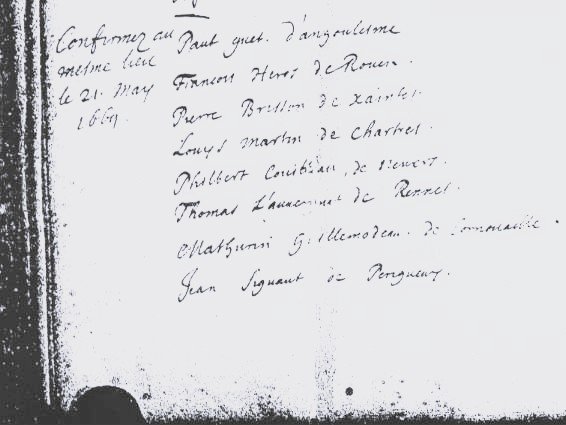
| Military service — Chambly confirmation and Carignan fort maps | 4 records | PRDH #403509 · BnF |
| Departure from France and the Atlantic crossing (contextual) | 2 records | Public domain |
| Early settlement at Montréal — Massicotte list and the 1667 land sale | 4 records | BAnQ-Montréal · SRC 1913 |
| Marriage — Catherine Laporte's baptism and the Laporte family entry | 3 records | PRDH · FrancoGene [409] |
| PRDH Family #4480 and individual records for all eleven children | 11 records | PRDH-IGD |
| Children's baptism records and reconstructed acts | 8 records | FamilySearch · BAnQ · ANQ |
| Notarial witness and land records, 1679–1680 | 4 records | Mesnard · Adhémar No. 481 · BAnQ |
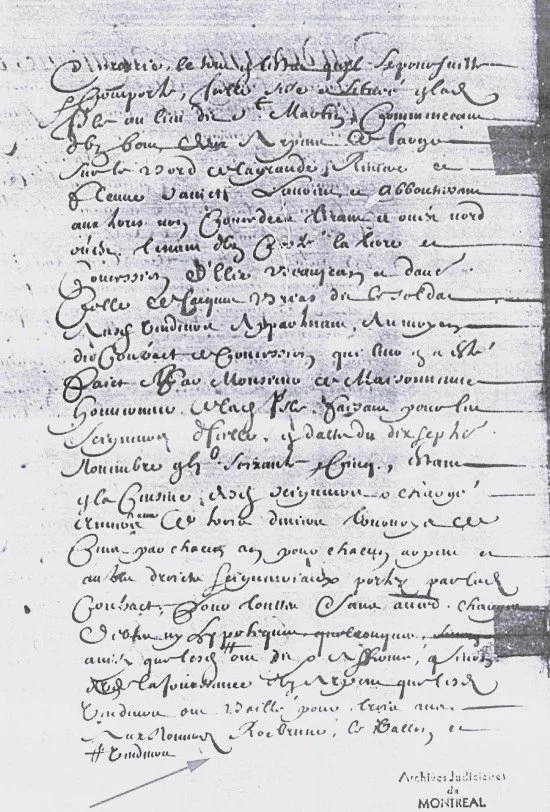
| Settlement at Contrecoeur — chapel contract, 1681 census, monument, 1718 terrier | 5 records | BAnQ · LAC · Larocque archive |
| Parish register gaps — cover, compiler's note, lacune index, reconstructed acts | 4 records | ANQ · FamilySearch |
| Obligations — Sédillot 1687 (lost), Couagne 1688, Lamorche No. 3063 | 4 records | Maugue · BAnQ-Montréal |
| Death, estate and legacy — Adhémar index, Aubuchon proceeding, 1711 auction, 1728 donation | 7 records | BAnQ TL4,S1,D480 & D1280 |
| Catherine Laporte — remarriage register, Varennes 1706 | 1 record | FamilySearch · ANQ |
| Marie-Anne Couillaud — L'Affaire Lachaume trial materials | 4 records | Archives judiciaires de Montréal |
| Analytical research — birth-date spreadsheets and narrative analysis | 3 records | Larocque family archive |
| Flagged false reference — retained as a caution against use | 1 record | FamilySearch |
| TOTAL | 70 records | 17 sections |
Counts are of catalogued records, each with its archive citation, evidentiary note and analysis status. A record may correspond to a single image, a multi-page file, a document known only through a later reference, or a source examined and excluded. The 1711 auction file runs to sixteen pages; the Aubuchon proceeding to four; the Sédillot obligation of 1687 survives only through the 1701 judgment that cites it.
Open Research Questions
- Who were Philibert's parents? No birth record has been found in French archives. Nivernais parish registers for c. 1635–1645 have not been systematically searched, and the nine spelling variants of the surname complicate the search.
- Is the Rocbrune of the 1667 Basset act Philibert Couillaud? The identification is well supported but undocumented. A negative search of stated extent across the Montréal greffes, for any other bearer of the name in this period, has not been completed.
- Resolved: Catherine's father was Jacques Laporte dit Saint-Georges, and "Sr george" in the 1688 obligation is the same man. The inventory of his estate, made 16 July 1698, names those present including "philibert Couliaux gendre" — son-in-law — and places his concession beside Philibert's. Catherine's own 1663 baptism calls her father Georges De la Porte dit St Georges, and her son's 1683 baptism does the same: the dit name displaced the given name in ordinary usage. A 1709 engagement separately documents Louis Laporte as uncle to Philibert's son.
- Resolved: the third census boy was not a son of the house. He is François Gazaille, born about 1680, son of Jean Gazaille dit Saint-Germain and Jeanne Touze (PRDH couple #2540), whose own household was enumerated separately in 1681 with three daughters and no small son. He married in 1711 and was buried at St-Denis-sur-Richelieu in 1760.
- Where is Jean's baptism? A son aged five in 1681 would have been born c. 1676, when the Contrecoeur chapel was not yet in service and the family used Sorel. The Sorel register has not been searched for him.
- What is the correct birth year for Louis? PRDH displays c. 1679, which produces a first-marriage age of about 37; Michel Larocque prefers c. 1689. PRDH's own note on the record allows a baptism after December 1686 and sets the burial age aside as uninformative, so the two are not rival authorities. The strongest evidence is the 1681 census, where a child born c. 1679 should appear at two and does not — unless Desjardins is right that the entry for Baptiste is Louis himself. Both candidate years fall inside a documented register loss, so the gaps discriminate between them not at all.
- Eleven children or thirteen? The Larocque model adds two unnamed births, one in each register loss, and moves Louis to c. 1689. The additional children are inferred from birth intervals, not from any record naming them.
- When exactly did Philibert die? The terminus ante quem is 8 March 1701 and the terminus post quem December 1686. The 1728 donation describes Catherine's dower rente as owed depuis trente ans, which if literal would place his death near 1698 — a possibility to be tested against the underlying Dubreuil act of 10 April 1728, which has not yet been examined.
- Why was the dower still owed in 1728? Antoine invoked the douaire préfix at the 1711 auction and the raised price is understood to have addressed it. The 1728 deed nonetheless records the rente as outstanding for thirty years. The two are not reconciled by any document examined.
- How did the Aubuchon matter end? The file closes on a summons for 9 November 1707 with no recorded outcome. Whether the seized grain was sold, and whether the Sédillot heirs recovered their 150 livres, is unknown.
- Who fathered Marie Hilaire's son Louis (b. 26 Dec 1715, Varennes) and Marie Barbe's son François (b. 23 Mar 1721, St-Sulpice)? Neither is identified in the records.
- What lies behind the dit name? Whether Rocbrune was toponymic, regimental, or descriptive cannot be determined from the surviving record. Research in Nivernais archives may clarify.
Access the Complete Research File
Choose how you'd like to view the full document inventory
Are You a Descendant of Philibert Couillaud dit Roquebrune?
Philibert's eleven documented children carried his dit name into the eighteenth century, and their descendants carry it still — through Larocque, Larock, Rock, Rockburn, Roque and Roquebrune, and through the related forms Couillaud, Couillau, Couillat and Caillou. If your line runs through any of them, we would be glad to compare notes. Get in touch — we'd love to hear your family's story.
About This Research
This research file is the complete evidentiary foundation for the Philibert Couillaud dit Roquebrune case study and documentary biography, following BCG evidence standards throughout. Six converging evidence lines are documented: the 1667 Basset land sale (earliest use of the dit name, with its identification analysis); the 1669 Chambly confirmation (the only contemporaneous origin statement); the 1675 chapel construction contract (settlement confirmed); the 1681 census (household snapshot); the 1688 Maugue obligation (property, witnesses, illiteracy and the X mark); and the legal cascade of 1701–1728 (death terminus, debts, and the recovered dower terms).
The fraudulent Bernard de Laroque pedigree is documented with its full rejection rationale. The 14.5-year register gap is evidenced by three components of the surviving parish volume — the cover, the compiler's note and the lacune index — which corroborate one another but are not independent of one another, being parts of the same compilation. Open research questions are stated rather than papered over, and inferences are labelled as inferences wherever the documents do not speak for themselves. Read the full methodology →