
The Storyline
"Real families.Real discoveries.Real stories."
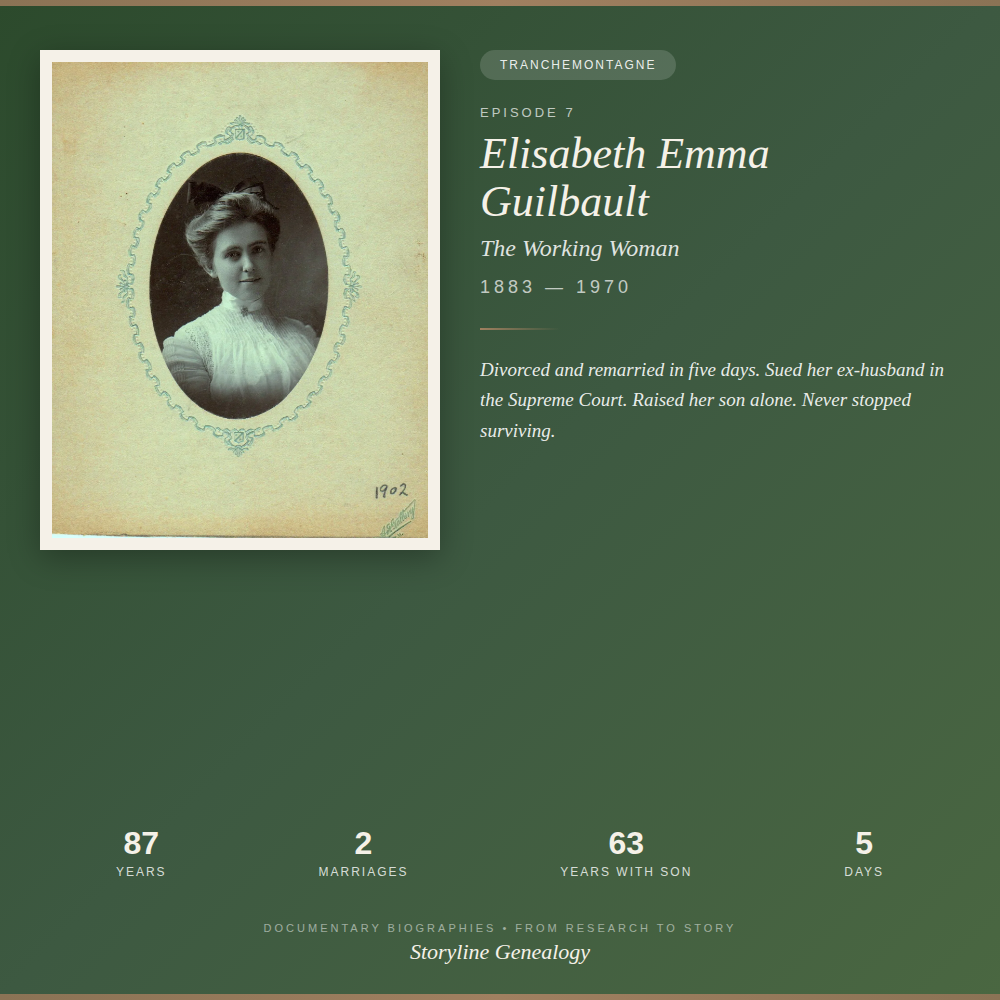
Tranchemontagne: Elisabeth Emma Guilbault
She divorced her first husband on October 18, 1907. Five days later, she married another man in Indiana. Five days. But before we judge Emma Gilbert for that desperate flight across state lines, we need to understand what it meant to be a divorced woman with a three-year-old son in 1907. This is the story of the voyageur's daughter who became the working woman—and never stopped surviving. Part of the Storyline Genealogy Series: Documentary Biographies From Research to Story
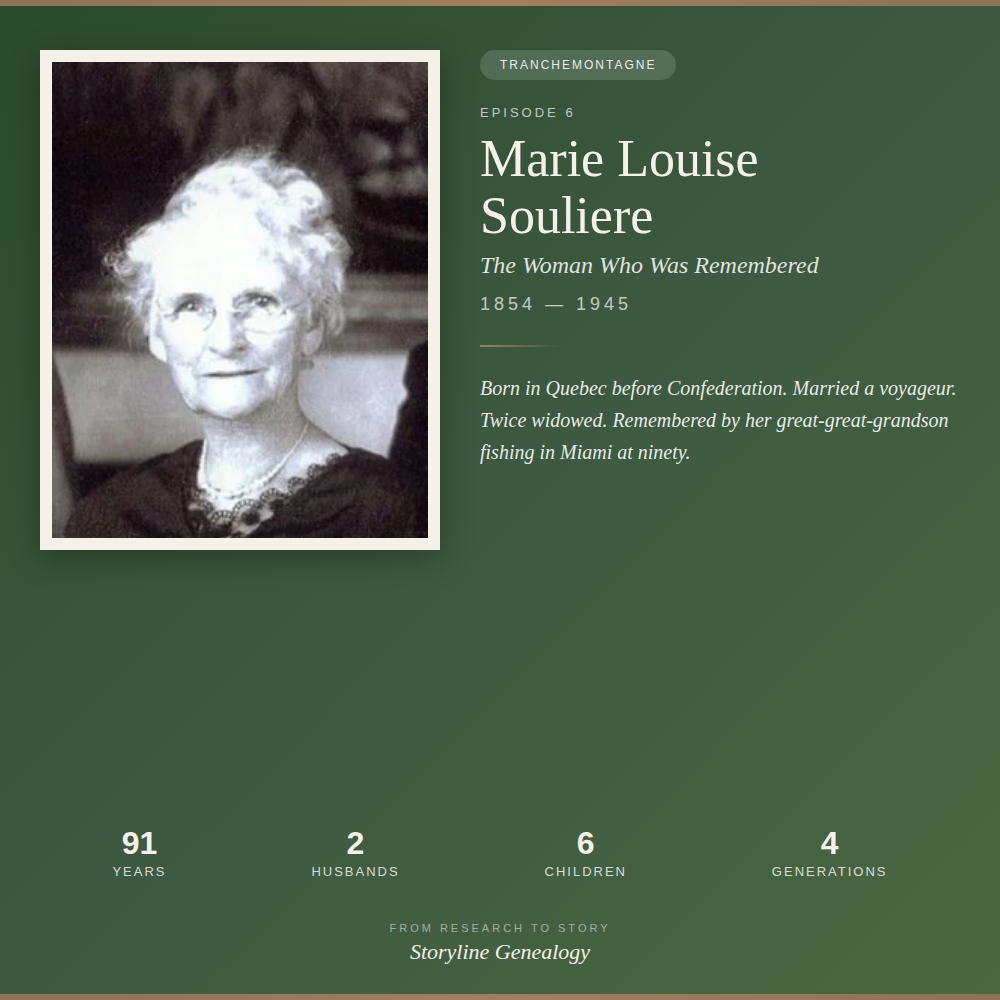
Tranchemontagne: Marie Louise Souliere
A boy fishes beside an ancient woman in Miami. She is in her nineties, he barely ten. Seventy years later, that boy will tell his daughter about the great-great-grandmother who taught him to fish—but he won't know her story. Born in Quebec before Canada was a nation, married to a voyageur, twice widowed, mother of six. This is her story, recovered from the records she left behind.
From the Storyline Genealogy series: Documentary Biographies From Research to Story
Marie Lorgueil: Three Generations in Court
Between 1683 and 1738, Marie Lorgueil's family appeared in colonial courts six times across three generations. They sued neighbors, defended against criminal charges, fought for orphaned children, and—in the most extraordinary case—a seventy-year-old granddaughter named Françoise demanded separation from her abusive husband Jean Larpenteur. This is the story of how one immigrant woman's strategic pragmatism became a family legacy of legal agency.
Part of the Storyline Genealogy series: Documentary Biographies
Marie Lorgueil: Fighting a Baron
On September 13, 1690, Gabriel Dumont, Baron de Blaignac, ran Marie Lorgueil's husband through with a sword and fled into the wilderness. Marie was 56, widowed, with eight children and mounting debt. She filed suit against the nobleman—then sold her legal rights for 520 livres and debt forgiveness. This is the story of an impossible choice, and what it reveals about justice, power, and survival in colonial New France.
Part of the Storyline Genealogy series: Documentary Biographies
Marie Lorgueil: The Documented Legacy
From her 1634 baptism in Bordeaux to her 1700 burial in Montreal, we've assembled 40+ documents tracing Marie Lorgueil's complete life. This is not typical—this is extraordinary. Most 17th-century women exist only in fragments. Marie's complete documentary arc reveals strategic intelligence, colonial resilience, and women's agency across 66 years and an ocean. Episode 4 concludes the series synthesizing what this remarkable documentation achievement means for family historians.
Part of the Storyline Genealogy series: Documentary Biographies
Marie Lorgueil: Widowhood and Resilience
In 1690, after 36 years of marriage, Toussaint Hunault died, leaving Marie a widow at age 56. Through legal documents from 1691 and the framework of the Custom of Paris, we examine how Marie navigated widowhood with agency and competence. She wasn't a helpless dependent—she was a legally capable woman who participated in estate settlements, protected her dower rights, and maintained dignity. Episode 3 of Marie Lorgueil's complete documented life (1634-1700).
Part of the Storyline Genealogy series: Documentary Biographies

Marie Lorgueil: Building a Family on the Frontier
In 21 years, Marie Lorgueil bore 10 children and raised 8 to adulthood—an extraordinary 80% survival rate in an era when half of all children died young. The 1666 census captures a perfect snapshot: all six children living, ages matching baptism records exactly. Through systematic analysis of baptism records, birth spacing, and documentary gaps, we reconstruct Marie's achievement as a frontier mother. Episode 2 of Marie Lorgueil's complete documented life (1634-1700).
Part of the Storyline Genealogy series: Documentary Biographies
Marie Lorgueil: The Girl Who Lied About Her Age
In 1654, Marie d'Orgueil crossed the Atlantic to New France and strategically misrepresented her age by four years. This wasn't desperation—it was calculated intelligence. Through baptism records, marriage documents, and census data, we resolve conflicting evidence and discover a family pattern: her daughter would employ the exact same strategy 22 years later. Episode 1 of Marie Lorgueil's complete documented life (1634-1700).
Part of the Storyline Genealogy series: Documentary Biographies
Finding the Filles du Roi in Colonial Records
The Filles du Roi left no personal diaries, but their lives are documented across colonial New France's archives. From marriage contracts to baptismal records, here's where to find the paper trail of the King's Daughters—and what those records can and cannot tell us.
Part of the Storyline Genealogy series: From marriage contracts to baptismal records—the documentary trail of the King's Daughters.
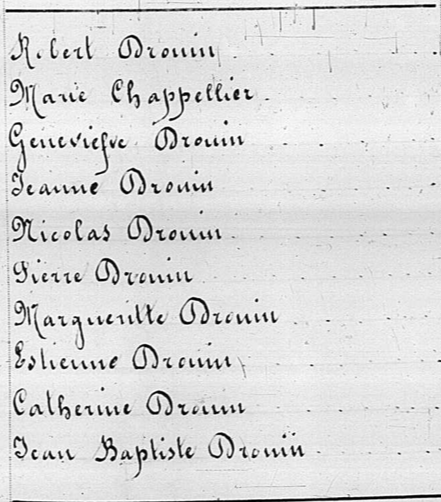
The Widow Who Never Lost: Marie Chapelier's Legal Victory
Marie Chapelier arrived in New France as a penniless widow in 1649. She could read and write—a rare skill that would prove decisive 44 years later. When her stepdaughter challenged her property rights in 1693, Marie fought back through five levels of colonial courts. The final score: 9-0. She died undefeated three months after her final victory. This is the story of strategic survival, legal warfare, and one woman's refusal to be defeated.
Part of the Storyline Genealogy series: From marriage contracts to courtroom victories—one widow's signature tells a 48-year story of literacy, strategy, and undefeated determination.
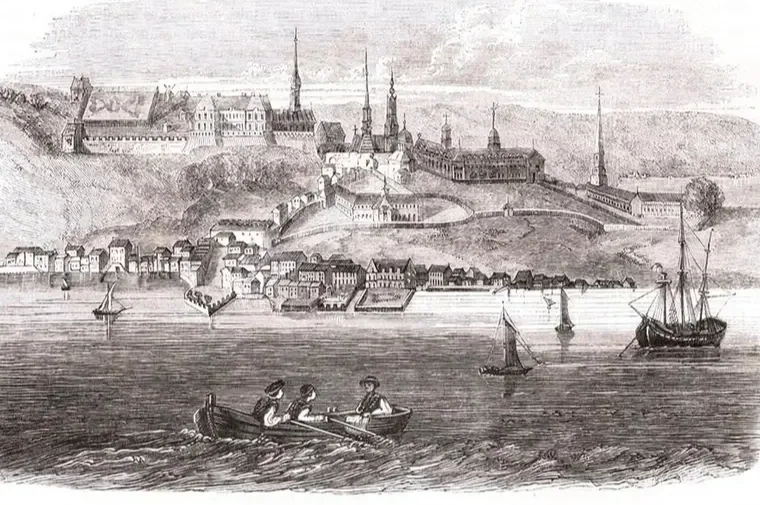
The Aversion: A Family War Over a Fille du Roi's Estate
On February 28, 1697, Provost Judge Guillaume Roger wrote a word that changed everything: "aversion." He wasn't describing a mild disagreement—he was documenting hostility so severe that normal legal proceedings couldn't work.
Who were these people who hated each other so intensely? A 52-year-old widowed farmer named Pierre Guilbault and his three adult children: Marie (29), Joseph (25), and Étienne (22).
What were they fighting over? Their dead mother's estate.
Louise Senécal arrived in Quebec in 1667 as a Fille du Roi—a King's Daughter sponsored by Louis XIV. She married in eleven days, raised four children, and built a prosperous farm over 26 years. When she died in 1693, her husband tried to remarry immediately and refused to settle her estate.
Her children waited nearly four years. Then they struck.
This is the story of how three siblings used the 17th-century court system to honor their mother's memory—and how primary sources documented a family war that would end in death, division, and justice.
Part of the Storyline Genealogy series: Uncovering the extraordinary stories hidden in ordinary family histories, one ancestor at a time.

Crossing the Atlantic: How Louise Senécal Became a Fille du Roi
Before the family war that required judicial intervention, there was a ship. Louise Senécal ignored the warnings of 20 women who filed formal complaints about conditions aboard the St. Louis de Dieppe. She crossed the Atlantic anyway, survived 107 days at sea, and married a man who had failed twice before to secure a bride. Eleven days after stepping off the ship, she became Louise Guilbault of Charlesbourg.
Part of the Storyline Genealogy series: Uncovering the extraordinary stories hidden in ordinary family histories, one ancestor at a time.

The Hidden Years: Marriage, Crisis and the Same-Day Contract
Pierre Guilbault appeared before a notary on April 13, 1693, to sign a marriage contract with 20-year-old Jeanne Morin. It was the same day his wife Louise died. The shocking timing—documented in colonial records—reveals the tensions that had been building in a marriage that survived separation, reconciliation, and 26 years of frontier life, only to end in a family war over Louise's estate.
Part of the Storyline Genealogy series: Uncovering the extraordinary stories hidden in ordinary family histories, one ancestor at a time.
Commemorative Poem: The Working Woman
"Do not judge her." A commemorative poem for Elisabeth Emma Guilbault, who was divorced on a Thursday and married on a Tuesday—five days to cross the Indiana line with a three-year-old and a need to survive.
Part of the Storyline Genealogy series: A Commemorative Poem for Elisabeth Emma Guilbault, The Working Woman (1883-1970)
Legacy Letter : Janvier Souliere
“You are the stones I laid for the future." A legacy letter imagining what Janvier Soulière—father of nineteen, husband to three wives, mason for sixty years—might say to the descendants who carry his name.
Part of the Storyline Genealogy Series : Letter to the Generations Who Carry My Name
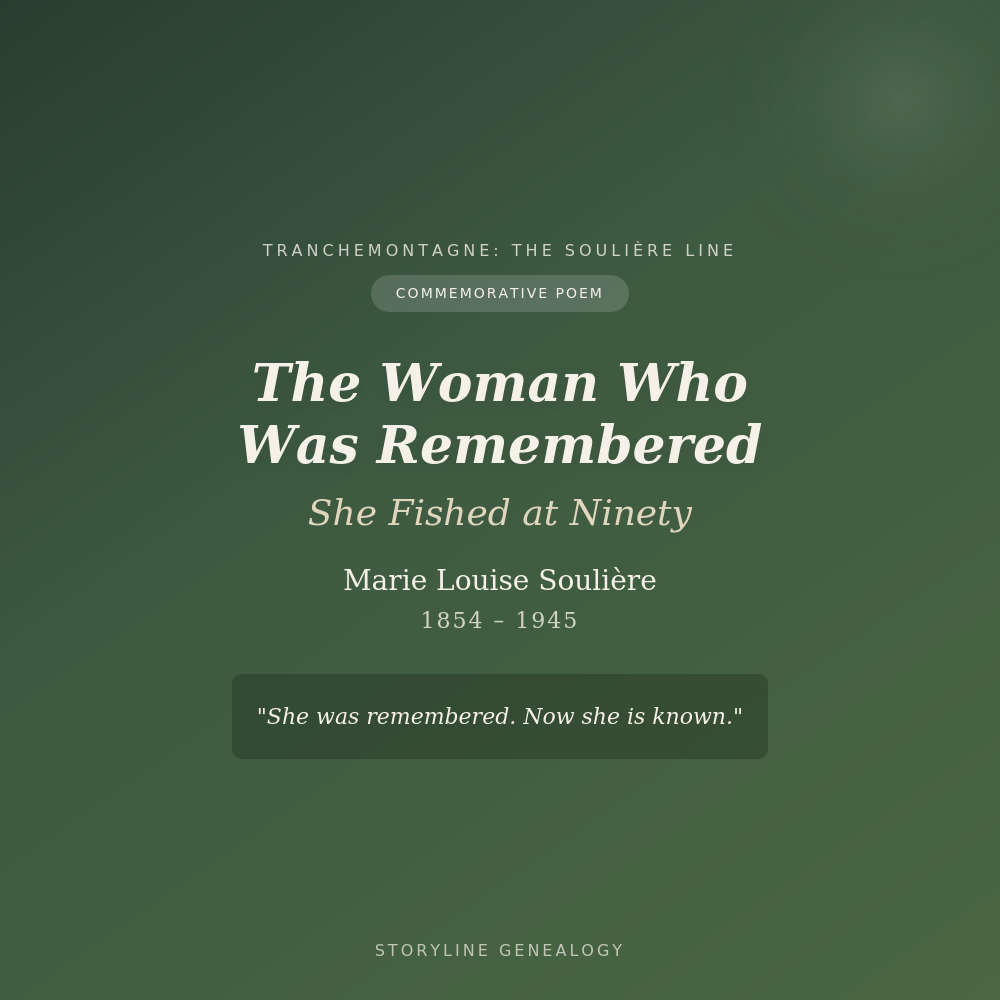
Commemorative Poem: The Woman Who Was Remembered
Before Canada was a nation, she was born. Marie Louise Soulière married a voyageur who paddled away and never came back. She crossed the border with three small children, built a life in Chicago, buried two husbands, and lived to ninety-one. At ninety, she fished in the Florida sun beside a grandson too young to know her story—but he remembered her, told his daughter, and now we know. A commemorative poem from the Tranchemontagne documentary biography series.
From the Storyline Genealogy series: A Commemorative Poem for Marie Louise Soulière (1854-1945)
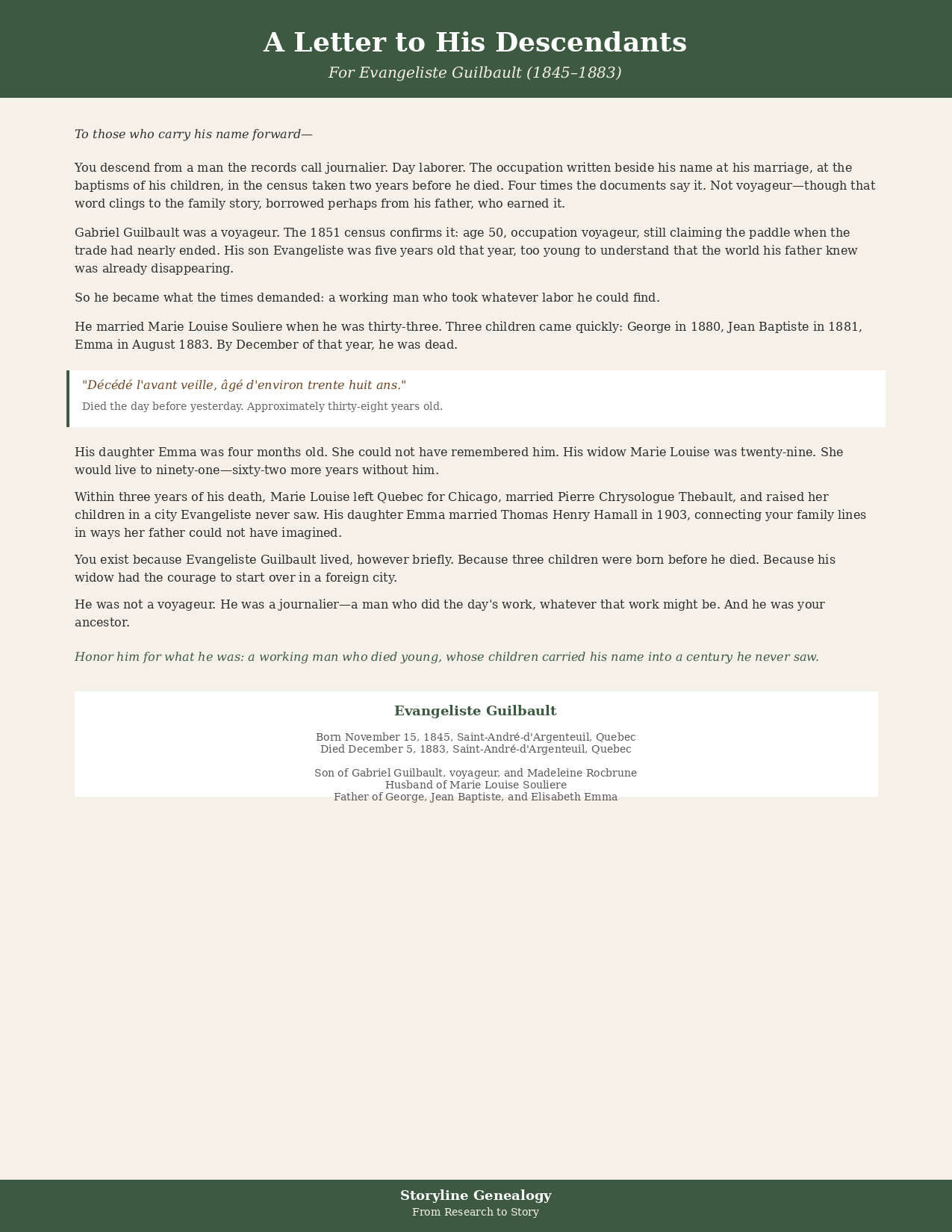
Legacy Keepsake: Evangeliste Guilbault Letter
You descend from a man the records call journalier. Day laborer. Four times the documents say it. Not voyageur—though that word clings to the family story, borrowed perhaps from his father, who earned it. Gabriel Guilbault was a voyageur. His son Evangeliste was five years old in 1851, too young to understand that the world his father knew was already disappearing. By the time he was old enough to work, there was nothing left to paddle.
Part of the Storyline Genealogy series: Legacy Keepsakes From Research to Story