
Margaret Mary McKenny
The Mother Who Couldn't Stay
The Tintype
Nichols, Photographer · 697 Broadway, New York · c. 1870For 150 years, this tintype photograph was carefully preserved — passed through four generations without a label, without a name, without anyone who could say with certainty who she was. A young woman of perhaps nineteen, photographed in a Broadway studio in the early 1870s. Dark Victorian dress. Pendant necklace. Hands folded, composed. A direct, intelligent gaze. Someone's treasure.
The back of the photograph still carries the studio card: Nichols, Photographer, 697 Broadway, 3 doors below 4th St., New York. It is an advertisement as much as a credit — promising card photographs retouched and burnished for $1.50 per dozen, locket pictures for 35 cents. For a working-class Brooklyn family, traveling to a Broadway studio was a statement. This portrait marked an occasion worth documenting.
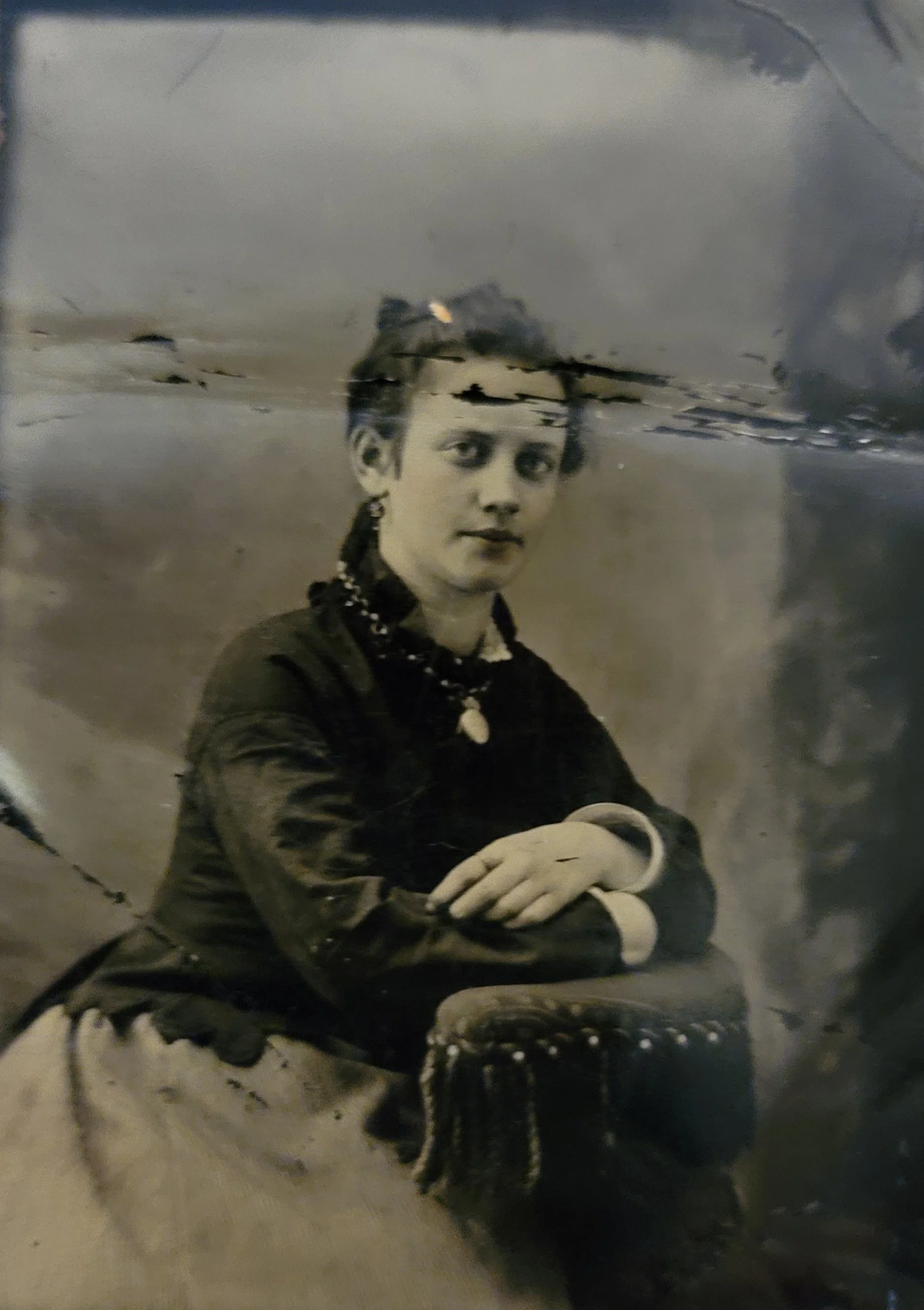
Nine independent lines of evidence converge on this identification: the tintype technology (peak 1865–1875), the fashion (1868–1872), the Broadway studio, the apparent age (18–22), the family tree match, the Brooklyn connection, the occasion (likely engagement), the preservation chain, and the family resemblance to her sister Mary — photographed fifty years later.
The photograph was preserved by her sister Mary F. "Aunt Maime" MacKinney and passed through four generations of Margaret's descendants.
Confidence of identification: 90–95%.
Full photographic analysis: The Tintype in the Box — Solving a 150-Year-Old Family Mystery.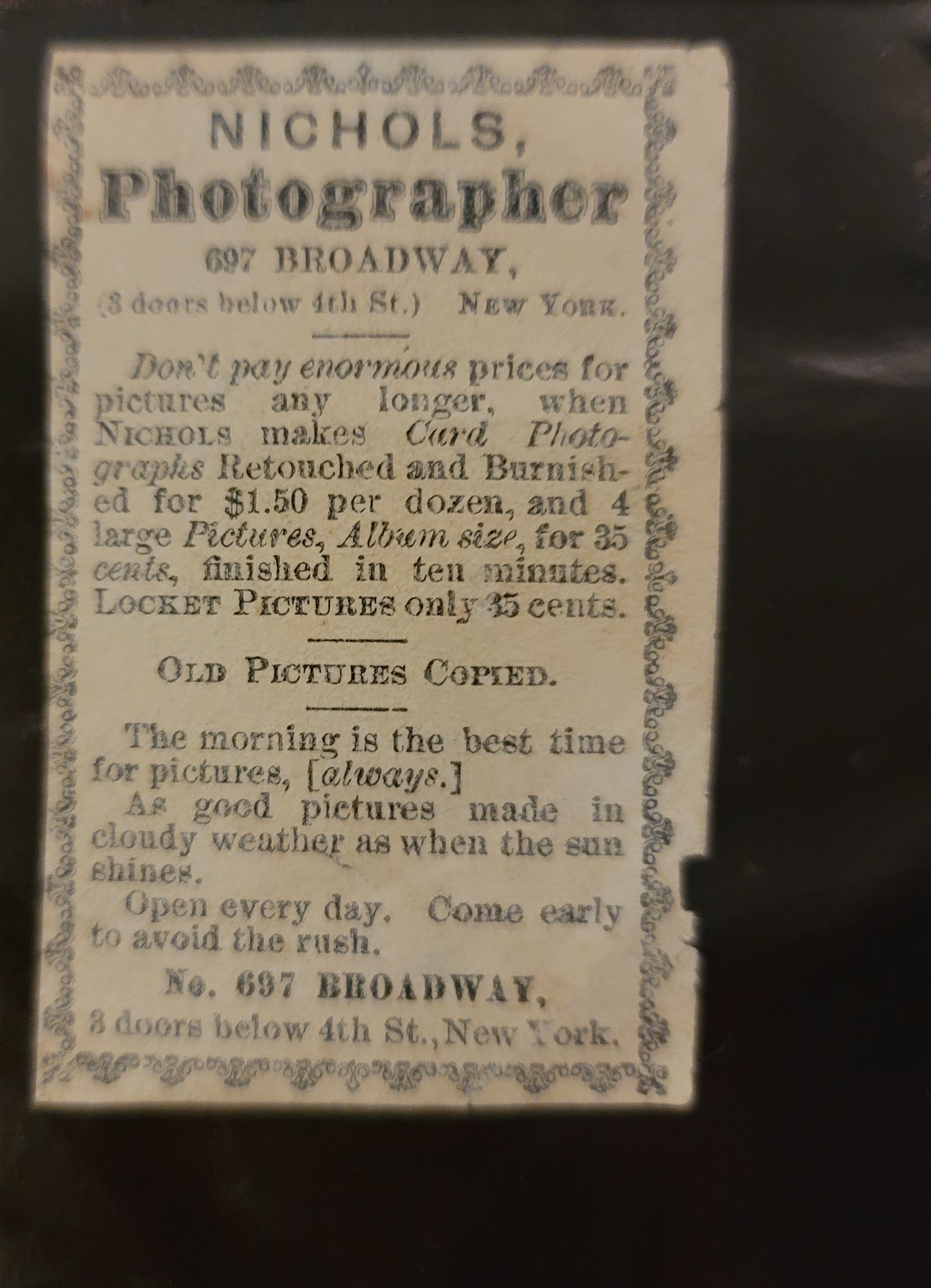
The studio card: Nichols, Photographer, 697 Broadway, 3 doors below 4th St., New York. Locket pictures 35 cents. Card photographs $1.50 per dozen. A working-class family making a deliberate investment in a formal portrait.
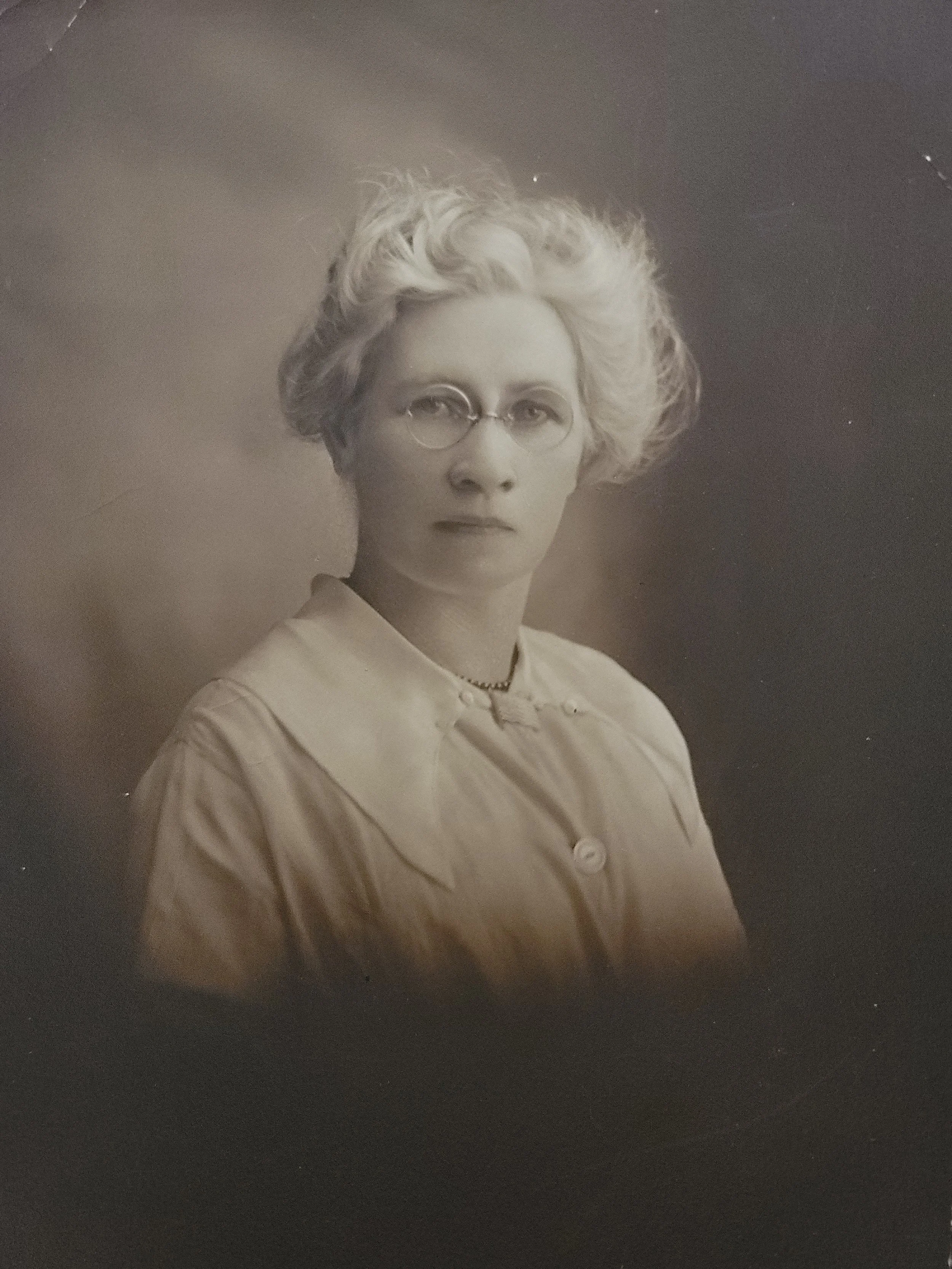
Left: Margaret McKenny, c. 1870, age approximately 19. Right: her sister Mary F. "Aunt Maime" MacKinney, c. 1915–1920, age approximately 55. Same oval face shape, same bone structure, same direct bearing. Photographed fifty years apart by different photographers using different technologies. The family resemblance anchors the identification.
The MacKinney Daughters
Ward 7, Brooklyn · 1851–1871 · Growing Up IrishMargaret McKenny was born approximately 1851 in Brooklyn, New York, the eldest daughter of George McKenna and Ann Lynch. She grew up in Ward 7, Brooklyn's Irish immigrant quarter along the waterfront — the same neighborhood that would anchor this family for the next forty years. Her father George worked as a day laborer. Her younger sister Mary was born around 1860. The family appears together in the 1860 census, and again in 1870 — the last time George would be recorded alive.

1860 U.S. Federal Census — George McKenna household, Ward 7, Brooklyn. George (Ireland), Ann, daughters. The complete family, before the first loss.
December 31, 1870: Father Dies
When Margaret was approximately nineteen years old — the same age she appears in the tintype — her father George died of Phthisis Pulmonalis on the last day of 1870. Tuberculosis. He was forty-two years old. The disease that killed him would return, fourteen years later, for his daughter.
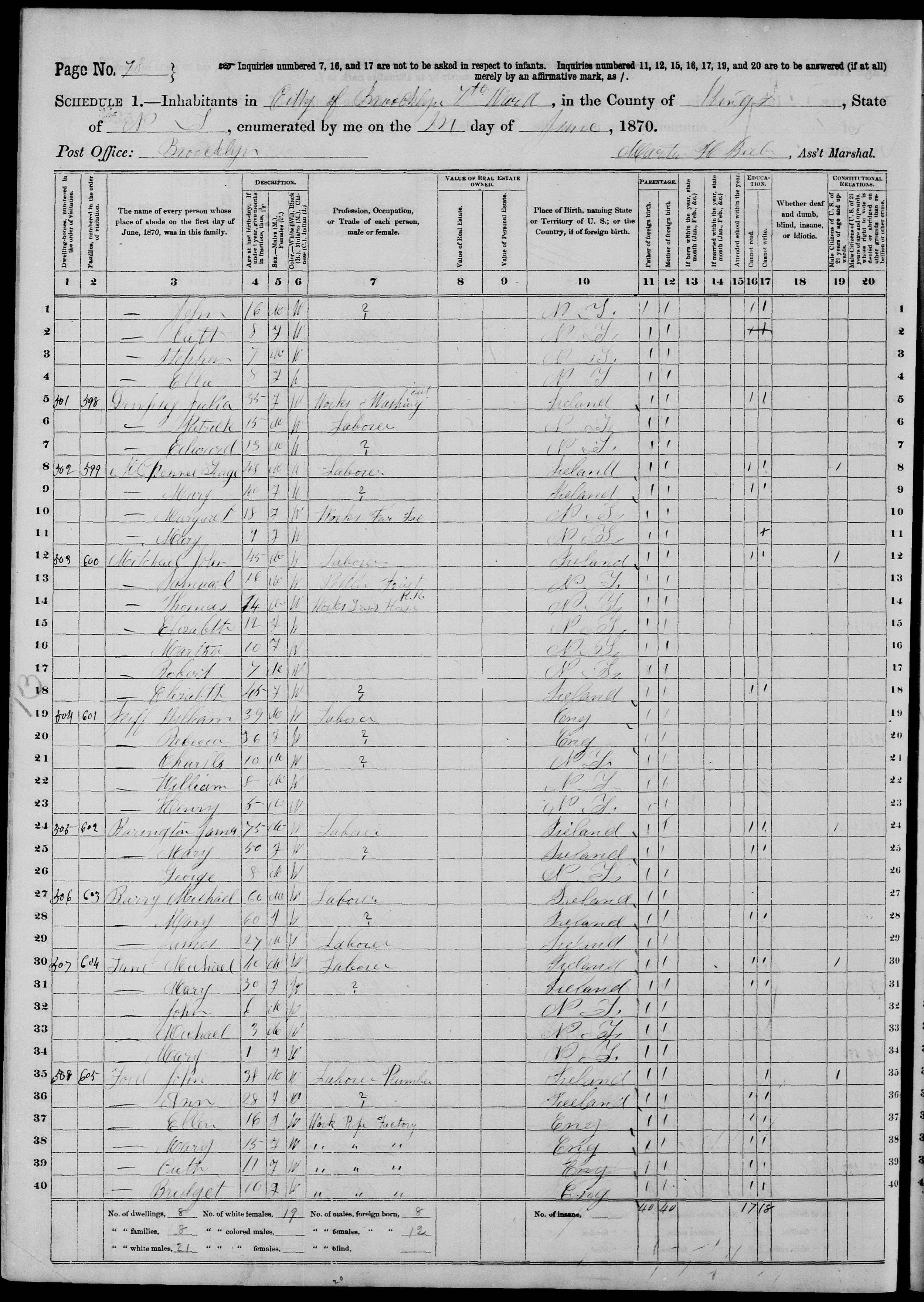
1870 U.S. Federal Census — George McKenna household, Ward 7, Brooklyn. Enumerated months before George's death on December 31, 1870. Margaret is approximately nineteen.
Ann Lynch MacKinney buried her husband on January 1, 1871, purchasing a family plot at Holy Cross Cemetery — Lett Row L, Plot 336. Margaret was now the eldest daughter in a fatherless household, her sister Mary ten years old. She watched her mother manage as a widow in immigrant Brooklyn. By 1875 the family was on Graham Street. By the late 1870s, Margaret had met John Kenny.

1875 New York State Census — Ann McKenny household, Graham Street, Ward 7. Margaret and Mary still at home with their widowed mother. This is the last census to show Margaret in her mother's household before her marriage to John Kenny.
Marriage and a Family in Ward 7
Brooklyn · c. 1875–1884 · The Years of HopeMargaret married John Kenny in the mid to late 1870s. He was a mat maker in Ward 7 Brooklyn — a craftsman working his way toward the skilled trade of hatter. They were a working-class couple, upwardly mobile, building a life together in the neighborhood where both families had roots. By 1880 they were living at 436 Park Avenue, Brooklyn, with their infant daughter Elizabeth — ten months old, born July 1879 — and with John's mother Eliza Kenny, the woman for whom the baby was almost certainly named.
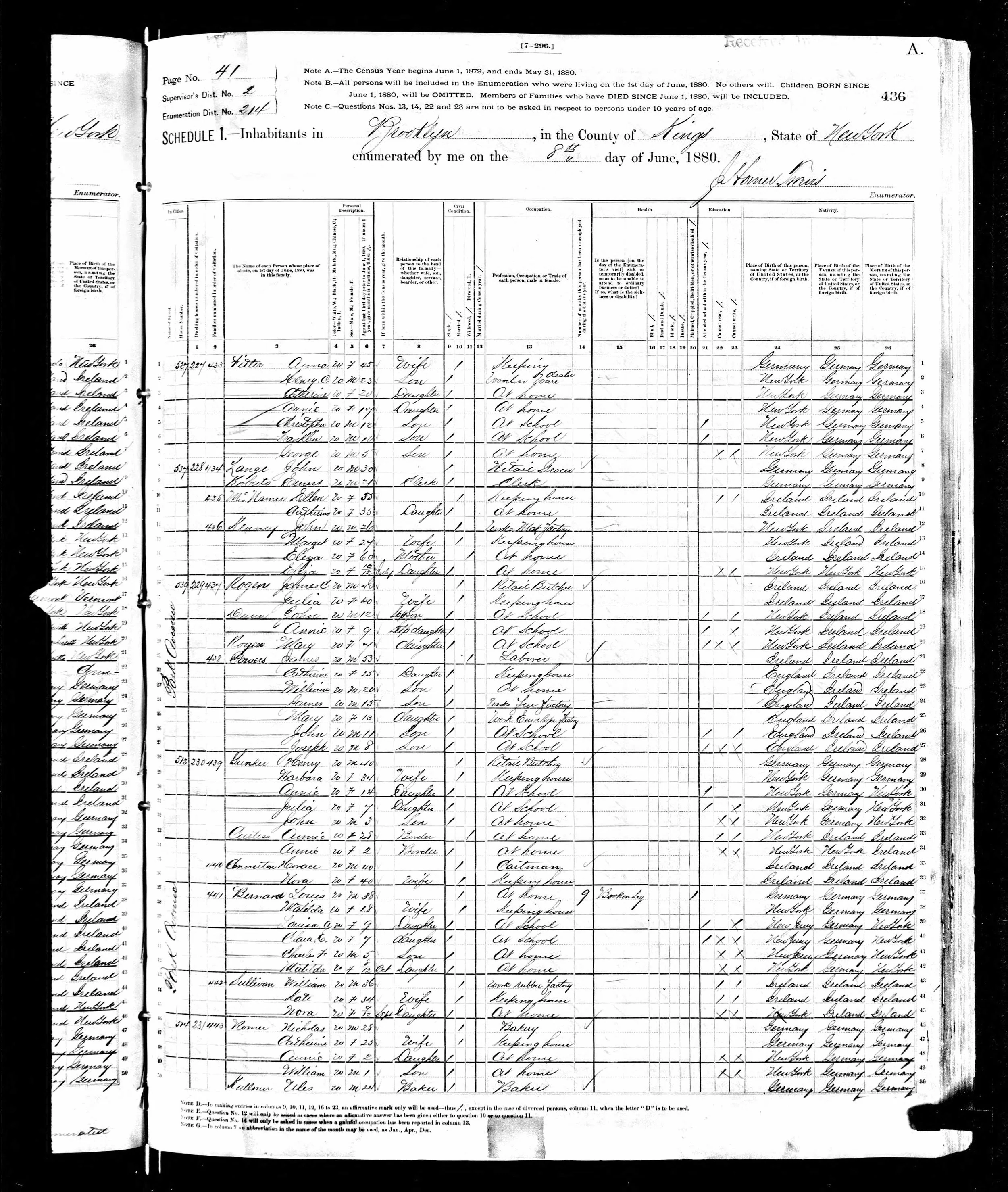
1880 U.S. Federal Census — Kenny household, 436 Park Avenue, Brooklyn. John Kenny, Mat Maker; wife Margaret, age 27, Ireland; daughter Eliza [Elizabeth], 10 months, born July. Eliza Kenny (mother-in-law), age 70. The only census to show Margaret in her own household, alive.
Two years after the census, in 1882-1883, their second daughter was born: Mary Agnes. The family was growing. John's career was progressing. In early 1884, Margaret became pregnant again.
She would never see 1885. The pregnancy that should have brought a third child home instead took Margaret and the baby both. In a single season in 1884, the Kenny family lost their mother and their infant sister. Elizabeth was five years old. Mary Agnes was one.
May and July 1884
39 Nostrand Avenue, Brooklyn · Two Deaths · Seven Weeks ApartIn 1884, tuberculosis — known as consumption or the "White Plague" — was the leading cause of death in urban areas, accounting for roughly one in seven deaths. It was particularly deadly for women of reproductive age. While Robert Koch had identified Mycobacterium tuberculosis in 1882, this knowledge had not yet shaped public health policy in Brooklyn. The disease was still widely believed to be hereditary rather than contagious.
Medical literature of the period documented that pregnancy and childbirth could accelerate tuberculosis progression in infected women. A study of female deaths between 1874 and 1884 found that nearly 12% of women who died of tuberculosis had given birth within the preceding year. Margaret McKenny Kenny fit this pattern precisely — she was already infected, and the physical stress of her third pregnancy accelerated the disease's final stage.
That same year, across the river in Manhattan, Alice Hathaway Lee Roosevelt died two days after giving birth on February 14, 1884 — her death from Bright's disease in the same season, in the same city, highlighting how universally dangerous childbirth and infection remained, regardless of social class.
May 24, 1884: Margaret Dies
On May 24, 1884, Margaret McKenny Kenny died at 39 Nostrand Avenue, Brooklyn, of pulmonary consumption. She was thirty-three years old. She had been ill since at least the spring — the doctor recorded having attended her since April 9. She died at approximately 4 o'clock in the morning on May 24. The death certificate was delivered to John Kenny the following day.

Death Certificate No. 4937 — Margaret Kenny [McKenny], May 24, 1884, 39 Nostrand Avenue, Brooklyn, Ward 21. Cause: Pulmonary Consumption, Asthenia. Age: 33. Delivered to John Kenny, May 25, 1884. The tuberculosis thread: George McKenney (1870) → Margaret McKenny Kenny (1884) → John Kenny (1888) → Mary Agnes Robertson (1924) → Helen Verhoek (1942).
July 12, 1884: Baby Margaret Dies
Seven weeks later, on July 12, 1884, the infant Margaret Mary Kenny died at 39 Sandford Street, Brooklyn. She was approximately three months old. The cause recorded was cholera infantum — a common summer diagnosis for infant intestinal illness in the era, exacerbated by the heat and the loss of her mother's milk. Certificate No. 6859 was delivered to John Kenny the same day she was buried.

Death Certificate No. 6859 — Margret [Margaret] Kenny, infant, July 12, 1884, 39 Sandford Street, Brooklyn. Cause: Cholera Infantum, three days. Buried Holy Cross Cemetery, July 13, 1884. Mother and infant daughter buried in the same family plot, seven weeks apart.
John Kenny was now a widower with two surviving daughters: Elizabeth, age five, and Mary Agnes, age one. Both grandmothers — Eliza Kenny on John's side, Ann Lynch MacKinney on Margaret's side — helped support the family. And Margaret's younger sister Mary, now in her mid-twenties, began the involvement with the Kenny household that would define the rest of her life.
Holy Cross Cemetery
Lett Row L, Plot 336 · The Family Plot Ann Purchased in 1871Margaret McKenny Kenny was buried at Holy Cross Cemetery, Brooklyn, in Lett Row L, Plot 336 — the plot her mother Ann Lynch MacKinney had purchased on January 1, 1871, when she buried George. Ann had purchased a family plot, not a single grave. In thirteen years, her first instinct had proved right: the family would need the space.
Infant Margaret was buried there seven weeks later, on July 13, 1884. Mother and daughter rest together in the plot that has held the family since 1871. John Kenny, when he died in 1888, was buried separately — in a different section at Holy Cross, with his brother Thomas Kenny and family. He is not with Margaret here.
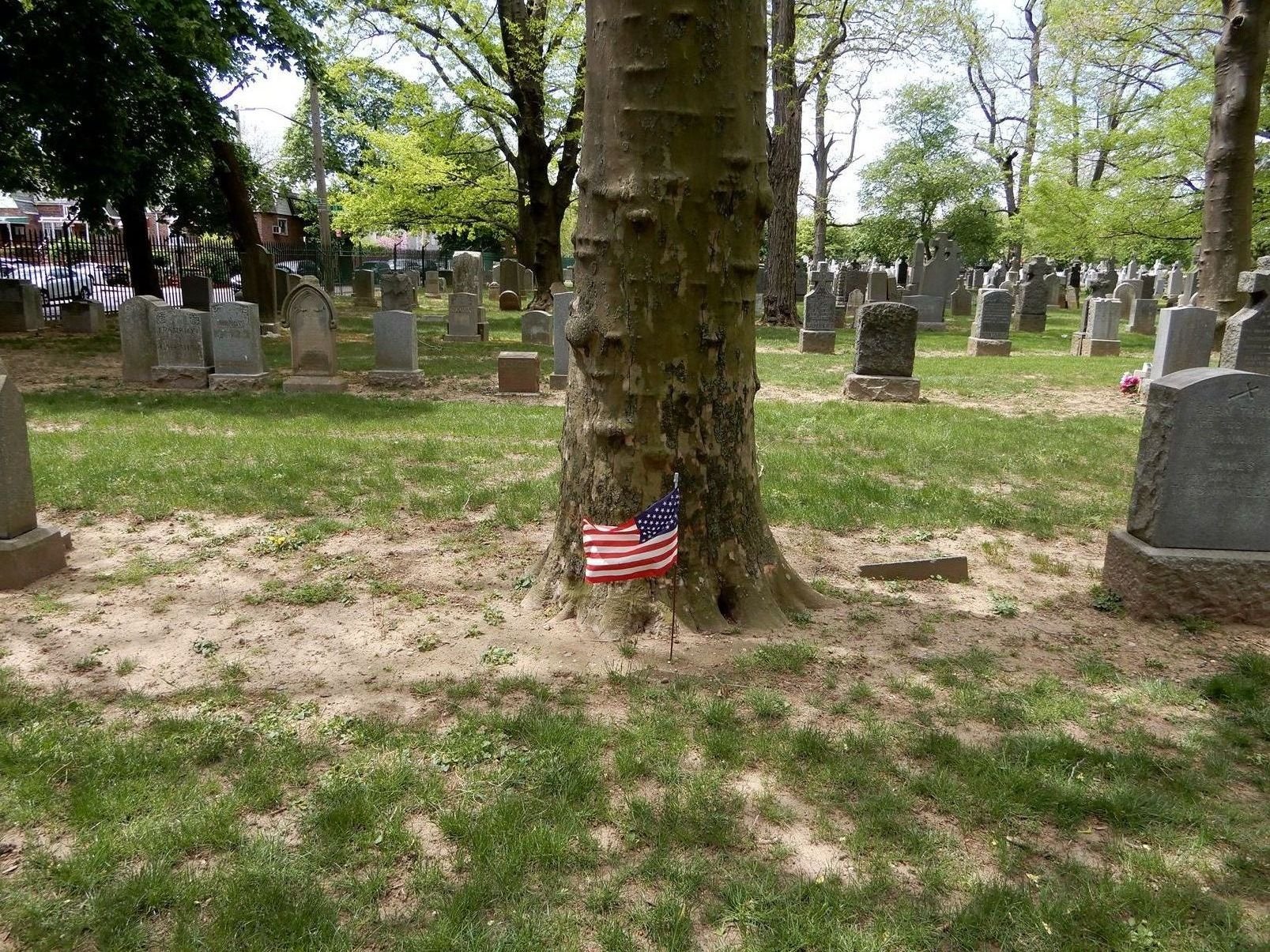
Holy Cross Cemetery, Brooklyn — Lett Row L, Plot 336. The family plot Ann Lynch MacKinney purchased on January 1, 1871, the day she buried George. Margaret and infant Margaret are buried here. Also in this plot: George McKenney (1871), Ann Lynch McKenna (1888), Mary F. MacKinney (1935), John Corbett (1949), Elizabeth Kenny Corbett (1950). Six people across seventy-nine years, returning to the plot Ann purchased on a January morning.

Find a Grave memorial — Margaret McKenny Kenny, Holy Cross Cemetery, Lett Row L, Plot 336. Parents: George McKenna and Ann Lynch McKenna. Sibling: Mary F. "Aunt Maime" MacKinney. Husband: John Kenney (buried separately). Children: Elizabeth Kenny Corbett, Mary Agnes Kenny Robertson, Margaret Kenny.
Margaret is the second link. Her death in 1884 set the chain of guardianship in motion that defines this entire series.
Coming soon: "Five Deaths, One Family, Seventy-Two Years" — the complete medical thread.
What Her Death Set in Motion
The Women Who Stayed · The Series She Made NecessaryMargaret McKenny Kenny died at thirty-three. She left behind a tintype photograph, two death certificates, four census entries, and two surviving daughters who had no memory of her face. She left behind a sister who spent the next forty-seven years making sure those daughters were raised, educated, fed, and loved. She left behind a family plot that her mother had purchased for her father — and that eventually received her mother, her sister, her niece, and her niece's husband, all returning to rest in the space Ann had secured the morning she buried George.
This series is called The Women Who Stayed. Margaret is the reason the phrase has meaning. Every biography in this series — Ann Lynch, Eliza Kenny, Mary F. MacKinney, Elizabeth Kenny Corbett, Mary Agnes Robertson, Helen Robertson Verhoek — exists in part as a response to what happened at 39 Nostrand Avenue on May 24, 1884.
For 150 years, Margaret's tintype was preserved — first by Aunt Maime, who kept it among the things she saved when she took in Margaret's daughters; then by Mary Agnes Robertson, who had it mounted in an ornate frame; then by Lillian Robertson O'Brien, who kept the frame safe for sixty years; then by successive generations who recognized it was important even after they had forgotten the name. When the identification was confirmed in 2025, Margaret McKenny Kenny was nineteen years old again — photographed at a Broadway studio on a morning full of hope, the whole of her short life still ahead of her.
The Face That Reappeared
In 1923 — fifty years after Margaret sat for her tintype at a Broadway studio — a photograph was taken in the backyard of 12 Elm Road, North Caldwell, New Jersey. Margaret's granddaughter Helen Robertson is kneeling in the foreground, her arm around her young brother Joe. She was approximately fifteen or sixteen years old.
Look at her next to the tintype. The same oval face. The same bone structure. The same direct bearing. The McKenny face, reappearing in the third generation fifty years on.
Helen died in 1942 at thirty-four — of tuberculosis, the same disease that killed her grandmother Margaret in 1884. The face and the disease both traveled down the line.

Margaret at approximately nineteen — the grandmother Helen never met. She died fourteen years before Helen was born.
Margaret's granddaughter. Standing behind: Elizabeth Kenny Corbett (left), Mary Agnes Kenny Robertson (center), Lillian Robertson (right). Taken approximately one year before both Mary Agnes and Joseph Robertson Sr. died within twelve days of each other in January 1924.
The face in the tintype reappears in Helen Robertson fifty years later: the same oval structure, cheekbones, eye placement, and bearing. Helen was Margaret's granddaughter — separated by a generation tuberculosis cut short. Margaret died of pulmonary consumption in 1884. Her daughter Mary Agnes died of pulmonary tuberculosis in 1924. Helen died of tuberculosis in 1942. The McKenny face and the McKenny disease traveled together through three generations.
Vital Statistics
| Full Name | Margaret McKenny Kenny |
| Born | c. 1851, Brooklyn (Kings County), New York |
| Father | George McKenney (Ireland; died December 31, 1870, tuberculosis, age 42) |
| Mother | Ann Lynch MacKinney (Ireland; died May 10, 1888, cerebral embolism, age 66) |
| Sister | Mary F. "Aunt Maime" MacKinney (c. 1860–1935) — confirmed by matching parentage on both death certificates |
| Married | John Kenny, c. mid-1870s; he died November 1888, pulmonary phthisis, age 36 |
| Children | Elizabeth M. Kenny (1879–1950); Mary Agnes Kenny Robertson (c. 1883–1924); Margaret Mary Kenny (born and died 1884) |
| Address at Death | 39 Nostrand Avenue, Brooklyn, Ward 21 |
| Died | May 24, 1884, approximately 4:00 AM; pulmonary consumption, asthenia; age 33 |
| Certificate | No. 4937, Brooklyn Department of Health; delivered to John Kenny, May 25, 1884 |
| Physician | W.A. Little, M.D., 443 Bedford Street; attended from April 9, 1884 |
| Infant Margaret | Born c. April–May 1884; died July 12, 1884, 39 Sandford Street; cholera infantum; Certificate No. 6859; buried Holy Cross Cemetery July 13, 1884 |
| Buried | Holy Cross Cemetery, Brooklyn, Lett Row L, Plot 336 — the plot her mother Ann purchased January 1, 1871 |
| Tintype | c. 1870, Nichols Photographer, 697 Broadway, New York; age approximately 19; identified 2025 at 90–95% confidence |
Margaret McKenny Kenny was the great-great-grandmother of the researcher. Her daughter Mary Agnes Kenny Robertson was the researcher's great-grandmother. Her daughter Elizabeth Kenny Corbett was the researcher's great-grand-aunt. The tintype photograph and the infant's death certificate were preserved by Margaret's sister Mary F. MacKinney and passed through four generations to the researcher. Research by Mary Hamall Morales. Tintype identification completed 2025; full methodology in The Tintype in the Box. Cemetery records confirmed with Holy Cross Cemetery, Brooklyn.
Document Gallery
Primary sources documenting Margaret McKenny Kenny (1851–1884) · Click any image to enlarge
c. 1870 Tintype Portrait
Margaret McKenny, age ~19
Portrait
Tintype Back — Studio Card
Nichols, 697 Broadway, N.Y.
Artifact
1860 Census
Complete family, Ward 7
Census
1870 Census
Last census with George alive
Census
1875 NY State Census
Margaret & Mary with mother
Census
1880 Census
Margaret in her own household
Census
1884 — Margaret's Death
Certificate No. 4937
Death Cert.
1884 — Infant Margaret's Death
Certificate No. 6859 · Seven weeks later
Death Cert.
Find a Grave Memorial
Holy Cross · Lett Row L, Plot 336
Cemetery
Holy Cross Cemetery Plot
Lett Row L, Plot 336
CemeteryScattered Stones: The Women Who Stayed · Navigation
← Series Hub: The Women Who Stayed The complete series — six biographies and companion pieces · The tuberculosis thread · Holy Cross Cemetery, 1871–1950 Episode 1: Elizabeth Kenny Corbett (1879–1950) Three Names, One Life · Margaret's eldest daughter · Navy Yeomanette · The niece Aunt Maime raised from age five Episode 4: Mary F. MacKinney "Aunt Maime" (c. 1860–1935) The One Who Stayed · Margaret's sister · The woman whose portrait was preserved without a name for ninety years Blog: The Tintype in the Box — Solving a 150-Year-Old Family Mystery The complete photographic analysis and nine lines of evidence behind the identification of Margaret McKenny Kenny Blog: Four Generations in Hats — A Brooklyn Story of Resilience The Kenny family story through four generations · When one craftsman's legacy becomes a through-line for an entire familyThe Woman in the Portrait: Aunt Maime's Story — For ninety years, the portrait was preserved without a name.
The Brooklyn Mat Maker — The BCG case study that established John Kenny's identity and unlocked this family's entire history.
Coming soon: "Five Deaths, One Family, Seventy-Two Years: Tuberculosis and the McKenny-Kenny-Robertson Line"
Are You Connected to the Kenny & McKenny Line?
If you descend from the Brooklyn Kenny family of the Mat Maker (also Kenney, Kinney; County Longford) or the McKenna / McKenny / MacKinney family of Ann Lynch and George McKenna — or from the connected Lynch, Corcoran, Heffernan, or Robertson lines — in Brooklyn, New Jersey, or Ireland, I’d like to compare notes. Documented trees, Brooklyn and Irish records, DNA matches, and old family photographs have all moved this research forward.
Get in Touch About This FamilyCousin connections are informal and reciprocal — no fee, no obligation, just shared work on shared ancestry.
Questions about your own research? Begin a research inquiry.
