
Saint-Constant-de-la-Prairie-de-la-Magdeleine
Saint-Constant
On August 11, 1797, a curé named Ch. Bégin baptized twin infants at Saint-Constant. One of them was Laurent Quintal—son of a farmer named François and his wife Marie Hébert. Twenty years later, that same child would enter the pays d’en haut as a North West Company hivernant, making his mark on the contract because he could not write his name. The baptism register that recorded his birth also records, in its margins, the world that made him.

The church of Saint-Constant, a stone structure reflecting the parish’s 19th-century growth. Though this building postdates the 1797 twin baptism, it stands in the same community where François Quintal recorded his children and where an entire generation of young men signed contracts for the fur trade before heading west. Photo by Cantons-de-l’Est, licensed CC BY-SA 4.0, via Wikimedia Commons.
The register entry is brief: two children baptized on the same day, born the day before. Father: François Quintal, fermier. Mother: Marie Hébert. The curé noted the act with a common device of the era—“Acte commun avec sa jumelle Marie Suzanne”—a shared record for twins. Marie Suzanne would die fifteen days later. Laurent survived, grew to manhood in the south shore landscape of the St. Lawrence valley, and in February 1817 made his mark—an X—on a contract binding him to the service of the North West Company.
The church that recorded his birth was not the formal institution that would define the parish in later generations. Saint-Constant in 1797 was a mission community settled on Jesuit land, its residents tied to the rhythms of farming and the seasonal pull of the fur trade. The same register that baptized Laurent Quintal had baptized the sons of other families who signed NWC and HBC contracts, paddled the canoe routes west, and sometimes returned. Sometimes did not.
The Record That Anchors the Line
In the parish register of Saint-Constant, this entry establishes Laurent Quintal’s correct family and place of origin:
Saint-Constant (La Prairie) | Baptized August 11, 1797 | PRDH-IGD #671580
Father’s occupation: fermier—farmer. The same La Prairie district that supplied labour to the fur trade brigades supplied Laurent Quintal to the North West Company twenty years later.
Two independent lines of evidence establish this identity. The first is the parish register itself, indexed in the PRDH-IGD database as Family Record #55528 and Baptism #671580 — the index is a transcription of the register, not a second witness to it, and the two are counted here as one. The second is the Hudson’s Bay Company Archives biographical sheet, which independently records his parish as St. Constant, Montreal. A third confirmation comes from the notarial engagement contract of February 1817, which names the same parish. What the circulating family trees assert has none of these behind it.
A Parish on the South Shore
Saint-Constant sits on the south shore of the St. Lawrence River, 30 kilometres south of Montréal, within what was the Seigneurie de La Prairie-de-la-Magdeleine. Though the civil parish was not formally established until 1841, the community had roots in the mid-18th century, its name honouring Constant Le Marchand de Lignery, a French officer whose son Jacques served as a missionary in the area for several years. By the time of Laurent Quintal’s birth in 1797, Saint-Constant was an established, if modest, Catholic community—its families farming the south shore land while its young men looked increasingly westward.


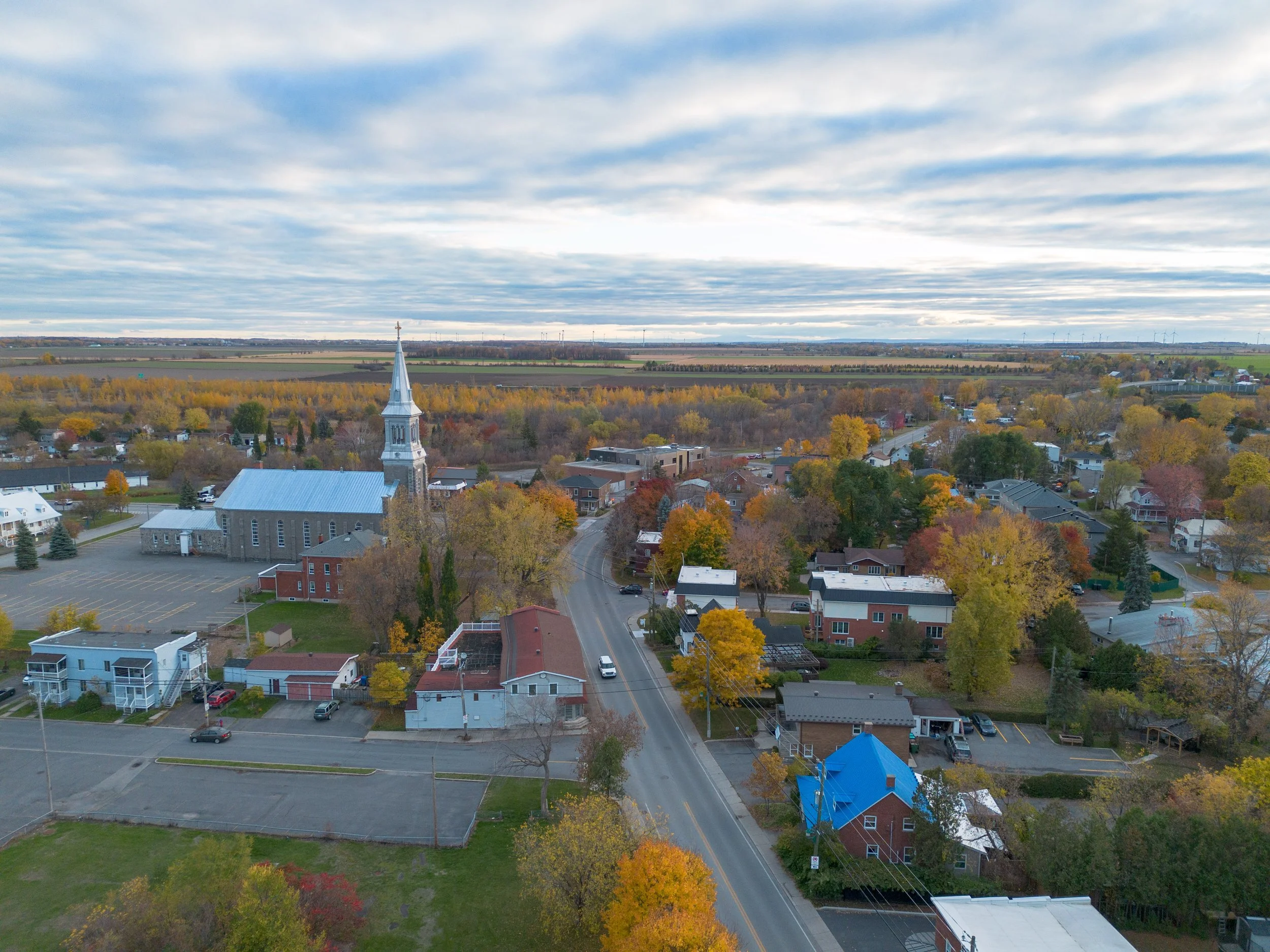
Saint-Constant from the air, the parish church at the centre of the village and the farmland of the south shore stretching to the horizon. This is the landscape of the Seigneurie de La Prairie-de-la-Magdeleine: level, arable, and within a day’s travel of the Montréal quaysides where the fur brigades assembled each spring. Photo by Hayden Soloviev, licensed CC BY 4.0, via Wikimedia Commons.
The La Prairie district was, by the late 18th century, one of the primary recruiting grounds for the fur trade brigades that departed Montréal each spring. Young men from farming families in Saint-Constant, Saint-Philippe, and the surrounding seigneuries signed notarized contracts as engagés—hired hands—for the North West Company and the Hudson’s Bay Company. They typically entered the trade in their early twenties, spent one to three years in the interior country, and returned with wages that helped establish a farm. François Quintal’s occupation in the baptism register—fermier—describes exactly the life to which so many voyageurs eventually returned.
The Baptism Record, August 11, 1797
Laurent Quintal (and twin Marie Suzanne)

Child: Laurent, né le dix août mil sept cent quatre-vingt-dix-sept (born August 10, 1797)
Father: François Quintal — fermier, Saint-Constant (La Prairie)
Mother: Marie Hébert — épouse de François Quintal, Saint-Constant (La Prairie)
Godfather (Laurent): Alexis Picard
Godmother (Laurent): Catherine Lanctot
Godfather (Marie Suzanne): René Bordeau
Godmother (Marie Suzanne): Marie Louise Roy, épouse de Charles Beauvais
Officiant: Ch. Bégin père — curé de St-Constant
Note: Acte commun avec sa jumelle Marie Suzanne (Shared act with his twin Marie Suzanne)
| Act | Baptism, 11 August 1797 |
| Parish | St-Constant (La Prairie) — MRC Roussillon, Montérégie |
| Birth | 10 August 1797 |
| 01 | Laurent QUINTAL — subject, male |
| 02 | François QUINTAL — father of 01; occupation FERMIER; residence St-Constant (La Prairie) |
| 03 | Marie HEBERT — mother of 01; spouse of 02; residence St-Constant (La Prairie) |
| Register note | Acte commun avec sa jumelle Marie Suzanne |
| Father | François QUINTAL (b. 1747) |
| Mother | Marie HÉBERT (b. 1752) |
| Marriage | 5 May 1777, Boucherville (Ste-Famille) |
| Children | Seventeen; Laurent is the fifteenth |
| Laurent | b. 10 August 1797, St-Constant (La Prairie); baptized 11 August |
| Twin | Marie Suzanne QUINTAL, baptized same day; died 25 August 1797 |
Marie Suzanne Quintal — August 11 to August 25, 1797
The register does not mark the difference between them. Laurent and Marie Suzanne are baptized together on August 11 in a single act—acte commun—their godparents different, their entry shared. Fifteen days later, Marie Suzanne was dead. The curé Ch. Bégin recorded her burial on August 26 in the same register: “décédée de la veille agée de quinze jours”—died the day before, age fifteen days. The witness at the burial was Joseph Lemieux, who declared he did not know how to sign.
Infant mortality in late 18th-century Quebec was not unusual. Families expected to bury children, and the registers document this expectation in their matter-of-fact notations. What is striking here is the precision of the record: fifteen days is specific, almost tender. The priest counted. He noted the day before. He gave her the full form of her parents’ names—François Quintal and Marie Hébert—the same names that appear in the baptism entry fifteen days earlier. The family lost a twin and kept a son. The register holds both facts on the same pages.
Marie Suzanne Quintal — age fifteen days
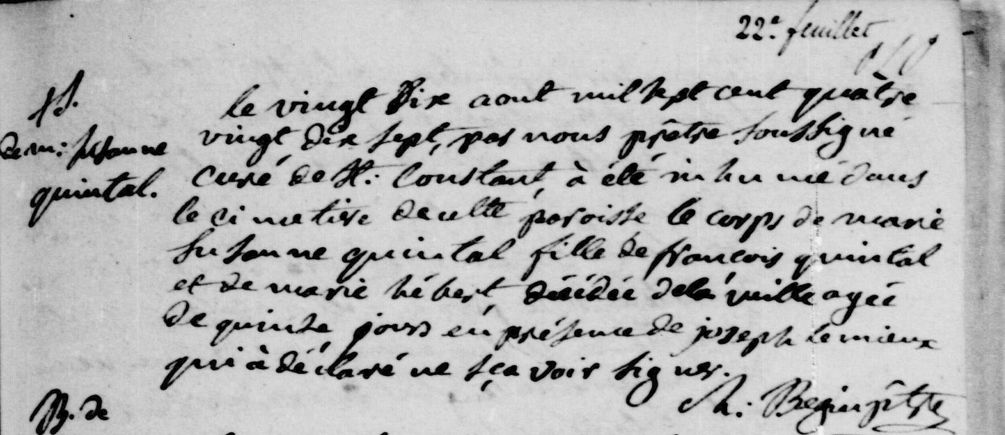
Deceased: Marie Suzanne Quintal, age approximately fifteen days (born August 10, 1797)
Father: François Quintal
Mother: Marie Hébert
Witness: Joseph Lemieux — qui a déclaré ne sçavoir signer (who declared he does not know how to sign)
Officiant: Ch. Bégin père — curé de St-Constant
Editorial note: the day-of-month in the opening line is difficult to read in the register hand. The burial is dated 26 August on the evidence of the surrounding entries and the statement that she died de la veille, the day before. The reading is to be confirmed against the original.
| Act | Baptism, 11 August 1797 |
| Parish | St-Constant (La Prairie) |
| Birth | 10 August 1797 |
| 01 | Marie Suzanne QUINTAL — subject, female |
| 02 | François QUINTAL — father of 01; occupation FERMIER |
| 03 | Marie HEBERT — mother of 01; spouse of 02 |
| Register note | Acte commun avec son jumeau Laurent |
| Death | 25 August 1797, age fifteen days |
A Nursery for Voyageurs
Saint-Constant and its neighbouring parishes in the La Prairie district were not incidental to the fur trade. They were central to it. The Montreal-Trois-Rivières corridor—the rural belt of south shore and north shore farming communities within a day’s travel of the city—supplied a significant proportion of the engagés who paddled the NWC and HBC canoe routes westward each spring. Notarized contracts between young men from these parishes and the major fur trade companies survive in the archives of Montréal in great number.
The World Laurent Quintal Was Born Into
The South Shore and the Fur Trade
The La Prairie district parishes—Saint-Constant, Saint-Philippe, La Prairie itself—were what historians of the fur trade have called a “nursery for voyageurs.” Young men signed their first NWC or HBC contracts in their early twenties, typically shortly after marriage, to earn capital needed to establish their own farms. Fur trade employment was not a career for most; it was a phase, a financial strategy, and for some a calling that proved stronger than the pull of the south shore land.
Before departing each spring, brigades made their way along the south bank of the St. Lawrence to the western tip of Montréal Island, stopping at Sainte-Anne-de-Bellevue to pray before their patron saint. The church at Sainte-Anne was the last familiar threshold before the pays d’en haut opened before them. Some men from Saint-Constant and the neighbouring parishes made that crossing once. Some made it many times over many years. Laurent Quintal’s NWC and HBC career spanned twenty years—not a phase, but a life.
The Chasse-Galerie legend—voyageurs flying home in a devil’s canoe to visit their sweethearts in parishes like Lavaltrie or Saint-Constant on New Year’s Eve—grew from exactly this world: men gone so long that only magic seemed likely to bring them back. The registers that recorded their children’s baptisms fell silent during the years the men were gone, then filled again when they returned with wages from the interior.
The Quintal family was part of this landscape. PRDH-IGD Family Record #55528 shows François Quintal and Marie Hébert with seventeen children, of whom Laurent was the fifteenth—a farming family of the south shore whose sons grew up in earshot of the canoe brigades assembling at La Prairie each spring. The family’s position in the register—fermiers, farmers—was the anchor from which the young men of the next generation would depart, and to which most eventually returned.
The parish register records Laurent Quintal’s baptism in 1797. The next primary source that names him is the notarial engagement contract of February 21, 1817, and the North West Company ledger in the Hudson’s Bay Company Archives, HBCA F.4/32 folio 970. Twenty years of life in Saint-Constant—childhood, young manhood, whatever circumstances led him to sign a NWC contract rather than establish a farm—are invisible in the surviving records. His twin sister died fifteen days after their shared baptism. His father could not sign his name. Beyond those facts, the documentary record falls silent until he appears as a young fur trader in the interior.
This silence is not unusual. It is the normal condition of the historical record for working-class French-Canadian men of this period. They appear in baptism registers, occasionally in marriage records, and then in the institutional records of the employers who sent them west. The HBCA, in this sense, is not supplementary to the Quebec parish record system—for men like Laurent Quintal, it is its continuation. The parish register at Saint-Constant opens his documentary chain; the HBCA account books span the middle of it; and the closing years in Oregon are documented in the 1850 federal census and, at second hand, in the Oregon State Archives Early Oregonian Database — a compiled resource rather than a primary record, and one whose profile for Laurent gives his birth year incorrectly as 1795. The arc is well documented at both ends, but the two ends are not documented equally well.
From the Baptismal Font to the Snake River
The life documented in primary sources for Laurent Quintal traces an arc that begins in this parish and ends sixty-four years later on a farm in Douglas County, Oregon. The baptism register at Saint-Constant is the first document in a chain that eventually runs through four archive collections on two sides of a continent.
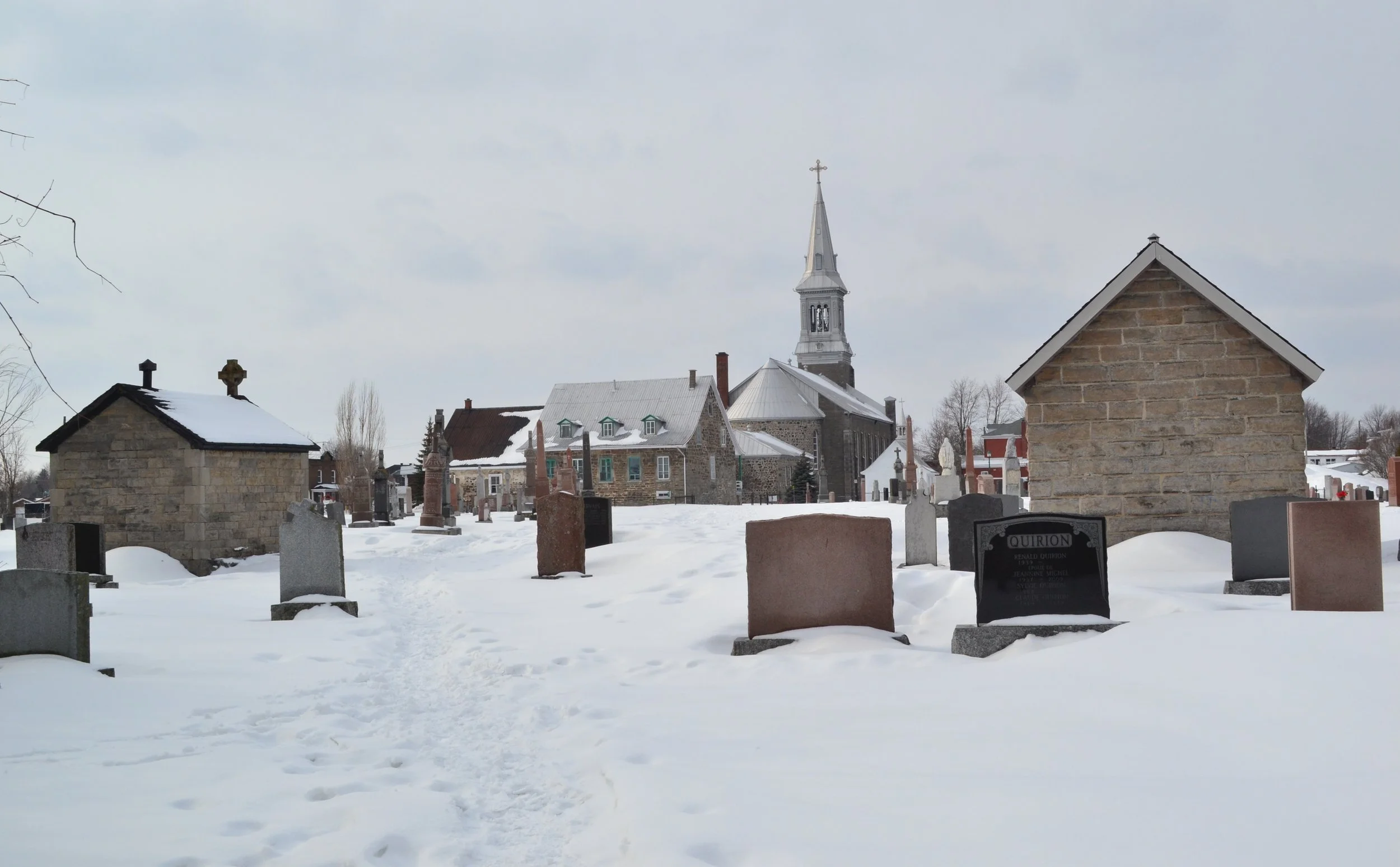
The old presbyteries of Saint-Constant, with the parish cemetery in the foreground and the church behind. The stone buildings and the burial ground sit together as they have for generations — the same ground where Marie Suzanne Quintal was buried on an August day in 1797, aged fifteen days, in the presence of a witness who could not sign his name. Her brother is buried two thousand miles away, in Oregon. Photo by Cantons-de-l’Est, licensed CC BY-SA 4.0, via Wikimedia Commons.
The Other Names on the Page
The register page that records Laurent Quintal’s baptism records other families alongside him — the farming households of the south shore community, their lives documented in the rhythms of the Catholic sacrament system: baptism, marriage, burial. For most of them the register is the complete primary record of their existence.
For some of their sons, however, the register is only the beginning. The Quintal family’s La Prairie district connections appear in the NWC and HBC account books as names among thousands of south shore men who signed contracts for the western trade. The Société historique de Saint-Boniface maintains a searchable database of voyageur contracts, indexed by surname and parish of origin — a record system that extends the reach of the Quebec parish registers into the pays d’en haut itself. Laurent Quintal’s own contract survives there as record #22959.
Document Gallery
Sources and photographs documenting Saint-Constant and the Quintal family records
Questions about your own research? Begin a research inquiry.
