
From Aklan to America: Christmas Day, 1959
Christmas Day, 1959
In the autumn of 1959, Manila was a city still rebuilding. Fourteen years after the devastating Battle of Manila—one of the most destructive urban battles of World War II—the Philippine capital had risen from the ashes with remarkable determination. New buildings stood where rubble once lay. Churches destroyed by bombs had been rebuilt in new locations. And in the University Belt district of Sampaloc, a young couple awaited the birth of their first surviving child.
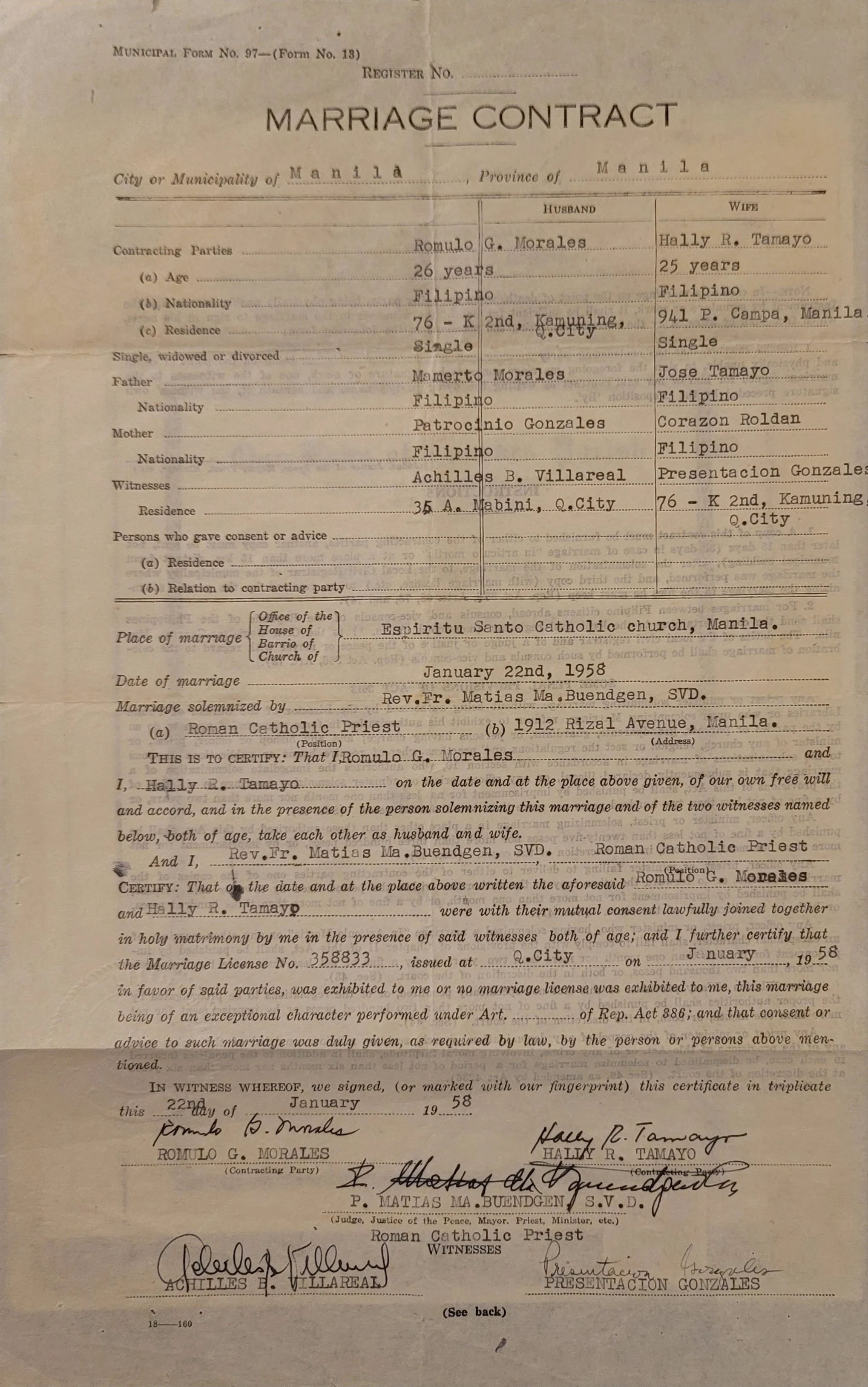
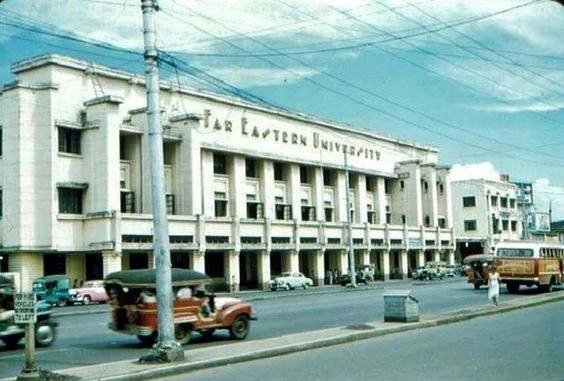
Dr. Romulo G. Morales, twenty-eight years old, had come from Numancia, Aklan—a small municipality in the Western Visayas—to study medicine at Far Eastern University. His wife, Dr. Hally R. Tamayo, twenty-seven, had roots in the same town. Both were children of Aklan, drawn to Manila by ambition and opportunity. They had married on January 22, 1958, at Espiritu Santo Catholic Church, a young couple building their future in the bustling capital.
But their first pregnancy had ended in heartbreak. The child was either stillborn or died shortly after birth—the records note simply "1 fetal death" under previous children. For Catholic parents in 1959, such a loss carried particular weight: a child who might not have received the sacrament of baptism, a soul whose fate was entrusted entirely to God's mercy.
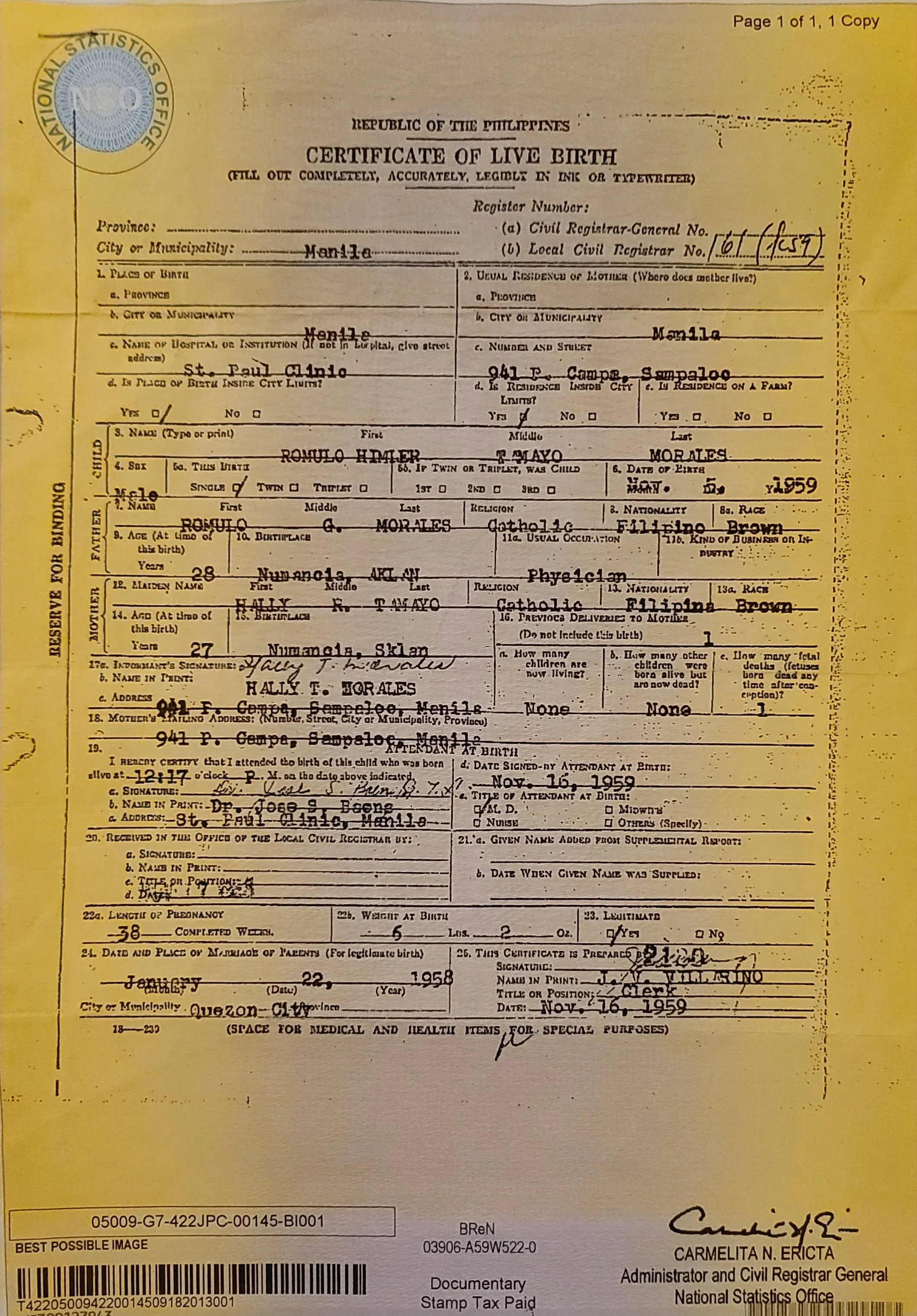
When Hally became pregnant again, the couple must have approached the months ahead with hope tempered by anxiety. They were living at 941 P. Campa Street in Sampaloc—the same address as St. Paul Clinic, suggesting they may have resided in quarters associated with the medical community that served the nearby universities.
A Son is Born
At 12:17 in the afternoon on Thursday, November 5, 1959, Hally gave birth to a healthy baby boy at St. Paul Clinic. Dr. Jose S. Esena attended the delivery. The child weighed six pounds, two ounces—a good, healthy weight. They named him Romulo Himler Tamayo Morales, carrying forward his father's first name.
941 P. Campa Street
Sampaloc, Manila
The birth certificate, registered on November 16, 1959, records the essential facts: a male child, born to Filipino parents, both Catholic, both from Numancia, Aklan. The father's occupation is listed as "Physician"—Romulo had completed his medical training. The certificate notes that this was the mother's first living child, with one previous fetal death.
St. Paul Clinic and the Sisters of St. Paul of Chartres
The St. Paul Clinic at 941 P. Campa Street was part of the extensive network of medical institutions established by the Sisters of St. Paul of Chartres in the Philippines. The congregation, founded in France in 1698, had arrived in Manila in the early 1900s and established St. Paul's Hospital in Intramuros in 1905. After World War II destroyed much of their infrastructure, the Sisters continued their healing ministry through smaller clinics throughout the city. The Sampaloc location served the dense University Belt neighborhood, home to Far Eastern University, the University of Santo Tomas, and thousands of students and young professionals. Today, the clinic no longer exists—the site has been redeveloped into The One P. Campa, a condominium complex serving the student population.
A Church Risen from the Ashes
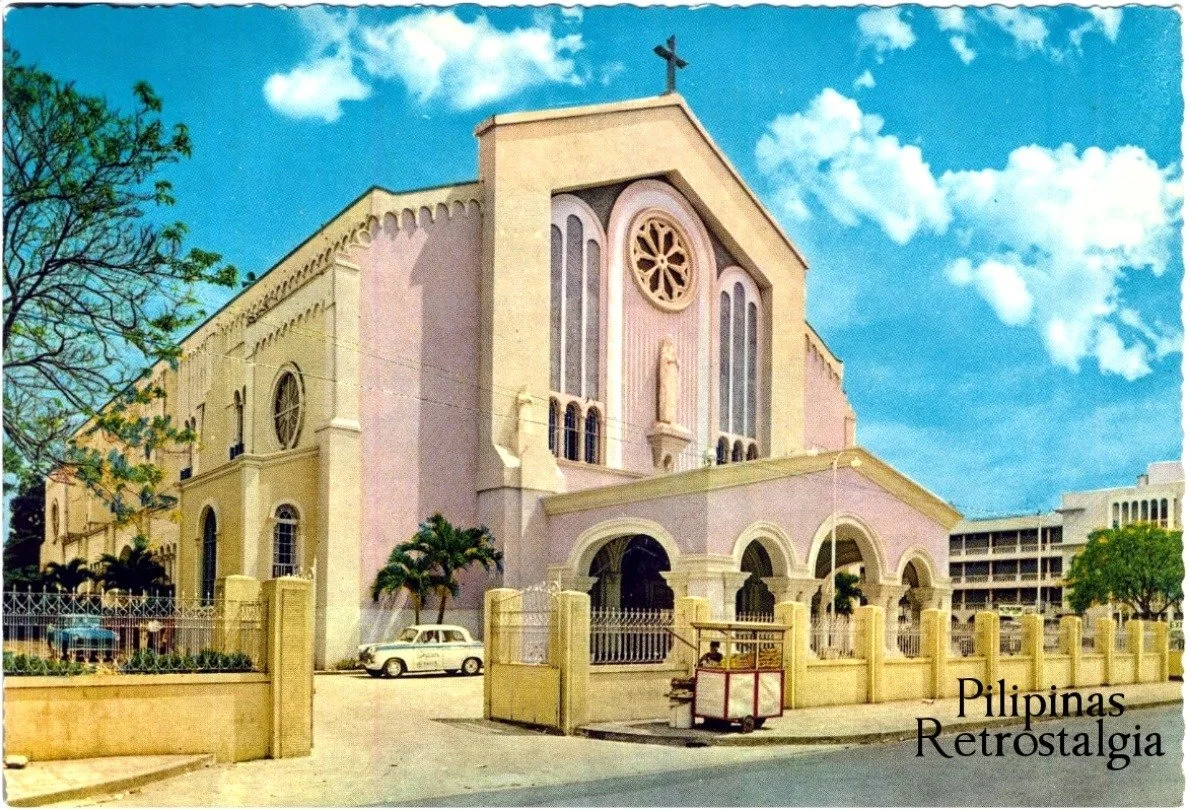
For the baptism of their son, the Morales family chose Our Lady of Lourdes Parish in La Loma, Quezon City—a church with its own story of destruction and resurrection.
The Journey of Our Lady of Lourdes
The devotion to Our Lady of Lourdes in the Philippines began in 1892, when Capuchin friars in Intramuros commissioned Filipino sculptor Manuel Flores to carve an image of the Virgin. The devotion grew so rapidly that by 1910, a magnificent church stood on General Luna Street within the Walled City.
Then came February 1945. As American forces liberated Manila from Japanese occupation, the Battle of Manila reduced Intramuros to rubble. The Capuchin church was completely destroyed. But the friars had managed to save the miraculous image, hiding it first in San Agustin Church, then moving it to the University of Santo Tomas chapel, and finally to a temporary home at Santa Teresita Chapel on Mayon Street.
In 1950, the Capuchins began construction on a new church in Quezon City, on land donated by the prominent Tuazon and Araneta families. On February 10, 1951, the images of Our Lady of Lourdes were transferred to their new home in a grand procession attended by thousands. The church was inaugurated on August 15, 1951.
By Christmas 1959, the church at Kanlaon Street corner Retiro Street (now N.S. Amoranto Avenue) was just eight years old—a modern, neo-Romanesque structure that testified to the resilience of faith.
Christmas Morning, 1959
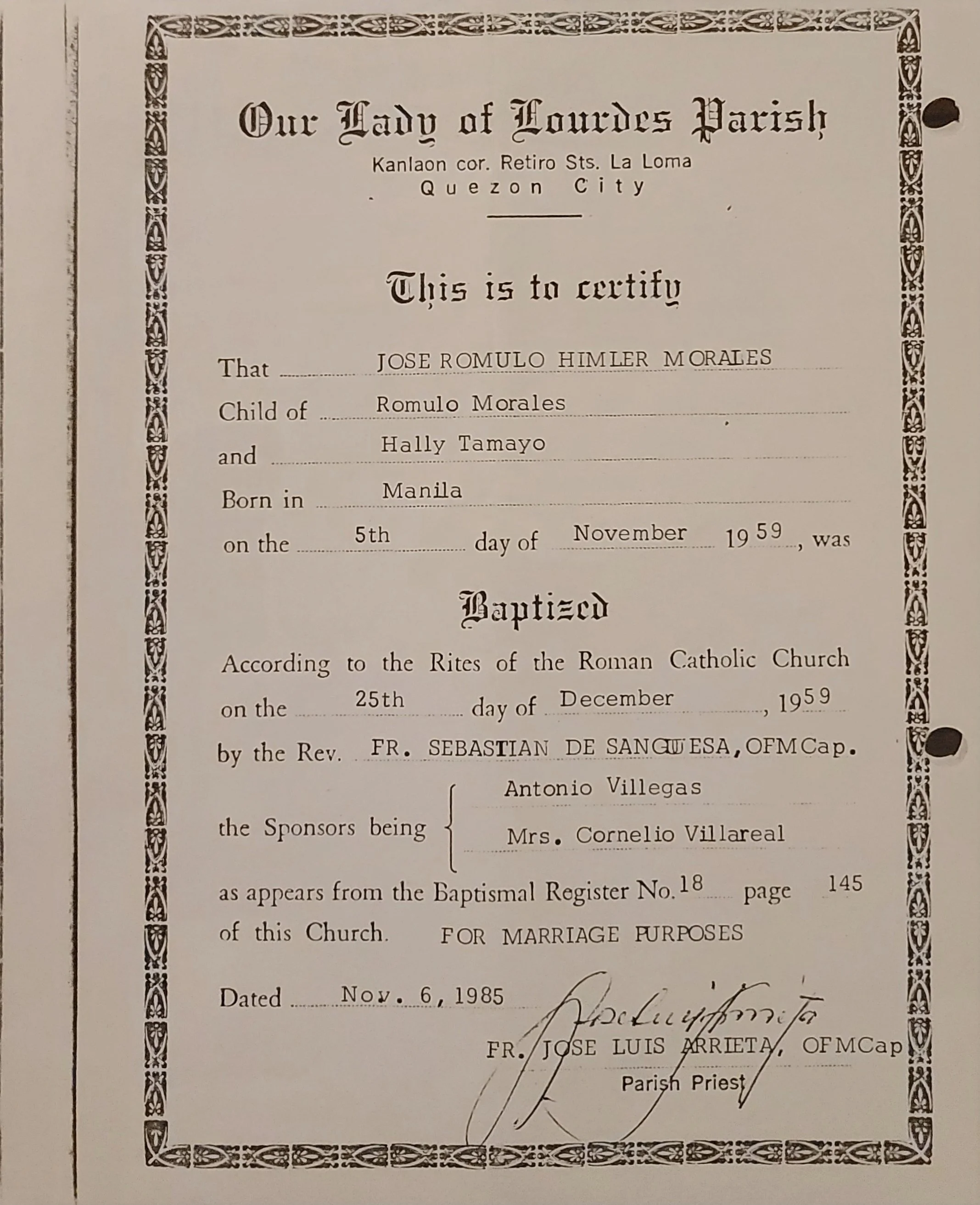
The Morales family chose December 25, 1959—Christmas Day—for their son's baptism. It was a meaningful choice: the feast of Christ's birth, seven weeks after their own son's arrival, a celebration of new life and salvation.
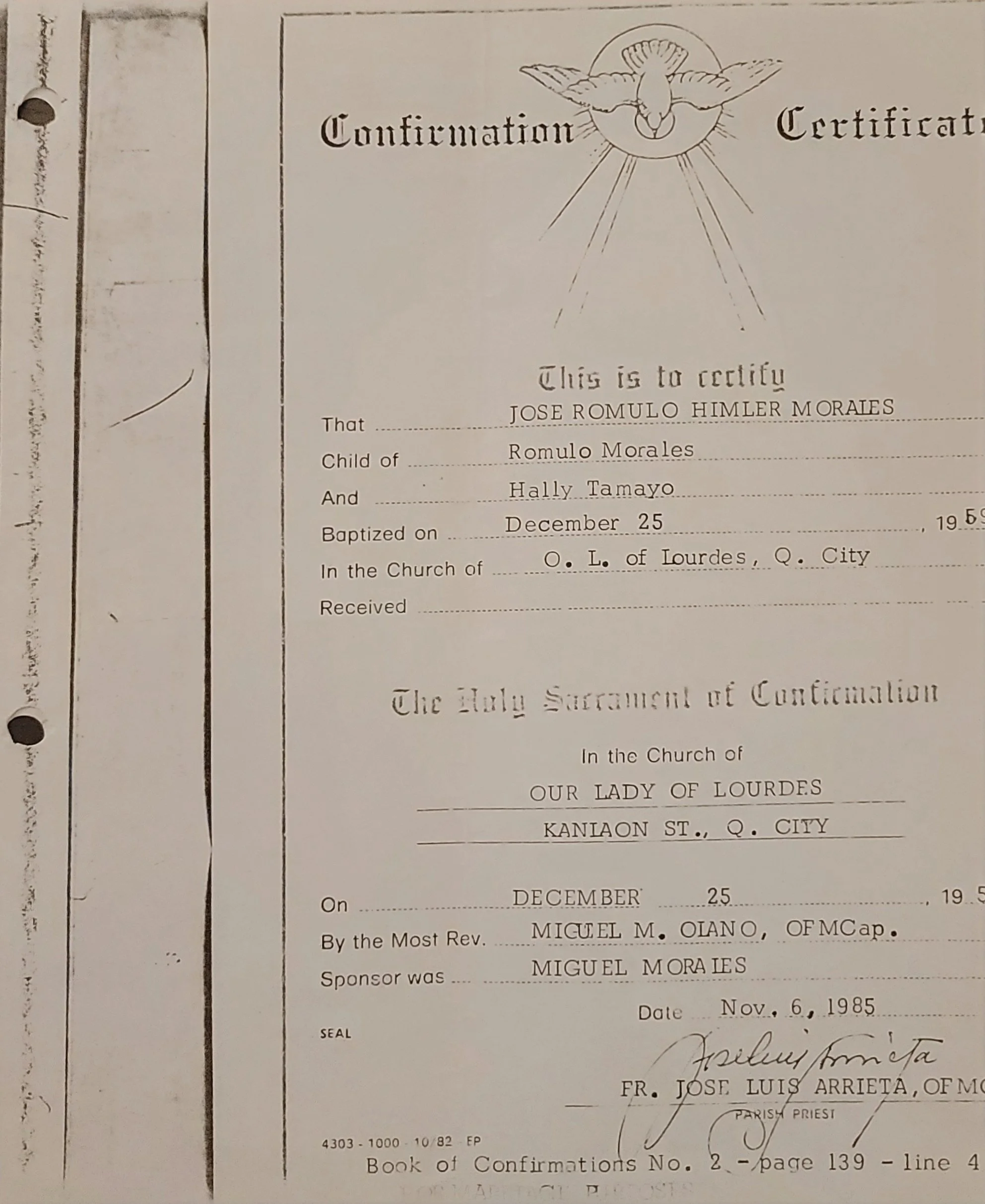
But what happened that Christmas morning was extraordinary. The infant Romulo Himler received not only the sacrament of Baptism but also Confirmation—on the same day, at the same church. In Catholic practice, this was highly unusual for an infant. Confirmation typically occurred years later, when a child reached the age of reason. But the Church permitted infant confirmation under special circumstances: imminent danger of death, or the presence of a bishop.
✝ Two Sacraments, One Christmas Morning ✝
The parish priest, Fr. Sebastian de Sangüesa, OFMCap, performed the baptism. But the confirmation was administered by Most Rev. Miguel M. Oiano, OFMCap—a bishop.
At baptism, the child received the additional name "Jose"—becoming Jose Romulo Himler Morales, as recorded in Baptismal Register No. 18, page 145. His godparents were Antonio Villegas and Mrs. Cornelio Villareal, likely family friends with connections to the couple's wedding party (Achilles B. Villareal had served as witness at the parents' marriage the year before).
For confirmation, recorded in Book of Confirmations No. 2, page 139, line 4, the sponsor was Miguel Morales—almost certainly Mamerto Miguel Morales a brother of the father, the child's uncle.
The Bishop Who Survived the War
The presence of Bishop Miguel Olano at Our Lady of Lourdes on Christmas Day 1959 was not coincidental. The Spanish Capuchin had been living at the Lourdes friary in Quezon City since 1945, assisting local bishops with confirmations. His own story was one of survival and service.
Bishop Miguel Angel Olano y Urteaga, OFMCap
Research Discovery
The confirmation certificate identifies the bishop as "Miguel M. Oiano, OFMCap"—a slight variation in spelling. Research confirms this was Bishop Miguel Angel Olano y Urteaga, the former Bishop of Guam. His presence at the Lourdes friary, where he resided from 1945 to 1960, made infant confirmation possible that Christmas morning. The bishop would leave for Spain the following year, making the 1959 Christmas confirmation one of his final acts of ministry in the Philippines.
Why did the Morales family seek both sacraments on the same day? Perhaps it was simply opportunity—a bishop happened to be present, and the family wanted their son to receive every blessing available. Or perhaps, having lost their first child, they wanted to ensure that this son received the fullness of the Church's sacraments as quickly as possible. The records do not tell us their reasoning, only their choice.
A Young Doctor and His Bride
The Parents
Numancia, Aklan
Both parents came from Numancia, a municipality in Aklan province on the island of Panay in the Western Visayas region. The town sits along the coast of the Sibuyan Sea, a fishing community that has sent many of its sons and daughters to Manila in search of education and opportunity. That two young people from this small town would meet, marry, and build their lives together in the capital speaks to the strong provincial ties that characterized Filipino society in the mid-twentieth century.
Godparents and Witnesses
Baptismal Sponsors
Timeline: 1958-1959
"On February 10, 1951, the image of Our Lady of Lourdes was transferred to the new church in a huge and solemn procession from the Sta. Teresita Chapel, presided by Archbishop Olano and was attended by thousands of devotees."
Eight years after Bishop Olano helped inaugurate the new Church of Our Lady of Lourdes in Quezon City, he stood at its altar on Christmas morning to confirm an infant boy—the first surviving child of two young doctors from Aklan. The same hands that had blessed the church's first Mass now blessed a new life.
Primary Sources
Are You Connected to the Morales-Tamayo Line?
If you descend from the Morales or Tamayo families of Numancia and Kalibo, Aklan, or from the intermarried Numancia families — Gonzales, Quimpo, Roldan, Isturis, Martelino, Icamina, Ferrer — whether your branch remained in the Philippines or emigrated to the United States, I’d like to compare notes. Documented trees, DNA matches, family papers, and even half-remembered stories have all moved this research forward.
Get in Touch About This FamilyCousin connections are informal and reciprocal — no fee, no obligation, just shared work on shared ancestry.
Every Family Has a Story Worth Telling
Whether you're just beginning your research or ready to transform years of work into a narrative your family will treasure, I'd love to help.
LET'S TALK ABOUT YOUR FAMILY