
Laurent Quintal: The Free Man of the Prairies
Laurent Quintal
He was born a twin in a south shore Quebec parish on a summer morning in 1797, the fifteenth of seventeen children of a farmer who could not sign his own name. His twin sister died fifteen days later. He survived, grew to manhood in the La Prairie district, and at nineteen signed his name—or made his mark—in the service of the North West Company. He would not return to Saint-Constant for the rest of his life.
Twenty years in the pays d’en haut. A fur trade career that ran from the English River to the Snake Country, from the Columbia District to the party roster of Alexander Ross’s 1824 expedition. A notation in an HBC ledger that records, in a single word, the moment everything changed: Free. A marriage in July 1839 to a woman who was half Nipissing and half Chinook, baptized the day before their wedding by the same priest who married them. Children born in Oregon Territory. A farm on the Calapooia Creek. And a death so specific it has stayed in the historical record for a century and a half: binding wheat in a field, a rattlesnake, a few hours.
Laurent Quintal is documented in four archive collections on two sides of a continent. His life can be traced from a baptism register in 1797 to a death notation in a Winnipeg archive. What follows is that life—in the primary sources.
Vital Records Summary
The South Shore Origins
The St-Constant parish register records the joint baptism of Laurent and Marie Suzanne on August 11, 1797, in a shared act—acte commun—one entry for two children born the previous day. The curé Ch. Bégin noted their father’s occupation as fermier—farmer. The godparents could not sign. The father could not sign. Fifteen days later the same curé recorded Marie Suzanne’s burial: décédée de la veille, agée de quinze jours—died the day before, age fifteen days.
Saint-Constant sat in the heart of the La Prairie district, 30 kilometres south of Montréal on the south shore of the St. Lawrence. It was farming country and fur trade country simultaneously. Young men from the parishes of the south shore signed NWC and HBC contracts by the hundreds, traded the interior for three years, and came home to establish the farms their fathers had begun. Most did. Laurent did not come home.
The Quintal family had been on the south shore for four generations. Raymonde Gauthier’s compiled ancestry, derived from Quebec notarial records, traces Laurent’s direct paternal line back to a single immigrant: a François Quintal who came from Aunis—the Atlantic coastal province of France, present-day Charente-Maritime, centered on the port of La Rochelle—and married Marie Gauthier in Québec City on October 17, 1678. That man’s son married in Varennes in 1712. His son married in Longueuil in 1740. His son—Laurent’s father François—married Marie Hébert in Boucherville in 1777, and settled at Saint-Constant to farm. Four generations of Quintals, each generation moving slightly along the south shore, each generation farming. And then Laurent, the fifteenth of seventeen children, who went the other direction entirely. The Gauthier ancestry is a compiled work; each of those four marriages is being verified against PRDH primary records in turn.
The Correct Parents: Why This Matters
Widely circulated family trees assign Laurent Quintal parents named Étienne Quintal and Gauthier Dit St Germain, with a birth year of approximately 1802. This is a different man. The correct Laurent was born August 10, 1797, at Saint-Constant, to François Quintal and Marie Hébert, as confirmed in PRDH-IGD Family #55528, the original St-Constant parish baptismal register, the HBCA biographical sheet, and the engagement contract (SHSB #22959 / ANQM Greffe Beek, February 21, 1817), which records his parish as St. Constant.
The error is not minor. The wrong parents substitute an entirely different Quebec family going back generations. Every ancestor listed above Laurent in those trees belongs to someone else—including the immigrant ancestor from Aunis.
Twenty Years in the Pays d’en Haut
On February 21, 1817, Laurent Quintal stood before notary John Gerbrand Beek in Montréal and made his mark—an X. He could not write his name. His father could not sign at the 1797 baptism. Laurent could not sign at nineteen. The contract he pressed his mark to was a three-year engagement with McTavish, McGillivray & Co., the North West Company’s Montréal partnership, for wages of 600 livres and a classification of MEDIUM—Middleman.
That classification is significant. He was not hired as a novice and promoted. He arrived at the NWC offices already assessed as a Middleman—the designation for an experienced interior paddler who handles the middle position in the canoe. Whatever he had done in the years between his 1797 baptism and his 1817 contract, he was not presenting himself as a beginner. His career designation would remain Middleman for the next twenty years.
The contract sent him to Michilimackinac, the Northwest Dependencies, Fort William, and Mountain Portage—the latter being Portage de la Montagne at Lachine, the western departure point for all NWC brigades leaving Montréal. He departed from Lachine. He overwintered from his first year—not a seasonal mangeur de lard who returned to the south shore each autumn, but a hivernant from day one. He was equipped with a three-point blanket, a two-and-a-half-point blanket, six ells of cotton, oxhide shoes, and a collar. He received fifteen piastres at signing and fifteen more at departure. And he undertook to contribute one percent of his wages to the Voyageurs Fund—the collective mutual aid system that connected every man in the canoe brigades to every other.
The NWC individual account ledger in HBCA F.4/32, folio 970, records his wages across four seasons: 300 livres in 1818, then 400 livres in 1819, 1820, and 1821—a stepped rate that exceeded the 600-livre contract base over the full engagement. The ledger also records a 44-livre advance to a woman identified only as Frances Fille in 1820—an identity not yet established.
| Heading | Dr. Laurent Quintal Cr. |
| 1817 Dr | To sundries of the Montreal Engagé Book — 487 |
| 1818 Cr | By wages — 300 livres |
| 1819 Cr | By wages — 400 livres |
| 1820 | By wages — 400 livres; advance to Frances Fille — 44 |
| 1821 | By wages — 400 livres; To sundries E.R. Eq. 816 [English River] |
| Source | Hudson’s Bay Company Archives, F.4/32, fo. 970. Archives of Manitoba, Winnipeg. Supplied by Vince Teetaert, HBCA Inquiry #621, 24 March 2026. |
Two additional HBCA volumes, identified through Ancestry’s indexing of the HBC Corporate and Employment Records, place Laurent in the NWC dissolution records at the moment of the 1821 merger. HBCA F.4/46 records him as Quintal Laurent with wages of 400 livres, department English River, and a debit of 530 livres 11 sols. HBCA F.4/47—the North West Balances 1821, page 14—repeats the identical debit but records his department as C.R.—Columbia River—rather than English River. The shift between volumes may document the precise moment his Columbia District posting became official: at the dissolution itself in 1821, not in 1823 as the HBCA biographical sheet suggests. Both volumes also record two other Quintals—Joseph and Antoine—in consecutive entries on the same dissolution pages. Antoine is assigned the Nipissing department and marked with an X, flagging a disputed entry. Their consecutive listing with Laurent follows the NWC convention of grouping men from the same family or engagement network—suggesting these three men may have entered company service together from the same south shore La Prairie community.
When the North West Company and the Hudson’s Bay Company merged in 1821, Laurent’s contract carried forward. He served two years at Île-a-la-Cosse in the English River District, then transferred to the Snake Country and Columbia District as a Middleman. He would remain there for thirteen years.
| Period | Employer / Post | District | Primary Source |
|---|---|---|---|
| 1817–1821 | NWC, hivernant under McTavish & McGillivray | English River | HBCA F.4/32 fo.970 |
| 1821 (dissolution) |
NWC dissolution accounts. Three Quintals on same pages: Laurent (Eng.R. → C.R.), Joseph, Antoine (Nipissing dept). Department shift Eng.R. → C.R. may push Columbia transition back to 1821. | English River → Columbia |
HBCA F.4/46; F.4/47 p. 14 (duplicate pair) |
| 1821–1823 | HBC, Île-a-la-Cosse | English River | HBCA B.239/g/1–2 |
| 1823–1836 | HBC Middleman | Snake Country / Columbia | HBCA B.239/g/3–16 |
| Feb 10, 1824 | ★ Named #6 in Alexander Ross’s expedition party | Snake River | HBCA B.202/a/1, p. 3 |
| 1836–1837 | Final HBC account. Remarks: Free. | Columbia District | HBCA B.239/g/16, pp. 120–121 |
Engagement Contract — SHSB #22959 / ANQM Greffe Beek, 21 February 1817
Wages: 600 livres (chelins) Advances: 15 piastres at signing + 15 at departure
Destinations: Michilimackinac · Northwest Dependencies · Fort William · Mountain Portage (Lachine)
“to depart from Montreal, as a crewman in one of their canoes, to make the voyage, and to winter for three consecutive years in the Northwest Dependencies of Upper Canada—to pass through Michilimackinac, if required, to perform six days of labor, to make two trips from Fort William to Portage de la Montagne, or instead to perform six days of other work at the option of the said Gentlemen—to help carry the canoes in threes inland”
Equipment: three-point blanket · two-and-a-half-point blanket · six ells of cotton · oxhide shoes · collar
“Each—undertakes to contribute one percent of his wages to the Voyageurs Fund”
In 1821–22, the same HBC servants’ accounts ledger that lists Laurent as “Quintal, Laurt” on page 150 lists, directly above him, “Quesnel, Amable”—Amable Quésnel, father of Frank Quenal. They were HBC Columbia District colleagues, documented in the same employment structure from at least 1821. Proximity in an ordered ledger establishes shared employment, not kinship—but the account books do document the connection that later Oregon records reflect.
| Entry | Quintal, Laurt |
| Balance | 1061.2 |
| Entry above | Quesnel, Amable — 2769.18 — Columbia |
| District | Columbia |
| Source | Hudson’s Bay Company Archives, B.239/g/1, York Factory — Abstracts of Servants’ Accounts 1821–1822. Archives of Manitoba, Winnipeg. |
The Snake River, February 10, 1824
He is six names down a list. That is the moment Laurent Quintal steps out of the financial ledgers and into a narrative record.
Alexander Ross’s journal of the 1824 Snake Country Expedition opens with a party roster headed “Our party as follows Viz.” The columns run Men, Guns, Traps, Horses, Lodges. Eleven men; twelve guns, thirty-three traps, fifty horses and three lodges between them. Laurent Quintal is number six, and his line is the same as almost every other man’s: one gun, three traps, two horses. He was twenty-six years old, seven years into his fur trade career.
They left the Flat Head House on the afternoon of 10 February to join the free men encamped at Rivière de Chevaux, and made eight miles. The snow lay eighteen inches deep and the weather was cold.
| Columns | Men · Guns · Traps · Horses · Lodges |
| 1 | Thyering Godden — 1 gun / 3 traps / 2 horses |
| 2 | Joseph Paul — 1 / 3 / 2 |
| 3 | Louis Paul — 1 / 3 / 2 |
| 4 | François Painant — 1 / 3 / 2 / 1 lodge |
| 5 | Antoine Asbruelle — 1 / 3 / 2 |
| 6 | Laurent Quintal — 1 gun / 3 traps / 2 horses |
| 7 | Joseph Annance — 1 / 3 / 2 |
| 8 | Jean Bapte Gadewa — 1 / 3 / 2 |
| 9 | Pierre Depot — 1 / 3 / 2 |
| 10 | François Rivet, Interpreter — 2 men / 6 traps / 15 horses / 1 lodge |
| 11 | Alexander Ross — 1 gun / 16 horses / 1 lodge |
| Total | 11 men — 12 guns / 33 traps / 50 horses / 3 lodges |
| Source | Alexander Ross, “Journal of Business kept during a Voyage to the Snake Country by Alexander Ross commencing on Tuesday the 10th day of February 1824.” HBCA B.202/a/1, p. 3. Archives of Manitoba, Winnipeg. |
The HBCA biographical sheet resolves a confusion that has circulated in secondary literature for over a century. Alexander Ross’s narrative includes a reference to “that sly dog Laurent” who deserted with Lazard—but that man was an Iroquois named Laurent Karatohon, not Laurent Quintal. Both men named Laurent were on the 1824 expedition. Secondary compilers who did not read the party roster did not distinguish them. The roster does.
Going Free: 1836–1837
In 1836–37, Laurent Quintal’s final entry in the HBC servants’ accounts carries a notation in the remarks column of page 121 that changes everything that comes after it. Three words, in the original ledger, in the hand of an HBC accountant who was closing a record: 6.8.10 Free.
This is not inferred from a later description. It is not read backward from the 1839 marriage record. It is the primary documentation of the moment Laurent Quintal became an independent trader—recorded at the moment of the transition, in the institution that tracked his service. He was thirty-nine years old. He had been in the pays d’en haut for twenty years. He would never be an HBC employee again.
| Entry (p. 120) | Quintal, Laurent — age 35 |
| Entry above | Quintal Jr., François — age 27, Laprairie, 5 years’ service |
| Balance (p. 121) | 6.8.10 |
| Remarks (p. 121) | Free |
| Below | Home of Columbia |
| Source | Hudson’s Bay Company Archives, B.239/g/16, York Factory — Abstracts of Servants’ Accounts 1836–1837. Archives of Manitoba, Winnipeg. |
The ledger gives his age as thirty-five, which would imply a birth of about 1801. He was in fact thirty-nine. HBC clerks recorded ages as given or as estimated, and understatement is common throughout the servants’ accounts; the parish, the service dates and the district all match, and the age is the one figure that does not.
Directly above him in the same 1836–37 ledger: “Quintal Jr. François, 27, Laprairie”—a younger Quintal from the same south shore district, with five years HBC service, whose identity and relationship to Laurent have not yet been established in primary sources. A nephew is the most probable connection, but it has not been confirmed. What is clear is that in Laurent’s final HBC year, a Quintal from La Prairie was in the Columbia District with him.
The 1839 Catholic Registers: Free Man of the Prairies
Three weeks before his marriage, the children’s baptisms (B-167, B-168) record Laurent as a free man of the prairies. The marriage record M-61 describes him as engaged in the party of the hunt of the prairie. The 1836–37 HBC ledger notation, the 1839 children’s baptisms, and the 1839 marriage record are three independent sources documenting the same transition across three years. Each confirms what the others say.
Marie Anne Nipissing
On July 8, 1839, Father F.N. Blanchet baptized a woman of approximately twenty years at Fort Vancouver. The register entry B-186 describes her as the natural daughter of Louis, “Nipissing by nation,” and of a woman of the country recorded as unbaptized. The margin notation identifies her as Tchinouk—Chinook—through her mother’s heritage. Her name was Marie Anne Nipissing.
The following day, July 9, she married Laurent Quintal. The marriage record M-61 names her father again—now the late Louis Nipissing, already dead—and acknowledges two pre-nuptial children: Louis, age five, and Rosalie, age one and a half, who had been baptized together eighteen days earlier. The same priest, the same register, three consecutive records over eighteen days, documenting a family that already existed and was now being formally regularized in the Church’s record system.
Harriet Duncan Munnick’s 1974 article on the Napassant family (“The Umpqua Treaty Chief,” Umpqua Trapper, Vol. X No. 2, pp. 34–40) describes Louis Sr. and Laurent Quintal together as two old Hudson’s Bay Company servants, and places Louis’s fur trade service at approximately 1820. Stephen Dow Beckham’s 2016 article (Umpqua Trapper, Vol. LII No. 1, p. 4) reports that Marie Anne’s father was “an Indian from Ontario, Canada” who came to Oregon in the fur trade and had, by a Chinook woman, a daughter Marie Ann and a son Louis.
These are not two witnesses. Beckham cites Munnick 1974 at page 34 for the whole of it, so what looks like corroboration is a single account and a later citation of it. The Ontario attribution needs a further caution: Munnick’s page 34 describes the Nipissing as an Algonquian people living north of Lake Superior, which is inaccurate—Lake Nipissing lies in Ontario near Georgian Bay—so Beckham appears to have corrected his source without saying so. B-186 establishes the nation. Every geographic claim beyond that is inference from the nation name, and no located record places this Louis at Lake Nipissing.
His trade name Tom-a-pierre, which appears in Munnick’s annotation, belonged to Louis Sr.—the father—not to his son Louis Jr. Munnick resolved that in the same 1974 article, though the records she says carry the alias have not been identified.
The Second Error Corrected
Widely circulated family trees assign Marie Anne’s father the surname Courteoreille. No primary source supports this. Two independent Catholic sacramental records—B-186 (baptism, July 8, 1839) and M-61 (marriage, July 9, 1839)—name her father as Louis Nipissing on consecutive days. The Courteoreille claim has no documentary origin that has been identified. It erases Marie Anne’s documented Nipissing and Chinook heritage and replaces it with an invented ancestry. Every descendant who carries this error carries a false heritage record.
Munnick annotation A-59 documents the western surname form: Napassant is the phonetic corruption of the Algonquian word Nipissing as rendered by English-language recorders. It is not a different family. It is the same name.
The Oregon Years
By 1850, Laurent Quintal was farming in Marion County, Oregon Territory. The federal census records him at approximately age fifty-five, with his wife of thirty-four, children including a ten-year-old named Zoé, and real estate valued at $4,700. Occupation: farmer. He had been in the Pacific Northwest for more than a decade, and would spend another ten years there.
The Calapooia Creek area of Douglas County, where Laurent died in 1861, was home to a community of mixed Columbia District heritage—former HBC servants, their Indigenous wives, and their children—in the same transition from fur trade to farming life that characterized the entire generation.
Marie Anne survived him by twenty-five years. She died in 1886 in Douglas County, Oregon, at approximately sixty-seven to seventy years of age. Munnick annotation A-59 places her later years in Douglas County, consistent with her Early Oregonian profile. Her Chinook mother is unnamed in every surviving document.
The Oregon Record, Year by Year
The Children
Six children of Laurent Quintal and Marie Anne Nipissing appear in primary sources. Three were documented in the 1839 Catholic registers at Fort Vancouver; three appear in Oregon vital records or the 1850 census. The children span twenty years of Oregon life—from pre-nuptial children born in the Columbia District fur trade community to a son born on Christmas Day 1859, some eighteen months before his father’s death.
Children of Laurent Quintal and Marie Anne Nipissing
Six children confirmed in primary sources. Rosalie’s later record has not yet been located; Louis’s 1853 marriage is documented in Munnick A-69. Toussaint appears in the 1850 census as “Toussaint,” age 8, male, born O.T. The Early Oregonian uses the variant surnames Cantelle, Chantell, and Quintal for the same family.
Marianne’s death date—August 21, 1935—is the last primary record connected to Laurent Quintal’s direct descendants in the Early Oregonian database. She was approximately eighty-seven years old. Her alias Chantell, Mary Ann reflects the same process of anglicization that turned Quintal into Cantrel, Kantal, and Cantelle across two generations of Oregon vital records. She outlived her father by seventy-four years, long enough to see the fur trade world he came from become history, then legend, then genealogical research.
François, born Christmas Day 1859, was not yet two years old when his father died at Calapooia Creek. Laurent Quintal never knew this son as anything other than a small child.
Document Gallery
Sources documenting Laurent Quintal across four archive collections
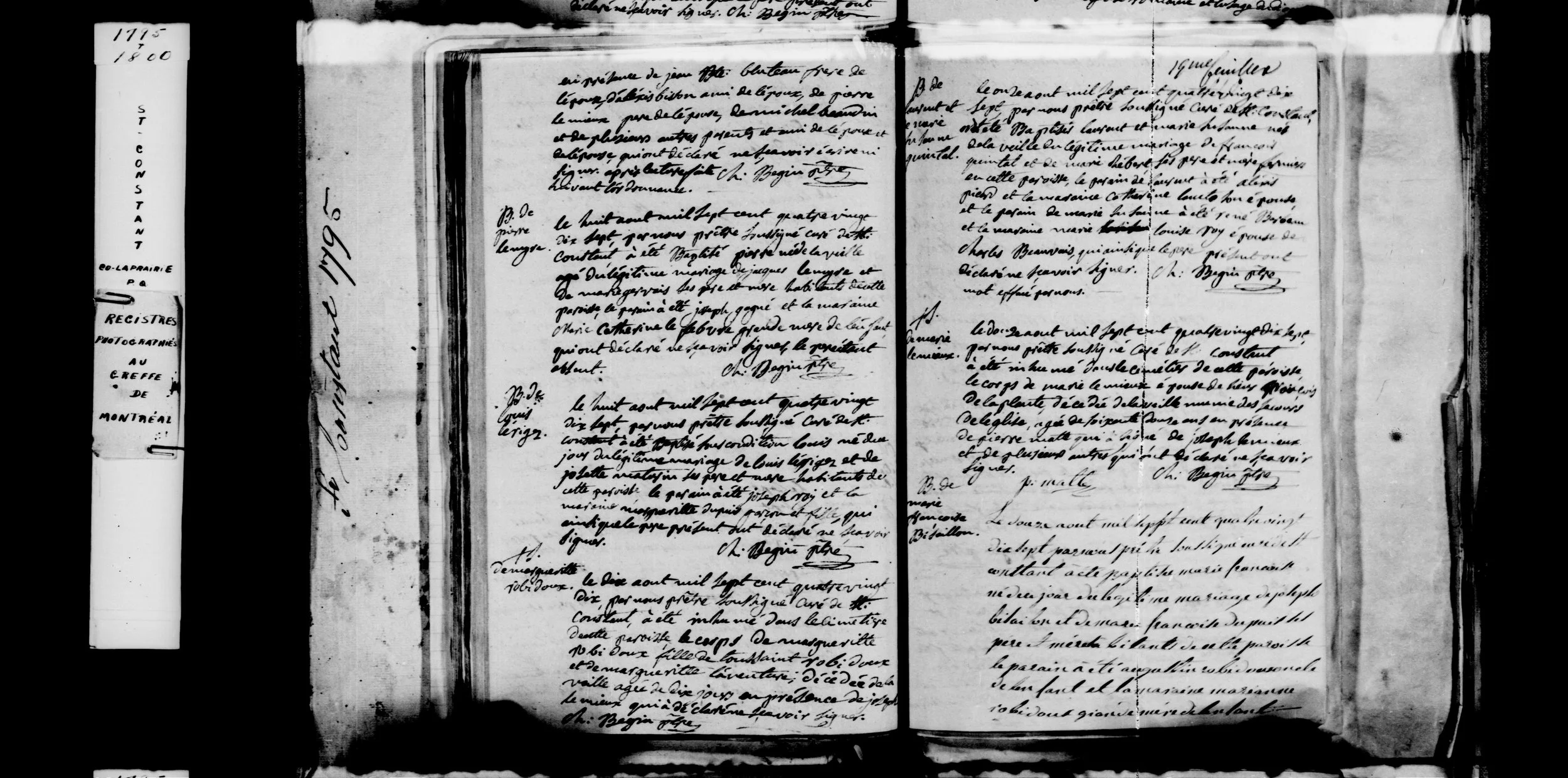
Baptism Register, 1797
St-Constant (La Prairie). Full page — twins Laurent and Marie Suzanne.

PRDH-IGD Baptism #671580
- Act
- Baptism, 11 August 1797 — St-Constant (La Prairie)
- Birth
- 10 August 1797
- Father
- François QUINTAL — occupation FERMIER
- Mother
- Marie HEBERT
- Register note
- Acte commun avec sa jumelle Marie Suzanne
F.4/32, Folio 970 — NWC Account
Individual account ledger 1817–1821. Wages 300 livres (1818), 400 livres (1819–21). Entry from the Montreal Engagé Book, 487. Advance to Frances Fille, 44. Supplied on HBCA Inquiry #621. Full transcription above.
B.239/g/1 — HBC 1821–22
Laurent listed as "Quintal, Laurt," balance 1061.2. Amable Quesnel directly above at 2769.18, Columbia — same ledger page, same district, same accounting year.
B.239/g/16 — HBC 1836–37
Laurent given as age 35 (actual 39). Balance 6.8.10; remarks column: Free. Home of Columbia below. François Quintal Jr., 27, Laprairie, directly above.
B.202/a/1, p. 3 — Party Roster
Laurent Quintal, sixth of twelve. One man, three guns, two horses. February 10, 1824, Snake Country, under Alexander Ross. Full roster transcribed above.

B-186 — Baptism, 8 July 1839
Marie Anne, aged about 20, natural daughter of Louis, "Nipissing by nation," and of a woman of the country recorded as unbaptized. Godmother Catherine Russie. Margin: Tchinouk [Nipissing]. Priest: F.N. Blanchet.
M-61 — Marriage, 9 July 1839
Natural daughter of "the late Louis Nipissing." Witnesses Michel Laframboise and Jean Baptiste Jeaudoin, both signed. Louis (5) and Rosalie (1½) recognized. Neither spouse could sign. Second independent record naming her father.
Zoé Quintal — Marriage to Augustin Délard
Identified as the daughter of Laurent Quintal. Married Marion County, August 25, 1857. "Quine" nickname explained; family of eight; Wasco then Crook County; buried near Suplee.

Louis Cantelle
- Born
- 1835, OR-Territory
- Ethnicity
- Indian
- Alias
- CHANTELL
- Census
- 1880, Douglas County
The pre-nuptial son baptized B-167.
Marianne (Chantell, Mary Ann)
- Born
- 1848, Oregon Territory
- Mother
- Nipissing, Marie Anne
- Father
- Quintal, Laurent
- Died
- 21 August 1935 — Inchileum, Ferry Co., WA — age ~87
François Quintal
- Born
- 25 December 1859, Oregon Territory
- Mother
- Nipissing, Marie Anne
- Father
- Quintal, Laurent
Not yet two years old when his father died.
Questions about your own research? Begin a research inquiry.
