
The Free Man of the Prairies — How the Research Was Done
A document-by-document account of four archive collections, two Catholic sacramental registers naming the same father on consecutive days, and the primary source evidence that corrects two compounding errors in the public genealogical record for this family.
Research Methodology
Six steps from recognizing a pattern of unsourced errors to a fully documented descent line
The Central Problem This Case Addresses
Standard genealogical practice requires correlating evidence across multiple independent sources and documenting every claim to a primary record. This case study began with two observations: widely circulated family trees for this couple carry no primary source citations, and the identities they assign — both for Laurent and for Marie Anne's father — are contradicted by primary records that have been accessible for decades. The methodology documents how each error was identified, which archives were searched, and what the original records actually contain.
The correction is not a matter of interpretation. The primary sources name Laurent's parents directly. They name Marie Anne's father directly, twice, in independent registers on consecutive days. The case is not ambiguous. It requires only that the sources be read.
Recognize the Pattern of Unsourced Errors
The starting point for this research was not a specific family tree but a pattern: multiple independent family trees in the public genealogical databases assigned Laurent Quintal parents that no primary source supports, and assigned Marie Anne Nipissing a father with the surname Courteoreille without citation to any original document. When the same unsourced claim appears across multiple trees on multiple platforms, it typically indicates copying rather than independent verification.
The diagnostic question is always the same: what is the original record that supports this assertion? For both errors in this case, the answer was: none. No baptismal register, no marriage record, no archival document of any kind names Étienne Quintal and Gauthier Dit St Germain as Laurent's parents, or any Courteoreille as Marie Anne's father. The absence of a source is not proof of error — but it is the signal to search the primary records before proceeding.
Establish Laurent's Correct Identity in Quebec Records
The PRDH-IGD (Programme de recherche en démographie historique) database at the Université de Montréal is the authoritative compiled source for Quebec vital records before 1800. A search for Laurent Quintal with a birth year approximately consistent with the fur trade career dates returned PRDH-IGD Family #55528 — François Quintal and Marie Hébert, married 1777, with Laurent listed as their fifteenth child, born August 10, 1797, at St-Constant in the La Prairie district.
The PRDH-IGD record was then verified against the original St-Constant parish baptismal register, which records the baptism of Laurent and his twin sister Marie Suzanne on August 11, 1797. The curé, the godparents, and the father's declaration that he could not sign all appear in the original register image. The HBCA biographical sheet for Laurent Quintal independently confirms his parish as St. Constant, Montreal — consistent across two independent sources.
A fourth independent confirmation came from an unexpected direction. The NWC engagement contract for Laurent Quintal, retrieved from the Société historique de Saint-Boniface Voyageur Contracts Database (SHSB #22959; original: ANQM, Greffe de John Gerbrand Beek, February 21, 1817), records his parish as St-Constant and his entry into NWC service on the exact date given in the HBCA biographical sheet. The contract also confirms his function as MEDIUM (Middleman) from his first year, that he overwintered, and that he signed with an X mark — he could not write his name at nineteen. Raymonde Gauthier's compiled ancestry (Gauthier, Ancestry of French Canadians to Oregon Prior to 1842, entry #109) independently cites the same notarial contract and extends the Quintal ancestry four generations above PRDH #55528, tracing Laurent's direct paternal line to an immigrant ancestor — François Quintal from Aunis, France — who married in Québec City in 1678.
This established: the correct Laurent Quintal was born 1797, not 1802; his parents were François Quintal and Marie Hébert, not Étienne Quintal and Gauthier Dit St Germain; he came from the south shore La Prairie district; and his identity is confirmed across four independent sources — PRDH, the original parish register, the HBCA biographical sheet, and the notarial engagement contract.
Document Laurent's Fur Trade Career in the HBCA
The Hudson's Bay Company Archives, held at the Archives of Manitoba in Winnipeg, maintain a Keystone online database providing access to digitized servants' accounts for the Northern Department. The HBCA biographical sheet for Laurent Quintal — compiled by HBCA archivists as a finding aid — was the entry point, providing the archival references for each phase of his career. From there, each record series was retrieved directly.
F.4/32, folio 970, is the North West Company ledger entry for Laurent's NWC service, 1817–1821, provided as a scan by HBCA archivist Vince Teetaert in response to HBCA Inquiry #621 (March 24, 2026) — this volume is digitized but not publicly accessible online. The HBC servants' accounts B.239/g/1 (1821–22) and B.239/g/16 (1836–37) are digitized and accessible via Keystone. The Snake River expedition journal B.202/a/1, in which Laurent appears as the sixth member of Alexander Ross's 1824 party, is also accessible via Keystone.
Each of these records is set out below as a transcription rather than as a page image. HBCA plates carry a printed reproduction prohibition, and this site transcribes them throughout rather than reproducing them — a practice applied consistently across the fur trade research. Transcription also has an analytical advantage: the arithmetic can be shown, and a reader can check the footings.
A note in the HBCA biographical sheet — that "that sly dog Laurent" in Ross's narrative was Iroquois Laurent Karatohon, not Laurent Quintal — was essential context. Both men named Laurent were on the same 1824 expedition. The party roster distinguishes them; secondary literature has not always done so.
Establish Marie Anne's Parentage from Two Independent Registers
The Catholic Church Records of the Pacific Northwest (French Prairie Press, 1972), transcribed by Mikell De Lores Wormell Warner and annotated by Harriet Duncan Munnick, are the standard published finding aid for mission sacramental records in the Oregon Territory. Vancouver Volume I covers the Fort Vancouver mission registers from which the relevant records derive. The original registers are held at the Archdiocese of Portland.
B-186 is Marie Anne's adult baptism, performed by F.N. Blanchet on July 8, 1839 — the day before her marriage. The record names her father as Louis, described as Nipissing by nation, and her mother as an unbaptized woman of the country. The margin notation identifies Marie Anne as Tchinouk (Chinook) — recording her mother's heritage. This record alone would be sufficient to establish Louis Nipissing as her father. But the following day's marriage record M-61 independently names him again, this time as already dead. Two records. Two days. One father. The same register system, with no possibility of the second entry copying the first — they were produced by the same administrative process but record different sacramental events.
Munnick's annotation A-59 further documents the western surname form: Napassant is the Columbia District phonetic corruption of the Nipissing nation name, used as a family surname. It is not a separate family. Identifying this variant is essential for finding community members of this family in later Oregon records.
Confirm the Descent Through Zoé — and Test Whether the Sources Are Independent
Zoé Quintal is the generational link between Laurent and Marie Anne and their living descendants. Confirming her parentage required sources that named her parents in more than one record system — and, equally important, establishing which of those sources are genuinely independent of one another.
The 1850 Oregon Federal Census places a ten-year-old "Zoe" in the household of Laurent Quintal and his wife in Marion County, Oregon — consistent with a birth of approximately 1840. This is a primary record, produced by a federal enumerator with no reference to the mission registers. Munnick's biographical annotation A-19 identifies her as Laurent Quintal's daughter, an identification made from Munnick's own reading of the register system that recorded her parents' marriage. The Early Oregonian Database profile for Zoé likewise names Laurent Quintal and Marie Anne Nipissing as her parents.
Testing that third source changed the count. The Early Oregonian profile's own source field cites St Paul I 19-B294 together with a marriage record and an online memorial index — that is, it draws on the St Paul register volume, the same published body of records as Munnick's annotations. As a database profile it therefore restates the register evidence rather than corroborating it independently. Two of the three identifications trace to one record system.
The same source string, however, points to something not previously pursued: St Paul I, 19-B294 appears to be a register entry in its own right — very probably Zoé's own baptism at St Paul, page 19, entry B-294. If that entry names Laurent and Marie Anne, it is a primary sacramental record of her parentage, distinct from the annotation, and it would restore a genuine second independent witness alongside the census. It has been added to the retrieval request to the Archdiocese of Portland.
The Marion County marriage record and subsequent census appearances (1880, 1900) confirm her life trajectory: Marion County, then Wasco County, then Crook County. Zoé died December 6, 1905, at Suplee, Crook County, and is buried at the Delore/Suplee Cemetery. The "Quine" nickname for Augustin Délard explains the variant "Augustin Quine Delore" that appears in some family trees — it is not a different person, and it is not a different surname.
Apply the Negative Evidence and Correction Standards
The BCG Genealogical Proof Standard requires that a thorough search include systematic review of sources likely to contain relevant information — and that a reasonably exhaustive search be documented. In this case, the negative evidence is equally important to the positive: no primary source names Étienne Quintal and Gauthier Dit St Germain as Laurent's parents, and no primary source names any Courteoreille as Marie Anne's father. Documenting the absence of support for the circulating claims is as essential as documenting the presence of the correct information.
The correction standard also requires that conflicting evidence be resolved, not ignored. The wrong Laurent — born approximately 1802 to a different Quebec family — is a real person whose records exist in the same databases. The methodology must distinguish the two men explicitly, not simply assert that one is correct. The birth year discrepancy (1797 vs. approximately 1802), the different parents, and the incompatibility of the 1802 man's documented life with the HBCA records for our Laurent all contribute to a resolved conflict, not an unresolved ambiguity.
For Marie Anne, the Courteoreille claim has no documentary origin that has been identified. It cannot be corrected by explaining a confusion between two individuals — it can only be corrected by demonstrating that the primary sources, examined directly, name a different father entirely, and that those primary sources are original Catholic sacramental registers of the highest documentary quality.
The same standard applies to the sources used here. A compiled source is cited at its own tier, never at the tier of the records behind it: the HBCA biographical sheet, the published Catholic register volumes, the Gauthier ancestry, and the Early Oregonian Database are all finding aids and derivative works, however useful. Each is identified as such on this page, and where a claim rests on one of them, that dependency is stated rather than concealed behind the word "primary."
The Records
Every source cited in this case study, with transcriptions, archival references, and analytical notes
The PRDH-IGD (Programme de recherche en démographie historique, Université de Montréal) family record for François Quintal and Marie Hébert confirms Laurent as their fifteenth child. François Quintal and Marie Hébert were married May 5, 1777, at Boucherville (Ste-Famille). Laurent was born August 10, 1797, at St-Constant (La Prairie district), baptized August 11. His twin sister Marie Suzanne was baptized the same day and died August 25, 1797.
| Father | François QUINTAL (b. 1747) |
| Mother | Marie HÉBERT (b. 1752) |
| Marriage | 5 May 1777, Boucherville (Ste-Famille) |
| Children | Seventeen; Laurent is the fifteenth |
| Laurent — born | 10 August 1797, St-Constant (La Prairie) |
| Laurent — baptized | 11 August 1797 |
| Twin | Marie Suzanne QUINTAL, baptized same day; died 25 August 1797 |
This record establishes Laurent's correct parents — François Quintal and Marie Hébert — and his correct parish of origin, St-Constant. It is incompatible with the parents assigned to him in unsourced family trees (Étienne Quintal and Gauthier Dit St Germain), who belong to a different Quebec family entirely.
The PRDH-IGD individual record for Laurent Quintal and the associated baptism entry confirm: born August 10, 1797; baptized August 11, 1797; St-Constant (La Prairie). Father: François Quintal, occupation fermier. Mother: Marie Hébert. The HBCA biographical sheet independently confirms his parish as St. Constant, Montreal — consistent with both records.
| Name | Laurent QUINTAL |
| Father | François QUINTAL |
| Mother | Marie HEBERT |
| Birth | 10 August 1797 |
| Baptism | 11 August 1797, St-Constant (La Prairie) |
| Act | Baptism, 11 August 1797 |
| Parish | St-Constant (La Prairie) — MRC Roussillon, Montérégie |
| Birth | 10 August 1797 |
| 01 | Laurent QUINTAL — subject, male |
| 02 | François QUINTAL — father of 01; occupation FERMIER; residence St-Constant (La Prairie) |
| 03 | Marie HEBERT — mother of 01; spouse of 02; residence St-Constant (La Prairie) |
| Register note | Acte commun avec sa jumelle Marie Suzanne |

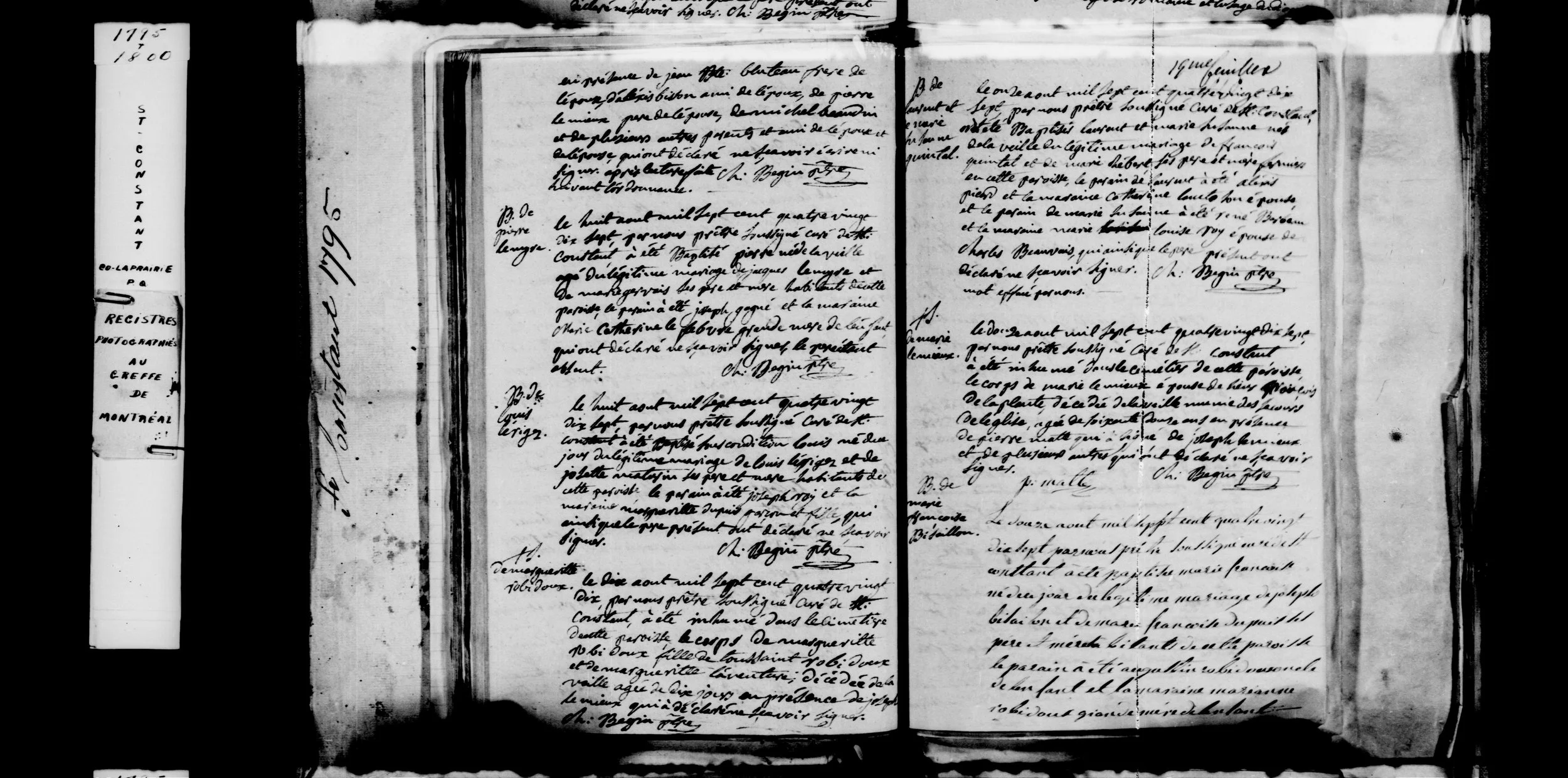
The original St-Constant parish register records the joint baptism of Laurent and his twin sister Marie Suzanne on August 11, 1797. Curé: Ch. Bégin père. Godfather (Laurent): Alexis Picard. Godmother (Laurent): Catherine Lanctot. Father declared unable to sign. Marie Suzanne died August 25, 1797 — fifteen days after birth. Laurent survived.
Born: 10 août 1797
Father: François Quintal, fermier
Mother: Marie Hébert
Parish: St-Constant, La Prairie district

The HBCA biographical sheet is a finding aid compiled by Hudson’s Bay Company Archives staff (initialed jhb, April 1997) that summarizes the archival record for Laurent Quintal across NWC and HBC service. It is not itself a primary source — it is a catalog-style digest of the primary sources, with archival references, key biographical facts, and a synopsis of the Samuel Handsaker narrative concerning Laurent’s death. Every primary HBCA record cited elsewhere in this methodology was located via the references on this sheet.
Entered Service: NWC 21 Feb. 1817 (ANQ, Beek); HBC 1821
NWC 1817–1821: Hivernant (McTavish, McGillivray), English River, F.4/32 folio 970
HBC 1821–1823: Île-a-la-Cosse, English River, B.239/g/1–2
HBC 1823–1836: Middleman, Snake Country, Columbia, B.239/g/3–16
HBC 1836–1837: Free (working as an independent trader), B.239/g/16
Marriage: Marie Anne Nipissing, 9 July 1839 (M-61)
Children: Louis (B-167) and Rosalie (B-168, age 1½)
Note: the sheet gives Louis as age 5 at baptism; B-167 reads age 4, and M-61 recognises him at 5 three weeks later. The sheet compresses the two records — the registers are the authority.
Name variants: Coutrell, Cantrel, Kantal
Karatohon note: “that sly dog Laurent” in Ross = Iroquois Laurent Karatohon, not Laurent Quintal
The biographical sheet resolves a critical confusion for secondary researchers: the “sly dog Laurent” who deserted with Lazard in Alexander Ross’s 1824 narrative was an Iroquois named Laurent Karatohon, not Laurent Quintal. Both men named Laurent were on the same expedition. Researchers who read only the published Ross narrative without consulting the party roster (B.202/a/1 p. 3) have at times merged them. The HBCA sheet documents the distinction explicitly, with citation to HBRS Vol. XIII pp. 2–3.
Methodological note on the 1860 date. The biographical sheet records the death date as 1860, based on Samuel Handsaker’s Pioneer Life — a memoir published decades after the event. The 1997 filename encodes this as “(ca.1799–1860).” The Oregon State Archives Early Oregonian Database gives 1861, Douglas County, Oregon, and Douglas County is where the relevant Calapooia Creek flows — the HBCA sheet identifies the creek but not the county. The Early Oregonian is itself a compiled database rather than a certified death record, so this is one finding aid corrected against another, pending retrieval of an underlying primary record. The county attribution is well supported on geography; the year should be treated as established by the better of two derivative sources rather than by a primary document.
On this image. The biographical sheet is a 1997 archivist-compiled typescript — a catalogue finding aid rather than a manuscript record. It is displayed here on that basis. The manuscript plates it points to are transcribed rather than reproduced, as set out below.
F.4/32 is the NWC general ledger. This volume is digitized but not currently available online; the folio was supplied directly by HBCA archivist Vince Teetaert in response to HBCA Inquiry #621 (March 24, 2026). The individual account for Laurent Quintal appears at folio 970, headed Dr. Laurent Quintal Cr.
| Heading | Dr. Laurent Quintal Cr. |
| 1817 Dr | To sundries of the Montreal Engagé Book — 487 |
| 1818 Cr | By wages — 300 livres |
| 1819 Cr | By wages — 400 livres |
| 1820 | By wages — 400 livres; advance to Frances Fille — 44 |
| 1821 | By wages — 400 livres; To sundries E.R. Eq. 816 [English River] |
The HBCA biographical sheet confirms: NWC service 1817–1821 as hivernant (winterer) under McTavish, McGillivray, English River District. Entered service February 21, 1817. This is consistent with the account entries above. Columbia River references appear in 1819–1820, suggesting an earlier Columbia posting than the 1823 date shown in the biographical sheet — a detail requiring further review of the intermediate B.239/g volumes.
This is the earliest primary record of Laurent Quintal's fur trade career. His wages (300–400 livres/year) are consistent with a mid-level NWC employee in the English River District. The "Frances Fille" advance in 1820 identifies a woman who received payment from his account — identity not yet established.
B.239/g/1 is the first HBC servants' accounts volume following the 1821 NWC/HBC merger. The volume is titled York Factory — Abstracts of Servants Accounts, 1821–1822. Laurent appears on PDF page 150 of 203, with the financial columns continuing to page 151.
| Entry | Quintal, Laurt |
| Balance | 1061.2 |
| Entry above | Quesnel, Amable — 2769.18 — Columbia |
| District | Columbia |
| Continuation | Financial columns carried to p. 151 of the same volume |
The Quesnel entry immediately above Laurent's is Amable Quésnel, father of Frank Quenal — both men HBC Columbia District servants in the same accounting year, listed on the same ledger page.
The proximity of Amable Quesnel and Laurent Quintal in the same HBC servants' accounts ledger — both in the Columbia District — provides the primary archival context for understanding the Quintal-Quenal community connection documented in later Oregon records. They were documented colleagues in the same HBC employment structure from at least 1821. Proximity in an ordered ledger establishes shared employment, not kinship.
B.239/g/16 is Laurent's final appearance in the HBC servants' accounts. Page 120 carries the name and age columns; page 121 carries the balance and the remarks.
| Entry (p. 120) | Quintal, Laurent — age 35 |
| Entry above | Quintal Jr., François — age 27, Laprairie, 5 years’ service |
| Balance (p. 121) | 6.8.10 |
| Remarks (p. 121) | Free |
| Below | Home of Columbia |
Age 35 in 1836–37 implies a birth of approximately 1801–1802; the actual birth is 1797. HBC ages are commonly understated, and the discrepancy is consistent with the pattern rather than evidence of a different man — the parish, the service dates, and the district all match.
The word Free in the original HBC servants' accounts is the primary documentation of Laurent Quintal's transition from company servant to independent trader. This is not inferred from the 1839 Catholic register description — it is recorded in the moment of the transition, in the original ledger, by the HBC accountant who closed his account. The two records together — the 1836–37 notation and the 1839 sacramental description — provide independent, temporally consistent confirmation of the same status change.
Alexander Ross's journal of the 1824 Snake Country Expedition opens with a party list headed "Our party as follows Viz." Laurent Quintal is the sixth name. The journal title reads: "Journal of Business kept during a Voyage to the Snake Country by Alexander Ross commencing on Tuesday the 10th day of February 1824."
| Columns | Men · Guns · Traps · Horses · Lodges |
| 1 | Thyering Godden — 1 gun / 3 traps / 2 horses |
| 2 | Joseph Paul — 1 / 3 / 2 |
| 3 | Louis Paul — 1 / 3 / 2 |
| 4 | François Painant — 1 / 3 / 2 / 1 lodge |
| 5 | Antoine Asbruelle — 1 / 3 / 2 |
| 6 | Laurent Quintal — 1 gun / 3 traps / 2 horses |
| 7 | Joseph Annance — 1 / 3 / 2 |
| 8 | Jean Bapte Gadewa — 1 / 3 / 2 |
| 9 | Pierre Depot — 1 / 3 / 2 |
| 10 | François Rivet, Interpreter — 2 men / 6 traps / 15 horses / 1 lodge |
| 11 | Alexander Ross — 1 gun / 16 horses / 1 lodge |
| Total | 11 men — 12 guns / 33 traps / 50 horses / 3 lodges |
Transcription — The plate carries five columns — Men, Guns, Traps, Horses, Lodges — and the earlier transcription collapsed them into four. The journal title reads Tuesday the tenth day of February, and the calendar agrees. The interpreter is François Rivet, a documented Columbia District figure.
The correction did not come from re-reading the original. It came from a transcription of it made in 1905 by Agnes Laut, working from the journal at Hudson’s Bay House in London, which gives Laurent Quintal one gun, three traps and two horses, names Rivet as interpreter, dates the departure to Tuesday the tenth, and counts eleven men. Every point on which Laut differed from this site’s reading, Laut was right. It is worth stating plainly what that means for method: the rule that a primary record prevails over a later copy governs conflicts of fact. It does not license dismissing a careful transcription that disagrees with your own reading of the manuscript — there, the copyist may simply have read the hand better than you did. A discrepancy between a primary source and a good secondary transcription is a prompt to look again at the primary, not to defend the first reading of it.
Still to verify. Three names in the roster remain uncertain in the hand and are given here as best readings: entries 2 and 3 (Paul, possibly Burel) and entry 8 (Gadewa, possibly Gadseur). The journal entry immediately below the roster tabulates the free men trappers of the Snake Country by lodge — Montour, Vieux Pierre, Martin and others, thirteen lodges, sixty traps, sixteen guns, fifty-seven horses — and has not yet been transcribed.
The HBCA biographical sheet for Laurent Quintal explicitly clarifies a confusion that has circulated in secondary literature: the "sly dog Laurent" who deserted with Lazard in Ross's 1824 narrative was Iroquois Laurent Karatohon — not Laurent Quintal. Both men named Laurent were on this expedition. Laurent Quintal was a named party member; Laurent Karatohon was one of the deserters. Secondary compilers who did not read the party roster did not distinguish them.
This is the most vivid primary source for Laurent Quintal's biography. He is no longer a name in a financial ledger — he is the sixth man listed on a specific expedition, departing on a specific morning, with three guns and two horses. He was approximately twenty-six years old, seven years into his fur trade career, heading into the Snake Country under Alexander Ross.
Source access. Catholic Church Records of the Pacific Northwest (translated by Mikell De Lores Wormell Warner, annotated by Harriet Duncan Munnick; French Prairie Press and Binford & Mort, 1972 onward) remains under active United States copyright as a compiled and annotated derivative work. Page images from the published volumes are therefore not reproduced here, and Munnick’s biographical annotations — her own original authorship — are reported as fact rather than quoted. What each record states is set out in full below; what is restricted is the published presentation of it, not the evidence.
The originals are held by the Archdiocese of Portland, and retrieval of the 1839 Vancouver entries is in progress; when those arrive, the French text and an independent translation will replace the summaries on this page.
Harriet Duncan Munnick's biographical annotation A-59 provides essential context for the Nipissing family in the Columbia District community. The annotation documents the western surname form Napassant — the phonetic corruption of the Algonquian word Nipissing as rendered by English-language recorders who had never encountered the original. It is not a separate family name. It is the same name.
The annotation records that the Nipissing (Napassant) people lived in east-central Canada and that many were employed by the fur companies as canoemen and hunters, the surname form Napassant arising in the West. For Louis it reports that he died long before the annotation's compilation, that he appears in other records under the names Tom-a-pierre and Lapset, and that his wife's name is unknown and her tribe Chinook. For Marie Anne it gives a birth of approximately 1819, records that her father was already dead by 1839 when she was baptized at Vancouver and married Laurent Quintal, and places her later years in Douglas County.
The Napassant identification is essential for finding this family in later Oregon records. Without knowing that Napassant = Nipissing, researchers lose the thread of Marie Anne's family in the records that post-date the Catholic mission registers. The annotation also resolves the dual ethnic identification in B-186: Tchinouk (Chinook) records the mother's heritage through the margin notation; Nipissing records the father's nation in the text. Both are correct. Neither is complete alone.
Marie Anne's adult baptism was performed by Father F.N. Blanchet on July 8, 1839 — the day before her marriage to Laurent Quintal. The register entry names her father directly and identifies her dual heritage through the margin notation.
Priest: F.N. Blanchet, V.G.
Subject: Marie Anne, aged about 20
Father: Louis, described in the entry as “Nipissing by nation”
Mother: a woman of the country, recorded as unbaptized
Godmother: Catherine Russie, who did not know how to sign
Margin: identifies her as Tchinouk [Nipissing]
This is the first of two independent sacramental records naming Louis Nipissing as Marie Anne's father. The margin notation records her Chinook identity through her mother's heritage. No Courteoreille name appears anywhere in this record or in any related entry in the same register series.
The marriage record of Laurent Quintal and Marie Anne Nipissing, performed the day after her baptism. This is the second independent sacramental record naming Louis Nipissing as Marie Anne's father — and the first to confirm he was already dead at the time of the marriage.
Groom: Laurent Quintal, engaged in the party of the hunt of the prairie, formerly of St. Pierre, district of Montreal, Canada
Bride: Marie Anne, natural daughter of “the late Louis Nipissing” and of a woman of the country
Witnesses: Michel Laframboise and Jean Baptiste Jeaudoin, both of whom signed
Children recognized: Louis, aged 5, and Rosalie, aged 1½, declared legitimate
Signatures: neither spouse knew how to sign
This is the second independent sacramental record naming Louis Nipissing as Marie Anne's father, produced the following day by the same administrative process but recording a different sacramental event. The description of him as already dead sets a firm boundary: he died before July 1839. The recognition of pre-nuptial children Louis and Rosalie establishes that the marriage regularized a prior union. Laurent is described as a free man — consistent with his 1836–37 HBC account notation.
Eighteen days before their parents' church marriage, Louis and Rosalie Quintal were baptized together on June 21, 1839 by F.N. Blanchet. Both entries name the parents as Laurent Quintal, described as a free man of the prairies, and Marie Anne Nipissing. B-167 gives Louis as aged 4 and B-168 gives Rosalie as aged 18 months. Godfather for both children: Pierre Belèque, who did not know how to sign.
These two records establish that Laurent and Marie Anne had a pre-existing union with at least two children before the church ceremony of July 9, 1839. The sequence — children baptized June 21, Marie Anne baptized July 8, couple married July 9 — is the standard Catholic regularization pattern in the Columbia District fur trade mission community.

The 1850 Oregon Territory Federal Census records Laurent Quintal (age 55) in Marion County with his wife (age 34, consistent with Marie Anne born approximately 1816), children including "Zoe" (age 10, consistent with birth approximately 1840), and several younger children — Louis (15), Toussaint (8) and Marianne (2). Real estate valued at $4,700. Occupation: farmer. Household number 0376. Laurent appears here under variant spellings of Quintal consistent with those documented in the HBCA records and Munnick's annotations.
This is the one source for Zoé's parentage wholly independent of the Catholic register system. A federal enumerator recorded the household as he found it, with no reference to the mission records. Where the register-derived identifications and the census agree, the agreement is meaningful precisely because the two record systems had no contact with one another.
The Early Oregonians Database (Oregon State Archives) is a sesquicentennial project documenting individuals who lived in Oregon before statehood — approximately 103,000 profiles. The Oregon State Archives describes it as compiled by volunteers and interns from the 1850 and 1860 federal censuses, supplemented from Archives holdings such as probate, death and marriage records, with some profiles citing secondary sources, publications, and family tree data from websites.
| Gender | Male |
| Date of birth | 1795 |
| Date of death | 1861 |
| Place of death | Douglas Co., OR |
| Mother / Father | [both blank] |
| Marriage | Nipissing, Marie Anne — 09 Jul 1839 — Vancouver Co. |
| Associated persons | Nipissing, Marie Anne — female, b. 1816 — spouse |
| Census events | 1850 Federal, OR, Marion Co., household 0376, age 55 |
| Sources | Vancouver I; St Paul Annotations |
| Gender | Female |
| Date of birth | 1816 (alternate: 1819) |
| Place of birth | OR-Territory |
| Date of death | 1886 |
| Place of death | Douglas Co., OR |
| Ethnicity | Chinook Indian |
| Mother | Chinook woman, –– |
| Father | Nipissing, Louis |
| Marriage | Quintal, Laurent — 09 Jul 1839 — Vancouver Co. |
| Census events | 1850 Federal, OR, Marion Co., household 0376, age 34 |
| Sources | Vanc and St P CC; wc |
How this source is weighted. The database is a compiled finding aid, not a primary record, and each profile must be weighed by what its own source field cites. Marie Anne's profile cites the Vancouver and St Paul Catholic records — the same body of records transcribed in Catholic Church Records of the Pacific Northwest. Her father's identification therefore restates B-186 and M-61 rather than independently corroborating them. Laurent's profile cites Vancouver I and the St Paul annotations and lists no parents at all, so it supports nothing about his parentage.
Discrepancy recorded. Laurent's profile gives his date of birth as 1795. The St-Constant parish register, PRDH-IGD, the HBCA biographical sheet and the 1817 engagement contract all establish 1797. The database is in error on this point, and the error is a useful illustration of why a compiled profile cannot be cited at primary tier.
The database remains valuable: it aggregates Oregon material that is otherwise scattered, it supplies the 1861 Douglas County death detail absent from the HBCA sheet, it independently records Marie Anne's ethnicity as Chinook Indian, and it provides the name-variant bridge across Quintal, Cantelle and Chantell. What it does not do is supply a second witness to facts that originate in the Catholic registers.
Munnick's biographical annotation A-19 identifies Zoé as the daughter of Laurent Quintal and documents her marriage to Augustin Délard at Marion County, Oregon on August 25, 1857. The annotation explains that Augustin was known by the nickname "Quine" in the customary usage of distinguishing among repeated common names, and that he is met with in pioneer references as a scout and guide; it records that the couple moved to Wasco County, reared a family of eight, and later moved to Crook County, where they are buried near Suplee, Oregon. The Marion County marriage abstract records the same marriage, with B. Delorme officiating and Joseph Delart and Lewis Yandall as witnesses. "Loe Quintal" in that entry is Zoé — a phonetic rendering consistent with the name variant pattern documented across this family's records.
Conflicting date. Munnick A-19 and the Marion County marriage abstract both give 25 August 1857. The Early Oregonian profile for Zoé gives 15 August 1857. The conflict is unresolved and is recorded here rather than smoothed over; the original Marion County civil marriage record has been requested and will settle it.
On the marriage record image. The Marion County entry was consulted in a compiled abstract volume rather than as an image of the original civil register. Until the provenance of that abstract is established, it is treated as a compiled source and no page image is displayed.
Munnick's identification of Zoé as Laurent's daughter comes from her own research in the same Catholic register system that recorded her parents' 1839 marriage — she read the registers directly and connected the family across entries. That is independent archival identification, not copying from a family tree. It is, however, the same record system that underlies the Early Oregonian profile, and the two should not be counted as separate witnesses.
| Alias | ––, Mary |
| Gender | Female |
| Date of birth | Aug 1840 (alternate: 1832) |
| Place of birth | St Paul, Marion Co., OR-Territory |
| Date of death | 06 Dec 1905 |
| Place of death | Suplee, Crook Co., OR |
| Place of burial | Delore / Suplee Cemetery, Suplee, Crook Co., OR |
| Ethnicity | 1/2 Indian |
| Mother | Nipissing, Marie Anne |
| Father | Quintal, Laurent |
| Marriage | Delard, Augustin — 15 Aug 1857 — Marion Co., OR |
| Census events | 1850 Marion Co. (household 0376, age 10) · 1880 Wasco Co. · 1900 Crook Co. |
| Sources | St Paul I 19-B294; wc; mcmr; findagrave |
The source string is the most useful thing on this profile. St Paul I 19-B294 is a register citation — page 19, entry B-294 of the St Paul volume — and appears to be Zoé's own baptismal entry. If it names Laurent and Marie Anne, it is a sacramental record of her parentage distinct from Munnick's annotation, and it would restore a genuine second independent witness alongside the 1850 census. It has been added to the Archdiocese of Portland retrieval request.
Munnick annotation A-69 documents Louis Quintal Jr.'s 1853 marriage — Louis being the pre-nuptial son baptized in B-167 (June 21, 1839), whose parents are named as Laurent and Marie Anne. A-69 records that Louis, son of Laurent Quintal, married Cécile Norwest at St Louis in 1853, and that his record continues through the St Paul, Oregon City and Roseburg registers. It provides Munnick's cross-reference connecting the 1839 baptism to the 1853 adult record, further establishing the family's presence in the Oregon Catholic community through the 1850s.

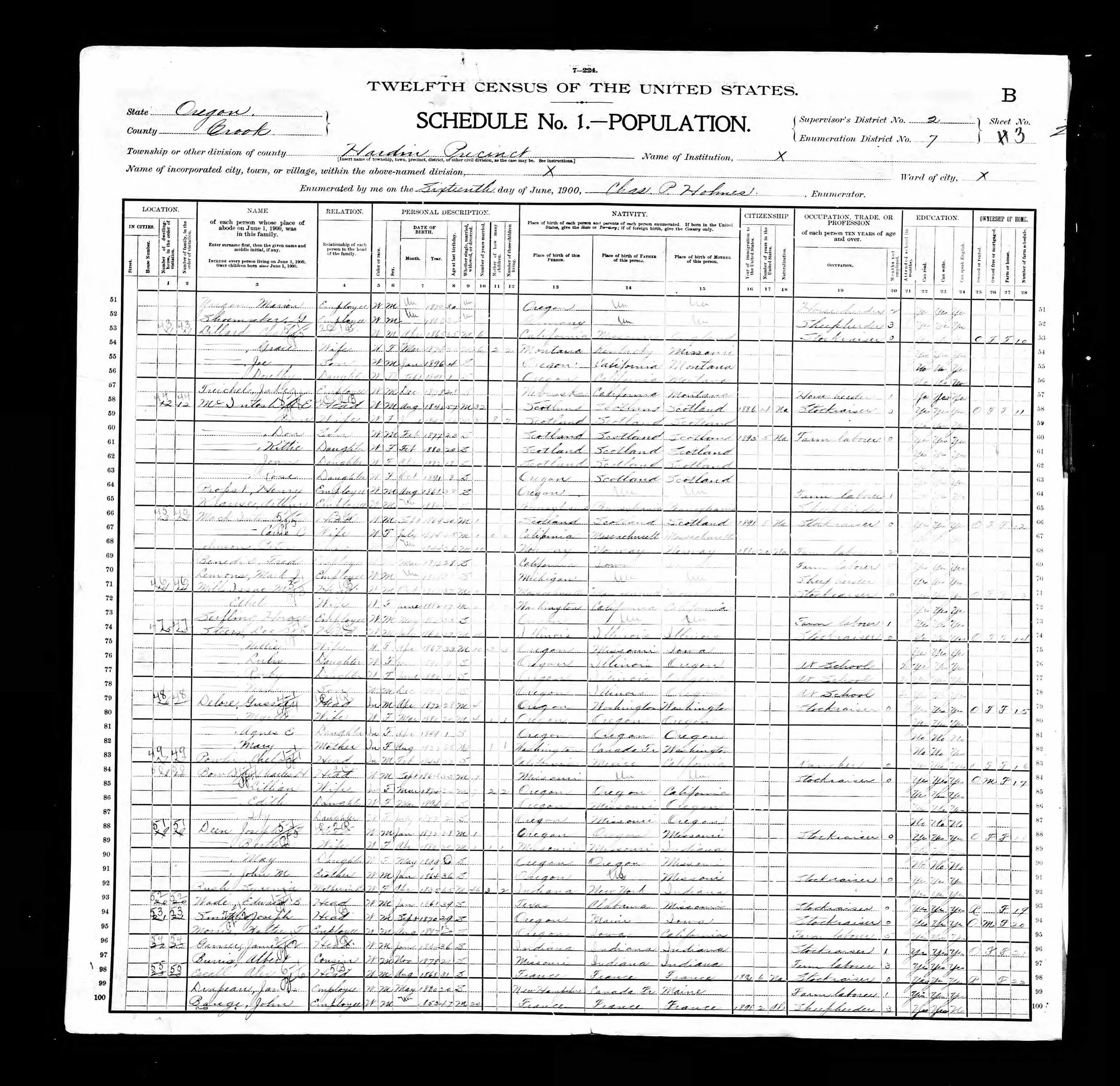
The 1880 and 1900 Federal Census records document Zoé's household in Oregon across two decades. The 1880 census places her with Augustin Délard and their family in Wasco County. The 1900 census continues the record in Crook County. Ages are consistent across entries with a birth year of approximately 1840 at St Paul, Marion County, Oregon Territory — matching the 1850 census age of 10, and inconsistent with the alternate 1832 date carried on her database profile.

The 1910 census for Larose Quenel — daughter of Louis Nipissing Jr. and Lizette Klickitat — documents the next generation of the Nipissing family network in Oregon, and places this extended family in the same community documented through the Catholic registers.
Louis Nipissing Jr., the Umpqua treaty chief, was Marie Anne's brother. That relationship does not rest on modern compilation. It was affirmed in the federal investigation of 1905 into the living descendants of the 1855 treaty signers: Marie Anne's son Louis Toussaint Quintal, known in Oregon records as Sam Chantell, testified that his mother was a full sister of Louis Napassant the Younger, and further that Louis himself had taken him before an Inspector and to agent Sinnott and explained the relationship, on which basis Sam was accepted as belonging to Louis's tribe. The chief affirmed the kinship to federal officials in his own lifetime. Investigator O. C. Applegate's summary report records the same relationship independently of Sam's own words. The testimony is known here through Munnick's 1974 quotation of it; the original files have not yet been retrieved.
| Alias | Napassank, –– |
| Gender | Female |
| Date of birth | 1845 |
| Place of birth | St Paul, Marion Co., OR-Territory |
| Date of death | 10 Sep 1932 (alternate: 09 May 1932) |
| Place of death | Grande Ronde, Yamhill Co., OR |
| Place of burial | Grand Ronde Catholic Cemetery, Grand Ronde, Yamhill Co., OR |
| Father | Nipissing, Louis — b. 1833 (see note below) |
| Marriage | Quenel, Francis — ca. 1867 |
| Census events | 1900, 1910, 1930 Federal, OR, Yamhill Co. |
| Alias | Quesnel, Francois |
| Gender | Male |
| Date of birth | 1833 (alternate: 1836) |
| Place of birth | OR-Territory |
| Ethnicity / occupation | Indian; farmer |
| Mother | Sauk-so, Marie Angelique Sophi |
| Father | Quesnel, Amable |
| Marriage | Nipissing, LaRose — 17 Nov 1869 — Polk Co., OR |
| Census events | 1900, 1910 Federal, OR, Yamhill Co. |
Larose Nipissing — also recorded as Larose Quenel after her marriage — was the daughter of Louis Nipissing Jr. and Lizette Klickitat, confirmed in the 1910 census. Frank Quenelle's sworn Statement No. 112 (1906) confirms his father was Amable Quesnel, not a blood relative of the Quintal family as some unsourced trees assert.
Discrepancy recorded — Larose's father's birth year. The Early Oregonian profile gives Louis Nipissing, her father, as born 1833. Louis Nipissing Jr. — Marie Anne's brother and the Umpqua treaty chief — was born about 1818 on Munnick's account, or about 1813 on Beckham's, and died at Grand Ronde on 25 June 1888 aged about seventy per Father Croquet's register. A birth of 1833 is incompatible with both, and with a man who signed a treaty as head chief in 1854. Either the database has erred, or a third Louis of this family stands behind the entry. Unresolved; the profile is transcribed as it reads and the conflict is left visible rather than reconciled.
A second conflict in the same family. Munnick's 1976 article describes Frank Quesnel as having a French-Chehalis father and a Nipissing-Nez Perce mother. Her 1974 article names the chief's daughter Rose as having married her cousin "Frank Quintal," a surname she corrects to Quesnel in the later piece. Frank's own sworn Statement No. 112 of 1906 names his father as Amable Quesnel and his mother as Sauk-so, a Lower Chinook woman. Where a compiled account and a man's own sworn testimony disagree about his parents, the testimony governs. The Nipissing-Nez Perce description is left recorded but not adopted.
These community records provide the context for understanding why Quintal, Nipissing, Napassant, and Quenal/Quesnel family names appear in proximity across Oregon records. They were part of the same post-fur-trade Columbia District Métis community — connected by shared employment history, Catholic mission life, and Oregon settlement patterns, not necessarily by blood kinship. The distinction matters for accurate genealogical claims.
Source Inventory
All primary and compiled sources cited in this case study, organized by archive and record series
Family #55528
Indiv. #496316
Baptism #671580
Register, 1797
Folio 970
pp. 150–151
pp. 120–121
p. 3 of 71
Sheet — Quintal
note — HBCA
July 8, 1839
July 9, 1839
June 21, 1839
Vancouver Vol. I
Vancouver Vol. I
Vancouver Vol. I
CCRPNW
Marion Co., OR
Database
Records, 1857
Oregon
Oregon
19-B294
Portland
Files — Grand Ronde
attribution
correspondence
Nipissing
4–8
& Marie Anne
sourcing
Entry #109
c. 1842
ANQM Greffe
Beek, 1817
MF M620/0070
This methodology page accompanies the case study summary. The case study presents the findings; this page documents how each finding was established and what each record contains.
← Return to Case Study Laurent Quintal Documentary Biography Saint-Constant-de-la-Prairie-de-la-Magdeleine The Guilbault Line Case Study: The Voyageur Years The War Chief’s Wife French-Canadian & Métis Research