
The Abitakijikokwe Discovery
Discovering the Identity of Josephte Sauvagesse
The Challenge
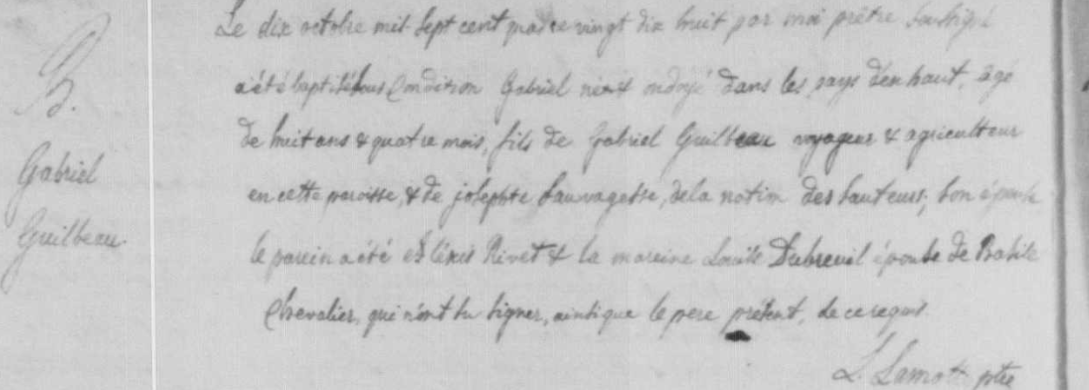
The initial mystery began with a French-Canadian voyageur named Gabriel Guilbault whose first wife appeared in family trees only as “Sauvagesse” — a generic term meaning “Indigenous woman.” No name, no identity, no story — just another woman lost to family memory through two centuries of distance from the original records.
Research obstacles quickly emerged. Quebec had no civil registration for anyone until 1926; parish registers served that function for the whole population. The real obstacle is narrower and more interesting: country marriages contracted in the pays d'en haut left no ecclesiastical record at all until the couple came within reach of a priest. Outside the missions, Catholic records often used only generic terms like “Sauvagesse” rather than recording Indigenous names. Multiple spelling variations of surnames (Guilbault/Guilbeau/Guilbeault) complicated searches across the Quebec-Ontario border region. The assumption seemed inevitable: like most Indigenous ancestors, she would remain forever nameless.
The search began in reverse. Gabriel was buried at St-Benoit on April 8, 1833, having died two days earlier; the register put his age at about ninety-three, though his own baptism at L’Assomption on June 13, 1762 makes him seventy. The discrepancy is the informant’s, and it is a useful warning at the outset of a case that would turn on stated ages. His 1815 remarriage identified him as “widower of Josette Sauvagesse” — placing his first wife’s death before February of that year, yet even there she appeared only under the generic term. The record confirming her death still withheld her name.
What remained was a fifteen-year window, a handful of parishes along the fur trade routes of the Quebec-Ontario border, and the question of whether any priest, anywhere, had written down who she actually was.

The Breakthrough
October 10, 1798 revealed the first clue. Three children baptized together at St-Paul-de-Lavaltrie identified their mother not just as “Sauvagesse,” but as “de la nation des Sauteux” — an Ojibwe/Saulteaux woman. This tribal identification was the key that unlocked everything.
The Marriage Record provided the breakthrough. On January 27, 1801, at L’Annonciation in Oka, the priest preserved her full Indigenous name: “marie josephte abitakijikok8e,” and legitimized their four children — Gabriel, Angélique, Joseph and François.
Her name, Abitakijikokwe, is a primary Anishinaabe name: abitakijik, the sky at its midpoint — the sun at midday — and -okwe, woman. Mid-Sky Woman. (The reading is Deliris López Tiwari's, who explained it and gave permission to cite her.)
Her own baptism sat one entry above the marriage. On January 26, 1801 — the day before the wedding, and as the prerequisite for it — she was baptized as an adult, “âgée de quarante ans,” and recorded as “de la nation Sauteuse sur le lac supérieur” — not merely a nation, but a homeland, some seven hundred miles west of the parish where she would be buried. Her godparents were Nicolas Oniaragete and Anne Satiok8en, Iroquois of the Oka mission. No other entry names her this fully.
Her burial closed the last gap. On June 25, 1813, at Ste-Madeleine-de-Rigaud, the priest recorded the burial of “Marie Josette Sauvagesse de nation,” died the evening of June 23, aged about fifty, lawful wife of Gabriel Guilbeault, mason, of the Seigneurie d’Argenteuil. Gabriel was present, named by the priest as Mari de la defunte, and could not sign.
The parishes were searched systematically along the Quebec-Ontario border, following fur trade routes — St-Paul-de-Lavaltrie, L’Annonciation at Oka, Ste-Madeleine-de-Rigaud, and St-Benoit among them.
Critical to the discovery was FamilySearch’s Full Text Search, which searches the handwritten content of documents rather than indexed fields alone. The key records were not indexed under any Guilbault spelling variation — they were found because the document text itself contained “Sauvagesse” and “Sauteuse.”
The Result
Her name is preserved in the registers of three parishes — St-Paul-de-Lavaltrie, L’Annonciation at Oka, and Ste-Madeleine-de-Rigaud — across records running from 1798 to 1827. Two independent age statements — forty at baptism in January 1801, about fifty at burial in June 1813 — bracket her birth to roughly 1760–1763.
Seven children documented between 1790 and about 1807. The four eldest were baptized at St-Paul-de-Lavaltrie in 1798–1799, their mother named de la nation des Sauteux in every entry. Louis was baptized at Rigaud on June 28, 1806, with his sixteen-year-old brother Gabriel standing as godfather — the eldest and youngest sons of the sibling group joined in a single record. A last daughter, born about 1807 and given the name of the sister buried in 1803, is known from her own marriage at Rigaud in 1827, where she is named as the daughter of Gabriel and of Marie Josephte, her father consenting in person. She was buried at St-Michel-de-Vaudreuil in December 1844 as the wife of Louis Labre, aged about thirty-seven — an age that agrees with a birth about 1807. Her baptism has not been found.
A fur trade family in a pattern the registers show again and again — a union begun “à la façon du pays” in the interior, children baptized sous condition on the family’s return, and a church marriage that legitimized them.
An identity built entirely from primary records — every statement of her name, her nation, and her homeland taken from an entry examined in the original register, with the open questions recorded alongside them. An “unknown Sauvagesse” became a named woman with a nation, a homeland, and seven children.
Fourteen register entries have been examined in the original — the greffe copies photographed for St-Jérôme and Montréal — across St-Paul-de-Lavaltrie, L’Annonciation at Oka, and Ste-Madeleine-de-Rigaud, spanning 1798 to 1827. Every entry in the sequence has been examined in the original, including the burial of the infant François at Oka in April 1801. Two independent age statements, twelve years apart and recorded by different priests, agree within two years. Her daughter’s stated age at burial reconciles exactly with her stated birth date sixteen months earlier. No conflicting evidence has been identified.
Her name appears in the registers as Abitakijikok8e and Tabitakijokok8e — French hands recording an Anishinaabe name by ear. The variants do not represent different women. The ending -okwe, “woman,” is consistent across them — one woman, one name, rendered by different hands. The element rendered “-kok8e” is not unique to her: the same Oka register records a Marie Josette of the Nipissing nation whose name carries it too, burying a daughter of similar age within the same month of 1803. The two women are distinguished by nation and by husband, and are not the same person.
The document-by-document analysis behind this case study — every parish searched, search term applied, record located, and analytical step taken from “unknown Sauvagesse” to a named Saulteaux woman — is available in the full methodology.
Read the Full Methodology Explore Services Begin Your Research Inquiry