
The Daughter Remembered as Tonang
The Challenge
The line of Mamerto Morales (1900–1942) ran cleanly on his father’s side — Juan Apdon Morales is well documented in the parish and civil records of Kalibo and Numancia. His mother was another matter. She survived in the family only as a name spoken, never written: Tonang Quimpo, remembered by Virgilio “Tito Bill” Morales as Mamerto’s mother. No baptism, no marriage, no civil entry anywhere records a woman by that name.
“Tonang” is not a baptismal name. It is a hypocorism — a household nickname formed with the Visayan diminutive ending -ng.
Searching formal registers for a nickname returns nothing by design. Priests and civil registrars recorded the formal name a person was christened with, never the name the family used at home. A negative result was the predictable outcome of the search — not evidence the woman did not exist.
In Visayan usage the construction is regular: a formal name contracts to a familiar form, then takes the affectionate -ng. “Tonang” most commonly stands behind Petrona — Pe-tro-na becomes Tona, then Tonang. The next most likely formal name is Antonia. The nickname pointed toward a real person; it simply could not be looked up directly.
Without resolving who Tonang was, the maternal line stopped at a nickname. Two further questions stalled with it. Were Mamerto and his sister Josefa Morales (baptized 1896) full siblings or half siblings? And who were the grandparents, great-grandparents, and wider kin on the maternal side — an entire branch of the family, unrecoverable so long as the matriarch herself was unidentified.
The working hypothesis was stated plainly, and held as a hypothesis: Tonang Quimpo was Petrona Quimpo, the wife of Juan Apdon Morales. The task was not to assert it but to test it — to find, in the formal record, a Petrona Quimpo of exactly the right surname, generation, parentage, and household, and to keep the alternative (a separate Antonia Quimpo) live until the documents ruled on it.
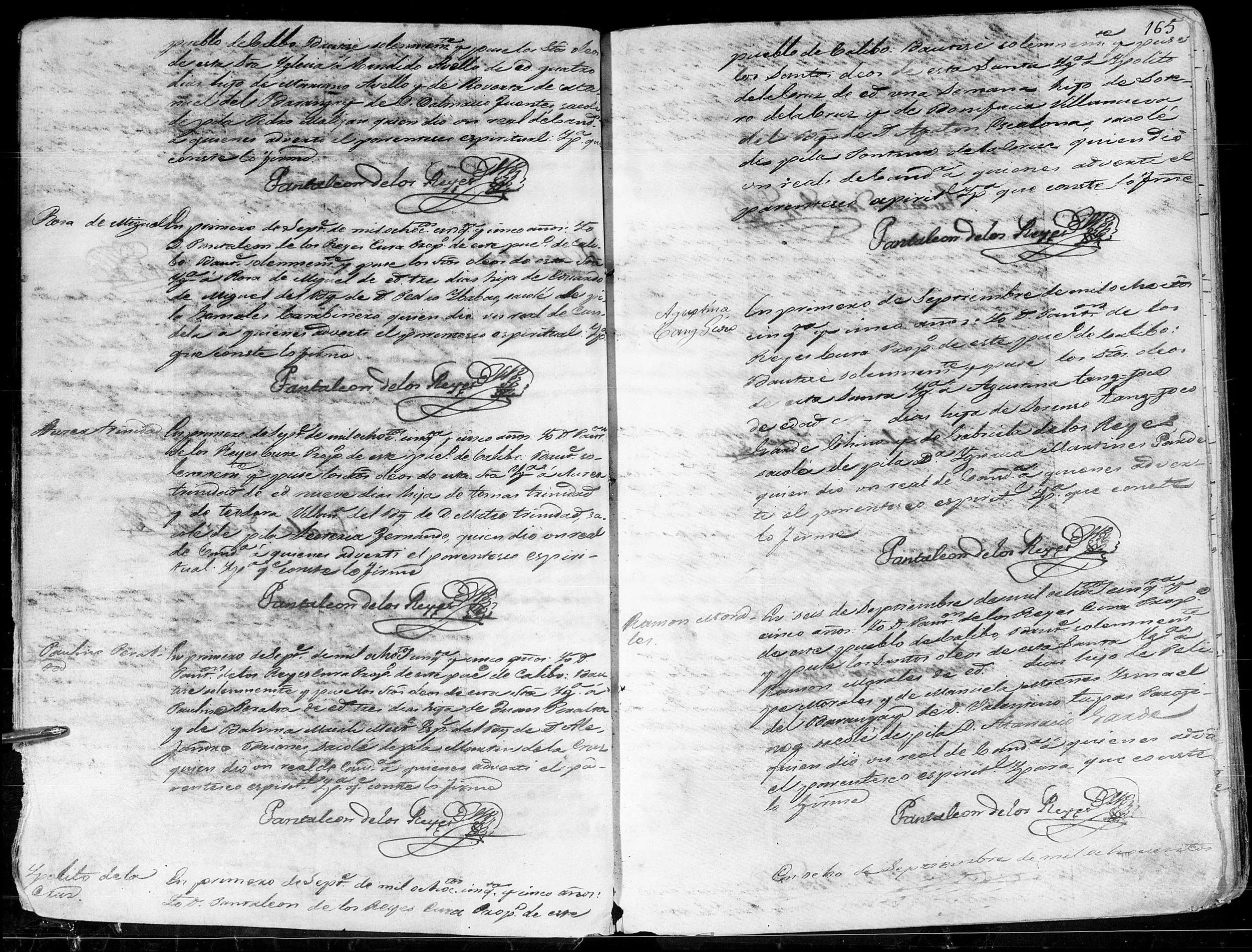
The records that would answer the question had been sitting in the parish registers of Kalibo for more than a century. They simply had to be read for what they named in the margins: not the mother, but her parents.

The Breakthrough
The christening of Josefa Morales, 3 July 1896 at Kalibo, names her parents as Juan Morales and Petrona Quimpo — and records the maternal grandparents as Ponciano (Potenciano) Quimpo and Mena (María) Ferrer.
This single entry supplied the key the search needed: not just a mother’s name, but her parents’ names — the fixed point every other record could be tested against.
If a documented Petrona Quimpo could be shown to be the daughter of Ponciano Quimpo and Mena Ferrer, and to belong to the right generation and place, then the woman remembered as Tonang had a record after all — under her christened name.
The christening of María de Loreto Briones, 13 December 1884 at Kalibo — original register image verified — names her mother as Petrona Quimpo and her maternal grandparents as the same Ponciano and Mena Ferrer.
Twelve years and a different husband apart (Basilio Briones in 1884, Juan Morales in 1896), two register entries name an identical parental couple behind the mother. The Petrona Quimpo of the Briones marriage and the Petrona Quimpo of the Morales marriage are one woman.
This was the decisive move. A name can be shared by many; a name attached to a specific parental couple, recorded independently in two parishes’ worth of register entries, identifies an individual. Petrona Quimpo had married first into the Briones family (daughters María de Loreto in 1884 and Carolina in 1886) and later become the second wife of Juan Apdon Morales (Josefa in 1896, Mamerto in 1900).
The registers then placed Petrona Quimpo in the community as a grandmother, in real time. Paz Soler, christened 31 May 1911 at the Church of San Juan Bautista, Kalibo, is recorded as her granddaughter. So is Concepción Soler y Briones, 22 January 1913 — through Petrona’s daughter Carolina Briones. And Guillerma Morales, christened 1916, is recorded as her granddaughter through the Magín Morales line — here Petrona stands as household matriarch and step-grandmother, Magín being Juan’s son by his first marriage. Three sacramental entries, naming the same woman as grandmother across two of her family branches.
A civil record sealed the parentage from another direction. The 1929 Report of Death of Julita Estrada, a Kalibo schoolteacher, lists her mother as Victoria Quimpo and her other relatives as Petrona Quimpo and Tomasa Quimpo — a set of Quimpo sisters matching exactly the children recorded for Ponciano Quimpo and Mena Ferrer. Josefa Morales appears in the very same kin list, tying the Morales children to the Quimpo sisters in a document written by the family itself.
The notarial record corroborated the household. Across three decades a widowed Petrona Quimpo of Kalibo appears buying and holding land — and the transactions stayed inside the family. In the 1934 Mabilo deed, the seller is Carolina Briones (Petrona’s own daughter) and the notary is Mamerto L. Morales (her own son). A daughter conveyed land to her widowed mother, and the mother’s son drew up the papers.
Read in isolation, no one of these records names “the mother of Mamerto.” Read together, they describe a single Petrona Quimpo — daughter of Ponciano and Mena, wife first of Briones and then of Morales, grandmother to a documented set of children, sister within a documented set of Quimpo women, and matriarch of a family whose land passed between her children and herself.

The Result
The maternal line of Mamerto Morales now runs, generation by generation, on the strength of primary register entries: Pablo Quimpo and Josefa Legaspi, married at St. John the Baptist, Kalibo, on 26 July 1837; their son Ponciano Quimpo and his wife Mena Ferrer; their daughter Petrona Quimpo; and Petrona’s son Mamerto Morales. The woman who survived in family memory as a single spoken name occupies a fixed place in a four-generation pedigree.
Mamerto and Josefa Morales were full siblings — both children of Juan Apdon Morales and Petrona Quimpo. Magín Morales, Juan’s son by his first marriage, was their half-brother. And because Mamerto later married Patrocinia Gonzales — daughter of Petrona’s sister Emilia Quimpo — the Morales–Gonzales union runs through two Quimpo sisters, making husband and wife first cousins. The maternal branch that had been unrecoverable now opens into a documented network of Quimpo siblings: Francisco, Tomasa, Emilia, Ramona, Bonifacia, Petrona, and Victoria.
One record returned more than a relationship. The family knew that Mamerto had a son, Jones Gonzales Morales — brother of Romulo G. Morales — who had died young, but little more than that. The Manila civil death certificate, located in the course of this research, supplied the rest: Jones was born 1 September 1941 in Numancia and died 15 July 1960 in Manila, son of Mamerto Morales. A life the family remembered only in outline was returned to the record in detail.
Families do not remember people by the names the church wrote down. They remember them by the names spoken across a kitchen, in a diminutive worn smooth by use. The gap between how a family remembers and how a register records is not a dead end — it is a research problem with a method. Here the method was triangulation: when no record names the person you seek, find the records that name her parents, and let three generations of margins converge. The woman remembered as Tonang was Petrona Quimpo all along. The registers had been holding her place for a hundred and twenty years.
The documentary chain establishes, from primary register entries, a Petrona Quimpo of exactly the remembered surname, generation, parentage, and household — daughter of Ponciano Quimpo and Mena Ferrer, wife of Juan Apdon Morales, mother of Mamerto. The final link, from the spoken “Tonang” to the written “Petrona,” rests on the regular Visayan nickname convention together with the absence of any competing Antonia Quimpo in the same family cluster. The identification is documented and consistent across every record located; it would be closed beyond all question by Mamerto’s own baptism naming his mother in words — a record still being sought. This case is presented as a resolved identification with its one remaining indirect link named openly, in keeping with the Genealogical Proof Standard.
The document-by-document analysis behind this case study — the full triangulation argument, original register and deed images, civil records, and the complete evidence base for the identification — is available in the full methodology and the document archive.
Full Methodology Document Archive From Aklan to America: The Morales-Tamayo Line