
The Survivor — How the Research Was Done
A document-by-document account of six archive groups: a Quebec baptism, a family pedigree confirmed in three interlocking PRDH records, the only surviving HBCA primary source in Hilaire’s name, and the Catholic Church Records of the Pacific Northwest that placed him at French Prairie from 1842 to his death in June 1849.
Research Methodology
Six steps from a Quebec baptismal record to a sworn deposition before James Douglas, a Catholic marriage with four adopted children, and a documented death at French Prairie in 1849
The Central Challenge This Case Addresses
Hilaire Guilbault presents the inverse of the challenge posed by Paul “The Canadian.” Where Paul’s Quebec identity was clear and his HBC service richly documented in published journals and Catholic registers, Hilaire’s HBC career is almost entirely opaque in the HBCA — no contract, no post journal appearances, one deposition. The Munnick annotation names him at the Dalles des Morts in 1838 and at Cowlitz Farm in 1847–48, but the intervening decade is thin. The breakthrough is not a journal or a contract. It is a single two-page sworn statement in Hilaire’s own voice, taken by James Douglas at Cowlitz Farm on July 30, 1842, that establishes his location, his role, his character, and the names of the men around him at a moment of crisis.
The methodology documents how each archive layer was identified, searched, and evaluated — and where the record honestly ends.
Establish Quebec Identity and Pedigree Through PRDH
The starting point was a systematic PRDH-IGD search for Hilaire Guilbault, son of Joseph Guilbault and Rosalie Lescault, born 1818. PRDH Individual #2462814 confirmed the baptism: June 23, 1818, Verchères (St-François-Xavier); father Joseph Guilbault, mother Rosalie Marie Lescault Lesot. The Verchères register image provides the original entry — the same entry that names Hilaire Lesot and Félicité Guinreau Labadie as sponsors, and Rambor père as priest.
PRDH Individual #611757 confirmed Joseph Guilbault: born December 15, 1786, St-Paul-de-Lavaltrie; baptized January 1, 1787; parents Paul Guilbault (b. 1761) and Marie Geneviève Olivier Milot. Joseph’s marriage to Rosalie Marie Lescault Lesot on September 23, 1811 at Verchères is confirmed in PRDH Family #116841, which lists their children, including Hilaire (b. June 23, 1818).
PRDH Family #34045 (Gabriel Guilbault b. 1731 × Marie Charlotte Morin) confirmed the relationship to Paul Guilbault b. 1761 — listed as a child of this family alongside Gabriel père b. 1762, the researcher’s 4th-great-grandfather. This established that Hilaire’s grandfather Paul (b. 1761) and Gabriel père (b. 1762) were brothers, making Hilaire the researcher’s second cousin four times removed through the Gabriel père line.
Locate Hilaire in the Gauthier Compiled Ancestry
Gauthier entry #56 (GUILBAULT, Hilaire; HBC 1838–1848; born June 23, 1818, Verchères; son of Joseph Guilbault, farmer, and Rosalie Lescault; linked to Paul Guilbault) was confirmed against PRDH Individual #2462814 on every verifiable field: birth date, parish, parents. The Gauthier document is a compiled secondary source, but its identification data for Hilaire is independently confirmable.
The Gauthier designation “HBC 1838–1848” provides the service period framework. The phrase “linked to Paul Guilbault” — which Gauthier applies to Paul as well — signals a community connection that the PRDH records now document as first cousin once removed. The relationship is not stated in the Gauthier entry; it must be established through the pedigree chain. Gauthier’s scope (“Ancestry of French Canadians to Oregon Prior to 1842”) explains why Hilaire is included: he belongs to the same westward migration community she was documenting.
No HBC servant contract has been located for Hilaire in the HBCA Name File. The Gauthier service dates cannot currently be confirmed against a primary HBCA source. This is documented as an open research question, not a gap that can be papered over.
Identify the Dalles des Morts Survival Through Secondary Sources
The Munnick annotation A-34 states that Hilaire was “one of those who saved himself in the bateau disaster at the Dalles des Morts with the brigade bringing Fathers Blanchet and Demers to the West in 1838.” This is a secondary source claim derived from Munnick’s research in mission and HBC records; it is not an original document. The claim is consistent with Gauthier’s HBC start date of 1838, with Hilaire’s presence in the Columbia District in subsequent Catholic register entries, and with the historical record of the 1838 Columbia Express disaster.
The Dalles des Morts disaster of 1838 is well-documented in HBC history and secondary literature. The brigade was transporting Fathers Norbert Blanchet and Modeste Demers — the first Catholic missionaries to Oregon Country — on the HBC Columbia Express. At Les Dalles des Morts, a bateau capsized. Twelve people drowned, including Maria Simpson Wallace (daughter of Governor Sir George Simpson and her husband Robert Wallace), three children of Pierre Leblanc, and two children of steersman André Chalifoux. Approximately fourteen survived, including steersman Chalifoux and one Leblanc daughter saved from an air pocket under the overturned hull.
The A-34 annotation designates Hilaire as “a middleman” — a specific HBC workforce category, indicating a paddler in a brigade, senior to a simple engagé but below a guide or steersman. The identification is consistent with the HBC service period Gauthier establishes. The claim is treated as a secondary source requiring eventual primary verification in HBC brigade records; it has not yet been located in any contemporaneous HBC journal entry.
Locate and Transcribe HBCA B.47/z/1 — The Deposition
HBCA B.47/z/1 (Section B, Class 47, Sub-division z, Piece 1; Description: Cowlitz Farm Miscellaneous Items, 1842) was identified through the HBCA finding aids as the archive group for Cowlitz Farm miscellaneous documents. The contents label, in a cataloging hand, reads: “Deposition of Hilaire Gilbeault re intended murder of Charles Forrest.” This is the only HBCA record identified to date that names Hilaire in its own right as a primary subject.
The document is a two-page sworn deposition in a clear clerical hand, dated 1842, with “1.” marked at the upper right of the second page to indicate this is the first of two depositions in the same file. James Douglas signed both — Hilaire’s deposition and the note confirming that Narcisse Forceur’s deposition “states to the same effect, as the preceding made by Hilaire Gilbeault” — on July 30, 1842.
The deposition establishes: (1) Hilaire’s HBC employment status and location — “a servant in the employ of the Hudsons Bay Company, stationed at a Farm on the River Cowelitz”; (2) the names of two fellow servants — Narcisse Forcier and Narcisse Moussette; (3) the substance of Moussette’s proposal to murder Charles Forrest, the Cowlitz Farm clerk; (4) Hilaire’s immediate rejection and reporting of the threat; and (5) James Douglas’s personal oversight of the investigation. The Cowlitz Farm manager at the time of the Roberts journal reference (September 1847) is identified as Roberts — not Forrest, suggesting Forrest was replaced as clerk before 1847, possibly as a consequence of this incident’s aftermath.
Search the Catholic Church Records of the Pacific Northwest
The Catholic Church Records of the Pacific Northwest, Vancouver Vol. I (Munnick & Warner, Binford & Mort, 1972) was searched for all Guilbault entries. The Munnick index returned Hilaire on the following pages: M-2 (marriage, April 21, 1842); B-876 (godfather, January 29, 1843). The Munnick annotation A-34 provides the biographical summary for both Hilaire and Paul Guilbault (I) on the same page.
M-2 (April 21, 1842) records Hilaire Guilbeau’s marriage to Louise, Walla Walla by nation, aged about 30 years. At the same ceremony, Hilaire formally adopted four children of the bride — names not given. Witnesses: Jean Baptiste Lajoie and Alexandre Pambrun. The dispensation and ban structure is consistent with the standard Columbia District mission marriage format. The register notes neither spouse could sign; both made the mark of a cross.
B-876 (January 29, 1843) records Father Bolduc’s baptism of François, legitimate child of Paul Guilbeau and Catherine, Walawala by nation. Godfather: Hilaire Guilbeau. Godmother: Louise Walawala by nation. Neither could sign. This is the primary document that confirms the family bond between the two cousins in the Oregon record.
The M-2 and B-876 records together establish a nine-month kinship arc: Hilaire married Louise in April 1842; Louise stood godmother with Hilaire for Paul’s son in January 1843. The two families were bound by the Catholic bonds of marriage and godparentage across both lines.
Confirm Oregon Settlement Through Civil and Cemetery Records
The Early Oregonians Database (Oregon State Archives) confirmed Hilaire’s Oregon record independently of the Gauthier entry and the Catholic registers. The database entry records: death June 24/26, 1849, St. Paul, Marion County; marriage April 21, 1842, Vancouver County (spouse Louise, surname unknown); provisional land grant March 8, 1847, Lewis County, Vol. 4, Pg. 205. Sources cited: Vancouver I; St Paul II 21-S11; findagrave. These three source citations confirm the database entry draws on the Catholic registers, the St. Paul Mission burial record, and findagrave — three independent record groups, all pointing to the same individual.
Findagrave Memorial #71847028 documents François Gilbeau, born 1847, died November 8, 1851 (aged 3–4), buried at the Old Saint Paul Roman Catholic Mission Cemetery, St Paul, Marion County, Oregon. The community plaque inscription reads: “Francois Gilbeau, 4 yr., Nov. 8.” This is Hilaire’s son by Louise Walla Walla, born in Oregon, died in Oregon, and buried in the same cemetery as his father. The community plaque records dozens of French Prairie fur trade settlers from the same world Hilaire inhabited — including names that appear in the same registers as both Guilbault cousins.
The Roberts Cowlitz Farm journal entry (September 6, 1847) is now a primary source in hand. The published journal entry names Hilaire directly — “Carrier pulling down & carters removing Gilbeauts old house to below the hill where it is to be set up again to answer for a stable this winter” — and footnote 44 on the same page provides an independent biographical note: “Hilard Gilbeault, middleman and farmer, 1847-48, Cowlitz Farm employee list, H.B.C. Arch. He was at the farm as early as 1842 (HBRS VI:66n).” This footnote citation independently confirms Hilaire’s 1842 Cowlitz Farm presence through a source entirely separate from B.47/z/1, and names a Cowlitz Farm employee list in the HBCA (not yet directly consulted) that may provide contract terms and service details the Name File search has not returned. HBRS VI:66n (Hudson’s Bay Record Society Vol. VI, footnote 66) is a further independent citation for the same 1842 service, also not yet consulted.
The Early Oregonians Database cites “St Paul II 21-S11” as a source for Hilaire’s death and burial record. St. Paul Mission Vol. II was searched in its entirety; the S-11 entry for Hilaire was not found. This is documented as negative evidence, not a gap. The death date and burial location are confirmed through the Early Oregonians Database and findagrave; the burial register entry itself remains unlocated in any surviving St. Paul Mission register.
Primary Documents
Every source cited in this case study, with original images and analytical notes, organized by archive group


The Verchères register records the baptism of Hilaire on June 23, 1818, entry #53, as the son of the legitimate marriage of Joseph Guilbet (agricultureur) and Rosalie Lescaut. The register label identifies this as Registres Photographiés au Presbytère, 1811–1821. The entry is signed by Rambor père as priest. The detail crop shows the godfather as Hilaire Lescaut (uncle through the mother’s family) and the godmother as Félicité Guinreau Labadie.
Born and baptized: 23 juin 1818
Father: Joseph Guilbet [Guilbault], agricultureur
Mother: Rosalie Lescaut [Lescault]
Godfather: Hilaire Lescaut (uncle, mother’s family)
Godmother: Félicité Guinreau Labadie
Parish: Verchères (St-François-Xavier)
PRDH Individual: #2462814
This is the evidentiary anchor for the identity claim. Every subsequent record that names Hilaire Guilbault in Oregon is evaluated against the identity established here: born June 23, 1818, Verchères, son of Joseph Guilbault and Rosalie Lescault. The Gauthier entry #56 matches on all verifiable fields. The PRDH individual record matches. The Early Oregonians Database does not give a birth date, but the parish, parentage, and the Gauthier cross-confirmation establish the Oregon Hilaire as this individual.


PRDH #2462814 (Hilaire) and PRDH #611757 (Joseph) together confirm the father-son link. Joseph (b. December 15, 1786, St-Paul-de-Lavaltrie; baptized January 1, 1787) is identified as the son of Paul Guilbault and Marie Geneviève Olivier Milot — confirming his position in the Paul Guilbault père (b. 1761) family line.


PRDH Family #116841 (Joseph Guilbault × Rosalie Lescault, married September 23, 1811, Verchères) lists Hilaire (b. June 23, 1818) among their children, along with siblings Joseph (b. 1814), Edouard (b. 1816), Justine (b. 1819), Jean Baptiste (b. 1821), Thomas (b. 1821), Eugene (b. 1822), Fabien (b. 1824), Rosalie (b. 1826), Marie Priscille (b. 1829), Pierre Jérémie (b. 1831), and Barthélemy (b. 1831). Hilaire was the fourth of thirteen children.
PRDH Family #34045 (Gabriel Guilbault b. 1731 × Marie Charlotte Morin, married 1757, Montréal) is the branching point for the relationship between Hilaire’s line and the researcher’s direct line. This family includes Paul (b. 1761-04-23) — Hilaire’s grandfather — and Gabriel père (b. 1762-06-13) — the researcher’s 4th-great-grandfather, the voyageur who married Marie Josephe Abitakijikokwe at Oka in 1801. The two brothers confirm that the researcher and Hilaire share a common ancestral couple in Gabriel (b. 1731) and Marie Charlotte Morin.
The relationship chain is confirmed across four PRDH records: Family #34045 (Gabriel b.1731 × Morin → Paul b.1761 and Gabriel père b.1762) + Individual #611757 (Joseph b.1786, son of Paul b.1761) + Family #116841 (Joseph × Lescault → Hilaire b.1818) + Family #34045 again (Gabriel père b.1762 → researcher's direct line). Hilaire is Paul "The Canadian" b.1798's first cousin once removed; he is the researcher's 2nd cousin 4x removed.


The HBCA cover identifies the file: Section B, Class 47, Sub-division z, Piece 1. Description: Cowlitz Farm Miscellaneous Items. Dated 1842. The contents label, in a different cataloging hand, reads: “Deposition of Hilaire Gilbeault re intended murder of Charles Forrest.” This label was added during HBCA cataloging and summarizes the document’s subject. The file contains two sworn depositions — Hilaire’s (the primary document, pages 1–2) and a summary note confirming that Narcisse Forceur’s deposition “states to the same effect.”
The full citation for this document is: Hudson's Bay Company Archives, B.47/z/1, "Deposition of Hilaire Gilbeault re intended murder of Charles Forrest," Cowlitz Farm, 30 July 1842. Sworn before James Douglas. Held at Archives of Manitoba, Winnipeg.

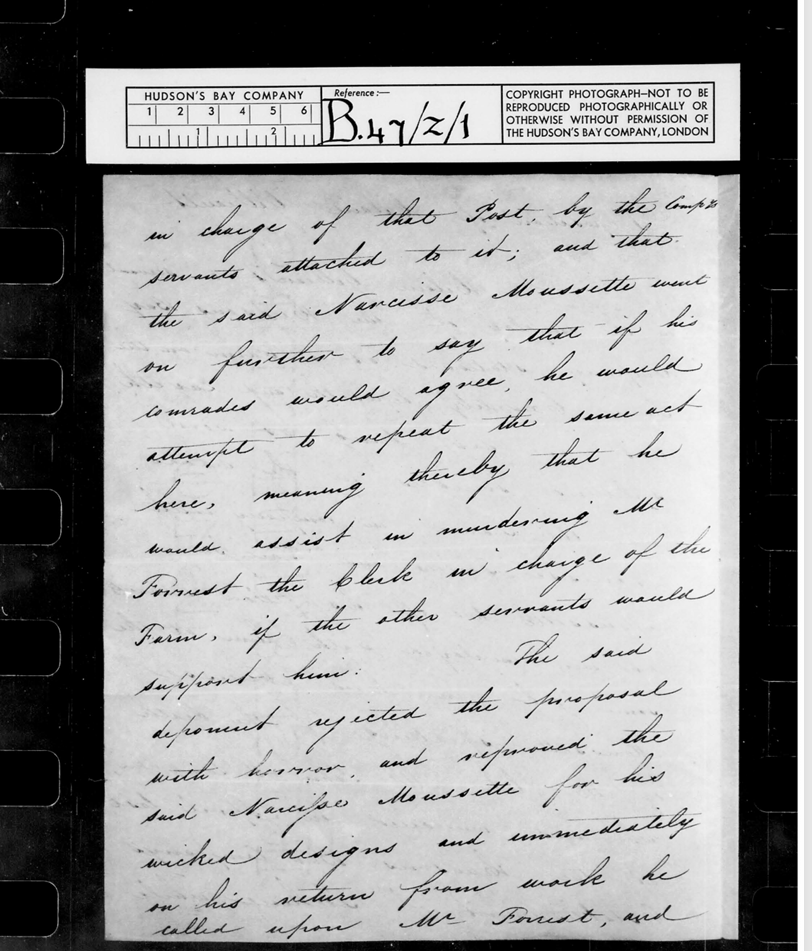

The three images show the complete deposition document. Page 1 opens with the deponent’s name, role, and location; recounts the shingle-splitting work party; and names both Narcisse Forcier and Narcisse Moussette. It describes Moussette raising the murder of John McLoughlin Jr. at Fort Stikine (April 1842) as a reference point and proposing to repeat the act at Cowlitz Farm against Charles Forrest. Page 2 completes Moussette’s proposal and records Hilaire’s response — rejection and immediate reporting. The closing page gives the date, location, and James Douglas’s signature, followed by his summary note confirming Narcisse Forceur’s corroborating deposition.
Taken at Cowelitz Farm 30 July 1842
Sworn before me — James Douglas
“Narcisse Forceurs deposition states to the same effect, as the preceding made by Hilaire Gilbeault. Taken at Cowelitz Farm 30th July 1842. Sworn before me — James Douglas”
Four analytical points. (1) The deposition places Hilaire at Cowlitz Farm as an active HBC servant on July 30, 1842 — three months after his April 1842 marriage to Louise Walla Walla. He was a married man, a new stepfather, still in company service. (2) Moussette’s reference to the McLoughlin Jr. murder at Fort Stikine confirms the depositions were taken in an atmosphere of genuine institutional concern — this was not a routine disciplinary matter. (3) Hilaire’s conduct is documented: he refused, reproved Moussette, and reported immediately. The deposition was sworn — he gave this account under oath. (4) Narcisse Forcier’s corroborating deposition, taken the same day, establishes independent confirmation of Hilaire’s account. Where Hilaire went in Oregon records after 1843, Forcier appears nearby.


Harriet Duncan Munnick’s biographical annotation A-34 appears on the same page as the annotation for Paul Guilbault (I), reflecting their linked community presence in the registers. The Hilaire entry states: “Hilaire Guilbault was a middleman in the employ of the Hudson’s Bay Company, and was one of those who saved himself in the bateau disaster at the Dalles des Morts with the brigade bringing Fathers Blanchet and Demers to the West in 1838. From 1847 to 1848 he was a laborer at the Cowlitz Farm belonging to the Company. Roberts, manager of the Farm, noted in his journal of September 6, 1847, ‘Carrier pulling down and carters removing Guilbeaus old house to below the hill where it is to be set up again to answer for a stable this winter.’ Guilbault married Louise Walla Walla in 1842, at which time four children of the bride only, names not given, were recorded and adopted by the groom. He died June 26, 1849, at St. Paul.”
Event: Dalles des Morts bateau disaster, 1838 (secondary source claim)
Brigade purpose: bringing Fathers Blanchet and Demers west
Cowlitz Farm: laborer, 1847–1848
Roberts journal: September 6, 1847 — house removal named
Marriage: Louise Walla Walla, 1842; four children adopted, names not given
Death: June 26, 1849, St. Paul
The A-34 annotation is a compiled secondary source based on Munnick’s direct research in the original Vancouver registers and, for the Roberts journal entry, in external HBC farm records. The Dalles des Morts survival claim, the Roberts journal quotation, and the death date at St. Paul are all secondary-source assertions that require primary verification. The marriage details (M-2) and the adoption of four children are independently confirmable in the original register. The death date is confirmed in the Early Oregonians Database. The Roberts journal has not been consulted directly in this research.

M-2 records the marriage of Hilaire Guilbeau and Louise, Wallawalla by nation, aged about 30 years, on April 21, 1842, at Fort Vancouver (designated in the Early Oregonians Database as Vancouver County). At the same ceremony, Hilaire formally adopted four children of the bride. The register notes their names are not given. Witnesses: Jean Baptiste Lajoie and Alexandre Pambrun. Priest: Mod. Demers. The sait groom adopts as if they were his own 4 children belonging to the bride namely: [no childrens’ names given].
Bride: Louise, Wallawalla by nation, aged about 30 years
Date: April 21, 1842, Fort Vancouver
Witnesses: Jean Baptiste Lajoie and Alexandre Pambrun
Priest: Mod. Demers
Children adopted: four children of the bride — names not given in register
The names of Louise’s four children remain the most significant open gap in the Hilaire Guilbault record. The M-2 register explicitly notes the adoption without providing names. No subsequent baptism, burial, or marriage record in the St. Paul Mission registers has been identified that names any of the four children with a parental reference to Hilaire or Louise. The search for these children in all surviving Oregon Catholic and civil records is ongoing.


B-876 records: “This 29 January, 1843, we priest undersigned have baptized François, aged about…years, legitimate child of Paul Guilbeau and of Catherine, Walawala by nation. Godfather Hilaire Guilbeau: godmother Louise Walawala by nation, who have declared not knowing how to sign.” Priest: J.B.Z. Bolduc. This is the primary document that confirms the kinship bond between the two Guilbault cousins in the Oregon record.
The nine-month arc from M-2 to B-876 is the documentary heart of the Hilaire case study. April 1842: Hilaire marries Louise. Louise becomes stepmother to four unnamed children. July 1842: Hilaire gives his deposition before Douglas. January 1843: Hilaire stands godfather for Paul’s son; Louise stands godmother. The two cousins are bound by Catholic godparentage across both lines within nine months of Hilaire’s marriage. These are not casual neighbors — they are family who made themselves so deliberately, in a community three thousand miles from the Quebec parishes where their shared surname was first recorded.


The September 6, 1847 journal entry is now a primary source in hand, not a secondary citation. The full Monday entry for that date records: “Smoky still strong NW breeze — employed ploughing removing mill to white wheat shed — digging well (16 feet deep to night). Sent Laportre to Naw wa cum for bark. Carrier pulling down & carters removing Gilbeauts old house to below the hill where it is to be set up again to answer for a stable this winter. Boys carting manure. Engaged two heads of indian families. Sow a sow & Kawasi to look after the sheep for four months at the rate of 1½ Blkts pr month. Engaged 5 Indian women to work at the thrashing machine or elsewhere until strawberry season summer ‘48. The water in the Cowelitz exceedingly low. The indians at the weir take but very few salmon. Sal-lal ripe.”
Footnote 44 on the same page reads in full: “Hilard Gilbeault, middleman and farmer, 1847-48, Cowlitz Farm employee list, H.B.C. Arch. He was at the farm as early as 1842 (HBRS VI:66n).”
Service period cited: 1847–48 (consistent with Gauthier HBC 1838–1848)
Primary source cited: Cowlitz Farm employee list, H.B.C. Arch. (HBCA — not yet consulted directly)
1842 presence: “He was at the farm as early as 1842” — independent confirmation of B.47/z/1
Secondary citation for 1842: HBRS VI:66n (Hudson’s Bay Record Society Vol. VI, footnote 66 — not yet consulted)
Footnote 44 is the most significant new finding in this source. It confirms Hilaire's 1842 Cowlitz Farm presence through a citation chain entirely independent of B.47/z/1: the Cowlitz Farm employee list (H.B.C. Arch.) and HBRS VI:66n. If either of those sources can be located, they would establish Hilaire's Cowlitz service in a second primary record independent of the deposition. The employee list in particular — as an HBC administrative document rather than a legal proceeding — might also provide his contract terms, wages, or post assignments that the Name File search has not yet returned. Jean Baptiste Lapoitre (footnote 42 on the same page) appears in the same employee list for 1847–49, confirming the Roberts footnotes draw on a genuine administrative record. The map establishes the scale of the operation Hilaire worked within: 29 fields totaling more than 1,800 acres under cultivation, with permanent residential structures, a barn, and a working farm community on the Cowlitz River.


The Early Oregonians Database confirms Hilaire’s Oregon civil record across three event types: marriage (April 21, 1842, Vancouver County); land grant (March 8, 1847, Lewis County, Vol. 4, Pg. 205, Provisional); death (June 24/26, 1849, St. Paul, Marion County). Sources cited: Vancouver I; St Paul II 21-S11; findagrave. The double death date (June 24 and June 26 both appear) reflects the difference between date of death and date of burial or recording. The Munnick annotation gives June 26, 1849.
Findagrave Memorial #71847028 documents François Gilbeau: born 1847, died November 8, 1851, aged 3–4, buried Old Saint Paul Roman Catholic Mission Cemetery, St Paul, Marion County, Oregon. Plot: Plaque Only. Inscription: “Francois Gilbeau, 4 yr., Nov. 8.” This is Hilaire and Louise’s son, born in Oregon, died in Oregon, buried in the same cemetery as his father two years after Hilaire’s death.
The community plaque at the Saint Paul Roman Catholic Mission Cemetery is itself a significant historical document. It records dozens of French Prairie settlers from the fur trade era — in the single photograph available, names visible alongside François Gilbeau include Achange Pruneau, Marguerite Pot, Joseph Looney, Caroline Mousheau Labonte, Jean Chalifoux, André Chalifoux (the Dalles des Morts steersman), and others from the same world Hilaire inhabited. Hilaire's son is buried in the same community where the survivors of the 1838 disaster eventually settled — the cemetery records the end of the same story the bateau disaster began.
Source Inventory
All sources cited in this case study, organized by archive and record type, with current research status
Baptism, 1818
Entry #53
Family #116841
Entry #56
Hilaire Guilbault
30 Jul 1842
Servant contracts
Name File
Hilaire Guilbault
21 Apr 1842
29 Jan 1843
Hilaire Guilbeau
#71847028
François Gilbeau
Monday, Sep 6, 1847
p. 118 / fn. 44
Cowlitz Farm
Roberts Journal
HBCA Name File
B-series records
Hudson’s Bay
Record Society
four children
Names unknown
Burial record
St. Paul Mission
This methodology page accompanies the case study summary for Hilaire Guilbault, “The Survivor.” The case study presents the findings; this page documents every primary source that establishes them, and every open question the record cannot yet answer. The Catholic Church Records of the Pacific Northwest, Vancouver Vol. I, consulted in parallel research on the Laurent Quintal, Marie Anne Nipissing, and Paul “The Canadian” case studies, are the archive that placed Hilaire at French Prairie from 1842 to his death in 1849.
← Return to Case Study The Canadian: Paul Guilbault → The Invisible Voyageur: Paul Guilbault père → From Oka to Oregon → French-Canadian & Métis Research