
The Brother Who Also Vanished
The Brother Who Also Vanished
A son disappears from a Perthshire family in 1861. He surfaces again only because, nine years later, a marriage register paused to name his parents.
Every large family seems to have one. The child whose name is written carefully into the baptismal register, who appears as a boy in a census or two, and who then — somewhere between one decade’s enumeration and the next — simply stops being written down. In the family of George Robertson, mason of Blairgowrie, and his wife Margaret Paterson, there were two such children. One was David, the stonecutter whose Brooklyn-and-back journey is told elsewhere in these pages. The other was his older brother James.
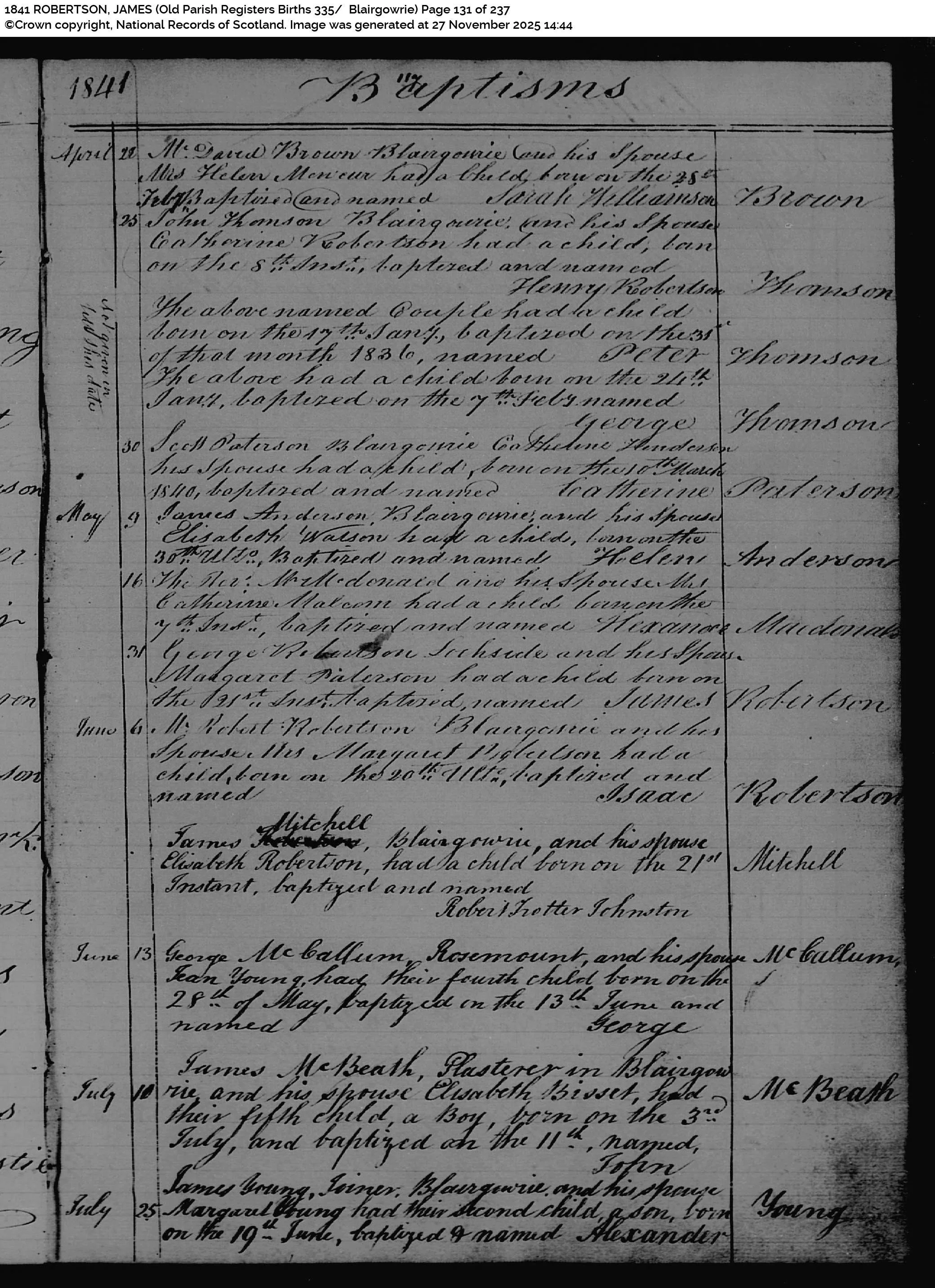
James Penmuire Paterson Robertson was baptized on the last day of May in 1841, when he was ten days old. The parish clerk recorded the essentials in his small, even hand: George Robertson of Lochside, his spouse Margaret Paterson, a child born on the twenty-first, named James. The elaborate middle names — Penmuire, Paterson — were the family’s own; the register kept only the plain one.
He was nine years old in the census of 1851, still under his parents’ roof at the Tannage in Blairgowrie, listed as a scholar. And then, in the census of 1861, when the enumerator came to George Robertson’s household and wrote down the children present, James was not among them. He was twenty. He had gone.
The silence
Where a young man goes when the records stop
For a long time that was the end of him. A young man named James Robertson — the most common given name attached to one of Scotland’s most common surnames — who left no forwarding address. To search for him directly is to drown: there are James Robertsons in every parish, every shipping list, every city directory on two continents. A name like that is not a thread to follow. It is a haystack.
What breaks a silence like this is rarely a record about the missing man. It is a record about someone standing next to him — and, in this case, a peculiarity of Scottish law. When Scotland began civil registration in 1855, it required something the English and American certificates of the era did not: that a marriage entry name the parents of both the bride and the groom, the mother by her maiden surname. A Scottish marriage record does not merely record a wedding. It reaches back a generation.
So when a James Robertson married a young woman named Mary Kennett at St Giles in Edinburgh on the twenty-sixth of September, 1870, the register did what registers in other countries would not. It named his father.
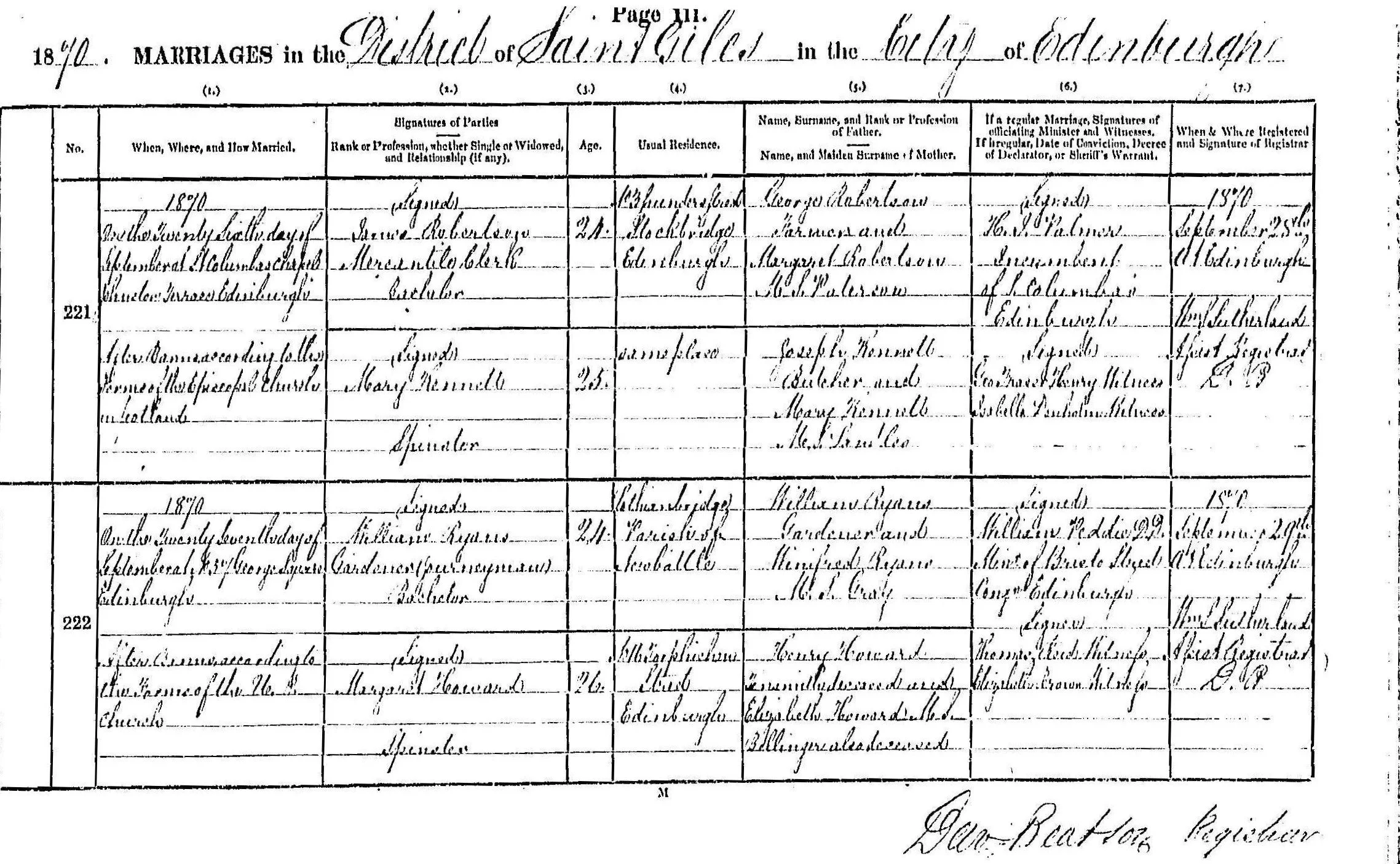
George Robertson, farmer. Margaret Robertson, maiden surname Paterson. The same two people who had carried a ten-day-old boy to the font in Blairgowrie twenty-nine years before. The mercantile clerk marrying Mary Kennett was not just a James Robertson. He was the James Robertson — George and Margaret’s vanished son, alive and twenty-nine and starting a family of his own.
The gamekeeper of Liverpool
A trade, a second city, and a wife who would not live long
From Edinburgh the trail runs south, across the border into England, and settles in Liverpool — where James turns up not as a clerk but as a gamekeeper, and later a herbalist. It is a striking change of trade, and it becomes, oddly, one of the surest ways to follow him. A man can share a name with a thousand strangers; he is far less likely to share a name and a profession across record after record. From the 1870s onward, wherever the documents place a James Robertson keeping game in and around Liverpool, the same man is almost certainly present.
In the autumn of 1875, James and Mary had twin daughters, Rose Anne and Mary Jane, baptized together at St Silas. The register gives the father’s trade plainly: game keeper, of 59 Gill Street. The little family was complete, and then it was not. Mary Kennett does not appear for long afterward. By the middle of the next decade, James was a widower.
We know this because of how he is described when he married again. On a December day in 1886, at the Liverpool parish church, James Penmuire Patterson Robertson — all four names set down in full, the only document in his life ever to record them so — married Martha Williamson Bates. Both were widowed. The register names his father once more: George Robertson. Three decades, three records, one father’s name holding them together like a knot.
What became of the twins is its own quiet proof. In the census of 1891, in a household at Brighton on the south coast, an elderly widow named Mary Kennett — born in Liverpool, keeping house as a cook — has her granddaughter living with her: Mary J. Robertson, also Liverpool-born, in service. The grandmother is the first wife’s mother; the granddaughter is one of the 1875 twins. Even after Mary Kennett’s death, her own mother kept one of her girls. Families leave these fingerprints without meaning to.
A second family, and a trap of names
Seven more children, and three boys who were nearly impossible to tell apart
With Martha, James began again. Through the 1890s the baptisms come in a steady file through the parishes of Liverpool and West Derby: James Panmuir the younger, Janet Downey, Mary Clementine, Frances Ann, and a cluster of sons whose names would later cause more trouble than any other part of the research.
For James and Martha did a thing that Victorian families did often, and that drives their descendants to distraction: they reused a cherished name after a child died. A son baptized Charles Augustus Roper in 1896 did not survive infancy; he was gone by 1898. An earlier boy, John Robert Duncan, born in 1894, had already died in 1897. And then, in January 1899, another son arrived and was given a name that gathered up the lost ones — Charles John Augustus Roper Derby Robertson. Three boys, names overlapping like roof tiles. Only the cold arithmetic of birth, baptism, and death registers tells them apart: two died small, and one lived.
The one who lived is the one who traveled farthest. Charles John Augustus Roper Derby Robertson grew up, shortened himself to plain John Charles Robertson, crossed the Atlantic, and in 1930 married Helen Pape in New York City. His marriage certificate, like his Canadian siblings’ records, names both his parents — James and Martha Williamson — the detail that finally locks the New York emigrant back onto the Liverpool gamekeeper. It is worth pausing on that. The English registers, for all their number, gave only the father’s name, and only “George.” It was the records made abroad — in Ontario, in New York — that named both parents and sealed the family together. The children who left England documented their father more fully than England ever had.
The children scatter
Toronto, Richmond Hill, New York
They went, as the children of that generation went, outward. James Panmuir the younger became a street-railway conductor in Toronto and married there in 1910. Frances Ann married a man named Harry Artt at Richmond Hill, Ontario, in 1922 — and on her marriage record, asked her father’s birthplace, she answered Scotland, a daughter half a world away still correctly placing her father at Blairgowrie against the census that once miscalled him Canadian. John Charles, as we have seen, settled in New York. From a mason’s cottage at Lochside, within two generations, the family had reached Toronto and Manhattan.
James himself did not follow them across the water. There is a temptation to send him there — a census once recorded him, wrongly, as “born Canada,” and an ocean away in Brooklyn a man named James P. Robertson died in 1906 and was buried at the Evergreens. It would be tidy to make that man our James, come to America at last to be near his children. But he is not. The Brooklyn man was a watchman, not a gamekeeper; his death certificate leaves his father’s name blank; the newspapers could not even agree on his age, calling him forty-five in one column and sixty in another. He shares the name and nothing else. To claim him would be to graft a stranger onto the family — the very error this whole search was built to avoid.
Where James died, and exactly when, remains the one loose thread. His daughter Rose Anne’s 1900 marriage calls him “deceased” — yet a James Robertson, gamekeeper, still seems to stand in the 1901 census, and is gone by 1911. The likeliest reading is that he died somewhere in that decade, and that the word “deceased” on a daughter’s wedding record ran a year or two ahead of the fact. The certificate that would settle it has not yet surfaced. Some stones stay scattered a while longer.
What the search was really about
Why a common name is the hardest kind to keep honest
The quiet lesson of James Penmuire Paterson Robertson is not about him at all. It is about how easily a family tree goes wrong, and how the same tools that recover a lost son can, used carelessly, invent a false one. A common name is an open door: it lets the wrong records wander in — the Brooklyn watchman, an unrelated gamekeeper, a half-remembered “born Canada” — and it shuts the right ones out behind a thousand identical entries.
What kept this search honest was a discipline of reading records not for the surname they share but for the parents they name and the trade they record. George Robertson and Margaret Paterson, written down at a font in 1841 and again at a marriage in 1870 and once more in 1886. The word gamekeeper, carried from a twins’ baptism through a police-court squabble over an Irish setter to a census and two daughters’ weddings. Those were the threads worth pulling. Everything else was haystack.
George and Margaret raised ten children in Blairgowrie and watched the world take them — to Brooklyn, to Liverpool, to Canada, to graves near and far. Two of those children vanished from the record entirely, and both, in the end, were found. David’s story is told in Episode 6. This was the story of his brother.
James Penmuire Paterson Robertson (1841 – c.1901–1911) was the second child of George Robertson and Margaret Paterson, whose Blairgowrie household is the subject of Scattered Stones, Episode 2. His identity — one man told apart from two others sharing his name — was established entirely from documentary evidence, with DNA confirmation to follow.
The forensic proof behind this narrative, including every source, transcription, and the resolution of the conflicting records, is set out in the case study and its methodology.
Are You Connected to the Robertson Line?
If you descend from the Robertson family of Blairgowrie, Bendochy, or Rattray in Perthshire — from George Robertson and Margaret Paterson or any of their ten children, the Brooklyn stone cutter David Paterson Robertson, or the connected Paterson, Craig, Anderson, McNab, McIntyre, Ferguson, Nisbet, or Lockhart lines — in Scotland, Brooklyn, New Jersey, or Liverpool, I’d like to compare notes. Documented Scottish trees, DNA matches, family papers, and even half-remembered stories have all moved this research forward.
Get in Touch About This FamilyCousin connections are informal and reciprocal — no fee, no obligation, just shared work on shared ancestry.
Every Family Has a Story Worth Telling
Whether you're just beginning your research or ready to transform years of work into a narrative your family will treasure, I'd love to help.
BEGIN YOUR RESEARCH INQUIRY