
One Name, Three Men — The Evidence in Full
The document-by-document proof behind the disambiguation of James Penmuire Paterson Robertson
The companion case study, One Name, Three Men, presents the conclusion: that the James Penmuire Paterson Robertson baptized at Blairgowrie in 1841 is the same man who married Mary Kennett in Edinburgh, worked as a gamekeeper in Liverpool, remarried there in 1886, and fathered children who settled in Canada and New York — and that he is not the James P. Robertson who died a watchman in Brooklyn in 1906.
This page shows the work. The proof rests on no single document but on five distinct evidentiary devices, each anchored to primary record, converging on one identity. None depends on DNA: the paper establishes the conclusion, and a separate DNA analysis will confirm it. What follows treats each device in turn — the records, their transcriptions, and the reasoning that binds or excludes.
A note on method. Disambiguation differs from ordinary lineage research in one respect: proving who a person is not carries as much weight as proving who they are. A common surname — and Robertson is among Scotland’s most common, James its most common given name — invites wrong records in and keeps right ones out. The discipline throughout is to read records for the parents they name and the trade they record, not the surname they share.
The father named across three decades and two continents
Scotland’s statutory marriage records carry what parish registers and censuses rarely do: the names of both parties’ parents, including the mother’s maiden surname. This single feature is what makes the case provable. A baptism names a child’s parents; a marriage decades later, naming the same parents, links the adult to the child beyond reasonable doubt.
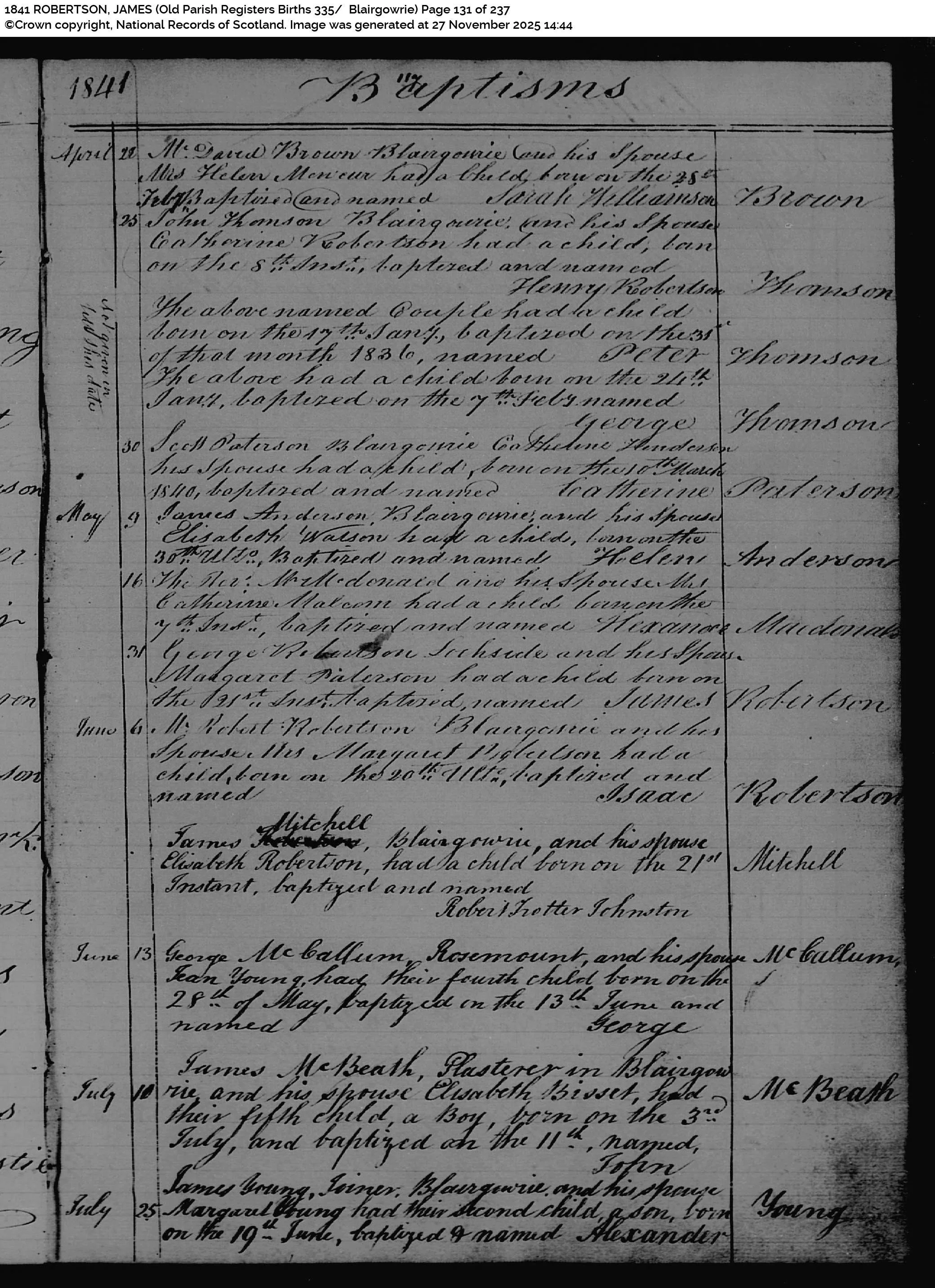
James Penmuire Paterson Robertson was baptized 31 May 1841 at Lochside, Blairgowrie, “born the 21st instant,” son of George Robertson and Margaret Paterson. Confirmed The distinctive triple given name recurs on later records and is itself a tracking feature, but it is the parents who carry the proof.
On 26 September 1870, at St Giles, Edinburgh, James Robertson, mercantile clerk, aged 24, married Mary Kennett. The register names his father George Robertson, farmer, and his mother Margaret Robertson, maiden surname Paterson — the identical pair from the 1841 baptism. Confirmed
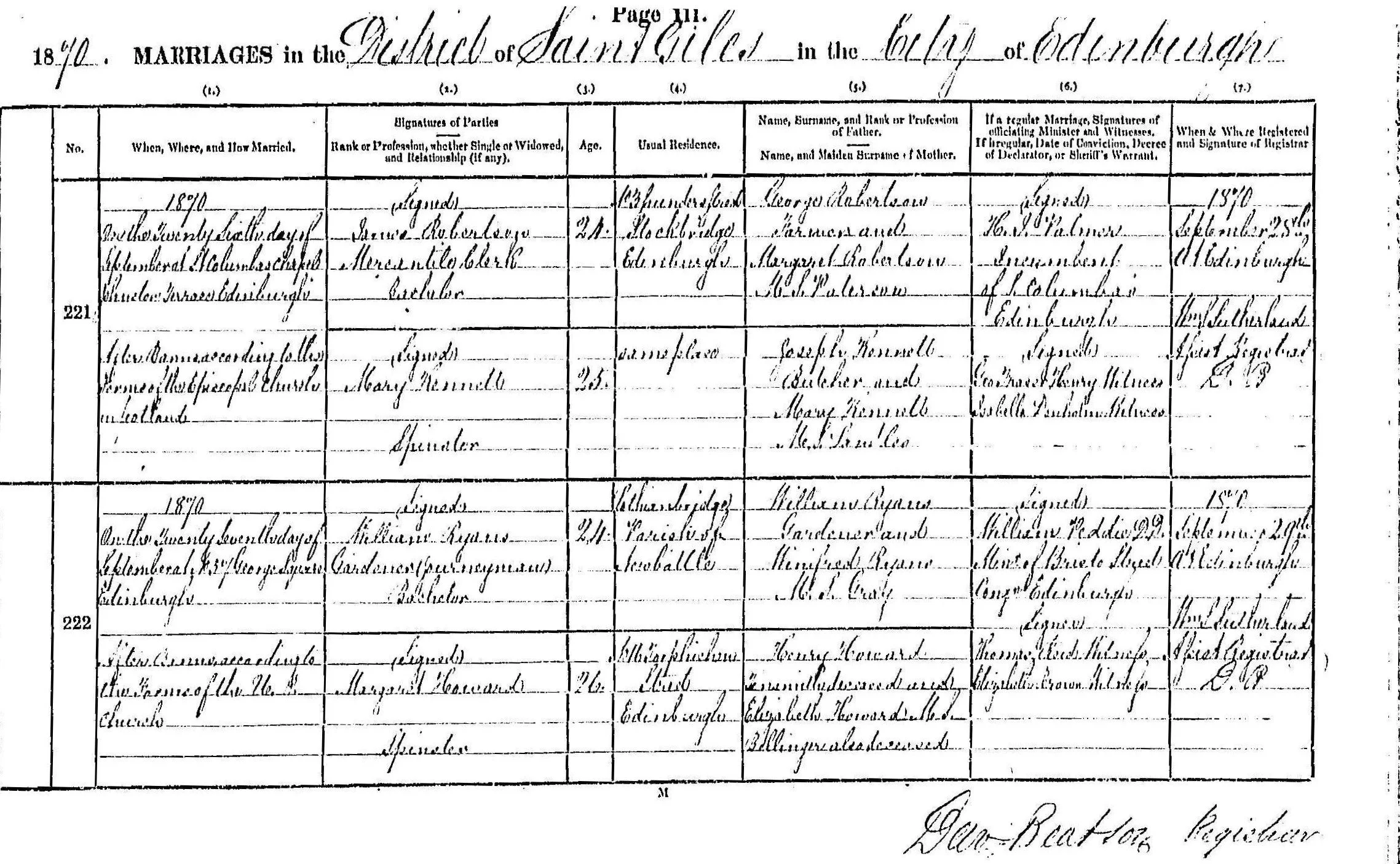
One occupational note bears comment: George is here a “farmer,” though Blairgowrie records elsewhere style him mason, quarrier, or labourer. Such variance across decades and informants is ordinary; it is the names, not the trade label, that carry the identification. (This recurs at the 1886 marriage, where George is elevated to “Gentleman” — addressed in the Conflict Resolution below.)
The father’s name recurs across the subject’s own marriages and his children’s — and the overseas marriages supply the mother’s name where England gave only the father. No coincidence assembles this table.
| Record | Year · Place | Father named | Mother named |
|---|---|---|---|
| Baptism of subject | 1841 · Blairgowrie | George Robertson | Margaret Paterson |
| Subject’s 1st marriage | 1870 · Edinburgh | George Robertson, farmer | Margaret, m.s. Paterson |
| Subject’s 2nd marriage | 1886 · Liverpool | George Robertson, “Gentleman” | — |
| Son James Jr.’s marriage | 1910 · Ontario | James Penmuir Robertson | Martha Williamson |
| Daughter Frances’s marriage | 1922 · Ontario | James Robertson | Martha Williamson |
| Son John Charles’s marriage | 1930 · New York | James Robertson | Martha Williamson |
The man who married Mary Kennett in 1870 is, by his parents’ names, the son baptized at Blairgowrie in 1841. The overseas marriages of his children then name both parents together — James Robertson and Martha Williamson — binding the second family to the same man. England recorded only “George”; the transatlantic records proved more genealogically generous.
The occupational fingerprint — one trade that binds and excludes
Where the father’s name proves the subject is George’s son, occupation proves that the Liverpool gamekeeper and the Edinburgh groom are one man — and, in the same stroke, helps rule out the Brooklyn watchman. A single thread doing double duty is unusual and worth isolating.
| Record | Year | Occupation recorded |
|---|---|---|
| Twins’ baptism, St Silas Liverpool | 1875 | Father a Game Keeper |
| 2nd marriage, Liverpool | 1886 | Herbalist / gamekeeper |
| Liverpool Police Court report | 1888 | Gamekeeper (Irish setter dispute) |
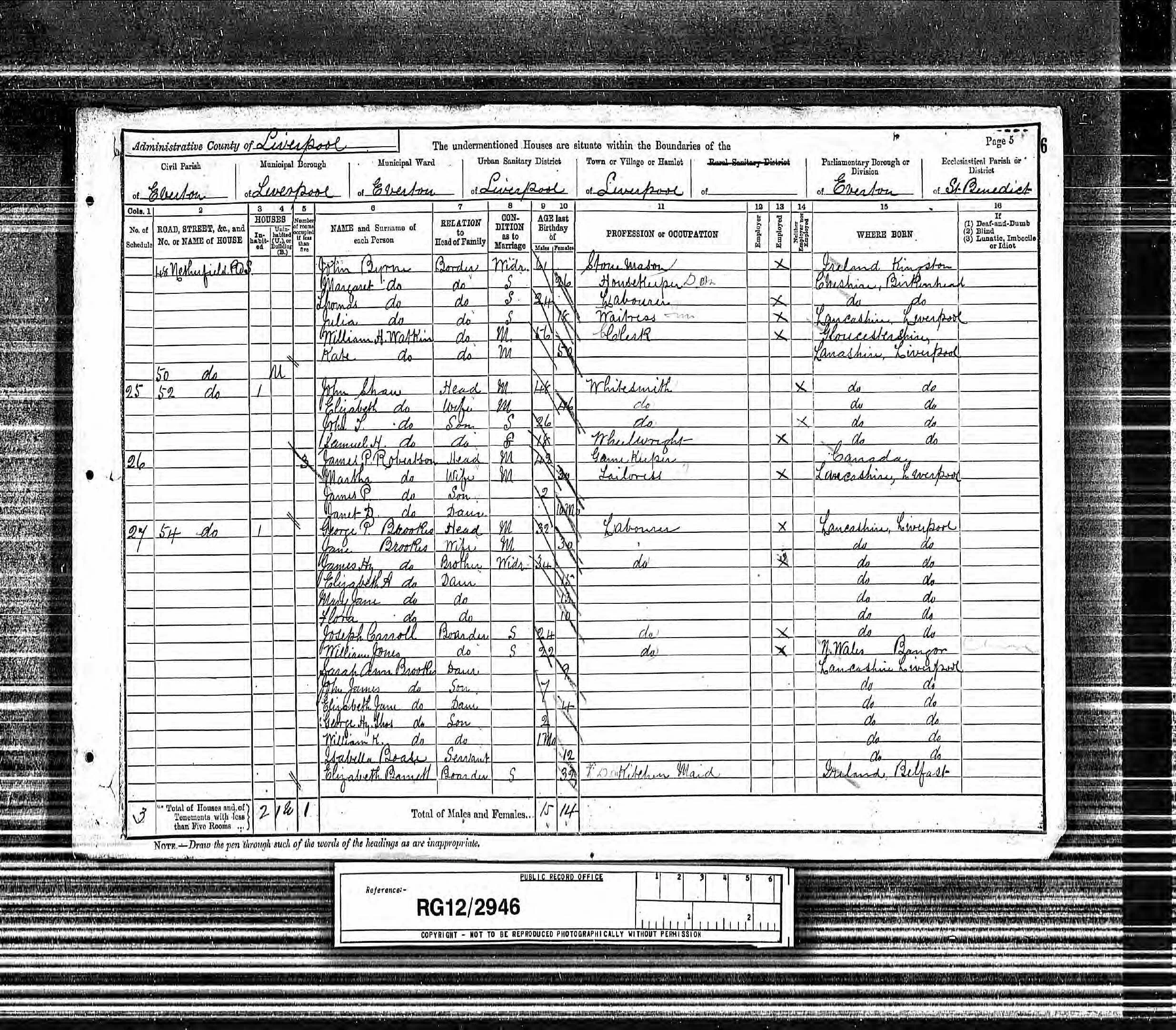
| Census, Everton | 1891 | Game Keeper |
| Children’s baptisms, West Derby | 1889–1901 | Gamekeeper / Sportsman |
| Daughters’ marriage records | 1900, 1922 | Father a gamekeeper |
The 1888 police-court item is a small but telling corroborator: a James Panmuir Robertson, gamekeeper, of Canterbury Street, pursuing a dispute over an Irish setter valued at £25 — the distinctive given name and the gamekeeping trade together, in a third independent record type.
Occupation links the two marriages to one man; a census links that man’s first wife to his Liverpool children. In 1891 at Brighton, Mary Kennett — widow, born Liverpool — keeps house with her granddaughter Mary J. Robertson, also born Liverpool: one of the 1875 twins, living with her grandmother. Confirmed
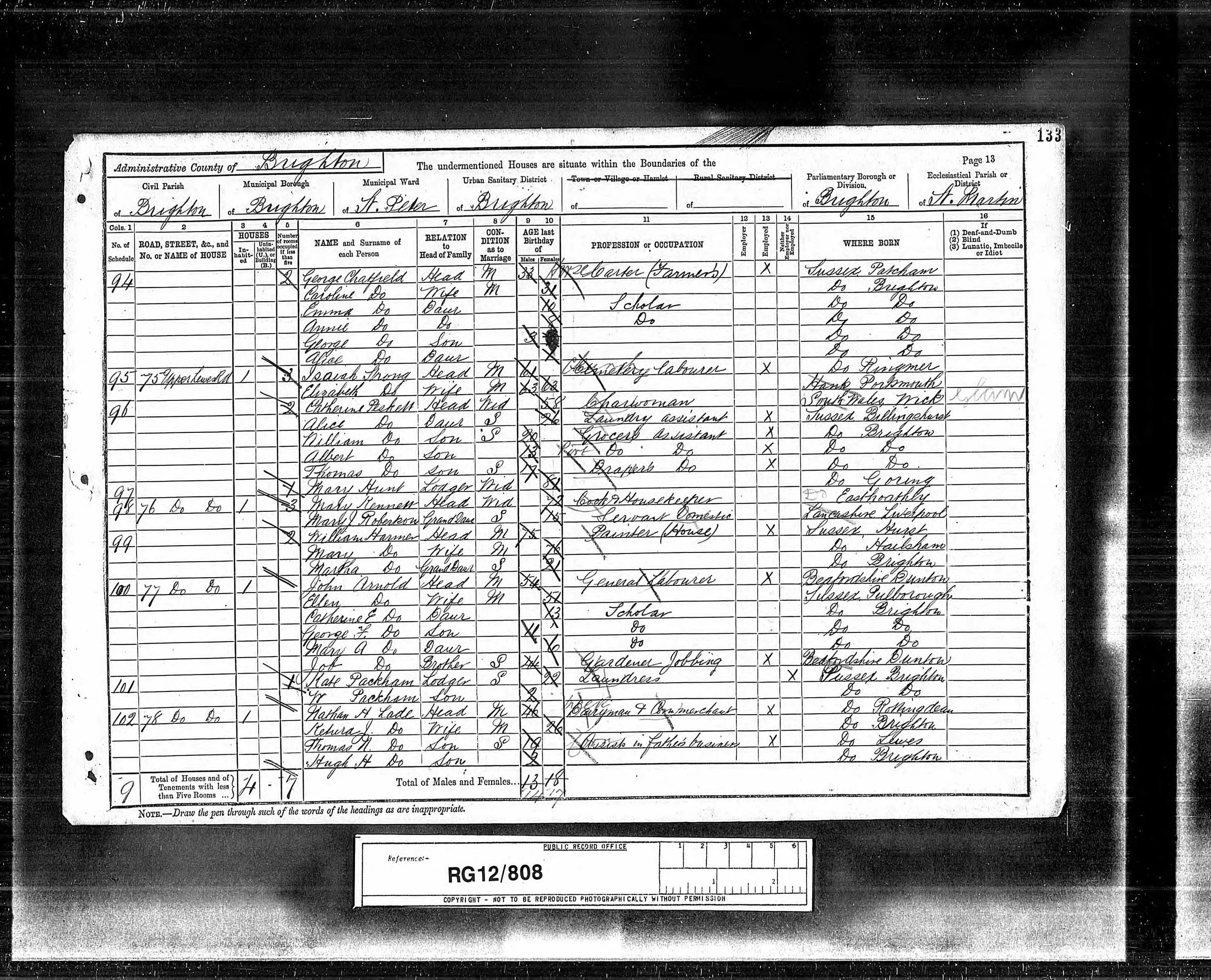
The continuous gamekeeper/herbalist trade ties the Edinburgh groom, the Liverpool householder, and the father in both daughters’ marriages into one working life — and stands in pointed contrast to the watchman of Device 5. The Brighton census independently welds Mary Kennett to the Liverpool children, closing the loop between marriage and family.
Three sons, nearly the same name — resolved by vital-record arithmetic
The second family produced a disambiguation problem of its own, internal to the household: three boys whose names overlap so heavily that online trees routinely merge them into one or two people. Birth registrations, baptisms, and death indexes pull them cleanly apart. Two died in infancy; one survived to cross the Atlantic.
| Child | Born | Baptized | Outcome |
|---|---|---|---|
| John Robert Duncan Robertson | 1894 | 1896, Liverpool | Died 1897 — infant |
| Charles Augustus Roper Robertson | 1896 | 1896, St Barnabas Rock Ferry | Died 1898 — infant |
| Charles John Augustus Roper Derby Robertson | 20 Jan 1899 | 1901, St James West Derby | Survived — “John C.” of New York |
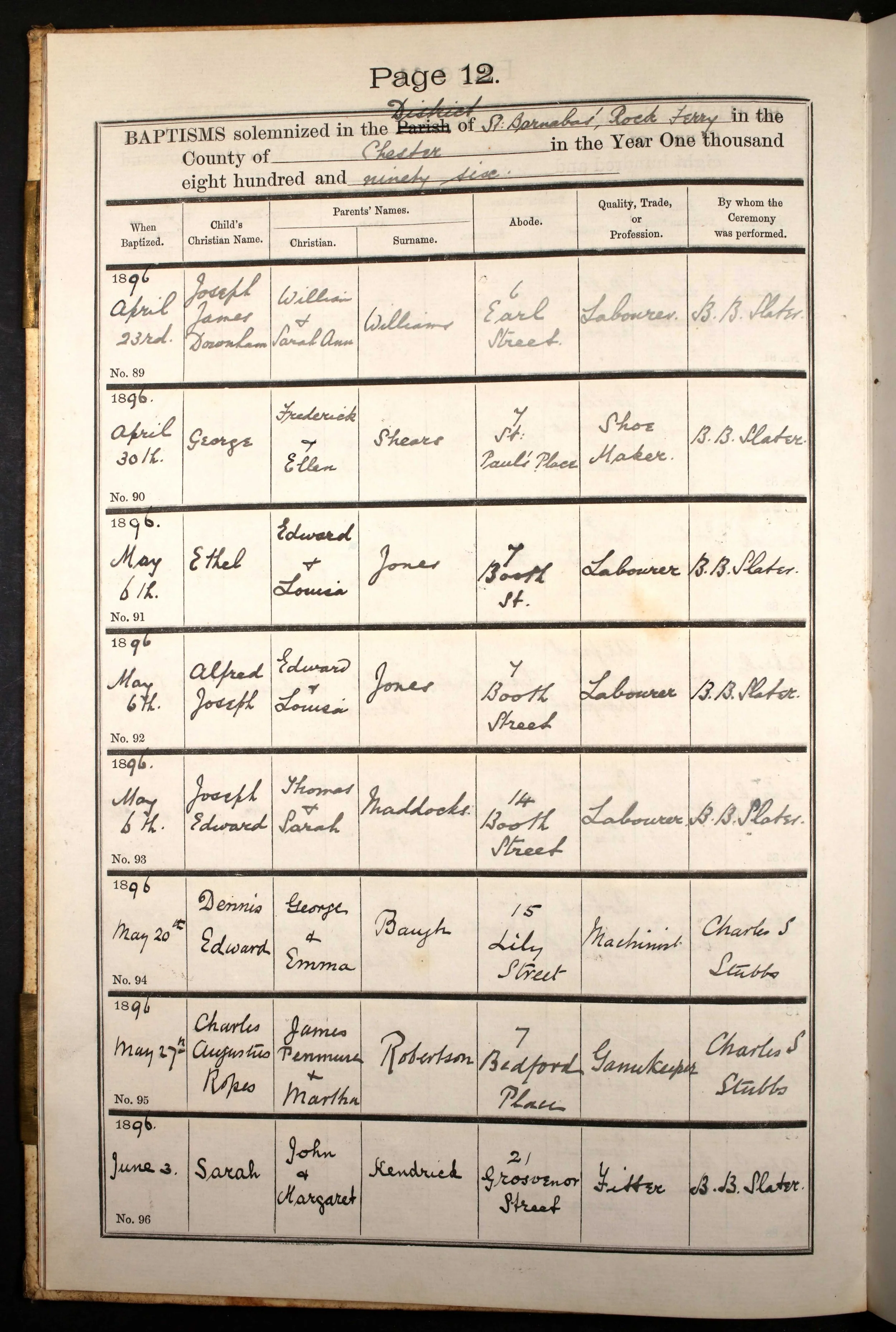
Charles Augustus Roper Robertson was baptized 27 May 1896 at St Barnabas, Rock Ferry — father James Penmuir, gamekeeper — and his death was registered in 1898. The earlier John Robert Duncan Robertson, born 1894, appears in the 1897 GRO death index. Both were infants; neither survived to be the man later found in New York.
The survivor was baptized 22 September 1901 at St James, West Derby, as Charles John Augustus Roper Derby Robertson, born 20 January 1899 — father James Penmuir Robertson. Confirmed He is the John Charles Robertson who emigrated to New York and married Helen Pape in 1930; his 1942 U.S. draft registration gives birth 12 January 1899, England, and his widow’s 1987 obituary names her late husband John.
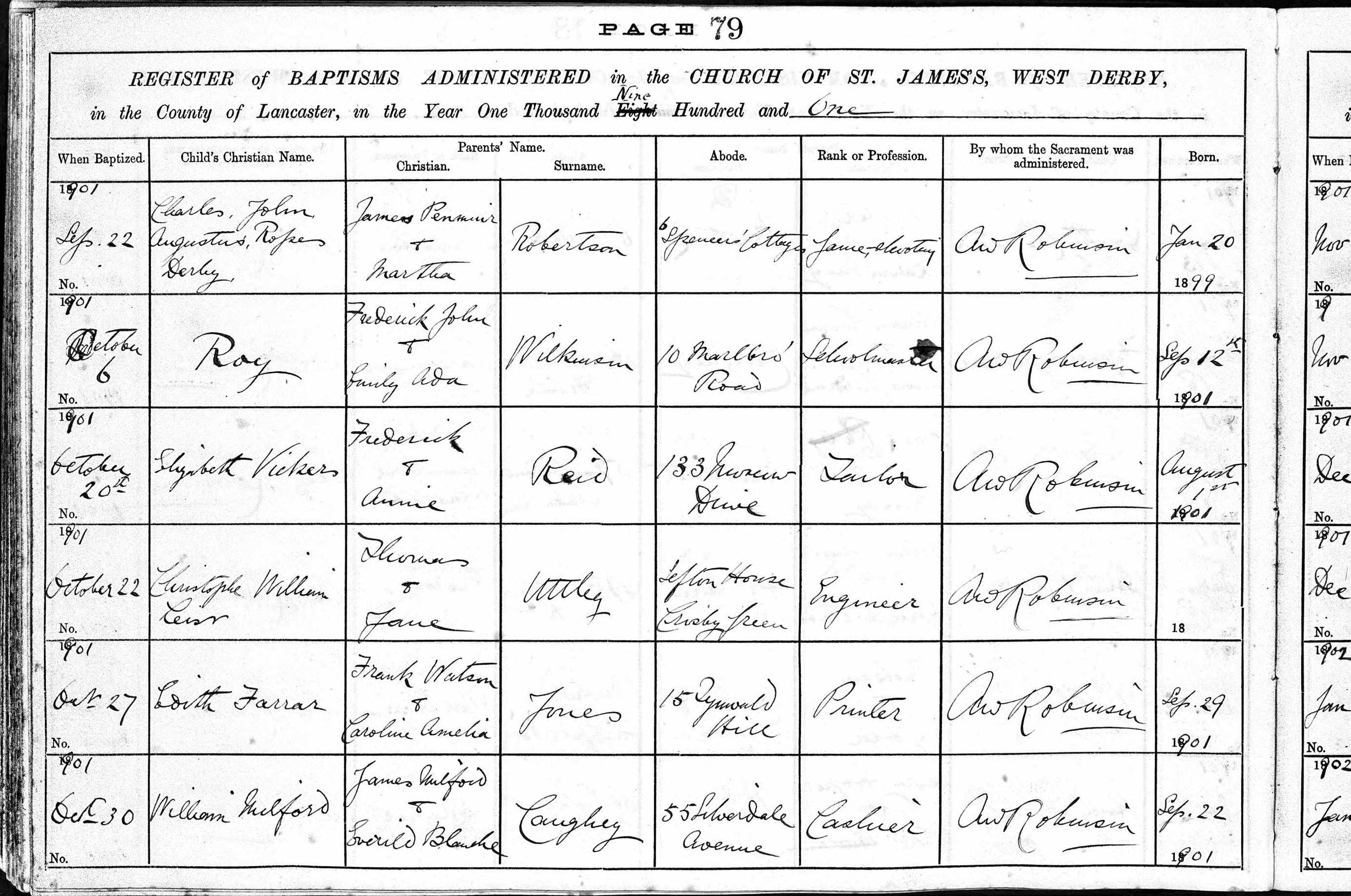
Three distinct children, separated by birth, baptism, and death records: two infants who died (1897, 1898) and one survivor (b. 1899) who became John Charles Robertson of New York. Conflating them — the default error in unsourced trees — would graft a dead child onto a living line or invent a survivor who never was. The arithmetic of vital records is the resolution.
A death bracketed on three sides
A sound proof names what it cannot yet close. The subject’s death resists a single date because three records pull against one another — a genuine conflict, presented here in full rather than smoothed away.
1900 — Daughter Rose Anne’s marriage at St Marylebone names her father “James Robertson, gamekeeper, deceased.”
1901 — A James P. Robertson, gamekeeper, nonetheless appears on the English census.
1911 — He is absent from the census entirely.
One: the death fell 1901–1911, and the 1900 “deceased” was premature, mistaken, or a convention sometimes used when a parent was absent or estranged. Two: the 1901 census man is a different James Robertson, gamekeeper, and the subject did die before 1900. Three: a clerical error in one of the three records.
The reading most consistent with the weight of evidence is the first: a death between 1901 and 1911. The 1901 census man matches on trade and given name, and a wholly separate gamekeeper named James Robertson in the same locale would itself be a coincidence requiring proof. The “deceased” notation on a marriage record — supplied by the bride, not the father — is the more fallible source. Open
Not a closed date, but a disciplined position: the subject most probably died 1901–1911. Naming the conflict openly — and declining to force it shut — is itself part of meeting the proof standard. The death certificate, once located, will resolve it.
The negative-evidence engine — the watchman excluded
Disambiguation is as much elimination as identification, and a correct exclusion protects a family tree as surely as a correct identification builds one. The most tempting wrong turn in this case is the James P. Robertson who died in Brooklyn in 1906 — same surname, same era, an ocean where the subject’s own children had settled. Read field by field, he connects to nothing.
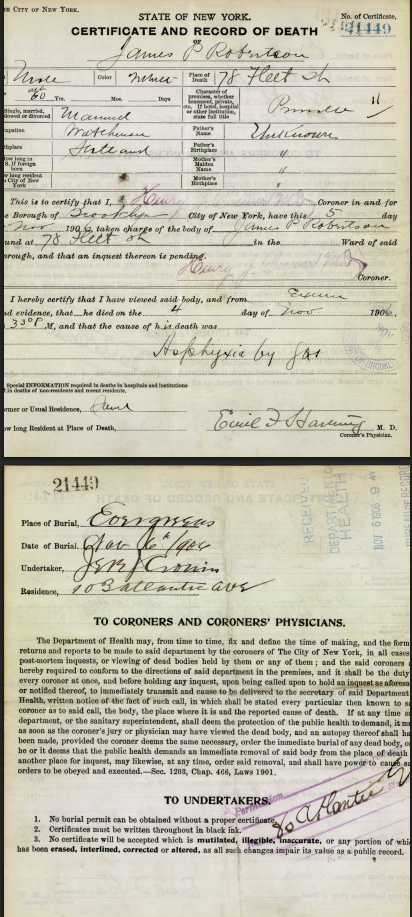
- Father’s name left blank — no possible link to George Robertson
- Age recorded inconsistently across sources (one 45, another 60)
- Trade “watchman” — unconnected to the subject’s lifelong gamekeeping
- No documented tie to Scotland, Liverpool, or the subject’s family
None of the four identifying axes — parentage, age, trade, geography — connects this man to the Blairgowrie line. The temptation to claim him rests entirely on the shared surname James Robertson, the very coincidence this whole methodology is built to resist.
The 1906 Brooklyn watchman is a different man. Excluding him is not a gap in the proof but a component of it: in a disambiguation case, the candidates ruled out are as load-bearing as the records ruled in.
Source Inventory
Conflict Resolution & Open Questions
Where the records disagree — and what remains to be found
The 1891 census records the subject as born in Canada, contradicting the 1841 Blairgowrie baptism. The baptism is the original, contemporaneous record and governs. “Canada” reflects either an enumerator’s error or a later self-report shaped by family time spent there — consistent with a Scotland-born man whose children later settled in Ontario, not evidence of a Canadian birth. Resolved
George Robertson appears as mason, quarrier, and labourer in Blairgowrie; “farmer” on the 1870 marriage; and “Gentleman” on the 1886 marriage. This is ordinary informant variance — the 1886 “Gentleman” an aspirational flourish on a marriage record — and does not unseat the consistent names George Robertson and Margaret Paterson, which carry the identification across every record. Resolved
Charles Augustus Roper (b. 1896, d. 1898), John Robert Duncan (b. 1894, d. 1897), and Charles John Augustus Roper Derby (b. 1899, survived) are three distinct children, told apart by vital records as set out in Device 3. Resolved
As set out in Device 4, the death is bracketed by the 1900 “deceased” notation, an apparent 1901 census presence, and 1911 absence. The working position is a death in 1901–1911; the death certificate, once located, will settle it. Open
Two of the subject’s children, James Jr. and Frances Ann, are documented in Ontario, and the 1891 census labels him “born Canada.” Whether the subject himself ever resided in Canada — as opposed to his children emigrating there — is not established by any located record. The case claims only what the documents support: the children settled in Canada; the father’s own Canadian residence remains unproven. Open
DNA matches descend from both the first-marriage (Liverpool) and second-marriage (Canadian and New York) lines. Because the matches currently sit on three different testing platforms, cross-line triangulation awaits shared-segment data; a separate DNA analysis will present it as the confirming capstone to the documentary proof established here.
The proof, in one sentence
A marriage register that names the parents, a census that seats a granddaughter beside her grandmother, a trade carried unbroken through six records, the vital-record arithmetic that separates three same-named sons, and the disciplined exclusion of a man who shared only a surname — five independent devices, converging on one identity, none of them DNA.
The documentary case is complete and stands on its own. DNA evidence across the descendant lines will, in a companion analysis, confirm what the paper already establishes.
← Back to the Case Study ← Read the Story — The Brother Who Also Vanished