
One Name, Three Men
James Penmuire Paterson Robertson
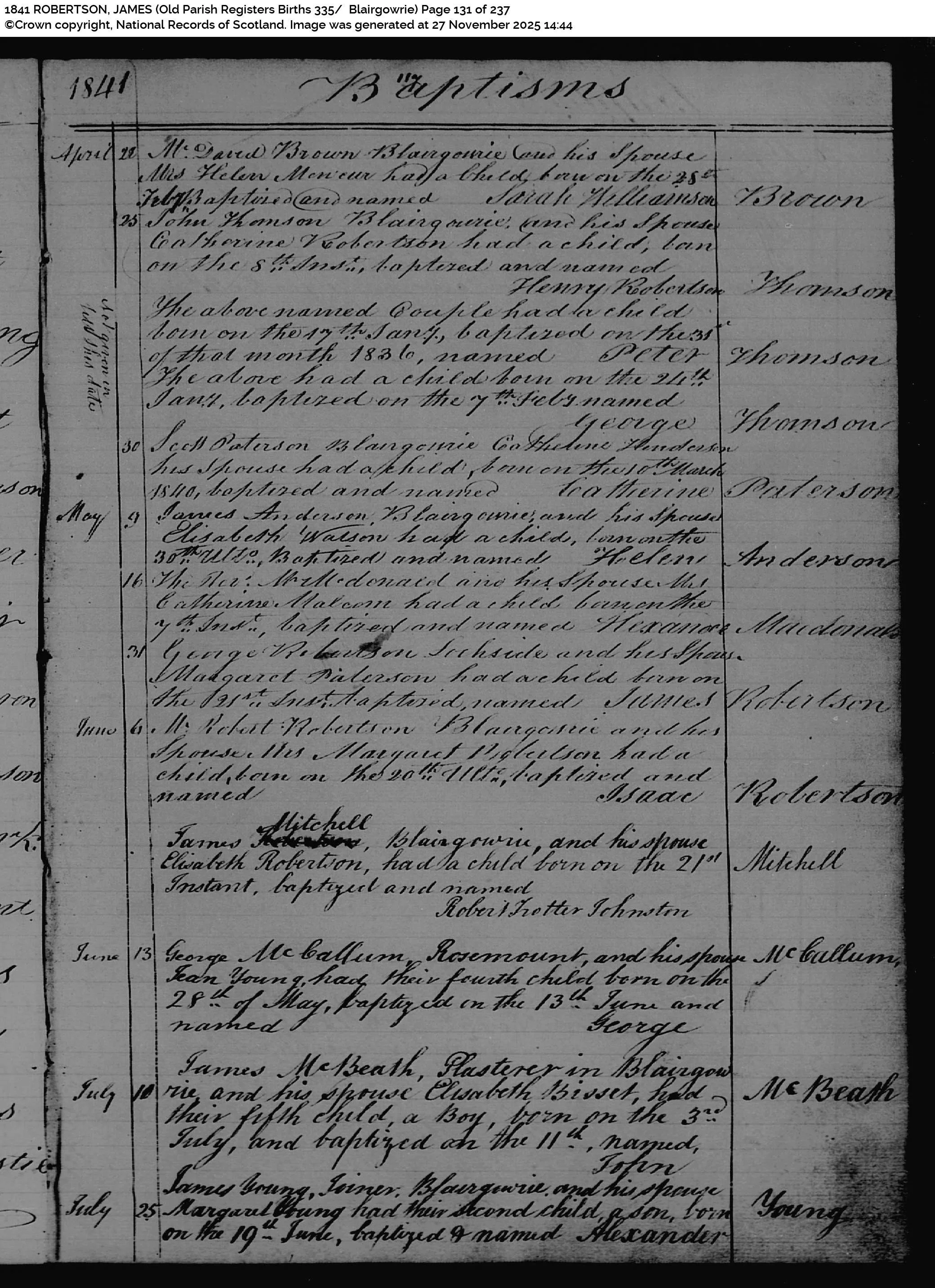
Baptized 31 May 1841 at Lochside, son of George Robertson and Margaret Paterson. Gone from the family by 1861. The man this case sets out to follow.
The subjectJames, gamekeeper of Liverpool
Married twice, raised families in Liverpool and saw children settle in Canada and New York. Recorded variously as “born Canada,” father a “Gentleman.” Is he the Blairgowrie son?
Proven the same manJames P. Robertson, Brooklyn
Died 4 November 1906 at 78 Fleet Street, Brooklyn — a watchman, father’s name left blank, age recorded inconsistently. A tempting match on the surname alone.
Ruled outThe Challenge, the Breakthrough, the Result
A son vanishes from his Perthshire family after 1861. A gamekeeper surfaces in Liverpool with a near-identical name. And an ocean away, a same-named man dies in Brooklyn. Three records, one surname — and the genealogical question of which threads belong together, and which must be cut.
A son who leaves no forwarding address
The 1841 baptism at Lochside is unambiguous: a son of George Robertson and Margaret Paterson, given the striking triple name James Penmuire Paterson. He is nine years old in the 1851 census, still in the household. By 1861 the family is intact — and he is gone.
What makes the gap genuinely hard is not the absence itself but what fills it. A gamekeeper named James Robertson appears in Liverpool with the very same unusual middle names. A James P. Robertson dies in Brooklyn. The surname is among the most common in Scotland; the given name James, the most common of all. Coincidence is the default, not the exception.
- No emigration record naming his Scottish parents
- No Scottish death — he left the country
- A later census saying “born Canada,” flatly contradicting the 1841 baptism
- Two Liverpool sons baptized with nearly identical names
Three men named James Robertson, overlapping in era and place. The task was to prove which records belonged to one life, and which belonged to strangers who merely shared a name.
A marriage register that names the parents
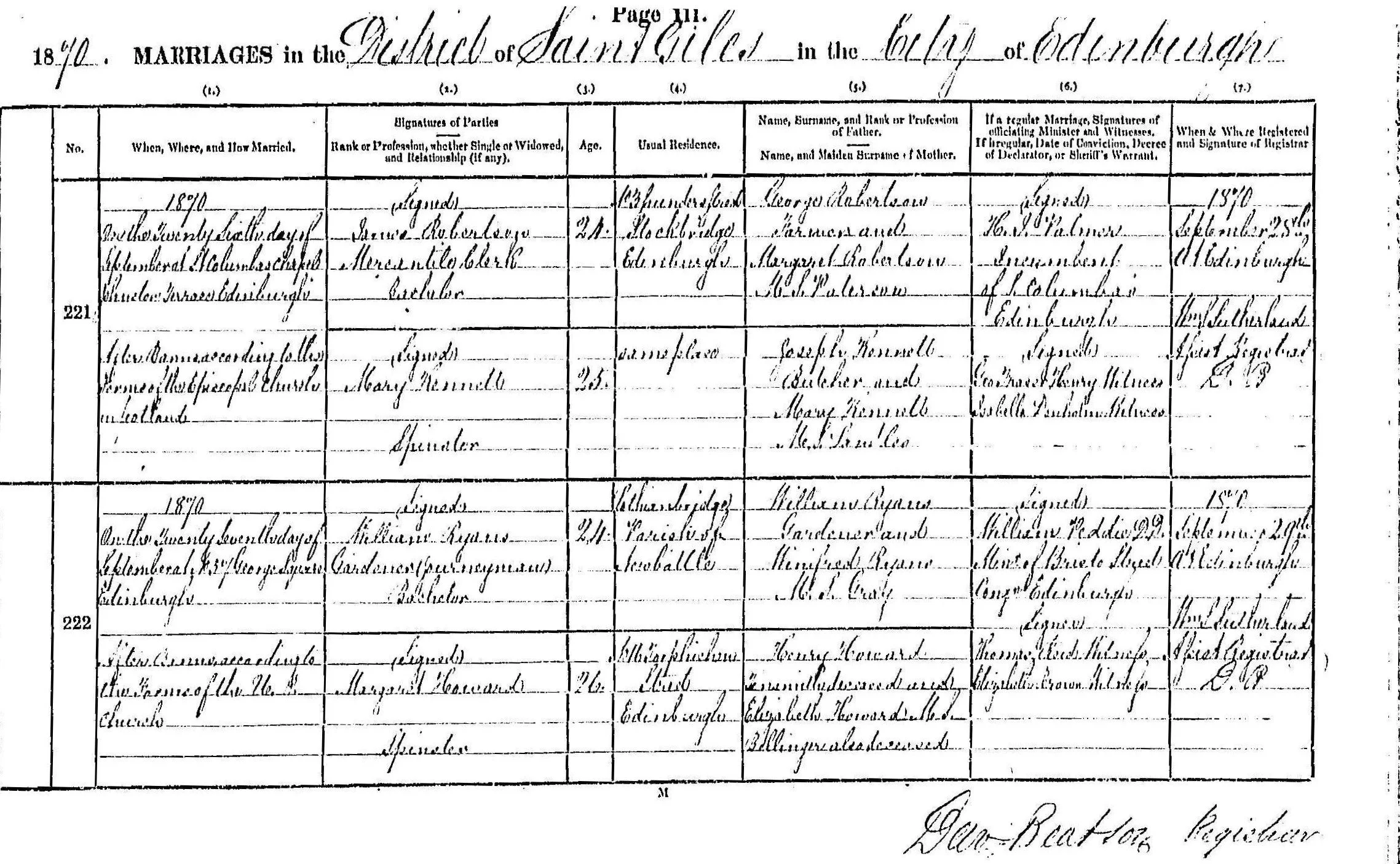
On 26 September 1870, at St Giles, Edinburgh, James Robertson, mercantile clerk, married Mary Kennett. The register names his father George Robertson and his mother Margaret Robertson, maiden surname Paterson Confirmed — the identical pair from the 1841 Blairgowrie baptism.
That single record converts the chain from circumstantial to documentary. The man who married Mary Kennett is, by his own parents’ names, the Blairgowrie son.
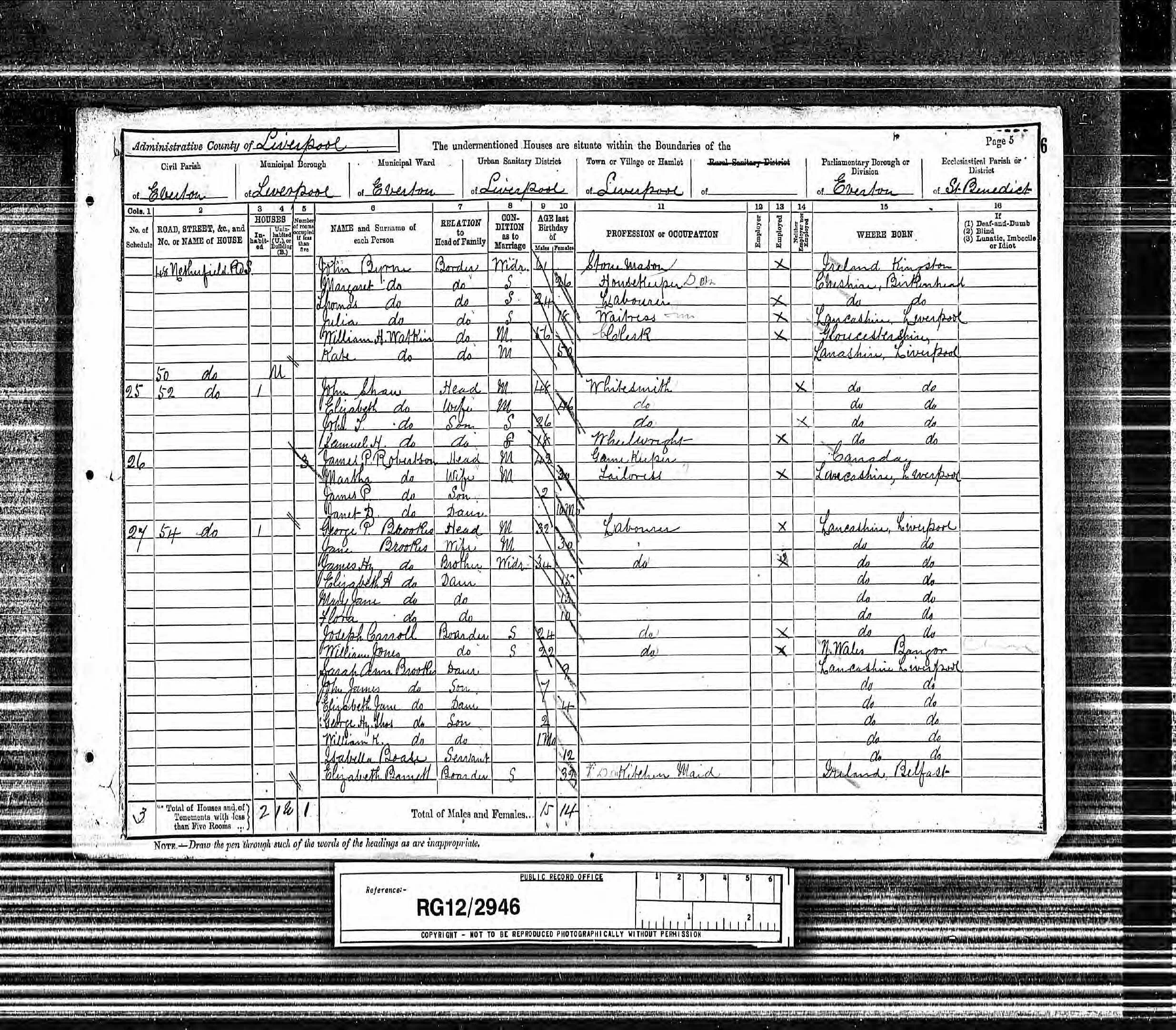
One record proved the marriage; another tied it to the Liverpool family. In the 1891 census at Brighton, Mary Kennett, widow, born Liverpool, keeps house with her granddaughter Mary J. Robertson, also born Liverpool Confirmed — one of the gamekeeper’s 1875 Liverpool twins, living with her grandmother. Marriage, children, and Blairgowrie family are bound into one line.
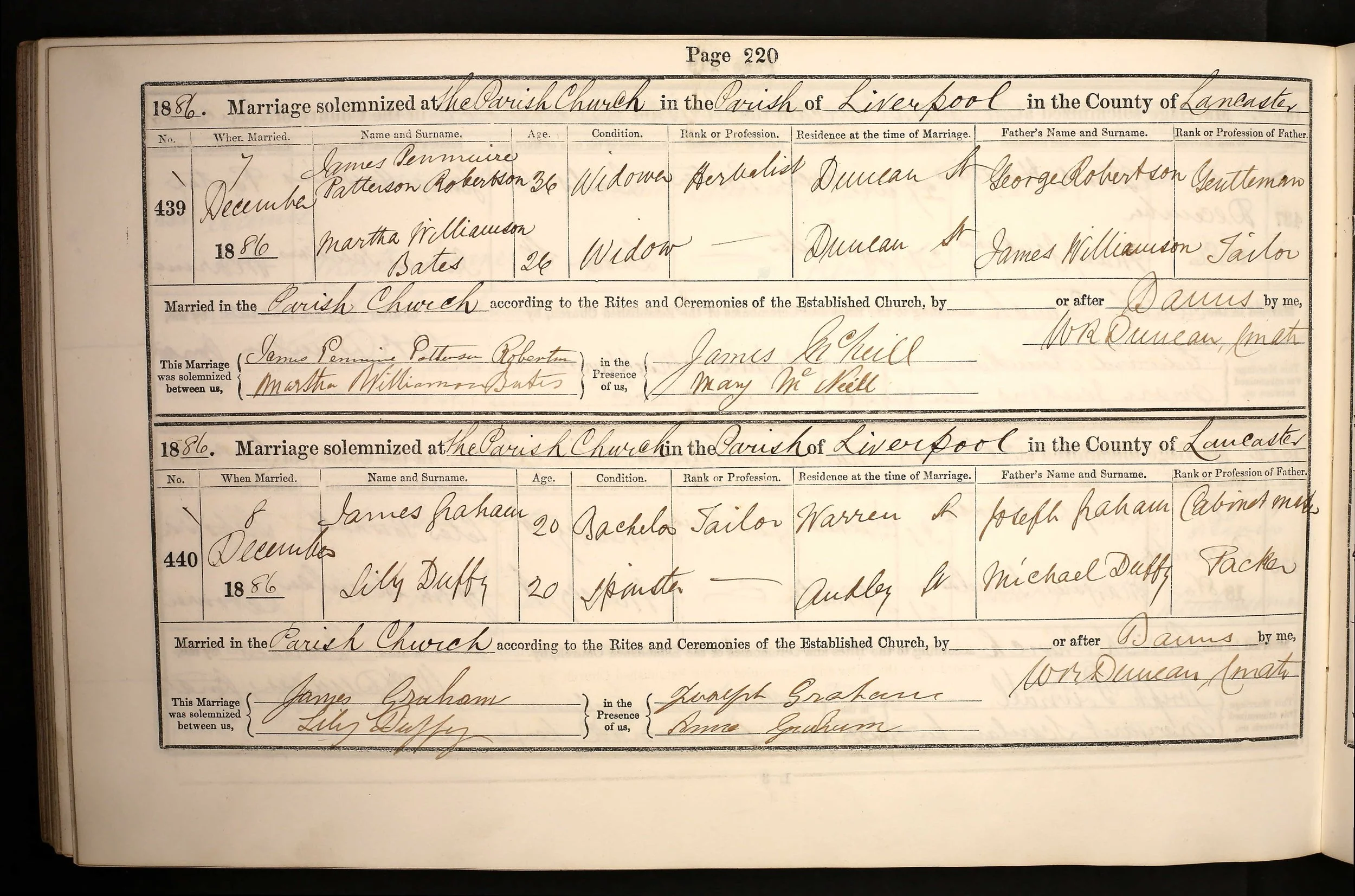
When the widowed gamekeeper remarried in Liverpool in 1886, the register again recorded his father as George Robertson — the same name, a third time, in a third decade.
One life, two families, three countries
James Penmuire Paterson Robertson left Perthshire and settled in Liverpool as a gamekeeper and herbalist — a trade he carried, unbroken, across every record that follows. With first wife Mary Kennett he had the 1875 twins, Rose Anne and Mary Jane. Widowed, he married Martha Williamson Bates in 1886 and raised a second family.
- Rose Anne & Mary Jane — the 1875 twins (first marriage)
- James Panmuir Jr. — to Toronto; married Ontario, 1910
- Frances Ann — to Ontario; married Harry Artt, 1922
- John Charles Robertson — to New York; married Helen Pape, 1930
England recorded only “George Robertson” for the father — a name too common to narrow anything. It was the children’s overseas marriages that named both parents: the Ontario and New York certificates record James Robertson and Martha Williamson together Confirmed. The transatlantic records proved more generous than the English ones.
The second thread is the trade. Gamekeeper runs unbroken through the 1875 baptism, the 1886 marriage, an 1888 court report, the 1891 census, and both daughters’ marriages — the continuity that separates this James from every other.
The Brooklyn watchman who died in 1906 leaves his father’s name blank, gives wildly inconsistent ages, and works a trade unconnected to gamekeeping — no thread of name, parentage, occupation, or place ties him to the Blairgowrie line. Excluded
One name had hidden three men. The records, read for the parents they name rather than the surnames they share, told them apart.
The father named three times, across three decades and two continents
A common surname is proven by what stands beside it. Across the subject’s own marriages and his children’s, the father’s name recurs — and the overseas records add the mother’s, where the English ones never did. No coincidence assembles this pattern by accident.
| Record | Year · Place | Father named | Mother named |
|---|---|---|---|
| Baptism of the subject | 1841 · Blairgowrie | George Robertson | Margaret Paterson |
| Subject’s 1st marriage | 1870 · Edinburgh | George Robertson, farmer | Margaret, m.s. Paterson |
| Subject’s 2nd marriage | 1886 · Liverpool | George Robertson, “Gentleman” | — (not recorded) |
| Son’s marriage | 1910 · Ontario | James Penmuir Robertson | Martha Williamson |
| Daughter’s marriage | 1922 · Ontario | James Robertson | Martha Williamson |
| Son’s marriage | 1930 · New York | James Robertson | Martha Williamson |
The 1870 Edinburgh register is the linchpin: it names the father and the mother as the exact pair from the 1841 baptism — converting a shared name into a documented identity. The overseas marriages of the next generation then do what England would not, naming both parents together and binding the second family to the same couple.
The occupational fingerprint — a trade that both binds and excludes
Where the father-name proves the subject is George’s son, occupation proves the Liverpool gamekeeper and the Edinburgh groom are one man — and simultaneously rules out the Brooklyn watchman. One thread does double duty.
Gamekeeper / herbalist runs unbroken: the 1875 twins’ baptism (father a gamekeeper), the 1886 marriage (herbalist), an 1888 police-court report (gamekeeper, in a dispute over an Irish setter), the 1891 census (gamekeeper), and both daughters’ marriage records, which give the father’s trade as gamekeeper. The Brooklyn watchman who died in 1906 worked an entirely unrelated trade — one of several reasons he is not the subject.
Three sons, nearly the same name — resolved by vital-record arithmetic
The second family produced a trap of its own: three boys whose names overlap so heavily that trees routinely collapse them into one. Birth, baptism, and death records pull them apart — two died as infants; one survived to emigrate.
| Child | Born | Baptized | Outcome |
|---|---|---|---|
| John Robert Duncan Robertson | 1894 | 1896, Liverpool | Died 1897, infant |
| Charles Augustus Roper Robertson | 1896 | 1896, Rock Ferry | Died 1898, infant |
| Charles John Augustus Roper Derby Robertson | 1899 | 1901, West Derby | Survived — “John C.” of New York |
The survivor, baptized with the full mouthful Charles John Augustus Roper Derby, is the John Charles Robertson who emigrated to New York and married Helen Pape in 1930 — his 1942 draft card giving birth 12 January 1899, England. Conflating him with either infant would have grafted a dead child onto a living line, or invented a survivor who never was.
A death bracketed on three sides — an open conflict, honestly held
Not every question this case raises is closed, and a sound proof says so. The subject’s death resists a single date because three records pull against one another.
1900: Daughter Rose Anne’s marriage names her father “James Robertson, gamekeeper, deceased.”
1901: A James P. Robertson, gamekeeper, nonetheless appears on the English census.
1911: He is gone — absent from the census entirely.
The reading most consistent with the weight of evidence is a death falling 1901–1911, with the 1900 “deceased” either premature, an error, or a convention of estrangement. The case study does not force the point closed; the methodology page lays out all three possible readings. Naming an open question is part of the proof, not a flaw in it.
The negative-evidence engine — proving who he was not
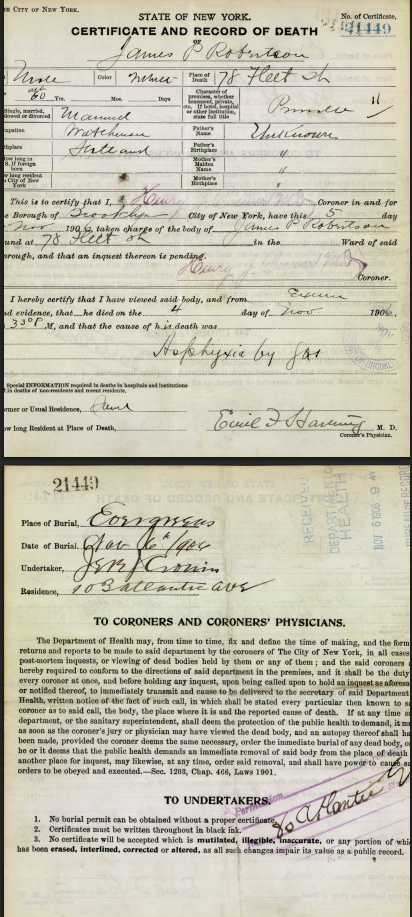
Disambiguation is as much elimination as identification. The most tempting wrong turn is the James P. Robertson who died in Brooklyn in 1906 — same surname, same era, an ocean where the family had relatives. Read closely, every identifying field fails to connect him.
- Father’s name left blank — no link to George Robertson
- Age recorded inconsistently (one source 45, another 60)
- Trade “watchman” — unrelated to gamekeeping
- No tie to Scotland, Liverpool, or the documented family
A correct exclusion protects a tree as surely as a correct identification builds one. The watchman shares a name and nothing else.
Blairgowrie, 1841 — a named son
James Penmuire Paterson Robertson baptized to George Robertson and Margaret Paterson. Present in 1851; absent by 1861.
Edinburgh, 1870 — the parents named again
Marriage to Mary Kennett; register records father George Robertson, mother Margaret Paterson. The decisive weld.
Liverpool, 1875 — the gamekeeper’s twins
Rose Anne and Mary Jane baptized to James & Mary, gamekeeper. Mary Jane later lodges with grandmother Mary Kennett (1891), binding marriage to family.
Liverpool, 1886 — a widower remarries
James Penmuire Patterson Robertson weds Martha Williamson Bates; father again recorded George Robertson. A second family follows.
Canada & New York, 1910–1930 — the line continues
Children marry in Ontario and New York, their certificates naming James and Martha — closing the arc from a Perthshire baptism to a North American generation.
Why this case matters
Common surnames are where family trees go wrong. A shared name invites the wrong record in and keeps the right one out; a single confident misattribution can graft a stranger onto a family for generations. This case is a study in the discipline that prevents it — reading records for the parents they name, not the surnames they share, and being as willing to exclude a candidate as to claim one.
The proof here rests entirely on documents: a marriage register that names the parents, a census that seats a granddaughter beside her grandmother, a chain of vital records that no coincidence can assemble by accident. DNA evidence across the descendant lines will, in a companion analysis, confirm what the paper already establishes.