
The Bertault–Banne Trial
How a criminal file of sixty-three images from the Prévôté de Québec — interrogations, confrontations, a death sentence, an appeal — yields the hardest biographical facts we have for Gillette Banne, and why the record must be read with discipline.

The Challenge
In the spring of 1672, Gillette Banne, her husband Jacques Bertault, and their daughter Isabelle were accused of killing Isabelle’s husband, Julien Latouche, at the family farm across the river from Trois-Rivières. The case produced a large, difficult dossier — and the reward for reading it is a biography almost nowhere else recoverable.
This same file is the source for Gillette’s age — the “quarante cinq ans” that corrected a decades-old birth-year error. Reading the trial correctly is therefore the foundation the rest of her documentary biography stands on.

The Breakthrough
The most productive feature of the file is the clerk’s routine. When he records the opening of each interrogation, he captures — incidentally, under oath — exactly the data a genealogist needs.
“…qu’elle se nomme Gillette Banne, aagée de quarante cinq ans Environ, Natifve du bourg d’Argences… femme de Jacques Bertault Masson de son mestier…”
She names herself Gillette Banne, about forty-five, native of Argences (near Caen), wife of Jacques Bertault, mason by his trade.
Interrogation of Gillette Banne · verso of fol. 100 (image 28 of 63), margin “continuation page 93” · 2 June 1672 Confirmed
Two more opening formulas anchor the family. Jacques states he is “âgé de 50 ans environ, natif de Poictou, paroisse des Essards” (fol. 97) Confirmed — a birth year near 1622 and a home parish matching independent sources. Isabelle, examined first on the morning of 1 June (fol. 94), gives her age as thirteen; the clerk wrote douze, then corrected it to treize Confirmed.
“…son père lui a fait prendre [La Touche] sans son consentement… sa mère n’y avait pas voulu consentir…”
Isabelle testifies her father forced the marriage; her mother had not wished to consent.
Interrogation of Isabelle Bertault · fol. 95 · 1 June 1672 Proven
Isabelle’s trial age (13) is her sworn statement. Her marriage age (~12) is a derived figure — marriage date minus inferred birth year — and must be labelled as derived, never quoted as her words.
All dates below are stated in the record. Where the witnesses disagree, the variant is marked.
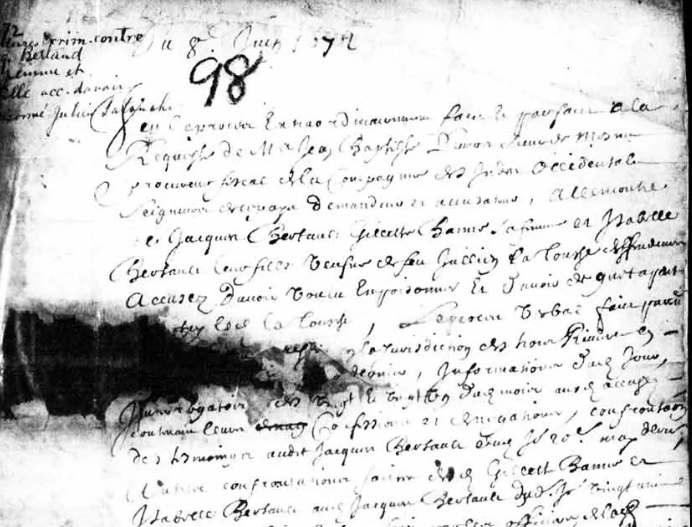
The Result
The file yields a three-phase arc: a household, a killing, and a public reckoning — each grounded in a dated primary document.
A marriage the mother opposed
- Gillette, ~45, native of Argences; Jacques, ~50, of Poitou, mason by trade
- Isabelle, 13, married the previous August to Latouche
- A union Isabelle testified her father forced and her mother refused
Reconstructed from testimony
- A failed poisoning, then the killing in the barn with a hoe (houe)
- Neighbours as earwitnesses to Latouche’s cries; son Nicolas (~10) nearby
- The plot described in the accuseds’ own reported words
Two courts, one day apart
- 8 June: Prévôté sentences the parents to death; Isabelle convicted, not condemned to die
- 9 June: Sovereign Council dismisses both appeals; Jacques strangled then broken; the fine cut to sixty livres; Isabelle to the amende honorable “ayant esgard à l’aage”
- Execution the same afternoon; goods confiscated; a will noted in the liasse
Her survival reads as mercy, but the mechanism is procedural — and it begins one court earlier than the retellings allow. The Prévôté did not condemn her to death: the greffier’s acte records “laquelle n’appelloit point” — she did not appeal, having nothing to appeal from. What reached the Sovereign Council was the prosecution’s appel a minima, arguing her sentence too light and asking the court to look past her “prétendu age.” Under the Criminal Ordinance of 1670 a corporal sentence required three judges and the most lenient opinion prevailed, and any sentence heavier than the amende honorable carried an automatic appeal. Her youth gave the appellate court its ground — and the Council used it to refuse the scaffold, not to release her: she was condemned to make the amende honorable herself and then to watch.
Colonial capital convictions were meant to rest on two unimpeachable eyewitnesses. This case had none to the killing — the neighbours were earwitnesses; the only near-eyewitness was a ten-year-old. The conviction rested on the accuseds’ confessions plus circumstantial “proximate indications” — the bloodied barn, the flail. Any retelling that implies eyewitness proof misstates the record.
The biography that began in an interrogation formula closes in a cost ledger — the jailer’s charge for board and lodging, the executioner’s fee for the walk to the scaffold. Read with discipline, even a murder file becomes a life.
Go Deeper
The full document-by-document methodology behind this case study — how a reverse-bound trial file of sixty-three images was rebuilt into a documented life — is available as a companion page, and as a formatted PDF research file for saving, printing, and sharing with family.