
Three Marriages, One Property
A single woman, named under four surnames across sixty-five years and three marriages, reconstructed through the integration of parish, notarial, judicial, seigneurial, and Crown-taxation records — yielding a documentary density rarely achieved for a non-elite woman of seventeenth-century New France.

The Challenge
Marie Crête appears in the parish register of Notre-Dame de Québec as the daughter of an habitant of Beauport in October 1657. Sixty-five years later she is buried from the same parish on November 10, 1722, with the priest's note that she was the wife of "the said Bellerose." Between those two acts, the documentary record names her successively as Marie Creste, Marie Pepin (wife of Robert), Marie Bridault (wife of Jean), and Marie Jourdain dit Bellerose (wife of Pierre). Four surnames. Three marriages. Three different marital communities of property under three different husbands. One woman.
The Documentary Surface
What the parish register alone yields is a life-frame without a person. Five sacraments (one baptism, three marriages, one burial), two royal censuses, and twelve baptismal acts naming her as mother establish that Marie existed, married three times, and bore twelve children — but the register gives no account of the property that carried through her three marriages, no record of what she did during her two widowhoods, and no resolution of why one source reads her third husband's name as "Soudain" where every other source reads "Jourdain."
Reconstructing the person beyond the surface requires integrating documentary modes that early Canadian biographies rarely treat together — judicial filings of the Provost's Court of Quebec, notarial protocols of the colony's working notaries, seigneurial-survey records of the Greffes d'arpenteurs, and Crown-taxation receipts of the Domaines d'Occident.
Three Source Conflicts at the Outset
PRDH-IGD #61361: Grisy, eveché de Sées, Normandie — with the arrondissement given as Caen, Calvados. Fichier Origine #380055: Grisy (St-Brice), commune de Vendeuvre, Calvados. The two agree on the parish and the department; Fichier Origine refines the location to the commune. The genuine divergence is the birth year: circa 1639 against PRDH's circa 1643.
Charpentier in the 1687 marriage register and the first four children's baptisms. Bourgeois in the 1698 baptism of Louise Catherine. A social-class transition is documented not by any single act but by the changing designations across eleven years of parish records.
The 1705 marriage contract (Notary Chambalon) has been read by some interpreters as "Soudain." Six independent primary records read Jourdain: the 1706 church register, the 1707 surveyor's partition signed by the husband himself, the 1712 lots-et-ventes receipt, the 1722 burial of Marie ("wife of the said Bellerose"), the 1723 remarriage of Pierre, and the 1738 burial of Pierre. Three further derivative and secondary sources agree. A single contested reading against nine.
Beyond these three, an additional set of secondary-source corrections required primary-source resolution: the "Josephte" middle name (unsupported, dropped), the spelling Creste/Crête (parish-register original / modern standardization), the Bridault wedding date (Lebel: 24 April 1687 / PRDH: 21 April 1687), the youngest Bridault daughter's name (parish register: Louise Catherine / PRDH normalization: Marie Louise), the Pepin sibling Jacques (Tanguay: son of Robert / verified: son of Antoine Pépin dit Lachance), among others. Twenty-one source discrepancies are now tracked across the research log; each required identification of the authoritative primary record and explicit resolution.

The Breakthrough
The methodological move at the heart of this reconstruction was to refuse the parish-register constraint. By integrating judicial filings (BAnQ Fonds Cour de la Prévôté de Québec, TL5 series), notarial protocols (Vachon, Genaple, Rageot, Chambalon), seigneurial surveys (Greffes d'arpenteurs, CA301), and Crown taxation records (Fonds Intendants, E1) with the parish corpus, Marie Crête's identity becomes reconstructible at a level of documentary density rarely achieved for a non-elite woman of the colonial period.
Three worked sub-cases demonstrate the methodology in practice.
Sub-case I · The Jourdain Proof
Confirmed The surname of Marie's third husband is Jourdain, not Soudain. The reading is established by preponderance of evidence and by the husband's own autographs.
Sources Consulted
- 1705 marriage contract (Chambalon, contested reading)
- 1706 marriage register (Notre-Dame de Québec, reads Jourdain)
- PRDH Marriage #67784 (Jourdain)
- PRDH Individual #37271 (Pierre Jourdain Bellerose)
- 1707 surveyor's partition (signed "Pierre Jourdain" by the husband)
- 1712 lots-et-ventes receipt (Jourdain throughout)
- 1722 burial register (Marie as wife of "the said Bellerose," dit-name attached to Jourdain)
- 1723 remarriage of Pierre (Neuville, Jourdain)
- 1738 burial of Pierre (Notre-Dame de Québec, Jourdain)
- Lebel and Laforest 1979 (secondary, Jourdain)
Conflict Resolution
One source — the 1705 contract — has been read as Soudain. Nine sources read Jourdain, including the husband's own signed autograph on two property records spanning five years. An autograph is the strongest evidence a seventeenth-century record can supply for a man's own name, and the class of evidence least vulnerable to a later copyist. The preponderance reading is adopted; the contested contract reading is interpreted as a calligraphic ambiguity, the lowercase "J" of the notarial hand resembling an "S" when the initial stroke is unusually angular. Re-examination of the Chambalon protocol via Parchemin remains desirable for completeness but is no longer load-bearing on the identification.
Sub-case II · The Widow's Docket
Confirmed Marie Crête appears in four BAnQ Provost's Court filings between December 1700 and May 1702 — three as named plaintiff, one as recipient of court order. The arc establishes her as an active civil-legal subject during her second widowhood.
The Four Filings
- 4 Dec 1700 — Summons of Henri Delaunay (her own brother-in-law) for 1200 livres tournois (TL5, D277-120)
- 14 Dec 1700 — Lieutenant General's order, three pages, dismissing parties with mutual prohibition against mistreatment and slander (TL5, D277-125)
- 27 Feb 1702 — Default judgment against Gilles Bourret of Bourg-Royal, granted by Provost Judge Lepailleur (TL5, D2788-1)
- 31 May 1702 — Final judgment for six livres and fifteen sols against Bourret (TL5, D2785-5)
The corpus integrates a documentary type — TL5-series Provost's Court filings — that is rarely brought into early Canadian biographical reconstructions. The sequence demonstrates Marie's willingness to sue close kin, to pursue small-claim debts (six livres fifteen sols) through the full procedural sequence from default to substantive judgment, and to act consistently in her own legal name across two and a half years of court appearances.
The kinship detail bears one correction. Henri Delaunay was Marie's brother-in-law through her sister Marie Françoise, who married him at Beauport on 6 November 1679. Marie Françoise died at the Hôtel-Dieu de Québec on 29 November 1702 — six months after the last of these filings, and not, as this page formerly stated, twenty years later in 1722. The correction is set out in Column Three.
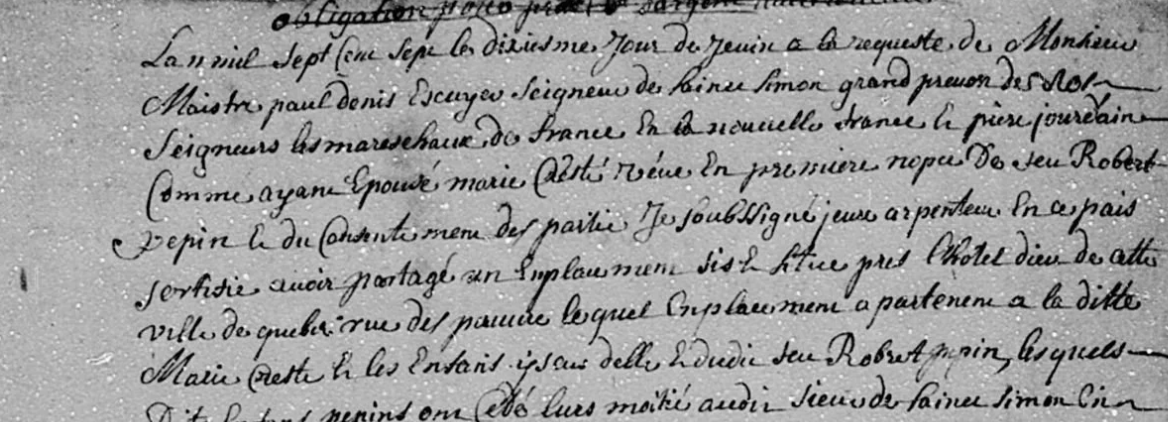
Sub-case III · The Hôtel-Dieu Lot
Confirmed An urban Quebec property near the Hôtel-Dieu, on the Rue des Pauvres, traced as a continuous asset across all three of Marie's marital communities — and the cleanest single piece of evidence for the Jourdain reading via the husband's autograph.
Property Stages
- Acquired during the Pepin marriage (1670–1686); enters Pepin marital community
- 14 Aug 1686: Rageot inventory after Robert's death; lot notionally divided
- Marie's half carries into the Bridault marital community (1687–1699)
- Pepin children's half remains separately held
- 10 June 1705: Chambalon arbitration finalizes Pepin estate
- 1706: Pepin children's half sold to Sieur de Saint-Simon (50 livres each) — date and instrument not yet verified; see open items
- Marie's half carries into the Jourdain marital community (1706–1722)
- 10 June 1707: Surveyor Hilaire Bernard de la Rivière partitions the lot; Pierre Jourdain signs "as husband of the said Crête" (BAnQ CA301, S56, P149)
- 24 Oct 1712: Jourdain & Crête pay 60 livres lots-et-ventes to Crown on additional Arnaud acquisition (BAnQ E1, S4, SS1, D224, P3)
The Result
The integration of the three worked sub-cases — the Jourdain proof, the litigation arc, and the property continuity — yields a coherent reconstruction of Marie Crête's identity across sixty-five years and three marriages. The nine-year-old child of the 1666 Beauport census, the thirteen-year-old bride of the 1670 parish register, the twenty-eight-year-old widow of the 1686 Pepin inventory, the forty-one-year-old widow of the 1699 Bridault hospital burial, the forty-three-year-old plaintiff of the 1700 Provost's Court docket, the forty-eight-year-old bride of the 1706 Jourdain marriage, the forty-nine-year-old joint owner of the 1707 partition, the fifty-five-year-old taxpayer of the 1712 receipt, and the sixty-five-year-old decedent of the 1722 Notre-Dame de Québec burial — all one woman.
The Documentary Reconstruction
Three Marriages, Documented
- 1670–1686: Robert Pepin, master slate-roofer of Vendeuvre, Calvados — six children
- 1687–1699: Jean Bridault, master carpenter of Montmorency, Paris — six children
- 1706–1722: Pierre Jourdain dit Bellerose, soldier of the Marine, Parisian — no children
Twelve Children, Documented
- Six Pepin (1675–1686): Jean, Robert, two François who died in infancy, Marie Rose Rosalie, Louis
- Six Bridault (1688–1698): Marie Anne (descent line), Marie, Jean Hilaire, Jean Baptiste (died at three weeks), Marie Françoise Jeanne, Louise Catherine
Nine of the twelve reached adult marriage; three died in infancy.
Eighteen Discrepancies Resolved
- Robert Pepin's natal parish: refined to Vendeuvre, Calvados (Fichier Origine), where PRDH gives Grisy in the diocese of Sées with the Caen arrondissement — complementary, not contradictory
- Robert Pepin's occupation at arrival: master slate-roofer (Fichier Origine), absent from PRDH
- Robert Pepin's death window: 13 Feb–11 Aug 1686 (Fichier Origine + Rageot 14 Aug 1686)
- The third husband's surname: Jourdain, established on the husband's own autographs, not Soudain
- Marie's middle name: no "Josephte" — unsupported, dropped
- Marie's surname spelling: Creste (original) / Crête (modern standardization)
- Youngest Bridault daughter: Louise Catherine (register), not Marie Louise (PRDH normalization)
- Jean Bridault's mid-marriage status: charpentier → bourgeois by 1698
- Jean Pepin's role: structural family witness across all three marriages
- The Pepin family count: six children (correcting Lebel's seven, via Tanguay error on Jacques 1674)
- Bridault wedding date: 21 April 1687 (PRDH) reconciled against Lebel's 24 April
- 1688 Marie Anne baptism: descent-line carrier identified
- 1694 Jean Baptiste Bridault: died at three weeks, only Bridault infant loss
- Pierre Jourdain's prior natural daughter: Marie Rose Rosalie Jourdain (b. 1701 Montreal)
- 1707 land partition: Jourdain's portion 76 pieds frontage / Saint-Simon's 132 pieds
- 1712 Arnaud acquisition: separate from the Hôtel-Dieu lot
- Marie Françoise Crête's death: 29 November 1702, established by the patient register of the Hôtel-Dieu du Précieux-Sang de Québec and by PRDH individual record #19407
- The autumn 1722 mortality cluster: two deaths — Marie Anne Bridault on 23 September and Marie Crête on 9 November, forty-six days apart
Three Items in Working Status
- Robert Pepin's birth year: circa 1639 (Fichier Origine) against circa 1643 (PRDH). The Fichier Origine figure rests on direct examination of the French register and is preferred, but neither has been verified against the Grisy baptismal act.
- The letterform of the 1705 Chambalon contract. The identification is settled; whether the notary's hand reads J or S has not been re-examined at the protocol.
- The 1706 Saint-Simon purchase of the Pepin children's half. The 1707 partition references it; the sale instrument itself has not been retrieved, so its date is carried as unverified.
The Documentary Corpus
Twenty-eight primary-source documents, two database integrations, and one published secondary reference were integrated:
- 12 baptism register acts (Marie + 11 of her 12 children; Robert's falls in a Beauport register gap)
- 3 marriage register acts (1670, 1687, 1706)
- 1 burial register act (1722)
- 2 marriage contracts (1669 Vachon, 1705 Chambalon)
- 1 posthumous inventory (1686 Rageot)
- 1 notarial arbitration (1705 Chambalon)
- 4 judicial filings (1700 ×2; 1702 ×2)
- 1 surveyor's partition (1707, with hand-drawn map)
- 1 lots-et-ventes receipt (1712)
- 2 royal censuses (1666, 1667)
- 1 Fichier Origine identification (Robert Pepin #380055)
- 1 PRDH-IGD database integration (multiple records)
- 1 secondary reference (Lebel/Laforest 1979)
One further primary source entered the corpus with the 1702 correction: the patient register of the Hôtel-Dieu du Précieux-Sang de Québec, roll of November 1702.
The Apparatus Behind the Reconstruction
I. Source Hierarchy
Sources were ranked by proximity to the event and by the institutional reliability of the recording authority. The hierarchy applied throughout this reconstruction:
- Primary records, contemporary to the event: parish registers (baptism, marriage, burial), institutional registers (the Hôtel-Dieu patient rolls), notarial protocols (marriage contracts, inventories, partitions), judicial filings (court summonses, orders, judgments), seigneurial surveys, Crown-taxation receipts, royal censuses.
- Primary records, indexed retrospectively: PRDH-IGD database records (transcribed from parish registers), Fichier Origine identifications (transcribed from French parish registers by FQSG researchers). A card and the act it indexes are one witness, not two: their agreement is not corroboration, and only their disagreement carries information.
- Published secondary references: Lebel and Laforest, Our French-Canadian Ancestors, Volume 3, Chapter 22 (1979); Tanguay, Dictionnaire généalogique, Volumes 1 and 7. Treated as research aids, not as authoritative for conflicts with primary records.
- Not used as evidence: crowd-sourced public trees and unsourced online compilations. Their characteristic failure is that an error, once entered, carries no trace of its origin and no means of retraction — which is what makes them unusable as evidence and hazardous even as a source of leads.
Where database extracts conflict with the underlying parish register (as in the Louise Catherine / Marie Louise case, where the register is authoritative over PRDH's family-level normalization), the register prevails. Where two databases differ (as in the Robert Pepin origin case, where Fichier Origine gives the commune of Vendeuvre and PRDH the diocese of Sées with the Caen arrondissement), the readings are examined for whether they actually conflict — often, as here, one refines the other rather than contradicting it.
II. The GPS Five Criteria Applied
The Board for Certification of Genealogists' Genealogical Proof Standard was the analytical framework throughout. Each of the five criteria was applied to the major biographical assertions of this reconstruction:
Criterion 1 — Reasonably Exhaustive Search
For each major assertion, primary records were consulted across the parish, notarial, judicial, seigneurial, and Crown-taxation modes; database records were checked against the underlying primary sources; secondary references were checked against the primary records they cite. The Jourdain proof draws on ten distinct sources, two of them the husband's own autographs; the litigation arc draws on the full TL5 series for the 1700–1702 period; the property arc integrates the 1686 inventory, the 1705 arbitration, the 1707 partition, and the 1712 receipt.
Criterion 2 — Complete and Accurate Source Citations
All sources are cited by full archival reference: parish register (parish, date, page), notarial protocol (notary, date, where available), judicial filing (BAnQ fonds, series, dossier and piece number — e.g., TL5, D277-120), seigneurial survey (BAnQ Greffes d'arpenteurs, CA301, S56, P149), Crown-taxation record (BAnQ Fonds Intendants, E1, S4, SS1, D224, P3), royal census (LAC, Archives des Colonies, Série G1, Volume 460), and database record (PRDH-IGD or Fichier Origine with database identifier).
Criterion 3 — Skillful Analysis and Correlation
Identity continuity is established by correlation across record types: the Marie Crête who is named in the 1657 baptism register is the same woman who is named in the 1666 census, the 1669 marriage contract, the 1670 marriage register, the twelve children's baptisms (1675–1698), the 1700–1702 court filings, the 1705 marriage contract, the 1706 marriage register, the 1707 surveyor's partition, the 1712 receipt, and the 1722 burial register. Each record-to-record correlation rests on convergent identification (name, age, spouse, parish residence, naming patterns of children) and on absence of competing candidates in the same place at the same time.
Criterion 4 — Resolution of Conflicting Evidence
Where conflicts arose — the Pepin origin and birth year, the Jourdain surname (vs Soudain), the youngest Bridault daughter's name (Louise Catherine vs Marie Louise), the date of the 1687 wedding (21 April vs 24 April), the Pepin sibling count (6 vs Tanguay's 7), and the death year of Marie's sister Marie Françoise (1702 vs 1722) — the conflict was identified explicitly, the conflicting sources catalogued, and the resolution justified by appeal to source hierarchy, preponderance of evidence, or convergence of multiple independent witnesses. Where a resolution has since been overturned, the earlier reading is kept visible with the record that retired it.
Criterion 5 — Soundly Reasoned Coherent Conclusion
The integrated identity reconstruction — Marie Crête, daughter of Jean Crête and Marguerite Gaulin, born at Beauport in October 1657, married three times to Robert Pepin (1670), Jean Bridault (1687), and Pierre Jourdain dit Bellerose (1706), mother of twelve children of whom nine reached adult marriage, plaintiff in four Provost's Court filings between 1700 and 1702, joint owner of an urban Quebec property near the Hôtel-Dieu across her three marital communities, and decedent at Quebec on 9 November 1722 — is the conclusion that the documentary corpus supports without internal contradiction.
III. Defensible Language Framework
Following BCG standard practice, biographical assertions are stratified by evidentiary strength. The framework applied throughout the published biography and case study:
| Tier | Definition | Example from this case |
|---|---|---|
| Confirmed | Established by multiple primary sources in convergent agreement; no competing reading remains plausible. | Marie's three marriage dates; the four 1700–1702 court filings; the Jourdain surname, on two autographs. |
| Proven | Established by primary source with corroborating secondary support. | Robert Pepin's master-slater trade (Fichier Origine + Lebel chapter). |
| Suggestive | Implied by primary source but not directly established; a probable reading awaiting confirmation. | Robert Pepin's birth year, circa 1639 (Fichier Origine) against PRDH's circa 1643, awaiting the Grisy baptismal act. |
| Exploring | Working interpretation pending further documentation; uncertainty acknowledged in published prose. | The 1706 date for the Saint-Simon purchase of the Pepin children's half, referenced in the 1707 partition but not verified against the sale instrument. |
IV. Discrepancy Resolution Summary
Twenty-one source discrepancies are tracked across the working research log; eighteen have been resolved by primary-source examination and three remain in working status, named in Column Three above. The full discrepancy resolution table — including each conflict's identification, the sources catalogued on each side, the rule of resolution applied, and the citation supporting the final reading — is maintained in the chronological research log.
Four categories of discrepancy bear particular methodological note:
- Database vs. primary record: When PRDH's family-level normalization conflicts with the underlying parish register (e.g., Louise Catherine vs Marie Louise), the register prevails.
- Database vs. database: When two reference databases give different readings (e.g., Fichier Origine's Vendeuvre commune against PRDH's Sées diocese for Robert Pepin's origin), the first question is whether they conflict at all. Here they do not: one refines the other. Where they do conflict — as on Pepin's birth year — the more carefully researched record prevails, Fichier Origine being built on direct examination of the French departmental archives.
- Secondary vs. primary record: When Lebel and Laforest (1979) or Tanguay (Dictionnaire) attribute children, dates, or names that the primary record does not support (e.g., Tanguay's "Jacques Pepin 1674" attributed to Robert, who was actually the son of Antoine Pépin dit Lachance), the primary record prevails.
V. Open Research Items
Pending Verifications
- The 1705 marriage contract letterform. The identification of the third husband as Pierre Jourdain is settled on the preponderance of nine sources and two autographs. Re-examination of the Chambalon protocol via Parchemin would close the residual question of whether the contract's own hand reads J or S, but the reading is no longer load-bearing.
- The Grisy baptismal act for Robert Pepin. Fichier Origine gives circa 1639, PRDH circa 1643. Neither has been verified against the parish register of Grisy (St-Brice), commune of Vendeuvre, Calvados. This is the one substantive divergence between the two databases on Pepin's origin.
- The 1706 Saint-Simon purchase of the Pepin children's half. The 1707 partition references a 1706 sale to Saint-Simon at fifty livres per heir. The sale instrument has not been retrieved, and its date is carried as unverified.
- The 1699 Bridault death inventory. Jean Bridault died at the Hôtel-Dieu de Québec on 7 June 1699. The marital-community inventory that should have followed has not yet been retrieved. This document would clarify the financial stakes of the 1700 Delaunay litigation.
- The 1686 Rageot inventory. The Lebel chapter cites this as drawn on 14 August 1686; the original protocol has not yet been retrieved from BAnQ. Retrieval would close the dating of Robert Pepin's death.
- Robert Pepin's burial register entry. Not yet located in the surviving Notre-Dame de Québec sepultures for 1686. Probable record loss; absence noted in the published biography.
VI. Methodological Contribution
The principal methodological contribution of this reconstruction is the demonstration that integrating judicial, notarial, seigneurial, and Crown-taxation records with the parish corpus yields a documentary density rarely achieved for a non-elite woman of seventeenth-century New France. The Provost's Court of Quebec (TL5 series) is rarely brought into early Canadian biographical reconstructions, despite its availability at BAnQ; the seigneurial-survey records (Greffes d'arpenteurs) are similarly under-integrated. Marie Crête's documentary footprint demonstrates what these record types add when treated as full members of the source corpus rather than as supplemental annotations.
The Jourdain proof additionally demonstrates the value of the husband's autograph as evidence of his own name. In seventeenth-century New France, where many habitants — and the majority of women — could not write, the survival of a signed signature on a property record is the strongest available witness to a name and the class of evidence least vulnerable to a later copyist's misreading. The 1707 partition and the 1712 receipt, both bearing Pierre Jourdain's autograph, are the cleanest single sources for the Jourdain reading.
A third contribution is negative, and arrived late. A twenty-year error in a death date, entered in the working log under the citation of a database record that gives a different year, sat undetected inside a published conclusion until every register act in the corpus was placed beside the database record that indexes it and compared field by field. The exercise is tedious and it is not a verification — a card derived from an act cannot corroborate that act — but it is a diagnostic, and it caught what nothing else had. The lesson is that the moment to audit an index against its source is after the conclusions are drafted, when there is something for a discrepancy to break.