
The Woman With Two Names
as Geneviève Pachitabanok8e
The Challenge
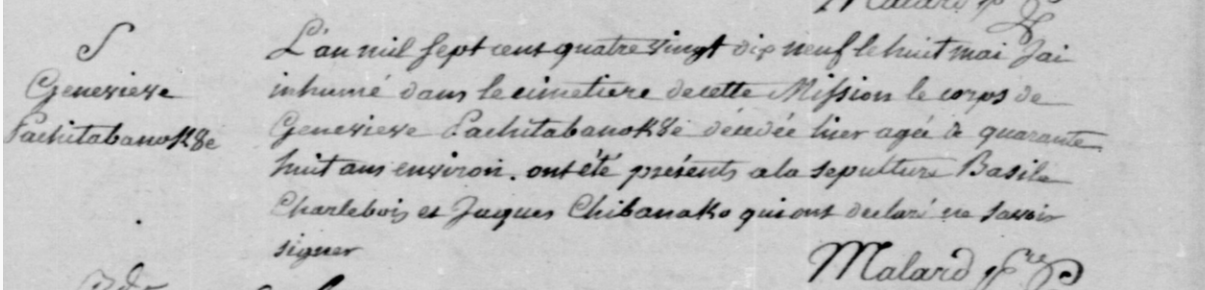
On May 8, 1799, Father Malard buried Geneviève Pachitabanok8e in the cemetery of the Oka mission. She had died the previous day, aged approximately forty-eight years. The witnesses were Basile Charlebois, a French-Canadian settler, and Jacques Chibanako, an Algonquin man. Neither could sign.
The name Pachitabanok8e appeared nowhere else in the genealogical record linking to Kitchiwabisi’s family. The wife of the war chief was documented under an entirely different name — Abitakijikokwe and its variants — in every record from 1786 through 1796. For any researcher relying on name-based searching, these were two different women. The name discrepancy was absolute.
Geneviève Abitakijikokwe appears throughout the Oka mission registers from 1786 to 1796, always in connection with the chiefly family of Kitchiwabisi — “Wabisi the Great.” In 1786, she served as godmother at a baptism under the name Abitakijig8k8e. In 1788, she was explicitly identified as Abitakijig8ek8e femme de 8abizi le grand — wife of Wabisi the Great. In 1793, she appeared as mother of Thérèse, with her husband identified as “the Great 8abissi.” After Kitchiwabisi’s death in April 1794, she appeared once more in 1796 as the mother of Joseph, a fils naturel born to a man named Simon Na8ak8eskan — a child conceived outside of marriage, consistent with her widowed status.
After 1796, she vanished from the registers. No burial was recorded for a Geneviève Abitakijikokwe. No death date appeared in Paquin’s genealogical fiche. The only Geneviève who died at Oka in the right timeframe was the woman the priest called Pachitabanok8e.
The name variants documented across Geneviève’s lifetime already showed dramatic variation within the ABITAKI- family: Abitakijig8k8e, Abitakijig8ek8e, Ontakijikok8e, Kontakijikok8e, Abitakijikok8e. These are all recognizably the same root name, rendered differently by different priests at different times. But Pachitabanok8e shared no visible root with any of them. The challenge was not a spelling variation — it was an entirely different name. Either the identification was wrong, or the assumption that Indigenous individuals carried only one name was wrong.
The answer carried direct genealogical consequences. Marie Josephte Abitakijikokwe — the researcher’s 4th-great-grandmother, who married the voyageur Gabriel Guilbault at Oka in 1801 — shared the same clan name as Geneviève. If Geneviève was the wife of Kitchiwabisi and the mother of Bernard Wabisi, then Marie Josephte belonged to the same Algonquin kinship network as a chiefly family — and the identification of Geneviève’s burial would anchor the entire Abitakijik family chronology at the mission.
The Breakthrough
Pauline Cadieux’s typed transcription of the Oka mission registers — received by the Public Archives of Canada on April 7, 1927 — is a faithful copy of the only surviving original. Her preface states it plainly: “Ce travail est une copie fidèle et conforme des registres de l’état civil du Lac des Deux Montagnes (Oka), dont un seul exemplaire existe.” Everything was preserved, including the spelling variations that would prove essential: “Dans la copie, tout a été respecté, orthographe comprise.”
The Cadieux transcription of Volume 2 (1786–1806) is critically different from Volume 1 on the same reel. The Volume 1 title page (image 374) explicitly states: “Moins les actes entièrement relatifs aux Indiens” — it excludes all Indigenous records. Volume 2, by contrast, includes every baptism, marriage, and burial of every person at the mission. The original pre-1786 registers were destroyed in the 1922 fire at Oka. Volume 2 is the most complete surviving record of Indigenous community life at the mission in the 18th century.
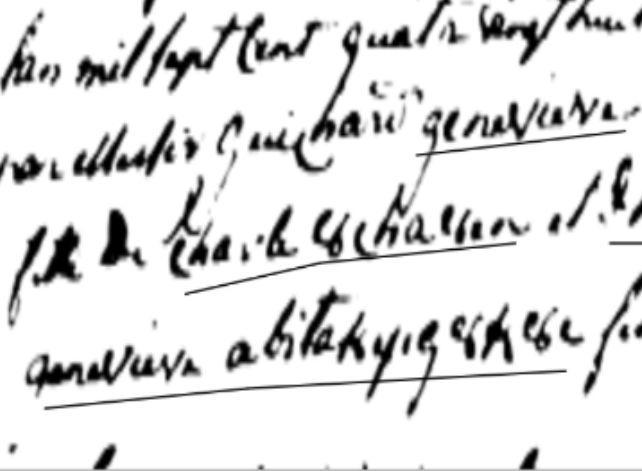
The breakthrough came on pages 5 and 6 of the Cadieux transcription. In the space of twelve days in May 1786, three women carrying variants of the Pachitaban- name appear in the registers:
Three women. Three variants of Pachitaban- (Patchitabanik8e, Pechabankk8e, and the later Pachitabanok8e). All present at the same mission in the same month. This is the evidence that collapses the name discrepancy argument: Pachitaban- is not a personal name. It is a clan or family name, carried by multiple women simultaneously. Just as multiple women in a European parish might share the surname “Martin,” multiple women at Oka carried the Pachitaban- identifier. Geneviève carried both names — Abitakijik from one kinship affiliation and Pachitaban from another — depending on which context the priest was recording.
The same priest wrote both records. Father Malard, a French Sulpician who arrived in Lower Canada in 1794, knew this woman. He baptized her child in 1796 and buried her in 1799. He used a different name each time — not because he was recording different women, but because Indigenous individuals carried multiple names from different kinship systems, and the name a priest recorded depended on the social context of the moment.
Abitakijig8k8e · Abitakijig8ek8e · Ontakijikok8e · Kontakijikok8e · Abitakijikok8e
Fathers Guichart, Lebrun, and Malard — 1786, 1788, 1793, 1796
Pachitabanok8e
Father Malard — 1799 (burial)
The identification does not rest on any single record. It rests on the convergence of eight evidentiary streams: the same Christian name (Geneviève, uncommon at the mission); compatible age (born c. 1751); the same location (Oka mission throughout); the same recording priest for the critical 1796 and 1799 records; the absence of any separate burial for Geneviève Abitakijikokwe in the complete 1786–1800 registers; widowed status consistent with Kitchiwabisi’s 1794 death; the proof that Pachitaban- is a clan name carried by multiple women; and the blank death date in Paquin’s genealogical fiche, suggesting this connection had not previously been made.

The Result
Geneviève Abitakijikokwe, also known as Geneviève Pachitabanok8e, was an Algonquin woman born around 1751, likely at or near the Mission du Lac-des-Deux-Montagnes. She married the Algonquin chief Kitchiwabisi — “Wabisi the Great” — no later than 1786, and probably in the late 1770s. Their marriage record, if it survives, is lost within the gap in the mission registers from August 1777 to February 1785, when Father Guichart certified only statistical summaries — eighty-one Indigenous marriages reduced to a number on a page.
She bore at least four children with Kitchiwabisi: Marie Jeanne (documented 1787), Thérèse (baptized 1793), Marie Angélique, and Bernard Wabisi, who would become a young Algonquin war chief. After Kitchiwabisi’s death on April 21, 1794, Geneviève remained at the mission as a widow. By 1796, she had a child — Joseph, fils naturel — with a man named Simon Na8ak8eskan, recorded by Father Malard without any title or marital designation. She died on May 7, 1799, approximately forty-eight years old, and was buried the following day in the mission cemetery.
The Cadieux transcription and index reveal that Geneviève was not an isolated figure but the center of a substantial kinship network at Oka. The ABITAKIJIK root name appears across multiple individuals documented from 1786 through 1832: Catherine Abitakilaik8e (buried 1795, age 60 — possibly Geneviève’s older sister or aunt); Guillaume Abitakyiko8itch (married 1795, buried 1800); Jean Atabitakijik (father of Jean Baptiste, 1795); Martin Abitakigiko8ich (buried 1802); and Marie Josette Abitakijikokwe, who married Gabriel Guilbault in 1801. By the 1820s, the name had evolved into TABITAKIJIK, with Michel Tabitakijiko appearing repeatedly through 1830 — the core element -TAKIJIK- persisting across fifty years of colonial record-keeping.
The identification of Geneviève Pachitabanok8e as Geneviève Abitakijikokwe does three things that extend beyond a single family record. First, it completes the biography of a chiefly wife and fills the blank death date in Paquin’s genealogical fiche for Bernard Wabisi — a correction that may be original to this research. Second, it demonstrates that the Pachitaban- name is a clan or family identifier, not a personal name, which has implications for how other Oka mission records are read: any researcher encountering an unfamiliar Pachitaban- name should consider whether the individual also appears under a different name system. Third, it anchors the Abitakijik kinship network in a firm chronological framework, from Geneviève’s first appearance in 1786 through the Tabitakijik generation of the 1830s, establishing the family context into which Marie Josephte Abitakijikokwe — the researcher’s direct ancestor — married.
This research also uncovered a critical distinction in the archival record itself. Volume 1 of the Oka registers on LAC reel C-2895 (1721–1786) carries the explicit notation “Moins les actes entièrement relatifs aux Indiens” — it was deliberately stripped of Indigenous records. Volume 2, containing the Cadieux transcription, preserves them faithfully. The original pre-1786 registers were destroyed in the 1922 fire at Oka. However, the 1786 judicial authentication page — signed by René Ovide Hertel de Rouville, judge for the district of Montreal, dated December 28, 1785 — confirms that civil doubles were deposited at the Montreal courthouse. These courthouse doubles, if they survive in the judicial archives at BAnQ, may contain the Indigenous records excluded from the transcription, including Geneviève’s baptism and marriage.
Documented from: Cadieux Transcription, Volume 2, page 5 (Marie Josette Patchitabanik8e, May 18, 1786); page 6 (Geneviève Abitakijig8k8e as godmother, May 27, 1786; Marguerite Pechabankk8e burial, May 30, 1786); page 248 (burial of Geneviève Pachitabanok8e, May 8, 1799); Pouliot-Thisdale Index (1788: Abitakijig8ek8e femme de 8abizi le grand); Paquin genealogical fiche, Bernard Wabisi (weskarini.ca); Parish Registers, L’Annonciation-de-la-Bienheureuse-Vierge-Marie, Oka, 1786–1806; Library and Archives Canada, MG 8, G 21, Reels C-2895 and C-2896; Cadieux Index, MG 8, G 21, prepared September 26, 1938.
The researcher behind this case study is a direct descendant of Marie Josephte Abitakijikokwe, who married Gabriel Guilbault at Oka in 1801 — their 4th-great-granddaughter through the line: Gabriel & Marie Josephte → Gabriel Guilbault fils (1791) → Evangeliste Guilbault (1845) → Elisabeth Emma Guilbault Gilbert (1883) → Thomas Eugene Hamall (1904) → Thomas Kenny Hamall (1932) → Researcher. Marie Josephte carried the same Abitakijik clan name as Geneviève. This identification confirms that the researcher’s ancestor belonged to an Algonquin kinship network that included a war chief’s family — a connection that was invisible until the Cadieux transcription revealed the dual-name system that colonial record-keeping had obscured.
This summary presents the case study findings. The full methodology documents each record with complete primary source transcriptions, analysis of the Cadieux transcription’s role in preserving Indigenous name variants, the linguistic evidence for dual Algonquin name systems, and the eight-stream convergence logic that confirmed Geneviève’s identity across two name systems and seven colonial spellings.
Read the Full Methodology → Case Study: The Woman at the Grave → The Guilbault Line: Series Index →