
The Voyageur Years:
Which Gabriel Guilbault?
One Account, and the Men Who Could Have Held It
HBCA F.4/32, folio 414, carries an account headed Dr Gabriel Guilbeau Cr. It records five annual wages and closes at the 1821 merger. It gives no birth year, no parish, no father’s name, no age, and no mark. Everything that would identify the man has to come from outside the volume.
That would be straightforward if only one man of this family bore the name. Several did.
| Candidate | Age in 1817–1821 | Status |
|---|---|---|
| Gabriel Guilbault père b. 1762, L’Assomption d. 8 April 1833, Saint-Benoît | 55–59 | Excluded on direct presence evidence — see §8. A documented voyageur, but of the 1790s, not of this account. |
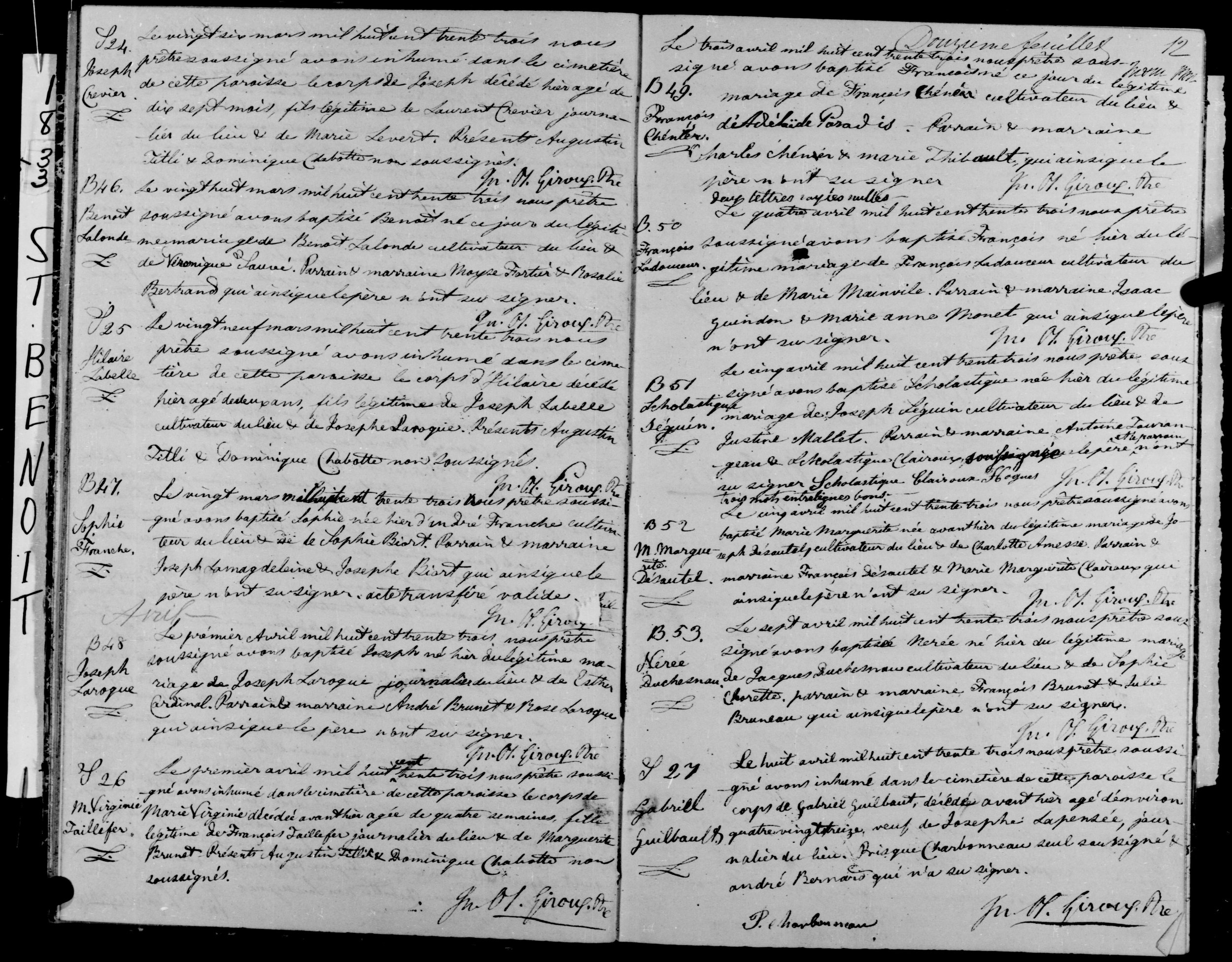
| Gabriel Guilbault fils b. c. June 1790, pays d’en haut d. 5 September 1880, Saint-Placide | 27–31 | Open. No presence-attested appearance of any kind between his baptism in 1798 and his marriage in November 1823 — a documentary silence of twenty-two years covering the whole of the wage span. |
| Gabriel Guilbault, son of Charles Thomas b. 4 March 1764, L’Assomption d. 17 April 1826 | 53–57 | Open and untested. First cousin of Gabriel père, same parish. Documented in Quebec in April 1811, in the 1825 census and at his burial — and nowhere in between. |
Others were separated out along the way — further cousins, uncles and nephews carrying the same name in the same district. Being separated as a distinct individual is not the same as being excluded from the fur trade. Several of these men have simply never been tested, and this page says so rather than implying a closed field.
The Evidence Controls
Each of these was written after a specific error was found in this file. They are stated here because they carry the analysis that follows, and because they are the transferable part of this work — every fur-trade family that recycled its given names presents the same traps.
| Control | Where it bites in this study | |
|---|---|---|
| E-1 | Proximity in an ordered document is not evidence | An alphabetical ledger puts men near each other because of their names. The claim that father, son and uncle appeared “within eighteen pages” of one another in F.4/32 was an artifact of the alphabet. |
| E-2 | Duplicate volumes are not independent witnesses | F.4/43 and F.4/45 are one account and its fair copy; so are F.4/46 and F.4/47. Agreement between a pair confirms nothing. |
| E-3 | Named is not present | A baptism naming a man as father asserts the child’s legitimacy. It is not an observation that he stood in the church. |
| E-4 | Index dates are not service dates | The finding aid gives 1816 against folio 414. The folio itself opens in 1817. A five-year career was being read off an index. |
| E-5 | Index data is not record text | Database abstracts, and English-language renderings of French abstracts, sit at two removes from the act. |
| E-6 | A negative search is as wide as the range actually browsed — and its extent must be stated | Nothing found is only usable evidence when the boundaries of the search are written down. |
| E-7 | Presence cannot be inferred from naming | The operating rule behind the presence ledger in §8. |
| E-8 | A standardized surname is an editorial judgment | Databases normalise Gilbeau, Gibeau and Gibouleau to a single form. That is a decision by an editor, not a statement about family. |
| E-9 | Separating two accounts is not identifying two men | Added August 2026. The figures cleanly divide the records of two men called Paul. Neither figure says who either man was, and one of the two is still unidentified — see §7 and §11. |
In the ledgers, figures are the discriminator and spelling is noise. In the parish registers, the wife’s name is the discriminator and occupation is noise. Neither of those is an assumption; both are demonstrated below from the documents themselves.
And neither, on its own, produces a name. That is E-9, and it is the hardest thing this file has had to learn.
Two Indexes, One Collection, and a Substitution Card
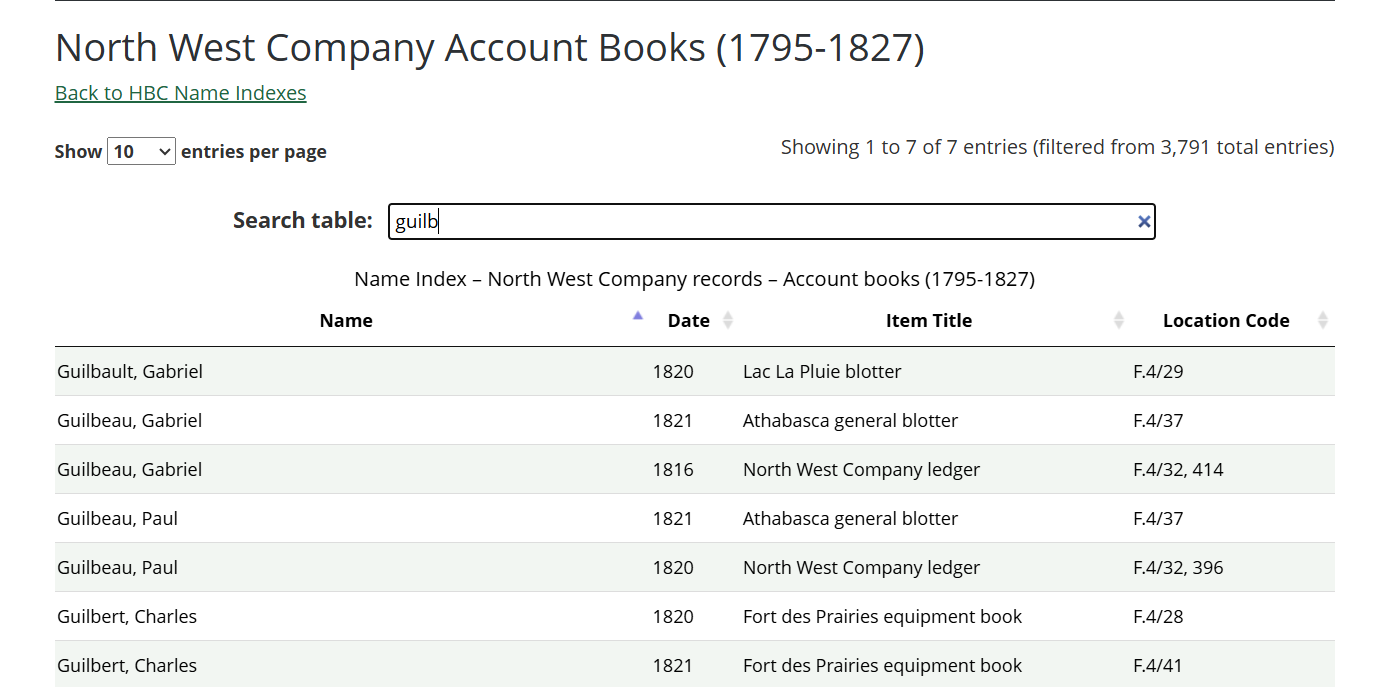
The HBCA name index to the North West Company account books — 3,791 entries covering 1795 to 1827 — is the standard entry point. Filtered on guilb it returns seven entries: Gabriel at F.4/29 (1820), F.4/37 (1821) and F.4/32 folio 414 (1816); Paul at F.4/37 (1821) and F.4/32 p.396 (1820); and two men named Guilbert. Filtered on gib the same index returns six more, including three ledger pages nobody had looked at: p.389, p.404 and p.435.
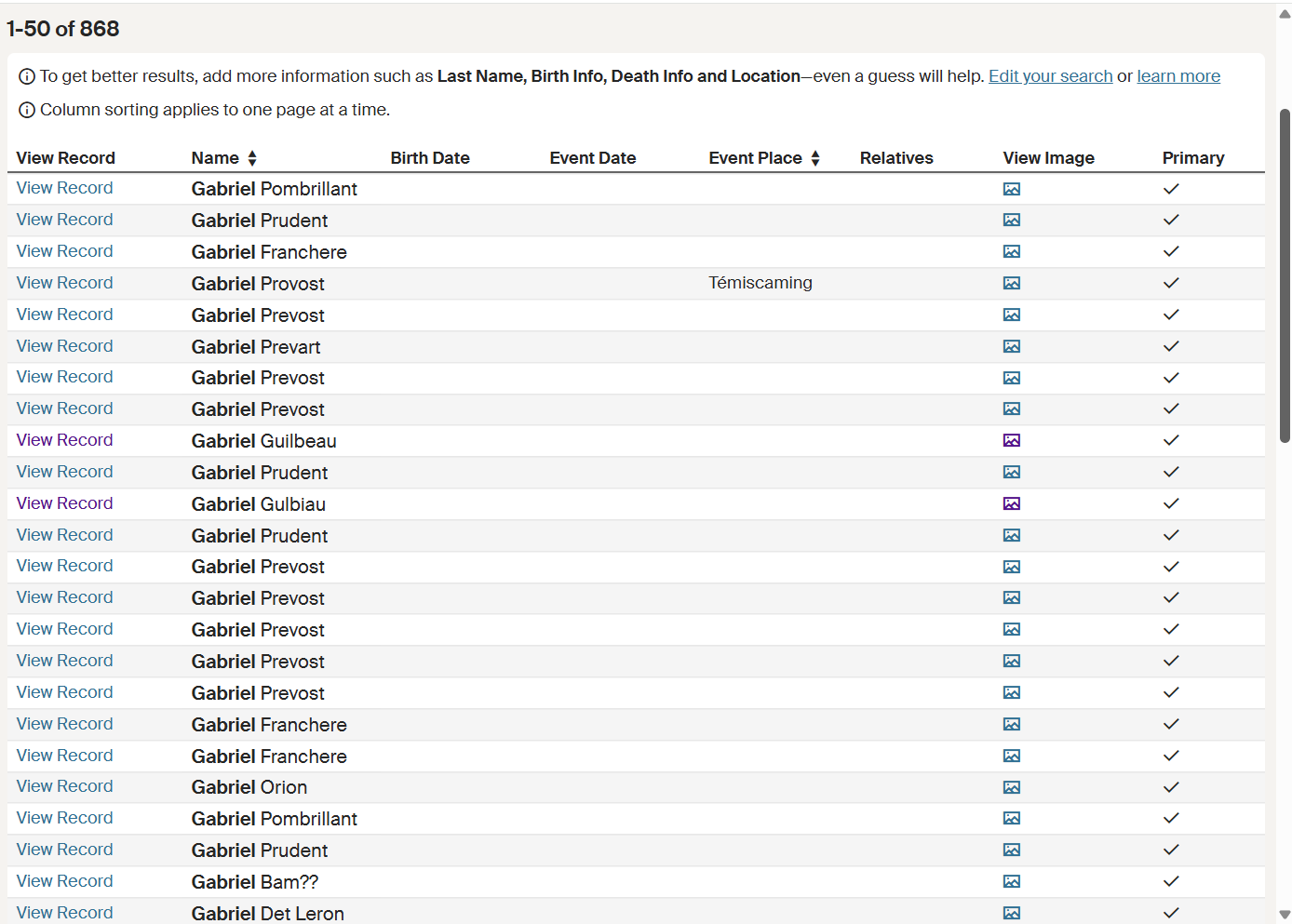
Ancestry’s index of the same archive returns 868 results on the given name alone, among them entries rendered Guilbeau and Gulbiau. Two volumes — F.4/43 and F.4/45 — are returned by Ancestry and by no Guilbault variant in the HBCA index.
F.4/43 and F.4/45 look like two additional volumes, and therefore like broader coverage. They are one account and its fair copy (E-2). The two indexes genuinely do not return the same set — but what Ancestry adds here is one document the HBCA index misses, not two.
The reel that isn’t there
A second finding aid problem sits underneath the first, and it is not visible from either search interface. HBCA microfilm reel 5M6 is catalogued as Subsidiary Companies, North West Company Account Books 1817–1821. At image 420 the film carries a substitution card: “For F.4/32 (North West Co. Ledger) see Reels 5M7 & 5M8.”
F.4/32 is the volume holding p.389, p.396, p.403, p.404, folio 414 and p.435 — every open ledger question in this file. It is filmed on two reels outside the set that carries the rest of the series. A researcher working through 5M6 in order would conclude the ledger had been searched.
Compiling that map was necessary to establish the negative. It records where each volume and post inventory begins across 774 images: F.4/29 to image 89; F.4/30 Fort William; the Lake Huron inventory at 176; Lac Nipigon; Athabasca spring 1820 at 209; Lac La Pluie at 221; Fort des Prairies at 224; Athabasca continued at 237; Columbia at 254; Red River at 311; Lac Quinipic at 349; an unalphabetised NWC account book at 376–419; the substitution card at 420; F.4/33 at 421–593; F.4/34 at 595–774, with its own index at 598.
The Account Itself
Specially scanned by the Archives of Manitoba in February 2026 and read from the image in August. Headed Dr Gabriel Guilbeau Cr, immediately below the account of Louis Giroux.
| Year | Wages credited | Note |
|---|---|---|
| 1817 | 551 | First line of the account: To Sundries against By Wages 551. No balance brought forward from an earlier folio. |
| 1818 | 330 | Roughly half the year before and less than half the year after. Anomalous in an otherwise consistent series — see the open question below. |
| 1819 | 687.10 | The highest wage in the account. In the same year’s credit column: By Mr Paul Guilbeau — 50. |
| 1820 | 500 | The Lac La Pluie year. |
| 1821 | 650 | The Athabasca year. The same 650 appears in the F.4/37 Athabasca blotter. |
| Closes | To Balance 336 — the same figure struck in F.4/37. | |
Five consecutive annual wages, each followed by a balance struck and carried. The account opens in 1817, not 1816, and carries nothing forward from an earlier ledger. HBCA, F.4/32, NWC General Ledger, folio 414; specially scanned February 2026; Archives of Manitoba, Winnipeg. The Hudson’s Bay Company Archives plates carry a printed prohibition on reproduction; they are transcribed on this page, with full references so that any reader may order the images from the Archives of Manitoba.
The question put to this plate was whether the account had a history before 1817. It does not. The first line is a wage credit, not a carried balance.
That matters because a man already long in the trade would normally arrive on a new folio with a balance attached to him. This account belongs to someone beginning documented company service in 1817 — which sits awkwardly with a fifty-five-year-old who had been a voyageur since the 1790s, and comfortably with a younger man.
The same test run elsewhere in the volume works in both directions. F.4/32 p.389 and p.403 each open in 1811 on a substantial balance carried from an earlier ledger — the signature of a career already under way. Folio 414 has no such history behind it.
It is a lean, not a proof. A clerk opening a new ledger can start a fresh folio for anyone.
Present and legible in the 1819 credit column. Two accounts transacting with each other is real evidence of a working relationship between two named men — unlike nearness on an alphabetical page, it is something a reader can check.
What it does not do is say which Gabriel or which Paul. Both Paul accounts run in these volumes, and neither has been tied to a named man with a parish. It is evidence of a transaction, not of brotherhood.
330 sits between 551 and 687.10, in a series otherwise running in the 500–690 band. A single year at roughly half rate usually indicates a part-year engagement — a late departure, an early return, or a season not fully worked.
If that is what it is, then 1818 stops being a blank in the presence analysis and becomes a testable proposition: a man partly in Lower Canada that season should leave a trace there. The 1818 debit column on the same plate should be read against this — a correspondingly thin run, or one that starts or stops mid-season, would corroborate it.
Lac La Pluie, July 1820
The leaf does not close at a balance of 188, and it carries no transfer notation to Athabasca.
It is a single dated purchase run headed Gabriel Guilbault, 26 July 1820, footing at 133. The 188 is real, but it lives on the receiving side — in F.4/37, entered as a debit reading To Sundries at Lac la Pluie — 188. The link between the two posts stands, and stands on a specific non-round figure — in the receiving book.
Below the rule, in a second hand: “Paid him 30 promised by [A. G.] McTavish” and “2 Eq’t Pints d[itt]o him, 28th July 1820.” The neighbouring account is Pierre Gayazlen. The portage sling is the one item on the list that only a working canoeman buys.
The index, and the one real exception to E-1
The F.4/29 index for 1820 reads, in the G run: Gbault Paul — 33; Gigains Ignace — 34; Grandbois Michel — 34; Gayazon Pierre — 35; Guilbault Gabriel — 35; Goulait Jacque — 36.
A post blotter is not an alphabetical list of a company-wide workforce. It is a working record of who held an account at that post in that season. So this document does place a Gabriel and a Paul at Lac La Pluie together in 1820. Shared presence at one post is real evidence, where nearness in an alphabetical ledger is not (E-1).
State it correctly, though. Gayazon and Guilbault are both at reference 35, so “two entries apart” describes a sequence in the index, not a position on a page. The finding is presence at one post, not adjacency. And since neither man has been identified, it places two accounts at one post — not two known relatives.
Gbault Paul at 33; Guilbault Gabriel at 35, sharing that reference with Gayazon Pierre. Two Guilbault accounts held at one post in one season. The purchase run at reference 35 is transcribed in full above: a dated outfit of 26 July 1820 footing at 133, with no closing balance and no Athabasca transfer notation. HBCA, F.4/29, NWC Lac La Pluie Blotter, 1820, index and ref 35; Archives of Manitoba, Winnipeg.
The Athabasca General Blotter, 1820–1821
Gabriel appears as Gilbian Gabriel at reference 100. The index to this volume shows the clerk rendering one family three ways on a single leaf — Gibeault, Gilbian, Guilbian — and shows exactly one Gabriel in the Athabasca department, with no second man hiding under another spelling.
The page foots at 692.10 both ways: 42.10 + 650 in credits; 188 + 168.10 + 336 in debits. It cannot foot at any wage other than 650. Purchases include a blanket, leggings and capots at 21.10; a pint of rum at 90 with cotton and other goods at 44; a shirt and corded cotton at 40; a charge of 40 to Lewis Mongan; and three pints of rum at 90.
The 188 ties backward to Lac La Pluie. The 650 and the 336 tie forward to folio 414 in the general ledger. One man, three volumes — and the 188 is not a round number, not a standard wage, and not a figure that recurs by chance.
This establishes that F.4/29, F.4/37 and folio 414 all describe the same individual. It says nothing whatever about which individual. That is E-9 in its simplest form.
The x-marks in the index denote settled accounts. Gabriel’s account at ref 100 is transcribed above. The leaf is cited by reference number; the viewer’s image numbering is not a folio. HBCA, F.4/37, NWC Athabasca General Blotter, 1821, index and ref 100; Archives of Manitoba, Winnipeg.
The 1821 Volumes, and Why Four Are Two
Four volumes record the 1821 settlement. Set side by side, F.4/43 and F.4/45 prove to be line for line identical, differing only in pagination; so do F.4/46 and F.4/47. Each pair is an account and its fair copy.
The 610 is attested once. A fair copy is not a second witness (E-2).
One spelling, not two. Both pages read Guilbeau.
The 610 and the 336 are not reconciled. The 610 cannot be a gross figure from which deductions produce 336 — the arithmetic runs the wrong way. How the 610 in these volumes relates to the 336 struck in F.4/37 and folio 414 is an open question, and no explanation is offered here.
What survives, and is worth keeping: the 1821 settlement is a comprehensive one. It lists a whole workforce, name by name, with wages and closing balances side by side. No ordinary trading year produces such a document — and it is the instrument that separated the two accounts held under the name Paul.
The two volumes carry the same entries, in the same order, at the same amounts; only the pagination differs. F.4/45 is retained here as the demonstration of E-2: this is what a duplicate looks like, and why two agreeing volumes must always be checked before they are counted as two. How the 610 relates to the 336 struck in the blotter and the ledger is not established. HBCA, F.4/43, NWC Pays 1821, p. 101; F.4/45, NWC Balances 1821, p. 76; Archives of Manitoba, Winnipeg.
The two Paul accounts, separated by figures
Two accounts held under the name Paul Guilbault appear in these records. The spellings do not separate them — the same clerk writes Gibeau, Gibault and Guilbeau across the volumes. The figures do, and each set matches that account’s own documents elsewhere.
| Wages | Balance | Matched elsewhere by · and whose it is | |
|---|---|---|---|
| The account at 500 Gibeau / Gibeault / Gebeault | 500 | 617.14 | Its F.5/3 servants’ contract at cinq cents livres, its F.4/37 Athabasca account, and its ten-year run in the general ledger at p.389. The man has not been identified — see §11. |
| The account at 350 Guilbeau / Guilbau / Guilbian | 350 | 96 | Its F.4/32 p.396 ledger account. Probably Paul Guilbault “the Canadian,” b. 1798, later of Oregon — a join that rests on name, period and trajectory, and is held to the same standard as any other. |
The account at 350 carries two different balance figures in two books — 96 in the general ledger at F.4/32 p.396, and 80.8 in the Athabasca blotter. These are balances struck at different points in different books, not a conflict. The constant that identifies the account is the wage of 350. Note also that Paul “the Canadian” is a first cousin once removed, not a second cousin; he is a first cousin once removed, proved by the 1727 baptism of Charles Thomas Guillebaut.
Both Paul accounts settled on the same page under different spellings and different figures. The heading reads North West Balances. The two entries’ nearness is alphabetical and means nothing (E-1). What decides the two accounts is the wage column — and what it does not decide is who either man was (E-9). HBCA, F.4/47, North West Balances 1821, p. 7; Archives of Manitoba, Winnipeg.
The Presence Ledger
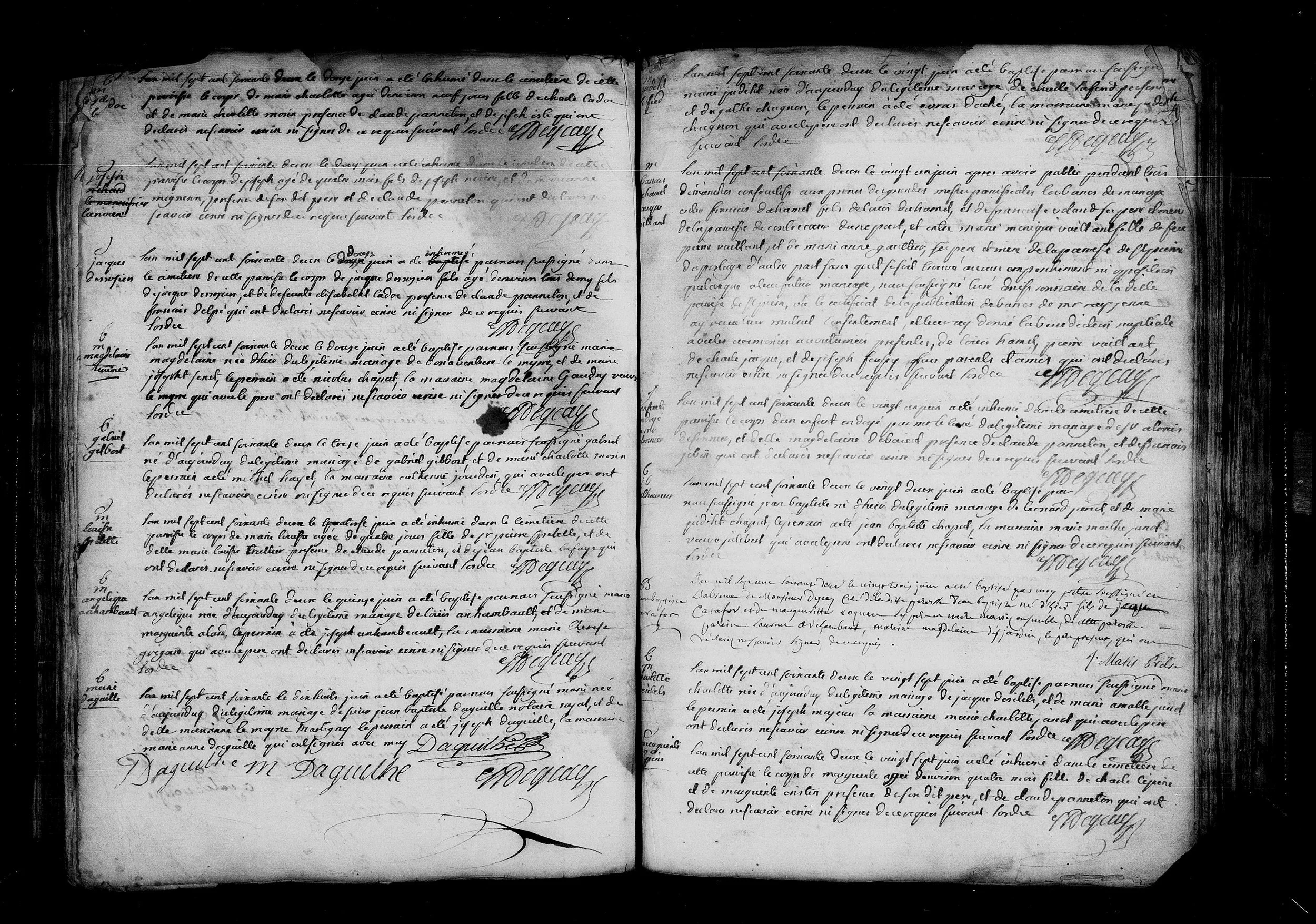
The tempting argument runs: Gabriel père appears continuously in the Quebec registers from 1798 to 1833, so he cannot have been in the interior.
That argument defeats itself, and the entry that opens the span is the one that defeats it. On 10 October 1798 at Saint-Paul-de-Lavaltrie he is styled voyageur et maintenant agriculteur and recorded present — a man in the Quebec register and a voyageur, in the same line. A voyageur home between engagements is exactly what the record of a voyageur looks like. Continuity of appearances cannot exclude a trade career.
What replaces it is narrower and much harder to argue with: not continuity, but presence at specific dates inside the account’s own wage years, credited only where the register says so in its own words.
Every appearance is logged as one of three things and never as a bare yes or no. ATTESTED — the act carries a presence clause, or records him acting as a party, with the register’s wording quoted. NOT ESTABLISHED — he is named but the act says nothing about his presence. NOT EXAMINED — the plate has not been read, and no verdict is offered.
| Date | Parish and event | The register’s own words | Styled |
|---|---|---|---|
| 10 Oct 1798 | St-Paul-de-Lavaltrie — baptism of his son Gabriel | ainsi que le père présent | voyageur & agriculteur |
| 30 Mar 1815 | Rigaud — baptism of Josette | ainsi que le père présent | maçon |
| 9 Dec 1816 | Rigaud — baptism of Catherine | ainsi que le père présent | maçon, styled père |
| 18 June 1819 | Rigaud — baptism of his son Joseph | lesquels, ainsi que le père présent, ont déclaré ne savoir signer | maçon, of Argenteuil |
| 23 June 1819 | Rigaud — godfather at the baptism of a Bachelard child | lesquels ainsi que le père présent ont déclaré ne savoir signer | — |
| 20 Feb 1821 | St-Eustache — baptism of his son Charles | lesquels et le père ont déclaré ne savoir signer | — |
| 25 Nov 1823 | Rigaud — his son’s marriage | en présence de Gabriel Guilbeault père de l’époux | ancien maçon |
| 1 Mar 1824 | Rigaud — baptism of Marie Esther | present | maçon, styled père |
| 21 Dec 1824 | Rigaud — godfather to his grandson | grand père de l’Enfant, present | — |
| 30 Apr 1826 | Rigaud — baptism of Jean Baptiste | ainsi que le Père présent | journalier |
1821 is decisive. The account’s closing wage of 650 is the Athabasca year, and the same 650 and 336 appear in the Athabasca blotter with the Lac La Pluie transfer carried in. Athabasca is a wintering department; it cannot be worked seasonally. A man declaring in person at Saint-Eustache on 20 February 1821 was not wintering at Fort Chipewyan that season. The two statements cannot describe one person.
1819 is nearly as strong. The account’s highest wage, 687.10, falls in the year Gabriel père stands at Rigaud on 18 June and again on 23 June. The brigades left Lachine in May.
1817 and 1818 are untouched. No evidence places anyone anywhere in those two years. That is the honest residual, and it is stated as one.
Formula varies by priest, so a missing clause has to be read against the officiant’s other entries before anything is concluded from it. At Saint-André one curé records no father’s presence in any entry on the page. At Saint-Paul-de-Lavaltrie on a single day in 1798 the same priest used two different formulas for two children of the same family. Silence in a register is very often about the writer. It cannot be read as absence any more than a name can be read as presence.
This ledger has been built a second time, for Gabriel’s brother Paul, with the same kind of result: three presence-attested appearances inside a company account’s own wage years, and an exclusion. Two brothers, two accounts, two exclusions, one method — see §11.
The Voyageur Years Were the 1790s
Losing the ledger account does not cost Gabriel père his trade. It is documented, and by a better class of evidence than an account book — by where his children were born.
On 10 October 1798 the curé of Saint-Paul-de-Lavaltrie baptized three of his children in one sitting. Each entry says the child was born and privately baptized dans les pays d’en haut.
| Child | Age stated | Implied birth |
|---|---|---|
| Gabriel | eight years and four months | about June 1790, in the interior |
| Angélique | six years | about 1792, in the interior |
| Joseph Claude | sixteen months | about June 1797, in the interior |
Their mother is recorded as Josephte, an Indigenous woman de la nation des hauteurs. All three entries read baptisé sous condition — conditional baptism, the form used where a child had been privately baptized already and no priest had been present at the birth.
This is not the record of a mangeur de lard — the seasonal man who left Lachine in May and came home in September. It is a hivernant: a wintering voyageur who lived where he worked, kept a household there, and came out at intervals.
That distinction matters for the ledger question too. A hivernant of the 1790s is a different proposition from a man taking a fresh engagement at fifty-five in 1817 — and the account at folio 414, opening with no history behind it, is not the account of a man already twenty-five years in the trade.
The godparents at Angélique’s baptism that day were Paul Guilbeau and Marie Olivier, his wife — and the act records that neither could sign. That single line places Gabriel’s brother Paul in the parish on 10 October 1798, which is one of the three documents that withdrew the fur-trade career attributed to him (§11).
One entry, two brothers, and it has now been used against both of them.
Why the company records do not show these years is a question about the archive, not the man. The HBCA name index to the North West Company account books begins in 1795 — after his interior decade opens. And before about 1800 a Lower Canadian voyageur engaged before a Montreal notary, not a company clerk. Those engagements survive in the notarial minutiers, and they are the right place to look for a Gabriel Guilbault of 1789, 1791 or 1794.
They have been searched. Surname variants were run across the indexed Montreal engagements held by the Société historique de Saint-Boniface, with the pre-1780 decade sequences browsed in full and the page boundaries recorded. The Berthier cluster runs 1780 to 1810 across five given names — Joseph, Louis, Jean-Baptiste, Ambroise, Grégoire — and no Gabriel. Under E-6 that negative is stated with its extent, and its extent is not yet complete: three of the four surname buckets remain to be swept.
The Merger Solved One Problem and Closed the Other
Dissolution required a single comprehensive settlement — the whole workforce, name by name, wages and closing balances side by side. That is the instrument that separated the two Paul accounts. Without it there is no such page, and no separation.
The same event stops the trail. Every North West Company account ends in 1821 because the company ended in 1821; the series does not close around one man, it closes around everyone at once. After the merger, servant records move into different classes under a different company’s filing logic. The evidence that would have separated father from son in 1822, 1823 and 1824 — a renewed contract, a continuing account, a parish of residence in a servants’ list — was never created, because the employer was gone.
It is tempting to read the account closing in 1821 and Gabriel fils marrying at Rigaud in November 1823 as convergence: a man comes home from the trade and marries. But the account closed because the company dissolved, and the merger discharged a large share of the Canadien workforce, who came home in numbers in 1821 and 1822. A man marrying at Rigaud in 1823 is doing what hundreds did. It is a pattern, not a fingerprint.
It is also why the archive’s coverage fails this family twice over. Lists of Hudson’s Bay Company servants run 1774 to 1841, but the columns that would identify a man — capacity, wage, contract expiry, parish of residence, age — stop at 1819. Servants’ contracts before 1818 are bound chronologically rather than filed by name. So the years when this family’s voyageur life is best documented in the parish registers are the years the fur-trade archive covers least well, and the later generations fall off the other end entirely.
The Brother, and the Account That Is Not His
Paul Guilbault, born 23 April 1761, was Gabriel père’s brother — son of the same Charles Gabriel Guilbault and Marie Charlotte Morin. The 1783 Varennes marriage register places Gabriel as a witness at Paul’s wedding, the one Quebec document putting both brothers in one place at one time. Paul died at Saint-Paul-de-Lavaltrie on 2 January 1831, styled cultivateur.
| Father | Charles Gabriel Guilbault (1731–1784) |
| Mother | Marie Charlotte Morin |
| Son | Paul Guilbault, baptized 23 April 1761, Notre-Dame-de-Montréal |
| Son | Gabriel Guilbault, baptized 1762, L’Assomption |
| Note | Reconstruction by the database compilers from the parish registers. Cited here as derivative evidence; the underlying baptismal acts are listed in §15. |
The North West Company account at 500 livres, settling at 617.14, is the obvious candidate for Paul. Separating the two Paul accounts in the 1821 settlement is correct, but it names neither man (E-9). The account at 500 is not Paul père’s.
The account’s own documents record no parish, no parentage and no age, and spell their man Gibeau, Gibeault and Gebeault. Three Quebec documents place Paul Guilbault père at home inside the years the account books pay him: the godparent clause of 10 October 1798 set out in §9; a guardianship account rendered in person before Notary Barthélémy Joliette on 22 July 1820; and a witness clause at his daughter’s marriage on 16 October 1821. Athabasca is a wintering department. The two cannot be one.
The general ledger account at F.4/32 p.389 settles the matter from the other side: ten consecutive years of wages, 1812 to 1821, opening on a balance carried from an earlier ledger. That is a career servant permanently in the country, not a mason from Lavaltrie with twenty-three children baptized there.
“By Lieut Franklin — 100”
The account at 500 carries a credit reading By Lieut Franklin — 100. Its page foots at 669.14 both ways — an opening balance of 69.14, the Franklin credit of 100, and wages of 500 in credits; 52 in charges and 617.14 carried down in debits. The man therefore contracted at 500 and settled at 617.14, and the Franklin credit is visibly what lifted him above his wage. The 617.14 is a settlement, not a wage; the page would not foot if it were.
Lieutenant John Franklin was at Fort Chipewyan from late March 1820, requisitioning men from both companies and paying through company accounts — exactly the mechanism that produces a credit of this form.
But the two accounts pull in opposite directions. The Franklin credit sits on the account at 500. The account whose charges trace the Franklin corridor — transferred in from Fort William, then purchases at Fort Chipewyan, at Slave Lake, then tobacco and sundries at Fort Providence, in that order, in the season Franklin travelled it — is the one at 350.
The documents do not choose. Fort Providence was an ordinary North West Company post as well as the place the Copper Indian guides were to meet the expedition, and this page defaults to the ordinary reading. Verification would require the Admiralty financial records; until then the credit is a credit through the Lieutenant’s account, on the account of a man nobody has named.
The 1827 Declaration of Title
A declaration of title of 1827 for land on the Ottawa River looks, at first sight, like evidence placing Gabriel back in Quebec. Read in full, it cannot place either man.
| Instrument | Declaration of title before George Dorland Arnoldi, notary, made under a commission for the renovation of the rights and titles of the Seigniory of Argenteuil |
| Declarant | “Gabriel Guilbault, residing at the Seigniory of Argenteuil in the District of Montreal, Farmer” — no père or fils qualifier, no wife named |
| The parcel | The just moiety of Lot Number Ten, in the Baie Carillon — one acre and a half in front by forty in depth, about sixty superficial, of which about ten under cultivation |
| Bounded | In front by the Ottawa River; in the rear by the lands of the Côte du Midi; Joseph Ménard on one side, Gabriel Décary on the other |
| Chain of title | Granted September 1782 by P. L. Panet, then seignior, to A. Mellish; afterwards held by Marie Esther Ainse, who left it by legacy to Léon Aubertin; sold by Aubertin and his wife to the declarant by deed before A. T. Kimber and colleague, notaries, 23 July 1827, for £41 8s 4d |
The extent is about sixty superficial. The purchase is 23 July 1827. And the declaration cannot place either man, because it carries no qualifier: it names a Gabriel Guilbault and styles him Farmer, and in these same years the register styles the father maçon and journalier while styling the son cultivateur. It is left unattributed.
The adjoining neighbour is suggestive but neutral: Joseph Ménard was the father’s son-in-law and the son’s brother-in-law equally. What would settle it is the Kimber deed of sale of 23 July 1827, which should name the purchaser’s wife.
The Occupation Arc, and What It Is Good For
The trades recorded against these men look like a way of telling them apart. Laid out in order, they demonstrate the opposite.
| Date | Gabriel père — wife Josephte Clausier dite Lapensée | Gabriel fils — wife Madeleine Rocbrune |
|---|---|---|
| Oct 1798 | voyageur et maintenant agriculteur | — |
| Sep 1799 | laboureur | — |
| Jan 1802 | maçon — the trade begins | — |
| 1815, 1816, 1819 | maçon | — |
| Nov 1823 | ancien maçon | — |
| Dec 1824 | — | journalier |
| Mar 1824 | maçon again — four months after “former mason” | — |
| Apr 1826 | journalier | — |
| Jul 1826 | — | cultivateur — three months later, same parish |
| Mar 1828 · May 1831 | — | journalier |
| Apr 1833 | burial: journalier du lieu | cultivateur |
The register contradicts itself about one man. Gabriel père is a former mason in November 1823 and a mason again in March 1824.
Father and son alternate the same two trades in overlapping years. April and July 1826, three months apart in one parish: journalier with Lapensée, then cultivateur with Rocbrune. Occupation moved. The wife’s name never did, and it is present in every entry.
Note also that the register sometimes does the work itself: the acts of 9 December 1816 and 1 March 1824 style him “Gabriel Guilbeault père” — the curé distinguishing the two men on the page, in the middle of the wage years.
Ages recorded after death are unreliable throughout this family. Gabriel père was buried in 1833 at a stated 93 and was about 70. Paul was buried in 1831 at a stated 73 and was about 69. Gabriel fils was buried in 1880 at a stated 92 and was 90. His son was buried in 1904 at a stated 92 and was 79 — an age that would place his birth eleven years before his parents married. Where the same men gave their own ages in life, the figures are right. Compute from the baptism; record the stated age as a discrepancy, never as corroboration.
Open Questions, in Priority Order
- Rule out the cousin born 4 March 1764. The last structural gap. Until he is placed, the file can say only that the account does not belong to the père — not that it belongs to the fils. Build his record from the L’Assomption registers and look for any presence-attested appearance in Quebec, 1817–1821. His wife after April 1811 was Marie Beauchamp, not his first wife.
- The 1818 wage of 330. Read the 1818 debit column on folio 414. If it shows a part year, one of the two undetermined years becomes testable.
- Ledger D, folio 317. Named on the opening line of F.4/32 p.389 and never examined. It holds whatever service preceded 1811 for the man at 500, and is the best remaining chance of an account heading fuller than a bare name. The folio number is a marginal reading not confirmed by arithmetic and should be verified at higher resolution before an order is placed.
- The 610 and the 336. How the settlement figure relates to the balance struck in the ledger and the blotter is unexplained. The 610 is not a gross figure from which the 336 can be derived, and the gap should not be filled by guesswork.
- The remaining surname buckets. Three of the four standardized forms in the Montreal engagement index are unswept. Until they are, the negative for the 1790s cannot be stated with full extent under E-6.
- F.4/32 p.404 and p.435. Returned by the name index under the “gib” prefix and still unexamined. Filmed on reels 5M7 and 5M8 with the rest of F.4/32.
- Marie Josephte Abitakijikokwe’s origins. Recorded as an Indigenous woman de la nation des hauteurs. Her band and family connections remain the research frontier for this line.
- The Franklin credit. Unverified against the Admiralty financial records, and complicated rather than settled by the two accounts pulling in different directions (§11).
One ledger account. One candidate excluded on direct evidence. Two candidates remaining, one of them wholly untested. Two wage years with no evidence in either direction.
The account may never be assigned. A case study that says so is worth more than one that reaches — and the companion study of this family’s Paul now ends the same way, for the same reasons.
Primary Source Documentation
Hudson’s Bay Company Archives, Archives of Manitoba, Winnipeg
- HBCA, F.4/32, NWC General Ledger, folio 414 — account of Gabriel Guilbeau, wages 1817–1821, closing balance 336. Specially scanned February 2026.
- HBCA, F.4/32, p.389 — the account at 500, 1811–1821; ten consecutive annual wages, opening on a balance from Ledger D. Read August 2026. Not Paul père’s.
- HBCA, F.4/32, p.396 — the account at 350, wages 350, balance 96.
- HBCA, F.4/32, p.403 — account of Joseph Gibeau, opening 1811 with 1,622.19 carried forward; not Joseph Claude Guilbault.
- HBCA, F.4/32, p.404 and p.435 — identified, not yet examined.
- HBCA, F.4/29, NWC Lac La Pluie Blotter, 1820 — index leaf; Gabriel Guilbault purchase run of 26 July 1820, footing 133.
- HBCA, F.4/37, NWC Athabasca General Blotter, 1819–1821 — index leaf; Gabriel Guilbeau, ref 100; Paul Gibeault, ref 93; Paul Guilbeau, ref 104.
- HBCA, F.4/43 and F.4/45, NWC 1821 — a duplicate pair. Gabriel Guilbeau, 610.
- HBCA, F.4/46 and F.4/47, North West Balances 1821 — a duplicate pair. Both Paul accounts settled.
- HBCA, F.5/1 fo. 115 and F.5/3 fo. 16, NWC Servants’ Contracts — the two engagements belonging to the account at 500. No servants’ contract found for any Gabriel across the F.5 volumes searched.
- HBCA, Ledger D, folio 317 — cited on the opening line of p.389; not yet retrieved.
- HBCA NWC Account Books Name Index, 3,791 entries, 1795–1827; HBCA microfilm reel 5M6, substitution card at image 420.
Quebec parish registers
- L’Assomption, 1762 — baptism of Gabriel Guilbault. Notre-Dame-de-Montréal, 1761 — baptism of Paul Guilbault. L’Assomption, 4 March 1764 — baptism of Gabriel, son of Charles.
- Saint-Paul-de-Lavaltrie, 10 October 1798 — the three conditional baptisms, with Paul Guilbeau and Marie Olivier as godparents to Angélique; and September 1799.
- L’Annonciation d’Oka, 27 January 1801 — marriage; 4 April 1801 — burial of François; 25 January 1802 — baptism of Marie Louise.
- Rigaud (Ste-Madeleine) — 30 March 1815; 9 December 1816; 18 and 23 June 1819; 25 November 1823; 1 March 1824; 21 December 1824; 30 April 1826; 29 July 1826; 12 September 1831.
- Saint-Eustache, 20 February 1821 — baptism of Charles.
- Varennes (Ste-Anne), 1783 — marriage of Paul Guilbeau, Gabriel Guilbeau witness.
- Saint-Paul-de-Lavaltrie, 16 October 1821 — marriage of Rose Guilbault, Paul père named in the witness clause; and 4 January 1831 — burial of Paul. Saint-Benoît, 8 April 1833 — burial of Gabriel père.
Notarial, census and index sources
- BAnQ, CN605,S24, Notary Barthélémy Joliette, 22 July 1820 — tutelle rendered in person by Paul Guilbault père.
- Declaration of title, greffe of George Dorland Arnoldi, notary, 1827–1836, Seigniory of Argenteuil.
- Deed of sale, Aubertin to Guilbault, before A. T. Kimber and colleague, notaries, 23 July 1827 — cited in the declaration; not yet retrieved.
- Société historique de Saint-Boniface, Voyageur Contracts Database — Montreal notarial engagements, searched under all attested surname forms.
- Censuses of Canada East, Saint-Placide — enumerated January 1852 and January 1861.
- Ancestry, Canada, Hudson’s Bay Company Corporate and Employment Records, 1766–1926.
Published secondary sources
- Franklin, John. Narrative of a Journey to the Shores of the Polar Sea, in the Years 1819, 20, 21, and 22. London: John Murray, 1823 — chapter IV, for the Fort Chipewyan period and the requisition of company men.
- Gauthier, Raymonde. Ancestry of French Canadians to Oregon Prior to 1842. 2013 — entry 57, Paul Guilbault “the Canadian.”
Database reconstructions are cited here as derivative evidence and transcribed rather than reproduced. Where a database and a register disagree, the register governs, and the discrepancy is named rather than smoothed over.
This methodology accompanies The Voyageur Years case study summary, and the companion study of Gabriel’s brother Paul — the second account in this family that has had to be detached from the man it was assigned to.
Case Study Summary → Who Was Paul Gibeau? → The Voyageur Register → The Abitakijikokwe Discovery → Research Methodology →