
The Guilbault Line: Charles Francois Guilbault
Charles François Guilbault
June 1760
Charles François Guilbault died on June 16, 1760. He was buried the next day at La-Visitation-de-la-Bienheureuse-Vierge-Marie, Sault-au-Récollet. The priest recorded him simply as a habitant—a farmer, a resident, a man of the parish.
Three months later, Montreal would surrender to British forces. New France would cease to exist.
Charles François lived his entire fifty-seven years under the fleur-de-lys. He was born in the reign of Louis XIV, married during the reign of Louis XV, and died as the colony his grandfather had helped build was collapsing around him. His burial record captures a single word for his life's work: habitant. It was enough. The habitants were New France—the farmers who cleared the land, raised the families, and built the communities that would outlast the regime itself.
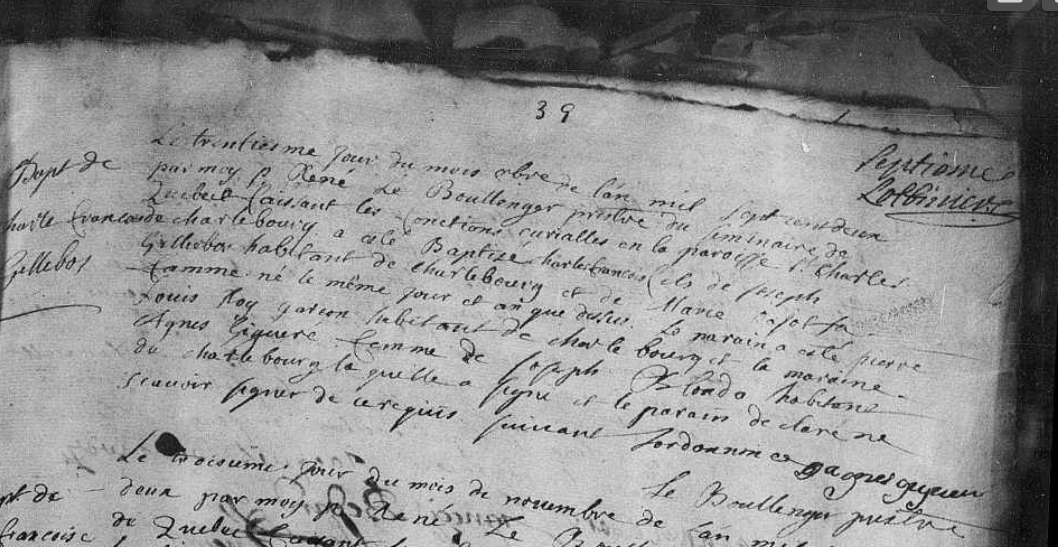
Origins: Charlesbourg, 1702
On October 30, 1702, in the parish of St-Charles-Borromée at Charlesbourg, a boy was baptized Charles François. His parents were Joseph Guilbault and Marie Anne Pageot—established residents of the farming community just north of Quebec City.
Charlesbourg was one of New France's earliest settlements, founded in 1659 with a distinctive radial village plan. The Guilbault family had been there for generations: Charles François's grandfather Pierre Guilbault had married Louise Senécal, a Fille du Roi, establishing the family's roots in the region.
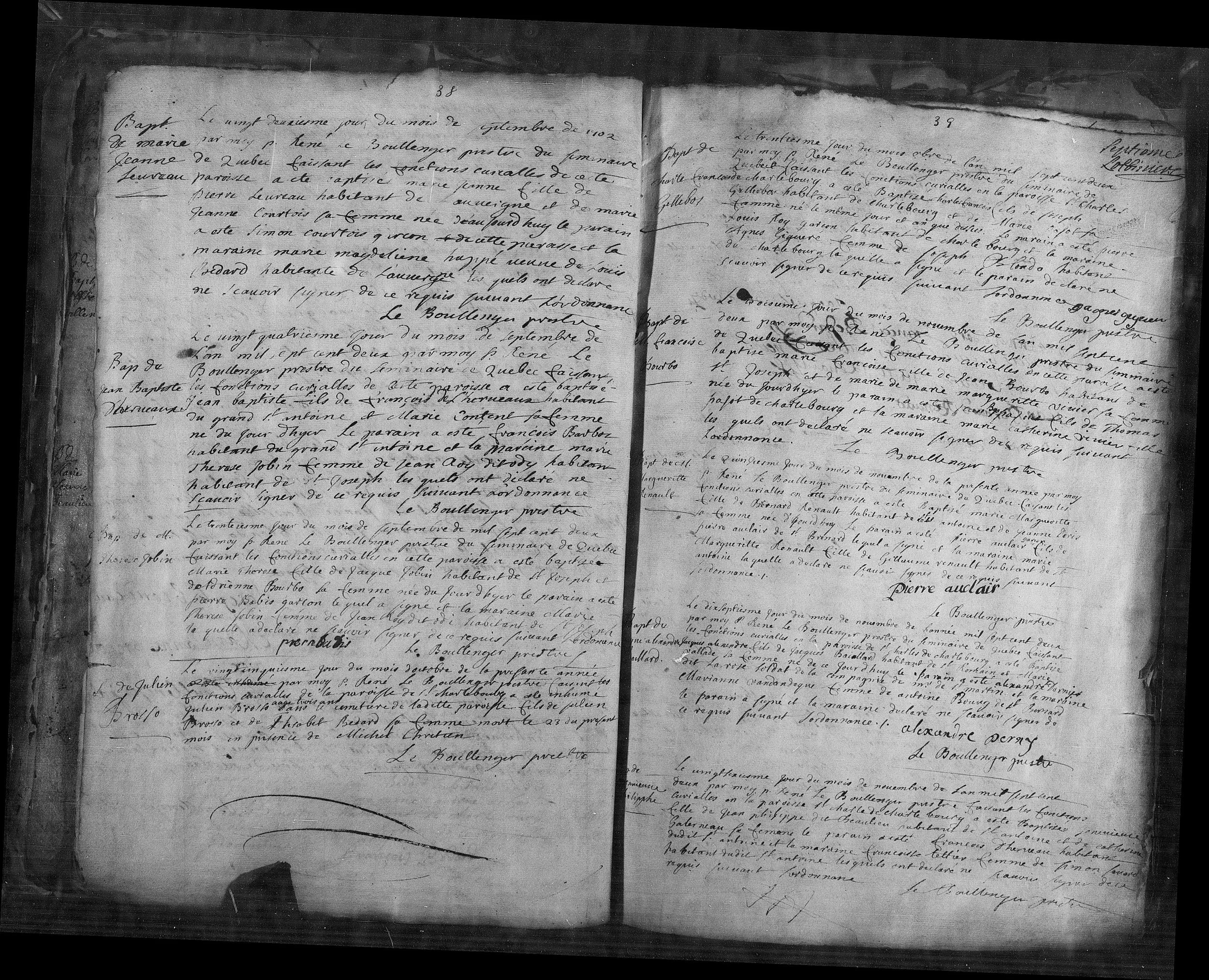
The Guilbault Family of Charlesbourg
Charles François was one of five children born to Joseph Guilbault and Marie Anne Pageot, who had married in 1694. His siblings included Marie Marguerite (1695), Marie Charlotte (1698), Anne Elisabeth (1699), and Joseph (1705). Of these, Charles François would be the one to carry the family line forward to future generations.

First Marriage: Marie Catherine Antoinette Deguise Flamand
On March 19, 1727, at Notre-Dame-de-Québec, Charles François married Marie Catherine Antoinette Deguise Flamand. He was twenty-four years old; she was twenty-two, born May 25, 1704, to Guillaume Deguise Flamand and Marie Anne Morin.
The marriage record lists prominent witnesses: Jacques de Guise, Pierre de Guise, Thomas Alard, Jean Thesier, and Charles Vachiur. The presence of multiple Deguise family members suggests this was a well-connected union between established Quebec families.


The First Family: Joy and Sorrow
Charles François and Marie Catherine had four children in just four years—a rapid succession that ended tragically when Marie Catherine died in November 1731, just months after giving birth to their youngest son Gabriel.
Of the four children, only two survived infancy. The parish registers of Notre-Dame-de-Québec tell a story familiar to colonial families: baptisms followed too quickly by burials, the rhythm of hope and loss that marked 18th-century life.
Documentary Evidence: The First Family
The parish registers preserve the brief lives of two infants who did not survive, alongside the baptisms of the two sons who would continue the family line.
Charles Thomas - First Son

The Infant Losses


Gabriel - The Link Forward

Marie Catherine Antoinette Deguise Flamand died on November 11, 1731—just three months after giving birth to Gabriel. Charles François was left a widower with two young sons: Charles Thomas (age 4) and Gabriel (age 3 months).

Second Marriage: Marie Croquelois Laviolette
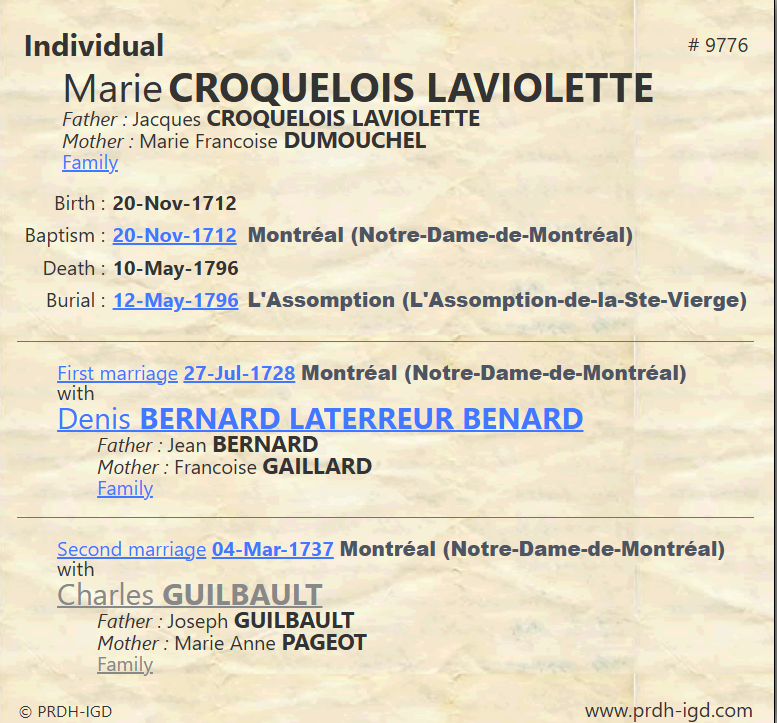
Six years after losing his first wife, Charles François remarried. On March 4, 1737, at Notre-Dame de Montréal, he married Marie Croquelois Laviolette, daughter of Jacques Croquelois Laviolette and Marie Françoise Dumouchel.
Marie was herself a widow—she had previously married Denis Bernard Laterreur Benard in 1728. At twenty-four years old, she was ready to begin a new chapter, and Charles François, now thirty-four with two young sons, needed a partner to help raise his family.
The marriage in Montreal rather than Quebec suggests Charles François had already relocated—or was in the process of moving—westward. By the time children from this marriage were baptized, the family was established at Sault-au-Récollet, north of Montreal on the Rivière des Prairies.
This marriage would prove remarkably long-lasting. Marie Croquelois Laviolette would survive until May 10, 1796, living to the remarkable age of eighty-three—outliving her husband by thirty-six years.
First Marriage: Marie Catherine Deguise
- Married: March 19, 1727
- Wife's dates: 1704-1731
- 4 children (2 survived)
- 4 years of marriage
- Married in Quebec City
Second Marriage: Marie Croquelois
- Married: March 4, 1737
- Wife's dates: 1712-1796
- At least 5 children documented
- 23 years of marriage
- Married in Montreal
The Second Family: Sault-au-Récollet
After his second marriage, Charles François established his family at Sault-au-Récollet, a parish north of Montreal on the Rivière des Prairies. Here, the children of his second marriage were baptized—and here, too, he would eventually be buried.
The parish records of La-Visitation-du-Sault-au-Récollet document at least five children from this second marriage, though infant mortality again claimed several:
| Child | Born | Died | Notes |
|---|---|---|---|
| Marie Angélique | 1744 | 1747 | Died age ~3 |
| Marie Rose | 1747 | — | Survived |
| Marie Victoire | 1750 | 1751 | Died age ~10 months |
| Marie Archange | 1752 | — | Survived |
| Louis | ~1749 | 1754 | Died young |
The Children's Records




The End of an Era: June 1760
Charles François Guilbault died on June 16, 1760, and was buried the following day at La-Visitation-de-la-Bienheureuse-Vierge-Marie, Sault-au-Récollet. The register records his age as approximately fifty-nine years—he was actually fifty-seven.
The timing of his death placed him at a hinge point in history. Just nine months earlier, Quebec City had fallen to British forces after the Battle of the Plains of Abraham. The French had won a desperate victory at Sainte-Foy in April 1760, but British reinforcements arrived by ship in May. By the time Charles François was laid to rest, French forces were retreating toward Montreal for a final stand.
He would not live to see the surrender. On September 8, 1760—less than three months after his burial—Montreal capitulated to the British. New France was finished. The colony Charles François's grandfather had helped build, the world the Guilbaults had known for four generations, ceased to exist.
At the time of his death, his son Gabriel (Charles Gabriel of Episode 4) was twenty-eight years old and had already been married for three years to Marie Charlotte Morin. The family line was secure—and would continue under British rule.
The Burial Record
The burial record identifies Charles François simply as a habitant de cette paroisse—a resident farmer of this parish. It is the only occupation recorded for him in any surviving document. In a colony built by habitants, it was identity enough.


The Habitant's Legacy
Charles François Guilbault lived the life of a Quebec habitant: he farmed, he married, he buried children, he remarried, he raised a family, and he died in his parish. The records preserve the essential facts—baptisms, marriages, burials—but reveal little of the daily labor, the seasonal rhythms, the small negotiations of colonial life.
What they do reveal is continuity. His son Gabriel (Charles Gabriel) would marry, settle in L'Assomption, and father another Gabriel—the voyageur who would paddle into the pays d'en haut and marry Marie Josephte Abitakijikokwe. The habitant's grandson would travel farther than Charles François likely ever imagined, connecting the family to the Indigenous peoples of the Great Lakes.
From habitant to voyageur: two generations of Guilbaults adapted to the changing landscape of Quebec. Charles François worked the land near Montreal; his grandson Gabriel would work the canoe routes of the fur trade. Both were shaped by the same colony—but the grandson would live to see it transformed under British rule.
The PRDH Records


Connecting the Generations
Charles François Guilbault's life forms a crucial link in the chain that connects the earliest Guilbaults of New France to the Métis heritage of later generations. His son Gabriel (Charles Gabriel of Episode 4) would father Gabriel the voyageur (Episode 3), who would marry Marie Josephte Abitakijikokwe and create the documented connection to Ojibwe heritage.
The path from habitant in Charlesbourg to voyageur in the pays d'en haut required three generations and nearly a century of adaptation. Each generation responded to the opportunities and challenges of their time: Charles François to the agricultural needs of the Montreal region; his son to the farming communities around L'Assomption; his grandson to the fur trade and frontier life.
Charles François Guilbault (1702-1760) →
Charles Gabriel Guilbault (1731-1784) →
Gabriel Guilbault "le voyageur" (1762-1833) →
married Marie Josephte Abitakijikokwe (Ojibwe)
Document Gallery
Continue the Journey
Charles François Guilbault's story takes us to the heart of the 18th century, to the final decades of New France. He lived through the expansion of the colony, the wars with Britain, and died just as the French regime was collapsing. His descendants would adapt to British rule and eventually produce a voyageur who would travel farther west than Charles François could have imagined.
The documentary trail continues both forward and backward: Episode 4 follows his son Charles Gabriel forward into L'Assomption and the family that would produce the voyageur. Episode 6 explores his father Joseph Olivier, and Episode 7 returns to the founder Pierre Guilbault and his Fille du Roi bride.
Research Note: The PRDH (Programme de recherche en démographie historique) database has been invaluable in reconstructing this family line, providing verified linkages between generations that might otherwise be lost in the variations of spelling and incomplete parish registers.
Are You Connected to the Guilbault Line?
If you descend from the Guilbault (Guilbeau, Guilbeault) family of Charlesbourg and the Quebec parishes, from the children of Marie Josephte Abitakijikokwe, or from the founding families of the line — Senécal, Séguin dit Ladéroute, Morin, Couillaud dit Roquebrune, Gaulin — I’d like to compare notes. Documented trees, DNA matches, family papers, and even half-remembered stories have all moved this research forward.
Get in Touch About This FamilyCousin connections are informal and reciprocal — no fee, no obligation, just shared work on shared ancestry.
Every Family Has a Story Worth Telling
Whether you're just beginning your research or ready to transform years of work into a narrative your family will treasure, I'd love to help.
LET'S TALK ABOUT YOUR FAMILY