
Spools of Thread: On Holding Things Together, Imperfectly
A STORYLINE GENEALOGY DISCOVERY
Spools of Thread
A Genealogist's Discovery
On Holding Things Together, Imperfectly

Farberware Dorchester, pattern #388—my mother's "company's coming" dishes.
"Do we need to pull out the leaves?"
My sister asked me this as we set the table for nine. And in that moment, I realized I couldn't remember the last time I'd extended the leaves on my dining table. It used to be a frequent occurrence—holidays, birthdays, Sunday dinners. But it had been so long that I had to go searching for the spools of thread.
The mechanism that holds the leaves in place has been broken for years. But spools of thread, inserted just so, work perfectly. We've always made do.
The Table
My parents bought this solid rock maple table used, around 1960. It has been there for my five siblings and me, and then for my two children. It has seen more family meals than I could ever count—the ordinary ones and the special ones, the celebrations and the difficult conversations, the noise of six children and the quieter years that followed.
My father was always our most important dinner guest. He would arrive with a bottle of wine. He carved the turkey, the roast. Our gatherings were never quite the same after he died, fifteen years ago now. But we kept gathering. Less frequently. Often at Mom's house when my siblings and their children would visit from out of state.
And when company came to Mom's house, she would pull out the dishes.
Company's Coming
Farberware Dorchester, pattern #388. A discontinued 1990s stoneware line—bright white background, floral border with pink tulips and blue berries, a green verge line. Heavy, durable, oven and dishwasher safe.
Most people describe it as having a farmhouse aesthetic. My father thought it was Italian. European. Something more worldly than country. He picked it out himself, pre-retirement, and they bought the entire set—dinner plates, salad plates, the large serving bowls, everything.
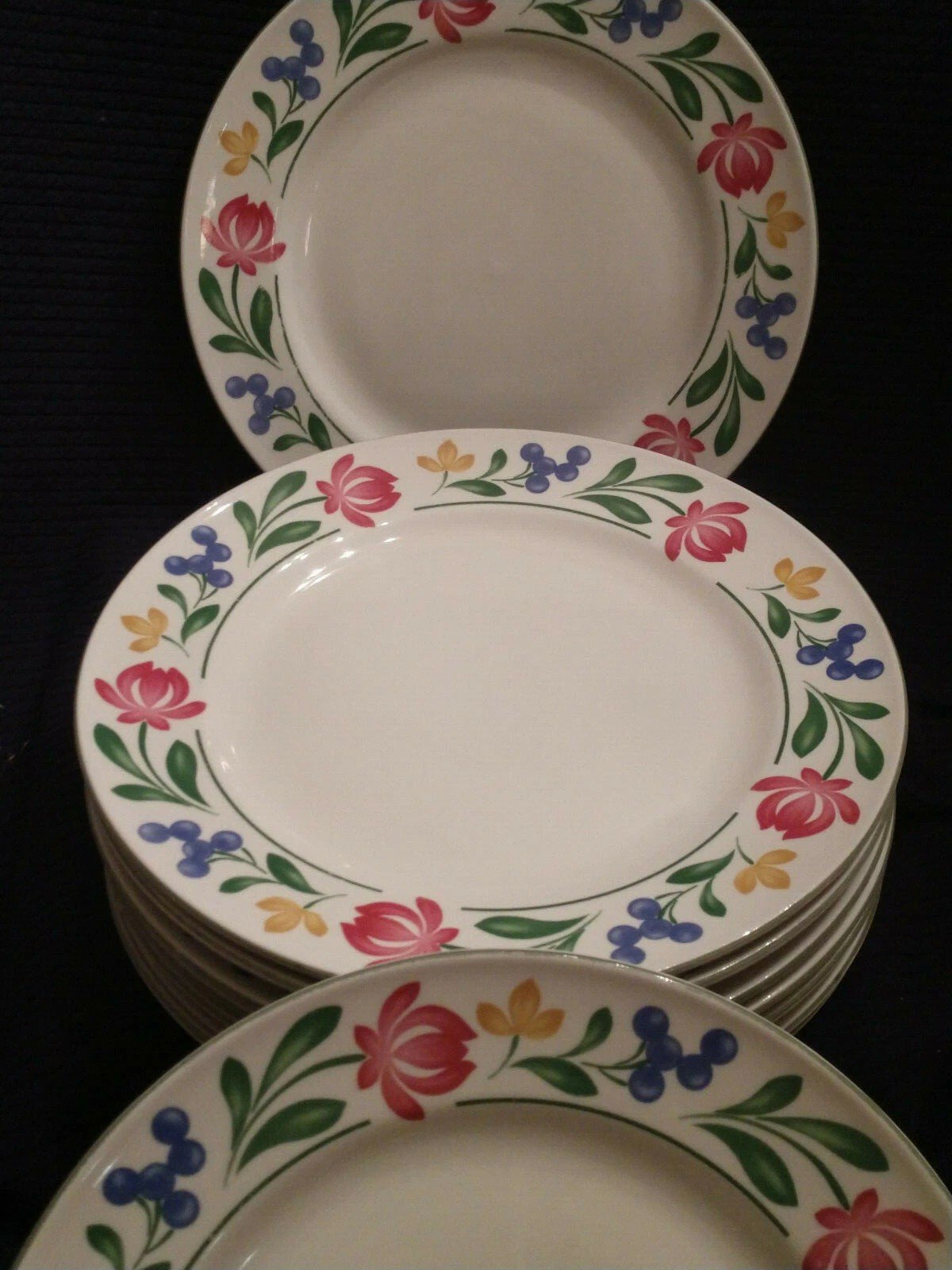
The full set—dinner plates, salad plates, bowls, serving pieces.
My father picked them out. He thought they were European.
These weren't the dishes we grew up with—by the 1990s, my kids were in elementary school. But when the family gathered at my parents' house, these became the dishes of choice. Less formal than the "china days," more festive than the plain white Corelle that had become the daily standard in both her house and mine. When Mom pulled out the Dorchester, it meant something. Company was coming.
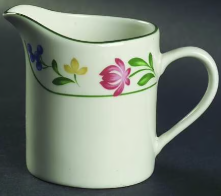
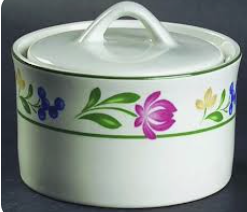
The creamer and sugar bowl—part of the complete set.
The Keeper of Things
When we cleaned out my mother's house, no one else wanted the dishes. They're heavy. There are a lot of them. Everyone has their own dishes, their own lives, their own storage limitations.
So I took them. Another thing I couldn't bear to part with. Another thing I probably didn't need—I already have stoneware and china and Corelle and a few place setting sets from my husband's mother. But here they are, in my house.
For two years, the Dorchester sat in the left cabinet of my rock maple buffet, coming out occasionally. The set made the buffet so heavy I couldn't move it for proper cleaning. Then our dog had an accident on the kitchen rug, and one thing led to another as it always does—the table turned on its side, pushed against the wall. While it was out of the way, I decided to paint the wall behind the buffet. On Christmas Eve, last year. Dishes stacked everywhere on my counters.
Eventually the painting got done, the table and rug went back in place, and I found a new spot for the dishes—in what was once my children's school supply cabinet, on the opposite side of the peninsula. For years that cabinet had been blocked by a huge dog kennel for our greyhound. When I finally cleared it out, removing school supplies my kids haven't needed since they were children (they're in their thirties now), I found it was the perfect place for my mother's "company's coming" dishes.

Farberware Stoneware, Dorchester, pattern #388, ©1995.
The mark on the bottom of every piece.
Nine for Dinner
This past weekend, my sister and her husband visited with two of their grown children. Another sister who lives locally was able to join us. Nine for dinner—chairs and a few stools pulled up to the table, both leaves extended, held in place with spools of thread.
I pulled out the Dorchester. My mother's silverware. Her artificial flowers for the centerpiece. We sat at the table I grew up with, eating from dishes that meant "company's coming" in her house, and now mean the same thing in mine.
The dishes were bright. The dinner was wonderful. The company was grand.
And it was sad to realize how seldom we do this anymore.
The Great Passage of Time
We were still missing a very special sister in Athens, Georgia, and my brother in Ohio. But it was still a glimpse back at what used to be—the extended table, the good dishes, the home-cooked meal, the faces of people I love. Mom and Dad would have loved knowing we were together, thinking of them.
Everything really changed when my father died. And then again when my mother was gone. These gatherings that used to be ordinary became rare. The traditions we took for granted became precious, fragile things we have to choose to continue.
It's these small rituals—pulling out the leaves, setting the table with those dishes, using her silverware—that remind me of the great passage of time. Of those we have lost. Of what it means to be the one who keeps the things.
My son and I finally emptied the storage unit a few weeks ago. More crates of "things" to go through in my garage. A beautiful tapestry bedspread my mother made herself. The curtains she sewed for my family room when we first moved to this house, thirty-two years ago. These are the things most difficult to part with. I don't really need them. I can't throw them away. I'm warming up to donating some of them—I have, in recent months. It's time to get brutal with the getting rid of things.
But some things remain. And I will continue to keep them, and use them, and remember.
Holding Things Together
The mechanism on my table has been broken for years. But spools of thread work perfectly.
Maybe that's how we carry forward the traditions now. Imperfectly. With whatever we have on hand. The table still extends. The family still gathers—when we can, when life allows, when someone makes the effort to cook and someone else makes the effort to come. It's not the same as it was. But it's still something.
As a genealogist, I spend my days researching ancestors I never met, piecing together their lives from documents and records. But sometimes the most powerful discoveries aren't about the distant past. They're about the people we loved, the tables we sat around, the dishes that meant "company's coming."
These objects don't need research. They need remembering.
For Mom and Dad—
who taught us that the table extends,
the dishes come out,
and company is always welcome.
Related Reading
The Silver That Came Before Us: Inherited Silver Tea Sets →
Dating inherited objects to discover their stories—F.B. Rogers and Poole Silver Company.
Ojibwe Baskets, Beads, and Art: A Genealogist's Discovery →
Finding tangible connections to my Ojibwe 4th great-grandmother.
Perthshire Paperweights: A Genealogist's Discovery →
Three generations of women, six generations of ancestors.
This piece was written the week of what would have been my mother's 90th birthday.
The table is back to its usual size now. The dishes are put away.
But the memory of nine for dinner remains.
