
The Silver That Came Before Us: Inherited Silver Tea Sets
A STORYLINE GENEALOGY DISCOVERY
The Silver That Came Before Us
A Genealogist's Discovery
Dating Inherited Objects to Discover Their Stories

F.B. Rogers silver-on-copper coffee pot — inherited from my mother's house. Still holding flowers. Still part of the daily rhythm.
"Part of my process of researching ancestors is that when I discover their location of origin, I search for some type of historical map or artifact or art from that area as a tangible connection to them."
Two silver tea sets sit in my home. One came from my mother's house after she passed. The other was a gift from her when my husband and I set up our first home—I'd just refinished our dining room buffet, and she presented me with this set to display on it. I believe it came from my father's side of the family, though I can't say for certain.
As a genealogist, I'm trained to follow evidence. But with inherited objects, the trail often runs cold. No one thought to write down who bought these pieces, or when, or why. The people who knew are gone now. What remains are the objects themselves—and the clues they carry.
This is what genealogists do: we read the marks, research the manufacturers, narrow the timeline, and work backward to the most likely ancestors who might have owned these pieces. We may never know for certain—but we can narrow the possibilities.
Reading the Marks
The first rule of object research is the same as genealogical research: check the primary source. With silver, that means turning pieces over to examine the maker's marks.
Set One: F.B. Rogers Silver Company
The set from my mother's house is substantial—a coffee pot, tea pot, creamer, sugar bowl, and a large footed tray that makes the whole set weigh over fourteen pounds. Each piece is marked "F.B. Rogers."
F.B. Rogers Silver Company was founded in 1883 in Taunton, Massachusetts. They specialized in "silver on copper"—a construction method where a copper base is electroplated with silver. This differs from cheaper silver-plated items that use nickel alloys or Britannia metal as the base. The copper gives the pieces their notable heft and, as the silver wears over decades of polishing, produces a warm reddish patina that many collectors find beautiful rather than objectionable.

The copper bleeding through in high-contact areas creates a rosy undertone against the remaining silver — evidence this set was used, not just displayed. F.B. Rogers silver-on-copper tea set with coffee pot, tea pot, creamer, sugar bowl, and footed tray.
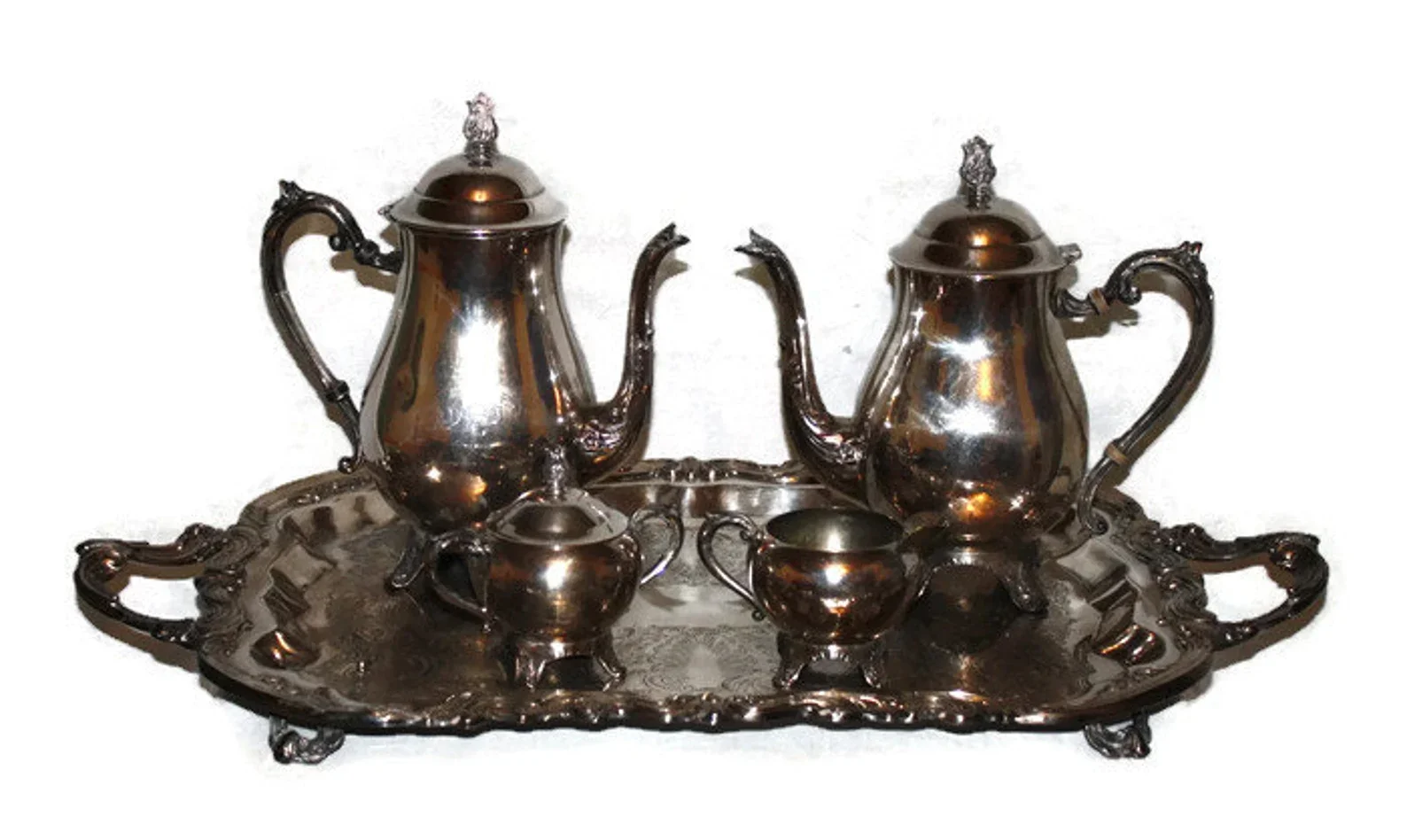
The ornate scrollwork feet and etched tray surface suggest Victorian or Edwardian influence — likely dating to the 1920s through 1950s. The complete set as inherited from my mother's house.
The tray in this set shows exactly this kind of wear—the copper bleeding through in high-contact areas, creating a rosy undertone against the remaining silver. The style—with its ornate scrollwork handles on the tray and pineapple finials on the lids—suggests Victorian or Edwardian influence.
Unlike the Poole set, I have clear memories of this one. It was always displayed prominently on the mahogany buffet in my mother's home—never hidden away in a cabinet. She used it for holidays and special occasions, and from time to time she would clean and polish the pieces. I would often help, fascinated by watching the tarnished silver shine up like new under our hands. The polishing cloth would come away black, and the set would gleam.
Now, looking at the copper patina showing through, I find I love the wear she once polished away. Those warm spots where the silver has thinned are evidence of all that care—all those afternoons of polishing, all those holidays of use. I don't polish it anymore. I let it tell its story.
Set Two: Poole Silver Company
The second set—the gift from my mother—bears different marks. On the bottom of the sugar bowl, I can make out "Guaranteed Poole Silver Co Taunton Mass" in a circular stamp, with the pattern number 9050 below it.

The maker's mark clearly reads "Guaranteed Poole Silver Co Taunton Mass"
with pattern number 9050—the primary source for dating this set.
Poole Silver Company was also based in Taunton, Massachusetts—just like F.B. Rogers. The company was founded in 1892 by George Poole and Edward Roche, originally operating as Poole, Roche & Co. from a small two-room factory at 106 Whittenton Street. They produced electroplated copper alloy (EPCA) hollowware until being acquired by Towle Silversmiths in 1971.
This set has no tray, just the teapot, creamer, and a two-handled sugar bowl. The pieces feature beautiful etched floral designs—leaves that catch the light differently depending on the angle.
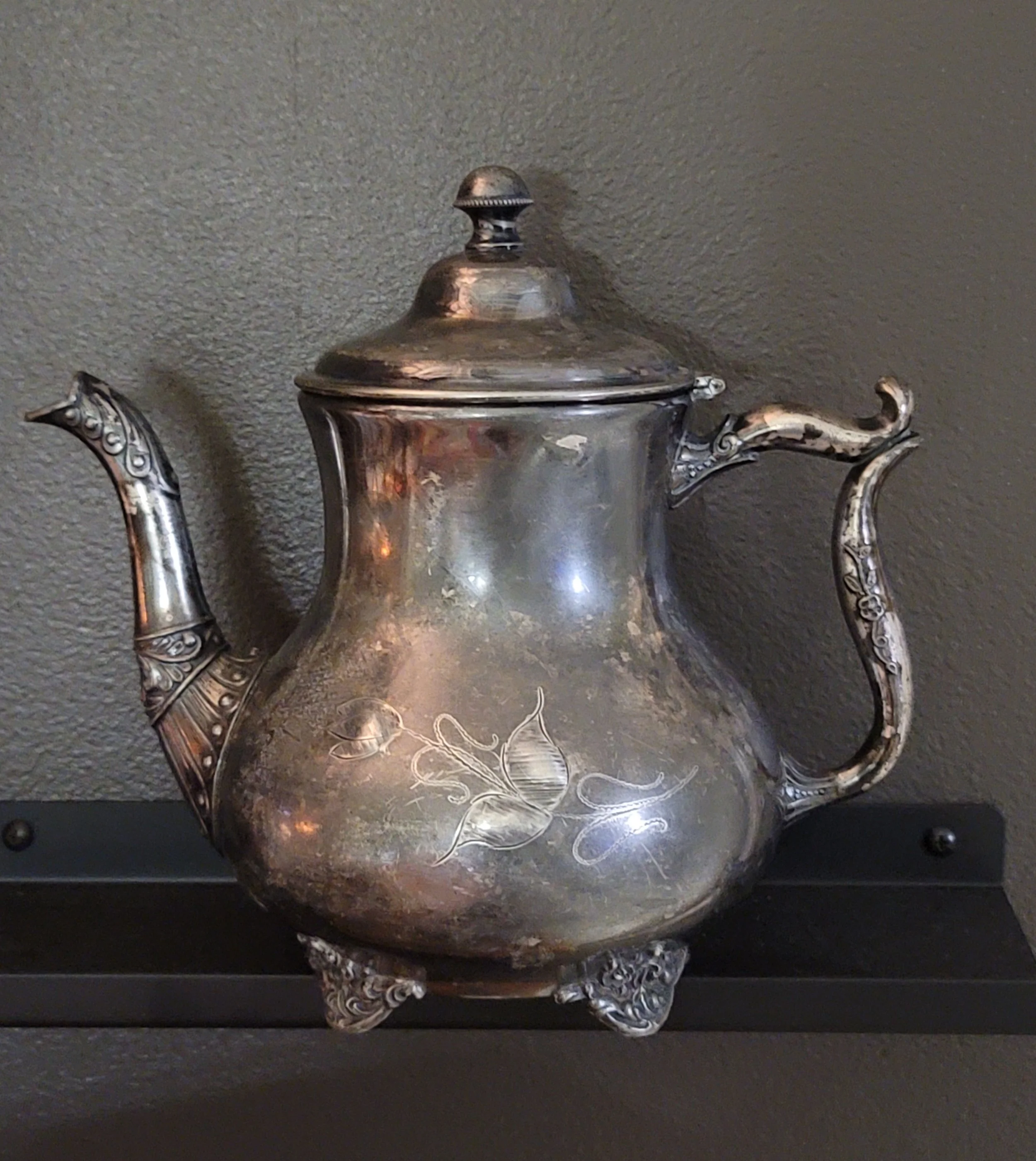
The Poole teapot with etched floral design
and ornate handle detailing.
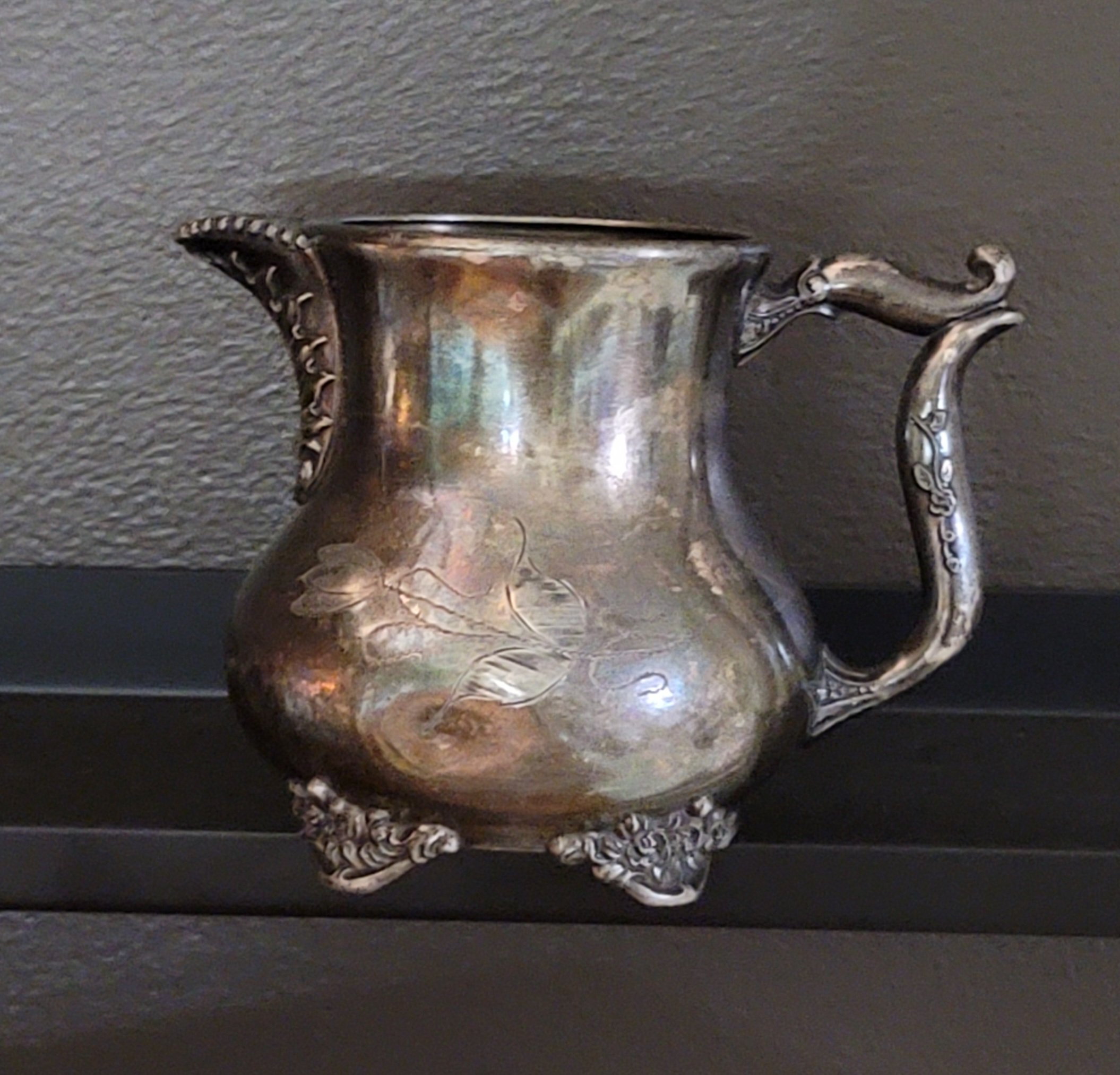
The creamer shows the same etched leaf pattern
consistent across all pieces in the set.
Like the F.B. Rogers set, this one shows its age honestly. The copper base peeks through on the sugar bowl where generations of hands lifted it by the handles.

The two-handled sugar bowl shows copper patina where generations of hands
lifted it—evidence of use that tells its own story.
Narrowing the Timeline
Neither of these sets is sterling silver—they're silver-plated, which means they don't carry the melt value of solid silver. But for a genealogist, monetary value isn't the point. The question is: what can these objects reveal about who owned them?
The F.B. Rogers set could date anywhere from 1883 (when the company was founded) through the mid-twentieth century. The style—with its ornate scrollwork handles on the tray and pineapple finials on the lids—suggests Victorian or Edwardian influence. Similar sets on the antique market are often dated to the 1920s through 1950s. The substantial weight and quality construction suggest this was a wedding gift or special purchase, not an everyday acquisition.
The Poole set with its 9050 pattern and etched floral design is likely mid-century, probably 1930s to 1950s based on comparable pieces. A similar set on Etsy dated to the 1920s-1930s featured the same pansy floral etching and "Guaranteed" mark. Poole was acquired by Towle in 1971, so the set predates that.
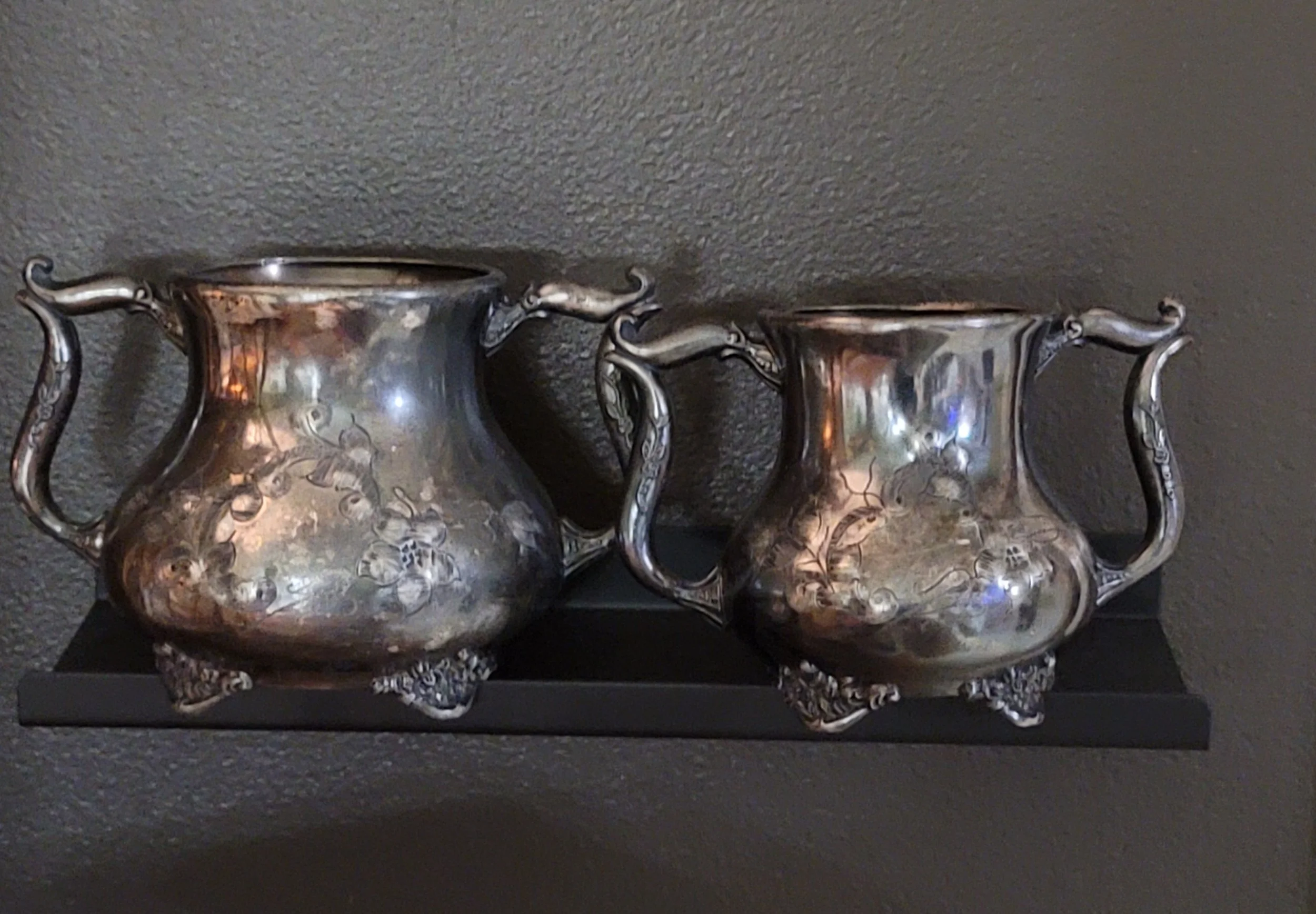
The creamer and sugar bowl together—matching the etched floral pattern
found on similar Poole sets dated to the 1920s-1930s.
The Genealogical Question
If the F.B. Rogers set dates to the 1920s-1940s and came through my mother's line, possible original owners include my maternal grandparents or my maternal great-grandparents. A silver tea service of this quality would have been a significant purchase or gift—the kind of thing given for a wedding or milestone anniversary.
The Poole set, which I believe came through my father's family, presents a similar puzzle. If it dates to the 1930s-1950s, it could have belonged to my paternal grandparents or great-grandparents. The absence of a tray makes me wonder if pieces were lost over time, or if this was always sold as a partial set.
Without documentation—a receipt, a photograph of these pieces in use, a letter mentioning them—I may never know for certain who first owned these sets. But I can narrow the possibilities by understanding when these objects were most likely manufactured and sold.
Understanding Silver Types
For anyone else trying to research inherited silver, here's a quick guide to what you might find:
Sterling Silver is 92.5% pure silver alloyed with copper or nickel for workability. It will be marked "Sterling," ".925," or bear official hallmarks. Sterling has intrinsic melt value and is generally more valuable than plated pieces.
Silver-Plated items have a thin layer of silver applied over a base metal through electroplating (invented in 1840). Common marks include "EPNS" (electroplated nickel silver) or "EPBM" (electroplated Britannia metal). These pieces have no melt value but may have antique or decorative worth.
Silver on Copper is a specific type of silver-plating where copper serves as the base metal. This construction, used by both F.B. Rogers and Poole, produces heavier, more durable pieces. As the silver wears, the copper shows through with a pleasant reddish tone rather than the unattractive greenish verdigris you'd see with other base metals.
Two Massachusetts Companies: Both F.B. Rogers (founded 1883) and Poole Silver Company (founded 1892) operated in Taunton, Massachusetts—making this small city a significant center for American silver-plated hollowware production during the late 19th and early 20th centuries.
The Joy of Discovery
There's a particular pleasure in this kind of research—turning a piece over to find the maker's mark, searching for the company history, learning about electroplating and copper bases and Taunton, Massachusetts. Examining the craftsmanship up close: the way the scrollwork was formed, the precision of the etched florals, the weight of a piece in your hands.
And then the memories surface. Trying to remember the pieces in use. The mahogany buffet. My mother's hands on the polishing cloth. The way the set looked on the holiday table, gleaming under the dining room light. Objects have a way of unlocking moments we didn't know we'd stored away.
My mother had many serving pieces beyond these tea sets—platters, bowls, trays—probably a bit more modern, mid-century acquisitions for the entertaining life she and my father built. I've inherited those too, and I find myself wondering how to use them. My family is much less formal than hers was. We don't set a proper table for Sunday dinner. We don't have occasions that call for a fourteen-pound silver tray.
And yet these pieces exist. They survived. They came to me. The question isn't whether they fit my lifestyle—they don't, not really—but whether I can find ways to enjoy them anyway. Display them. Use them unexpectedly. Let them be beautiful even if they're not functional in the way they once were.
So that's what I did. The F.B. Rogers tray now hangs on my wall, right next to the china cabinet and ancestor photos. Displayed vertically, its ornate scrollwork frame looks almost like an antique mirror—the patina catching the light, the engraved surface telling its story of use. It no longer holds tea service. It holds memory.

The F.B. Rogers tray now hangs on my wall next to the china cabinet—
its copper patina glowing against the dark wall, the engraved scrollwork on full display.
The Poole tea set found its home in my coffee bar—the teapot, creamer, and sugar bowl displayed on the top shelf above my modern stainless canisters. They don't match anything. They don't need to. They're conversation pieces now, prompting the question every genealogist loves to answer: Where did that come from?
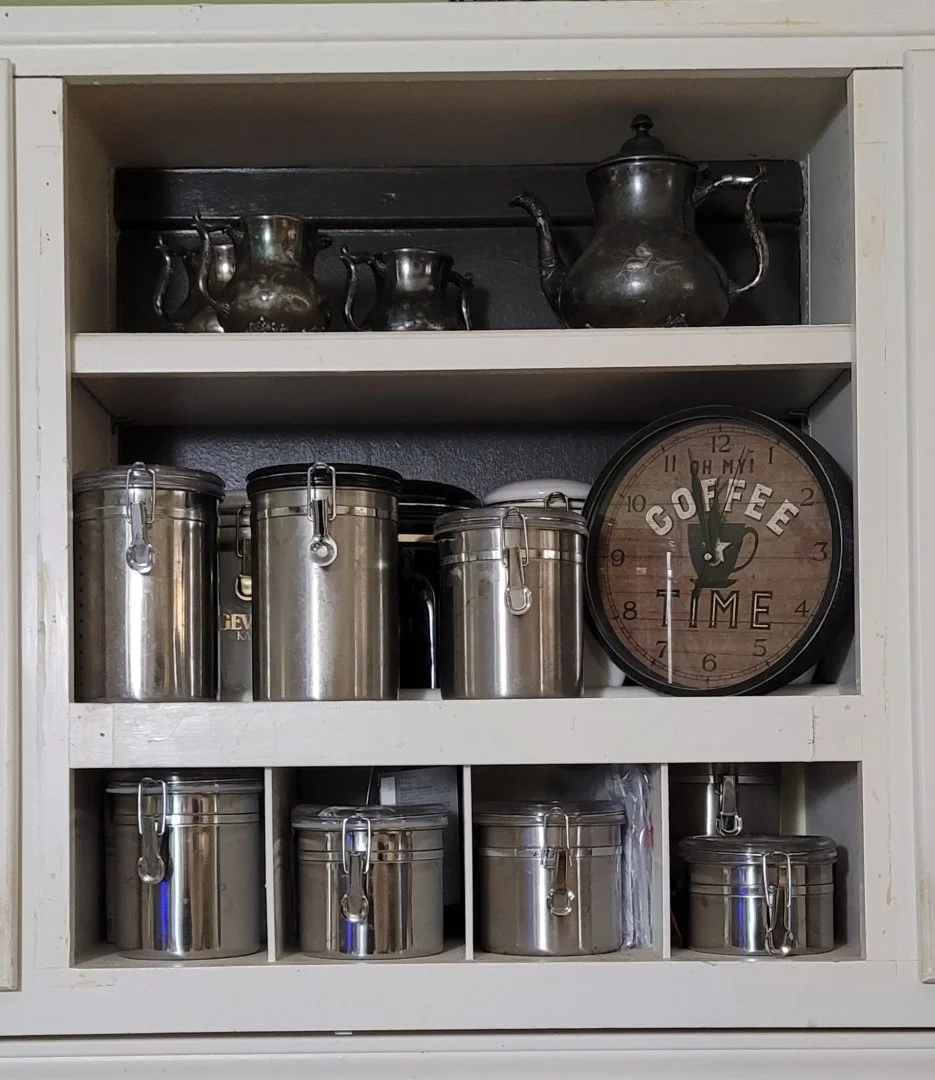
The Poole tea set now lives in my coffee bar—
vintage silver above modern stainless, past meeting present.
The ancestors who bought these pieces would probably be horrified. Or maybe they'd understand that objects need to be lived with, not just preserved.
Objects as Evidence
In genealogical research, we're trained to build cases from multiple evidence types—direct and indirect, original and derivative. Inherited objects fall somewhere in this framework. They're original sources in one sense (physical artifacts from the past), but the information they convey is largely circumstantial.
A maker's mark tells me where and approximately when something was made. Wear patterns tell me it was used, not just stored. Style and quality suggest economic status and aesthetic preferences. But none of this tells me definitively who owned these pieces first, or what occasions they commemorated.
What I do know is that both these sets came to me through my mother—one from her own household, one as a gift when I was setting up mine. They connect me to generations I never met, even if I can't draw the line with certainty. And perhaps that's enough. Not every genealogical question gets a definitive answer. Sometimes the value lies in the asking—in turning the object over, examining the marks, and imagining the hands that held it before ours.
Both sets now sit on display in my home. I don't polish away the patina. It's evidence.

The patina tells its own story — decades of polishing, holidays of use, generations of hands. Now it hangs where I can see it every day.
For the ancestors who poured tea from these pots—
whoever you were, wherever you are in my family tree,
your silver found its way home.
Related Reading
Ojibwe Baskets, Beads, and Art: A Genealogist's Discovery →
Searching for tangible connections to my Ojibwe 4th great-grandmother through traditional art forms.
Perthshire Paperweights: A Genealogist's Discovery →
Another companion piece on tangible connections to ancestral origins.
Storyline Genealogy Services →
Professional genealogy research transforming family history into compelling narratives.
Sources
"Poole Silver Company." Wikipedia. Accessed December 2024.
"Poole Silver Co: History, Marks and Flatware Patterns." Silvercollection.it. Accessed December 2024.
"How to Tell if Something is Silver Plated or Solid Silver." Hemswell Antique Centres. Accessed December 2024.
Comparable F.B. Rogers and Poole Silver Co. sets examined on eBay and Etsy marketplaces for dating reference.
Every Family Has a Story Worth Telling
Whether you're just beginning your research or ready to transform years of work into a narrative your family will treasure, I'd love to hear your story.
BEGIN YOUR RESEARCH INQUIRY