
Louis Couillaud dit Larocquebrune
Louis Couillaud dit Larocquebrune
A House, a Barn, and a Name That Crossed a Continent.
A Birth With No Record
Most lives in New France begin with a baptism entry — a date, two parents, a godfather and godmother, a priest's signature. Louis Couillaud's does not. The parish that would have recorded it lost its registers to fire twice, and both of the years he might have been born fall inside one of those losses. We do not know when he was born. We know only that he was.
His parents were Philibert Couillaud dit Roquebrune, a soldier of the Carignan-Salières Regiment who came from the diocese of Nevers and could not sign his name, and Catherine Laporte dit Saint-Georges, who was twelve when she married. They lived on sixty arpents at Contrecoeur that Philibert had bought from the seigneur in 1680 for thirty livres.
Contrecoeur is among the very few Quebec parishes to have lost its registers not once but twice. The first fire, at the house of the surgeon who kept them for the visiting missionary, destroyed roughly two and a half years — June 1678 through January 1681. The second was worse: 1687 en partie through 1701, fourteen and a half years, every missing year named in the register's own index.
The database record places Louis's birth about 1679, which falls in the first loss. Research analyst Michel Larocque argues for about 1689, which falls in the second. The gaps explain a missing baptism equally well either way, which is precisely why they cannot settle the question.
PRDH-IGD displays c. 1679, reconstructed from the 1681 census. Michel Larocque argues c. 1689, on the grounds that the earlier date produces a first-marriage age of about thirty-seven against a colonial average near twenty-seven, and leaves an eight-year hiatus in Catherine's childbearing between 1686 and 1694.
The two are not rival authorities. PRDH's own note on the record reads: "Due to the loss of Contrecoeur's earliest records in a fire, it is possible that his baptism took place after François's in 1686. His age at death is not very informative due to the notorious inaccuracy of the very older age statements." François was baptized in December 1686 — so the database itself allows a birth inside the second gap and sets the burial age aside.
A further point tells for the later date: Louis does not appear in the 1681 census. A child born in 1679 should stand in that household at age two. He does not. Against this, the analyst behind the database reconstruction reads the son entered there as Baptiste, aged three as Louis himself, which would dissolve the absence entirely.
This biography does not resolve the question. It is the subject of a separate case study, and the dates given throughout are given in both readings.

The household as enumerated in November 1681: Philibert Couillaut, forty; Catherine Laporte his wife, seventeen; sons Jean, five, and Baptiste, three; a third boy of two under a different surname; one musket, five head of cattle, five arpents under cultivation. Whether Louis is in this entry — and if so under which name — is the question the case study takes up.
Library and Archives Canada · Recensement de 1681, Seigneurie de ContrecoeurThe Debts He Inherited
Louis was a child, or a young man, when his father died. No burial record survives — Philibert died inside the register gap, and it was a creditor, not a priest, who first put his death on paper.
On 8 March 1701, Joseph Aubuchon came before the Lieutenant Général of the Royal Jurisdiction of Montréal, acting for himself and his brothers and sisters as heirs of their late mother, Marguerite Sédillot. He asked that a debt of 150 livres, contracted by "deffunt Philibert Couillau dit Roquebrune vivant habitant de Contrecoeur" in February 1687, be declared enforceable against the widow.
Catherine was named in two capacities: in her own right for the community of goods she had held with her husband, and as mère et tutrice naturelle et légitime administresse des biens et enfans mineurs — mother and natural guardian of the minor children. Louis was one of them, on either dating of his birth.
She answered in person. Her husband had made several payments, she said; she offered to prove them and to pay whatever remained. Then the line that describes the household Louis grew up in: comme elle n'est pas en état de payer — since she is not in a position to pay — she offered to pay the interest instead.
The court ruled the same day. The obligation was declared executory. There were two more debts besides: 118 livres to a Montréal merchant, contracted on the act where Philibert made his X, and 145 livres to another creditor. At least 413 livres, against an estate that was sixty arpents and a musket.

The first document to record Philibert's death — a debt collection, not a burial entry. Catherine is named as guardian of the minor children, which is the only place Louis appears in the proceeding at all: unnamed, among the minors.
BAnQ TL4,S1,D480 · Royal Jurisdiction of Montréal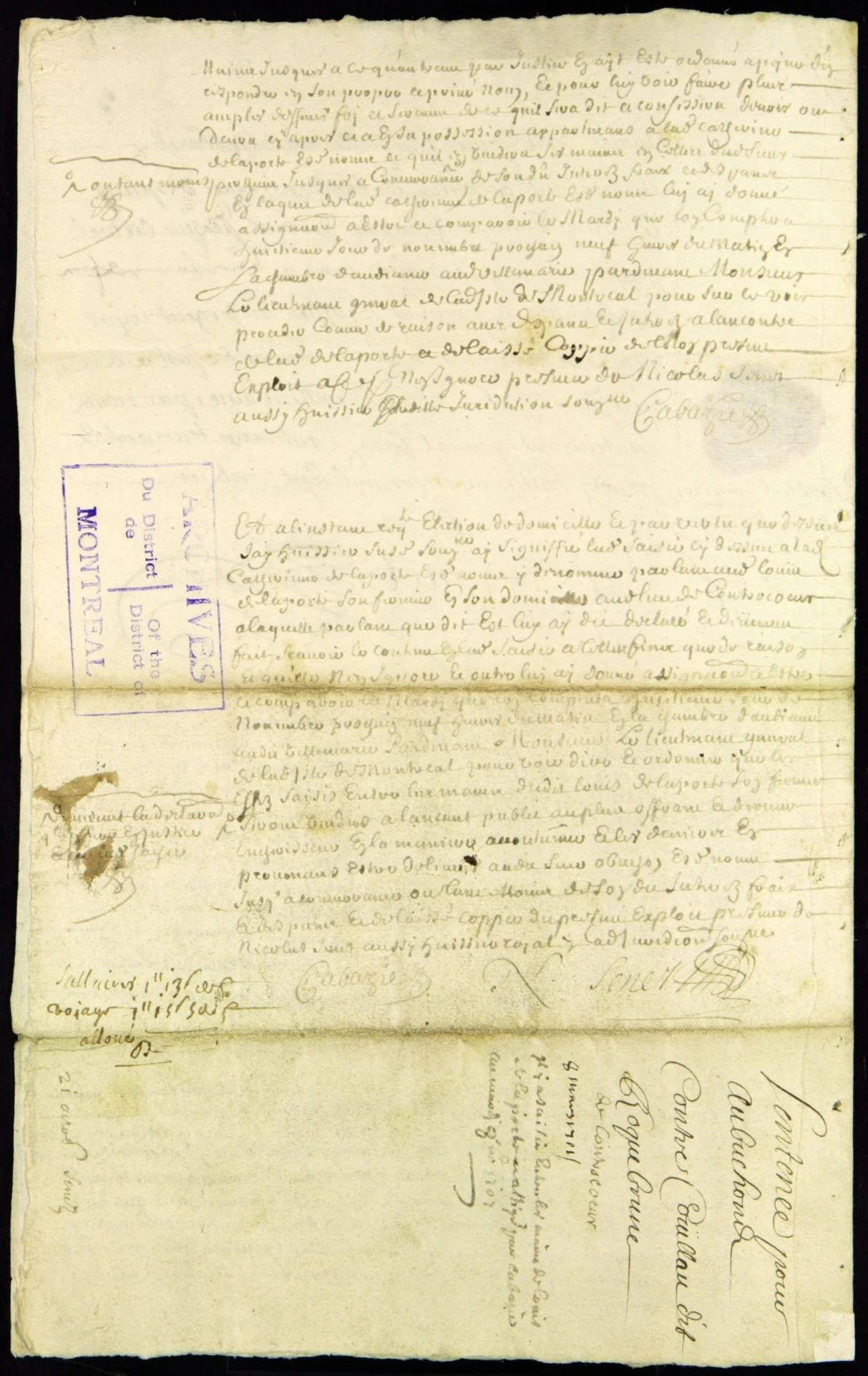
Six years later the huissier came to Contrecoeur. Money, wheat, peas and oats were seized sous la main du Roy in the hands of Louis Delaporte, Catherine's tenant, with a request that they be sold at auction. She was summoned for the ninth of November. The file ends there, with no recorded outcome.
BAnQ TL4,S1,D480 · Royal Jurisdiction of MontréalIn the middle of those years his mother remarried. On 9 October 1706 Catherine Laporte married Jean Charpentier at Varennes; the register calls her veuve de feu Jean Couillault, Philibert having been written down as Jean in that parish. A year later the court still described her as a widow of Contrecoeur, still resident there. Whatever household Louis had belonged to was coming apart around him.
Sent Out
The single most revealing document of Louis Couillaud's life is a hiring contract. On 24 March 1709 he went before Antoine Adhémar, royal notary, and bound himself out for a year. The act records where he had been living, what he was worth, and what he owned — which was nothing.
He is described as Louis Couillaud dit Roquebrune of Contrecoeur, living with Louis Laporte Saint-George, son oncle. Laporte was his mother's surname. The uncle was her brother, and he had been born about 1667 — which, on the later reading of Louis's birth, makes them roughly twenty-two years apart, uncle and nephew in name and something nearer to an employer and a poor relation in practice.
The terms are the part worth reading slowly. He was hired to Estiennette Hurtubise, wife of Jean Quenet, for one year. For that year he would receive eighty livres, his food, humane treatment, his laundry done — and one pair of beef-hide shoes.

Eighty livres was not a bad wage for a year's labour. But the shape of the arrangement tells its own story: a young man of the seigneury, with a father eight years dead and a mother remarried into another parish, living in a relative's house and being placed into service somewhere else. He owned no land. He had no trade recorded. The pair of shoes had to be written into the contract because he could not be assumed to have any.
Two years later, what remained of his father's estate was disposed of without him.
Beyond its place in Louis's life, this contract answered a question that had stood open across five published pages of the Philibert Couillaud research file. The 1688 obligation had described Philibert's land as lying between the holdings of "Sr george" and Louis Laporte, without stating any relationship between those men and Philibert. No document examined had named one.
This one does. Because Louis Laporte is son oncle to Philibert's son, he is Catherine's brother — and therefore Philibert's brother-in-law. A hiring contract for a landless young man resolved a question about his father's property that no property record could.
The Land Sold
By 1711 the concession his father had bought in 1680 was legally abandoned. The seigneur petitioned the court to have it sold, complaining that the neighbours were carrying the ditch maintenance the heirs were not doing.
The permission to sell was read aloud at the church door at Contrecoeur on 29 March. Notices went up at Notre-Dame in Montréal on the seventeenth, twenty-fourth and thirtieth of May. At the auction Louis's elder brother Antoine bid 214 livres, then formally opposed the sale by invoking the douaire préfix from their parents' marriage contract — the clause securing their mother's dower — which raised the adjudication to 278 livres. Antoine took the land.
It was a shrewd piece of legal work, and it kept the sixty arpents in the family. It did not keep them for Louis. Seventeen years later, when their mother and stepfather signed over the accumulated dower rente, that went to another brother, Philibert fils. Twice the estate was disposed of, and twice it passed him by.
Whatever Louis was going to have, he would have to go and get.
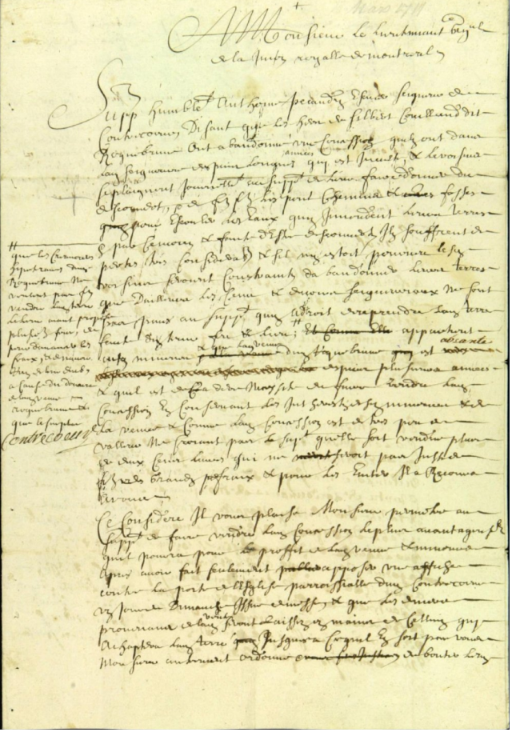
The opening of the auction file. Sixteen pages document six sequential steps — the seigneur's petition, the reading at the church door, three public notices at Montréal, the bidding, Antoine's opposition, and the final adjudication.
BAnQ TL4,S1,D1280 · Royal Jurisdiction of MontréalMarie Madeleine Sabourin
She was baptized at Lachine on 26 January 1699, daughter of Pierre Sabourin and Marie Madeleine Josephe Perrier. When she married Louis Couillaud she was seventeen. She would bury him forty-eight years later and outlive him by twenty.
The marriage was celebrated at Saint-Joachim de Pointe-Claire on 21 May 1716, on the western end of the island of Montreal — a long way from Contrecoeur, and a decisive move. Louis was leaving the seigneury where his family had no land left for him.
His age at that marriage is the crux of the whole dispute about his birth. On the earlier reading he was about thirty-seven; on the later, about twenty-seven. The colonial average for a first marriage was nearer the second figure.

Marie Madeleine Sabourin, baptized at Lachine. Daughter of Pierre Sabourin and Marie Madeleine Josephe Perrier — a family whose earlier generation is documented separately in this series through the Perrier and Gaillard lines.
Saints-Anges de Lachine, Registre BMD · ANQ, Montréal
Louis Couillaud dit Larocque and Marie Madeleine Sabourin, Saint-Joachim de Pointe-Claire. He was about twenty-seven or about thirty-seven, depending on which birth year is accepted; she was seventeen.
Saint-Joachim de Pointe-Claire, Registre BMD · ANQ, Montréal. His 1744 marriage at Oka is recorded in PRDH-IGD and in FrancoGene [21618]; no register image for L'Annonciation, Oka, has been located for that period.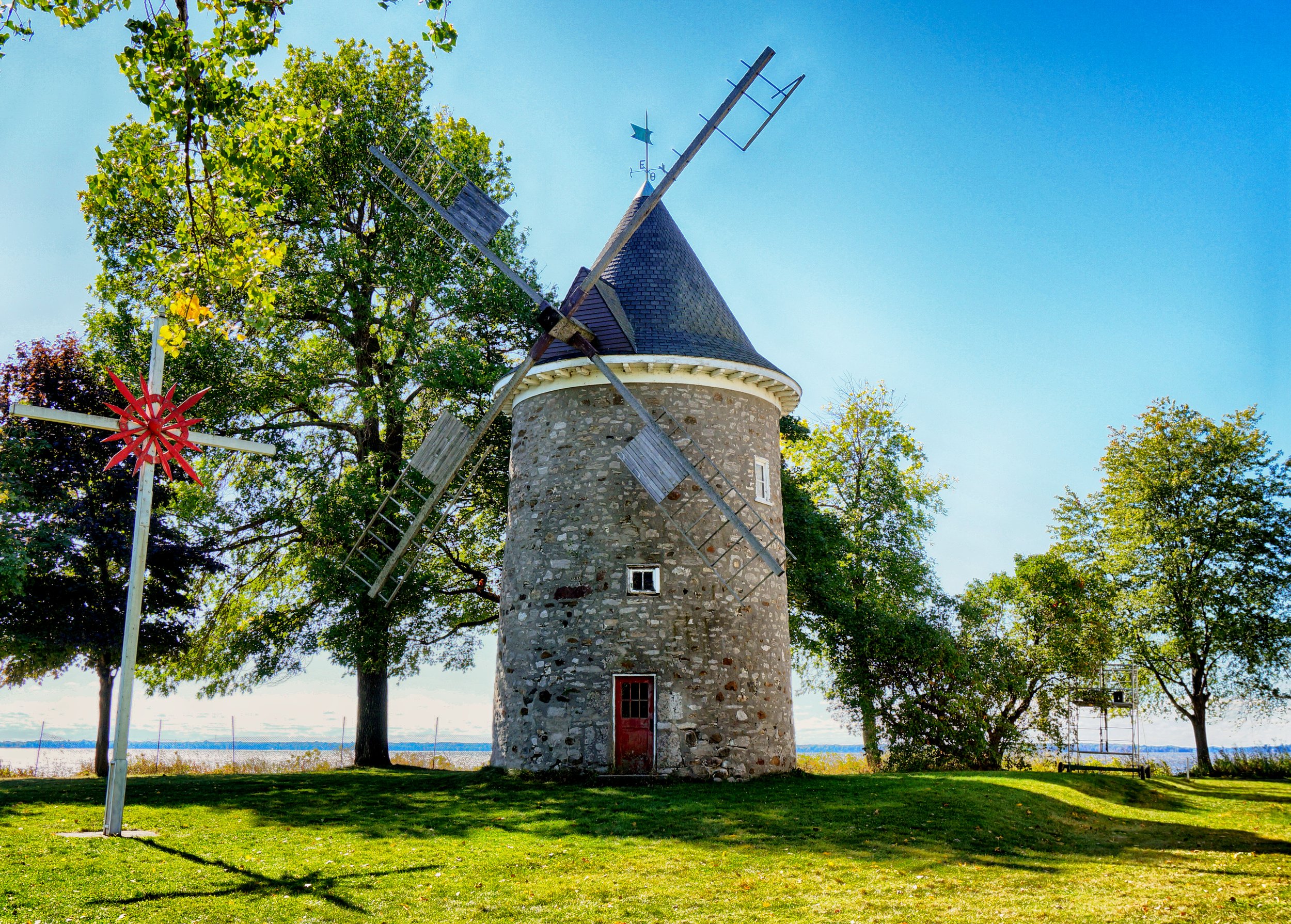
The mill on the point at Pointe-Claire, built about 1708 and standing when Louis and Marie Madeleine married eight years later. It belonged to the Sulpicians, seigneurs of the island of Montreal, and ground the wheat of the farmers along Lac Saint-Louis. Within two years he would be recorded as a miller himself — at Sainte-Anne, at the far end of the island, not here — and twenty-five years later he would be farming beside another windmill of the same age, on the point at Île Perrot. Mills bracket his working life. This one ran until about 1860; by 1900 the sails and conical roof were gone and it served as an observation tower, and it was restored to the state seen here in 1967. The church he was married in was wooden and has not survived. The mill has.
Photograph by RedAndr, CC BY-SA 4.0, via Wikimedia Commons · creativecommons.org/licenses/by-sa/4.0The Children
Between 1718 and 1741 Marie Madeleine Sabourin bore fourteen children — or thirteen, depending on which count you follow. The baptisms move westward across the parishes as the family moved: Sainte-Anne-de-Bellevue, Pointe-Claire, and the Île Perrot. Whatever the total, the registers that failed his own generation did not fail theirs. Every one of these children has an entry.
The first, Louis fils, was born on 20 February 1718 and baptized the next day at Sainte-Anne-de-Bellevue — two years after the marriage. The second son, Jean Baptiste, was baptized at Pointe-Claire on 21 February 1720, with Baptiste Sabourin standing godfather. He is the ancestor through whom this line descends.
Between those two baptisms the registers give him a trade. At his brother Michel's marriage in February 1718, among those present, the priest wrote "Louis LaRocbrune, meunier du haut de la ditte Isle de Montreal" — miller of the upper end of the island of Montreal. Seven years later, at his daughter Marie Madeleine's baptism in April 1725, he is again "louis la roque meunier." He was working a mill at the western tip of the island, in the parish where most of his children were baptized.
The last child, Pierre, was baptized on 12 May 1741, and by then the description has changed: his father is habitant de l'île Perrault, a farmer of Île Perrot. Somewhere in those twenty-five years the young man hired out with his shoes written into the contract had become a miller, and then a man with land of his own.
The compiled lists disagree. Michel Larocque's enumeration of the family runs to fourteen baptisms between 1718 and 1741; he also cites Mgr Forbes's compilation of the families of Sainte-Anne-de-Bellevue for a figure of thirteen. Two sons named Pierre appear in the sequence, which in this period usually means the first died in infancy and the name was given again — a pattern that can easily produce a one-child difference between compilers depending on whether the first is counted. That is a plausible explanation and not a demonstrated one. The question is recorded here rather than resolved, and this biography gives no single figure as settled.

Louis fils, born 20 February and baptized the following day at Sainte-Anne-de-Bellevue. The first of fourteen, and the first Couillaud of this line to be born with a surviving record of it.
Sainte-Anne-du-Bout-de-l'Île, Registre BMD · ANQ, Montréal
Jean Baptiste Larocque, baptized at Pointe-Claire on 21 February 1720; godfather Baptiste Sabourin, from his mother's family. He married Marie Charlotte Séguin dit Ladéroute at Oka on 27 January 1744, and died at Vaudreuil in November 1791. In his own generation the dit name shifted again: the compiled records carry him as Larocque dit Lebrun. The line to the present researcher runs through him.
Saint-Joachim de Pointe-Claire, Registre BMD · ANQ, MontréalTwo entries record Louis as a meunier. The marriage of his brother Michel at Sainte-Anne-de-Bellevue on 2 February 1718 lists among those present "Louis LaRocbrune, meunier du haut de la ditte Isle de Montreal"; PRDH's record of that marriage (#15256) carries the occupation in its own field. The baptism of his daughter Marie Madeleine at the same parish on 12 April 1725 names her as daughter of "louis la roque meunier et de marie magdlaine sabourin sa femme de cette paroisse"; PRDH #15161 again records meunier.
The same 1718 entry gives Michel's age as twenty-four, and names his parents as feu Philibert LaRocbrune, habitant de Contrecoeur, and Suzanne St Georges — the earliest of two records, forty-six years apart, to give Louis's mother a name other than Catherine.

The last of the children. The entry describes the father as habitant de l'île Perrault — no longer the miller of the upper island, but a landholder on Île Perrot. He was about fifty-two, or about sixty-two.
Registre BMD · ANQ, MontréalThree Arpents by Eighteen
In 1724 the seigneur of Île Perrot rendered his aveu et dénombrement — the sworn statement of who held what on his island. Louis Couillaud appears in it twice, and the two entries between them describe everything he had built since the year he owned a pair of shoes.
He is the first habitant named on the south coast, immediately after the domain itself: "Louis Laroque qui possede trois arpens de front sur dix huit de profondeur… lequel a maison, grange, Etable et vingt arpens de terre labourable." Three arpents by eighteen, a house, a barn and a stable, and twenty arpents under the plough, against thirty sols and a minot and a half of wheat a year in rente.
Further along the same coast, a second parcel: three arpents of frontage, aucuns batiments mais seulement huit arpens de terre labourable — nothing built, eight arpents broken. On the seigneurial plan the two are lots 4649 and 4668.
Lot 4649 sits at the eastern tip of the island, immediately beside the seigneur's own domain, on the point that is still called Pointe du Moulin — the windmill point. A stone mill had stood there since about 1708. The man the parish registers had been calling meunier for six years had taken land at the foot of a mill.
Whether he worked it is not recorded, and there is a complication worth stating: the following year, at his daughter's baptism, he is still entered as a miller of this parish — Sainte-Anne-de-Bellevue, across the water on the island of Montreal. He may have held the Île Perrot land while still working a mill at Sainte-Anne. By 1741 the descriptions have resolved: he is simply a habitant of Île Perrot.

The south coast of Île Perrot, declared household by household. The list opens "au sud dud. premier domaine sont les habitans qui suivent, sçavoir de la Coste du sud de lad. Isle" — and the first name written is his: Louis Laroque, trois arpens de front sur dix huit de profondeur… maison, grange, Etable et vingt arpens de terre labourable.
Aveu et dénombrement de damoiselle Françoise Cuillerier… pour la moitié du fief de l'île Perrot, 1724 · BAnQ, ark:/52327/3315597Aveu et dénombrement for half the fief of Île Perrot, 1724 — rendered by Françoise Cuillerier, wife of Jean Quenet, merchant of Montreal, previously widow of Joseph Trottier sieur Desruisseaux
Côté nord-est
- Domaine — ten arpents of frontage across the width of the island140 arpents of ploughable land
Côté sud du domaine
- Louis Laroque — 3 × 18 (20)maison, grange, étable · thirty sols and a minot and a half of wheat in rente, three sols of cens
- Pierre Deschamps — 3 × 20 (60)maison, grange, étable
- Guillaume Lalonde — 4 × 20 (30)maison, grange, étable
- Noël Lacerisaye — 3 × … (20)maison, grange, étable
- François Lamoureux — 3 × … (15)maison, grange, étable
- Joseph Gauthier — 3 × 20 (20)maison, grange, étable
- Michel Lacerisage — 3 × … (30)maison, grange, étable
- Jean-Baptiste Lalonde — 3 × … (30)maison, grange, étable
- Toussaint Hunault — 6 × … (60)maison, grange, étable
- Charles Deau (Daoust) — 3 × … (30)maison, grange, étable
- François Lalonde — 3 × … (20)maison, grange, étable
- René Fortin — 3 × … (30)maison, grange, étable
- S. Deschaillons — 6 × … (6)aucun bâtiment
Côté sud, continued
- Pierre Leduc — 3 × … (20)maison, grange, étable
- Jean-Baptiste Sabourin — 3 × … (10)maison
- Jacques Sabourin — 3 × … (15)maison
- Jean Chotart — 3 × … (10)maison
- Joseph Fortier — 6 × … (40)maison, grange, étable
- Antoine Deschamps — 3 × … (10)aucun bâtiment
- Louis laRoque — 3 × … (8)aucun bâtiment
- Arrière-fief conceded to S. Raimbault, procureur du roi — 6 × 20, aucun établissement
- Two leagues of land not conceded
Côté nord du domaine
- Jean Neveu — 3 × 20 (20)maison, grange, étable
- Louis Neveu — 3 × … (20)maison, grange, étable
- Joseph LaCerisaye — 3 × … (40)maison, grange, étable
- Joseph Leduc — 3 × … (50)maison, grange, étable
- Lafleur — 3 × … (50)maison, grange, étable
- Joseph Deslage — 6 × … (60)maison, grange, étable
- Jean-Baptiste Desloges — 3 × … (7)aucun bâtiment
- Edouard Lalonde — 3 × … (7)aucun bâtiment
- Guillaume Lalonde — 3 × … (30)maison, grange, étable
- Joseph Lalonde — 3 × … (8)aucun bâtiment
- Louis Lalonde — 3 × (9)aucun bâtiment
- Jacques Plante LaPlante — 3 × … (10)aucun bâtiment
- The former domain as explained above; two leagues not conceded; and the islands
The half-fief was declared by Françoise Cuillerier, wife of Jean Quenet, merchant of Montreal. In March 1709 the engagement that sent Louis out to work had bound him for a year to Estiennette Hurtubise, wife of Jean Quenet.
They are the same man. Jean Baptiste Guenet, baptized at Saint-Godard in Rouen in April 1647, married Étiennette Antoinette Hurtubise at Notre-Dame-de-Montréal in December 1675 and, after her death, Françoise Cuillerier in the same church on 3 January 1718. Cuillerier had been the widow of Joseph Trottier, sieur Desruisseaux, and it was through her that half the fief of Île Perrot came into that household.
So the sequence runs: in 1709 a landless young man is hired out for a year by the Quenet household. In January 1718 that household marries into the seigneury of Île Perrot. By 1724 the same young man, now past forty, stands first among the habitants named on its south coast, with a house, a barn, a stable and twenty arpents under the plough.
Whether one thing led to the other is not recorded. The date Louis took his concession has not been established, and until it is, the sequence is a sequence rather than a cause. But the two acts fifteen years apart name one household, and that much is documented.
The answer is two entries above his own in the same 1724 enumeration. Jean-Baptiste Sabourin, three arpents, ten cleared, with a house. Jacques Sabourin, three arpents, fifteen cleared, with a house.
His wife's family were already there. Jean-Baptiste Sabourin had stood godfather to their son Jean Baptiste at Pointe-Claire in 1720. Louis did not move to open ground; he moved to where the Sabourins were, and took land in the same row.
His neighbours on that side of the domain were Pierre Deschamps, holding eight arpents by twenty and sixty cleared — the largest farm on the south shore — and a long run of Lalondes. Much of what was lot 4649 now lies under a golf course.
Forty Kilometres, and a Different Life at the End of Them
Louis Couillaud's whole adult life is a single westward movement. He was born at Contrecoeur on the south shore, below Montreal. By 1716 he was marrying at Pointe-Claire, near the western end of the island. By 1718 he was a miller at Sainte-Anne-de-Bellevue, at the island's western tip, where most of his children were baptized; by 1724 he held two lots across the water on Île Perrot, and by 1741 he was farming there. His son Jean Baptiste married at Oka, on the Lake of Two Mountains, in January 1744, and would be buried at Vaudreuil. He died there in 1764, and his widow was buried at Vaudreuil twenty years after that.
It is not a great distance — forty kilometres or so, end to end. But it took him from a seigneury where his family's land had been auctioned to a parish where he was recorded as a habitant, and every one of those places appears on a map drawn in his lifetime.

Carte de l'Isle de Montreal et de ses environs, by Nicolas Bellin, hydrographer of the Marine. Drawn when Louis was in his fifties or sixties and farming on Île Perrot. Pointe-Claire, Ste-Anne, the Isle Perot and the Lac des Deux Montagnes all appear — the entire geography of his adult life on one sheet.
Jacques-Nicolas Bellin, 1744 · Public domain, via Wikimedia Commons
Île Perrot as surveyed by Joseph Bouchette, sixty-seven years after Louis's death. The long narrow farm lots running back from the shore are the seigneurial pattern he would have worked within; the church marked on the south shore is the parish his youngest children belonged to.
Joseph Bouchette, 1831 · Public domain, via Wikimedia CommonsThree Men of the Same Name
In February 1764, in one parish, in the space of eight days, two of his sons married. The register page that records both of them also records something a genealogist has to reckon with: by the end of his life there were three living men called Louis Laroque Brune in the same parish.
On 13 February his son Louis fils — the child baptized at Sainte-Anne in 1718 — married Marie Françoise Lamadeleine dit Ladouceur. The entry names his parents as Louis Laroque Brune and Marguerite St Julien, and among those present were ledit Louis Laroque père and Joseph Laroque, oncle dudit époux.
On 20 February, seven days later, that same uncle Joseph married Marie Joseph Sauvé. His parents are given as Louis Laroque Brune and M. Magdelene Sabourin.
So the Louis who was father to the groom on the thirteenth was himself a son of the Louis who was father to the groom on the twentieth. Grandfather, son and grandson, all bearing the name, all alive, all in one parish register within a week.
The 20 February entry names Louis and Sabourin as living parents, without feu or défunt. It is the last documentary evidence that he was alive.

Two Larocque marriages eight days apart. The thirteenth: Louis Laroque Brune fils, son of Louis and Marguerite St Julien, with his father and his uncle Joseph present. The twentieth: Joseph Laroque Brune, son of Louis and M. Magdelene Sabourin. Three generations of the same name in one parish, and the last record of the eldest alive.
Sainte-Anne-du-Bout-de-l'Île, Registre BMD · ANQ, MontréalAny Larocque record from Sainte-Anne-de-Bellevue or the surrounding parishes after about 1740 needs to be tested before it is attached to this Louis. The name alone identifies nobody. What identifies him is the pairing with Marie Madeleine Sabourin, or the naming of Philibert as his father — and records that supply neither should be held aside.
Lake of Two Mountains
He died on 4 June 1764, three and a half months after the last of his sons married, and was buried the following day at the Lake of Two Mountains. He was seventy-five, or eighty-five.
The burial names his father as Philibert Couillaud dit Rocquebrune, deceased; his mother as Suzanne-Catherine Laporte dit Saint-Georges; and his wife as Madeleine Sabourin. Among three living men of the same name in the same district, that filiation is what makes this entry unmistakably his.
It also gives his mother a name that the Philibert research file gives her nowhere else — except once. Everywhere in that file she is Catherine. Here, at her son's burial, she is Suzanne-Catherine; and in 1718, at another son's marriage forty-six years earlier and in a different parish, she is Suzanne St Georges. Two independent records, and neither of them says Catherine.
No age at death is recorded in the abstract that survives. That absence is worth stating plainly, because a figure of ninety has circulated for this burial and cannot at present be traced to a source. It would not have settled anything in any case: his brother Jean-Baptiste's burial entry, made at Varennes eleven years earlier, gives an age of about eighty-six for a man whose surviving baptism proves he was seventy-five.
Marie Madeleine Sabourin outlived him by nineteen years and seven months. She died on 17 January 1784 and was buried at Vaudreuil on the nineteenth, recorded as his widow. She was eighty-five, and she had been married to him for forty-eight years.
Burial of Louis Couillaud / Larocquebrune
| Death | 4 June 1764 |
|---|---|
| Burial | 5 June 1764 |
| Place | Lake of Two Mountains, Two Mountains |
| Civil status | Married |
| Father | Philibert Couillaud / Rocquebrune (deceased) |
| Mother | Suzanne-Catherine Laporte / St-Georges |
| Spouse | Madeleine Sabourin |
| Age recorded | None given |

Marie Madeleine Sabourin, died 17 January and buried at Vaudreuil on the nineteenth, recorded as the widow of Louis Larocque. She had married him at seventeen and outlived him by nearly twenty years.
Saint-Michel de Vaudreuil, Registre BMD · ANQ, MontréalWhat He Actually Left
Louis Couillaud inherited nothing. The sixty arpents went to his brother at auction in 1711; the dower rente went to another brother in 1728. At twenty or thirty he was living in an uncle's house and being hired out by the year, and the contract had to specify that his shoes were included.
Nine years later a priest wrote him down as meunier — a miller of the upper island. In 1724 a seigneurial enumeration credited him with three arpents by eighteen, twenty of them cleared, and a house, a barn and a stable. By 1741 he was simply habitant de l'île Perrault. Between the shoes and the barn lies everything he did that no record describes.
He never signed his name — no signature of his survives, and his father before him made an X. What survives instead is the register evidence of a family that stopped disappearing. His own birth went unrecorded because a parish burned. Every one of his children has a baptism entry — compilers disagree over whether there were thirteen or fourteen, which is a luxury his own generation never afforded anyone. That is the difference one generation made, and it is the whole of his estate.
Every Family Has a Story Worth Telling
Whether you're just beginning your research or ready to transform years of work into a narrative your family will treasure, I'd love to hear your story.
BEGIN YOUR RESEARCH INQUIRY