
Other Men’s Farms
Le Nommé LaDeroutte
Jean-Baptiste Séguin dit Ladéroute was born at Boucherville on 10 November 1688, a son of François Séguin dit Ladéroute and the Fille du Roi Jeanne Petit. He married Geneviève Barbot dite Boisdoré there in 1710. Nine children were baptized at Sainte-Famille between 1711 and 1724 and a tenth at Chambly in 1726. He died at the Hôtel-Dieu of Montréal in May 1728.
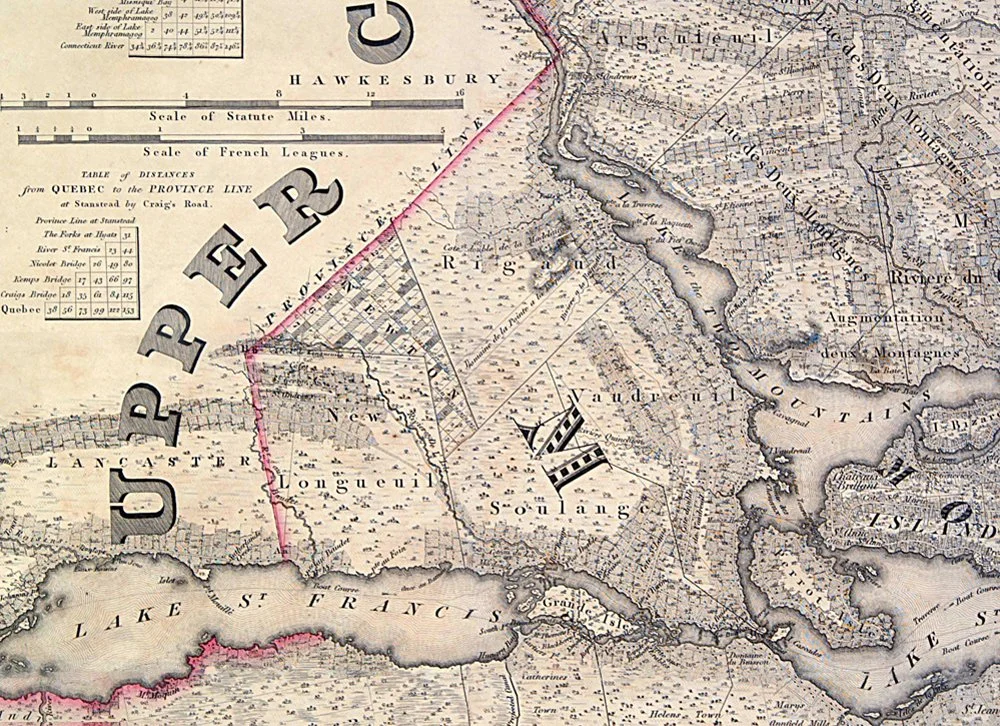
Quaudessus dud. arrière fief Est le nommé LaDeroutte qui possède Trois arpens de front sur Trente de profondr… lequel n’a q’une maison sept arpens de terre Labourable et Sept arpens de prairie.
Rendered by Philippe de Rigaud, marquis de Vaudreuil, before the intendant Bégon at Québec. Published by Lionel Groulx, Revue d’histoire de l’Amérique française 2:4 (1949), 586.
The registers record births and deaths. They say nothing about land, tenancy or money, and for a man who never signed his name they offer no way to follow him from one year to the next. His burial in May 1728 calls him only « Jean Baptiste La Deroute… habitant de la paroisse de Chambly ».
An online family-tree narrative, widely copied, makes him the first settled family of Vaudreuil: counted in a census of 1725, holding concession no. 15 de l’Anse ahead of the Léger and Poirier families. It cites nothing. The document behind it is not a census but the seigneur’s aveu et dénombrement of 2 March 1725, which lists some thirty-eight holdings along the Ottawa in order of their place on the shore, not of their age. One of them belongs to « le nommé LaDeroutte »: three arpents by thirty, a house, seven arpents ploughed and seven of meadow. No given name, no surname, no age, no date of concession.
The 1725 declaration reached print through Robert-Lionel Séguin, who found a copy in an attic at Rigaud and gave it to Lionel Groulx in 1949. The way into Jean-Baptiste’s own record was a different finding aid. The member fiche of the Association des Séguin d’Amérique and the dated abstracts compiled by Raymond Séguin and Gilles Birtz for La Séguinière in 2002 named the acts. Every one was then read in the original before any of it went onto a page. The abstracts were the map; the minutes were the ground.

Baptiste Ceguain dit Laderoutte
| Date | Greffe Tailhandier |
|---|---|
| 7 Jun 1710 | Marriage contract, no. 319. A cow, a filly and two pigs from the bride’s parents; a douaire of 150 livres. |
| 2 Feb 1713 | Borrows 160 livres in five 32-livre cards from Pierre Chaperon, his brother Simon as guarantor, no. 425. Three days later he buys sixty arpents on Île Jésus. |
| 15 Sep 1715 | Takes Jean Giasson’s farm at Boucherville for three years at half profit, no. 549. |
| 11 Oct 1717 | Sells the Île Jésus land to his brother Pierre for 350 livres in card money, no. 676. |
| 11 Oct 1719 | Owes Gilles Papin, merchant, 105 livres in hard money « a leurs urgentes necessités », no. 743. |
| 18 Jun 1720 | The seigneur’s home farm at half profit, from Saint-Michel 1719; barn, stable, henhouse, and no house, no. 829. |
| 31 Oct 1722 | Buys fifty arpents of uncleared land on credit from René Boucher de la Perrière, no. 984. |
| 21 Mar 1724 | Gives it up for exactly what he still owed. |
…baptiste Ceguain dit La Deroutte et Geneviefve Barbot Boisdoré sa femme… pour valeur receue en marchandises… a leurs urgentes necessités…
Greffe Marien Tailhandier, act 743. BAnQ, Montréal.
On the backs of the 1715 and 1720 acts the notary filed him as « baptiste Laderroutte ». The 1719 debt closes with « lesd. Laderoutte Barbot sa femme ». In 1713 he and Simon are together « dits les Laderoutte ». A search of the indexes under “Séguin, Jean-Baptiste” finds almost none of it.
The act that gives him land of his own in 1720 is not his act at all. It is a neighbour’s grant: on 21 June 1720 the seigneur conceded fifty arpents in the fourth range to Nicolas Laframboise, blacksmith, bounded on one side by « celle de Baptiste Ceguain La Deroutte ». Jean-Baptiste appears in it only as a boundary. No grant to him has been found.
Réduite à l’Aumône
From his marriage in 1710 to March 1724 the acts place Jean-Baptiste at Boucherville without a break. He worked other men’s land at half profit: Jean Giasson’s farm from 1715, the seigneur’s own from 1719. Beside the tenancies he held small pieces of land briefly — the Île Jésus holding, bought on borrowed cards in 1713 and sold to his brother in 1717; a concession in the fourth range by 1720; and the Côte Saint-Jean purchase of 1722, never paid for and given up in 1724. On 29 November 1724 his son Jean-Louis was baptized at Sainte-Famille, the parents « parroissiens de Boucherville » the godfather Jean-Louis Bougret dit Du Fort, son of the widow in whose house they had lodged in 1719, and the godmother the wife of Gilles Papin, the merchant to whom they had owed money that same year. By 2 September 1725 he was at Chambly, standing godfather there as « Jean Baptiste La Deroute ».
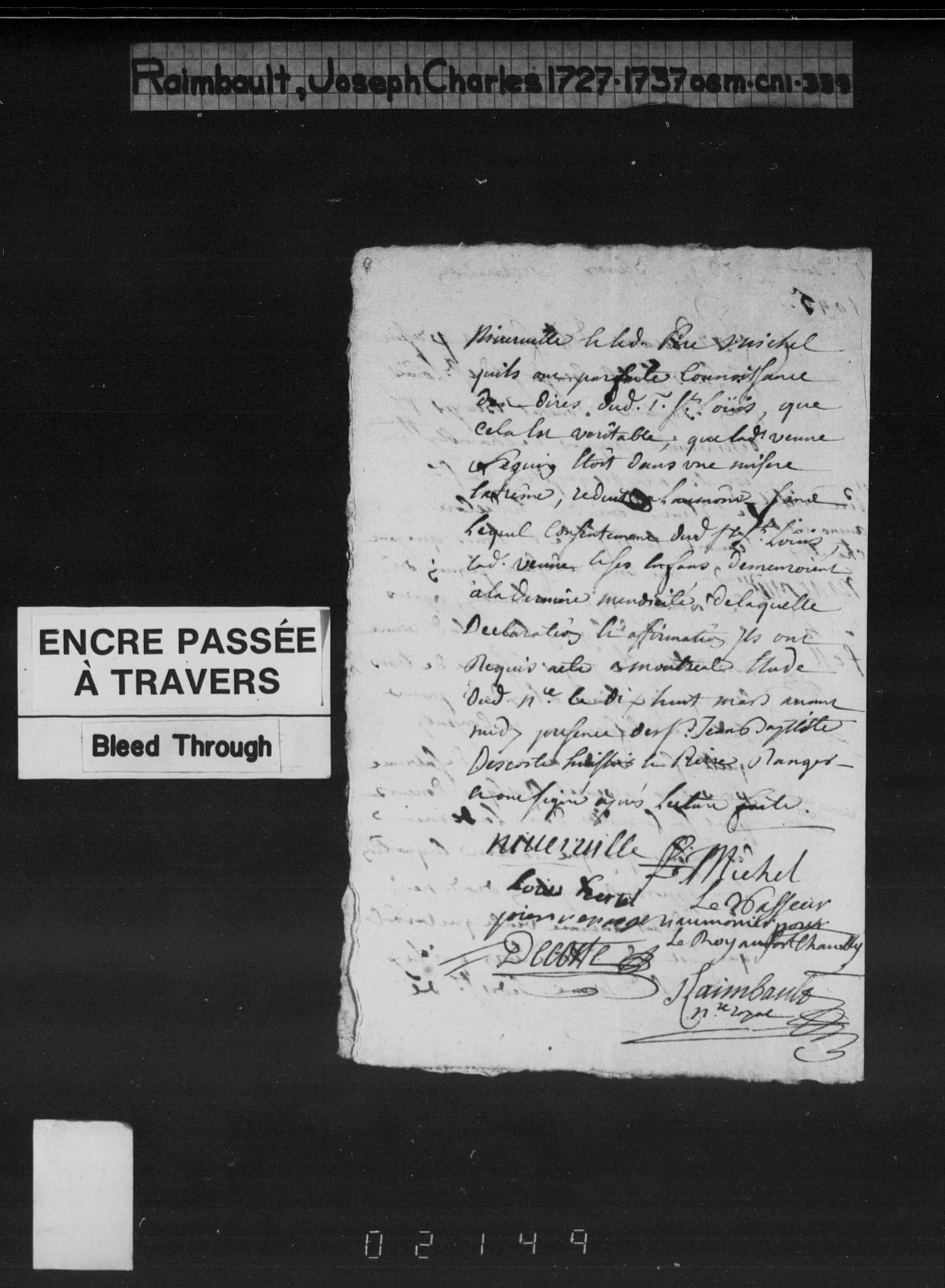
At Chambly he took land from Louis Hertel, sieur de Saint-Louis, on a spoken agreement only, and died with 315 livres of the price unpaid. In March 1734 Saint-Louis declared that he had let it be sold in the widow’s name to give her family some relief, though the land was still his by right. The seigneur of Chambly and the chaplain of the fort confirmed it.
…que lad. veuve Seguin estoit dans une misere extreme, reduite a l’aumosne, sans lequel consentement dud. Sr de St Louis lad. veuve et ses enfans demeuroient a la derniere mendicité…
Greffe Joseph-Charles Raimbault, act 1045. Signed Niverville, Louis Hertel, Fr. Michel Le Vasseur.
Ten days earlier the same notary had inventoried the goods of the marriage, at Geneviève’s request as guardian of the children, with Jean-Baptiste’s brother Simon attending for them. It was taken in 1734 in the one room on the Place Notre-Dame where she then lived with her second husband: a broken pine trough, a buffet, six straw chairs, an axe « hors de service », seven pewter plates, two coffers without lids or locks, a child’s bed. Not every one of the seventeen debts listed can belong to the first marriage, but the account is plain enough.

Montréal, 8 March 1734. Greffe J.-C. Raimbault no. 1042: the inventory made at the request of « Geneviefve Boisdoré femme de Philippe Charles Rolland… auparavant veuve de feu Jean Bapt. Seguin dit La Deroute ».
The record-by-record account behind this case study — how each act was located across two reels of the Tailhandier greffe, how every act was tied to Jean-Baptiste when his name never appears in the form the indexes expect, the residence evidence year by year, and the full citations — is set out in the methodology. Every act is reproduced and cited in the document gallery.
Full Methodology Documents & Sources Evidence TimelineThe notarial minutes and parish registers cited here are held by Bibliothèque et Archives nationales du Québec, and are cited to the BAnQ cote together with the image group or ark through which each was consulted. The fonds creator for the notarial records is Montréal (Québec : district judiciaire), Notariat.