
The Cousin Who Wasn’t
The Cousin Who Wasn't
A family tree said we were cousins with Samuel Huntington, signer of the Declaration of Independence. The connection ran through a surname — Cary — that appeared on both sides. This is the story of how the origin records disproved it, and why a shared surname at the colonial-to-European transition is the most dangerous coincidence in genealogy.
The Research Question
An online family tree connected our French-Canadian Soulière Line to Founding Father Samuel Huntington, making him a fourth cousin, nine times removed. The bridge was a Cary ancestry said to be shared between Huntington's New England family and our Norman ancestor Thiphaine Carrey. Before publishing the connection, we asked the question that discipline demands:
Is the "Cary" in Samuel Huntington's ancestry the same family as the "Carrey" in ours — or are these separate families that a common surname wrongly merged?The answer, established through immigrant-origin records, parish registers, and published scholarship, is that the connection does not hold. There are not one but three distinct Cary/Carrey families in this story, from three different places, joined only by the accident of a shared spelling.
It began, as these things often do, with a delightful hint. FamilySearch surfaced a relationship path suggesting that our French-Canadian Soulière ancestry descended from the same Cary family as Samuel Huntington, the self-taught Connecticut lawyer who signed the Declaration of Independence and presided over the Continental Congress. A Founding Father in the family tree, and just before the Fourth of July. It was the kind of discovery worth celebrating.
It was also worth checking. The relationship traveled a long and suspicious road: from a Connecticut farmhouse, across the Atlantic, into the parish registers of New France, and back to Elizabethan England — all hinging on a single surname appearing on both sides. That is precisely the pattern that should make a genealogist slow down. Surnames are not proof of kinship, and the colonial-to-European transition is where wishful trees most often manufacture ancestors. So we went to the origin records.
What the Family Tree Asserted
The proposed path ran through the Cary surname on both sides of the Atlantic. On the Huntington side, his mother Mehetabel Thurston descended from a Hannah Cary; that Cary line was said to trace to the prominent Cary family of Bristol, England — William "the Elder" Cary, draper and Mayor of Bristol, and his descendants. On our side, the Soulière Line reaches back through Marie Louise Souliere and the Poulin family to Jean Barette, whose mother is recorded as Thiphaine Carrey. An online tree equated that Thiphaine Carrey with the same English Cary family — and, through it, joined our line to Huntington's.
Three things made the merge attractive. The surnames matched — "Cary," "Carey," "Carrey," "Carré" all collapse into one another in transcription. The eras matched — all the candidate ancestors lived in the late 1500s and 1600s. And the story was flattering — it delivered a Declaration signer into a family whose documented colonial-American connections were otherwise nonexistent. Every one of those pulls is an argument for caution, not confidence.
Following Each Cary to Its Origin
The way to test a surname bridge is to refuse to let the surname do the work — and instead follow each individual back to a documented place of origin. When we did that for every "Cary" in the chain, they did not converge. They scattered. Three separate families emerged, each anchored to a different place by independent primary sources.
John Cary (Carew)
A Pilgrim who came from near Bristol, England, about 1634, settled at Duxbury and Bridgewater, and served as the town's first clerk. His name appears in Plymouth court records as "Carew" until 1661, when the spelling shifted phonetically to "Cary." His daughter Hannah Cary (b. 1661 Bridgewater) is Samuel Huntington's great-grandmother.
→ Samuel Huntington descends hereRichard Carrey
A Norman resident of Beuzeville (St-Hélier parish), married to Robine Bailleul. His daughter Thiphaine Carrey married Guillaume Barette at Beuzeville on 12 January 1627. Their son Jean Barette emigrated to New France in 1646 — the ancestor of the Soulière Line.
→ The Soulière Line descends hereWilliam & Richard Cary
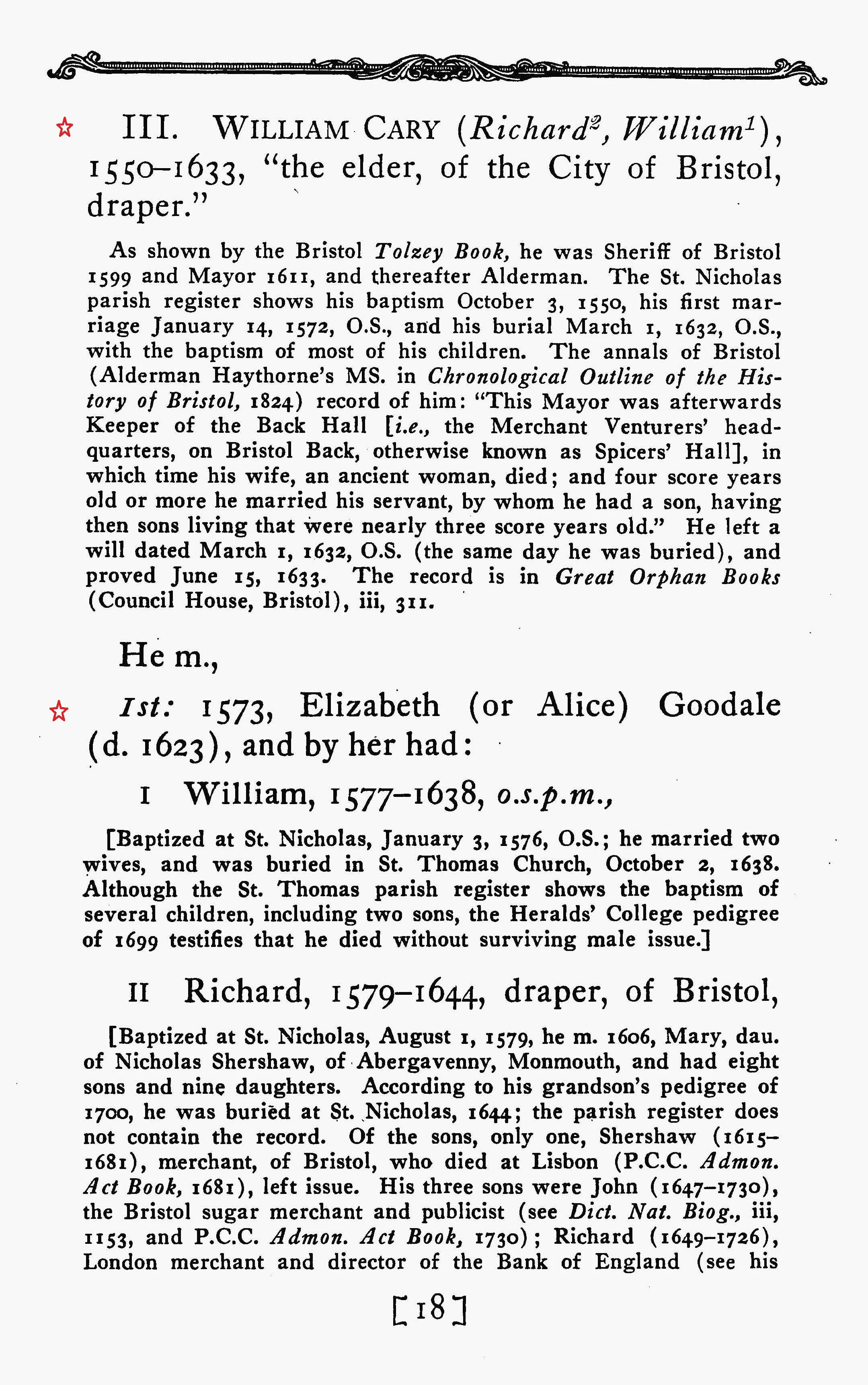
William Cary (1550–1633), draper, Sheriff and Mayor of Bristol, and his son Richard Cary (1579–1644), merchant, married to Mary Shershaw in 1606. A fully English, Bristol-rooted family documented in parish registers, a will, and The Virginia Carys (1919). Connected to neither of the other two.
→ Belongs to no one in this treeFamily A: Huntington's Somerset "Carew"
Samuel Huntington's Cary ancestry does not run to Bristol merchants. It runs to a Plymouth Pilgrim. John Cary came from the neighborhood of Bristol in Somerset, England, arrived in the colony about 1634, and settled at Duxbury before becoming one of the original proprietors and the first town clerk of Bridgewater. As town clerk he meticulously recorded his own children's births — including his daughter Hannah, born at Bridgewater on the last of April, 1661.
The Decisive Detail: A Name Spelled by Ear
The Plymouth Colony court records spell John Cary's name "Carew" — not "Cary" — in every entry before 1661. The surname only became "Cary" when English clerks began spelling it the way it was pronounced.
This is the linchpin. Huntington's ancestral surname originated as the Welsh-derived "Carew" of southwest England. Our ancestral surname originated as the Norman-French "Carrey / Carré." They are two unrelated names that happen to converge on the same modern spelling — the exact coincidence that made the false merge look convincing.
Hannah Cary married John Thurston in 1688; their daughter Mehetabel Thurston married Nathaniel Huntington in 1723 and became the mother of Samuel Huntington. The line is fully documented in the Bridgewater vital records, in Savage's Genealogical Dictionary of the First Settlers of New England, and in Seth Cary's John Cary the Plymouth Pilgrim (1911). At no point does it touch France.
Family B: Our Norman "Carrey"
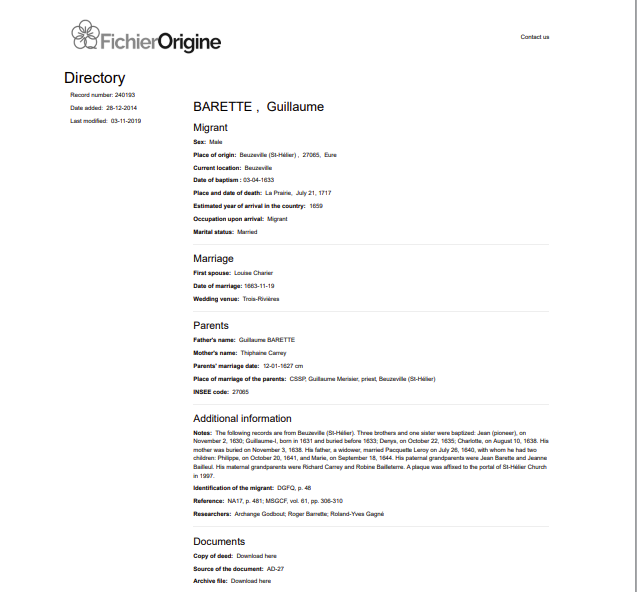
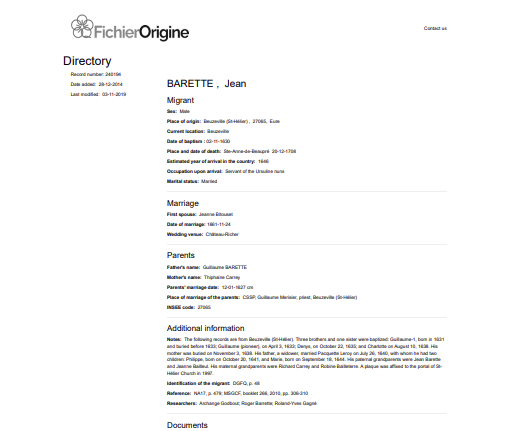
Our own Cary ancestor is not English at all. FichierOrigine — the immigrant-origin authority file maintained by the Quebec Federation of Genealogical Societies — documents Guillaume Barette of Beuzeville (St-Hélier), Eure, Normandy, and independently, his son Jean Barette, the Soulière Line emigrant. Both records name the same parents: Guillaume Barette and Thiphaine Carrey, married at Beuzeville, and both name the maternal grandparents as Richard Carrey and Robine Bailleul — a thoroughly Norman family, with a plaque affixed to the portal of the St-Hélier church in 1997.
The Marriage of Guillaume Barette & Thiphaine Carrey
A 1997 letter from researcher Roger Barrette to the Association des Barrette d'Amérique quotes the Beuzeville marriage register directly:
("1627: between Guillaume Barette on the one part, and Thiphaine, daughter of Richard Carrey, on the other part.")
Family C: The Bristol Carys — the Decoy
Where did the "Bristol" in the false claim come from? From a third, genuinely English Cary family — one that belongs to neither our line nor Huntington's. The Virginia Carys: An Essay in Genealogy (1919) documents William Cary (1550–1633), draper, Sheriff of Bristol in 1599 and Mayor in 1611, and his son Richard Cary (1579–1644), a Bristol merchant who married Mary Shershaw in 1606 and had a large family in the city. This family is exhaustively recorded in the St. Nicholas parish register, in a proved will, and in a Heralds' College pedigree.
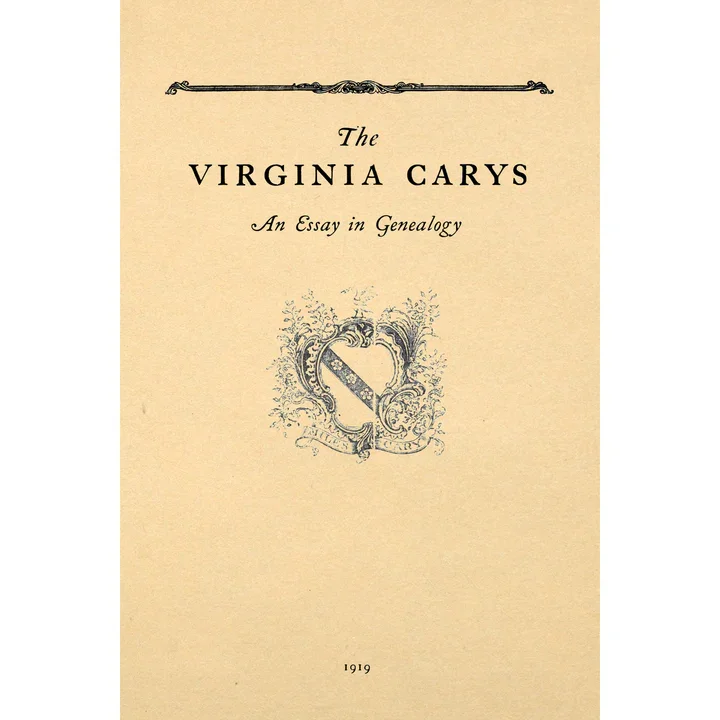
The Virginia Carys: An Essay in Genealogy (1919) documents the Bristol Cary family — William the Mayor and his son Richard the merchant — as a fully English lineage with parish, probate, and heraldic records. This is the "Bristol Cary" family that older trees wrongly grafted onto both the Huntington and Barette lines.
The merge worked in two moves. First, our Norman Richard Carrey of Beuzeville was equated with the English Richard Cary of Bristol — two men of the same name and era, one in Normandy with Robine Bailleul, one in Bristol with Mary Shershaw, each with his own fully documented household. A single merchant could not have maintained two families on opposite sides of the Channel. Second, Huntington's Carew/Cary line of Somerset-and-Plymouth was folded into the same Bristol family, on nothing more than the shared modern spelling. The merge was especially seductive because the Bristol Carys genuinely did cross the Atlantic—to Charlestown and Virginia—just never to Bridgewater. A real emigration made a false one look plausible. Three families, three origins — Somerset, Normandy, Bristol — collapsed into one flattering fiction by the gravitational pull of a surname.
The Verdict
When each Cary is followed to its own documented origin, the connection dissolves. Samuel Huntington descends from a Somerset "Carew" who became a Plymouth "Cary." The Soulière Line descends from a Norman "Carrey" of Beuzeville. The Bristol Carys — the supposed bridge — belong to neither. There is no documented join between them, and the origin evidence actively places these families in three different countries. The cousinship is not merely unproven; it is contradicted by the primary record.
Our descent from Richard Carrey of Beuzeville, Normandy (FichierOrigine; 1627 Beuzeville register). Huntington's descent from John Cary/Carew of Bridgewater (Plymouth vital records; Savage; Seth Cary, 1911).
The equation of Norman Carrey with the Bristol Cary family, and the resulting cousinship with Samuel Huntington. Contradicted by three independent origin records placing the families in Somerset, Normandy, and Bristol respectively.
The Honest Outcome
We did not gain a Founding Father cousin. We gained something a working genealogist values more:
The investigation that dismantled the Huntington claim also confirmed, at FichierOrigine standard, the true origin of our Barette-Carrey ancestors in Beuzeville. The story we lost was a fiction. The story we kept is real.
Methodology: What This Case Teaches
- A shared surname is a hypothesis, not a conclusion. "Cary" appearing on both sides of a tree is a prompt to investigate, never a proof of kinship — especially across a language boundary, where "Carré," "Carrey," "Carew," and "Cary" all collapse into one another.
- Follow every individual to a documented place of origin. The merge survived only as long as no one asked which Cary, from where. Three origin records — Somerset, Normandy, Bristol — ended it immediately.
- The colonial-to-European transition is the danger zone. This is where online trees most often manufacture connections, splicing a documented immigrant onto a prestigious European family of the same name. Treat every such join as suspect until an emigration or marriage record proves it.
- Watch for the flattering result. A hint that hands you a Founding Father, a royal line, or a famous name deserves more scrutiny, not less. The pleasure of the conclusion is itself a bias to guard against.
- Disproving a line is real genealogy. Pruning a false branch is as valuable as growing a true one. The goal is an accurate tree, not a big one.
Document Gallery




Explore the Full Case
This story is also documented as a formal case study, with the three-family evidence laid out side by side and every record traced to its source.
→ The Cousin Who Wasn't — Case Study Summary
→ The Full Methodology — document by document
