
The Cousin Who Wasn't
A family tree named Samuel Huntington — signer of the Declaration of Independence — as our fourth cousin, nine times removed. The bridge was a surname, "Cary," that appeared on both sides of the Atlantic. This is how the origin records took one flattering connection apart and confirmed a truer one in its place.
Every genealogist knows the pull of a famous name in the tree. This is the story of resisting one. An online lineage connected our French-Canadian Soulière Line to a Founding Father through a shared Cary ancestry. Before celebrating, we asked the question that discipline demands — which Cary, from where? — and followed each one to its documented origin. They did not converge. They scattered into three separate families, joined only by the accident of a spelling.

A Founding Father, by Surname Alone
A relationship chart traced our Soulière ancestry through the Poulin and Barette families to a Thiphaine Carrey — and equated her with the prominent Cary family of Bristol, England. Through that Cary line, the tree connected us to Samuel Huntington: a fourth cousin, nine times removed.
Surnames are a hypothesis, never a proof. So we set the chart aside and went to the origin records for each Cary in the chain.
Three Families, Three Countries
Following each individual to a documented place of origin split one surname into three unrelated families:
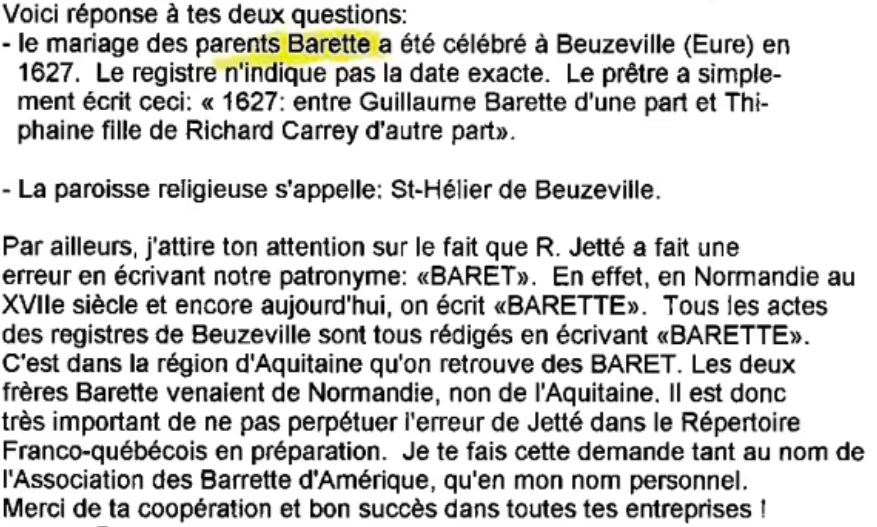
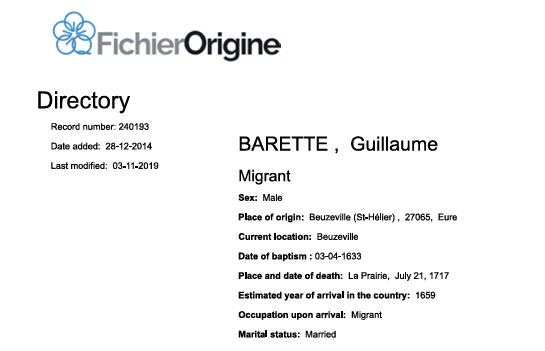
Normandy: our ancestor Richard Carrey of Beuzeville, whose daughter Thiphaine married Guillaume Barette in 1627.
Bristol: the merchant Cary family of The Virginia Carys — whose own emigrants went to Charlestown and Virginia, connected to neither of the others.
The 1627 Beuzeville register names Thiphaine plainly as "fille de Richard Carrey" — a Norman father, a Norman parish, no England in sight.
A Fiction Lost, a Truth Confirmed
The cousinship with Samuel Huntington is disproven. His "Cary" is a Somerset "Carew"; ours is a Norman "Carrey"; the Bristol Carys belong to neither. Three origins, one coincidental spelling.
We did not gain a Founding Father. We gained something a working genealogist values more: an accurate tree, and a false branch pruned before it was ever published as fact.
The Principle
"A shared surname at the colonial-to-European transition is the most dangerous coincidence in genealogy. Follow every name to its origin — and let the records, not the flattering result, decide the line."
The Full Methodology
How do you dismantle a lineage built on a surname? The complete methodology — the phonetic "Carew/Cary" shift, the FichierOrigine origin standard, the anatomy of a three-family merge, and five transferable lessons for testing any surname bridge — is documented in the companion methodology piece.
Read the Full Methodology