
The Cary Conflation — How the Research Was Done
A document-by-document account of how an online lineage linking our French-Canadian Soulière Line to Founding Father Samuel Huntington was tested against the primary records — and disproven. The correction is not a matter of interpretation. The origin records name each family's home directly. It requires only that the sources be read.
The Central Problem This Case Addresses
Standard genealogical practice requires correlating evidence across multiple independent sources and following every claim to a primary record. This case began with two observations: a widely appealing relationship path carried no primary-source citation for its central link, and the identity it assigned — equating our Norman ancestor Thiphaine Carrey with the English Cary family that produced Samuel Huntington's line — is contradicted by primary records that have been accessible for over a century.
The methodology documents how the error was identified, which collections were searched, and what the original records actually contain. The primary sources name each family's place of origin directly: a Norman parish for ours, a Somerset-to-Plymouth migration for Huntington's, and a Bristol mercantile dynasty for the third. Three families. One spelling. The case is not ambiguous.
Recognize the Pattern of an Unsourced, Flattering Claim
The starting point was not a specific document but a pattern. A FamilySearch relationship chart traced our Soulière ancestry through the Poulin and Barette families to a Thiphaine Carrey, then equated her with the prominent Cary family of Bristol, England — and through that family, connected the line to Samuel Huntington, signer of the Declaration of Independence, as a fourth cousin nine times removed.
Two diagnostic signals demanded caution. First, the entire connection rested on a single surname bridging France, England, and colonial America — the precise juncture at which online trees most often manufacture ancestors. Second, the result was flattering: it delivered a Founding Father into a family whose documented colonial-American ties were otherwise nonexistent. A hint that hands you a famous name deserves more scrutiny, not less.
The question that governs the entire investigation is simple: which Cary, from where? A surname is a hypothesis, never a proof. The chart was set aside, and each Cary in the chain was followed independently to a documented place of origin.

Establish Our Line's True Origin: Richard Carrey of Normandy
FichierOrigine — the immigrant-origin authority file maintained by the Fédération québécoise des sociétés de généalogie — is the standard scholarly source for the European origins of New France settlers. Records 240193 (Guillaume Barette) and 240194 (Jean Barette) independently document the family at Beuzeville (St-Hélier), Eure, Normandy. Both name the parents as Guillaume Barette and Thiphaine Carrey, and both name Thiphaine's parents — the maternal grandparents — as Richard Carrey and Robine Bailleul. A plaque was affixed to the portal of the St-Hélier church in 1997 commemorating the family.
The FichierOrigine compilation was then verified against the primary record it rests on. A 1997 letter from researcher Roger Barrette to the Association des Barrette d'Amérique quotes the Beuzeville marriage register directly: the 1627 entry reads "entre Guillaume Barette d'une part et Thiphaine fille de Richard Carrey d'autre part" — naming Thiphaine plainly as the daughter of Richard Carrey. The parish is named as St-Hélier de Beuzeville; the notary as Guillaume Merisier, priest.
Thiphaine Carrey's father, Richard Carrey, is a documented resident of Beuzeville in Normandy, married to a Norman woman, in a Norman parish. There is no England in this record. The same letter also corrects a standing error: the Beuzeville registers consistently spell the surname "Barette," not the "Baret" of Jetté's dictionary — a caution that even standard references carry mistakes worth verifying.

Establish Huntington's True Origin: John Cary of Bridgewater
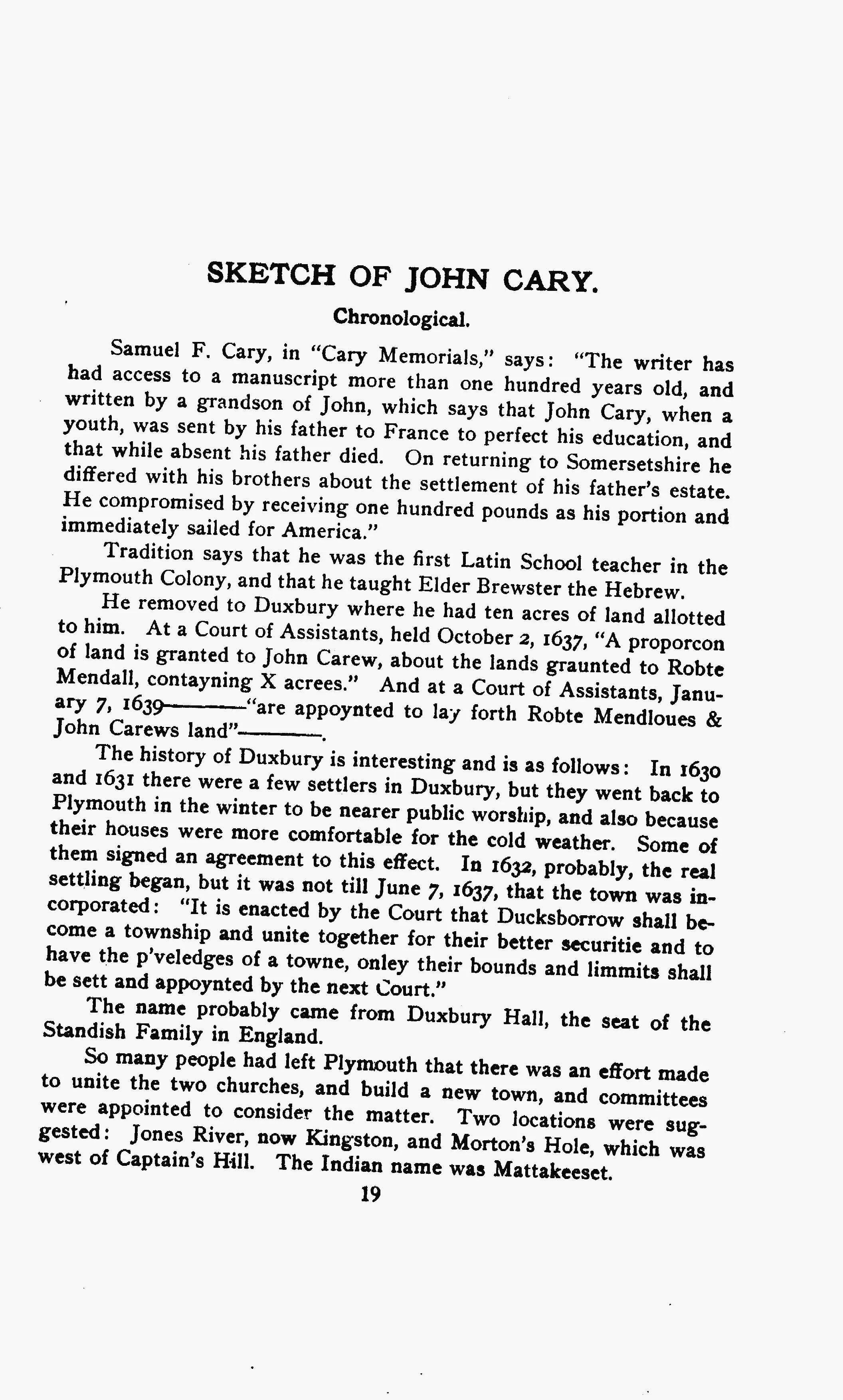
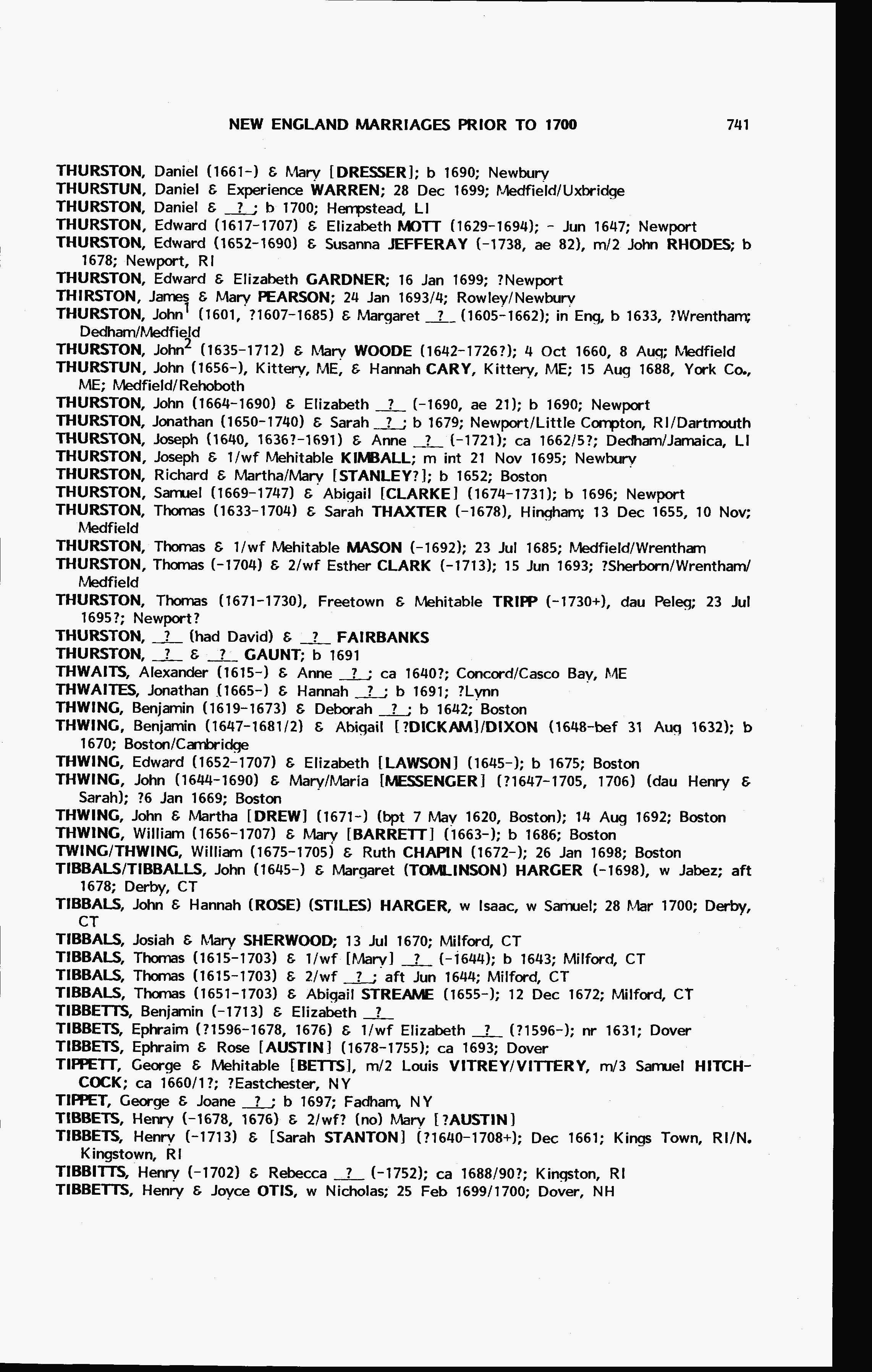
Samuel Huntington's Cary ancestry does not run to England's merchant Carys. It runs to a Plymouth Pilgrim. Huntington's mother was Mehetabel Thurston, whose birth is recorded in the Medfield, Massachusetts vital records on 18 June 1700, daughter of John Thurston and Hannah. Her mother, Hannah Cary, was born at Bridgewater in the Plymouth Colony in 1661, daughter of John Cary — one of the original proprietors and the first town clerk of Bridgewater, a man who came from the neighborhood of Bristol in Somerset, England, about 1634.
The Plymouth Colony court records, transcribed in Seth C. Cary's John Cary the Plymouth Pilgrim (1911), show the surname evolving phonetically in one continuous record. The land grants of 1637 and 1639 name "John Carew"; the 1656 incorporation of Bridgewater lists "Bridgewater John Carew"; a 1658 Bridgewater document is "signed by John Carew and eleven others." Then the spelling drifts as clerks wrote by ear: "John Carye" (1661), "John Carrey" (1667), and finally "John Cary."
Huntington's ancestral surname originated as the southwest-English "Carew." Ours originated as the Norman-French "Carrey / Carré." Two unrelated names that converge on a single modern spelling — the exact coincidence the false merge exploited.
A telling coincidence: in the 1667 Bridgewater court entry, the clerk spelled the Pilgrim's name "John Carrey" — the identical spelling of our Norman ancestor Richard Carrey of Beuzeville. Same six letters, two different men, two different continents. It is the conflation trap captured in a single word of a primary record.
The chain from Huntington to this Somerset Pilgrim is unbroken and documented at every link: the Windham record names Samuel as son of Nathaniel and Mehetabel; the Medfield record names Mehetabel Thurston (b. 18 June 1700) as daughter of John Thurston and Hannah; Torrey's New England Marriages Prior to 1700 records the marriage of John Thurston and Hannah Cary (15 Aug 1688, York Co., ME; residence Medfield/Rehoboth), fixing that Hannah as a Cary; and the John Cary book records "Hannah was born April 30, 1661," daughter of John Cary of Bridgewater. The descent is further corroborated in Savage's Genealogical Dictionary of the First Settlers of New England. At no point does this line touch France, Bristol's merchant Carys, or the Norman Carreys.
Seth Cary's book repeats a family tradition (from Cary Memorials) that John Cary was "sent by his father to France to perfect his education." This is an unsourced tradition, not a documented fact — but it is almost certainly part of why later compilers found a France connection plausible and drifted his line toward the Norman Carreys. We note it as tradition, cite no record for it, and treat it as a likely origin of the error rather than evidence of kinship.
The sources disagree on Samuel Huntington's birth date. The compiled Huntington Family Memoir (p. 111) gives July 3, 1731. The contemporary Windham town vital record (Barbour Collection, Vol. 1, p. 74), recorded far nearer the event, gives July 5, 1731 — "s. Nath[anie]ll & Mehetabel." Standard practice favors the contemporary town record over the later compiled genealogy. We therefore cite July 5, 1731, and note the divergence rather than silently choosing one. The discrepancy is itself instructive: it is exactly the kind of small error a compiled source can introduce and a primary record can correct.


Identify the Decoy: The Bristol Carys of The Virginia Carys
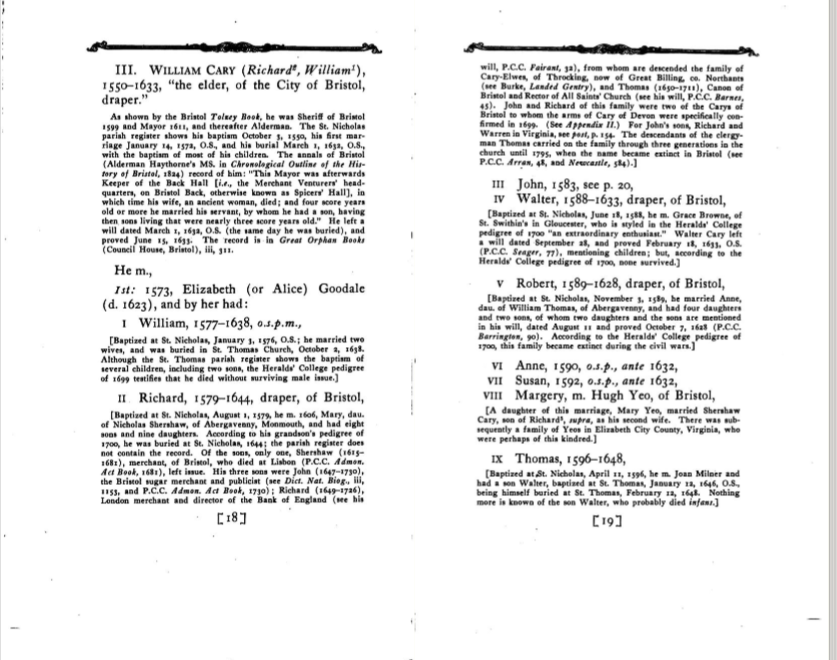
Where did the "Bristol" in the false claim originate? From a third, genuinely English Cary family — one documented in exhaustive detail, and connected to neither of the first two. Fairfax Harrison's The Virginia Carys: An Essay in Genealogy (1919) traces the family from William Cary "the Elder" (1492?–1572), sheriff and mayor of Bristol, through generations of drapers and merchants recorded in the St. Nicholas parish register, the Bristol wills, and the Heralds' College pedigrees.
Crucially, this family did send emigrants to America — which is precisely why the merge was tempting. Harrison documents James Cary (1600–1681), "the pioneer American emigrant of his family," who went to Charlestown, Massachusetts in 1639 (p. 20), and Miles Cary (1623–1667), the Virginia immigrant. But neither is Huntington's ancestor, and neither is ours. Huntington descends from John Cary of Bridgewater — who appears nowhere in Harrison's Bristol genealogy. The Bristol Carys crossed the Atlantic to Charlestown and Virginia; they did not produce the Bridgewater line.
The conflation was more seductive than a simple same-name coincidence: the Bristol Carys were real, prominent, well-documented, and had genuine American emigrants. But The Virginia Carys is itself the proof of separation — its own meticulous genealogy sends the Bristol line to Charlestown and Virginia, never to Bridgewater, and never to Normandy.
State the Verdict and Preserve the True Line
When each Cary is followed to its own documented origin, the connection dissolves. Samuel Huntington descends from a Somerset "Carew" of the Plymouth Colony. The Soulière Line descends from a Norman "Carrey" of Beuzeville. The Bristol Carys — the supposed bridge — belong to neither, their own emigrants going to Charlestown and Virginia. There is no documented join among the three, and the origin records place them in three different countries. The cousinship is not merely unproven; it is contradicted by the primary record.
The same investigation that dismantled the false claim confirmed a truer one. Our Barette-Carrey ancestors are documented at FichierOrigine standard to Beuzeville (St-Hélier), Eure — a firm Norman foundation for the Soulière Line. We did not gain a Founding Father. We gained an accurate tree, and a false branch pruned before it was ever published as fact.
The Evidence, Document by Document
Each source, its collection, its analysis, and its status
Guillaume Barette, migrant, of Beuzeville (St-Hélier), Eure. Names parents Guillaume Barette & Thiphaine Carrey; parents' marriage 12 Jan 1627; maternal grandparents Richard Carrey & Robine Bailleul. Establishes the Norman origin of our Carrey ancestor.
Retrieved ✓Jean Barette, the Soulière Line emigrant to New France (1646). Independently names the same Beuzeville parents and the same maternal grandparents — a second authority-file record corroborating the Norman origin.
Retrieved ✓Marriage of Guillaume Barette & Thiphaine, "fille de Richard Carrey." Quoted verbatim in Roger Barrette's 1997 correspondence. The primary record naming Thiphaine's Norman father. Also corrects the "Barette" spelling against Jetté.
AnalyzedFairfax Harrison's genealogy of the Bristol Cary family. Documents William "the Elder," the drapers, and the American emigrants James (Charlestown, 1639) and Miles (Virginia, 1645) — none connected to Bridgewater or Normandy. The decoy, and the proof of its separateness.
Retrieved ✓"HUNTINGTON, Sam[ue]ll, s. Nath[anie]ll & Mehetabel, b. July 5, 1731." The contemporary town record. Cited over the compiled memoir's July 3 — a primary-source correction of a secondary date.
Retrieved ✓Huntington's mother, "daughter of John Thurston and Hannah." The documentary hinge linking Huntington's mother to his grandmother Hannah Cary — one link in the unbroken chain to the Somerset Pilgrim.
Retrieved ✓"John Thurstun & Hannah Cary, 15 Aug 1688, York Co., ME; Medfield/Rehoboth." The record fixing Mehetabel Thurston's mother as Hannah Cary — closing the join between the Medfield birth and the Bridgewater Cary family. The last open link, now documented.
Retrieved ✓Transcribes the Plymouth court records year by year: "John Carew" (1637, 1639, 1656, 1658) drifting to Carye (1661), Carrey (1667), Cary. Records Hannah Cary b. 30 Apr 1661. The primary-source spine of the "Carew" linchpin — and the 1667 "Carrey" coincidence.
Retrieved ✓Samuel Huntington of Norwich m. Martha Devotion Jr. of Windham, 17 Apr 1761, by Ebenezer Devotion, Clericus. Confirms Huntington's identity and Connecticut context.
Documented"Hon., late Governor of Conn., d. Jan. 5, 1796, in the 65th year of his age." Confirms the terminal date of the signer whose kinship was tested.
DocumentedCompiled Huntington genealogy, entry 232. Gives birth as "July 3, 1731" — the secondary date corrected by the Windham town record. Documents the Windham/Scotland Society context and Mehetabel Thurston as mother.
AnalyzedStandard reference confirming John Cary of Bridgewater's Somerset origin and Plymouth Colony settlement — the "Carew" line. Corroborates the Huntington-side descent independent of the compiled family memoir.
DocumentedOpen Research Questions — Not Yet Resolved
The 1627 marriage is currently sourced through Roger Barrette's 1997 transcription rather than a personally examined register image. Locating the original page (or a microfilm/digital surrogate) would move this from Analyzed to Retrieved ✓.
PendingFichierOrigine gives Jean Barette's arrival as 1646. The original engagement or emigration record has not yet been personally examined — a step toward fully documenting the New France entry point of the Soulière Line.
PendingThe "Carew"-to-"Cary" progression in Plymouth is documented (Seth Cary, 1911). What remains open is John Cary's specific English parish of origin in Somerset — the Cary Memorials "sent to France" story is unsourced tradition. A documented English baptism would complete his origin, though it is not needed to disprove the conflation.
PendingNo record has been found connecting the Norman Carreys of Beuzeville to any English Cary family. This negative evidence is documented, not assumed; should a genuine cross-Channel record ever surface, the analysis would be revisited. None is expected.
PendingThis methodology page accompanies the case study summary. The summary presents the findings; this page documents how each finding was established and what each primary record contains.
← Return to the Case Study